The Money Information Network

June 25, 2023

by Stephen Stofka

This week’s letter is about money, both conventional and digital, prompted by the news that Argentina’s yearly inflation just passed 100%, 25 times the U.S. rate of inflation reported a week ago. Let’s not confuse money and the banking system. Money exists within a banking system. The regimes, or set of rules, that govern that system are fluid but the institutions that manage that regime have evolved over centuries. The pillars of international institutions rarely crumble suddenly.

On Monday June 19, Bitcoin’s 24 hour volume was $10B, almost 2% of its $513B market cap. M1, the measure of transactional money like cash and checking accounts, was $18.6 trillion, about 36 times the market cap of bitcoin. Bitcoin’s algorithm changed the nature of money hoping that the adoption of Bitcoin would bypass the hegemony and inequities in the global banking system.

Satoshi Nakamoto, the pseudonym of the developer of the Bitcoin algorithm, understood the informational nature of money. Let’s explore that informational model. Economics students learn the three roles that money plays: a unit of account, a medium of exchange, and a store of value. The banking system manages a network of information databases. That’s the store of value function. That information is denominated in various currencies, the unit of account function. As a medium of exchange, access to that information is mostly guarded by a banking system that manages permissions. Our credit or debit card number is a password into that exchange.

Within this database model, cash is a permission-less and anonymous public information source that can be exchanged freely and (usually) confers a property right with that exchange. However, the availability and flow of cash is managed by central banks.  Satoshi designed Bitcoin to take advantage of those two characteristics of cash and avoid the negative aspects of central management, including the risk of inflation. To avoid a central gatekeeper, Bitcoin’s algorithm introduced a lot of nodes as gatekeepers. Those nodes formed a path of past exchanges which verified the existence of the funding source for an exchange.

Some entity had to keep a digital record of those exchanges, however. That has become a vulnerability in digital currencies because the exchange is also a broker, facilitating trades within its own exchange. Conventional securities are traded in an environment where the exchange, like the New York Stock Exchange, and the broker, like Vanguard, are entirely separate. Not so with digital currencies and that presents an opportunity for mismanagement and fraud. The implosion of the FTX exchange owned by Sam Bankman-Fried is a recent example. Until digital currencies can separate their broker and exchange functions, they are vulnerable to these shenanigans. Yes, the banking system is subject to mismanagement and fraud but the gatekeeper, the government, provides some recourse.   

Bitcoin is like a set of Christmas lights with many bulbs. If one goes out, a circuit may not complete and a transaction between two parties be recognized on both ends of the exchange. The banking system is like a network of traffic lights in a city. Traffic lights are permissions. Should one go out, a policeman will likely show up to manage those permissions and direct traffic. There is no recourse when a node in a digital currency block goes out or an exchange produces tokens to cover its trading losses.

Nations are their own banks and their security and welfare depend on that status. Wikipedia lists more than 150 central banks among the 195 countries in the world. The adopters of bitcoin and other digital currencies dreamed big but cannot overcome the political advantages of such a system. The dream of one-world currency may be destined for the same graveyard where the one-world government envisioned in the 1990s went to die. The hope that digital currency embodies will live on.    

////////////////

[20230625Lights.png]

Photo by Aedrian on Unsplash

Keywords: bitcoin, money, banking

Great But Not Perfect

June 18, 2023

by Stephen Stofka

This week’s letter is about the political movement to remove books from schools and libraries that reveal the uglier parts of American history. Any society makes mistakes, historical debts that never be paid and the succeeding generations are reluctant to shoulder the burden of those mistakes. A truly great people acknowledge those flaws and adopt policies that ameliorate some of the suffering caused by those mistakes. Some who shout the loudest that America is great are more concerned that America appears great than contributing to America’s greatness.

For some groups in America, the nation was never great. Some laws kept people out of restaurants, bathrooms, schools and other public places. American customs and federal policy kept some Americans from living in certain neighborhoods – the process of redlining in real estate. Some customs kept some Americans from jobs and credit because of their religion or skin color. These restrictive laws have been repealed or found unconstitutional but the customs and sentiments live on.

In 1705, Bernard Mandeville (1795) published The Fable of the Bees: or Private Vices, Public Benefits, an eleven page poem and commentary about a thriving beehive. When some bees complain about the many vices of their neighbors in the colony, the god Jove grants their wish and makes everyone virtuous. Bars are closed for lack of business, prices fall to an honest level, debtors pay their debts, and most lawyers are put out of business. Criminals are either hanged or set free and the jails closed. The jailers and attendants are put out of work. Many locksmiths and blacksmiths are idled because no one needs security locks or bars. Without vanity, the now contented bees no longer want clothes and other accoutrements that signify their civic stature, and this causes much industry to be idled. As the bees leave the hive, it collapses.

A prosperous society emerges from both the virtues and the vices, Mandeville claimed. Preachers assailed Mandeville’s criticism of good Christian virtues. That a good could come from vice was a heresy at the time of the book’s publication in the early 18th century. Mandeville described an emergent vitality and wisdom in the interplay between vice and virtue, contradicting the Christian teaching that wisdom was received from God’s or from reading the ancients.

Mandeville’s thoughts inspired David Hume, a giant of 18th century philosophy, and Adam Smith, the founder of the study of economics. Both were keen observers of human behavior, empiricists who believed that a variety of perspectives promoted vitality in a society. In time Adam Smith would develop the concept of the division of labor, that greater specialization improved productivity and promoted economic growth. Specialized trades can only develop and flourish in areas with large populations. Competition and diversity were the key to this outlook.

In another camp of political philosophy were Rousseau, Kant, Hegel and Marx, idealists who believed that a uniformity of rules and circumstances was the key to social improvement. A rigid adherence to norms that curbed people’s greed and self-centeredness was the key to a flourishing society. Policy proposals that ban books and public behaviors fall into this camp.

The Declaration of Independence and the U.S. Constitution embody this conflict between the idealists and empiricists. The Declaration of Independence espoused an idealistic uniformity like “All men are created equal.” Governments were allies to the individual’s pursuit of happiness. In contrast, the U.S. Constitution was an act of pragmatic bargaining to form a more powerful alliance between diverse colonies. In the text (Article 1, Section 2) of that bargain, slaves were to be counted as three-fifths of a person and the Congress could not regulate the importation of slaves for twenty years (Article 1, Section 9). Article 4, Section 2 preserved a universal right of ownership of a human being regardless of which state that human being was located. Governments promoted the happiness of some at the expense of others.

If we are a great nation and a great people, we teach our children about the good, bad and ugly truths that formed the backbone of this nation. There is a lot of each. Teach it all. A great people stand up in the daylight of truth. They pick up their legal tools and their steel tools and they get to work fixing the ugly, not burying it. They don’t drape themselves in flags and blather slogans. They put on their work clothes because building strong institutions and repairing ugly is hard work.

/////////////

Photo by Tom Hermans on Unsplash

Keywords: Constitution, Declaration of Independence, history, book bans

Mandeville, B. (1795). The fable of the bees: Or, private vices, public benefits. Printed for C. Bathurst and others. Available free from https://books.google.com/books/about/The_Fable_of_the_Bees.html?id=I7JlAAAAMAAJ&printsec=frontcover&source=kp_read_button#v=onepage&q&f=false

Bank Money and Hard Money

June 11, 2023

by Stephen Stofka

This week’s post is about money and Adam Smith (2009), the author of the Wealth of Nations, a book that authors sometimes refer to by its acronym – WON. In 2026, it will be the 250 year anniversary of the publication of that work and Smith remains the most cited author in economics literature, according to Avner Offer and Gabriel Söderberg (2019), authors of The Nobel Factor. Smith lived in an age of a metallic or hard currency standard, but one with an active trade in paper or “bank” money. In Part 1, Chapter 4 of WON he attributed the debasement of hard currencies to the “avarice and injustice of princes and sovereign states.” We will see why he thought so.

Smith noted the chief flaw of hard currencies, particularly in an era of increasing industry. The supply of those metals depends on the success of mining operations and the fortunes of ships carrying the metals across the seas. There is either not enough hard currency to support the number of transactions in a country of increasing industry, or there is too much of the metal currency during economic downturns. Paper or bank money acted as a substitute for hard currency. In Part 2, Chapter 2, Smith notes that the exchange of bank money was mostly between wholesalers, not between dealers and consumers. In an age when the revenue of a country depended largely on excise taxes on particular goods and property taxes on landowners, the flow of taxes was mostly between the wealthy and the state.

Like most substitute goods the value of bank money rose when there was a shortage of hard currency, falling again when there was an adequate supply of gold or silver coin. A prince or state stabilized the value of paper money by allowing or stipulating the payment of taxes in paper money. Smith admired the resilience of the working class, a sentiment not shared by others in the higher social classes. When the American colonies drafted their Constitution, only those of means were allowed to vote because they were the primary source of direct government funding. The founders paid little recognition to those on the lower rungs of the socioeconomic ladder who paid few taxes directly to a government.

The working class paid taxes in three indirect forms: 1) higher prices on goods, 2) lower compensation for their labor, and 3) inflation. In an open letter written about 1780, American founder Benjamin Franklin remarked (https://founders.archives.gov/documents/Franklin/01-34-02-0156) that the printing of vast quantities of paper money to fund the American war against Great Britain had caused an explosive hyperinflation. In less than five years, 60 dollars of American paper currency had become equivalent to one dollar in gold. As Smith noted, a country abandons a hard currency standard as soon as it goes to war so that it can fund the war without increasing taxes.   

The developed countries of the world have realized Smith’s vision. Diverse economies with a lot of specialization promote growth. Less developed countries share a common characteristic – the economy is very reliant on agriculture. The growth of the retail trade in developed countries necessitates the increasing use of bank money. Hard currency is neither reliable nor convenient. Smith might attribute the persistent inflation of bank money not to an oversupply of paper money but to a shortage of hard currency. In growing economies, that shortage promotes deflation, benefitting those who have at the expense of those who have not. That is the injustice of hard money.

////////////////

Photo by Zlaťáky.cz on Unsplash

Keywords: Adam Smith ,gold coin, silver coin, hard currency, bank money

Malthus, T. R. (1989). An essay on the principle of population. Cambridge: Cambridge Univ. Pr.

Offer, A., & Söderberg, G. (2019). The nobel factor: The prize in economics, social democracy, and the market turn. Princeton University Press.

Smith, A. (2009). Wealth of Nations. New York: Classic House Books.

Fiscal Cliffs

June 4, 2023

by Stephen Stofka

This week’s letter is about household debt and income. First I’ll touch on the latest news in the debt ceiling debacle. In a late Thursday session, the Senate passed a debt ceiling bill 63-36 and the President is expected to sign it before Monday, the day when Treasury Secretary Janet Yellen said the country would start delaying or defaulting on payments. There were few significant cuts to social and military spending, the biggest contributors to the nation’s rising debt. The CBO’s recent outlook estimates that the debt will rise by almost 50% in the next decade.

Although the issue is laid to rest until 2025, neither side is willing to pass a law that voids the 105 year old debt ceiling law. Since the passage of the 17th Amendment in 1913, only the Democratic Party has ever held a filibuster proof 60 vote majority in the Senate. For Republicans, the debt ceiling is a critical bargaining chip to undo Democratic spending priorities. When Democrats had a filibuster proof majority in 2009-2010, they could have undone the debt ceiling law but chose other priorities like Obamacare and banking reform. In 2021, ten Republicans joined Senate Democrats to bypass the 60 vote filibuster threshold and permit a vote to raise the debt ceiling, the Hill reported. Last year, Janet Yellen asked Democrats to lift the debt ceiling while they held majorities in both chambers of Congress but Chuck Schumer probably didn’t have the votes in a narrowly divided Senate.

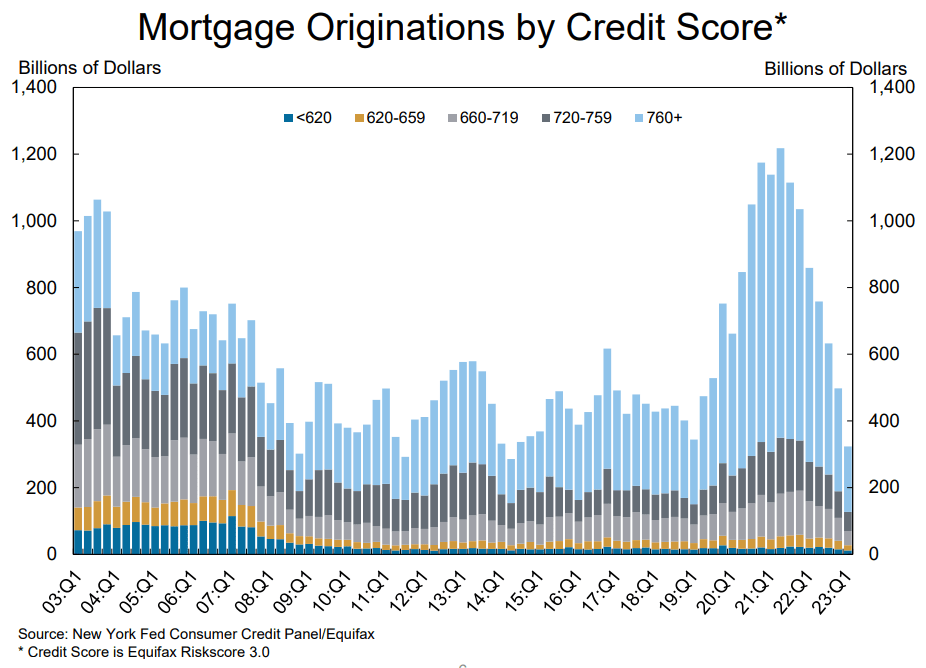
The latest report on household debt from the New York Federal Reserve (2023) reveals some interesting trends in mortgage debt. During the pandemic, the surge in mortgage originations was particularly strong among those with the best credit scores of 760 and above.

Those with the greatest house buying power are now “locked” into historically low interest mortgages below 4%. How low is 4%? The 50 year average of the 30-year fixed mortgage rate is 7.74%, according to Trading Economics. An entire generation was accustomed to very low rates after the financial crisis. Those low mortgages will create a resistance to sell that will likely dampen the housing market for a decade to come. A $400,000 mortgage at 4% costs $1900 per month. At a 6.5% rate that same monthly payment covers only a $300,000 mortgage. How many people will be willing to downsize into a more affordable mortgage?

In the past 15 years, Americans have reduced their debt load to a level less than their disposable income but how long can that continue? For the past 20 years, real disposable personal income per household has grown at only 1% annually, half of the rate of growth from 1982-2002. (Disposable income is what remains after taxes). In the graph below, that is the blue line. That same income series per job, not household, has grown at 1.25% annually (red line), down from 1.5% annual growth in the previous 20 year period. I’ve charted the two series on a log scale to demonstrate the different growth rates. The difference indicates that those with higher paying jobs have enjoyed higher growth of after tax income for the past two decades. The two series show the cumulative effect of favorable tax policies for those with higher incomes.   

Because the growth of household income is tepid, families are more likely to increase their debt burden. In a decade this could provoke a credit crisis similar to the great recession 15 years ago. Republicans are fiercely resistant to higher taxes on the top income earners and equally resistant to any reductions in military spending or agricultural supports. Democrats continue to promote social programs without the additional tax revenues to support that spending. A higher federal debt level will reduce the federal government’s capacity to support families when the next crisis arrives.   

//////////////////

Photo by Leio McLaren on Unsplash

Keywords: fiscal cliff, public debt, household debt, mortgage, disposable income

Federal Reserve Bank of New York. (2023, May). Quarterly report on household debt and credit. https://www.newyorkfed.org/medialibrary/interactives/householdcredit/data/pdf/HHDC_2023Q1

U.S. Bureau of Economic Analysis, Real Disposable Personal Income [DSPIC96], retrieved from FRED, Federal Reserve Bank of St. Louis; https://fred.stlouisfed.org/series/DSPIC96, June 2, 2023. Other series shown are Total Nonfarm Payroll (PAYEMS), the Census Bureau’s estimate of  households (TTLHHM156N)