
The Role of a Rule

December 31, 2023

by Stephen Stofka

This week’s letter is about the role of a monetary rule and the guiding points that help the Fed steer its policymaking. Since the 2008-9 financial crisis, the Fed has purchased a lot of assets, increasing its balance sheet from less than one trillion dollars at the end of 2007 to almost $8 trillion this month. It has kept the federal funds rate that anchors all other interest rates near zero for ten of the last 15 years. The members on its board of governors serve 14 year terms, affording them an autonomy resistant to political influence. From those board members the President and Senate choose and confirm the Chair and Vice-Chair of the board. The governance structure allows them to set and follow a plan of steady guidance but their actions have resembled those of sailors steering against unpredictable winds. What are the guiding lights?

In the late 1950s, economists and policymakers enthusiastically endorsed the concept of the Phillips Curve. Picture an ellipse, a circle that has been stretched along one axis so that it appears like an egg.
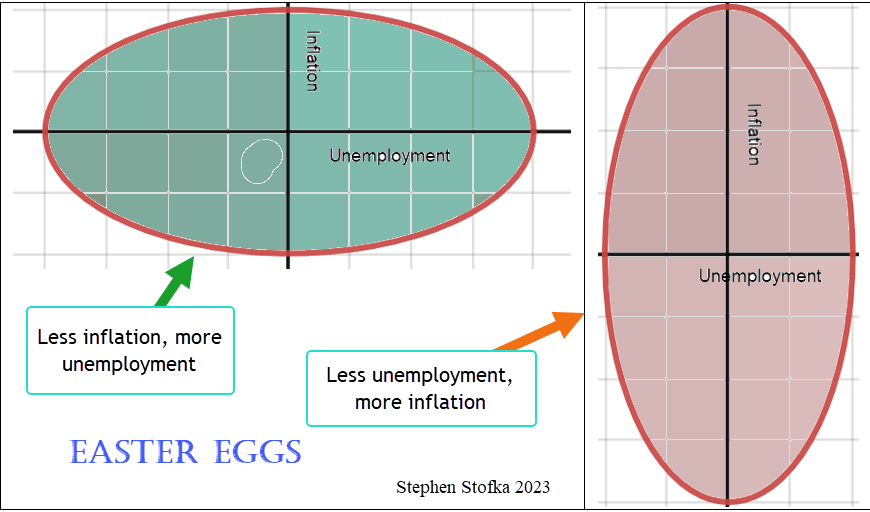
Think of unemployment along the x-axis and inflation along the y-axis. More unemployment stretched the circle, shrinking inflation. More inflation stretched the circle in the y-direction, lessening unemployment. Policymakers could tweak monetary policy to keep these two opposing forces in check. In the 1970s, both inflation and unemployment grew, shattering economic models. Nevertheless, Congress passed legislation in 1978 that essentially handed the economic egg to the Fed. While the central banks of other countries can choose a single policy goal or priority – usually inflation – Congress gave the Fed a twin mandate. It was to conduct monetary policy that kept inflation steady and unemployment low – to squeeze the egg but not break it.

Mindful of its twin mission, the Fed later recognized – rather than adopted – a monetary policy rule, often called a Taylor rule after John B. Taylor (1993), an economist who proposed the interest setting rule as an alternative to discretion. The Fed would use several economic indicators as anchors in policymaking. The Atlanta Fed provides a utility that charts the actual federal funds rate against several alternate versions of a Taylor rule. I’ve included a simple alternative below and the actual funds rate set by the Fed. When the rule calls for a negative interest rate, the Fed is limited by the zero lower bound. Since the onset of the pandemic in March 2020, the Fed’s monetary policy has varied greatly from the rule. Only in the past few months has the actual rate approached the rule.

In a recent Jackson Hole speech, Chairman Powell said, “as is often the case, we are navigating by the stars under cloudy skies.” What are these guiding points that should anchor the Fed’s monetary policy? I’ll start with r-star, represented symbolically as r*, which serves as the foundation, or intercept, of the rule. Tim Sablick at the Richmond Fed defined it as “the natural rate of interest, or the real interest rate that would prevail when the economy is operating at its potential and is in some form of an equilibrium.” Note that this is the real interest rate after subtracting the inflation rate. The market, including the biggest banks, consider it approximately 2% (see note at end). This is also the Fed’s target rate of inflation, or pi-star, represented as π*. The market knows that the Fed is going to conduct monetary policy to meet its target inflation rate of 2%.

Why does the Fed set a target inflation rate of 2% instead of 0%? The Fed officially set that target rate in 1996. The 2% is a margin of error that was supposed to give the Fed some maneuvering room in setting policy. There was also some evidence that inflation measures did not capture the utility enhancements of product innovation. Thirdly, if the public expects a small amount of inflation, it adjusts its behavior so that the cost is so small that the benefit is greater than the cost (Walsh 2010, 276). Today, most central banks set their target rate at 2%.

The definition of r-star above is anchored on an economy “in some form of equilibrium.” How does the Fed gauge that? One measure is the unemployment rate and here we have another star, U-star, often represented as un, meaning the natural rate of employment. In 1986 Ellen Rissman at the Chicago Fed described it (links to PDF) as “the rate of unemployment that is compatible with a steady inflation rate.” So now we have both unemployment and the interest rate anchored by the inflation rate.

Another part of that r-star definition is an economy “operating at potential.” Included in the Fed’s interest rate decisions is an estimate of the output gap that is produced by economists at the Congressional Budget Office (CBO). The estimate includes many factors: “the natural rate of unemployment …, various measures of the labor supply, capital services, and productivity.” The CBO builds a baseline projection (links to PDF) of the economy in order to forecast the federal budget outlook and the long term financial health of programs like Social Security. Each of these factors does contribute to price movement but the analysis is complex. A more transparent gauge of an output gap could help steer public expectations of the Fed’s policy responses.

In a paper presented at the Fed’s annual Jackson Hole conference in Wyoming, Ed Leamer (2007, 3) suggested that the Fed substitute “housing starts and the change in housing starts” for the output gap in constructing a monetary policy rule. At that time in August 2007, housing starts had declined 40% from their high in January 2006. Being interest rate sensitive, homebuilders had responded strongly to a 4% increase in the Fed’s key federal funds rate. Despite that reaction, the Fed kept interest rates at a 5% plateau until September 2007. By the time, the Fed “got the message” and began lowering rates, the damage had been done. Six months after Leamer delivered this paper, the investment firm Bear Sterns went bankrupt. The Fed engineered a rescue by absorbing the firm’s toxic mortgage assets and selling the rest to JP Morgan Chase. Six months later, Lehman Brothers collapsed and the domino effect of their derivative positions sparked the global financial crisis.

I have suggested using the All-Transactions House Price Index as a substitute for the output gap. A long-term average of annual changes in this index is about 4.5%. The index is a summation of economic expectations by mortgage companies who base their loan amounts on home appraisals, banks who underwrite HELOC loans to homeowners and loans to homebuilders. The index indirectly captures employment trends among homeowners and their expectations of their own finances. Any change that is more than a chosen long-term average would indicate the need for a tightening monetary policy. Anything less would call for a more accommodative policy. Either of these housing indicators would be a transparent gauge that would help guide the public’s expectations of monetary policy.

Although the Fed considers the Taylor rule in setting its key interest rate, the rate setting committee uses discretion. Why have a rule only to abandon it in times of political or economic stress? The rule may not operate well under severe conditions like the pandemic. A rule may be impractical to implement. A Taylor rule variation called for a federal funds rate of 8% in 2021. This would have required a severe tightening that forced the interest rate up 7% in less than a year. The Fed did that in 1979-80 and again in 1980-81. Both times it caused a recession. The second recession was the worst since the 1930s Depression. An economy as large as the U.S. cannot adjust to such a rapid rate increase.

How strictly should a rule be followed? Some of us want rule making to be as rigid as lawmaking. A rule should apply in all circumstances regardless of consequences. Many Republican lawmakers felt that way when they voted against a bailout package in September 2008. Some of us regard a rule as an advisory, not a straitjacket constraint of policy options. Each of us has a slightly different preference for adherence to rules.

See you all in the New Year!

/////////////

Photo by Mark Duffel on Unsplash

Keywords: housing starts, house price index, stars, output gap, unemployment, interest rate, inflation

All-Transactions House Price Index is FRED Series USSTHPI. The annual change is near the long-term average of 4.5%, down from a high of 20% in 2022.

Housing starts are FRED Series HOUST. The output gap is a combination of two series, real GDP GDPC1, and real potential GDP, GDPPOT.

A gauge of long-term inflation expectations is the 10-year breakeven rate, FRED Series T10YIE. The 20-year average is 2.08%. The series code is T=Treasury, 10Y = 10 year, IE = Inflation Expectations. The T5YIE is a 5-year breakeven rate.

Leamer, E. (2007). Housing Is the Business Cycle. https://doi.org/10.3386/w13428

Taylor, J. B. (1993). Discretion versus policy rules in practice. Carnegie-Rochester Conference Series on Public Policy, 39, 195–214. https://doi.org/10.1016/0167-2231(93)90009-l

Walsh, C. E. (2010). Monetary theory and policy. MIT press.

Solow’s Growth Machine

December 24, 2023

by Stephen Stofka

I will start off this week’s letter with a look at the assumptions of neoclassical economics. I will finish up with some thoughts on the contributions of Robert Solow, a Nobel laureate who died this week at the age of 99. His growth model was built on neoclassical foundations and is still a workhorse of intermediate level macroeconomics.

In the late 19th century, several economists blended mathematics and utility theory to separate the study of economics from political economy. They thought that they could study human behavior with the same quantitative analysis that physicists and engineers used to make predictions about the mechanical world. To make their analysis consistent with established mathematical principles they made several assumptions regarding both consumer choice and the production process. I’ll begin with consumer choices.

The first assumption was that individual choice making was rational. This meant that people had preferences for some goods over others and could construct bundles of goods that would maximize their utility, or satisfaction. These preferences were consistent and independent of circumstances like income. For instance, a person might not be able to afford a steak but they preferred steak to ground beef. The ordering of preferences was complete. A person either preferred this bundle of goods to that bundle of goods, or preferred that over this, or considered them equal.

In order to predict human behavior, the neoclassicals assumed that humans behaved predictably. Behavioral economists challenged those assumptions as unrealistic. We may try to optimize our satisfaction but our lives are a series of circumstances partly determined by our prior choices and circumstances. Because of this our preferences change. Our “priors” introduce biases into our decision making that sabotage our attempts to maximize our utility. We want to put a decision behind us so we may shorten a lengthy examination of options and choose something just to have it done. This is known as decision fatigue. The choice of a hotel room while on vacation might be an example. Ratings systems address this fatigue.

A second assumption was that the market clears, balancing supply and demand so that there is no surplus or shortage. At this equilibrium is the market clearing price. A surplus or shortage would introduce some serial correlation into the price analysis and raise the likelihood that errors in the data were not random. A third assumption was that people form expectations by reducing the errors in prior expectations. This was later formalized as a concept called rational expectations but it was based on the idea that people optimized their satisfaction. These assumptions interpret human behavior so that our behavior is amenable to mathematical modeling and statistical validity. How realistic are they? The law of inertia models motion under the assumptions that there is no gravity or friction.  Although unrealistic, it is the basis for accurate prediction. In 1966, economist Milton Friedman wrote “The Methodology of Positive Economics,” a seminal paper asserting that a valid test of an assumption was not how likely or reasonable it seemed but its ability to enable accurate prediction.

In analyzing the production process, the neoclassicals assumed that the proportions of the factors of production were consistent. If the production costs for an industry were half labor and half capital, they were always in those proportions. In order to make production amenable to differential analysis, the neoclassicals pretended that production was continuous and incremental, even when it was seasonal or halting. They assumed that the output from production was constant, or constant returns to scale. X number of inputs went into the production function in certain proportions and the same Y output came out. The neoclassicals assumed that savings were automatically turned into investment. When the Great Depression of the 1930s showed that the process was not automatic, the neoclassical analysis could not explain it.

The neoclassicals failed to predict the extraordinary growth in productivity during the twentieth century. In the thinking of some economists, growth was inherently uneven and would introduce market instability that made it more difficult to reach equilibrium. In 1956 Robert Solow and Trevor Swan independently published papers that introduced a model where technological innovation enhanced labor productivity. The higher productivity led to higher savings rates which led to a higher rate of investment. Policies that encourage investment would lead to more efficient use of that investment and a steady rate of economic growth.

Like the neoclassical economists, the Solow-Swan models assumed that savings were turned into investment. With that increased investment, companies adjusted the mix of capital and labor used in production. The ratio of capital (K) to labor (L) inputs, the K/L ratio, kept increasing. In a medium term of like ten years, higher savings and investment led to higher economic growth. But greater investment increased depreciation costs so that savings and depreciation rates competed with each other. In the long-term of two or more decades, their models described a steady state of balanced growth. Capital, effective labor and economic output would approach the same rate of growth.

In their steady state model, technological innovation was an exogenous factor, meaning that it was not generated or explained by the model. In studying developing countries, other economists realized the importance of property rights protection. Policies and institutions must encourage investment and afford some assurance that the fruits of R&D research will be protected. Without this sense of security, investors must account for the risk that their research will be copied and the resulting loss of profits will impact projections of long term cash flows. This dampens investment in those countries with low property rights protection. Consequently there is a low amount of R&D investment and the people within those countries become stuck in a trap.

Nobel laureates are recognized for their contribution to a field of study. Their ideas and their analytical approach became an incubator for more research, more questions, discussion and controversy. As growth theory and development economics have evolved, they have incorporated the ideas of Robert Solow. He was born in the early 1920s when electricity was ushering in large gains in mechanical productivity. He died when those same electrical currents are powering a revolution in information processing. His birth and death are the bookends of a century of transformation.

///////////////

Photo by Mike Hindle on Unsplash

Keywords: neoclassical economics, consumer, production, steady state, growth theory, Solow

AI, Ideas and Perspectives

December 17, 2023

by Stephen Stofka

This week’s blog is about perspective as a launching point for understanding current and historical events and our own transformation in this digital age. There is plenty of controversy over the wars in Israel/Palestine and Ukraine, immigration and abortion policy. In 1991 Rodney King was beaten with batons by several L. A. police. In an age before cell phone cameras, a bystander on his apartment balcony recorded the incident with a video camera. When the video was shown by a local TV station, the city brought charges against four officers. When a jury acquitted the officers a year after the incident, L.A. erupted in riots that lasted almost a week. Rodney King famously asked, “Can we get along?,” which became a Why can’t we get along? meme. We don’t get along because we have individual perspectives.

Perspective is a point of view that encompasses beliefs, identity, values and assumptions. Although each person has a unique perspective formed by individual experience, we form groups with those who share a similar perspective. We convince ourselves that our values and assumptions are the correct ones. From the jury box of our values and assumptions we judge the actions of others.

The elements of perspective are the foundation of an analytical framework, a toolset of principles and theories that help us build a community of shared perspectives. A framework prioritizes some values and assumptions to achieve the goals of the analysis. An academic researcher and an advocacy group have different goals and methodologies. The advocacy group uses a framework like that of a lawyer, sifting through facts and opinions to find those that support the group’s policy goals. Substance above process. A researcher will adopt a framework with a sound and accepted methodology that will most likely earn favorable peer review and publication. That researcher may filter out facts that don’t fit the methodology. Process above substance.

Our conclusions are shaped by our attention. Our attention is directed by our intention. We discredit facts that threaten our intention and undermine our self-interest, values or identity. On the other hand, we do not challenge those facts that confirm our perspective. Why should we? We interpret facts to support the assumptions so foundational to consensus within a group. Social media has increased the scope of our conflict and consensus. We can agree or disagree with strangers around the world about the ethical issues of current events. We can hone our skills of ridicule and outrage. We can join a group to exploit trading platforms in the hopes of financial gain, buy almost anything online, and find romantic partners and people with similar hobbies and interests.

The chain of communication breakthroughs began with Gutenberg’s printing press 500 years ago. Broadsheets and newspapers followed in the following centuries but their ideas and sentiments were constrained by geography. The circulation of the Federalist papers supporting the adoption of the U.S. Constitution was limited. The ideas penned by Madison and Hamilton found a wider audience when a publisher bound those op-eds into a single volume. In the 20th century, radio and TV spread ideas, new and entertainment to a wider audience. The development of the internet in the 1990s led to a revolution in time – information and entertainment became both a good and a service.

Last week I wrote about the four types of goods/services. Many goods are asynchronous. The consumption of the good occurs at a different time than the production of the good. Many services are synchronous. A haircut is consumed and produced at the same time. Social and news media captures both aspects. The content may be asynchronous, produced and stored on a server in the cloud. It may be synchronous – either a broadcast of an event or a Twitter exchange in real time between two people separated by multiple time zones. Social and news media has changed our daily experience. We may cling to the belief that our perspective has remain unchanged, our values and principles intact, but have they? Experience shapes perspective and an evolving set of experiences must surely have some effect on our values, assumptions and the way we interpret events.

Will the internet change history? The printing press changed individual perspectives. Within a few decades it made possible the wide dissemination of Luther’s 95 theses in 1517 that sparked the Protestant Reformation. Luther’s principles challenged the long dominant authority of the Catholic Church in the interpretation of the Christian faith. In 1543 Copernicus’ book on the revolution of the planets and other celestial bodies ignited the Scientific Revolution. His ideas challenged the centuries old thinking of Ptolemy, the second century Greek astronomer and mathematician.

In the political sphere, the works of John Locke led to an uprising in England that challenged the extent of monarchical authority. Those ideas would become the foundation of America’s Constitution. Not only was it the first written Constitution but it had to be printed and circulated to state assemblies as well as the general public in order to win ratification. Almost 400 years after Gutenberg invented the printing press, the United States emerged from the printing press.

It was a country built on confrontation, cooperation and conflict between regional interest groups that threatened to tear apart the new republic. The economies of the southern states were based on agriculture while those in the north were founded on industry. There was so much fractiousness at the Constitutional Convention in Philadelphia that the delegates fought over the text of the Constitution behind closed doors. America has stayed intact despite a civil war because its Constitution encourages public arguing as an alternative to civil war.

Social media companies have developed algorithmic platforms that support arguing as a way to keep viewers engaged. Arguing fosters new combinations of identities and values and these shifting combinations promote new group formation much like the variety of Protestant sects that emerged during the Protestant Reformation. To a historian in the twenty-fifth century, the historical significance of the internet age may be the development of artificial intelligence, or AI, to efficiently mimic many human capabilities. A set of algorithms cannot replicate the intricacies of individual perspective but it will alter our perspectives. We are becoming not the hardware cyborgs of science fiction movies but the software cyborgs of ideas and perspectives.   

////////////////

[20231217Letters.png]

Photo by Amador Loureiro on Unsplash

Keywords: Constitution, analysis, values, assumptions, perspective

Money – the Shape Shifter

December 10, 2023

by Stephen Stofka

This week’s letter is about public goods and the characteristics of public goods. I’ll discuss whether money or a digital currency is a public good. I’ll explore the four types of goods as economists classify them. These properties can enrich our understanding of some contentious debates. Hop on board as we tour the safari park of economic ideas.

Economists use two criteria to classify goods: whether they are rival and whether they are excludable. Rival means that one person’s consumption of a good lessens another person’s consumption of the good. An excludable good means that there is a feasible mechanism to prevent someone from consuming a good. A private good is both rival and excludable. A public good is both non-rival and non-excludable. It helps to look at public goods from a cost perspective. The marginal cost of providing the good to one more person is practically zero. The marginal cost to prevent someone from consuming a public good is very high.

An example of a public good is the national defense. One person’s protection from attack has little if any effect on another person’s protection. A country cannot practically prevent someone from being protected. Another example is firework displays. Although we call the street out in front of our house a “public street,” it is a toll good or club good according to these characteristics. Once built and maintained, the cost for one more driver to use the road is zero so it is non-rival just like the national defense. But it can be made exclusive at a reasonable cost by restricting access. A toll road is an example. A city makes a street public by decree, not by any characteristic of the road. A decree can be undone as when a city converts a city street to a pedestrian mall.

Another type of good is rival but non-exclusive. These are called pooled goods. A classic example is fishing in the ocean. The fish that someone catches are no longer available to someone else so they are a rival good. However, it is difficult and costly to prevent someone from fishing in the ocean. Pooled goods typically include natural resources or game animals. A government manages the depletion of the resource by issuing licenses and imposing fines. Overfishing of the world’s oceans has been a contentious issue for decades.

Governments have managed the problem of pooled resources by selling a property or use right to a private owner. The manager restricts access to the resource and charges a fee to users of the resource, effectively turning a pooled good into a toll good. A use right might be in the form of a 99 year renewable lease or a public-private partnership where a private company manages a park or other natural resource. 

These characteristics can provoke some lively discussion. For instance, is money a public good? It might seem so. It costs almost nothing to make another $1 of currency. But providing the next $1 of currency requires billions of dollars of legislative and judicial debate because public spending is rival. If that $1 is spent on one cause, it cannot be spent for another project. If transferred to one person, that same $1 cannot be given to another person. Is it excludable? Social spending programs are based on criteria that exclude some while entitling others to the benefits of the program. We argue so much about “public” spending because the spending itself has characteristics of a private good. It is rival and excludable. Once built an air defense system might act as a public good, providing non-excludable protection. The spending itself is not a public good.

Let’s follow the path of a tax dollar. It went from a private party through a banking system that restricts access to money resources, then into a government pool where it became an indistinguishable unit of tax revenue, a pooled good, then became private again when the tax dollar was spent or transferred to someone. If spent, the use of the good or service became public in some sense. An air defense system or the building of a public library, for example. If transferred to a person, the money was spent in the private economy for goods and services like food and rent. The  transformation of private dollars to public pot and back to private dollars is accompanied by a lot of heated debate.

The money supply has characteristics of a pooled good although it is not a natural resource. In circulation it acquires the characteristics of a natural resource, a good that has many access points. A government manages the money supply like a pooled resource. It licenses out the ability to create money to member banks, imposing some regulations and trusting that the discipline of gain and loss will cause banks to act prudently when making loans that increase the money supply. However, banks don’t just loan money to individuals and businesses. They loan money to financial institutions who loan money, thus magnifying the power of the money-creation process.

Money in the economy acts like a magnetic field in a giant turbine. The turbine turns as long as the magnetic field keeps changing. Money has the characteristics of a private good in exchange, then a pooled good in taxation and a toll good in the banking system, and then a private good again. Money can buy public goods and services but can’t assume the characteristics of a public good. Like money, a digital currency like Bitcoin has an exchange power between private parties that relies on the seller’s willingness to accept payment in Bitcoin. But it cannot act as another type of good because the government refuses to accept Bitcoin as a payment for taxes. Doing so would interrupt its control of the money licensing process. Money then becomes an intermediary in a Bitcoin exchange, like the Universal Translator on the original Star Trek TV series. Money is adaptable to each type of good for which it is exchanged. That adaptability gives money power, a power that governments have abused in centuries past, giving people a cause for concern.

///////////////

Photo by Richard Horvath on Unsplash

Keywords: private goods, public goods, toll goods, club goods, private goods. Bitcoin, digital currency.

The “As If” Pandemic War

December 1, 2023

by Stephen Stofka

Last week I mentioned that the pandemic simulated conditions similar to a large scale war. This week’s letter explores those war-like aspects, the personal behavior and public policy choices that promoted inflation. Economists measure indicators of supply and demand to gauge the human emotion and calculation that guides decision making. Supply and demand are discernible but inseparable, a synergy of planning, emotion and reaction. Wars and global pandemics transform the routine of our daily lives into a natural experiment to help us better understand the dynamics of our daily choices.

As inflation increased in 2022, economists fell into several camps. There were those who thought the inflation was due to supply bottlenecks and that it would resolve itself. Some thought that the government had provided too much stimulus and the excess demand fueled inflation. Others thought that it was a combination of the two – both supply and demand. Some thought the Fed had waited too long before recognizing and responding to the problem of rising prices. The public sometimes gets frustrated with the arguments of prominent economists who help shape public policy.

Economists gather a lot of data and develop causal models to construct scenarios of future events. People do not respond to events like automatons. People try to anticipate what’s coming and change our behavior before anything has happened. From several blocks away I can see that the light is green but it is unlikely to be green when I get to the intersection at the speed I am going. I can either accelerate quickly or ease up in anticipation of making a full stop at the light. I am not responding to the state of the world as it is but as I predict it will be. The philosopher Ludwig Wittgenstein (1889 – 1951) wrote that the future could not be inferred from the present. What if I speed up to beat the light and a driver swerves onto the road? At the same time I am making my decision to speed up, a pedestrian might think it is safe to cross the road. It is a minor tragedy in the making. What doesn’t happen is as much the reality of the moment as what does happen, Wittgenstein claimed. As economists try to predict human behavior, the subjects being studied are also trying to predict the behavior of the people and events around them.

During the pandemic, the global supply chain exhibited bottlenecks that would be more likely during a large scale war. A critical strategy during war is to disable or destroy the enemy’s supply lines. Factories, roads, railways and airports are bombed. The initial response to the pandemic was to shut down much of the global manufacturing capacity. The transportation networks were not destroyed but disrupted. For months shipping containers sat on ocean ships outside the port of Los Angeles in California. The ships could not return empty to factories in Asia and load up with more shipping containers. The conveyer belt of the global supply chain had stopped. To get critical supplies, U.S. companies hired planes to fly goods from Asian ports.

In January 2022, several economists at the New York branch of the Federal Reserve published a GSCPI composite index that estimates the price pressures in the global supply chain. You can read about their methodology here. In December 2021, the index measured a stress level that was so rare – less than four out of a million chance of occurring. In March the NY Fed estimated that global supply pressures had eased a bit but May’s report indicated worsening pressures. A month earlier the Fed had started a series of interest rate increases to curb inflation.

During a war, civilians alter their buying habits. Governments impose travel restrictions and curfews on the civilian population. Some goods are diverted to armaments. The armed forces requisitions certain foods for the soldiers fighting the war. During the pandemic, house-bound people bought household appliances and furniture, computers and entertainment devices. These are “core” goods that people buy infrequently so suppliers were likely to have a supply in stock. Stores could not restock and shelves were often bare. Where were the goods? Sitting in a container on a ship in the Pacific. By early 2021, Covid-19 vaccines were made available to seniors and others deemed vulnerable. By late 2021, restrictions on personal services like hair salons and restaurants were eased. By early 2022, a world that had gone stir crazy for two years visited restaurants, booked vacations, joined gyms and had their hair done. The household goods and appliances that stores had ordered now arrived but the public had switched their buying habits.

Many Americans had never experienced wartime restrictions and resented the heavy hand of government in their daily lives. Many states closed schools and day care facilities, leaving parents with round the clock care of their children. Some of us are content to be alone while others thrive on the company of others. As people re-emerged into normal public life, some rebelled against institutional rules of any sort. A request from a flight attendant on an airplane might incite a violent reaction from a passenger who regarded the flight attendant as representative of all institutional authority. Some passengers responded as if they were escaping from prison. They verbally attacked employees working in airlines, in restaurants and grocery stores, in hair salons and other public facing businesses. Here is a compilation of confrontations between passengers and airline employees. In the public square and on social media, we were acting as though we were at war with each other.

There are often social frictions following a war. The passage of the Prohibition amendment following World War I disrupted social relations in America. Some states and cities imposed restrictions to curtail the spread of the so-called Spanish flu (see note below). The drop in crop prices following the war put many farmers and regional banks out of business during the severe recession of 1920-21. Americans turned against other Americans, particularly minorities who enjoyed any good fortune. A prosperous Black community in Oklahoma was burned to the ground. Americans of British and northern European heritage pressed lawmakers for new immigration rules that would restrict anyone but northern Europeans from legal entry into the U.S. In 1924 Congress passed the Johnson-Reed Act that imposed country quotas favoring those from northern European countries at the expense of southern Europeans and Asians.

During World War 2, Americans were at war with Japanese, Italian and German Americans in the barracks and in the public square. A 1942 musical featured a song The House I Live In to promote a camaraderie among the public. In 1945 the popular singer Frank Sinatra starred in a short movie of the same name to combat prejudicial attitudes toward minorities. In the year after the war ended, the marriage rate hit an all-time high but the divorce rate also spiked.

During the 1960s and 1970s the Vietnam War provoked social and political hostilities among Americans. The conflict erupted on public streets, on college campuses and in households where children and parents debated the ethics of the war. To a growing coalition of Americans returning vets represented the barbarous atrocities that the country’s leadership had ordered. They were treated with scorn or disregard by a public that wanted to forget the war. Many were betrayed by the bureaucratic red tape that kept many waiting for benefits that the government had promised in return for their service. See 2: 45 on this 5 minute clip from the History Channel. How does rude and antagonistic behavior affect inflation?

The rudeness, the lack of kindness in social relations stirs a deep sense of dissatisfaction within us. The circumstances of the pandemic aroused feelings of vulnerability and anger. The antidote to dissatisfaction is satisfaction. The antidote to powerlessness is the exercise of power. Spending money on ourselves and our family promotes a sense of satisfaction and power – just what the doctor ordered. Newly escaped from pandemic prison consumers increased their credit card balances by an average of 15% annualized in 2022 and 17% in the first half of this year. Over a ten-year period, consumers increased their credit card balances by 4% each year, slightly more than the 3.65% average of all consumer debt. As they did after WW2, Americans put the pandemic crisis behind them by us by spending.

/////////////

Photo by Shalom de León on Unsplash

Keywords: World War 1, World War 2, Vietnam War, curfews, consumer spending, credit card debt

Note on Spanish flu:  The U.S., Britain and other allies suppressed news of the flu spreading among their troops. Spain did not impose wartime restrictions on publication of the news so the public first became aware of it from Spanish newspapers. Later genetic testing and historical records indicated that the origin of the world wide pandemic was an Army base in Leavenworth, Kansas.