Crystal Ball

February 25, 2024

by Stephen Stofka

This week’s letter is about the public’s expectations of inflation. The interest rate setting committee of the Fed indirectly controls the borrowing costs on our mortgages, credit cards and auto loans. The committee pays attention to public expectations of inflation because we respond now to what we see as potential threats. A fear of “making a mistake” in a job interview can make us nervous, increasing the chances that our behavior will decrease our chance of securing that position. A consumer who expects higher gas prices next year may buy a more fuel efficient vehicle this year.

Consumers must anticipate their future circumstances and income when they decide between different consumption bundles. Should they spend more on housing and live closer to work or get more house for their dollar and have a longer commute? Invest time and money in college, including the loss of income while attending school. Consumers must decide how much to spend and how much to save. Despite the difficulty of such decisions, many consumption choices are made on a shorter time scale than the suppliers who provide those goods and services. To survive, a business must live in the future, anticipating the trends of customer behavior that shape demand for its products or services. Since the pandemic, the shift to work at home has hurt many downtown businesses that depend on foot-traffic. There aren’t enough office workers to support some types of businesses.

In his General Theory published in 1936, John Maynard Keynes gave a prominent role to investor expectations. John Muth (1961) presented a more formal model that he termed “rational expectations.” In the 1970s, Thomas Sargent and Robert Lucas developed more extensive models to understand how people responded to the stagflation of the 1970s. The formation of expectations is an important economic variable and remains a hotly debated topic among economists.

Each month the New York branch of the Federal Reserve surveys a rotating sample of 1300 people to gauge their expectations of overall price changes as well as principle expenses like housing, food and gas (questionnaire pdf here). The Fed provides data on the past decade of surveys which allows us to assess changes in public expectations. As I explored this data with graphs, I was surprised at how closely expectations conformed to a textbook model that students are taught in an intermediate macroeconomics class. Macro is hard because there are few natural experiments to test theories and models. The pandemic led to a series of events that provided such a natural experiment.

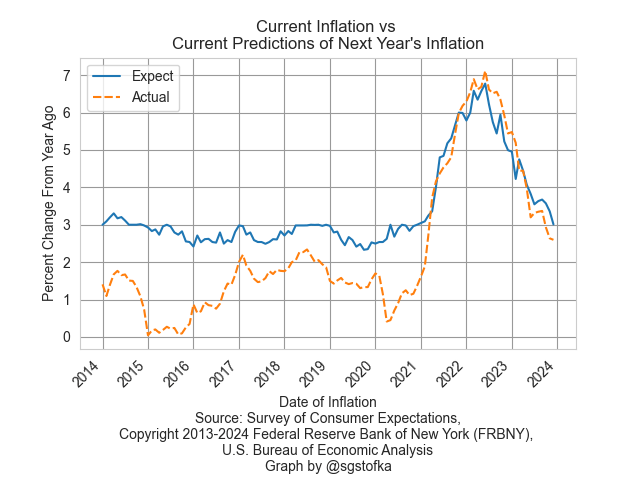
I’ll begin by comparing actual inflation to public expectations of inflation a year earlier. The first graph is actual inflation and the predictions of that inflation from a year earlier. From 2014 to 2020, the median value of expected inflation, the blue line, stayed anchored in the 2.5% to 3% range even when actual inflation, the orange dotted line, was below that. Lower inflation was not a threat to people’s pocketbooks so there was little reason to revise their estimates downward. We have a well-studied risk aversion, meaning that we place greater weight on loss than we do on gains. In this case, lower than expected inflation is a gain. Economists and the general public were both caught off guard when inflation surged higher in 2021.

As soon as inflation rose above long-term averages, as it did in 2021, survey respondents revised their estimates of next year’s inflation. Higher inflation is a threat to our finances, so we pay greater attention. However, survey respondents based their estimates of next year’s inflation on this year’s actual inflation. Is that a good estimating procedure? Maybe not, but estimating trends requires knowledge, practice and error checking to improve our skills. Many times we use shortcuts, called heuristics, instead. I will leave a textbook explanation of the formation of inflation expectations in the notes.
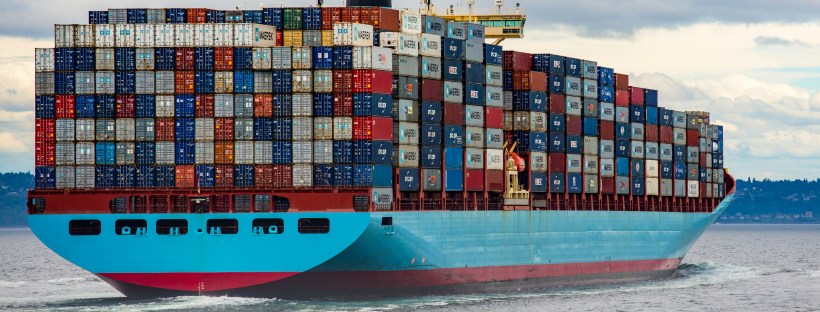
How do we survive using shortcuts? One of those shortcuts is our degree of uncertainty. There are fewer traffic accidents at roundabout intersections because they introduce a degree of uncertainty that causes us to be more cautious. The median percent of uncertainty jumped in March 2020 when pandemic restrictions were announced. When Biden took office a year later uncertainty remained at this elevated base. As the economy reopened in the spring of 2021, supply disruptions became apparent. “When are you going to get more of these in stock” was met with “We don’t know. They’re on a boat somewhere in the Pacific.” While people sat at home during the pandemic, they bought a lot of goods from online retailers like Amazon. The reopening of service-oriented businesses caused another price shock as the economy transitioned from goods-heavy back to one that relied heavily on services.

The peak of uncertainty occurred in mid-2022, shortly after the Fed began a series of consecutive interest rates increases that would lift the benchmark lending rate by 5%. The uncertainty of survey respondents decreased in reaction to the Fed’s intention to keep increasing rates until rising inflation was tamed. I’ll zoom in on the past three years of uncertainty and the Fed’s “get serious” campaign of interest rate increases.

Despite criticism of the Fed, its intentions were credible to the public. Expectations are as difficult to measure as animal pheromones but they are real. They cause responses. Surveys are an imperfect gauge of expectations but they will have to do until someone invents an expectarometer that detects the mental disturbances in the sub-ether caused by expectations. That’s a world similar to Philip K. Dick’s Minority Report and I’m not sure we want that.

////////////////////

Photo by Jan Huber on Unsplash

Keywords: federal funds rate, inflation, expectations

Note on inflation expectations: A textbook explanation is

πet = (1- θ)π̅  + θπt-1, or in words
πet   is current expectations of future inflation,
π̅   is average inflation,
θ is the weight people give to recent inflation πt-1 (Blanchard, 2017, p. 162).
From 2014-2020, survey respondents gave little weight to recent inflation, such that θ was close to 0 and expectations of inflation were close to a long-term average. As soon as inflation rose above the long-term average, θ went quickly to 1, resulting in an equation that looked like πet = (1-1)π̅ + 1π̅t-1   which simplifies to the most recent reading of inflation.

Blanchard, O. (2017). Macroeconomics (Seventh ed.). Boston, MA: Pearson Education.

Muth, J. F. (1961). Rational Expectations and the Theory of Price Movements. Econometrica, 29(3), 315-33512

Changing the Rules

February 18, 2024

by Stephen Stofka

This week’s letter continues to take a historical look at survey data. Every July the polling organization Gallup publishes a mid-year assessment of sentiment toward political institutions like Congress and the President, and the civic institutions that help bind our society together. These include our schools, the medical system and organized religion. Institutions are a set of rules and relationships, of rights and responsibilities. The company provides historical tables of these surveys that show a declining trust in our institutions.

Graphing the positive responses against a background of seminal events like 9-11 and the start of the Iraq war reveals the volatility of the public’s confidence in the president. Over 50% of respondents to Gallup’s survey  expressed a “great deal” or “quite a lot” of confidence in George Bush before and after 9-11.  His ratings fell  sharply after the invasion of Iraq. The justification for the war collapsed when the public learned that there were no WMD, or weapons of mass destruction, in Iraq. By the end of 2006, positive sentiment was just 25%, less than half the results at the start of the Iraq war. In 2007, the Bush administration committed troops to ensure security in the capital city of Baghdad and this helped turn the momentum of the war. The success of this strategy called the surge helped lift confidence in the president. Notice that confidence in Biden’s presidency is about the same as the confidence in the Bush presidency in 2006.

According to Ballotpedia, 94% of Congressional members are re-elected yet survey respondents have a low confidence in Congress as an institution. On a bipartisan vote 22 years ago, Congress authorized the Iraq war. Within a year, confidence ratings sank and have never recovered. Today positive sentiment is less than 10%. The rules of both the House and Senate are designed to let a few key people in either body control the flow of legislation to the floor of each chamber. Party leaders are more concerned about their own power and reputation than the voices of the people who elected the members of the House and Senate. Almost 250 years after fighting the British over taxation without representation we have lots of taxation and little effective representation.

Medical

The Affordable Care Act (ACA) was supposed to restore public confidence in our very expensive and bloated medical system. Judging by the responses to this Gallup survey question, the creation of this bureaucracy in 2010 has had little effect on the public’s confidence in the system as a whole. Many of the provisions in the act known as Obamacare rolled out slowly and the marketplace for insurance did not open until the beginning of 2014. When the online public exchange opened, its inability to handle the surge of applicants was a humiliation for the Obama administration. Despite the improving functionality of the public exchange and the greater access to health insurance, there was little effect on public confidence. In the initial months after the Covid-19 shutdown, confidence spiked but fell again to its former level the following year.  

Schools

Gallup’s 2020 survey of confidence in schools also saw of surge of support that declined to a pre-pandemic average the following year. The decline in confidence began after the onset of the Iraq war and continues to this day. At 26%, positive sentiment is only two-thirds of the level at the start of the Iraq war and matches a low set during Obama’s second term.

Banks

At the height of the housing bubble in 2006, almost 50% of survey respondents expressed strong confidence in banks. In the following two years, confidence plummeted and has barely recovered in the 15 years since.  This lack of confidence may explain the growing support for a digital currency alternative like Bitcoin.

What is the takeaway? A declining confidence in institutions can spark a revolution just as it did in the Progressive era a century ago. As people become discontent with the rules that govern their daily lives, they look to change the institutions that embody those rules. The people within those institutions are regarded as corrupt. Groups turn to violence in an attempt to restore the integrity of those institutions as they perceive it. In the years leading up to World War I, there were hundreds of bombings of prominent buildings and frequent riots to protest working conditions for adults and children, as well as living conditions within America’s growing cities. People were beaten and jailed for wanting freedoms that we now take for granted. Sixty years ago Bob Dylan wrote The Times They Are A-Changin’, heralding an era of protest and reform in the 1960s. This may be another seminal moment when people will demand a change in the rules because the old rules are serving so few.

/////////////////

Photo by Sean Pollock on Unsplash

Keywords: Congress, President, schools, banks, medical, healthcare

Survey Signals

February 11, 2024

by Stephen Stofka

This week’s letter takes a detour toward political polling. NBC News recently posted a story summarizing its latest opinion poll on the overall state of the country and the favorability of presidential candidates. Hart Research Associates regularly conducts this poll for NBC News and asks the question “All in all, do you think things in the nation are generally headed in the right direction, or do you feel that things are off on the wrong track?” One of the reporters at NBC News was kind enough to post the survey data on a central repository, and included in Hart’s survey data were the results of past surveys. A visual depiction of those survey trends contradicted some of my beliefs.

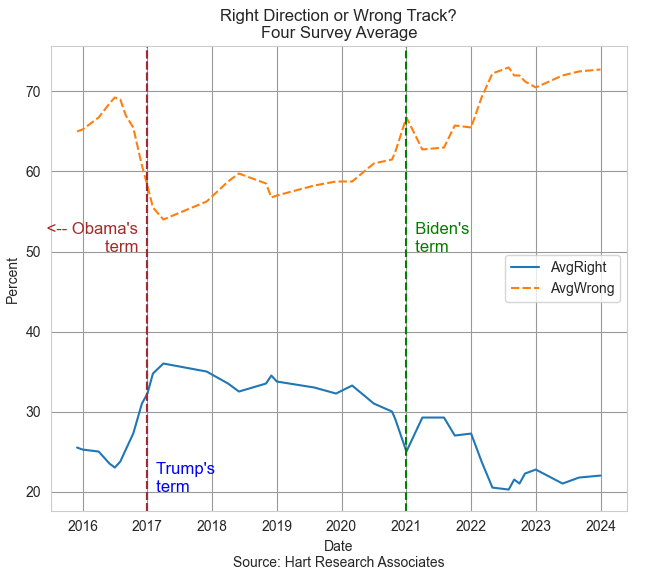
For a decade, the majority of survey respondents regularly answered that they don’t like the direction the country is going. More than half of these surveys were conducted among registered voters only and it doesn’t matter who the President is. The wrong track responses outnumber those who think the country is on the right track. In the graph below I’ve charted a four survey average to smooth the trends in the results. The orange dotted line is the percentage of those who answered wrong track. The blue line indicates those who answered right direction. Less than 10% of respondents have a mixed opinion or are not sure and I did not include those responses in the graph.

Toward the end of Obama’s second term, the percentage of wrong direction responses declined to about 55% before Trump took office in January 2017. From there, the survey responses became increasingly pessimistic. In the final year of Trump’s term negative sentiment shot up in reaction to the pandemic and it kept rising during Biden’s term. The percentage of those with a negative outlook this past month is over 70%, but just a few percent higher than a peak toward the end of Obama’s second term.

Favorability

Given such pessimism about the direction of the country, it is no surprise that a President’s favorability ratings rarely exceed 50%. Survey respondents were routinely asked to rate their feelings toward several public figures. Although both Biden and Trump are subjects of this question for more than a decade, I focused on the responses while both men were in office. The survey has five categories of feelings, from very positive to very negative. I chose just the two favorable categories, very positive and somewhat positive. A chart of the response numbers indicates stark differences in the trend of feelings toward each person. I’ll begin with Joe Biden.

In the first few months of Biden’s term, the sum of positive responses increased from 44% to 50%. Although the Democrats had a political trifecta, their majorities in the House and Senate were slim and prevented passage of controversial legislation like comprehensive immigration reform. The realities of the political process dampened the ardor of progressives who hoped for reforms in immigration, as well as education and child care. The level of moderate feelings, those who answered they were somewhat positive toward Biden, remained anchored at about 20%.

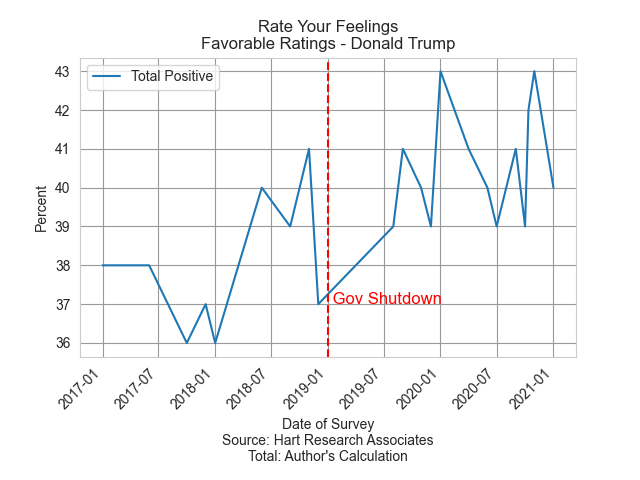
Unlike Biden, the percent of respondents with very positive feelings toward Trump continued to grow during Trump’s term. His disruptive style won him more appeal from ardent supporters than he lost among moderates. Trump’s overall favorability increased slightly during his term from 38% to 40%. Unlike Biden, Trump has a zealous voter base which affords him room to make reckless political postures.

In contrast, Biden’s support is more tempered and results oriented. After an initial positive rating among half of respondents in the early months his very positive ratings in this survey dropped by almost half. The passage of the Inflation Reduction Act in August 2022 helped revive his favorability ratings but the bloom faded after the Republicans won a slim majority in the House a few months later. For Democratic voters, policy choices trump party and person loyalty. With little prospect of further legislative gains in a divided Congress, voter enthusiasm waned.

Party loyalty has long been a central characteristic of Republican voters. Like an operator switching a train track, Trump has steered that loyalty to himself as a person. As such his favorability has been more resilient. In November 2018, midway through Trump’s term in office, the Democrats won the House Majority. Just before Christmas, the Republican-led Congress and Trump were unable to pass an Appropriations bill or a Continuing Resolution. The federal government shut down all non-essential services for a month, the longest government shutdown on record. Trump’s favorability ratings should have taken a hit.

Unlike Biden, Trump’s favorability increased in reaction to the shutdown and the swing of power in the House to Democrats. A wing of the Republican Party, fervent and defiant, continue to fight for control of the party and its agenda. Trump is their champion. The party has evolved from a party holding the political center – think of Mitt Romney – to a reactionary movement of None of the Above. No taxes, no immigration, no Obamacare, and no restrictions on guns to name some prominent issues. Nikki Haley, a Republican challenger to Trump, lost the Nevada primary to a candidate on the ballot named None of these candidates.

After the January 6th riot at the Capitol, fervent support for Trump waned. By June of 2023, survey responses of  very positive had dropped by half to a low of 17 and his total positive sentiment was less than Biden’s numbers. His success in the upcoming election will depend on whether he can re-engage strong sentiment among Republican voters.

These polls demonstrate the strength of Trump’s support in the party. Those in the Republican caucus are afraid of a primary challenge that will cost them their seat. In 2014, the Republican House Majority Leader, Eric Cantor, lost a primary to a Tea Party challenger who received a boost from conservative media. Trump wields a big trumpet and blows it daily. As any parent of a two-year old knows, saying no is easier than making choices that involve compromise. With only a slim majority in the House, loyalty to Trump has made it difficult for Republicans to pass any legislation in the House. Republican congressman Chip Roy from Texas worries that his party will have few accomplishments to attract voters in the upcoming election. However, voters in the coming election will likely cast a rejection vote as in Not Trump or Not Biden. The media will be bombarded with even more negative advertising than usual. Grab a big box of popcorn and settle in.

//////////////

Photo by Emily Morter on Unsplash

Keywords: election, survey, opinion poll, ratings, favorability

Producer and Consumer Prices

February 4, 2024

by Stephen Stofka

This week’s letter is about the inflationary spurt that began a little over two years ago. The causes of the inflation have been a controversial topic among economists and political commentators. Some blame Biden and the Democrats for enacting a third round of stimulus shortly after he took office. That’s fiscal policy on the hot seat. Some target monetary policy, blaming the Fed for leaving interest rates at a pandemic low near 0%. In this letter, I will focus on a price signal that the Fed could have treated with more importance. A combination of the two is more credible. Republicans hope to make inflation and the immigration crisis at the southern border central issues in this year’s election campaign.

I’ll begin with two measures of changes in consumer prices. The Consumer Price Index, or CPI, is a headline gauge of inflation that reflects current price changes. Because Fed policy must anticipate price changes, it uses a  a less volatile index called the PCEPI, or Personal Consumption Expenditures Price Index. I’ll call it PCE. The CPI is based on a static basket of goods that the average family might buy each month. Households adapt to changing prices where they can but the CPI methodology does not measure that. Nor does it measure costs paid by someone other than the members of a household. To address those weaknesses, the PCE measures the actual spending choices that households make. The PCE includes expenses like health care benefits that an employer provides. The Cleveland branch of the Federal Reserve has a deeper dive on the differences between the two measures.

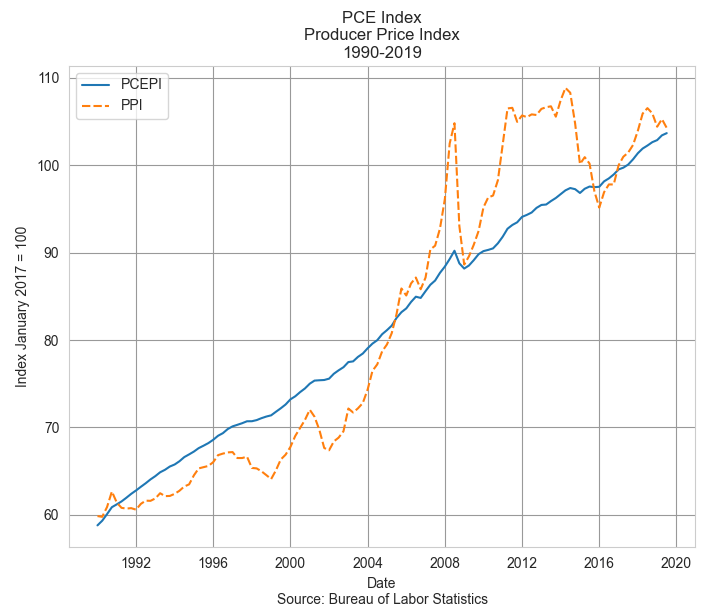
The oldest price index, first charted in 1902, is based on a measure of prices that producers and wholesalers receive at both the intermediate and final stages of production. In the final demand phase, a product is going to be sold to a consumer. In the intermediate stage a producer sells a product to another producer as a component in their product. Each month the BLS surveys thousands of companies to compile the wholesale prices on most of the goods sold in the U.S. and 70% of traded services. The agency then builds hundreds of indexes to measure the changes in those prices. The Producer Price Index, or PPI, is a headline composite of those indexes. As you can see in the graph below, the PPI is more volatile than the PCE measure of consumer price inflation. Government subsidies can increase the prices that suppliers receive with little impact on consumer prices. The PPI is more responsive to changes in transportation and distribution costs.

Despite its volatility, the PPI is regarded by the Fed, Congress and the administration as an advance indication of movements in consumer prices, according to the BLS. It indicates producers’ forecast of consumer demand and reflects economic stress and global supply pressures. However, wholesales prices may not be a reliable forecast tool of consumer inflation if the economy is weak and households cut back on their spending where they can. In the recovery years following the financial crisis in 2008, real GDP did not rise above 3% until the end of 2014. Unemployment finally dipped below 5% in the spring of 2016.

In 2021, the PPI indicated a developing surge in wholesale prices that would become apparent in consumer prices by the following year. But the economy still had not fully opened and unemployment did not fall below 5% until the fall of 2021. Would the pandemic recovery follow the sluggish trend of the recovery after the financial crisis? The Fed waited, preferring to keep interest rates low to support the labor market. In the graph below I’ve charted both the PCE and PPI over the past eight years. I’ve marked out the beginning of Biden’s term in the first quarter of 2021 and the Fed’s tightening that began in the spring of 2022.

The PPI (dotted orange line) had already reversed higher before Biden took office. As we can see in the chart above, the Fed did not enact stricter monetary policy until the PPI had peaked. In hindsight, the Fed was late to respond to surge in prices but Congress has given the Fed a dual mandate to maintain stable prices and full employment. During times of economic stress, those two objectives can indicate contradictory policies. During the initial months of the pandemic in 2020, five million people left the work force. In early 2020, the participation rate for the prime work force aged 25-54 stood at 83%. By the fourth quarter of 2021, the rate was still only 82%. 1.5 million workers had still not returned to the labor force. During a severe crisis like the pandemic, the Fed has trouble balancing those two objectives of stable prices and full employment. If they raised rates too soon, they could have damaged a recovery in the labor market.

While the general price level has come down in the past year, the inflation beast is not dead. There is still a residual inflation energy in some intermediate goods. Had the pre-pandemic price trends continued for the past four years, we might expect prices to be 8 to 10% higher than they were at the start of 2020. The prices of a number of goods have stabilized at levels far above their pre-pandemic levels. Meats are 32% higher after four years. Natural gas prices (WPU0551) have declined from the highs of last winter but are 38% higher than pre-pandemic prices. Residential electric power (WPU0541) and gasoline (WPU0571) are up 25% in four years. LPG gas is up 28% in that period. The prices of paper boxes (WPU095103) are up the same amount. Paper (WPU0913) is up 25%. The prices of bakery goods (WPU0211) are up 22% and still rising.

Despite promises made during the upcoming presidential campaign, the general price level is not going to return to its pre-pandemic level no matter who is president. The pandemic shook up the global economy, raised the general price level and there is no going back. A U.S. president may have their finger on the button of an arsenal of destruction but they have little influence on the producer prices of goods sold around the world. A hindsight analysis can identify policy winners and losers made by both the Trump and Biden administrations. The Fed and other central banks waited too long to respond to a worldwide inflation. Finally, the lessons learned from this pandemic will not all be applicable to the next global crisis.    

////////////////

Photo by Ian Taylor on Unsplash

Keywords: PCE, PPI, wholesale prices, consumer prices, inflation

Note: In April 2022 the Fed began raising its key interest rate by .25% or more each month.