Targets of Taxation

April 28, 2024

by Stephen Stofka

The subjects of this week’s letter are home prices, household income and property taxes. The policy of using property tax revenue to fund public education has provoked controversy since the 19th century. Like other social species we are watchful of threats like freeloading to our group’s cohesion, however we determine “our” group. Newcomers to an area are often regarded with suspicion as being freeloaders who get from the group before they have contributed to the common welfare. This suspicion often underlies the heated debates that erupt at local council meetings. I will begin with property valuations, the basis of property taxation.

As a young man I was taught not to buy a home that was priced more than four times my income. In 2022, families paid more than six times the median household income, as shown in the chart below. Despite the high prices, mortgage debt service is a tame 10% of the household disposable personal income. Almost 40% of homeowners have a fully paid mortgage, according to Axios. Many homeowners hold mortgages at the historically low rates of the last decade. If higher mortgage rates persist for several years, we may see greater delinquency rates as recent buyers cope with payments that stretch their budget.
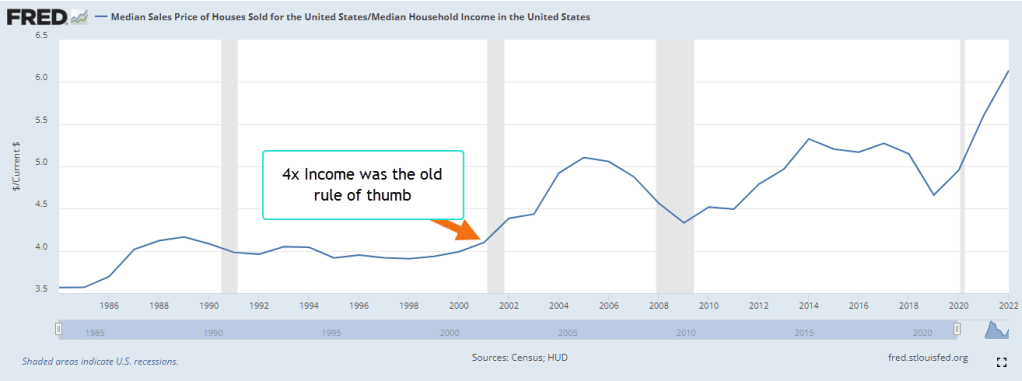
Graph shows an increasing ratio of home prices to median household income since 2000.

The Center for Microeconomic Data at the NY Federal Reserve has tracked household finances for more than twenty years. The highest percent of total household debt continues to be mortgage debt at 68% to 70%. Mortgage debt has grown at an annual rate of 3.9%, slightly more than the 3.7% annual increase in owner equivalent rent that I discussed last week. A low 3% of mortgages are more than 30 days delinquent, down from 11% to 12% during the 2008-2009 financial crisis. Only 40,000 people are in foreclosure, less than half the number in 2019. The numbers today are the lowest on record except for the pandemic years of 2020 and 2021 when many foreclosures were halted.

As I discussed last week, property prices reflect the anticipated cash flows from the house during a 30-year mortgage, a process called capitalization. The home buyer replaces the seller in the stream of cash flows from the house. Because property taxes are based on the appraisal values, the taxing authority implicitly bases property taxes on cash flows that a homeowner has not received yet. Each state sets an assessment rate that is a percent of the appraised value of the home. Each taxing authority within the state then charges a dollar amount – the mill value – per thousand of that assessed value. A home with an appraised value of $500,000 and an assessment rate of 8% would have an assessed valuation of $40,000. If the mill levy were $100 per $1000 of assessed value, then the homeowner’s property tax bill would be $4000. The effective property tax rate would be $4000 divided by $500,000, or 0.8%. Investopedia has a longer explanation for interested readers.

Each state taxes property at different rates. Colorado charges ½% of the appraised property value, one of the lowest in the nation. California averages ¾%. Texas averages a whopping 1.74% of home property values but has no income tax. Families earning the median household income and owning a house valued at the median house price in Texas and Colorado pay the same combined property and income tax of $5883 and $5669, respectively. Colorado has a cheaper tax burden despite having an income tax and far higher median house values. The same family living in California would pay $8256, largely because their property tax bill would be about the same as in Texas because the home values are more than double those in Texas. I will leave data sources in the notes.

Many districts give seniors a discount on their property taxes, effectively throwing a higher burden on working homeowners. Some argue that these exemptions should be means tested, effectively lessening or eliminating the discount for seniors with higher incomes. A wave of seniors may move to an inter-urban area that features lower home prices yet is within an hour of vital medical services like a hospital. The higher demand drives up home prices for others who have lived in the area for decades. Secondly, seniors consume more medical services and public accommodations. That requires more public spending, which is shared by the entire community and leads to resentments and contentious public meetings at the local town hall.

The majority of property taxes are used to fund public schools, and it is the largest line item on an individual homeowner’s property tax statement. This system of funding raises principled objections from childless couples and those who privately school their children, but are expected to share the burden of funding public schools. Homeowners have often resented having to fund the schooling of recently arrived immigrants. In the 19th century a wave of immigrants from Catholic Ireland, then Catholic Italy prompted many states with Protestant majorities to pass laws that excluded public funding for schools run by Catholics. Since the 16th century, the two main branches of Christianity had fought bloody civil wars in Europe and Britain. Those who colonized America brought those antagonisms with them.

During the 1970s, the number of encounters at the southern border increased almost ten times, according to the CBP. High inflation and migration of Amerians to western states caused a surge in property valuations and higher property taxes. In 1978, a taxpayer revolt in California led to the passage of Proposition 13 limiting property tax increases. In some school districts, undocumented parents had to pay a fee to enroll their children in public school.

In a 1982 case Plyler v. Doe, a slim 5-4 majority on the Supreme Court ruled that undocumented immigrant children did not have to pay a fee to go to school. The court reasoned that the equal protection clause of the 14th Amendment extended protection to “persons,” not “citizens.” Therefore, a state could not provide public benefits to one child in a school district and not another child because their parents were undocumented. The court interpreted “protection” to include public benefits, a construction that the Connecticut Constitution made explicit in 1818 with the phrase “exclusive public emoluments or privileges from the community.” The conservative majority on the Supreme Court overruled an interpretation of the due process clause in the 14th Amendment that justified the 1972 Roe v. Wade decision. This court might revisit this interpretation of the equal protection clause of the 14th Amendment as well.

Districts with lower property valuations struggle to raise adequate taxes to meet minimum educational standards. They may have to tax homeowners at a higher rate than a neighboring district, raising legal questions about uniformity and proportionality. The disparity in valuation was the subject of the 1997 Claremont decision by the New Hampshire Supreme Court. At the time, local districts provided 75% to 89% of funding for elementary and secondary education. The state’s general fund provided only 8% of school needs. The decision forced the state to distribute tax revenues among districts to meet adequate education standards for all children in the state. A 2017 analysis found that states now provide almost half of public education funding, relying on income tax revenue to smooth disparities in income among districts within each state.

People do not like paying taxes but grudgingly accept them. People elect local officials to decide on spending priorities yet some homeowners object to the way their taxes are spent. On my property tax bill are eleven items which include funding for schools, the city’s bonds, police, fire, libraries and flood control. Homeowners might prefer a questionnaire of thirty categories of spending which allowed them to allocate their tax dollars by percentage when they paid their property tax each year. In my district, a half-percent goes to affordable housing, three percent to social services. Some might prefer 5% or more. A homeowner paying online could elect to answer the questionnaire online. Would homeowners respond? Next week I will begin an exploration of various aspects of consumption, the chief component of our economy.

///////////////////////////

Photo by Museums Victoria on Unsplash

Keywords: housing, home prices, mortgage, property tax

Property taxes by zip code and state can be found at Smart Asset
Median home prices by state are at Bank Rate
Median Sales Price of Homes Sold in the U.S. is FRED Series MSPUS at https://fred.stlouisfed.org/ Median Household Income in the U.S. is series MEHOINUSA646N. The ratio of mortgage payments to disposable personal income can be found here. The home price to property tax ratio can be found here


Home Sweet Housing Service Flow

April 21, 2024

by Stephen Stofka

This week’s letter is about the cash flows we receive from a house and whether we can use those cash flows to help us determine an appropriate price range for a house. While we might not think of a house as a business, the owner is a landlord. Like any business, a house has similar metrics: an initial investment, loans, cash flows, continuing expenses and investment, “sweat equity,” capitalization and profits.

A house offers similar features to a coupon bond with one important difference – the mortgage. When we buy a coupon bond, we pay for the bond outright. The bond pays a series of payments called coupons over the life of the bond, then pays back the principal amount at the end of the bond’s term. What is the coupon we receive from a house? The housing service which is valued at what we could expect to rent the house for. Each year we discount that coupon by the opportunity cost of what that money could earn. As a benchmark rate, I will use the 40-year average rate of 5.5% that a 30-year Treasury bond (FRED Series DGS30) has paid.

As I noted last week, average owner equivalent rent has grown 3.7% each year for the past thirty years. Urban areas drive the growth of housing rents, and the highest growth occurs in the most competitive cities that offer employment and urban amenities. For several decades the city average of owner equivalent rents has been 8 – 15% higher than the median household income in the country as a whole (FRED graph). Incomes are much lower in rural areas and so are the rents and the taxes. Some rural areas offer a picturesque natural setting and recreational opportunities, but the lackluster job market does not attract young families.

Consider a house that might rent for $2000 a month, or $24000 a year. In thirty years, that annual rent will be $68,833, the result of a 3.7% increase in housing rents each year. Using the 30-year Treasury yield of 5.5%, today’s net present value of those rising cash flows from the house is $537,673. I will leave the calculation in the notes along with the address of an online calculator so you can do this yourself. These are long-term averages that can vary by decade. In 2014 the fair market rent for a 2-BR apartment in the Denver metro area rose 20%, according to HUD. Rental prices can respond quickly and dramatically to population migration and underinvestment in multi-family housing.

An investment in a house is partially funded with a mortgage whose principal and interest payments remain stable for the term of the mortgage. Although interest rates are above recent averages, they are about half of what a borrower might pay on a car loan or a margin loan from a broker. Interest on car loans can vary from 6% to 25%, according to Bankrate.com. Vanguard would charge 11% to 14% on a margin loan to buy stock. These are shorter term loans yet charge higher interest rates. Implicit guarantees of mortgages by the federal government give a homeowner the same interest rate on long-term debt as Apple, the second most valuable company in the world. In 2014, Apple paid a rate of 4.45% on its 30-year bonds. The average 30-year mortgage rate (MORTGAGE30US) at that time was 4.36%.

While government support introduces distortions to the housing market, residential investment and strong population growth do not fit a free-market model because land in a dense urban area is not a commodity like farm or ranch lands. Before the Federal Housing Administration was created in 1934, creditors often required a down payment of up to 40% even from those with good income and credit, according to a history published by the Richmond Fed. In the late 19th century, twelve percent of mortgages were underwritten by building and loan associations of the mortgage holders themselves. During stressful economic times, these associations would go bankrupt, leaving homeowners with deficient claims to their property. In all developed countries today, national government policies support home ownership.

Let us say a homeowner buys a home for almost $600,000 as in the example above. After thirty years, the owner will have received the net present value of the purchase price and will have a home that will be worth $2 million (calculation in the notes). However, this does not represent a windfall for the owner. A replacement home will also contain its cash flows for the past thirty years so that similar homes in that area will sell at a similar price. What the owner discovers is that their home’s value is priced like a share in a community resource. They can capture the capital gain in their home while they are alive by buying a home in a different community with a lower-priced resource pool, a strategy often employed by retired folks.

So, future cash flows are capitalized into the price of a house. The homeowner’s profit comes from any spread between the growth in house prices and the growth in market rentals over three decades of ownership. For some people, the true profit is the piece of mind that comes from ownership in a house that is mortgage free. Economic factors and changing tastes can slow the growth of home prices in an area. Crime may have increased; the quality of schools may have declined. Homeowners in these areas can feel trapped because they can not leverage the smaller equity in their home to buy a home in a more expensive area.

While the principal and interest on a mortgage remain stable during the term of the mortgage, taxes, repairs and insurance do not. Next week I will look at property taxes, the annual dues we pay to the county where our property is located.

////////////////////

Photo by Kara Eads on Unsplash

This online calculator allows you to specify the number of cash flows but you need to input each cash flow.

Excel requires less work so you can calculate 30 years of cash flows based on a 3.7% increase in housing rents and an opportunity cost of 5.5% each year. Microsoft has an example of using NPV. In case you do not use Excel often for this kind of work, here are some instructions. In an empty spreadsheet:
In cell A1 enter 1.037. That is the annual growth of housing rents at 3.7%.
In cell B1, enter .055, the interest rate you could earn investing the purchase price of the house in a Treasury bond.
In cell A2, enter 24000, an estimate of the current rental value of the home.
In cell A3, enter the formula “=A2*A$1” without the quotes.
With the caret, grab the right lower corner of cell A3 and drag it down to include cell A31. This will copy the formula to the cells A4:A31.
In cell C1, enter “=NPV(B1, A2:A31)” without the quotes. That is the Net present value.
You can change the starting annual rent in cell A2, vary the discount rate in cell B1, or the growth of housing costs in cell A1. You can select and copy cells A1:C31, then go to cell E31 and paste in the cells. Now you have a side-by-side comparison.

Calculation of future home price: The Case-Shiller national home price index (CSUSHPINSA) has risen an average of 4.25% for the past 35 years.

Landlord and Tenant

April 14, 2024

by Stephen Stofka

This week I will continue my look at housing, focusing on the dual role of homeowners. There are several advantages to owning a home, one of which is a type of self-imposed rent control. Our mortgage payments are fixed for the term of the mortgage, so we do not have to worry about a 10% rent increase from our landlord. We are the landlord, and we are our favorite tenant. While the mortgage payments remain stable, the maintenance costs for the home do not. The house may need a new furnace, hot water heater, updated plumbing or a new sewer line, major expenses that remind us that we are the owners of an investment property.

In this dual role, a  homeowner takes money out of her right tenant’s pocket each month and puts it in her left landlord’s pocket. As landlord, a homeowner does not report that income nor does she report the mortgage payments and expenses necessary to maintain the property. The Census Bureau estimates that homeowners with a mortgage spend $1900 a month. Those without a mortgage spend about $600.

The federal government calls the difference between this implied income and expenses a net imputed rental income and estimated (pdf link) that the tax exclusion saved homeowners $135 billion in 2023 (p. 22).

What is the average yearly tax saving for a homeowner? The Census Bureau estimated that there are 143 million households with an owner-occupancy rate of almost 65%. That results in 93 million owner-occupied homes, making the tax exclusion worth almost $1500 yearly to a homeowner that is not available to a renter. The tax exclusion is worth much more than average to those with higher incomes and more expensive homes.

When we sell the home, we hope to realize a capital gain from the home in addition to the cash flows we received while we were living in the home. After Congress changed the law in 1997, most homeowners do not have to pay tax on the capital gains from their home, an exclusion estimated at $45 billion in 2023. Real estate property is treated differently than other assets under the tax code, an implicit recognition that property ownership has a value to the community where the property is situated. A house attached to the land by a foundation is immoveable and taxed differently than a moveable asset like a car. In fact, a mobile home is taxed similarly to cars while the land the mobile home sits on is taxed like real estate (Investopedia bulletin).

Some assets provide a series of cash flows while we own them; some do not. In the case of a house, an owner’s implied cash flows start as soon as we take possession of the house. The house provides us with a housing service while we live in it. In the Consumer Price Index (CPI) published each month, the Bureau of Labor Statistics (BLS)  includes a calculation of what it calls owner equivalent rent, OER. This is an estimate of what a homeowner would rent out their home to a stranger. The estimate is based on rental prices for similar units in the area, but the calculation uses survey data that is slightly out of date. Some analysts do not think this implied income should be 25% of the CPI calculation, and the Eurozone countries do not include it in their CPI estimates. Below is a chart comparing the EU method, what is called the Harmonized CPI (FRED Series HICP), and the headline CPI (CPIAUCSL) produced by the BLS each month.

Notice the divergence between the two series starting in 2014. During the financial crisis, homebuilders started  the fewest number of multi-family units per capita in modern history. This laid the foundation for the next crisis, and the pandemic sparked a remote work trend that disrupted the customary supply and demand for housing. In the chart below I have charted the number of multifamily units per capita and highlighted the fallout from the S&L Crisis and the financial crisis.

We can see that the rent of a primary residence and the estimate of OER track each other pretty closely. In the following graph I compare the survey of actual rents to the OER estimate and index it to the beginning of 2014 to illustrate the trends more closely. In 2014, rents (redline) began to grow faster than OER, indicating the pricing power migrating to landlords several years after the financial crisis. In the decade that followed, housing costs grew 50%, an annual growth rate of 4%, higher than the 75-year average of 3.6% or the 30-year average of 3.7% (see notes). Most of the above average growth has been in the three-year recovery from the pandemic.

The cost of housing rises faster than the overall price level and faster than incomes. Homeownership limits the actual impact of rising housing costs on an owner’s budget. A homeowner plays the dual role of landlord and tenant and receives favorable tax treatment of imputed income and capital gains. Given these long-term averages, can a buyer calculate the price they would be willing to pay for a home from its future cash flows? I will look at that next week.

///////////////////

Photo by krakenimages on Unsplash

Hui Shan (2011) has written a brief history of the tax treatment of housing capital gains and measured the effect of the 1997 tax law on home sales in the Boston area.

Owner’s Equivalent Rent of primary residence in U.S. City Average is FRED Series CUSR0000SEHC01. Rent of primary residence in U.S. City Average is CUUR0000SEHA.

Annual growth rates: Average annual growth rates are calculated over a rolling 10-year period.

A Home Is a Magic Wallet

April 7, 2024

by Stephen Stofka

In this week’s letter I will explore the various roles that housing plays in our lives. Last week I showed the divergence of household formation and housing supply during the financial crisis. Home builders responded to the downturn in household formation by building fewer homes. Because the recovery after the crisis was slow, the demand for housing did not pick up until 2014. It is then that a mismatch between housing demand and supply started to appear in the national and some local home price indices. This week I will examine the demographics of homebuyers and sellers in recent history and the secret life of every homeowner as a landlord. A home is a magic wallet where money flows come and go.

Data from the National Association of Realtors (NAR) indicates that the median age of home sellers has increased from 46 to 60 since 2009. I will leave NAR data sources in the notes. In the four decades between 1981 and 2019, the median age of home buyers rose by twenty years, from 36 in 1981 to 55 in 2019. The median age of first-time buyers, however, increased by only four years, from 29 to 33. In 1981, the difference in age and accumulated wealth between first-time buyers and all buyers was only seven years. Now that difference has grown to 22 years. First-timers typically buy a home that is 80% of the median selling price of all homes.

In the past four decades, there has been a divergence in wealth between older and younger households. The real wealth of younger households has declined by a third since 1983 while households headed by someone over 65 have enjoyed a near doubling of their real wealth in thirty years. Accompanying that imbalance in growth has been a shift in capital devoted to housing.

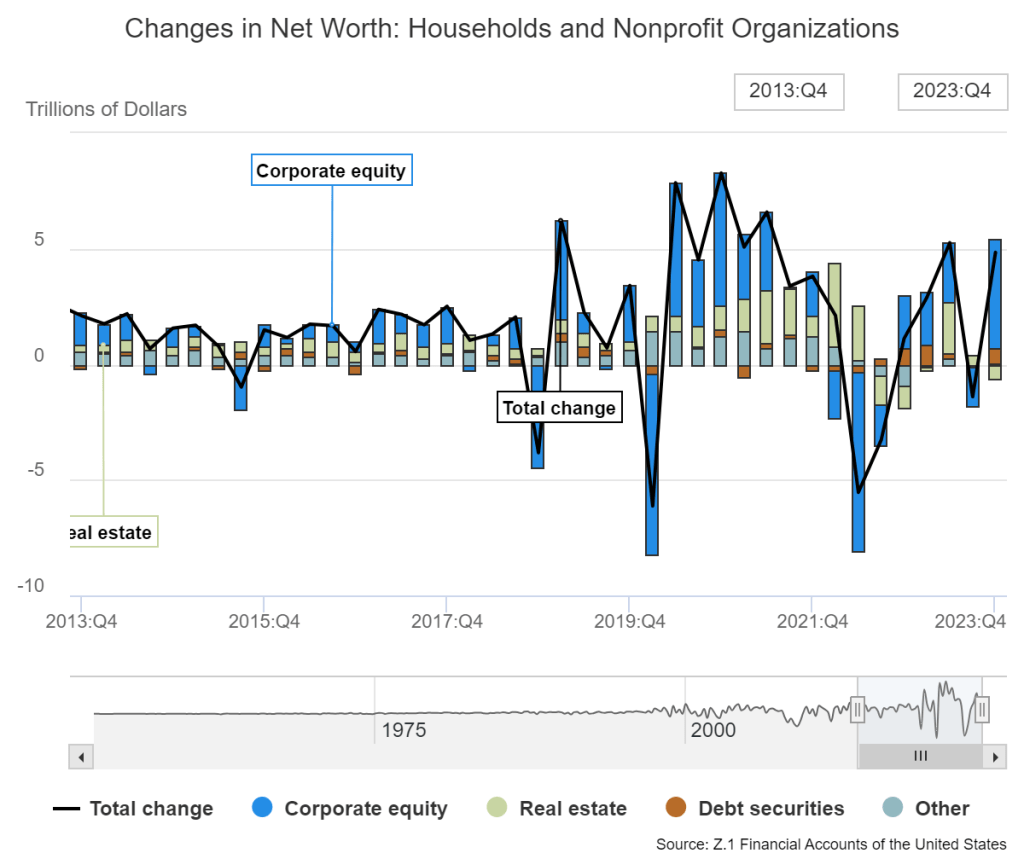
The Federal Reserve regularly updates their estimates of the changes in household net wealth. The link is an interactive tool that allows a user to modify the time period of the data portal. The chart below shows the most recent decade of changes in wealth. The lighter green bars are the changes in real estate wealth for households and non-profits and show the large gains in real estate valuations during the pandemic. The blue bars represent equity valuations and demonstrate the volatility of the stock market in response to any crisis, large or small.

The Fed’s data includes various types of debt as a percent of GDP. Twenty years ago, household mortgages were 11-12% of GDP. Today they are 19% of GDP, a huge shift in financial commitment to our homes and neighborhoods. A city average of owner equivalent rent (FRED Series CUSR0000SEHC) averaged an annual gain of 2% during Obama’s eight- year term, 2.8% during Trump’s term, and 6% during the first three years of Biden’s term. Biden has little influence on trends in housing costs, but the art of politics is to use correlation as a weapon against your opponent. People feel the change in trajectory as a burden on their households.

The Bureau of Labor Statistics calculates owner equivalent rent by treating a homeowner as both a landlord and renter. Property taxes, mortgage payments, interest, maintenance and improvements to a home are treated as investments just as though the owner were a landlord. The BLS uses housing surveys to determine the change in rental amounts for different types of units. A sample of homeowners are asked how much they would rent out their home but this guess is used only to establish a proportion of income dedicated to rent, not the actual changes in the rental amounts for that area, as the BLS explains in this FAQ sheet.

Let us suppose that a homeowner has a home that is fully paid for. If the house might rent for $2000 a month and monthly expenses are $500 a month, that would represent $1500 per month in implied net operating income for that homeowner, an annual return of $18,000. A cap rate is the amount of net operating income divided by the property’s net asset value. If similar homes are selling for $450,000 in that area, the homeowner is making 4% on their house’s asset value, slightly less than a 10-year Treasury bond (FRED Series DGS10, for example).

Long-term assets compete with each other for yield, relative to their risk. A property is a riskier investment than a Treasury bond, so investors expect to earn a higher yield from a property. Before the pandemic, 10-year bonds were yielding between 2-3%. Landlords could charge lower rents and still earn more than Treasury bonds. As yields rose for Treasury bonds, property investors must charge higher rents to earn a yield appropriate to the risk or sell the property and invest the money elsewhere.

When we own an asset that provides an income, it is as though the asset owes us. When a home declines in value, we feel a sense of loss. When the housing market turned down in 2007-2008, homeowners expected to get a similar price as the house their neighbor sold in 2006. They used that sale price to determine what their house owed them. In order to get the listing, a real estate agent would agree to list the home for that higher amount, but the property would get few offers. After a period of time, the seller would cancel the listing and wait for the “market to turn around.”

Earlier I noted the dramatic rise in mortgage debt as a percent of GDP. At one-fifth of the economy, that debt represents capital that is not being put to its most efficient use because most homeowners do not regularly evaluate the yield on their homes as professional investors. A higher percent of capital devoted to housing will help sustain higher housing costs and pressure household budgets. I worry that an inefficient use of capital will contribute to a pattern of lower economic growth in the future, stifling income growth. The combination of these two pressures will make it difficult for younger households to thrive. The generational gap will widen, adding more social and political discord to our national conversation.

/////////////////

Photo by Towfiqu barbhuiya on Unsplash

Keywords: mortgage, housing, owner equivalent rent

Notes on median age of sellers: 2009 data is from the NAR and cited in a WSJ article (paywall). Current data is from the NAR FAQs sheet. Jessica Lautz, an economist with NAR, reported the four-decade trend in home buyers. Median home prices of first-time buyers is from a 2017 analysis by the NAR. The comparison of older and younger households comes from a 2016 NAR analysis.

Notes on Federal Reserve data:  The change in mortgage debt as a percent of GDP is in the zip file component z1-nonfin-debt.xls, in the column marked “Noncorporate Mortgages; Percent of GDP.”