Cause and Effect

May 26, 2024

by Stephen Stofka

This week’s letter is about the causes of inflation. Inflation can be easily described as a mismatch between supply and demand but that is a tautology that does not explain how the mismatch occurred. For hundreds of years, scholars and academics have identified various components of inflation’s causal web but identifying a primary cause has inspired enthusiastic debate. In the past century, economists have built sophisticated mathematical models which failed to predict a subsequent episode of inflation or predicted an inflation that did not occur. Economic models predicted that large government support during the financial crisis fifteen years ago would lead to higher inflation. It did not. Some economists were surprised at the extent and strength of the inflationary surge following the pandemic. In hindsight, turning off the world’s economic supply engine for even a short time was likely to have a strong effect on prices.

In The Power of Gold, Peter Bernstein (2000) recounts the causes that sixteenth century scholars gave for the persistent inflation in Europe during the 1500s. Those factors included “the decline of agriculture, ruinous taxation, depopulation, market manipulation, high labor costs, vagrancy, luxury and the machination of businessmen” (p. 191). Five hundred years later, most factors are relevant today in an altered form. With more sophisticated analytical tools, economists have developed a better understanding of these causal influences but that understanding has not led to better inflation forecasting. These factors can be grouped into those that affect supply or demand. Missing from that list was war, a common cause of inflation that distorts both supply and demand.

Prior to the severe cooling of the Little Ice Age in the 1600s, England and northwest Europe experienced a cooler climate that affected harvests. In an economy that relied mostly on agriculture, a poor harvest, or decline in agriculture was a supply constraint that pushed up prices. The demand / supply relationship is a fraction that helps explain a change in price. A lower supply, the denominator in that fraction, equals a higher price. Repeated waves of the plague and other general pandemics led to a depopulation that reduced the work force and pushed up the subsistence wages paid to workers. Employment in the U.K. has still not recovered from pre-pandemic levels, contributing to slightly higher inflation in the U.K. compared to the U.S.

High labor costs are the essence of a cost-push theory of inflation. When there is not enough supply of labor, workers are able to command higher wages. In many businesses, labor is an employer’s highest cost. Because employers markup all production costs, that markup increases the rise in prices. If employees get an extra $1 wage and the employer marks it up 50% to cover operating expenses, required taxes, fixed investment and profit, then the price will rise $1.50. The additional wage income will increase demand, resulting in a wage-price spiral that further exacerbates inflation. Any policy that reduces the supply of labor can be included in a cost-push theory of inflation.

Vagrancy, or homelessness, was a new phenomenon in the 16th century as Europe emerged from the feudal system in which workers were bound to the properties they cultivated. Policies that tolerated idleness of any sort reduced the work force and gave workers more bargaining power. Scholars of that century would be puzzled by modern day unemployment insurance which “rewards” workers for idleness. The mathematics of probability and risk that makes any insurance program feasible was barely in its infancy. By the late 17th century, Blaise Pascal and Pierre de Fermat had developed probability analysis, giving pools of underwriters gathered in coffee houses near London’s Royal Exchange the mathematical tools to sell insurance policies on many risky events (Bernstein, 1996, 63, 90).

Ruinous taxation consisted of import taxes and the debasement of hard metal currencies by the sovereign as a substitute for taxation. Import taxes on necessary commodities increased production costs, creating a cost-push effect. To repay debts incurred during war campaigns, rulers debased the currency by mixing base metals with gold or silver. In the 4th century B.C., Dionysius of Syracuse in Sicily had all the coins in his kingdom restamped to double their value so he could pay his debts (Bernstein, 2000, 48). Monetarists claim that an excess supply of money is the root cause of inflation. The economist Milton Friedman, never one to equivocate, stated flatly that inflation was “always and everywhere a monetary phenomenon.” In the Wealth of Nations, Smith (1776; 2009) noted that gold discoveries in the Americas had driven prices higher in England. A higher supply of money of any form will increase demand so this root cause is a subset of demand-pull theories of inflation.

Popular and scholarly opinion often points an accusing finger at the business class, whose conspiratorial machinations are thought to be responsible for rising prices. Historian Barbara Tuchman (1978, 163-165) described the power that merchants had acquired as the Third Estate under feudalism in 14th century France. Because many merchants were free citizens of a town and not subject to the rule of a noble, they enjoyed wealth and privileges like that of nobles, and at the expense of the workers who regarded them with scorn and envy. In Part 1, Chapter 10 of the Wealth of Nations, Smith wrote “People of the same trade seldom meet together, even for merriment and diversion, but the conversation ends in a conspiracy against the public, or in some contrivance to raise prices.” Responding to the global inflation following the Covid-19 pandemic, some op-ed writers and Twitter threads were convinced that collusion by business interests was the primary cause of the inflation.

The reasoning and analysis by thinkers of centuries past did not include the role of expectations in fostering and feeding inflation. Expectations are a key part of some prominent models because supply and demand operate on different time scales. The companies that make up the supply chain must anticipate the level of demand for a product or service before the demand manifests. Each year, the risk of being wrong increases in an economy marked by technological change and rapidly evolving tastes. Inflationary expectations needs a bit more space and will have to wait until next week. Have a good holiday weekend!

//////////////////

Photo by Elias Kauerhof on Unsplash

Keywords: expectations, money, taxation, unemployment, supply, demand, cost-push, demand-pull

Bernstein, P. L. (1998). Against the Gods, the Remarkable Story of Risk. John Wiley & Sons.

Smith, A. (2009). Wealth of Nations. Classic House Books.

Tuchman, B. W. (1978). A Distant Mirror: The calamitous 14th Century. Alfred A. Knopf.

Price Waves

May 19, 2024

by Stephen Stofka

This week’s letter is about our perception of inflation and the uncomfortable feelings we experience at higher-than-expected changes in prices. We notice price changes relative to the goods and services we experience and purchase in our daily lives. If the water is rising under our boat, we reason that the water is rising under all boats. We may have a good understanding of local conditions but a less accurate picture of underlying trends in a national economy. Economists understand the term on a macro level, when most people experience rising prices in the bundle of goods they buy. Inflation is a rise in the average of all prices for consumer purchases and often reflects price changes throughout the supply chain. To gather this information, the Bureau of Labor Statistics and the Census Bureau interview households and businesses from around the country each month. The monthly report on inflation may confirm our intuitive sense of changing prices or it may challenge our own appraisal. With all those resources and data, why do economists argue over the causes of inflation? In either case, we experience high inflation as a loss of purchasing power, and that sense of loss is magnified by the particular attention we pay to losses.

The Federal Reserve and most central banks around the world try to keep inflation at about 2% per year. That rate is thought to compensate for measurement error and a rise in the quality of goods. Our tendency to ignore small changes is evident in other areas of our lives. The 410-mile journey west on I-70 through Kansas is almost flat, yet in that span there is gain in elevation of 3258 feet (calculations in notes). Expectations play a key role in the decisions that people and companies make. Central bankers want small changes in the average price to play a negligible role in those decisions. Claude Shannon wrote that if what happens tomorrow is what happened today, then there is no new information. Our attention is piqued by news, or new information, so that we tend to pay attention to deviations from that average. The average becomes our environment. Statisticians recapture this human tendency when they standardize or normalize an average by setting it to 0, called a z-score.

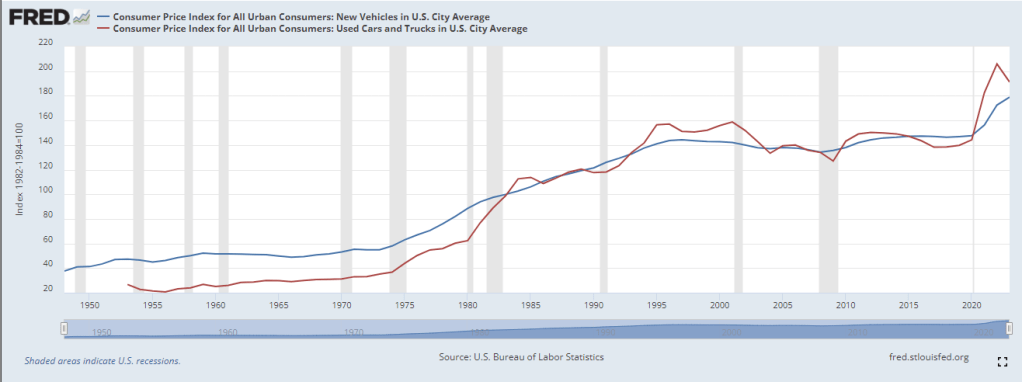
We integrate quality improvements into our expectations so that gradual improvements are little noticed. In 35 years a 2% annual improvement in the quality of a product or service will result in a doubling of its quality. The reliability, safety, efficiency and performance of cars today are vastly superior to the cars in the 1970s. In 2020, the price of a new car was about 50% higher than in 1980, an annual price increase of less than 2%. I will leave the series identifier in the notes.

The quality of cars has increased far more than the increase in price. During that time, control of many systems within a car transitioned from mechanical control to precise electronic control, improving fuel efficiency. The quality of tires improved, reducing the number of flats that forces a driver to the side of the road. Air conditioners perform better and do not need to be recharged every few years because the seals leak. In 1980, the design of a car transferred too much of the impact of a crash to the driver. Today, a car is designed to absorb and distribute those physical forces. Seat belts protect the passengers from being thrown about during an accident, while front and side airbags cushion a violent change in direction. Quality has improved by at least twice the 50% increase in price.

During the high inflation of the 1970s, the real weekly earnings of wage and salary workers (LES1252881600) fell, as shown in the chart below. The term real means inflation-adjusted. In an age when families paid their monthly bills by check or money order, rapidly increasing costs sometimes meant that there was not enough money to pay all the bills. Although the recent surge in inflation has invited comparisons with the 1970s, workers’ earnings have outpaced inflation in this past decade and shown real gains.

If wage gains are rising faster than prices, why do consumer sentiment surveys not reflect this economic reality? Economist Paul Krugman had a short and helpful op-ed on the sentiment gap in recent surveys. Consumer purchasing power has increased since the pandemic, but consumer sentiment has declined by an amount comparable to the Great Recession in 2007-2009 when purchasing power decreased. He shows evidence from other surveys that one’s political party affiliation is strongly correlated with changes in consumer sentiment. People who usually vote Republican are optimistic about the economy when a Republican is President. Democrats express positive feelings when a Democrat is in the White House.

Political alliances are easily exploited via social media, whose use has skyrocketed since the Great Recession began at the end of 2007. Negative news and negative views proliferate on social media because we have a tendency to pay more attention to bad news. In the newspaper business, the rule was “If it bleeds, it leads.” Taking advantage of this human tendency, anonymous accounts on social media post total fabrications in order to get views. Higher views earn more revenue from ad placement, turning bad news into good news for the poster. News that gives the reader a sense of uplift or empowerment can be treated as “Pollyannish.” What other factors might account for the discrepancy between sentiment and reality? One aspect might be a rising standard of living.

Just as the quality of cars has increased, so has our standard of living in general. Families today are used to a higher standard with more conveniences than was typical fifty years ago. More conveniences equals more bills. These include monthly cell phone costs, TV and cable subscriptions, and higher electrical costs to run all the new appliances, computers and entertainment devices we have today. Some homeowners may experience fees for trash pickup or parking fees that were not typical in decades past.

Higher prices feel like a loss to us, and we pay attention to losses more than we do the wage gains. Economists Daniel Kahneman and Amos Tversky (1977) invented behavioral economics when they presented compelling evidence that our decisions are not always rational, that we weigh gains and losses on different scales. This challenged the conventional view that people’s choices were fundamentally rational, that bad decisions or poor choices were due to errors in judgment or a lack of information. Kahneman and Tversky asserted that irrational decisions were systematic rather than random error. Our tendency to measure gains and losses with different yardsticks can help explain why we become accustomed to improvements in our lives so that they escape our attention. Losses challenge our survival more than wins so we give losses our greater attention.

We survive by reacting promptly to threats. Children are taught to curb this natural impulse, to use their words, not their fists when responding to the behavior of other young children. We do not hit the butcher in the grocery store because the price of a steak has gone up 20%, but we might feel a bit of anger or resentment toward some nameless cause of the higher price. Even though inflation is part of our economic environment, it is not like the weather, we reason. Human decisions cause inflation so someone is responsible. However, the cause is more likely to be a composite of human behavior, of natural biases in how we process and react to information. That would make each episode of high inflation a unique blend of circumstance and policy decisions unlikely to be repeated in the future.

Economists, ever on a quest to find the Holy Grail, to understand the underlying process of high inflation, cannot admit the singularity of each episode. Next week, I will explore some of the factors that contribute to episodes of high inflation. Until then, watch Monty Python and the Holy Grail.

//////////////

Photo by Tadeu Jnr on Unsplash

Keywords: monetary policy, Prospect Theory, inflation

Bernstein, P. L. (1998). Against the Gods. John Wiley & Sons. In Chapter 16, Bernstein explores the ideas in Prospect Theory proposed by Kahneman and Tversky.

Kahneman, D., & Tversky, A. (1977). Prospect Theory. an Analysis of Decision Making under Risk. https://doi.org/10.21236/ada045771.

The index on new car prices is https://fred.stlouisfed.org/series/CUUR0000SETA01 The series identifier for the used car price index is CUSR0000SETA02.

Journey through Kansas: Kansas City on the eastern border is 909′ in elevation. Burlington, CO, at the western border of Kansas is 4167′, a rise of 3258′, or 0.617 miles. Dividing Hays, KS on the west side of Kansas is 2018′, a rise of 1000 feet. The state is 410 miles wide so the 1000′ gain in elevation is only .05% per mile. The 3000 gain in elevation is .15% per mile, a grade that feels flat to us.

Our Perception of Risk

May 12, 2024

by Stephen Stofka

This week’s letter is about our perception of investment risk, and the subjective and objective aspects of risk evaluation. Our journey will take us several hundred years in the past and several decades into the future. The triennial survey of consumer finances indicated that less than half of people nearing retirement have $100,000 in liquid financial assets like savings accounts, stocks and bonds. Half of all working households have no savings, leaving them vulnerable to specific circumstances or a general economic shock. In our 20s, retirement looks remote with many years of work ahead of us. As we near retirement, we look in the other direction, to the past, and wish we had saved more. We confront the reality that we feel today’s needs more urgently than tomorrow’s possibilities. A $100 saving has a $100 impact on our current consumption but is only a faint light compared to the many thousands of dollars we will need in the future. We may not understand the underlying mechanism of saving.

We rely on what is visible to our senses to develop a flow of causality. We press on our car’s gas pedal and go faster, convinced that our action is adding more fuel to the engine. What the pedal controls is not fuel, but the air flow leading into the combustion chambers of the engine. The increased flow of fuel occurs in response to the change in air pressure. Prior to the 1980s cars used carburetors and mechanically employed this process called the Bernoulli principle, the idea that faster moving air induces a lower air pressure, a vacuum effect that sucks fuel toward the engine. Today’s fuel injection systems use air flow sensors that direct a computer to adjust the fuel flow. So, what does this have to do with risk?

Bernoulli’s principle is named after Daniel Bernoulli, the son of a noted Swiss mathematician and the nephew of Jacob Bernoulli, a 17th century mathematician who developed foundational concepts in probability like the Law of Large Numbers. Jacob maintained that people perceived risk in two ways. The first was an objective measure, an estimate of the probability of some event. The second was a subjective measure that depended on each person’s wealth, an inverse relationship. The first is visible, like the pressing of a gas pedal. The second is less visible, like the change in air pressure. Imagine that two people agree to flip a fair coin for a $100 bet. Person A has $1000 in her pocket; person B has $200. The loss or gain of $100 represents only 10% of A’s wealth, but 50% of B’s wealth. Even though the chance of winning or losing is the same for each person, they perceive the outcome differently. Peter Bernstein (1998) presents an engaging narrative of Jacob’s ideas in his book Against the Gods. His trilogy of books on the history of investing, risk and gold will inform and entertain interested lay readers.

Jacob may have identified one subjective element in each person’s evaluation of risk, but a person’s stock of wealth is not the only basis for a subjective estimate of risk. There are retired folks with accumulated savings of a million dollars who keep their money in savings accounts or CDs because they perceive the stock and bond markets as risky. A $10,000 loss in the stock market is only 1% of a million-dollar wealth yet some people perceive that loss in absolute dollars, magnifying the effect of a $10,000 loss. They regard the stock and bond markets as different versions of a casino. That same person might give $10,000 to a grandchild for college or to help buy a car, reasoning that there is an exchange of something that a person values for the $10,000. A person has no sense of receiving anything when their stock portfolio shows a $10,000 decrease. The stock market should have to pay an investor for using her investment, not the other way around. Such perceptions are confirmed during crises when the stock market loses 50% of its value.

Is an investment in the stock market like putting a quarter in a slot machine? Another perspective: an investor is like an investment company selling insurance to the stock market. A century of data shows that the probability of a loss in the stock market in any specific year is about 25%, according to an article in Forbes. In 70 years, the SP500 has doubled every seven years on average. An insurance company relies on Jacob Bernoulli’s Law of Large Numbers and diversification to manage risk. An investor, like any insurance company, will experience losses in some years. In last week’s letter (see note below) I wrote about surplus as a key dynamic factor in market transactions. In most years, an investor with a surplus of funds can “sell” those funds to the market and reap a gain.

Like risk, values in the stock market are based on both objective and subjective components. Sales, profits, dividends and efficiency help anchor a stock’s price movements as objective measures of value. Price responds to changes in these variables. Objective measures also include the variation in a company’s stock as a precise measure of uncertainty. There are various less precise but objective measures of economic and financial risk. Subjective measures include an investor’s need for liquidity, the ability to turn an investment into cash without impacting the price. An investor’s wealth can act as a cushion against fear of loss, a subjective measure discussed earlier.

Index funds have grown in popularity because they take advantage of Jacob Bernoulli’s Law of Large Numbers. By owning partial shares in many companies, an investor reduces the risk exposure to the variation in the fortunes of one company. The SEC might open an investigation into the ABC company, or the company loses an important overseas market, or the company reveals that the profit margins on some of its popular products are decreasing. To an index fund investor, a 10% decrease in that company’s stock price may be barely noticeable. The investor still has a risk of a change in general conditions, like a pandemic, but has dramatically reduced the risk of local conditions specific to one company.

Investors in Bitcoin do not act as an insurance fund for Bitcoin companies who mine Bitcoin. The miners have the surplus and are the sellers of Bitcoin. In the secondary market, the sellers of access to the digital currency market are the two dozen or so ETFs that allow investors to buy interest in a fund that owns bitcoin. Price movement is like a tailless kite flying in a breeze, responding mostly to price forecasts, a characteristic of some derivatives markets. The only objective measure of value and risk is the number of Bitcoin in circulation and the reward for mining new Bitcoin. Bitcoin’s price movement has a high volatility greater than 50% because there is little economic activity that anchors the variation in Bitcoin’s price. Despite the high volatility, an asset manager at an ETF fund makes the case for investing a few percent of a portfolio in a bitcoin ETF. As in our earlier example, the loss or gain depends on the current state of one’s savings.

Understanding the two aspects of risk perception, the objective and subjective, can help us manage our personal risk profile. Through research or the advice of a financial consultant we can understand the objective measures of portfolio risk but there are subjective elements unique to our personal history and disposition. The fear of having to be in a long-term care facility may influence our yearning for safety, regardless of our current health. A parent or relative may have had a similar experience and our primary concern is the protection of our portfolio value. We may feel fragile after the loss of our entire savings in a business venture. We can only become comfortable with our apprehensions by becoming familiar with them.

Next week I will look at our perceptions of other significant factors in our lives, particularly inflation.

/////////////

Photo by π“΄π“˜π“‘π“š 𝕝𝔸𝕀 on Unsplash

Keywords: stocks, bonds, risk, investment

Bernstein, P. L. (1998). Against the Gods: the Remarkable Story of Risk. John Wiley & Sons.

In last week’s letter I wrote about surplus as a key dynamic factor in market transactions. A seller of a good or service has a surplus which it values less than the buyer. However, the seller’s cost, including opportunity cost, is more than the cost to the buyer. These two ratios of benefit and cost find an equilibrium in the market that depends on the type of good or service and general conditions.

https://etfdb.com/themes/bitcoin-etfs/

https://www.vaneck.com/us/en/blogs/digital-assets/the-investment-case-for-bitcoin/

The Role of Surplus

May 5, 2024

by Stephen Stofka

This week’s letter begins a series of subjects related to income and consumption. I will start with income, how we get the money to buy the goods and services we consume. A first-year course in microeconomics conveniently and simplistically divides the world into consumers and producers. In their textbook titled Microeconomics, Krugman and Wells (2018) explore the subject of labor as a factor of production in Chapter 19 at the end of the book. Since most of us work for forty to fifty years, the subject could be introduced to students in one of the early chapters. John Maynard Keynes, schooled in neoclassical analysis as a student of Alfred Marshall, criticized this framework because it ignored many of the flows in an economy. In a modern economy, we implement our choices with an exchange of money. Where did the money come from?

An entrepreneurial attitude to work is this: we either work for money or money works for us. If we work for money, money is our boss. If money works for us, we have a responsibility to direct it and manage it well. In that framework, money is a factor of production, the capital we use to realize goals for ourselves and our family. I was first introduced to this notion of money working for me when I was a child, and my folks opened up a savings account for me. I was amazed that my birthday money did chores just like a real person and got an allowance called interest. As the money got bigger, it worked harder and got a bigger allowance. What an amazing system!

Adam Smith, the first economist, analyzed the exchange of goods and money as a system. In the Wealth of Nations, Smith (1776; 2009) emphasized that the key to a developing economy was the subdivision of tasks to become more productive. Higher productivity created a surplus of a good or service so that the producer was willing to trade with someone else who wanted that good or service. In Chapters 2, 3, and 4 of Part 1 he repeats the point that this imbalance of supply and demand provides the energy to an economic system. In an often-cited example, Smith recounted the efficient production of a pin factory where each worker is assigned just one step in the production of a pin. An economy grows as the division of labor becomes more complex.

In Part 5 of the book, Smith predicted that the increasing division of labor would lead to greater prosperity but unevenly distributed. “For one very rich man there must be at least five hundred poor,” he wrote. Such inequality could lead to violent anarchy because the “avarice and ambitions in the rich” clashed with the “hatred of labour and the love of present ease and enjoyment” by the poor. A sovereign government had a responsibility to keep order and protect people from each other. Secondly, it should provide public works and institutions that distributed the benefits of a growing economy to more people. A road or port does not provide enough benefit to any one person or group to justify its expense, but such public projects raise the productivity and standard of living for many. Smith saw this improved public welfare and private security as key features that distinguished England from less-developed economies. To Smith, government was an intermediary between parties just as money was an intermediary of exchange.

A cost-benefit analysis of an exchange of surplus reveals some interesting ratios. A seller with a surplus of a good values the benefit from the good less than the buyer does. On the other hand, the cost to the seller includes the opportunity cost of not producing something which would earn a higher price from a buyer. The commitment of capital or time to producing a good or service requires a choice between alternative uses of that capital or time (see notes for measurement of opportunity costs). Presumably, the ratio of benefits equals the ratio of costs. If not, there is less motivation for exchange between seller and buyer. A less developed economy like Brazil generates less surplus so there is less inducement to make economic trades and money circulates at less than a third of the speed that it does in the U.S. (Notes).

The concept of surplus helps us distinguish different types of exchange. When two people trade services, they trade their labor, which has no surplus as such. To barter their labor, buyer and seller must match the type of good or service to be exchanged. To each party, the benefit must equal the cost, a hindrance to exchange. In an economy promoting the production of surplus, the benefit and cost are unequal to each party, but the ratios of benefits and costs are equal. Matching is easier and there are more trades.

Can we apply this analysis to the exchange of securities? The seller of a security like Apple’s stock does not have a surplus because she produces Apple stock for sale. She is motivated to sell because she thinks it might go down in price, and the benefit she receives from the sale is greater than the cost if she held onto the stock. The buyer thinks the security might go up in price, so his benefit is also greater than the cost. The key to this transaction is the broker who produces trades for sale, the matching of security transactions. The benefits to the buyer and seller of the stock are greater than the benefit to the broker. The broker’s cost, including the opportunity cost, is greater than either the buyer or seller of the security because the broker could always make more in commission by facilitating a different type of trade.

A year ago, I spent a few months studying the dynamics of a developing country in Africa. Because there was a lack of surplus in some parts of the economy, I came to appreciate the key role that surplus plays in our lives. In the coming weeks, I will try to understand various aspects of our working lives through these ratios of seller and buyer costs and benefits and how those ratios are influenced by surplus.

///////////////////

Photo by Adam Jang on Unsplash

Keywords: securities, stock, cost, benefit

Krugman, P. R., & Wells, R. (2018). Microeconomics (Fifth). Macmillan education.

Smith, A. (2009). Wealth of Nations. Classic House Books.

Brazil Money Velocity: In the third quarter of 2023, M1 velocity for Brazil was .35, meaning that money circulates a rate that is a third of GDP output. The same velocity in the U.S. was 1.5, more than four times the rate. Brazil M1 measure is MANMM101BRM189S. Final demand, a measure similar to GDP, is  BRAPFCEQDSMEI. There was not a current measure of M2, a broader measure of money often used in the U.S. The series for M1 velocity is M1V.

Physics Imbalance: Coincidentally, an imbalance in electron fields causes atoms to bind together in an exchange of electrical charge. Khan Academy has a short explanation with graphics.

Opportunity cost: this is a fundamental concept in economics, yet economists disagree on how it should be measured. In 2012, Potter & Sanders justified four different answers economics graduate students gave to the calculation of opportunity cost found in an introductory economics textbook.

Potter, J., & Sanders, S. (2012). Do economists recognize an opportunity cost when they see one? A dismal performance or an arbitrary concept? Southern Economic Journal, 79(2), 248–256. https://doi.org/10.4284/0038-4038-2011.218