The Party Swamp

June 30, 2024

by Stephen Stofka

This week’s letter is on expectations and alliances. After separating voters into two parties, alliances within each of the parties coalesce to form intra-party squabbles. These alliances can form despite radically different approaches to managing problems: analytical and instinctual. Voting for the same candidate might be a person with an instinctive dislike of government and a business owner who estimates the impact of that candidate’s policy preferences on a company’s bottom line. These two different approaches also produce conflict.

In past weeks I have distinguished between expectations and anticipations, the first being more analytical and the second more imaginative or instinctual. The two work symbiotically in our individual lives but that symbiosis becomes outright conflict in a group. Some prefer a more analytical approach to discussing and solving problems while others rely on their gut, their moral compass. Individuals participating in that debate want to convince others to adopt their perspective and values. Perspective evolves over our adult lifetime and its purpose is to protect our values which have evolved since childhood. Attacking a person’s perspective can be perceived as an attack on their values, so we are resistant to persuasion. A variation of a 17th century quote goes, “A man convinced against his will is of the same opinion still.” The trick to persuasion is to insert your argument into another person’s perspective like a key and let them turn the key.  

In the Democrat Party, the center left contends with the radical left who weaponize shame. Advocates of DEI funding and mandates within all public institutions honestly believe that such training will moderate or eliminate racist attitudes. The majority of U.S. colleges and universities require students to take these non-credit classes to graduate. For students with a heavy academic schedule and work commitments, the burden of that mandate multiplies a student’s stress. Those within and without the academic community debate the conflict between these mandates and academic freedom.

Those favoring more spending on affordable housing disagree with voters in the party who prefer the personal space buffer that R-1 Single Family Home zoning gives residents. Proponents of free needle exchange must overcome fears that such tolerance will introduce a moral hazard that promotes more rather than less drug use. Supporters of more resources for  immigrant housing, job and medical services encounter principled opposition from those who are mindful of the resources and money that must be diverted from other programs. Should the needs of newcomers take higher priority than those of long- time residents, particularly the descendants of those African-Americans brought to this country centuries ago? Party leaders struggle to manage these ideological conflicts because these issues permeate the leadership ranks as well.

The Republican Party is more dominant in the ex-urban and rural parts of each state. Party leaders and candidates express strong support for religious faith as a cornerstone of American society. According  to Pew Research, Republicans attend church more often than Democrats or Independents but the majority of Republican voters do not attend church weekly. Like Democrats and Independents, a third of Republicans rarely step inside of a church. Those who believe that public institutions should be secular confront those who think religious principles and doctrine offer the only sound foundation to good governance. A person supporting their argument with Bible verses may truly believe that they are taking an analytical approach. In their belief framework, the Bible is history, recorded by various authors or sources but inspired by God himself. To those devotees, the Bible is fact, not an arbitrary assembling of oral traditions and myths. Two Republican voters, each with very different religious beliefs, practices and priorities still vote for the same candidates and issues. Leaders within the party must negotiate a compromise between Christian compassion and checkbook constraints.

Immigration is a key issue on ideological lines even though most immigrants initially settle down in urban areas where political sentiments skew Democratic. When the labor market is strong in the U.S. relative to other countries, that acts as a draw to legal and illegal immigration. The emphasis is on the “relative to other countries” part. A mismatch in labor market demand between the U.S. and neighboring countries is an important contributor to immigration flows. The strong economy in the late 1990s and early 2000s attracted a surge of immigrants, far more than today’s levels when adjusted for population.

 A recent analysis by the Federal Reserve estimated that restrictive immigration policies from 2017 to 2020 made it moderately more difficult for employers to fill job vacancies.  Farmers and ranchers, a strong Republican cohort, have long lobbied for changes to the H-2A “guest worker” program that would help them meet seasonal worker demand. The number of slots for foreign workers is not enough to meet demand and the application process is burdensome. Employers have similar complaints about the H-2B program for non-agricultural workers, and are heavily used by janitorial and landscaping services. Regardless of the impact of restrictive immigration policies on their businesses, owners may still vote for a candidate who promotes an immigration crackdown.

Jobs and sustainable wages are the cornerstones of family support, individual self-respect and autonomy. Those in rural areas are keenly aware that urban areas offer a more developed communications and transportation network that attracts companies, jobs and talent. For the past several decades, small to medium-sized manufacturing has migrated to foreign markets which offer lower labor costs. The influx of immigrants is yet another potential threat to community stability and resources. Long established immigrants who came to the U.S. through a legal process may not feel welcoming to those who have jumped ahead in the immigration line.   For decades, rural areas have fought to retain businesses and develop more jobs at a sustainable wage. Those who advocate more government spending on infrastructure to attract businesses clash with those having an ideological preference for laissez-faire markets.

Candidates within each party search for and exploit the shifting alliances within their party’s voters. Challenges to incumbents emerge not from the other party but from a primary election by a candidate in their own party. Primary elections attract only a small percent of party faithful whose political passion gives their small numbers a lot of leverage within the party. Fringe candidates with less funding can appeal to special interest groups to further an agenda with a dedicated party base. A candidate can appeal to a single-issue like abortion, immigration, or project a no-nonsense, get-tough persona and attack an incumbent who compromised on a piece of legislation. A Representative must learn to manage different sets of alliances: those in their district and state, and those in Washington. Next week, I will look at several Representatives and how they have navigated relationships of political power within their party.

////////////////////////////

Photo by Ryan Noeker on Unsplash

Expectations and Elections

June 23, 2024

by Stephen Stofka

This week’s letter begins a series on the shaping of Americans’ expectations by the election system. The structure of U.S. political institutions and election rules favor a two-party system that channels voter choice and identification. In this system there are unlikely alliances as voters are corralled into one of two political pens. Voters may feel like the patrons of the Olympia Restaurant, whose meal preferences were bluntly diverted by John Belushi to the only meal choice the restaurant served – cheeseburgers, chips and Pepsi (1978 SNL YouTube clip).  Despite an election cycle that is far longer than those in Parliamentary democracies, voters have less choice, and it is no surprise that average turnout in a U.S. Presidential election is only 60%. In a 2001 election in the U.K. that same percentage of turnout was a hundred year low for the Brits (Clark 2021). In America, party platforms and policy aims are as immaterial as the menu items at the Olympia Restaurant.

The U.S. was set up as a republic of thirteen colonies for their mutual benefit as stated in the Preamble to the Constitution. It is those colonies, now numbering fifty states, who elect the President through the Electoral College. The College was an arcane compromise between those who favored a popular vote and those who wanted the state legislatures to elect the President. The Federalists at the Constitutional Convention hoped that the Electoral College would act as buffer between public passion and the power of the Presidency. At the Constitutional Convention, the Antifederalists objected to the Electoral College but could not offer a more acceptable alternative (Klarman, 2016, p. 367). They argued that a majority of electors was unlikely in a nation of such diverse interests and most Presidential elections would be decided in the House, effectively sidelining the public voice. Their fears were confirmed in the 1800 and 1824 elections.

In each state, the two parties choose a slate of electors for their Presidential candidate. A vote for a candidate is a vote for that candidate’s electors, not the President. In most states, the candidate that gets the most votes in that state gets awarded all of that state’s electors, a winner-take-all system. A Presidential election is a composite of fifty elections that rewards each party for incremental gains as a path to national power. Each party tries to control a state legislature, which constructs the districts within the state and writes some election rules that exclude certain people from voting. Many voting districts are gerrymandered to ensure victory for the party who draws the electoral map (O’Neil et al., 2018, 114). The party in power partitions the voters to maintain the party’s power in the state. Thus, the two parties curb any but the most incremental changes in political power.

Control of a state legislature gives a party greater power in choosing a President. The Constitution gives each state a lot of discretion in the conduct of their elections for national office. Article 1, Section 4 states:

The Times, Places and Manner of holding Elections for Senators and Representatives, shall be prescribed in each State by the Legislature thereof; but the Congress may at any time by Law make or alter such Regulations, except as to the Places of chusing [sic] Senators.

However, the Constitution makes a special provision for a Presidential election. Article II, Section 1 states:

The Congress may determine the Time of chusing[sic] the Electors, and the Day on which they shall give their Votes; which Day shall be the same throughout the United States.

The word “may” indicates an optional power for Congress, not the specific duty conveyed by the word “shall.” May appears only 33 times in the Constitution while shall appears 192 times. This careful wording acknowledged a certain degree of state autonomy even in Presidential elections.

The contentious 2000 Presidential election first introduced the terminology red states and blue states to refer to those states which were reliably Republican or Democrat, respectively. The phrase has become so popular and often used that it seems decades if not centuries old. There are twenty reliably red states, twenty reliably blue states and ten states that lean toward one of the parties or are toss ups. The concerns, interests and perspective of a Democrat voter in a red state are effectively silenced. The same for a Republican voter in a blue state. Voters are like the crowd at a football game. They do not control each team’s strategies or the rules of the game. The framers constructed a system that separates political power and fosters incremental policymaking. There are no “Holy Mary” passes, only a grinding ground game to further the progress of one’s policy goals. Only special interest groups have the ear of the leaders on each political team and are able to achieve their objectives (O’Neil et al., 2018, 125). Marginalized by the two parties, many voters become disinterested, and the control of power becomes increasingly consolidated in a small number of political party operatives and special interests.

That undemocratic result is by design. In a long election cycle, a smaller pool of dependable voters makes the marketing of candidates and ideas less expensive. There simply is not enough money to fund many closely contested state elections so the parties try to construct voting districts that minimize those types of elections. In a two-party system that limits choice, each party appeals to alliances of socioeconomic status, alliances of regional interests, alliances by tradition and those by race, or at least a shared history of grievance. The different expectations and anticipations of the voters within those alliances can make those connections fragile. More on that next week.

///////////////////

Photo by Erik Mclean on Unsplash

Keywords: Constitution, Electoral College, election, red states, blue states

Clark, D. 2021. “Voter Turnout in the UK 1918-2019.” Statista. https://www.statista.com/statistics/1050929/voter-turnout-in-the-uk/ (July 9, 2021).

Klarman, Michael J. 2018. The Framers’ Coup: The Making of the United States Constitution. New York, NY: Oxford University Press.

O’Neil, Patrick H., Karl J. Fields, and Donald Share. 2018. Cases in Comparative Politics. 6th ed. New York: W.W. Norton & Company.

Expectations and Anticipations

June 16, 2024

This week’s letter continues my study of expectations, focusing on the political aspect. While some economists have treated expectation and anticipation as synonyms (the Stockholm school, for one), I want to distinguish between the two. Expectation is planning for or projecting into the future from an observation point in the present. Anticipation is visionary, an imaginative leap into the future in which some event or state has already happened. Anticipation is intuitive; expectation is calculating.

Anticipation invokes our identity and biases as well as our imagination. Political campaigns often target our sense of anticipation with negative advertising that impugns the candidate, then implies that a vote for such a character is an association with that candidate. Imagine how bad things would be if such a person were elected. Do we really want to be associated with someone like that? At a 2008 Presidential debate between Republican candidate John McCain and Democratic candidate Barack Obama, McCain defended Obama’s character against the innuendo spread by right wing TV and talk radio personalities. Much as we deplore negative political advertising, it is effective.

In the game of chess, each player strategizes to take the other’s king. Getting to the other side of the board first does not win the game. One achieves victory by the opponent’s loss. Elections like those in the U.S. are similar to baseball or football. Preventing the opposing team from scoring will not win the game. The victorious team must also make a score. The winner must get more points than the loser, a typical characteristic of a race, which is why our type of elections are called first past the post voting. What makes an election different than a 100-yard dash are the battle tactics employed to weaken an opponent’s efforts to score votes. Successful campaigns strive to get there first while persuading voters to vote NO on their opponent. Campaigns target two separate processes we use to make choices.

One axiom of rational choice theory in economics is a completeness of preferences – that people are able to weigh the costs and benefits of two options and choose the option that maximizes their self interest. We choose an option that provides what we think will give us the most utility. Yes, we make mistakes, but the errors are random. Behavioral economists have challenged the assumption that our choices are rational, pointing out biases that introduce systemic, not random, error in our choices. Losses have a greater impact on our senses than equal gains. Options may be too complex to evaluate fully before making a choice, so we rely on instinct.

 In Chapter 8 of his book, Optimally Irrational, Lionel Page (2023) discusses the debate and presents several examples that test the axiom. Given two grocery lists, could you pick the best option? Consider there might be twenty or more items on the list and a grocery store carries thousands of items. How could any person decide the best option? This past week, after checking out my groceries, I picked up what I thought was the receipt that had fallen out of my pocket. With a glance, I knew it was not mine because there were a few items on the list that I would never buy. I realized then that I could choose between two random grocery lists in less than a minute. I would scan the list for things that I definitely did not like or want. The list that had the fewest of those would be my choice.

When we do have difficulty making choices, it is because we are trying to choose the best, not the worst, option. Page cited (p. 101) an episode of the Big Bang Theory where Sheldon had difficulty choosing between two computer game consoles. He had approached the problem in a very analytical manner typical of Sheldon and was unable to choose. The shortcut, or heuristic, of decision-making that we use in our daily lives is not finding the best, but establishing the worst of two options. We know our dislikes more than our likes because our dislikes amplify the cost of our decisions, helping us choose the cheaper option with less deliberation. Secondly, identifying the worst alternative makes it more probable that we can live with our decision.

A successful political campaign structures its rhetoric to take advantage of this shortcut in decision making. Just before the 1980 election, candidate Ronald Reagan posed a question to President Carter at an October debate: Are you better off than you were four years ago? Despite the word “better” in the question, this was an “identify and reject the worst” choice using both rational expectations and more imaginative anticipations. On the one hand were the empirical realities of high inflation and unemployment, and the energy shortages that voters had experienced during Carter’s term. Voters could form expectations based on that data. Reagan’s term as Governor of California during the 1960s gave voters some basis to form a rational expectation of a Reagan term. However, much was left to voters’ imaginations to construct a post-hoc, or after the fact vision of a Reagan term. This was the anticipation instinct at work. The question helped turn a  close race into a landslide victory for Reagan.

Some voters may not have a clearly defined worst or judge two candidates to be equally worse. Each may have one or two repulsive personal characteristics, political alliances or policy stances. To appeal to those voters, a political campaign offers hope that their candidate will maximize a voter’s income, personal freedom, autonomy or other circumstance like the health of the community a voter lives in. The negative approach targets the cost calculation that voters make. The positive approach appeals to the benefit calculation, but the negative approach is the more powerful. The disadvantage of the negative approach is that it can persuade voters to abstain from voting. In a national campaign for President, a voter’s abstention is neutral, but a lack of turnout can be a decisive factor in local races where a small number of voters can be the tipping point of a political victory.

I hope I have made a clear distinction between expectations and anticipations. When a person stands in the present and plans ahead for some state or event, she is expecting. When a person stands in an imagined future and looks back at an event, she is anticipating. I will take a closer look at the unintentional political alliances between voters as a result of the symbiosis between expectations and anticipations.

/////////////////////

Photo by Ahmed Almakhzanji on Unsplash

Keywords: campaign, election, choice, anticipation, expectation

Page, L. (2023). Optimally irrational: The good reasons we behave the way we do. Cambridge University Press.

Key Expectations

June 9, 2024

by Stephen Stofka

This week’s letter continues my exploration of the role of expectations. They coordinate the supply, demand and price relationships that form the web of our economic and financial lives. They shape our voting patterns, and alter our behavior in interactions with others. If we expect a police officer to be hostile, we are defensive. That reaction will affect the behavior of the officer, increasing the chance that the encounter will be hostile. Expectations cause us to behave in ways that confirm and amplify our expectations, aggravating undesirable circumstances.

Expectations and yearnings act symbiotically within us but there is a distinction between the two. Expectations are a calculation; yearnings are a desire. “I think that” is an expectation. “I hope that” is a yearning. A woman may yearn to have a child, but she expects to have a child within a period of time. A yearning knows no time or logic. We expect a certain range of compensation for the type of work we do, our skill level and experience. Business coaches encourage people to visualize and enhance their good attributes to raise those expectations. Business owners expect their capital to earn a certain percentage of profit as compensation for the risk, planning and skill that a successful business requires.

Consumers expect a certain range of prices for many frequently bought goods and services. The price of meat may be more or less than average in a week, but the price will not be $100 a pound for ground beef. We may have no price anchor for infrequent purchases like replacing a hot water heater. A few hundred dollars or a few thousand? A search in a browser can help with an average price of approximately $2100 to help a homeowner evaluate quotes from a plumbing contractor.

In the U.S., the pricing of medical care is treated as a catastrophic event like a house fire. The connection between price and medical care has been cut so that patients may not know beforehand the price of a procedure. A browser search for the cost of a colonoscopy indicates an average cost of $2200, close to that of a hot water heater, coincidentally, but medical providers do not quote a price. Prices are negotiated between health insurance companies and a network of medical providers. The negotiated price may be a fifth of the stated list price. If patients have health insurance, the only price visible to them is a co-pay. The prospect of higher medical costs next year does not incentivize us to seek care now at a lower price. Colonoscopy prices going up soon? Let me book one now! However, as costs increase, workers negotiate for better benefit packages that cover the anticipated higher costs.

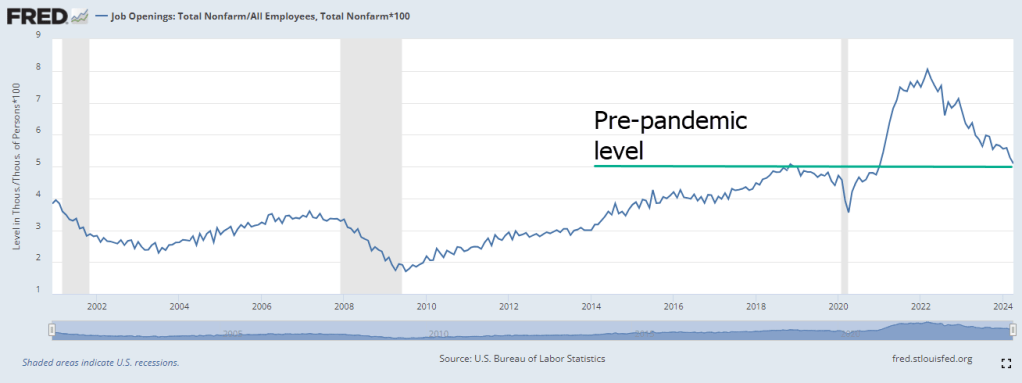
In our economy, workers play a dual role of producer and consumer. The monthly labor report and retail sales report captures the importance of these roles, and the release of these reports move markets. In the core labor force age range of 25 to 54, four out of five people are working or looking for work, according to the latest labor report. The largest generation in this demographic are the Millennials, born between 1981 and 1996. They produce the most and buy the most so their expectations steer the economy. Job openings as a percent of total employment indicate a historically robust labor market. Recent reports indicate that openings are returning to pre-pandemic levels.

Job openings as a percent of total non-farm employment

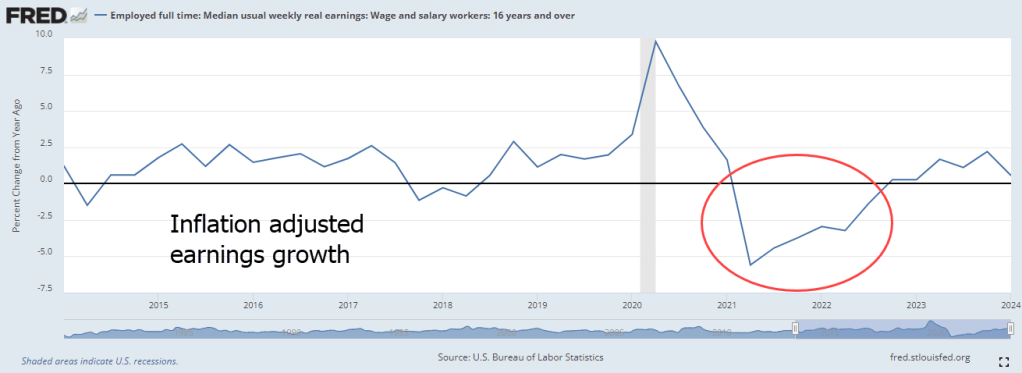
Despite the strong demand for labor, post-pandemic inflation has taken a bite out of gains in median earnings. Biden assumed office as earnings gains turned negative. Despite legislation meant to promote investment and support the labor market – the Inflation Reduction Act – the decline in real earnings did not turn positive until 2023.

Real earnings equals real purchasing power. Late Millennials reaching their early thirties expected to be able to settle down and buy a house. Older Millennials in their forties who expected to trade up to a different home are frustrated by high home prices and interest rates. Political power in our system is captured by the interests of older voters, particularly the Boomers. Less than one out of four in this generation is working (FRED series here). They want to reduce their tax costs, and preserve or enhance the government benefits they feel they have earned after a lifetime of working.

This week, David Leonhardt, editor of the N.Y. Times Morning Newsletter, pointed out a poll indicating strong support for many policies initiated by the Biden administration. Most of the public’s attention is directed to controversial issues like immigration, the war in Gaza and American support for Ukraine in their continuing war against Russia’s invasion. The pandemic focused the public’s attention on Trump’s chaotic governing style. His behavior defied expectations and his supporters became accustomed to excusing or rationalizing his actions. A majority voted for Biden as a return to normalcy in the recovery from the pandemic.

People vote their expectations, and those expectations strongly influence voters’ assessments of the economy even before a candidate has taken office. A candidate needs to offer a clear set of new expectations that manifest the yearnings of a majority of voters. Has either candidate made the connection between voter expectations and yearnings? Next week I will look more closely at the political aspect of expectations.

////////////////

Photo by Jan Tinneberg on Unsplash

Keywords: prices, growth, earnings, inflation

Invisible Expectations

June 2, 2024

by Stephen Stofka

This week’s letter continues a topic from last week, our expectations of inflation. The high inflation of the 1970s prompted a lot of debate on this topic, and I will try to cover a portion of those ideas. Hypotheses regarding the formation of expectations influence monetary policy and the manner in which the Fed raises interest rates. Different policy approaches reach across the country into the pocketbooks of many Americans. They can mean the loss of many jobs or few jobs, or the viability of buying a home.

The University of Michigan conducts a monthly survey of consumer sentiment in a rotating sample among 500 participants. Respondents are asked to estimate the rate of inflation for the next twelve months (see here, p. 5). Inflation is a rise in the average price of all goods but in casual conversation, we often use the term loosely to refer to a rise in prices of the goods and services that have the most impact on our lives. Each of our estimates are biased but an average of many estimates should approximate a comprehensive survey of the prices of many goods. This BBC five-minute video explains this phenomenon known as The Wisdom of the Crowd when many people try to estimate the number of jelly beans in a mason jar.

The blue line in the graph below is the headline CPI that tracks a basket of goods and excludes expenses like the employer portion of health care insurance. The Fed pays more attention to the PCEPI, the green line in the graph below. That methodology is based on actual expenditures in various sectors of the economy, including employer paid health insurance. Notice how closely the average estimates of inflation approximate this broad measure of price movement. In the April 2024 survey, expectations averaged 3.2%, a big decrease from over 5% in 2022 but a slight rise from 2.9% in March.

How do we form inflation expectations? There are two hypotheses, and they are distinguished by how errors occur in our expectations. Adaptive expectations was a predominant hypothesis until the 1970s. It holds that we revise our forecasts up when actual inflation is higher than we expected, and down when inflation data indicates that our forecast was too high (Blanchard, 2017). Imagine that we are offered a discount at the doctor’s office if we guess our weight within three pounds. We base our guess on a previous weight reading. If it is too low, we lose our discount so the next time we revise our guess higher. Under this hypothesis, our expectations are very much guided by past experience and our forecast errors are systemic. To tame high inflation, monetary policy must act like a shock that induces a recession and alters the expectations of investors and consumers.

In August 1979, during the Carter administration, Paul Volker assumed the position of Fed chair. In October, the Fed raised interest rates 1.5%, then lowered by a half-percent in November, then raised them again by a half-percent in December. In those three months, sales of new one-family homes (HSN1F) dropped 25%. A few months later, in the spring of 1980, came another interest rate shock of a 3.5% increase over two months and new one-family homes sank by 38%. They did not begin to recover until the spring of 1982. This cattle prod approach to taming expectations was influenced by the adaptive expectations hypothesis.

Statistical tests done in the early to mid-1970s showed that we paid much more attention to ongoing conditions than previously thought. This contradicted the notion that our expectations relied mostly on past experience. Two economists, Robert Lucas and Thomas Sargent presented a rational expectations hypothesis claiming that we form the best inflation forecast we can with the information available to us. Rational does not mean perfect. Errors in our forecasts are random and arise from unseen shocks (Humphrey, 1985). The critique against this hypothesis was that people were too naïve or uninformed to form rational expectations. Information frictions blurred the distinction between rational and non-rational (Angeletos et al, 2021).

 Over the past several decades, the rational expectations hypothesis has guided policymaking at the Fed. If the Fed presents a convincing policy commitment to steer inflation toward a particular target, investors will change their behavior in accordance with their belief in the Fed’s commitment. Economist Roger Farmer (2010) has called them self-fulfilling beliefs and devotes a section of his book to rational expectations. Under this regime, the Fed uses steady, incremental rate increases and consistent policy statements to “corral” expectations like a trained sheepdog persistently badgering a flock of sheep to guide them into a holding area. By guiding expectations, monetary policy can tame high inflation without necessarily producing a recession. This has been dubbed a soft landing.

In the spring of 2022, the Fed under Chairman Jerome Powell raised rates a half percent a month, a steady rate to let everyone know that the Fed was serious. From the spring of 2022, the number of new one-family homes did not fall. That was the rational expectations hypothesis at work. The Federal Reserve as sheepdog. As with any comparison, there are a number of other factors. My point here is that ideas about people’s motivations and behavior make a concrete difference in the lives of ordinary people.

We respond to high inflation with behavior that can exacerbate inflation. Next week I will look at several scenarios that illustrate why the Fed is concerned about managing consumer and investor expectations.

///////////////////

Photo by Hassaan Here on Unsplash

Keywords: housing, interest rates, monetary policy, adaptive expectations, rational expectations, inflation

Angeletos, G.-M., Huo, Z., & Sastry, K. A. (2021). Imperfect macroeconomic expectations: Evidence and theory. NBER Macroeconomics Annual, 35, 1–86. https://doi.org/10.1086/712313

Blanchard, O. (2017). Macroeconomics (Seventh ed.). Boston, MA: Pearson Education. p. 337. This is an intermediate economics textbook.

Farmer, R. E. A. (2010). How the economy works: Confidence, crashes and self-fulfilling prophecies. Oxford University Press. This book contains succinct descriptions of various economic theories that have influenced policy and is aimed toward the general reader.

Humphrey, Thomas M., The Early History of the Phillips Curve (1985). Economic Review, vol. 71, no. 5, September/October 1985, pp. 17-24, Available at SSRN: https://ssrn.com/abstract=2118883