
February 16, 2025
by Stephen Stofka
This is part of a series on centralized power. This week’s debate is about the power of the President relative to the other branches of the federal government. The debates are voiced by Abel, a Wilsonian with a faith that government can ameliorate social and economic injustices to improve society’s welfare, and Cain, who believes that individual autonomy, the free market and the price system promote the greatest good.
Abel began the conversation. “Our country is founded on the principle of federalism, a sharing of power between the states and a centralized government in Washington. In that central authority are three branches that balance and check each other’s ambitions for power. It looks like Trump is challenging those restraints.”
Cain shrugged. “The Speaker of the House doesn’t seem worried. The Congress hasn’t been able to get anything done. It’s been almost thirty years since Congress completed a full budget (Source – pdf). The executive branch is stuck with the burden of implementing years of legislative compromises. It is entirely appropriate that the President clean up the mess.”
Abel shook his head in disbelief. “Trump is taking control of the purse, a power given to Congress by the Constitution. Doesn’t it worry you that a Democratic president could simply undo any laws passed by a Republican legislature?”
Cain looked puzzled. “If the President gets out of line, the Constitution gives Congress the power to impeach the President.”
Abel laughed. “Trump has already been impeached twice. Never in the history of this country has the Senate convicted a President. Impeachment is an empty threat. After the Supreme Court’s decision to grant the President immunity from criminal prosecution, the President can act like a king.”
Cain frowned. “FDR expanded the scope of the executive when he took office in 1933. Did your group sound the alarm then? Did you cry ‘Constitutional crisis’ when Roosevelt threatened to pack the Supreme Court to get his way? No, your group stood by silently as Roosevelt upended 150 years of tradition. This President is trying to undo that shameful legacy, to return this country to its founding roots.”
Abel showed his disdain. “He is undoing a century of building government institutions that help people, that protect people from the power of large corporations. This is not the America of the 18th century.”
Cain argued, “They are inefficient government institutions that swear allegiance not to the people they serve but Washington lobbyists and their own internal processes. We have a spending crisis. The Constitution gives the President the executive power. Alexander Hamilton argued for a strong executive and President Trump embodies Hamilton’s vision.”
Abel sighed. “You’re talking about the unitary executive theory. Advocates for that theory take Hamilton out of context. He wanted to convince those in the state legislatures that the strong executive in the proposed Constitution was preferred to the weak plural executive that had been defined in the Articles of Confederation. Hamilton was not advocating for a President with all the powers of a king. The country had fought seven bloody years to rid themselves of a king.”
Cain shook his head. “Look, Washington and Jefferson set the example. They were strong Presidents who sat at the top of the executive hierarchy. They didn’t ask Congress for permission. They defined their role as the chief executive of the laws.”
Abel interrupted. “Ok, but the executive branch was small in the early 19th century. Employees worked at the whim of the President. As the country grew, there needed to be more stability in the executive work force. Congress wanted more control or supervision of the various departments. After all, it is Congress who writes the laws. Congress represents the people. The President is the people’s agent, executing the laws that the representatives of the people have passed.”
Cain held up his hand. “Look, you’re describing a clerk, not the leader of a country. Hamilton was arguing for a leader with enough power to meet threats from other countries led by monarchs with absolute power.”
Abel argued, “That was another century when even the mightiest rulers had relatively little firepower at their command. We have invented weapons that are too destructive to put at any person’s command. There have to be checks and balances within the executive just as there are within the legislative and judicial branches.”
Cain shook his head. “The more destructive the weapons, the more we need a strong leader with the authority and power to act decisively to answer any threats from other countries.”
Abel frowned. “There has to be checks and balances within each branch. That’s especially true for the executive. All previous empires have fallen because one person gained too much power. Rome, Persia, Egypt, and Byzantium come to mind. There are too many temptations. A President with control of the Bureau of Labor Statistics would be able to adjust the monthly unemployment numbers or inflation report to make his administration look good. Argentina did this for seven years (Source). China, Venezuela and Hungary do it. He could disallow the counting of some of the population by the Census Bureau to reduce some grant funding for states who did not vote for him.
Cain scoffed. “There are checks and balances between Congress and the Executive. If a President were to ‘cook the books,’ that information would be leaked. The Congress could impeach the President.”
Abel’s expression was stern. “When the founders wrote the impeachment rules, they envisioned a system without political parties. In a party system, the President is the leader of the party. Impeachment is not a check. If the House is the same party as the President, they dare not bring their leader up on impeachment charges. A Democratic-led House would not impeach Andrew Jackson in 1833. All the anti-Jacksonian majority in the Senate could do was censure Jackson.”
Cain argued, “In 1868, the Republican-led House impeached Andrew Johnson.”
Abel shook his head. “Johnson was a Democrat who ran with Lincoln on a third-party ticket called the Union Party (Source).”
Cain’s tone of voice was conceding. “Ok, maybe impeachment is not the ideal check on a President. But they pay attention to popular opinion. If the public is outraged, they will complain to their representatives. Presidents care about public opinion.”
Abel showed a wry smile. “George Bush’s poll numbers fell as low as 25% (Source). What did that accomplish? There is an entire phalanx of advisors who shield the President from disheartening news. A President lives in an information bubble designed to protect his self-confidence.”
Cain argued, “Well, there are no checks on the Supreme Court. They have lifetime tenure and the last one to be impeached was in 1805 (Source). They control their own agenda. The House and Senate make up their own rules (Source) and have no internal Constitutional checks. In the Senate, the Majority Leader controls all the floor time. If he doesn’t want some legislation brought to the floor, it isn’t considered. The President should have the same authority over officials in the executive branch. He should be able to direct them on how he wants the law executed. His decisions should not be subject to review by a court.”
Abel frowned. “You’re describing the unitary executive theory again. It grants the President most of the powers of a king. We know that Hamilton, Jefferson, Madison and the other founders did not want a king. This country rejected rule by the whim of one person, the king. We are a nation of laws, not whims. Trump and Musk are two rich crackpots who dance to the music of their own whims. The wolves in Russia and China are licking their chops. By the time Trump is done, this country will be weaker.”
Cain scoffed. “This country was already weak. That’s what the President is trying to fix. The country has $36 trillion dollars in debt. We’re spending more on interest than we do on defense. We play mister nice guy, letting other countries take advantage of our charity, then vote against our interests in the U.N. DOGE is going to trim the discretionary items in the budget then look to implement fraud controls in mandatory spending programs like Medicare and Medicaid. Trump has shown he’s a tough negotiator.”
Abel laughed. “Trump changes his mind from day to day, from week to week. It’s a sign of weakness that Putin and Xi will take advantage of.”
Cain shook his head. “The President dances like Muhammed Ali in the ring. That’s what we need. A fighter who keeps other countries hesitant to make any aggressive moves. That’s the road to a cautious peace.”
Abel sighed. “It’s only a few weeks since Trump took office. He will leave a trail of chaos and carnage and half of the people in this country won’t hold him responsible.”
Cain laughed. “And the other half of the country thinks he’s the devil. That says more about all of us than it does President Trump. We’ll talk next week.”
//////////////////
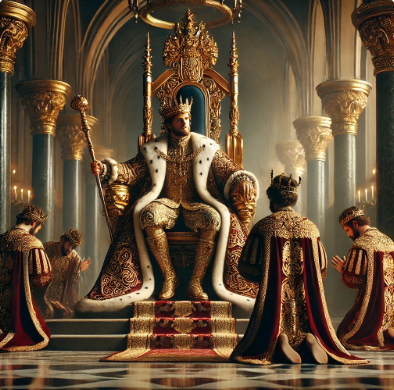
Image by ChatGPT
 Innocent Investor