March 2, 2025
by Stephen Stofka
In this week’s conversation Abel and Cain discuss current events and two theories of international relations – realism and liberalism.
Abel looked out the window of the restaurant onto the busy street. He fidgeted on the bench seat in the booth opposite Cain.
Cain sensed his discomfort. “Is it too bright for you?”
Abel shook his head and shifted closer to the window. “No, there’s a bit of a lump in the bench seat cushion.” He gave a quick laugh. “A Trump lump. Trump’s transactional style is forcing European countries to shift their diplomatic positions.”
Cain took a sip from his coffee cup. “It’s about time that they shouldered some of the burden for their own defense. After World War II, America wanted a larger security role to avoid a large-scale military build up that led to the first two world wars. But that was 75 to 80 years ago. Trump is renegotiating those post-war agreements.”
Abel slipped a cube of ice into his coffee. “I never thought I would see the day when the US voted with Russia and North Korea and against most other countries in the U.N. Trump is building an autocracy the same way that Putin did in the early years of his reign.”
Cain shrugged. “The U.S. often stands alone in support of Israel in the U.N. This vote is not a slippery slope to autocracy. It’s a pragmatic vote. Trump does not want to aggravate Russia ahead of negotiations over a peace in Ukraine.”
Abel said. “There are too many principles being sacrificed to pragmatism if you ask me. The U.S. stands with Israel to recognize its democracy, its sovereignty and its right to exist. Russia and North Korea represent what George Bush once called an “axis of evil.” You say that Trump is placating the devil to better his bargaining position.”
Cain motioned for more coffee. “International relations is a system built on anarchy. Each country claims to be the final authority. It’s a high stakes poker game and sometimes countries have to bargain with their enemies.”
Abel thought for a moment. “It’s a dog-eat-dog world, you’re saying. That’s the realist approach to international relations. That analysis sees national states as big robots on the world stage. They are the primary actors, motivated by concerns about their own security, sovereignty, and interests. John Mearsheimer is the most widely read proponent of that type of analysis.”
Cain interrupted, “Yeah, that’s his name. In the early 1990s after the collapse of the Soviet Union, there were worries that terrorist groups might get a hold of Ukraine’s nuclear weapons. Ukraine transferred more than 2000 nuclear weapons to Russia and the U.S. helped dismantle Ukraine’s nuclear facilities (Source). It was Mearsheimer who said that Ukraine, being next door to Russia, should not give up its nuclear weapons. He got a lot of guff for that. Ukraine would be in a more advantageous bargaining position if they had kept their nuclear weapons.”
Abel nodded. “Maybe Mearsheimer’s perspective is the better analysis, but that perspective assumes that we are little more than lions and hyenas fighting over a kill on the African plains. Two world wars and a 45-year cold war have taught us that our ability to fight has become too destructive. We won’t survive as a species unless we cooperate. The nations of the world must build common ground based on social relationships, shared values and democratic institutions. Trump is upending that entire project.”
Cain shook his head. “You’re talking about liberalism, the theory that states are defined by geographical borders but operate within the constraints of their civilian institutions, you know, like shared norms, the right of the people to choose their own government.”
Abel nodded. “Yeah, and human rights. The importance of NGOs, non-governmental organizations like CARE, Feed the Children and Doctors Without Borders (Source).”
Cain interrupted, “It’s an aspirational theory but we are left with ugly truths about human nature, state actors and power. As Russia and China have gained in economic and political strength, they have reasserted their desire to increase their sphere of influence. Putin wants to rebuild the former Soviet Union. China wants control of Taiwan. They are building bases in the South China sea, creating conflict with the Philippines and Vietnam.”
Abel smiled. “So, this lump in my seat cushion is not Trump, it’s a cancer of the human spirit, huh? Geez, I hope we’re better than that or we’re doomed. Should we not try to build a world based on cooperation and compassion?”
Cain shrugged as he took a sip of coffee. “We can try but the ugly reality is that resources are not distributed evenly around the world. Russia has little access to open water during the winter. To Putin, the Crimea Peninsula in the Black Sea is vital to Russia’s security (Source). Russia, China, and Iran have deep memories of European aggression. The western powers can’t just say “oh, we’re going to be good now” and expect other countries to trust that rhetoric.”
Abel asked, “You’re saying that we can’t overcome the national memories of past conflicts? That we’re doomed to endless feuding like the Hatfields and McCoys? There is an underlying cynicism in that analysis that is just too pessimistic for me. Besides, consensus is so much more efficient than conflict.”
Cain frowned. “Talk about consensus. At the Munich Security Conference this month, J. D. Vance scolded those European nations that have been willing to sacrifice individual freedom for the sake of consensus (Source – video). A forced consensus is more of a characteristic of totalitarian governments.”
Abel shook his head in disgust. “Imagine if Macron or some other European leader came over here and started lecturing Americans on their policies regarding freedom of speech. J. D. Vance is the personification of American hubris. A pompous preacher. The satirist Stephen Fry remarked that freedom of speech is a step to justice and fairness, not an end in itself (Source, 2:40). Unlike Americans, the European protection of speech emphasizes freedom and responsibility (Source). Individuals have a responsibility to the group. It’s not a one-way street. But don’t look for the word ‘responsibility’ in the American Constitution. It’s not there (Source). Maybe Americans could learn something about responsibility from Europeans on this topic.”
Cain scoffed. “Yeah, right, responsibility. How about Europeans being responsible for their own defense? Vance reminded them of that responsibility. The U.S. is $36 trillion in debt. American taxpayers can’t keep footing the bill for Europe’s defense so they can give European citizens generous social service programs. The French retire at 62! When the EU was forming thirty years ago, the defense target was 3% of each country’s GDP. Many of them haven’t even been spending 2% of GDP. The U.S. is spending almost 4% of GDP on defense. The European nations have not been doing their part. Free riders. They needed a good old swift kick in the can.”
Abel asked, “Do you think Trump wants to end NATO?”
Cain shrugged. “Who knows. He’s not in love with the organization. That’s for sure. The U.S. has other concerns, particularly in Asia. Ukraine was never in America’s security interest. Mearsheimer made that point after Russia took Crimea in 2014 (Source). Expanding NATO to include countries like Ukraine and Georgia just make Russia uncomfortable. The old saying is ‘don’t poke the bear.’”
Abel shook his head. “So, you agree with Trump that Ukraine started the war?”
Cain replied, “No, Trump’s brain is jumbled up with the last thing he heard on TV. But Ukraine could have stayed neutral instead of seeking a security alliance with NATO. Wake up, Ukraine! You’re next door to Russia and you have no nuclear weapons anymore. Stay neutral. Like I said, ‘don’t poke the bear.’”
Abel signaled for the check. “You’re depressing me.”
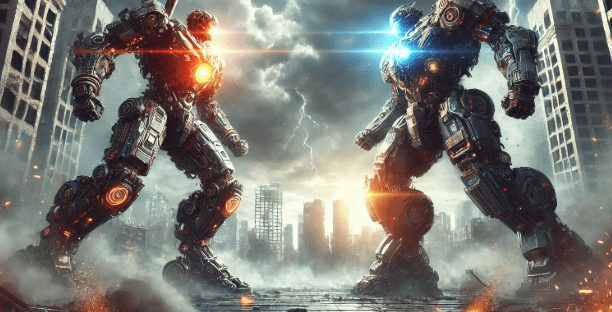
Cain laughed. “Hey, it’s not me. International relations is a study in power. Nation states are like big robots with national leaders pulling switches and levers inside the big machines.”
Abel smiled. “Reminds me of The Big O animation series (Source). Grim.”
Cain stood up. “I’ll catch the check and see you next week.”
Abel scootched to the outside of his seat. “Another eventful week, I’m sure. See you next week.”
////////////
Image by ChatGPT in response to the prompt “draw an image of two big robots facing off against each other.”
 Innocent Investor