The Haves and Have-Nots

June 29, 2025

By Stephen Stofka

Sunday morning and another breakfast with the boys as they discuss world events and persistent problems. The conversations are voiced by Abel, a Wilsonian with a faith that government can ameliorate social and economic injustices to improve society’s welfare, and Cain, who believes that individual autonomy, the free market and the price system promote the greatest good.

Cain smiled as he asked Abel, “You used to live in New York. So, are they getting ready to elect their first socialist mayor?”

Abel chuckled as he spread the linen napkin across his lap. “Mamdani is the Trump of the left. Knows how to work social media and promises he’ll make food and housing affordable again. Just like Trump. Neither one of them has a workable plan. Maybe that’s the age we live in. The age of blowhards on social media. Anyway, I wanted to ask you what you thought about the court’s decision this week. Can lower level courts issue nationwide injunctions? What’s the verdict, Mr. Court Watcher?”

Cain stared into his coffee cup then looked at Abel. “Well, I liked that part. Last year, Reuters did a study (Source). There have been almost 130 injunctions issued in the past sixty years. So, during the 1960s and 1970s, there were two injunctions. Two! Then it got political. Sixty injunctions during Trump’s first term. California judges were a go-to for Democrats.  Maybe twenty injunctions during Biden’s term. Republicans running to Texas judges. Now the Democrats have started again in Trump’s second term. It’s abusive tit-for-tat.”

Abel asked, “So you like the decision? How did it stand up to the famous Cain consequentialist rule?”

Cain held up his right hand, thumb down. “Failed. It confuses more issues than it clarifies. The court stayed Trump’s executive order for thirty days. Not a whole lot of time to get a class certification and a whole bunch of procedures (Source). A district judge can issue an injunction on the likelihood of class certification, but it only applies to the parties named in the suit (Source). Meanwhile there will be confusion everywhere. Confusion equals bad court decision in my book.”

Abel lifted his eyebrows. “A ‘Keep It Simple, Stupid’ approach. But this decision permits the White House to keep drafting unconstitutional orders then enforce them wherever there is no applicable injunction. I mean, this is a case where you can’t separate legal rules and procedures from the merits of the case, the Constitutional right to citizenship at birth.”

Cain frowned, then settled back as their food arrived. “Justice Sotomayor basically made that point in her dissent. The consequence of the court’s ruling is that the burden of protecting our constitutional rights falls on ‘we, the people.’”

Abel pursed his lips. “That’s expensive.”

Cain sighed. “It’s also depressing. Anyway, change of subject. We were talking last week about the One Big Beautiful Bill, the cuts to Medicaid.”

Able interrupted, “Oh yeah, why people vote against their best interests. What was that book?  What’s the Matter With Kansas? Thomas Frank.”

Cain nodded. “So you said you didn’t understand how Republican representatives could propose cuts to Medicaid that would hurt their constituents. I said that it was the principle of the thing and the huge costs to the states even after the cost-sharing with the federal government.. So, I was reading this week that some of the Republican members are concerned about the blowback from voters in the midterms (Source). “

Abel glanced at his phone. “Boy, I love this thing. My personal librarian. Last week, you made me aware of how much the states were spending on Medicaid. I did some digging this past week and I was surprised at how dependent we all are on Medicaid. It’s red states, blue states. Did you know that Medicaid finances 42% of all births (Source)?”

Cain shook his head. “Wow, I didn’t know it was that much. Now I’m remembering Romney’s remark about the 47% dependent on federal programs. He might have lost the 2012 election over that but maybe that’s what he was talking about.”

Abel frowned. “You know, when I think of poor rural states, Louisiana, Mississippi and Alabama come to mind. They have high percentages of  children who are covered by Medicaid. Like more than 60% in some cases. North Dakota is up there at 63%. Kansas and Iowa are above 50%. But there’s also blue states in that category. In Minnesota, it’s more than 60% and in Colorado it’s more than 50% (Source).”

Cain asked, “Colorado is a blue state? I thought it was purple.”

Abel shook his head. “Nah, they have a trifecta now. Governor, state House and Senate. All Democrat. In fact, most of the states have trifectas now, like almost 40 states (Source). Shows how polarized we are in this country. Forget about what happened to Kansas. What happened to divided government?”

Cain smiled. “For many years, that’s how I voted. I was against the Democrat, Republican duopoly. If Republicans held a lot of seats, I voted Democrat just to keep a balance of power. Groups get crazy when they have all the power. What did you call it? The monster in us. We start to uncage the monster. We want to enact revenge. We want what we want just to enjoy the power of getting what we want.”

Abel raised his eyebrows. “Wow, talk about dark. Well, you weren’t alone. I was reading that, in the 1970s, voters split their ticket like 30% of the time. That started to decline in the 1980s. Now, it’s less than 5% (Source).

Cain nodded. “Like I said last week, we’re in our silos. We got our political clubhouses with big signs that say, ‘Keep Out!’ That’s why I believe in the price system, supply and demand. Keeps people from getting their own way.”

Abel frowned. “You’ve talked about that before. I mean, how does a price system work in a democracy?”

Cain smiled. “I’ll talk about it another time. It’s simple. Most of us have social security numbers. Everybody living in a state votes, whether they cast a vote or not.”

Abel looked puzzled. “How would that work?”

Cain gave a Cheshire grin. “Not this week. Anyhow, back to Medicaid. So, I said last week that a lot of Republicans don’t respect dependency. It’s a bad word. That’s why they are against these big federal programs.”

Abel interrupted, “That’s  you.”

Cain nodded. “Yeah, but I’m not against dependency as such. We’re all dependent on each other in a lot of ways that we take for granted. That was Adam Smith’s point. My eggs here. Someone had to grow them, spread feed, and muck out the chicken coops. I appreciate that when I eat eggs. I’m connected to those farmers.”

Abel interrupted, “An illegal immigrant probably mucked out those chicken coops.”

Cain nodded. “Yeah, or the farmer’s kids before they went to school that morning. People who work hard. Eggs are under $3 a dozen now after the industry has recovered from the mass killing of chickens to stop the virus (Source). So, it’s like 25 cents an egg. That’s less than a minute of someone’s hourly wage, let’s say. So the farmer, the kids, or the illegal immigrant, as you point out, work their butts off and I get to buy an egg for less than a minute of work. A great deal.”

Abel set his water glass down on the table. “You put it like that, and I can understand the two different worlds perspective.”

Cain mopped up some egg yoke with his toast. “What were the two groups in the Time Machine story? The Eloi and I forget the name of the other group. In Wells’ book, they represented the working class of England (Source).”

Abel smiled. “The Morlocks. So, you’re saying that the Eloi are urban dwellers and rural people are Morlocks? That’s kind of stretching an analogy.”

Cain laughed. “No, not exactly. The Eloi are the ‘haves’ and the Morlocks are the ‘have-nots.’ That’s what I’m thinking. In any society, there are those two groups. That was Machiavelli’s point in the Republic. He thought the haves were the more dangerous group because they fought harder to keep what they had.”

Abel whistled softly. “Whoa. From Medicaid to political philosophy. Let me buckle my seat belt. Although, now that I think about it, that was a big cause of the Civil War. The plantation owners in the South wanted to keep on expanding. I was reading Alan Taylor’s book American Civil Wars and I was shocked to learn that Lincoln agreed to let the southern states keep slavery legal. This was even before the war started. His red line was no more expansion into federal territories or any new states. If the slave owners had agreed to that, would we have avoided a civil war? Anyway, the slave owners needed to expand to keep up the value of their slaves. New markets, new demand.”

Cain smirked. “A rich man’s war, for sure. Can you imagine paying a substitute to fight instead of your own son? (Source)”

Abel shrugged. “Reading that book, I could understand why we don’t learn a lot of that stuff in grade school. Too dark for grade school kids.”

Cain interrupted, “It’s the monster inside. So, you think the Republicans who vote for Trump’s big, beautiful bill are heartless?”

Abel replied, “No, I think that Trump is gambling that he won’t lose that much support from blue-collar workers even if those voters lose some or all of their Medicaid. These rural states showed strong support for Trump in the 2024 election (Source). They elect far more Republicans than Democrats to Congress (Source). It’s a political gamble. He’ll blame Democrats if he’s wrong.”

Cain frowned. “Yeah, but if that gives Democrats enough support to flip the House, they will try and block his agenda in the last two years.”

Abel shook his head. “He’s a gambler. He ran for President in 2016 to boost his brand. His businesses were failing, and he had trouble getting financing (Source). He didn’t think he had a chance to win the Presidency (Source). He admitted he didn’t know what he was doing his first term in office. He’s rolling the dice this term.”

Cain sighed. “Talk about the Time Machine. I wish I could get in a time machine and go to four years from now. Trump, Trump, Trump all the time. I kind of miss the days when we talked about who shot J.R. on the TV show Dallas, or something like that.”

Abel laughed. “I think there will be someone like Trump after Trump. Someone who knows how to maximize social media. Kyla Scanlon on Substack used the word ‘virality’ (Source). Someone who knows how to go viral. We talked about Mamdani earlier. He’s the same. Maybe that’s the new vanguard in the political arena. We will only elect people who get and keep our attention.”

Cain shook his head. “God, I hope not. So, we were talking about two groups, the haves and have-nots. I accept the fact that there will always be inequality in society. Life is multi-dimensional so it’s impossible to have equality. Each of us is like a soap bubble on an ocean wave. We’re all at different locations and elevations, different times in our lives.”

Abel raised his eyebrows. “That’s a good point, but I think a lot of us would like to reduce the growing economic inequality in this country. You think that these big government programs just aren’t very effective. That’s what you said last week.”

Cain nodded. “I think the data backs me up. The best way to reduce inequality is more economic growth. More jobs, more opportunities, more income. Democrats just focus on redistributing the profits. It’s like someone who spends all their time adjusting the heat vents in a home so that everyone feels comfortable. The problem is that Democrats don’t do maintenance on the furnace itself. Then the furnace breaks and no one has any heat.”

Abel chuckled. “Yet, economic growth is stronger under Democratic administrations. More job growth, lower unemployment, higher GDP growth (Source). Using your analogy, it’s the Republicans who don’t maintain the furnace. They make sure the gas valve is wide open. Low taxes, big investment. Republicans expect that the furnace will just keep running. Adam Smith’s Invisible Hand. The will of God, or something.”

Cain laughed. “Ok, you ran away with my analogy. You are watching too much Democratic propaganda. Under eight years of Obama, real per capita economic growth increased 11%. In Trump’s four years, it increased almost 7%. On an annualized basis, that’s better than Obama. Under Biden’s four years, it increased 8%. The big winners were Reagan and Clinton with 20% growth during their two terms (Source).”

Abel tapped notes in his phone. “You’re using per capita growth?”

Cain nodded. “Sure, that’s what people care about. If there is a bigger population, there will be higher overall growth. You have to divide by the population to get a sense of what people are experiencing in their daily lives.”

Abel nodded. “Ok, makes sense. The thing is, there was a lot illegal immigration during the Reagan administration. That’s why he agreed to grant amnesty in 1986 (Source). There was still high growth.”

Cain smirked. “And high deficits, don’t forget. Reagan had to work with a big spending Democratic Congress. And he needed to rebuild the military after the Carter administration.”

Abel laughed. “Sure, it was all the Democrats fault. For the first six years Reagan had a Republican Senate, don’t forget. Clinton raised taxes and there were actual budget surpluses and big growth. So Republicans are against illegal immigration and taxes but neither of those interfered with economic growth during the Reagan and Clinton administrations. So, what’s the secret sauce, professor?”

Cain grunted. “I’m just saying that Democrats need to focus on economic growth more than income inequality.”

Abel sighed. “You’re using per capita economic growth but that doesn’t capture the real effect of inequality on households since the start of Reagan’s first term.”

Cain shook his head. “No, remember we talked a little bit about this. The official measure of inequality doesn’t capture a lot of the income and benefits that lower households receive. In 2016, a Congressional Budget Office found a much lower GINI coefficient than the Census Bureau reported (Source). That lower figure was after taxes and government transfers were accounted for. The World Bank also computes a GINI coefficient that is closer to the CBO estimate (Source).”

Abel asked, “Does that include Medicaid or food stamps?”

Cain shook his head. “No. There is a lot of what’s called ‘in-kind’ support for lower income households that is not included in these inequality measures. Section 8 housing vouchers. The Census Bureau lists all the different types of income streams and which are counted (Source). Yet Democrats just throw these inequality figures around without acknowledging the subtleties.”

Abel interrupted, “Ok, I’ll admit that housing support can be sizeable. I had customers who paid maybe $300 for an apartment that normally rented for like $1500. Ok, go on.”

Glancing at this phone, Cain continued,  “Yeah, so that’s like almost $15,000 in after-tax income and it’s not counted. Food stamps or SNAP, they call it now, are not included and neither are school lunches. Medicaid, Medicare and employer health insurance are not counted (Source).”

Abel said, “So, I’ve been reading about all the horrible things Americans did to each other during the Civil War, and you’ve been digging up data. Ok, so how much was it before and after all these in-kind transfers?”

Cain replied, “Well, the GINI coefficient before those was .42. Lower numbers mean more equality of incomes.”

Abel interrupted, “What’s Mexico and Canada?”

Cain looked up at the ceiling, searching his memory. “Mexico is about the same as the U.S. Canada is low. Like 30 or so.”

Abel nodded. “Ok, so what was the GINI coefficient after including in-kind transfers?”

Cain shook his head. “I couldn’t find a GINI number for that. I mean, there are so many income measures. Before tax, after tax, with transfers, without, with capital gains and without. Survey data like the Census Bureau or figures from IRS tax records.”

Abel smiled. “Like you said, it’s complicated.”

Cain sighed. “Yeah. Some researchers have developed an ‘augmented’ income measure that adjusts a conventional measure called the ’90/10 ratio.’  You know, they compare the top 10% to the bottom 10%. One paper estimated a 30% reduction in that ratio in 2012 (Source).”

Abel smiled. “That sounds like a Bernie Sanders measure, comparing the very top and very bottom. What was the top compared to the middle? I’ve read that top incomes have been growing a lot faster than median household incomes.”

Cain squinted at his phone. “Geez, I need new glasses, I think. Hold on. Ok, that 90/10 ratio grew by a third between 1980 and 2018 (Source).”

Abel interrupted, “No taxes figured in?”

Cain shook his head. “No, just cash income. They do subtract capital gains. You know, they are trying to measure current year income (Source).”

Abel asked, “Ok, so do they compare the top and the middle?”

Cain expanded his screen with a flick of two fingers. “Yeah, it’s called a 90/50 ratio. So the top 10% has grown a lot. From 1979 to 2012, their incomes grew like 30%. The middle only grew by 7% (Source).

Abel nodded. “So that shows what I was talking about. The top has grown four times as fast as the middle in the past few decades. They are doing way better than the middle and yet the Republicans want to keep cutting taxes on the top. You’re saying that these inequality measures don’t include food stamps and housing vouchers and stuff like that. Well, the middle is mostly not getting those, so there’s no confusion. I mean, you can see the inequality in the data.”

Cain argued, “It’s a lot more complicated than that because the top 1% skew the comparison so much. If you dig into the income data for 2012, you find that the top 1% had 40% of the income in the top 10%. An income measure used by the Congressional Budget Office shows that the top 1% now have almost 14% of total income. That’s almost tripled (Note).”

Abel argued, “Ok, so what’s the 99/50 ratio, I guess it would be called. What’s that?”

Cain sighed. “The BEA didn’t have that.”

Abel sighed. “You seem skeptical about the accuracy of the measures themselves.”

Cain replied, “I am. The GINI coefficient jumped up like 6% in two years during a slight recession in 1990 and 1991. That tells me there was some change in the categorization of incomes, some anomaly in those years. During the Great Recession, that coefficient only dropped 2%. Like I said, there’s something doesn’t make sense about that jump in 1990.”

Abel said, “I want to do some research on poverty, but I suspect I’m going to run into the same problem. A lot of different income streams and measures of poverty?”

Cain nodded. “Exactly. The Census Bureau uses self-reported income, and several studies have found that lower income households underreport their income. One study compared self-reported income to actual Social Security checks sent to the people in the study and found that their reported income was lower than what they actually received (Source).”

Abel asked, “How much lower?”

Cain shrugged. “Well, it wasn’t a lot, like 7-8%.”

Abel replied, “So, slight underreporting of lower incomes. That’s not going to change the picture all that much. Income inequality is still a problem. Maybe a little bit less, but not a whole lot.”

Cain smiled. “I can see that I haven’t convinced you to focus on economic growth.”

Abel argued, “I think you are taking some slight imperfections in measurement and using that to cast doubt on the whole idea that inequality is a big problem in this country. During the Clinton years, taxes were raised on higher income families and that basically stopped the growth of inequality under Reagan and H.W. Bush (Source). Republicans just keep fighting any Democratic effort to reduce inequality through higher taxation.”

Cain shook his head. “Clinton was an anomaly. A lot of investment poured into the tech sector and stock prices tripled during Clinton’s eight years (Source). The result of that was a lot of capital gains taxes. It was an anomaly. Normally, higher taxes hurt economic growth. End of story.”

Abel let his head fall. “If we can’t resolve the disagreements in this country with the available data, what hope is there? I think of the story of the blind men touching different parts of an elephant and trying to identify it. If one person is convinced it’s a snake they will just keep searching the animal for a trunk then reason that the snake ate a big meal and is lying on a table with four stout legs.”

Cain laughed. “It’s like our brains are tuned to specific types of information. You know, the way our eyes see the world differently than birds or dogs.”

Abel said, “Well, nice data hunt this week. I just wish you would look at things the correct way. You bought last week. I’ll pick it up this week.”

Cain smiled. “Well, if you are buying, then I totally agree with you. See you next week.”

///////////////

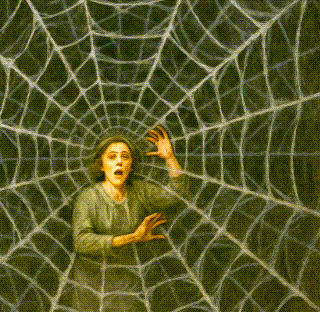
Image by ChatGPT

Note: Clarke, C., & Kopczuk, W. (2025). Measuring Income and Income Inequality. https://doi.org/10.3386/w33678

Poverty and Principles

June 22, 2025

By Stephen Stofka

Sunday morning and another breakfast with the boys as they discuss world events and persistent problems. The conversations are voiced by Abel, a Wilsonian with a faith that government can ameliorate social and economic injustices to improve society’s welfare, and Cain, who believes that individual autonomy, the free market and the price system promote the greatest good.

Cain twirled the rod on the blinds to reduce the sunlight. “Boy, it’s hot this week.”

Abel said, “I can take that side if you want. Nice and shady on this side.”

Cain replied, “Nah, it’s ok. There we go. That’s better. Anyway, did you hear about the Supreme Court’s decision this week? They said that states can pass laws that make it illegal for doctors to prescribe puberty blockers to minors (Source). I thought you would be up in arms about that.”

Abel replied, “I’m not. I thought it was a reach, especially with this conservative court. The plaintiffs in the case wanted to blur the distinction between gender and sex so that they could claim sex discrimination under the Fourteenth Amendment. The Biden administration filed an amicus brief in the case. Come on, Joe. You’re supposed to be a middle of the road guy. You were captured by the progressive wing of your party.”

Cain laughed. “Criticizing Biden? I thought it was performance politics, not legal reasoning. The Trump administration reversed their amicus argument as soon he was elected.”

Abel looked around the restaurant. “Where’s the guy with the coffee and water? Anyway, the N.Y. Times had a magazine article on the history of the case (Source). Ok, there he is.”

Cain settled back in his seat as the busser poured coffee for each of them. “It’s a tough job,” he said. “I bused for a country club when I was like 16 or so. Summer job. Everyone wants to be served as soon as they walk in the door. Anyway, have you heard of WPATH?”

Abel asked, “No. Sounds like a public transportation thing.”

Cain chuckled as he spelled out the acronym. “It’s some psychiatric association for transgender care that issued guidelines for treatment of transgender people in 1979.”

Abel frowned. “That long ago? It seems like its only in the past ten years or so that this has become an issue. Shows how long these things take to come to general attention. So what’s the deal with WPATH?”

Cain replied, “So this professional association revised its guidelines in the late 1990s to ‘permit’ not ‘recommend’ puberty blockers for minors in rare cases. So, get that. Rare cases only. And it was only for minors aged 16 or over. Then in 2012, they relaxed their guidelines to permit treatment in minors under age 16 (Source).”

Abel interrupted, “Maybe that’s why this issue has only come to the public’s attention in the past decade. Ok, so go on.”

Cain said, “In 2022, get this, they revised their guidelines again to ‘endorse,’ not just permit, puberty blockers starting at puberty.”

Abel smirked. “Ah, the step too far.”

Cain nodded. “Exactly. First the policy permitted sex-hormones in rare cases for emotionally disturbed individuals who were almost legal adults. Now it has grown into a recommended procedure for a lot of children who might be only 11 or 12 years old. Some states said no. A state often acts as a surrogate for parental responsibility like at school. It has a right to exercise reasonable prudence.”

Abel smiled when Maria appeared at their table. “Hello, boys. What will it be? The same as usual? Number one over medium, rye toast, and number four with French toast and bacon?”

Abel replied, “How many customers do you have memorized? Absolutely genius. Anyway, can I switch to sausage this week?”

After Maria left with their order, Abel said, “I think they changed their bacon supplier. It used to be thicker. Had a maple taste. Anyway, where were we? Oh, yeah. Gender dysphoria. I didn’t think the science with those treatments was very clear. You know, like effectiveness and long-term side effects.”

Cain nodded. “It’s not. In their 2022 revision, WPATH stated as much (Source). Anyway, that got me to thinking about rights in general, and Robert Nozick’s Theory of Rights.”

Abel asked, “Refresh my memory. Nozick, the libertarian guy?”

Cain replied, “Yeah. In 1974, his book Anarchy, State and Utopia was published. It basically set out the principles of the libertarian movement. His theory of rights was that people should be permitted to do anything that does not violate the rights of others.”

Abel argued, “Yeah, but who decides the bounds of those rights? I mean, women had a right to have an abortion, then the Supreme Court decided they didn’t. Gays did not have a right to marry until the Supreme Court decided they did. We recognize a right to self-defense, ok? But not if you’re resisting arrest. But maybe you do if the officer is using excessive or unlawful force (Source).

Cain smirked. “What’s excessive or unlawful? Like there’s a referee every time someone encounters a police officer.”

Abel nodded. “Right. That’s why bystanders take videos of an arrest with their cell phones. Some kind of public witness.”

Cain continued, “So Nozick argued that a state’s proper role was to enforce the sanctity of individual rights. The courts, a police force, that kind of thing. A federal government should provide for the common defense against foreign powers. You pointed out a big flaw in Nozick’s argument. What are those rights?”

Abel replied, “Yeah, the right to free speech, for instance. Countries set different boundaries on that right. In Britain, the burden of proof is on the defendant, the person accused of committing the libel. In the U.S., it’s the plaintiff, the accuser who has the burden of proof (Source). Two entirely different approaches to defining the limits of a right.”

Cain frowned. “That brings up the subject of what’s called ‘positive’ rights. You know, like FDR’s Four Freedoms. The first two were already in the Constitution. Freedom of speech and worship. But the other two were freedom from want and freedom from fear. So, is it the federal government’s responsibility to ensure those last two freedoms?”

Abel replied, “That is at the heart of the debate for the past eighty years. Is there an obligation to help the poor? If so, whose responsibility is that? In 17th century England, the local parishes administered relief for the poor (Source).”

Cain nodded. “That’s the way it should be in this country. Means tested programs like food stamps, Medicaid, and welfare should be handled by the states or local governments.”

Abel asked, “And pay for it how? In England, they charged an extra poor rate on property owners. So let’s say, a city has an above average rate of poor people and low property values. How is the city going to handle that? What about poor states in the deep south? They rely on federal funding. Mississippi gets like an additional $30 billion a year in federal funds (Source). Without those funds, people would start to migrate to states with more resources. That was a big problem in England.”

Cain argued, “I don’t think there would be a lot of migration. A richer state would be more expensive to live. It’s probably a more competitive job market. Besides, it takes resources to move. Something that a lot of poor people don’t have.”

Abel said, “I just think that policies founded on libertarian principles will have some bad consequences. The bad would overwhelm any good.”

Cain paused as he looked over his coffee cup at Abel. “All these federal programs create a sense of entitlement and dependency. People start making up rights to this, rights to that. Sometimes less is better.”

Abel sighed. “Yeah, kids can do with fewer dolls. That’s what Trump said. Not very charitable.”

Cain stared at his plate, deep in thought. “Taxes were high in the 1980s. I only took home 75% of my pay because of various taxes. I was young and I wasn’t making much. They kept raising the Social Security tax rate because the system was going bust then.”

Abel interrupted, “I agree. It sucked. High inflation, tough to pay bills as it was. Then all these small increases in taxes. It adds up.”

Cain continued, “So, older people were collecting far more than they had paid into the system during the first decades of the program. If they had paid anything, they felt entitled to collect. Social Security had become a big charity program, a transfer of money from the young to the old. That taught me a thing about rights. They had rights. I had none. That’s what it felt like.”

Abel argued, “I was young. I didn’t appreciate that Social Security is essentially an insurance program, an old age insurance program. I mean, old age was an eternity away. Hard to imagine getting wrinkles and ‘turkey neck,’ we called it. I thought old people looked that way because they didn’t get enough vitamins back in the old days.”

Cain laughed. “Ok, good point. We get older. We get a longer term perspective. Can the insurance company, the government, make good on its promises? Did it collect enough in premiums to pay out those promised benefits? No. It’s a badly managed insurance program. Why? Because the premium rates are set by politicians who don’t have the guts to charge an appropriate rate, a tax that is proportionate to the promised benefits. What’s the term? Actuarily sound. That’s why the program is going to run out of money in eight years, and the program will pay out reduced benefits (Source).”

Abel argued, “You call the politicians gutless. Because they are gutless, they will use general funds to make up the difference. They will be forced to, or the voters will throw them out of office.”

Cain asked, “How are they going to do that? This new spending bill reduces taxes even further and increases the deficit each year (Source). No, each side is going to use this issue as a weapon against the other side. Look, Social Security has not been very effective at reducing poverty among seniors. Google dug up an old Census Bureau report from 1966 that shows a poverty level of about 18% among seniors. This was before taking into account Social Security and Medicare and any other programs (Source). Today, after including the income from all those programs, it’s about 15% (Source).”

Abel argued, “Well, a 3% reduction is a lot, I think. Hey, here’s food. Thank you.”

Cain shook some pepper on his eggs. “Hold on. That’s not all. That old report estimated that about 12% of kids under 18 were poor (Source). What is it today? After all the programs, it’s gone up, not down. It’s almost 14% (Source). So, the government is essentially taking from families with young kids and giving it to seniors with no kids. Does that seem fair or effective to you?”

Abel frowned. “You know what I don’t like about your thinking? It’s uncharitable. Why don’t we have more of a sense of community? There were childless couples who had to pay property taxes to fund public schools. We benefited from that but never gave it a thought. Think of it as a game of poker. We throw money into the pot and sometimes we get back more than we put in. The winner of a hand is richer. The other players are poorer.”

Cain swallowed, then replied, “No, I think it’s your attitude that is uncharitable. “There’s all these kids whose outlook and personalities are going to be affected by that poverty for the rest of their lives. Some learn to be passive and helpless. Some rebel and turn to drugs and crime as a way to empower themselves.”

Abel interrupted, “Until they go to jail or get shot by another gang.”

Cain nodded. “Right. This is not a prudent long term strategy, let’s say. In prison, they sit around in a cage. Can’t get more helpless than that. I just think that all these big federal programs have ruined the character of this country. What happened to self-reliance? The states have become little more than departments in a big company taking orders from the bosses in Washington. They send a lot of tax money to Washington, then go crawling to Washington when they need something.”

Abel said, “We were talking about rights before, the so-called positive rights. Freedom from want. Freedom from fear. After eighty years, you are saying that ‘big daddy’ government is a failure?”

Cain nodded. “Exactly. This country doesn’t have a great record on rights. The Declaration cites all these universal rights, but those rights were not universal. Women were excluded. Blacks, American Indians, later the Chinese. Businesses could form trade associations, but labor unions could not go on strike. It wasn’t until the 1937 NLRB decision that the court recognized workers’ right to organize (Source). Women didn’t have the right to vote until 1920.”

Abel argued, “I thought you weren’t a big fan of unions.”

Cain replied, “I might not like the strategies that unions use, but I’m a big fan of consistency. If businesses can engage in quasi-collusion through trade associations, then workers should be able to do the same. I do like right-to-work laws. I don’t think employees should be forced to join a union to be employed at a company.”

Abel asked, “That’s why you don’t like Social Security? In a sense, you’re forced to join, to buy into the insurance program? I mean, that’s part of living in society. We trade some freedom for security. To me, your ideology seems too rigid.”

Cain laughed. “They’re called principles. Your approach seems too arbitrary. Where you conform to the circumstances of the moment.”

Abel smiled. “Marginal thinking. I’m practical. A few weeks ago, we talked about Stephen Breyer’s book on taking a pragmatic approach when evaluating court cases. That’s me. Mr. Practical. So you mentioned the spending bill that’s working its way through Congress.”

Cain smirked. “ The One Big Beautiful Bill Act, as it is now known. They should call it the One Big Bloated Bill.”

Abel interrupted, “They are going to cut back on Medicaid, which is going to hurt a lot of poor people, both kids and seniors. You talked about how much states are spending on Medicaid. A lot of that is on seniors. In California, seniors cost almost twice the state’s average on their Medicaid program (Source). California spends about $90,000 per year for a senior in a nursing home. What’s your plan? Put them out on the street?”

Cain asked, “Do you think that California could handle that load with its own resources?”

Abel nodded. “Sure. The problem is that California kicks in a lot of tax money to the federal government and gets far less back from them. That amounts to $90 billion in a year, a huge hole that California has to fill (Source). New York and Texas have similar holes. The feds take that tax money and give it to rural states that are usually poorer.”

Cain raised his eyebrows. “Is providing health care a state and local thing, or a national thing that the federal government should do?

Abel argued, “Well, health care insurance is a deductible expense for businesses, so that makes it a national issue. Businesses spend money on health insurance for their employees, but people don’t have to declare it as income. It’s the largest subsidy by the federal government to working people and businesses (Source). Why should some working people get a subsidy and others don’t? Is that a violation of the 14th Amendment?”

Cain shook his head. “That’s the problem. The tax deductibility of health insurance was a World War 2 policy. Because there were wage freezes in place during the war, companies wanted a way to attract employees. Health insurance was one of those. Again, we are saddled with the effects of a policy that ‘big government’ FDR started. As soon as the war was over, that program should have ended. Period.”

Abel shrugged. “Yeah, fat chance. It was tax-free money. No one wants to give that up.”

Cain replied, “Exactly my point. These big federal programs are like fishing boats coming back from a big catch. The gulls stay with the boat, wanting an easy meal.”

Abel argued, “Well, companies do the same at the state level.”

Cain smirked. “States must balance their budgets even if it does take some accounting tricks. So states have some constraint. The federal government has no such discipline other than the probability that generous federal transfers will cause inflation.”

Abel shook his head. “There’s like seven rural hospitals that close every year (Source). Remember, that’s with the Medicaid expansions under Obamacare. So, if Medicaid is severely reduced or eliminated, most rural hospitals will fail. I just don’t understand why the representatives of these rural states vote to reduce Medicaid. And for what? To keep giving big tax breaks to billionaires?!”

Cain sighed. “It’s the principle of the thing. Medicaid programs encourage people to drop private insurance in favor of a low cost government program. This ultimately has an effect on the larger market for employer sponsored health plans and drive up private insurance rates. The federal government covers a lot of the cost, but the states still have to cough up like 10% of Medicaid costs and it’s a huge program. Texas spends almost half of its state budget on Medicaid (Source).

Abel whistled softly. “Wow, I didn’t realize it was that much.”

Cain smiled. “You wouldn’t because you mostly consume left wing and mainstream media. Even the blue states struggle to pay their share of Medicaid. New York and California spend almost 40% of their budget on Medicaid. College students complain about the high cost of education but part of the reason for that is the states pick up less of the cost of higher education than they did like forty years ago. Why? Because Medicaid sucks up so much of each state’s budget. So college kids are basically paying for greater access to Medicaid. Is that fair? No, of course not.”

Abel argued, “That’s bogus. State spending on higher education has increased by $2000 per student over the past forty years (Source). That’s after adjusting for inflation. The real problem is that colleges have been raising tuition and housing prices for students at a faster rate than inflation.”

Cain sighed. “Come on. First of all, the schools have had big cost increases because of federal mandates. They have to present the material in a lot of different formats tailored to different learning styles. They have to make allowances for disabilities and special needs. That takes time and resources. The students themselves make it worse. They find a doctor who says they have some learning disability which entitles them to have more time taking tests or completing assignments. Some of those claims are legitimate. Some are simply working the system, trying to gain an advantage. The school has to deal with that.”

Abel argued, “I think a lot of those additional costs are not simply because of federal mandates. Learning has changed. Students spend a lot of time on computers or their phones. The curriculum has to be modified to accommodate that. The cost of housing has increased at a slightly higher rate than overall inflation (Source).”

Cain replied, “Ok, I’ll grant you that. But how much are schools spending on administrative costs? One organization said that those costs had increased by 61% in the twelve years before 2007 (Source). Ok, that’s not inflation adjusted but after accounting for that, administrative costs are going up an additional 2% above inflation. The Department of Education also estimates a growing share for administrative costs, like 16 cents of every dollar in 1980 has now grown to 25 cents of every dollar. These federal programs are not efficient. They rob from Peter to give to Paul. That’s my point. Social Security, Medicaid, and education mandates. Everywhere you look.”

Abel laid his napkin on the table. “I agree with you that a centralized structure has problems. But I think your approach is impractical. We have to live with the decisions that previous generations made. I believe we can patch some of the problems in these programs. Right or wrong, employer-sponsored health care is here to stay. Right or wrong, private insurance companies will not cover the medical risks that come with old age. Right or wrong, people don’t save enough for their retirement. That’s just the way it is.”

Cain settled back in his seat. “I still think that these problems would be better handled at the state or local level. My point is that they are not effective at the federal level.”

Abel stood up. “Half of the states have limited resources. We saw that during the pandemic. Rural hospitals in one state sent their patients to hospitals in other states. Idaho sent patients to Washington (Source). Wyoming sent patients to Colorado. Solutions to any problem have to deal with those hard realities. Does that involve a compromise with principles? Maybe.”

Cain looked up. “You’re ready to go. Maybe we can continue this next week. See you then.”

Abel replied, “It’s a huge problem, isn’t it? See you next week. Where’s the check?”

Cain said, “I think it’s my turn. I can’t remember. You go ahead and I’ll pick it up.”

/////////////////////

Image by ChatGPT in response to a prompt

Note: The standard poverty measure does not include any government transfers like Social Security. The Supplemental Poverty Measure (SPM) includes those transfers. The 1966 study used the conventional poverty measure. The recent poverty measure was the supplemental variety. Cain contrasted the two to show the relatively small reduction in poverty that the sum of government transfers has had over the decades. The 1966 study showed that a significant reduction in poverty before Johnson’s Great Society programs had taken effect. The strong economy of the early 1960s played a significant part (Source).

Two Worlds: Urban and Rural

June 15, 2025

By Stephen Stofka

Happy Father’s Day to the Dads out there. Even though it is Father’s Day, Cain and Abel have their usual Sunday breakfast together.

This is part of a series on persistent problems. The conversations are voiced by Abel, a Wilsonian with a faith that government can ameliorate social and economic injustices to improve society’s welfare, and Cain, who believes that individual autonomy, the free market and the price system promote the greatest good.

Abel settled down in his seat opposite Cain. “There is so much that is happening every week, it’s hard to keep up with it. LA demonstrations, the troops being called out in addition to the guard.”

Cain adjusted the window blinds to reduce the sunlight. “Yeah, there were ICE agents running after migrants in the field in the Central Valley. Imagine having all that gear on and running around in 90 degree heat. But, the farmers were complaining. About 40% of their workers are illegal (Source). Imagine if the crops rot in the ground and voters find empty vegetable displays at the grocery store. On Friday, Trump announced that ICE would no longer target farm workers (Source).”

Abel shook his head. “A 12-year old was left alone when his parents were grabbed and taken away (Source). Talk about a rotten Father’s Day. Then Trump made up some B.S. that criminals who were let in by Biden were applying for the jobs left vacant by the farm workers.”

Cain nodded. “The real battle in this country is between the moderates on either side of the political aisle and the nutjobs on the left and right wings. When I heard that the radical lefties had called Waymo taxis, then lit them on fire, I wondered if I was in a Twilight Zone episode (Source).”

Abel smirked. “Playing right into the hands of the MAGA crowd and the nutjob in the White House.”

Cain chuckled. “I don’t know if Trump is a nutjob. Remember, he outcompeted sixteen rivals in the 2016 race.”

Abel sighed. “It’s the primary voters in either party who are the extremists.”

Cain raised his eyebrows. “Another change ushered in by the Democratic reformists in 1972 (Source). A primary system would let the voters speak. Yeah, right. Often, it’s less than a quarter of eligible voters that turn out for a primary.”

Abel argued, “Wait, so it’s only wackos that vote in primaries? I vote in them.”

Cain made an equivocating hand gesture. “I didn’t say only wackos voted in primaries. But, they are a greater percentage of the small primary turnout. They influence primaries and each party caters to their interests and perspectives. The parties have drifted to the extremes in the past decades.”

Abel sighed. “Ok, let’s call them motivated voters spurred on by interest groups.”

Cain laughed. “You can call them that. I’ll call them wackos. Anyway, back to Trump. He reminds me of the Mule in Asimov’s Foundation series. A person who can control the emotions of others.”

Abel smiled. “Asimov was one of my favorite authors. I loved the Foundation series, the robot books. What, you think Trump is a mutant? I mean, that was science fiction.”

Cain looked into the distance for a moment. “He has a singular personality that draws some people. Do I think he has some emotional telepathic power like the Mule? No. But remember that the Mule assumed the guise of a clown to infiltrate the Foundation, then take it over. A lot of mainstream Republicans looked at Trump as a political buffoon in the 2016 race. He’s taken over the Republican Party just like the Mule did the Foundation.”

Abel raised an eyebrow. “Magnifico was the name the Mule assumed? Some hyperbole there. That’s Trump’s favorite tool.”

Cain nodded. “Magnifico Giganticus. I had to look it up a while ago when the similarity struck me. Physically, there’s little resemblance between Trump and the Mule.”

Abel replied, “In Asimov’s story, he was the anomaly that psycho-historians could not foresee. God, that was great stuff to read when I was a teen.”

Cain smiled. “I remember hearing that Paul Krugman loved the series as well. He said that the whole idea of psychohistory made him interested in studying economics (Source).”

Abel laughed. “If only economists had as much accuracy as the predictions of the psycho-historians. A hologram of Hari Seldon would appear at crisis moments. With his mathematics of history, he had been able to predict when a galactic crisis would occur, so he pre-recorded them before his death.”

Cain mused, “He couldn’t predict the Mule, though. That shook everyone’s faith in Seldon’s wisdom. The Democrats must be feeling like that about now.”

Abel frowned. “The second President in history to be elected in two non-consecutive elections. Cleveland was the first (Source). Until the 2024 election season, I didn’t think anyone had done that before. It’s funny. We had to memorize a succession of Presidents in grade school, but they were just names to me.”

Cain nodded. “Yeah, we often don’t appreciate the story of history until we’re older. I hated all that memorization when I was a kid, but it was good training for our brains.”

Abel sighed. “I get down on some of the kids working in stores because it seems like they can’t remember stuff. They gotta look up everything on their phone or the information gadget that the store gives them. Then, this week, I’m at Home Depot and ask this guy in his mid-twenties for something and he tells me the aisle and the location on the shelf.”

Cain chuckled. “Why do we stereotype people? Saves us time and effort, I suppose. It’s like we have a little theater, a Punch and Judy show playing in our brains. ‘Here’s how the world works,’ we say. People become characters in our internal play.”

Abel set his fork down. “Hey, talk about stereotypes. I meant to tell you about the American Communities Project. They classify the thousands of counties in this country into 15 groups. They have a color-coded interactive map so people can locate their local community (Source). This guy, Michael Bahareen, at The Liberal Patriot on Substack wrote three posts about the characteristics of each group (Source).”

Cain asked, “How do they distinguish the different groups?”

Abel replied, “Voting patterns, that’s one. Their ages, ethnicity, population, dominant industry and values. A lot of data that the Census Bureau gathers every year. Some of the data surprised me. Some didn’t. Like Native American Lands. I knew that the Indians struggled with poverty. I was surprised that counties classed as ‘Working Class Country’ had incomes that were just a few thousand dollars higher than people in Indian country.”

Cain asked, “Where are those counties?”

Abel shrugged. “Funny. All of them except one are in the eastern half of the country. Rural counties in Arkansas, West Virgina, eastern Oklahoma. In the past twenty years, those counties have become solid Republican.”

Cain argued, “So you were surprised at their low incomes? Their cost of living is a lot lower too (Source). I wish these government agencies would quote household incomes in terms of living costs.”

Abel interrupted, “Yeah, but there are a lot of things that don’t have local prices. Like life insurance, computers, cars.”

Cain agreed, “Ok, good point, but local pricing plays a huge part in a family’s finances. Let’s say a family makes $120,000 a year in Los Angeles. They might be paying $60,000 a year in housing costs. That’s $5,000 a month. Heck, it’s 50% of their income. Their income tax bite is higher than the family living in rural Arkansas or Missouri. Let’s say that family makes only $52,000 a year, but their housing costs are $12,000. Which family is more stressed out? The LA family. One of them loses their job and they can’t sleep at night.”

Abel nodded. “Ok, I get your point. But families in urban areas classified as Big Cities are generally healthier than those in Working Class Country. So why is that?”

Cain said, “Probably a lot to do with access to health care. I don’t know. I just wish we had data that allows us to do a better job at comparing incomes and living costs. Your point about computers and cars prices. An F-150 pickup starts at like $40,000 (Source). That’s like nine months of income for someone working in rural Oklahoma, but only five months for someone in L.A.”

Abel interrupted, “So housing costs might be a lot lower in rural areas, but not autos. Do you think that accounts for the political silos in this country? We talked about that last week, I think. Rural people and urban people live in different worlds in a lot of ways.”

Cain nodded. “Sure. Why is that pickup so expensive? Because of environmental and safety rules that the people in big cities voted for. The guy in Podunk, Oklahoma doesn’t want to pay for all that stuff but has no choice. Ford can’t build pickups without all those controls. Naturally, the guy in Oklahoma resents the voters in the big cities. Their priorities dominate and limit his choices and how he spends his money. Is that fair? No, of course not.”

Abel argued, “Well, you claim that the price system can allocate resources. Let’s say we got rid of mandates for environmental and safety controls. Would Ford build a new pickup for $25,000? Is there enough profit for the car manufacturer and dealer at that price? Probably not. What if we undid all the safety regulations? No more air bags or cars designed to absorb the impact of collision. Get rid of all those environmental controls while we are at it. What if you are wrong? Highway deaths skyrocket. Pollution in American cities starts to look like China cities. No one can see through the fog.”

Cain looked over his glasses at Abel. “You done? I’m not proposing anything that radical. I’m saying that we have enough car mandates. If people want air bags, they can pay for them. Let people decide. Let the car makers decide. We don’t need fat cats in Washington forcing their ideologies and priorities on us.”

Abel smirked. “We need some uniformity. Sure, this a diverse country. Geographically, culturally. That’s always been a challenge in this country. But the whole point of the Constitution was a bedrock of uniform laws that would apply to everyone.”

Cain replied, “Yeah, a bedrock, a foundation. The Constitution is only a few pages long. Why? Because the states were supposed to do the bulk of the lawmaking. What do we have now? Lawmakers in Washington, particularly the Democrats, want to keep imposing uniform regulations on all the states. Circumstances are not uniform. Incomes and cost-of-living standards are not uniform. Democratic politicians just don’t get that anymore. They look down on rural counties as they fly from the coast-to-coast. In the 2016 campaign, Clinton called them a ‘basket of deplorables‘ (Source).”

Abel shrugged. “That was just plain stupid politicking. Romney made the same mistake in the 2012 election campaign with his remark that 47% of people voted Democrat because they were dependent on government (Source). I mean, politics is mostly performance, not policy. Stupid remarks are bad performance, but not policy.”

Cain argued, “I agree with you about performance. A bunch of peacocks puffing up their tails.” Abel snorted with laughter and Cain paused. “You all right?”

Abel took a moment. “I started laughing while swallowing. I got this picture of the aristocracy in the French court dressed up in their frills and powdered wigs.”

Cain smiled. “That’s how it seems to working class people and farmers in rural counties. All those mandates. It’s disrespectful, disdainful.”

Abel argued, “A lot of regs are meant to address serious concerns that affect a lot of people. I mean, automobile fatalities averaged 36,000 per year in the 2010s (Source). That was the same as in the 1950s, even though the population doubled. Yeah, those safety features cost money but they save a lot of lives. I mean, I get your point that mandates have a disparate impact on some folks in lower income counties, but this doesn’t help your argument.”

Cain asked, “What about environmental controls? Those mandates addressed the concerns of people in urban areas. People living in a county with fewer than 10,000 people are going to be more concerned with the cost of emission controls, not the effect of those controls.”

Abel sighed. “Look, everyone has a right to breathe fresh air. Lawmakers couldn’t let automakers build two different sets of cars. Those with controls. Those without. I mean, people would just go to a rural county, buy a car without controls and drive it back to the city where they lived. How are the cops going to tell the difference? Cars need uniform laws set in Washington.”  

Cain shook his head. “There could be different license plates. Boom. Someone driving a car without controls in a county that requires them gets pulled over by the cops and their vehicle impounded.”

Abel sighed. “People with low incomes are going to get hit the worst by that policy. What if some farmer in a rural county wants to visit his family in the city? Let’s say his car doesn’t have controls. What is he supposed to do? Rent a car? I know you’re into local autonomy, but this just isn’t suited to it.”

Cain settled back in his seat. “We got by for decades without all these mandates and controls. Then the Democrats started to rewrite all the rules in the 1960s. The Big Daddy economy. Johnson’s Great Society, Medicare, Medicaid and a bunch of rules dictating production decisions.”

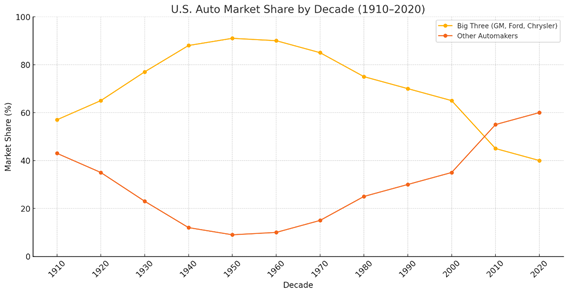
Abel argued, “Remember, for the first half of the century, there were a lot more car manufacturers. Wait, hold on a minute. I took a screenshot of a chart about a week ago. Here it is.

The vertical axis of the graph is marked from zero to 100 percent market share. The horizontal axis is marked in decades from 1900 to 2020. The yellow line depicts the changing share of the automobile market for the Big Three automakers. It rises from 55% in 1910 to 90% in 1950, then declines gradually to 40% in 2020. The orange line shows the changing share of other automakers. It declines from 45% in 1910 to 10% in 1950, then rises to 60% in 2020. The two lines cross in 2007, when the share of other automakers begins to rise over that of the Big Three.

Abel continued, “The dominance of the Big Three was already starting to decline in the 1960s and 1970s. It wasn’t the new mandates but foreign competition coming into the U.S. market.”

Cain whistled softly as he looked at the chart. “I didn’t realize that the majority of cars on the road are now foreign brands.”

Abel interrupted, “Some might be Teslas.”

Cain nodded. “Right. But this shows why a lot of people want to bring manufacturing back to the U.S. What got you into this?”

Abel replied, “I was sitting in traffic and noticed that there were no American brand cars around me. I wondered if that was a trend.”

Cain shook is head. “Our economy is too open to foreign competition, if you ask me.”

Abel argued, “America’s dominance in manufacturing was just the post-war period. The war crippled the industries of Europe and Japan. As they recovered, they began to compete with American autos. My daughter drove a used Honda Civic for like ten years when she was younger. Hardly any repairs. What American car in the 1990s could make a claim like that?”

Cain replied, “Dodge Dart. Slant-6 engine. I drove that thing for over 200,000 miles without putting much money into it. Well, we got to do something. There’s too much difference in incomes between the urban areas and rural counties.”

Abel argued, “A revival in manufacturing won’t help these rural areas. Manufacturing needs supply chains, good roads that are built for truck traffic and well maintained. Infrastructure like cable and fiber. That’s the stuff Biden wanted to build, and Trump wants to cancel.”

Cain looked through the steam rising from his coffee cup. “Well, government is not too efficient at building stuff. They are good at shuffling ones and zeroes, taking money from one person and giving it to someone else. There should have been better incentives for private companies to build infrastructure. More fiber optic in rural areas, for example.”

Abel frowned. “Rural counties with older populations, what ACP categorizes as ‘Graying America,’ make up a small percentage of voters, about 5%, according to the analysis at ACP (Source). Political advertising may pay them lip service and feature them in videos, but they don’t have much power. You talked about counties with less than 10,000 people. That’s like less than a quarter of the counties and less than 2% of the population (Source).”

Cain argued, “I want to look at the research this American Communities Project is doing. It seems to me that there’s like a $25,000 to $30,000 difference in incomes between rural and urban areas. Rural counties are becoming like second or third-world countries. They don’t like it.”

Abel nodded. “I know. Their kids are leaving for better opportunities in more populous areas. I don’t know what the solution is. Democrats have come up with needs based programs to help lower income families in urban areas, but they have ignored rural areas. Of course, Social Security is progressive and that helps older people in rural counties. They earn lower incomes and get proportionately higher benefits. Their Social Security income goes a long way in a rural area.”

Cain interrupted, “It’s not that progressive. Besides, they don’t have easy access to doctors or dentists.”

Abel shrugged. “Right. There’s not enough to attract young talent the way urban areas do. Local autonomy may have suited an 18th century economy based on farming and primitive means of travel. Urban areas permit more connections between goods and services, between people and institutions. Rural communities just don’t.”

Cain argued, “Come on. Rural communities are all about connections.”

Abel replied, “Yeah, among themselves, but not so much with other communities. Look, our society, our economy, it gets more multi-layered. Urban areas have the depth and scope to accommodate that complexity.”

Cain asked, “Well, for all that complexity, we still have to eat. Who is going to grow and harvest our food?”

Abel shrugged. “Robots. Tractors and harvesters become more automated every year. There’s a show called “Clarkson’s Farm” on Amazon Prime, I think. Jeremy Clarkson is big into cars. He did some worldwide tour. He writes. He’s a presenter. Anyway, he decided to take up farming. Great show if you haven’t seen it. Fourth season just finished, I think. Boy, the sophistication of these tractors and harvesters is amazing. That trend will continue.”

Cain asked, “You think AI agents will be driving tractors?”

Abel nodded. “Sure, they’ve already got GPS in these machines.”

Cain argued, “Yeah, but you still need people to repair the machines, to muck out the stalls, whatever else they do on a farm.”

Abel replied, “Robots are picking orders at Amazon (Source). Humans are still doing the packing. It’s happening everywhere.”

Cain laid his napkin on the table next to his plate. “It’s sad. There are already a lot of small farming towns that have too many closed up stores. It’s not just the destruction of capital in a big tech company. I mean, that’s part of progress. It’s the demise of those communities, their social relationships, their religious and cultural institutions.”

Abel sighed. “Ghost towns. Gold and silver mining towns are tourist attractions, a page in history. One day, people may visit main streets in small town, America, and gawk at mom and pop grocery and hardware stores.”

Cain slid out of his seat. “That’s an uncomfortable thought. Well, I gotta go. Something to think about.”

Abel smiled. “Ok, see you next week.”

////////////////

Image by ChatGPT

Unintended Laws

June 8, 2025

By Stephen Stofka

This is part of a series on persistent problems. The conversations are voiced by Abel, a Wilsonian with a faith that government can ameliorate social and economic injustices to improve society’s welfare, and Cain, who believes that individual autonomy, the free market and the price system promote the greatest good.

Abel asked, “No milk in your coffee?”

Cain replied, “I’ve been trying to go without the past few days.”

Abel asked, “Health concerns?”

Cain shook his head. “More a matter of simplicity, I think. Anyway, something caught my eye on Friday when the Supreme Court issued several rulings.”

Abel asked, “All in one day?”

Cain nodded. “Yeah, June is a big month when the court releases many of its rulings for the past nine months.”

Abel said, “I heard something about an employment discrimination case on the news, I think.”

Cain replied, “That was interesting, but no. It was actually a non-decision. The court decided not to rule on the Lab Corp case (Source).”

Abel asked, “What’s Lab Corp?”

Cain paused as their food arrived. “They process gazillions of lab tests, like blood tests and so on. Several years ago, they put self-service kiosks at their appointment centers. It was a convenience thing for some customers. I guess it also relieved the wait times for customers who needed or wanted help from a customer service rep or technician at the appointment center.”

Abel nodded. “They have those at the HMO I go to. It saves standing in line for a clerk. What’s the big deal?”

Cain lifted his eyebrows. “Lab Corp got sued by advocates for blind people. They claimed that the kiosk did not accommodate them (Source).”

Abel frowned. “Blind people couldn’t use the ones at the HMO I go to. It’s a touch screen. Blind people can walk ten feet and stand in line for a clerk. This makes no sense. There are a lot of companies that use these and the demand is growing (Source). What are they going to do? Sue all the fast food chains?”

Cain nodded. “Right. Some courts rule that if a clerk is nearby, that satisfies compliance with the ADA, the Americans with Disabilities act (Source). Other courts rule that the kiosks should offer some kind of audio assistance for blind people.”

Abel lifted the syrup dispenser above his pancake stack, then paused and set it back down. “I doubt if the lawmakers who passed the ADA in 1990 intended it to prevent the rollout of customer conveniences. I mean, the legislation got almost unanimous support in both the Senate and House. How often does that happen?”

Cain smiled. “1990. That was Bush, a Republican President. It doesn’t support the left’s portrayal of Republicans as mean, exclusionist white guys and the Democrats as the party of inclusiveness. ”

Abel returned the smile. “Good point. But people in both parties stereotype those in the other party. I’ve been reading a newer edition of Gary Gerstle’s book American Crucible. It’s a history of race, religious and cultural movements in America. In the first decades of last century Republicans painted Progressive Democrats as Communists. Why? Because they supported unions and worker protection laws like the 8-hour day and prohibitions against children working in factories. It helped swing political power to the Republicans after WW1.”

Cain nodded. “I never thought of that. Promoting stereotypes is an election strategy, for sure. So, a political marketing strategy becomes an ideological trope. It gets integrated into people’s brains like some kind of ad jingle.”

Abel asked, “A mechanical model of our brains? What, like rats in a maze?”

Cain shook his head. “A computer model, I guess. Our brains are a gazillion circuits connected together. Some are feedback loops, cycling over and over. Ad agencies and social media try to plant ideas into those loops and create repetitive behavior. So what’s up with this book?”

Abel replied, “Right. This newer edition was published in 2017 and Gerstle added a chapter to cover what he calls the ‘Age of Obama.’ He portrays twentieth century American history in broad movements. For fifty years after World War I, there was a movement toward a civic nationalism, a melting pot model that emphasized shared liberal values.”

Cain asked, “What was before World War I?”

Abel said, “A collection of immigrant groups that identified with others of like ethnicity, or language or European nationality. So anyway, in the post-Watergate period, a multiculturalism emerged. Instead of stressing assimilation, the new culture emphasized the diversity of race and ethnicity in this country. After forty years or so, the country elected Obama, a multi-racial man who appealed to a broad coalition.”

Cain smiled. “That’s a good insight. I wonder if Gerstle would say that Trump’s election is a return to that model of civic nationalism. Woodrow Wilson’s policies were pretty coercive.”

Abel asked, “A clash of two movements that dominated the twentieth century? Could be. Trump is going after DEI programs and any institutions that promotes that kind of sympathy or ideology.”

Cain frowned. “I thought it was a fight between the New Deal and the Great Society on the left, and individual freedom on the right. Maybe Gerstle’s onto something though. Multi-culturalism on the left and what? Assimilation into a dominant culture? That hopey, changey thing with Obama sure disappointed a lot of folks who voted for him. Not much hope for those who lost their homes. Not much change in Washington. As Trump said in 2016, the system is rigged to favor the fat cats. He knew because he was one of them (Source).”

Abel smirked. “Another campaign tactic. He was trying to appeal to Bernie Sanders voters.”

Cain interrupted, “Bernie might have been the Democratic candidate if the DNC hadn’t rigged the process for Hillary.”

Abel tilted his head. “I don’t know about that. But that helps to confirm Gerstle’s perspective. After forty years of a growing multiculturalism, people elected a multiracial or black candidate. Eight years later, one party nominated a woman. That couldn’t have happened in the ‘80s or ‘90s.”

Cain nodded. “Yeah, remember Geraldine Ferraro? She was Mondale’s VP pick in the 1984 race, and they got their butts kicked. People weren’t ready for even a woman VP at that time. So, big changes in public attitudes in forty years. That emphasis on diversity went overboard, if you ask me. Too much identity politics on the left. Gender identity, racial identity, ancestry, religion, and so on.”

Abel interrupted, “But most movements do that, I think. Gerstle talks about the struggle between hard and soft multiculturalists. We see the same thing on the right.”

Cain said, “Yeah, good point. So, is this multicultural movement coming to an end?”

Abel nodded. “Well, people voted for the promise that we could be something better, but it was 2008. The financial crisis blew up before the election. Graft and greed run amok. Then a huge number of minority homeowners lost their homes. High unemployment caused many young people in black communities to turn to drug dealing as a way to make money. The videos of black men being killed by police. The riots at Ferguson. The Black Lives Matter movement. The promise of something better stumbled over what one author called The New Jim Crow.

Cain asked, “Was all of that during the Obama years? The left-wing media framed those events as a struggle between the dominant white establishment and the black community. It was law and order protecting the community against anarchy.”

Abel argued, “That’s another discussion. Anyway, the white culture is not going to be so dominant when whites are no longer a majority in this country. Pew Research estimated that will happen before 2050 (Source). That’s what’s behind the anti-immigration fervor and the laws that are supposed to ensure ‘election integrity.’ It’s a fight for political dominance.”

Cain frowned. “Right. The whole idea of a democracy is to wage war with words, not on the battlefield. What I don’t like is when universities spread those ideas that focus on people’s differences instead of shared classical liberal values. You know, like individual freedom, respect for the law and private property. Even the private universities receive a lot of indirect funding from public taxes. They should be promoting shared values, not some professor’s pet Marxist ideology.”

Abel’s tone was impatient. “Oh, come on. Universities are supposed to expose students to a range of ideas, not some carefully curated set of values and ideas.”

Cain nodded. “Ok, I get your point, but there should be more emphasis on America’s strengths, not its faults. These colleges promote an ideology that focuses on people’s differences, their grievances with American culture. What do we have now? A nation that has all these cultural silos, racial and ethnic silos. There’s an element of exclusion in that kind of thinking. Like the ramshackle clubhouses we built when we were kids. ‘This is our clubhouse, and you can’t come in,’ we said. No wonder Americans are feeling so isolated.”

Abel looked into the distance for a moment, then looked at Cain. “Multi-culturalism was more a celebration of differences, don’t you think? Gerstle says the movement tried to build community around race and ethnicity. Community is not isolating. The internet has been more responsible for social isolation, I think.”

Cain replied, “Oh, there are a lot of causes. The internet, for sure. Celebration of differences? That’s what we do at a Mardi Gras parade. That happens once a year. It’s not supposed to be a continual celebration of diversity like the left-wing media does. Then it becomes indoctrination.”

Abel argued, “The right-wing media is just as guilty. They appeal to people’s desire for moral superiority. It’s BS. Reagan was not all that religious but faked it to win Evangelical support. Same with Trump. Biden has a strong religious faith and practiced it too. Still, Christians on the right criticized his policies as ‘non-Christian’ (Source). It’s the typical playbook for Republicans. Democrats are godless. Democrats are Communists.”

Cain nodded. “The left is just as guilty for appealing to moral superiority. Ok, they are political tropes designed to win an election. The problem is that people come to believe these tropes.”

Abel said, “We can’t ban campaign tactics, especially not after the Citizens United decision. I do wish there were a ‘Responsibility in Campaigning’ law that did not violate the First Amendment.”

Cain laughed. “Even if our irresponsible Congress could pass such an act, I can’t imagine any campaign manager paying attention to it. They would run the ads anyway and pay whatever fines had to be paid out of campaign funds.”

Abel shook his head. “Man, you are so skeptical!”

Cain smiled. “I’m a realist. People act in their self-interest. A successful election campaign sells soap suds that evaporate within a year after a Presidential election.”

Abel interrupted, “If it takes that long.”

Cain nodded. “So, you do agree with me. An election campaign is not about honor. It’s about winning. George Bush, the dad, was repulsed by the tactics that his own campaign wanted to use in the 1988 race. Still, he approved them after some polls showed he was slipping in the race.”

Abel asked, “Was Lee Atwater his campaign manager?”

Cain replied, “Yeah, a master of hardball tactics. They convinced voters that Bush’s opponent, Dukakis, was responsible for the release of a murderer who killed and raped a couple.”

Abel interrupted, “Willie Horton. Yeah, all over the news. He was out on furlough, I think (Source).”

Cain nodded. “Very effective. Democrats soft on crime. The same thing could happen to your family with Democrats in charge. That kind of thing. After Atwater got brain cancer, he was sorry for all the personal damage that aggressive campaign tactics had caused.”

Abel argued, “Well, not everyone is like that. Maybe it’s just Republican contenders who hire ruthless managers. Karl Rove managed George Bush’s campaign in 2000. The son, not the dad. His critics said he was pretty ruthless. I thought Obama’s campaign managers were pretty good.”

Cain said, “So we’re off on yet another tangent. What did we start talking about?”

Abel replied, “ADA regulations. Multi-culturalism. Gerstle’s book. Why did the Supreme Court not make a decision in the ADA case?”

Cain made a brushing motion with his hand. “Some technical point on class certification. Not important. The thing is that Congress passes some law. Then the enforcement of it and the interpretation of it by the courts distorts the law. There’s more harm than the good the law was intended to do. That’s why the courts need to look at the original intention of the law.”

Abel asked, “So the implementation of the ADA has gone too far? What else?”

Cain replied, “Affirmative action. In fact, the court ruled on Friday that an agency can’t discriminate against a person simply because they are part of a majority. Well, kind of like that. A person who is part of a majority does not have an extra burden of proof to bring a claim of employment discrimination (Source).”

Abel nodded. “Boy, you are the court watcher.”

Cain smiled. “In June, when all the opinions come out. I mostly read the first page or two of some decisions and gloss over the references to the sections in the law.”

Abel laughed. “So that ruling seems like a fair rule. Why did this case make it to the Supreme Court?”

Cain arched his eyebrows. “Until now, the rule has been that people who belonged to some majority class had to show more proof of discrimination. The woman who brought the case was heterosexual and had lots of experience at the agency. They gave the job to a lesbian woman.”

Abel interrupted, “Wait. Was the woman who didn’t get the job in the majority because she wasn’t lesbian? That’s nuts.”

Cain waved a hand. “Welcome to America. What were you calling it? Multi-cultural America. It’s become a legal advantage to be identified as some minority. It’s easier to win a discrimination suit. It’s easier to get hired for a competitive position. Lawyers try to create minority classifications so they can get some court to grant class certification. They spend a lot of money to get a class-action case before a court, but they make millions in fees if they win.”

Abel nodded. “This is another case where the lawsuits go far outside the bounds of the lawmakers’ intentions when they wrote the law.”

Cain sighed. “I think there has to be a way to stop the expansion of the effect and meaning of these laws. Like the touch screen thing. Should companies just remove their touch screens, so they don’t get sued by blind people? That has an impact on most of the people in this country who are not blind. The sum of that inconvenience is far more than the slight inconvenience that some blind people have who wait in line to talk to a clerk.”

Abel nodded. “So that’s one way to look at it. That’s a sum of utility thing. A few weeks ago, we discussed John Rawl’s idea that society should aim to lift the fortunes of the least among us.”

Cain shook his head. “Yeah, I remember. I disagree with Rawls. Look, the ADA mandated things like Braille on elevator keys. That did not inconvenience sighted people. Sloping curbs at street corners helped people in wheelchairs move about. That does not inconvenience those who can walk. But when the government says a company can’t put touch screens in their lobby unless it has audio capabilities, that is a huge inconvenience to sighted people. It’s a step too far.”

Abel replied, “Technology has changed since the ADA. So Congress can re-write the law. They haven’t so far.”

Cain settled back in his chair. “This country has gone in the wrong direction. It’s not just me. A lot of people feel it.”

Abel pushed his plate aside. “Those sentiments are mostly driven by politics. Pollsters find that Democrats are miserable when a Republican is in the White House. Same for Republicans when a Democrat is President. The latest Gallup poll shows that 80% of Republicans are satisfied with the way the country is going.”

Cain laughed. “Maybe I am hanging out with too many Democrats. I’ve been infected with pessimism.”

Abel stood up. “Yeah, those are four year cycles in sentiment. Gerstle made me aware of a longer term cycle that’s going on in this country. I’ll send you a link to the book. The last two chapters covers the past fifty years and it’s maybe fifty pages.”

Cain asked, “It’s not one of those expensive textbooks, is it?”

Abel shook his head. “No. Maybe the price of a lunch. Talking about that, I’ll pick up the tab. I think it’s my turn. See you next week.”

Cain nodded as he set pushed his plate aside. “Never a dull moment. See you next week and thanks.”

////////////////

Image by ChatGPT

A Web of Rules and Interpretations

June 1, 2025

By Stephen Stofka

This is part of a series on persistent problems. The conversations are voiced by Abel, a Wilsonian with a faith that government can ameliorate social and economic injustices to improve society’s welfare, and Cain, who believes that individual autonomy, the free market and the price system promote the greatest good.

Abel said, “What caught my attention this week was an article about some woman from Hong Kong being arrested and jailed prior to deportation (Source).”

Cain frowned. “Small Missouri town, wasn’t it?”

Abel nodded. “I forget the name of the town, but it voted heavily for Trump. Like 80%. This woman had lived in the town for twenty years, had a few kids. She worked as a waitress in the local restaurant and was well-liked by the folks in town. The arrest caught the town off guard. One person said they thought Trump was going to go after gang members and criminals, not mothers.”

Cain shrugged. “If I remember right, she had been in some fake marriage like twenty years ago to get a green card.”

Abel replied, “Yeah. She wasn’t convicted or anything. Back in the 1970s, I knew someone who got paid $10,000 to marry a Hungarian woman. That was a lot of money in those days. Hungary was behind the Iron Curtain, so there were a lot of people anxious to get out.”

Cain asked, “What did they do after they got married?”

Abel replied, “Went their separate ways, although they both had the same address. After a few years, they divorced. I think that was paid for, as well.”

Cain said, “Back to that Hong Kong woman. Almost half of the illegal immigrants in this country came in on visas and simply didn’t leave (Source). DHS reported record estimates of overstays in 2022 under the Biden Administration (Source).”

Abel argued, “Yeah, but a lot of those were from Venezuela. It’s basically a failed state. The UN estimated almost 8 million have left the country since 2014 (Source). That’s more than 25% of the 29 million people in the 2010 census.”

Cain frowned. “And the majority are coming here, it seems.”

Abel shook his head. “No, about 85% have gone to South and Central American countries. It’s a strain on the entire hemisphere. Syria is another country with a refugee crisis, but that was the result of a civil war. Almost half the population had to flee because of Assad’s war against his own people (Source). That doesn’t include all the internally displaced people who had to flee their homes and villages. In Venezuela, Maduro has destroyed his country’s economy. If people can’t eat, they got to leave.”

Cain sighed. “If they can leave. Look at Gaza.”

Abel nodded. “The largest prison in the world. A prison with no food. If we start talking about Gaza, my food will get cold.”

Cain said, “A country has to have rules and procedures for who can come in and how long they can stay. Who is a citizen? Who is not?”

Abel argued, “We didn’t have any rules for 80 years. Not until after the Civil War.”

Cain shook his head. “No way. The 1790 Naturalization Act limited citizenship to free white persons only. The Constitution hadn’t even been ratified yet. It’s the first time that the phrase ‘under the jurisdiction of’ appeared. It also included birthright citizenship (Source).”

Abel frowned. “No, that was the 14th Amendment.”

Cain smiled. “No, not for kids born here. Birthright citizenship for children born overseas if their parents were U.S. citizens.”

Abel was surprised. “So certain populations could immigrate here and work here but couldn’t become citizens.”

Cain nodded. “No Muslims, no Chinese. In a few decades, Congress added residency requirements for naturalization. People had to show proof when they entered the country. It was never an open door policy. All that ‘give me your tired, your poor’ stuff.”

Abel replied, “An open door for workers, but a lot of workers couldn’t be citizens.”

Cain raised his eyebrows. “Right. So, during the drafting of the 14th Amendment after the Civil War, the Senators argued over the wording of Section 1. Would the final wording include the children of Chinese immigrants (Source)? They agreed that it would.”

Abel asked, “Why was there a Supreme Court case about it then?”

Cain grunted softly. “This was in 1898, after Congress had passed the Chinese Exclusion Act barring citizenship specifically for all Chinese.”

Abel interrupted, “For like a hundred years, the British and Americans treated China really badly.”

Cain nodded. “And they haven’t forgotten it, either. The case was about Wong Kim Ark. Ark, like Noah’s ark. His parents were legally in the country when he was born but then they returned to China. So, when he was 21, he went back to China to visit them. When he returned to the U.S., authorities claimed that he couldn’t be a citizen and wouldn’t let him back in (Source). The court ruled that the birthright clause in the 14th Amendment gave Ark citizenship.”

Abel said, “And that’s where it’s stood for more than hundred years. Then Trump issued his executive order a few months ago.”

Cain tilted his head. “Not quite. I’ve heard about the ‘jurisdiction’ argument for some time. In 2010, Peter Schuck, a Yale professor, wrote an op-ed in the New York Times explaining some of the arguments against an outright grant of citizenship to anyone born in the U.S. (Source). He mentioned anchor babies. That’s like where a woman crosses the border …”

Abel interrupted, “or overstays a tourist visa like some Chinese women have done.”

Cain nodded. “That too. But anyhow, has a baby shortly after coming into the country. Did the framers of the 14th Amendment mean to include those children? Given the history of immigration laws in this country during the 19th century, that seems unlikely to a lot of people.”

Abel argued, “Even though the parents were here illegally, they were still subject to the jurisdiction of the U.S.”

Cain sighed. “The Ark precedent never settled the question of the parents’ status because Ark’s parents did have a right to live and work in the U.S. at the time their son was born. But what if your parents do not have permission to be here? What does it mean to be ‘subject to the jurisdiction’ of some country? Sure, some sheriff can arrest you and hold you, but the local district has no legal jurisdiction over you the way they would with an American citizen.”

Abel asked, “But we don’t penalize children for the sins or transgressions of their parents. If my parents owe money to some creditor and they die, that debt does not pass on to me.”

Cain agreed. “Schuck mentioned that. He was discussing the arguments on both sides.”

Abel nodded. “Right. Why should the legal status of my parents matter? If I am born in the U.S., badda-bing, I’m a U.S. citizen.”

Cain shrugged. “Depends on how the court reads the phrase “and subject to the jurisdiction thereof’ in Section 1.”

Abel shook his head. “What is a hospital supposed to do when a kid is born? Start checking the status of their parents? It’s a hospital, not an immigration court or the DHS.”

Cain nodded. “Yeah, there’s the practical side. Shuck suggested a compromise where a kid would spend so many years in school, perhaps, before they could become a citizen. Establish a connection to the U.S. Some European countries do that.”

Abel laid his fork down. “What about the status of all the kids that have been born in the past few decades. Are they suddenly going to become stateless?”

Cain shook his head. “Don’t ask me. The conservative justices will be looking at history and tradition at the time of the 14th Amendment.”

Abel’s tone was frustrated. “They’ve overturned Roe. They’ve nullified campaign finance laws in Citizens United. Money is speech! Who knew?”

Cain leaned forward and said in a hushed voice,  “I can hear you.”

Abel settled back in his seat. “Right, sorry. Anyway, the court adopted a whole new reading of the First Amendment in that case. Then they reinterpreted the Second Amendment in the Heller and Bruen decisions. Last year, they gave the President the immunity of a king in their reading of Article 2 of the Constitution. What’s next? Why don’t they just rewrite the entire Constitution?”

Cain smiled. “The Democrats have no one to blame but themselves. They were the ones who did away with the Senate filibuster rule for judges in 2013. Confirmation required only a majority vote, not the sixty votes required for a filibuster.”

Abel argued, “That was because the Republicans were blocking the appointment of many lower court judges as a matter of tactics, not ideology. Harry Reid, the Majority Leader, had no realistic choice.”

Cain replied, “That’s a matter of perception. The Senate is a tit-for-tat institution. When Republicans got the majority, they extended that exclusion from the filibuster to confirmations of  Supreme Court justices.”

Abel looked glum. “Then Trump appointed three extremists to the bench during his first administration.”

Cain asked, “Extremists? Anyway, whose fault was that? People had advised Justice Ginsburg to step down while Obama was in office. She was in her eighties, and had multiple health problems, including cancer (Source). Like a lot of politicians in Washington, she tripped on her big ego. I admire Justice Breyer for stepping down a few years ago while he was still in good health.”

Abel replied, “I read his book Reading the Constitution. He claims that a pragmatic interpretation of the law is better than an originalist or textual reading. He wrote, wait a second, I highlighted it. A jurist should ‘appeal more directly to values than a rules-based approach would advise’ (page 140).”

Cain frowned. “If there are several values, how much weight to give each individual value? Maybe freedom in one decision, civic order in another.”

Abel asked, “So you would argue that Scalia’s approach was more consistent?”

Cain nodded. “Yeah, I think a jurist has to ask themselves ‘what was the purpose of this law when it was written?’”

Abel said, “Breyer mentions that Scalia’s chief concern was the original intent of the law” (page 139). The framers of the Constitution argued over every clause. The final language tried to strike a balance between two principles, or two values. I think that’s what Justice Breyer was getting at.”

Cain asked, “So Breyer would have been looking for two values that needed to be balanced?”

Abel shrugged. “He didn’t say that. It’s more my thought based on what Breyer wrote and James Madison’s account of what the framers argued about during the Constitutional Convention (Source). I was trying to come up with a simple rule of constitutional interpretation. I like the balancing of values test.”

Cain nodded. “I like that method because it reminds me of the balance between supply and demand. My rule about limiting exceptions is when making the law, not interpreting the law. I think I agree with Scalia that justices should try to figure out what was the purpose of the law, the original intent, then come up with a simple rule that can be applied in the circumstances of the case before the court.”

Abel frowned. “You said the rule in the Heller decision wasn’t well constructed. Scalia wrote that decision.”

Cain shrugged. “Just because Scalia wrote it doesn’t mean it meets my test for a good rule.”

Abel argued, “Very often, lawmakers do not want to state the intent of a law. What they do is construct a process, a set of procedural rules to achieve a stated purpose. Take, for example, the 1924 Immigration Act. Republicans wanted to maintain a homogenous population of English and those from northern European countries. They already had a quota system in place, so that it allowed more immigration from those favored countries and restricted those from less desirable countries in southern Europe and other parts of the world.”

Cain shook his head. “Maybe the purpose was not stated, particularly in earlier laws. The justices should be able discern the purpose from auxiliary sources. There would have hearings, Congressional notes, commentary from the press that linked to Congressional sources. That kind of stuff.”

Abel nodded. “I understand. My point is that the purpose of a law can be subject to interpretation. Scalia sold the idea of original intent as a more grounded approach, but it can be a complex interpretation that is mostly grounded by the court’s own biases. That’s what we’re seeing the past decade or so. You didn’t like the reasoning in Heller.”

Cain replied. “No, I didn’t. I liked the conclusion they reached, or at least part of it. The contradictions in the reasoning meant that more cases would come to the court because judges in the lower courts would not be able to apply the precedent consistently.”

Abel interrupted, “Yeah. You said that was the sign of a badly constructed rule or precedent.”

Cain nodded. “Right. Scalia wrote the Heller decision (Source) and he had an ego at least as big as Ginsburg’s. In the Heller decision, Scalia took on the role of English professor, analyzing the grammar construction in the Second Amendment.”

Abel asked, “Did Scalia study English before going to law school?”

Cain shrugged. “I don’t know whether he had any formal training in grammatical construction during the 18th and 19th century.”

Abel replied, “It does seem like a constitutional scholar would have to become familiar with that kind of construction.”

Cain nodded. “Yeah, but a judge would read only a narrow slice of literature from a time period. It hardly makes them an English scholar of that period.”

Abel said, “So back to the Second Amendment.”

Cain continued, “Scalia asserted that the prefatory clause in the Second Amendment, the one about the Militia, does not limit the operative clause stating that individuals have the right to own and bear arms.”

Abel frowned. “Well, a prefatory clause can explain the reasoning for an operative clause. We see that construction in Madison’s notes during the Constitutional Convention (Source). So there’s the original intent of the Second Amendment. End of story. If Scalia was basically going to ignore the prefatory clause about the Militia, then anyone could own a firearm. Convicted felons, crazy people.”

Cain nodded. “In 1791 when the Second Amendment was ratified, states did not ban weapons for those kind of people, although a few towns had some rules against it. Scalia claimed to be a champion of rules (Source), but the lack of rules at that time gave him a problem. If his grammatical analysis did not limit the right to bear arms, states could not legally bar people from owning a gun.”

Abel nodded. “A practical problem. Breyer wrote that originalist interpretations like Scalia’s didn’t look to the consequences of an interpretation (page 128), but this time, you’re saying that Scalia did have to look at that.”

Cain replied, “Sure. The 2008 Heller decision was a 5-4 vote. Remember that Scalia is most noted for his dissents, not his majority opinions (Source). A dissenting opinion can lay out bold principles because it doesn’t need to reach a consensus. This time, Scalia couldn’t afford to lose a vote, so he had to step back from a rigid application of his own rules.”

Abel asked, “You would not have done so?”

Cain replied, “First of all, I would have used some sources on English grammar to validate my grammatical analysis. Did a prefatory clause limit the operative clause in general use at that time? Not just in legal texts, but in newspapers, novels, et cetera. You need more than legal citations. ”

Abel asked, “So how did Scalia resolve his practical problem?”

Cain squinted for a moment. “He asserted a natural limit to all rights based on common law. Blackstone’s commentary on English law notes that no right is absolute (Source). The right of one person can interfere with the right of another person, with the body politic (Source).”

Abel nodded. “Competing interests, in other words. That balancing test I mentioned earlier. Balancing values and interests. So why can’t the state limit a person’s right to carry a gun in the interest of keeping civil order?”

Cain replied, “Yep, that’s a problem and Scalia doesn’t really clarify that competing interest thing.”

Abel asked, “You would have clarified it?”

Cain nodded. “Sure. It doesn’t take a genius to know that the issue of competing interests will come to the court again as the lower courts try to resolve cases involving these interests. And they did.”

Abel said, “The 2022 Bruen decision said that local jurisdictions could not require permits for self-defense outside the home. They had to use historical tradition to support their case.”

Cain replied, “Correct. The court gave deference to the right of self-defense over a competing state or local government interest.”

Abel argued, “But you said that there were few historical cases when the Second Amendment was written. So states would have to use 19th century traditions. What makes the 19th century so special?”

Cain shrugged. “Like I said. The reasoning is a mess. If there is little historical tradition at the time of the amendment’s ratification, that should be the historic tradition.”

Abel smirked. “So, in your world, we would all go around with six-shooters in holsters just like in the Westerns.”

Cain laughed. “Gimme a break. My reasoning wouldn’t ignore consequences the way Scalia does.”

Abel said, “So you do agree with Breyer. You’re a liberal at heart.”

Cain chuckled. “The price system does not ignore consequences. It is a balancing of interests between suppliers and consumers.”

Abel interrupted, “Consumers who are factors in the supply of what they consume.”

Cain nodded. “As workers. Ok, good point. Anyway, there is no price system in the law.”

Abel asked, “Could you invent one?”

Cain looked puzzled. “Could I? Of course not. But that raises a good question. Why didn’t a price system evolve in a democratic system?”

Abel replied, “That’s easy. Everyone gets one vote.”

Cain smiled. “In a competitive market, some people have more of a surplus than others. Resources and wealth are not distributed evenly. Demand is not distributed evenly. It’s that imbalance that spawns the price system. There’s too much balance in a democratic system for a price system to work. Each party tries to tear away at that balance, to make it unstable so that they can exert their will.”

Abel frowned. “So, what? Sell votes?”

Cam shook his head. “No, votes are like money. A medium of exchange for the transfer of power, for authority, for legitimacy.”

Abel asked, “Allocate votes to each voter based on how much power or authority is at stake?”

Cain smiled and slid out of the booth. “It’s certainly something to think about. I will see you next week.”

Abel laughed. “Next week, another episode of Pinky and the Brain, plotting to take over the world.”

Cain laughed. “Or at least try to understand it. My treat this week. See you then.”

//////////////////////