The Doer and the Deed

February 15, 2026

By Stephen Stofka

The game show Jeopardy! features contestants who can memorize vast catalogs of facts, react with split-second timing, and manage to remain charming under pressure. When they answer correctly, they are rewarded with applause and game points. When they miss, the game’s host rarely says, “Wrong!” He uses a short and gentle “No” before moving on to another contestant for the correct answer. It is a small distinction, but not a trivial one. “No” is a neutral acknowledgement of the error in the answer. “Wrong” feels closer to correcting the person. This week I want to explore several shades of wrong.

There are wrong answers. Some are entirely wrong; others are nearly right. In school, one teacher may award partial credit; another may not. A student might miss a problem by a sign error or by misreading a date. The final answer is incorrect but the student’s methodology is sound. Students should be developing their problem solving abilities, not regurgitating answers.

On the other hand, the inclusiveness of the K-12 education system requires a certain degree of industrialization. These include efficient methods like multiple choice tests which can be graded quickly. Answers are either correct or incorrect, a binary framework that is at odds with the problems and choices that students will make throughout their adult lives. Students are not rewarded for recognizing subtleties that confuse a distinction between two choices. Too often, our schools do not make the time to explore these distinctions because the schools themselves must meet certain curriculum standards.

One of the mysteries of any language is why we use the same word to describe entirely different phenomenon. Language itself is a deception. The word wrong describes a misplaced decimal on a math test and the killing of a small child.

We are often guilty of judging others using a binary scale. They are wrong or they are not. When we judge ourselves, however, the edges blur. We were almost right. We lacked the data. Our timing was off. Circumstances interfered. Our error was circumstantial. When others are wrong, it says something about their character.

Economists and financial analysts are famous for this subtle dance. The forecast failed not because they were wrong, but because new variables emerged. They offer their predictions in a confident manner then disregard their errors. Instead, they shift their explanations. The model was sound, but the inputs changed. The thesis was correct, but the market behaved irrationally. Being wrong is reframed as being early, or misinformed, or misunderstood. Most economists failed to predict the 2008 financial crisis because their mathematical models regarded money as neutral. According to Wharton finance professor Franklin Allen, the models “failed to account for the critical roles that banks and other financial institutions play in the economy” (Source).

In his 2011 book Thinking Fast and Slow, psychologist Daniel Kahneman distinguished two types of reasoning. The first is fast and intuitive, able to generate a coherent story from limited information. Despite the thin evidence, the coherence of the story gives us confidence in the story. Not only are we inclined to make errors in forming these quick impressions, but we feel certain while doing so. The discomfort of discovering we were wrong threatens that internal narrative coherence. It is easier to revise the story than to accept that we misjudged it.

Children are especially prone to fast thinking because the capacity for slow, deliberative thinking takes time to mature. We have to learn sustained attention, abstract reasoning, and an impulse control to check our first impressions. Secondly, a child’s ego boundaries are porous. There is often little distinction between what they do and who they are. An incorrect answer does not merely indicate a mistake but an indictment of a child’s identity. “I got it wrong” becomes “I am wrong.” A hurried or impatient remark from a teacher can seal that association. The act and the person committing the act become fused together in a child’s mind.

Part of growing into adulthood is learning how to separate the act and the agent. We learn to distance ourselves from our mistakes as we grow older. We distance our present self from the self we were twenty years ago to help reconcile our mistakes. Our fifty year old self groans at some of the choices we made when we were twenty. We tell ourselves that mistakes are part of our growing process. A child is more likely to feel shame for the error, to feel exposed and vulnerable. Being wrong may feel as though one’s self is diminished. Even worse is the feeling of being a fraud, as though the child has been deceiving others. Deception is the other axis I want to explore this week.

Is deception wrong? Like so many of the topics I discuss each week, this question does not have a yes or no answer. Within the confines of a game, deception is a strategy. This is true in poker, in football, and in politics. In The Prince, Machiavelli wrote that rulers should be like foxes, masters of deception. In a democracy, politics is a team sport which requires some deception. Politicians often broadcast the talking points of their party’s leadership. Only in the waning days of their political career do they share their private thoughts with the public.

However, deception requires craft. President Trump uses a different strategy, tossing out exaggerations and lies like nuggets of fool’s gold. The greatest economy in the history of the country, the greatest deregulation, the greatest blah, blah, blah. Deception implies disguise. There is no disguise here. Just a shot gun shower of exaggerated and false claims. Liberal media organizations pick up each nugget, examine it and reveal the fact that there is no gold! Conservative media attacks not the claims themselves, but the methods and assumptions of liberal media organizations. It’s a media melee like the closing section of the 1974 comedic movie Blazing Saddles, but this is not a comedy. These are adults with the power to change or destroy lives.

In his book Determined: A science of life without free will, neuroscientist Robert Sapolsky (2023, pg. 388) writes that our capacity for self-deception helps us cope with the capacity for understanding truths about life like our own mortality. According to evolutionary biologists, self-deception can be a survival strategy. We are social animals. If we can convince ourselves of something, it makes the task of convincing others much easier. If we refuse to admit error to ourselves, we can convince others that we did not commit an error. I couldn’t have done something as stupid as a misplaced decimal point on that answer. No, my pencil must have broke while I was writing out the answer and the pencil made a stray mark in the wrong place. We smooth out the edges of our narrative then present it to others. We are not deceivers, but craftsmen polishing a story to bring out its luster.

A newspaper may carry a misleading advertisement in the middle of an article debunking a politician’s claim. Media outlets claim that they are common carriers. They are merely hosts selling space to advertisers. They are not responsible for the content of the advertising unless expressly illegal like advertising that promotes illegal drug use. They disavow any association between their hard hitting journalism and the dubious claims made by their advertisers. Is that a deception?

Why do people get into politics? The belief that they can do some good is one reason. People do not agree on good policy though and that leads to a bitter and divided politics. Helping the poor? One side believes that it is good policy, that it is right. Leviticus 19:10 of the Bible says that we should leave some of the grape harvest for the poor. The other side says that helping the poor is not a duty for the federal government so such programs are bad policy, that it is wrong. They are betrayals of the Constitution. They cause harm to the poor by making them dependent on charity. When a government takes from one person and gives to another, that is a forced charity, a moral offense.

Why do we have a low tolerance for being wrong? If we could tolerate being factually incorrect, we might be less inclined to use deception. We might hear a politician say, “I was mistaken,” or an economist admit, “My assumptions were wrong.” We might build a greater trust in public figures. Being wrong is inevitable yet the experience of being wrong is intolerable for some of us. A simple error becomes a moral failure we when we try to cover up the error. To admit we were wrong requires a confidence in our identity. Perhaps that is the ultimate self-deception, the failure to admit that we don’t have confidence in who we are. Something to think about and I hope I will see you next week.

//////////////

Photo by Volodymyr Yarossvit on Unsplash

Being Careful

February 8, 2026

By Stephen Stofka

In the AFC championship game between the Denver Broncos and the New England Patriots, the Broncos scored in the first quarter (Source). On a subsequent possession, the Broncos were deep in Patriots territory and chose to run a 4th and short yardage rather than take an easy field goal. They were unsuccessful and turned the ball over to the Patriots at that point. To many fans, the decision seemed reckless. Why turn down an easy field goal in the early part of the game? As the weather turned ugly in the 2nd half of the game, that field goal represented the difference in the final score, Patriots 10 – Broncos 7. This week I want to explore the theme of careful. In sports as in life, we must take calculated risks. When are we too careful or not careful enough?

A high school graduate may decide to take a job offer rather than continue their education. In the short term, this can be a prudent decision. Presumably, that person gains some financial and emotional stability as they begin to build a career. But data from the Bureau of Labor Statistics indicates that the time, effort and cost to earn a college degree has a better long-term outcome. Which is the more careful decision? It depends on the time frame.

The 2008 financial crisis exposed a Ponzi scheme with an estimated market value of $65 billion. The mastermind of the scheme was Bernie Madoff, whose securities firm helped develop the digital quotation market that became NASDAQ. Madoff also ran an investment advisory firm that employed the Ponzi scheme. For about thirty years, Madoff issued statements to his clients showing consistent returns of 10 – 12%. He achieved these abnormally consistent returns using a proprietary risk and timing strategy based on his long experience in the stock market. At least that’s what his clients believed. His scheme lasted so long because he was careful. Despite that carefulness, the scheme unwound in late 2008 and Madoff went to jail.

Joe McCarthy was a Republican Senator in the post-war period who rode a wave of Communist fear. Like Donald Trump, he drew attention by making unsubstantiated claims against prominent people. In a 1950 address, McCarthy claimed to have a list of Communists who were working in the State Department. A Senate subcommittee determined that McCarthy’s claims were a hoax but his claims gained credibility when a former State Department employee, Alger Hiss, was convicted of lying about his Communist associations during the 1930s (Source, Source). For three years, McCarthy led a Senate committee that investigated hundreds of people. The committee found not one Communist but ruined the careers of many in government and the media (Source). Casting about for a likely target, McCarthy turned his sights on the Army in 1954. This showdown was carried on the TV networks where the public witnessed his bullying tactics, his reckless accusations and his fondness for drink. McCarthy was politically marginalized and died three years later from cirrhosis of the liver. He was only 48.

Donald Trump has not made careful investing decisions with the money that his father gave all his children while they were growing up. He has branded himself as a builder but often leaves the building and management to other companies. Before becoming President, Trump’s role as the star of a reality show was his chief accomplishment. That, and a showy, gilt-edged product known as the Trump brand. His poor financial decisions led to six bankruptcies. Nearing 70 in 2015, his losses and reckless spending had made him a pariah to banks (Source). His 2016 run for the Presidency was a long shot with little chance of success but guaranteed to keep his name in the news.

Trump’s cruel comments and behavior drew media attention in a crowded field of Presidential candidates. The Bush administration had spent eight years “spinning” the Iraq war. Spin was a euphemism for the carefully constructed blather from Washington that was designed to cover up policy failures and judgment errors. The Obama administration had spun the government’s response to the financial crisis and the passage of Obamacare. The public was skeptical of carefully chosen words and chose a candidate that shunned political convention.

Some of us make careful choices in our diets and living habits yet we still get cancer, arthritis and other diseases. On average, careful choices should protect us from harm. A feeling of betrayal descends on us when we are diagnosed with a debilitating or life threatening disease despite our carefulness. McCarthy drank too much and died of cirrhosis. That makes sense. Cause and effect. Random events frighten us. Getting heart disease despite prudent lifestyle choices makes no sense. Being diagnosed with arthritis at the age of 30 seems like a cruel prank.

Where is the dividing line between careful and timid? We may have a caution that is inappropriate to the risk involved. A teenage boy may not ask someone out for fear that they will be rejected. Most of our parents and grandparents who grew up during the Great Depression have died. Many never bought a stock or mutual fund during their lives. The 1929 stock market crash and subsequent Depression had taught them that stocks were dangerous. Careful investors put their money in guaranteed savings accounts. They bought a house, CDs or government bonds.

The other avenue I want to explore are institutions. I have been talking about the degree of carefulness that individuals have, but we create institutions that feature carefulness, or the lack of it. A pass receiver who throws himself through the air to catch a football, then gets slammed by a defender, is not being careful. From the safety of our couch, we enjoy that practiced lack of carefulness. Two boxers face each other, each being careful to avoid a punch from their opponent. However, to throw an effective punch, a boxer must let his guard down for a moment, effectively reducing his level of carefulness. It is a dance of alternating defense and offense with split second timing.

Nations build a military to protect their sovereignty. Smaller nations seek alliances with larger powers, being careful not to threaten a nation dominant in their region. The political scientist John Mearsheimer has argued that an eastward expansion of NATO, the U.S.-European defense alliance, was a threat to Russia. In the late 1990s, Putin stated that position clearly to President Clinton. Despite those warnings, U.S. and European nations have continued that expansion (Source). Is the war in Ukraine the result of a lack of carefulness? A cause of many wars can be attributed to a miscalculation of risks and response.

There are many industries where careful precision is critical. The computer industry is probably the ultimate in precision manufacturing. The foundation of the legal profession is a precision with words. Lawyers draft contracts with a string of verbs that are near synonyms. An example of a verb string in a contract is sell, assign, transfer, convey, or dispose of. Lawyers do this to close loopholes in the interpretation of two words with similar but not exact meanings. Often lawmakers use wiggle room words like reasonable in order to secure some legislative consensus. Lawyers and judges must then apply these broad terms to specific cases. When there is conflict in interpretation, the Supreme Court becomes the final arbiter of how the term should be applied.

The Supreme Court has three levels of scrutiny. This describes how carefully they read a government statute which has an impact on individual freedom or rights. The most careful approach is strict scrutiny. The government has to show a compelling interest and that the law is narrowly tailored to achieve that interest. Most arguments do not survive strict scrutiny. One of the few was Grutter v Bollinger (2003), in which the court held that race-conscious admissions at a university had educational benefits. The court stipulated that each admission must be based on an individualized review of the candidate’s circumstances and strengths. Secondly, the law could not stipulate any quotas like 25% of a particular race.

The second level of judicial carefulness is intermediate scrutiny and is the most used standard. Under this type of scrutiny, a law only has to further a legitimate government interest. Regulations of speech that are content-neutral are a justified restriction of individual freedom. There is a clear connection between the means and the ends that those means serve. Noise ordinances are an example. The least restrictive interpretation is rational basis. The court basically defers to the government body claiming a health, safety or moral public interest.

That brings me full circle to today’s Super Bowl. In 2018’s decision Murphy v NCAA, the Supreme Court ruled that Congress could ban online sports betting, but could not force states to keep it illegal. At the heart of the decision was the concept of federalism, the separation of federal and state authority. The decision states “Congress may not simply ‘commandeer the legislative process of the States by directly compelling them to enact and enforce a federal regulatory program’” (Source). Today, the majority of states do not ban sports betting because it is a source of state revenue (Source). Illinois and Delaware charge a 50% tax on the winnings from sports betting (Source). Although many fans are careful with the amount of money they bet, approximately 25% of those surveyed by the National Council on Problem Gambling report some problems (Source).

So be careful this Super Bowl Sunday and I hope to see you next week.

/////////////////

Photo by Vivek Doshi on Unsplash

Shared Stories and Illusions

February 1, 2026

By Stephen Stofka

This post was not available earlier this morning because of a technical glitch.

As a child I enjoyed the puzzles in the Highlights for Children magazine. One of these was an optical illusion that we could share with our friends. There was a drawing of a cube. Did it face left or right? The lines of the cube do not move but different people see it facing different directions. I was surprised when I looked away from the drawing, then looked back and the cube faced in the other direction. Another illusion featured a debate over the number of rods in the picture. Four rods or three rods? It depends on our perspective and which part of the drawing we instinctively look at. This week I want to explore the axis of the whole and its parts.

Take the cube example. The cube faces left and the furthest vertical line is the left front edge of the cube. Or the cube faces right and the leftmost vertical line forms the left rear edge of the cube. The lines of the cube do not move but the role that each line plays can change depending on our immediate interpretation of the whole figure. Drawing just the hint of shadow along one line can fix the position of the cube.

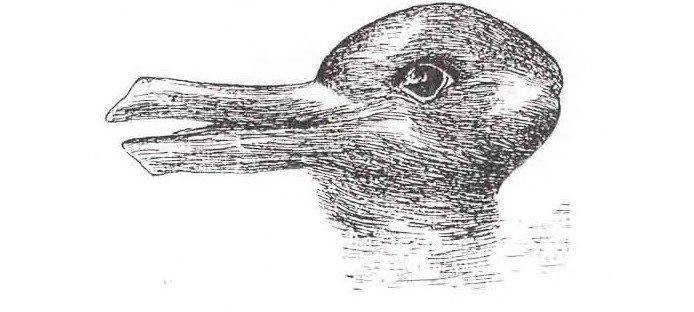
In 1892, an anonymous German illustrator drew the Duck-Rabbit Ambiguous Figure (Source).The duck-rabbit illusion led philosopher Ludwig Wittgenstein (1889 – 1951) to the insight that we often perceive the whole of something before noticing its parts. That interpretation of the whole then provides the context in which we see the parts. “We see a face as a face, not as a sum of eyes, nose, cheeks, and so on,” Wittgenstein (1953) wrote in Philosophical Investigations.

Wittgenstein did not say that we always perceive the whole first but that it is one type of perception. Our ability to rapidly identify faces supports the argument by Nancy Kanwisher and Galit Novel (2006) that the fusiform face area (FFA) is a part of the brain dedicated to face recognition. Some research has shown that the FFA may not be dedicated solely to faces but to any repeated visual identification task like identifying the make and model of cars (Source).

Daniel Kahneman and Amos Tversky (1974) have argued that we notice a few details and build an interpretation of the whole from those parts (Source). These shortcuts, or heuristics, explain our biases in interpreting what we experience. In his 2011 book Thinking Fast and Slow, Kahneman explained his dual system model of cognition. System 1 is fast and intuitive, able to build a coherent impression of some experience from limited information. We don’t need to look at all the jigsaw puzzle pieces to guess what the whole puzzle looks like. In Kahneman’s model, System 2 is slow and analytical, patiently putting all the pieces together to form a detailed impression.

In his book Determined: A science of life without free will, neuroscientist Robert Sapolsky (2023, pg. 407) notes that our nervous system must react in two extremely different time frames. The first is the lightning fast reaction to an immediate threat. The second is a considered judgment about an important transition in our lives.

Kahneman’s key insight was that we don’t need a lot of evidence to construct an impression. The quality of our evidence may be faulty as well. What determines our level of confidence in our interpretation of events is the coherence of the story that we build from that evidence. That leads me to the second axis I want to look at this week, levels of confidence.

Two parties dominate our politics. One party points to the beak on the left side of the  duck-rabbit illusion and says it’s a duck. The other party insists that those are the ears of a bunny, not the beak of a duck. Each party expects their followers to express belief in the party’s impression of the illusion. They must show confidence in the story and the party.

A jigsaw puzzle has a known and limited number of pieces. It says right on the box how many pieces there are. In life, how do we know that we have all the pieces? We don’t. We might argue that we don’t need all the facts to assess a particular situation. In the TV sitcom All in the Family, Archie Bunker often insisted to his son-in-law, Mike “Meathead” Stivic that he knew the truth when he saw it, that his common sense was superior to Mike’s academic knowledge.

In her 2016 book Weapons of Math Destruction, Cathy O’Neil drew a key distinction between understanding bounded phenomena like sports games and unbounded events like trading in the financial markets. The mathematics of Sabermetrics is used to analyze sports games like baseball. The key feature of games is that there is an end and a definite result. The game is over and one team won the game.

In finance, like life in general, the “game” is never over and there is no definitive win. An investment firm might make a winning trade one period only to find out the next period that they had misjudged the risk they had taken on. The winning trade in Period 1 can become a losing trade in Period 2 that threatens to “blow up” the firm’s portfolio and wipe out their investing capital as it did during the 2008 financial crisis. AIG and Goldman Sachs were one of many firms that exposed themselves to a lot of risk based on faulty risk assessment. They had looked at several puzzle pieces and were confident they knew what the whole jigsaw puzzle looked like. They did not account for the “simultaneity” risk when a number of firms made similar bets. They were wrong and the taxpayers had to bail them out.

How do we confirm our assessment of events? We can reach out to friends, family or co-workers for their impression. In this age of social media, we tend to connect with those who share our perspective and value system. Social media makes it easy to find people with biases similar to our own. We may only need a smidgeon of detail to confirm what we already believe to be true. During the 2024 campaign, Trump, Vance and a number of Republicans accused Haitian immigrants of eating dogs and cats in Springfield, Ohio (Source). The story was complete horse hocky, of course, and to many of us, the story lacked coherence. Why did it spread? Prejudice can infuse an incoherent story with credibility.

Rumors of Jews sacrificing Christian children often spread through communities in medieval Europe. What fueled this prejudice? The Catholic Church had long portrayed Jews as the killers of Christ and many Christians knew little about Judaism or its religious practices. As an outgroup, the Jews were sometimes assigned the unpopular task of tax collector. Because of the Christian prohibition on usury, i.e., charging interest on loans, Jews became a community’s moneylender. Both roles provoked economic tensions when times were hard. Like Jews, immigrants are convenient scapegoats. Got problems? Blame it on the Jews. Blame it on the immigrants.

Kahneman coined the term What You See Is All There Is, or WYSIATI, to describe the phenomenon where the story becomes the reality. Kahneman was probably inspired by the software acronym WYSIWYG, meaning that what a user sees on the screen is what they will see on the printed page. Our bias is that we think that what we see on the “screen” inside our minds represents an accurate picture of what is going on outside us. That bias enables us to take action, to form coalitions of other believers. Reality be damned. The reality is the shared story.

The best stories offer little evidence which could contradict the story. The Haitian rumor was one of those. The worst stories are built on a lot of video evidence. Each viewing of the evidence punches another hole in the story. The story is modified to repair its damaged coherence. Then more holes. Rarely does a political party abandon a shared story. Regardless of their relationship to reality, they build party loyalty. How long before this administration abandons its justification of the killing of Minneapolis protestor Alex Pretti?

I hope to see you next week.

////////////////////

Image Credit: Donaldson, J. (July 2016), “The Duck-Rabbit Ambiguous Figure” in F. Macpherson (ed.), The Illusions Index. Retrieved from https://www.illusionsindex.org/i/duck-rabbit. Creative Commons License

Sapolsky, R. M. (2023). Determined: A science of life without free will. Penguin Press.

Tversky, A., & Kahneman, D. (1974). Judgment under uncertainty: Heuristics and biases. Science, 185(4157), 1124–1131. https://doi.org/10.1126/science.185.4157.1124

Wittgenstein, L. (1953/2009). Philosophical investigations (P. M. S. Hacker & J. Schulte, Eds. & Trans.). Wiley-Blackwell.