Housing Affordability

August 14, 2022

by Stephen Stofka

The National Association of Realtors (2022) publishes a Housing Affordability Index (HAI) that measures median housing prices, mortgage rates and median family income to determine a ratio of housing costs to family income. June’s index was the lowest affordability since 1989. Since the Fed began raising rates this year, affordability has fallen by a third. In the notes I’ll include some comments on the methodology behind the HAI.

With technological progress, we expand our definition of what is a necessity. We argue whether government has a responsibility to ensure that each family has a certain level of sustenance – adequate housing, food, a source of income and access to educational resources. Those in neighborhoods with single family homes resist efforts to build affordable multi-family housing. A real estate developer earns a higher profit building expensive townhomes than affordable housing units. Should a developer be compensated if required to build affordable housing? City councils would prefer not to bring up the subject of using tax money to compensate a developer for doing less.

We disagree about who should pay, who should get and how much. Several decades ago, the homeless were less visible, a huddle of a human being lying under a tree or on a park bench, occupying about 18 square feet. In destination cities like Denver, Portland, L.A and other western states, encampments of homeless in colorful pop-up tents line downtown sidewalks and along streams and rivers that course through the town. Depending on the size of the tent each person may occupy up to 50 square feet. Like the rest of us, they are taking up more space per person. Are there more homeless or are they simply more visible?

The reasons why people are homeless are numerous and varied but the dynamics of housing supply and demand are key factors. Where demand for rental housing is low, landlords of affordable units may skip a criminal background or credit check. When demand is high, rents are higher and landlords are more discriminating. They may require higher security deposits as a tool to screen out renters. The annual change in rental costs was 6.3%, below the 7.3% increase in housing costs but workers’ wage increases have not kept pace in the past year. (I’ll put the series identifiers and index numbers in the notes at the end). Over a long time period, have earnings kept up with housing costs?

I began with 1973, the year that the U.S. and most of the world adopted floating exchange rates between currencies. This allowed capital more freedom to move around the world. Several economists mark that as a turning point when the returns to labor began to lag behind the returns to capital. Today’s workers make $612 for every $100 that workers made in 1973, a 6:1 ratio. Housing costs have risen even faster. The Bureau of Labor Statistics calculates that a person spends $888 for shelter today for each $100 spent in 1973. In computing the CPI, the Bureau of Labor Statistics (2022) and the Census Bureau include mortgage payments, taxes and insurance – PITI – to determine the cost of shelter itself (32% of income), about 5% for utilities and another 5% for maintenance and repairs. Together they make up more than 40% of a family’s income.

We measure things in order to compare qualities. An example might be measuring the width of a bookcase and the width of a space in the living room where we want to put the bookcase. Comparing total housing costs across five decades is difficult. We prefer to live in bigger spaces and in far greater comfort than we did 50 years ago. Today’s new homes average 2600 SF. The thirty year average is 1800 SF. Moura et al (2015) estimated that each of us has twice the space of a person living in 1900. Total housing costs may have grown almost 50% faster than wages but per capita housing space has grown at least as much. Adjusting for the larger personal space, we could conclude that wages have kept up with total housing costs. But that’s not how many of us perceive affordability. More space and comfort has become our standard.

Changing standards and expectations cause a shift in definitions and benchmarks. The BLS includes the cost of cell phones, computers and internet access under Information and Information Processing. Many families consider these to be utility expenses as necessary as the heating and electric bill. The BLS estimates a family spends 3.5% of their income on these modern day necessities – about $3000 a year. TV cable subscriptions add another 1%. Five decades ago, a family had a $0 monthly cost for these. Together that cost represents $320 per month that impacts housing affordability. The cars we drive today are safer, more mechanically reliable and more fuel efficient but we spend more of our income on transportation costs. In the post-war period, food and clothing were almost half of a typical family’s expenses. Today those items make up just 13% of a family’s spending (BLS, 2014). We live in bigger homes because other items that used to take up a lot of space in our budget have shrunk.

News media often puts current economic measures in historical context – the highest since and the lowest since – but these quantitative measures are not adjusted for improvements in the qualities of goods. On a hot summer’s day five decades ago, there might have been several overheated cars on the drive home from work. Changing a flat tire on the side of the road was common. Automobile deaths were far higher. Older people died from heat exhaustion in uncooled apartments and homes. Our standards and expectations have changed.

Each month economists measure thousands of data points – as numerous as the stars in the night sky. Economists and politicians connect those dots using different paths of reasoning, motivation and perspective. We may cling to a particular doctrine that clouds our interpretation of the data. In the end economic issues are personal. Have our earnings kept up with our housing costs?

////////////////

Photo by Tierra Mallorca on Unsplash

BLS. (2014, April). One Hundred Years of price change: The consumer price index and the American Inflation Experience : Monthly labor review. U.S. Bureau of Labor Statistics. Retrieved August 12, 2022, from https://www.bls.gov/opub/mlr/2014/article/one-hundred-years-of-price-change-the-consumer-price-index-and-the-american-inflation-experience.htm

BLS. (2022, February 11). Relative importance of components in the Consumer Price Indexes: U.S. city average, December 2021. U.S. Bureau of Labor Statistics. Retrieved June 17, 2022, from https://www.bls.gov/cpi/tables/relative-importance/2021.htm

Lautz, J. (2022, January 7). Tackling home financing and down payment misconceptions. http://www.nar.realtor. Retrieved August 12, 2022, from https://www.nar.realtor/blogs/economists-outlook/tackling-home-financing-and-down-payment-misconceptions

Moura, M. C., Smith, S. J., & Belzer, D. B. (2015). 120 years of U.S. residential housing stock and floor space. PLOS ONE, 10(8). https://doi.org/10.1371/journal.pone.0134135

National Association of Realtors (2022). Housing affordability index. http://www.nar.realtor. Retrieved August 12, 2022, from https://www.nar.realtor/research-and-statistics/housing-statistics/housing-affordability-index. As constructed, an affordability index of 100 should be affordable. However, the NAR calculates a mortgage payment that is not typical. They base their calculation on a 20% down payment. The average down payment is only 10%. First time buyers typically put down only 7% (Lautz, 2022). This raises the mortgage payment and lowers the affordability. After adjusting for this, an HAI reading of 140 is probably a better benchmark of affordability.

 U.S. Bureau of Labor Statistics, Consumer Price Index for All Urban Consumers: Housing in U.S. City Average [CPIHOSSL], retrieved from FRED, Federal Reserve Bank of St. Louis; https://fred.stlouisfed.org/series/CPIHOSSL, August 13, 2022. July’s annualized increase was 7.3% and climbing.

U.S. Bureau of Labor Statistics, Consumer Price Index for All Urban Consumers: Rent of Primary Residence in U.S. City Average [CUUR0000SEHA], retrieved from FRED, Federal Reserve Bank of St. Louis; https://fred.stlouisfed.org/series/CUUR0000SEHA, August 13, 2022. July’s annualized increase was 6.3% and climbing.

U.S. Bureau of Labor Statistics, Consumer Price Index for All Urban Consumers: Shelter in U.S. City Average [CUSR0000SAH1], retrieved from FRED, Federal Reserve Bank of St. Louis; https://fred.stlouisfed.org/series/CUSR0000SAH1, August 12, 2022. Note: Total cost of shelter was 39.90 in April 1973 and in 2022 it is 354.45, an 8.88 ratio.

U.S. Bureau of Labor Statistics, Average Weekly Earnings of Production and Nonsupervisory Employees, Total Private [CES0500000030], retrieved from FRED, Federal Reserve Bank of St. Louis; https://fred.stlouisfed.org/series/CES0500000030, August 12, 2022. In July 1973 the index was 153.14. In July 2022 937.38. A 6.12 ratio.

A Virtuous Cycle

August 7, 2022

by Stephen Stofka

July’s employment survey (BLS, 2022) reported a half-million job gains and marked a milestone – the recovery of all the jobs lost during the pandemic. In addition, earlier employment gains were revised higher by 28,000. The BLS survey indicated that only 7.1% of employees worked remotely, a surprising contrast to the amount of attention that the media gives teleworking. Last week, I discussed the dating of recessions. With this report, it is unlikely that the dating committee at the NBER will dub this a recession. Consumption, income, employment and investment are the pillars of this economy and they are doing well, contributing to the current inflationary trends.

Annual gains in private investment topped 18% in the second quarter, besting the 16% gain in 2012:Q1 a decade ago (series notes at end). Businesses invest in people, driving up employment gains. In the graph below, I multiplied the annual gain in employment by 4 to show the correlation between investment and employment.

Higher employment leads to higher incomes. Just as employment has returned to pre-pandemic levels, real (inflation-adjusted) disposable incomes are now at pre-pandemic levels. Disposable income includes government transfers like social security and pandemic stimulus checks. The last stimulus checks went out in March/April 2021, more than a year ago. It’s a good bet that these are sustainable income numbers produced by economic growth, not the result of special  transfer payments.

Higher incomes lead to higher spending. Real (inflation-adjusted) consumption spending marked an annual gain of 1.57% in June and is now up 4.5% over pre-pandemic levels. Consumers have made an abrupt shift from buying goods to buying services. Real sales at restaurants are now 10% above pre-pandemic levels.

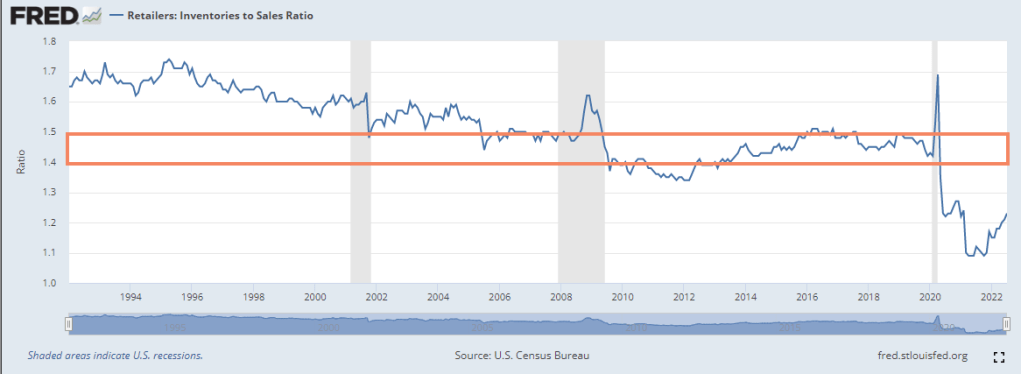
To keep up with high demand for goods and clogged shipping ports during the pandemic, Target and Wal-Mart ordered extra and now have more inventory than they would like. Their loss is the travel and leisure industry’s gain. Marriott Hotels (2022) reported a surge in demand this year. In the U.S. and Canada, their leisure traffic is 15% above pre-pandemic levels and their revenue per room is about the same as in 2019.

Higher incomes usually lead to higher savings. In the decade before the pandemic, households saved 6-7% of disposable income. In 2020 and 2021, the savings rate averaged a whopping 20% and 12%. Most of that higher savings was done by households with higher incomes. Congress could have passed a CARES act that sent stimulus payments only to those with lower incomes, but they chose not to. Those additional savings became investment and that brings us full circle to the higher investment and employment – a virtuous cycle that Adam Smith wrote about more than two hundred years ago.

////////////////////

Photo by Markolf von Ketelhodt on Unsplash

BLS. (2022, August 5). Employment situation summary – 2022 M07 results. U.S. Bureau of Labor Statistics. Retrieved August 5, 2022, from https://www.bls.gov/news.release/empsit.nr0.htm

Marriott Internatonal. (2022, August 2). Marriott International Reports Outstanding Second Quarter 2022 results and resumes share repurchases. Marriott International Newscenter (US). Retrieved August 5, 2022, from https://news.marriott.com/news/2022/08/02/marriott-international-reports-outstanding-second-quarter-2022-results-and-resumes-share-repurchases

U.S. Bureau of Economic Analysis, Gross Private Domestic Investment [GPDI], retrieved from FRED, Federal Reserve Bank of St. Louis; https://fred.stlouisfed.org/series/GPDI, August 5, 2022.

U.S. Bureau of Economic Analysis, Real Personal Consumption Expenditures [PCEC96], retrieved from FRED, Federal Reserve Bank of St. Louis; https://fred.stlouisfed.org/series/PCEC96, August 4, 2022.

U.S. Bureau of Economic Analysis, Real Disposable Personal Income [DSPIC96], retrieved from FRED, Federal Reserve Bank of St. Louis; https://fred.stlouisfed.org/series/DSPIC96, August 4, 2022.

U.S. Bureau of Economic Analysis, Personal saving as a percentage of disposable personal income [A072RC1Q156SBEA], retrieved from FRED, Federal Reserve Bank of St. Louis; https://fred.stlouisfed.org/series/A072RC1Q156SBEA, August 4, 2022.

U.S. Census Bureau, Advance Retail Sales: Food Services and Drinking Places [RSFSDP], retrieved from FRED, Federal Reserve Bank of St. Louis; https://fred.stlouisfed.org/series/RSFSDP, August 5, 2022. Note: I adjusted for inflation using the CPI.

 U.S. Bureau of Labor Statistics, All Employees, Total Nonfarm [PAYEMS], retrieved from FRED, Federal Reserve Bank of St. Louis; https://fred.stlouisfed.org/series/PAYEMS, August 5, 2022.

Different Measures

July 31, 2022

by Stephen Stofka

Inflation around the world is high but the primary contributors to rising prices vary by region. In the U.S., heightened demand has outpaced supply. In Europe, supply and rising costs have had the most influence on inflation. Price growth is outpacing wage growth, adding pressure to many household budgets. This week the first estimate of GDP growth in the second quarter was -0.9%, the second consecutive quarter of negative growth. Economists offered varying definitions of recession while politicians threw blame and accusations for the economic downturn. Only Japan and Germany have lower unemployment rates than the 3.6% rate in the U.S. (OECD, 2022). In the fall of 2019, Mr. Trump bragged when the rate was that low. Political messaging is founded on diversion, delusion and doubt. 

Let’s start with the inflation rate, a crucial factor in the calculation of real GDP, the headline GDP numbers that are highly publicized. The inflation rate is deducted from the quarterly growth in nominal GDP to arrive at an inflation-adjusted measure of output. The higher the inflation rate, the lower the real GDP growth rate. In the 38 developed countries that comprise the OECD, average inflation in the 2nd quarter was 9.6% and GDP quarterly growth was 0.2%, a flatline in growth. Stuck in a three decade economic malaise, only Japan had a reasonable inflation rate of 2.4%. Here are the inflation rates in a few selected countries: U.S. 9.1%, U.K. 8.2%, Germany 7.6%, Italy 8.0%, France 5.8%. The 19 countries of the Eurozone are averaging 8.9% inflation and GDP growth of 0.5%. Only 40% of OECD countries have growth greater than 1% and those countries have relatively small economies (OECD, 2022).

Gross National Product, GDP, is the most widely publicized measure of economic activity but there are alternative measures. GDP emphasizes production within a country’s borders regardless of ownership. If a Japanese firm owns an auto plant in Tennessee, that production is counted even though the profits are flowing to Japanese investors.

Gross Domestic Income, GDI, includes income from all American owned production around the world but would not include income to the Japanese owners of the Tennessee plant. Ford co-owns 50% of Changan Ford Automobile Corporation, Ltd. in China. GDI would include income from that production. U.S. companies have large investments around the world so GDI captures that global presence.

The two measures capture different aspects of a country’s economy. The graph below charts the quarterly growth in real, or inflation-adjusted GDP and GDI (BEA, 2022). Notice that GDI quarterly growth remained positive in the 1st quarter.  The Bureau of Economic Analysis (BEA, 2021) won’t release 2nd quarter data for Gross Domestic Income for another month. A third measure, Final Sales of Domestic Product, excludes inventory adjustments and it turned positive in the second quarter.

(BEA, 2022)

Major League Baseball uses high frame rate cameras to capture the second-by-second action on the field. With the advantage of multiple angles and slow motion, a review committee in NYC overturns almost 50% of disputed calls (AP, 2020). While the players and fans wait for that review, they argue the call.

In the U.S., the final arbiter of recessions is a recession dating committee at a private, non-partisan organization called the National Bureau of Economic Research (NBER, 2022). The committee requires several months to gather enough data to determine the start of a recession. They announced the start of the 2001 recession at the end of that recession. In the FAQ accompanying the announcing the committee warned that two quarters of negative growth do not always count as a recession because the committee uses monthly data (NBER, 2001). Neither the Fed nor political parties can wait for all the information. The Fed makes monetary decisions in real time. An opposition political party uses even the hint of recession in an election year to sow doubt in the minds of voters.

On June 3, 1980, five months before the Presidential election, the NBER (1980) declared a probable start to a recession in January of that year. That announcement gave Republican challenger Ronald Reagan momentum against incumbent Jimmy Carter. In 1992, as unemployment continued to rise following the 1990 recession, challenger Bill Clinton suggested that we might be headed for another recession and called for a change in leadership. In their campaigns, John F. Kennedy (1960) and George Bush (2000) suggested that the economy might already be in a recession as the election neared. Both called for a change in leadership. This year Republicans will run on economic issues conveniently summarized with one word – inflation and recession. Democrats can highlight historically high employment gains and a low unemployment rate and will certainly run on individual rights.   

In baseball, the MLB central review office makes the final call on disputed calls. In national accounting, the recession dating committee at the NBER makes the determination of the start and end of recessions. In disputed decisions among lower courts, the Supreme Court makes the final determination and rule. In presidential elections, the electoral college makes the final call. We may not like the calls but we agree to live by them. Following the 2020 election, former President Trump and his allies broke that agreement and on January 6th tried to overturn the final call by violence. There’s a single word for that – coup.

///////////////////

Photo by patricia serna on Unsplash

AP. (2020, July 21). MLB doubles camera angles for video reviews of umpires. Tampa Bay Times. Retrieved July 29, 2022, from https://www.tampabay.com/sports/rays/2020/07/21/mlb-doubles-camera-angles-for-video-reviews-of-umpires/

BEA. (2022, June 29). Gross Domestic Income. Gross Domestic Income | U.S. Bureau of Economic Analysis (BEA). Retrieved July 29, 2022, from https://www.bea.gov/data/income-saving/gross-domestic-income

U.S. Bureau of Economic Analysis (BEA). (2022). Real gross domestic income [A261RX1Q020SBEA], retrieved from FRED, Federal Reserve Bank of St. Louis; https://fred.stlouisfed.org/series/A261RX1Q020SBEA, July 29, 2022.

U.S. Bureau of Economic Analysis (BEA). (2022). Real Gross Domestic Product [GDPC1], retrieved from FRED, Federal Reserve Bank of St. Louis; https://fred.stlouisfed.org/series/GDPC1, July 29, 2022.

U.S. Bureau of Economic Analysis (BEA). (2022). Real Final Sales of Domestic Product [FINSLC1], retrieved from FRED, Federal Reserve Bank of St. Louis; https://fred.stlouisfed.org/series/FINSLC1, July 29, 2022.

NBER. (1980, June 3). Business cycle dating committee announcement June 3, 1980. NBER. Retrieved July 29, 2022, from https://www.nber.org/news/business-cycle-dating-committee-announcement-june-3-1980

NBER. (2001). Business cycle dating committee announcement November 26, 2001. NBER. Retrieved July 29, 2022, from https://www.nber.org/news/business-cycle-dating-committee-announcement-november-26-2001#:~:text=of%20this%20memo.-,FAQs,the%20recession%20in%20March%202001.

NBER. (2022). US business cycle expansions and contractions. NBER. Retrieved July 29, 2022, from https://www.nber.org/research/data/us-business-cycle-expansions-and-contractions

OECD. (2021, May 25). OECD welcomes Costa Rica as its 38th member. OECD. Retrieved July 29, 2022, from https://www.oecd.org/newsroom/oecd-welcomes-costa-rica-as-its-38th-member.htm

OECD (2022), Inflation (CPI) (indicator). doi: 10.1787/eee82e6e-en (Accessed on 29 July 2022)

OECD (2022), Quarterly GDP (indicator). doi: 10.1787/b86d1fc8-en (Accessed on 29 July 2022)

OECD (2022), Unemployment rate (indicator). doi: 10.1787/52570002-en (Accessed on 29 July 2022)

When We Swarm

July 24, 2022

by Stephen Stofka

Economists study individual and group human behavior as we try to satisfy our needs. Sometimes the sum of the quests for individual satisfaction produces an outcome that is unexpected or contradictory to the aims of each individual’s choices. People may synchronize their behavior to a point that their accumulated actions overload a system, causing it to become dangerously unbalanced and lead to a collapse. Our modern communication systems may introduce more frequent panics, more opportunities for reactionary zeal and anger.

During the Great Depression, the economist John Maynard Keynes proposed a Paradox of Thrift. Saving money is a prudent choice for each person but if too many people decide to save money at the same time, economic activity declines. An extreme example is the 2008 financial crisis and recession when millions of people decided to curtail their current spending, the blue line in the graph below, and increase their savings. This is the power of uncoordinated expectations. We act sometimes as if our actions were being choreographed.

These paradoxes introduce contradictions that challenge our assumptions and ideologies and cause a lot of disagreement among economists and the public. In an EconTalk (2009) podcast, economist Steve Fazzari explained the immediate consequences of the Paradox of Thrift. In an effort to save money for college, a family foregoes their weekly meal out at a nearby restaurant. At the first occurrence, the family saves money which they deposit in a bank savings account. The next day the restaurant owner must withdraw that same amount from the restaurant’s savings to make up for the lost revenue. In that immediate time frame, there is no increase in savings/investment and this violates the ideologies of some listeners. As the pattern continues, the restaurant owner will adjust her expectations for revenue and lay off some workers. The podcast listeners interpreted Fazzari’s analogy in several different ways. They could not agree on what a short time frame is or the scope of the story.

We see and hear words and events differently yet sometimes respond in a seemingly coordinated fashion. Our panicked response may cause or amplify the very thing we fear. In September 2008, banks and investment firms lost trust in the soundness of each other’s assets. The loss of confidence caused the value of those assets to plummet, actualizing the fear. The Fed and central banks around the world struggled to contain the panic as the global financial system seized up like an engine without oil. In March 2020, central banks were better prepared, flooding the markets with liquidity at the onset of the Covid-19 pandemic. Still we swarmed onto the streets, emptying shelves of merchandise ahead of lockdowns.

Every culture has its account of the consequences of humankind’s hubris, a lesson in the perils of our own arrogance. The Bible accounted for the variety of languages with the story of the Tower of Babel. Our phones connect us to the information hive, instantly relaying breaking news in our language of choice. The internet brings us together and drives us apart. As our communications become more rapid and extensive, we increase the likelihood of global panics, an unplanned reaction to some event. Fringe groups become more adept at coordinating their anger and actions like they did at the Capitol on January 6th. Our culture evolves with our technology but our laws are slow to adapt. Our mechanism of lawmaking, adapted to a horse and buggy age of communication, will have to be redesigned before it breaks apart our society, our culture and our union.

///////////////

Photo by Ante Hamersmit on Unsplash

EconTalk. (2022, April 21). Fazzari on Keynesian economics. Econlib. Retrieved July 23, 2022, from https://www.econtalk.org/fazzari-on-keynesian-economics/#c57267

Price Tides and Cultural Waves

This week I’ll look at the week’s events within a broad context of several centuries so make sure your seat belt is secure! Two weeks ago I wrote about two reliable indicators of recession, the annual acceleration in unemployment and in real retail sales. Since World War 2, an upward tick in unemployment and a downward movement in real retail sales has always preceded a recession. The unemployment report came out last week ending July 10th. The acceleration in the unemployed has remained negative, not confirming a high likelihood of a recession in the presence of weak retail sales.

The latest reports on inflation and retail sales were released this week. Although retail sales showed an increase, inflation adjusted retail sales decreased from last year. The deceleration in real retail sales is severe at -26%, indicating the dramatic consumer response to inflation and higher interest rates. Whether economists declare an official recession or not, consumers are feeling the pain and uncertainty. Here is an update on a graph I showed two weeks ago.

(FED, BLS, 2022)

In 2011, we saw a similar pattern – a plunge in retail sales but not an annual rise in the unemployment rate. There was a budget battle, a looming government shutdown and the stock market dropped 20% in anticipation of a recession that did not materialize. In the first quarter of 2012, the stock market began another historic climb, rising 60% in 30 months.

Each week we are reminded of rising food and energy prices but the rise in the cost of housing has been the most dramatic. According to Redfin (2022), a national real estate brokerage, a townhome in LA had a typical mortgage of almost $2400 in February 2021. In June 2022, they estimate a monthly mortgage cost of $4000, making it more expensive to own a townhome than to rent.

In David Hackett Fischer’s (1996) book The Great Wave he wrote about four centuries where prices continued to rise even during economic downturns. He dubbed these periods of sustained inflation “price revolutions.” The approximate dates are the 1200s, 1500s, 1700s, and 1900s (p. 6). The current price revolution began after World War 2, with prices falling only three times. Despite the severe recessions of 1974 and 1982, prices continued to rise.

Price revolutions create class conflict. The prices of life sustaining commodities like food, basic commodities, energy and shelter go up, having a greater impact on people with lower incomes. There are higher returns to property and capital owners. The price movements of manufactured goods are more tame but these benefit those with higher incomes, exacerbating class tensions (p. 86).

According to the Dept of Agriculture (USDA, 2022), the cost of food at home has fallen in only two of the last fifty years – in 2016 and 2017. There have been nine recessions since WW2, but the cost of shelter has fallen in only one year – 2010 (BLS, 2022). In a period of sustained price increase, people need more money. Since 1960, the per person quantity of a broad measure of money called M2 has declined in only two years – 1993 and 1995 (BOG, BEA, 2022).

Fischer identified seven causes of inflation (p. 279-280). Let’s review these in light of the rise in the cost of shelter. The first is an expansion of the money supply. A textbook example is the 1920s in Weimar Germany when people carted money in wheelbarrows to buy groceries. Today the Federal Reserve increases the money supply by lowering interest rates. People demand more credit and the banks increase the money supply. Low mortgage rates increase housing debt and the demand for housing.

A second cause  of inflation is an increase in aggregate demand. An extreme example is the surge in military spending during WW2. In this case we are focused on one sector – housing. According to the Case-Shiller Home Price Index (S&P, 2022), home prices have risen at last 5% each year in the past decade. China’s rapid industrialization since 2000 has elevated global demand for building supplies. A third cause of inflation is a contraction in supply. The pandemic caused supply bottlenecks in the supply of lumber and other building materials. A fourth cause is rising input costs, or “cost push inflation.” This is sometimes associated with rising wages as happened in the 1960s, but real wages in the decade before the pandemic rose only 5%, according to the BLS (2022). In that same ten year period, the costs of building materials rose 26% and jumped 50% in the second quarter of 2021 (BLS, 2022).

A fifth cause of inflation are administered prices, or oligopolies and monopolies created by government action or as part of an international pact. A good example is the alliance of oil exporting countries known as OPEC. This has not been a factor in the latest rise in home prices. A sixth cause is “bubble inflation” like the tulip mania of 1634 or the more recent surge in home prices during the 2000s. People bought homes in the expectation of a rapid rise in home asset values and they paid little attention to the home’s affordability.

The seventh cause of inflation is more applicable to the recent surge in home prices and current Fed policy – inflationary expectations. Anticipating higher prices of goods and services, people buy now, increasing demand and prices. The expectation starts a chain of events that fulfills the expectation. The late 1970s is a good example of this. Anticipating a 25% increase in the price of stereo in the coming year, a consumer would buy now on an installment plan, paying 15-20% interest. They were saving money and getting to use the stereo free for a year! It is that kind of thinking that the Fed wants to contain because those expectations continue to fuel inflation. Each of these inflationary factors adds to the persistence of inflation. Five of the seven causes are clearly present in this latest bout of inflation but the pandemic is the culminating event of decades of inflation.

In previous price revolutions, a crisis event led to a fundamental transformation of society, attitudes and thinking. The plague of 1348 ended the price revolution of the 1200s and early 1300s. In its aftermath,  humanism emerged and the serfdom of the Middle Ages declined. The price revolution of the 1500s was followed by the Thirty Years War and the founding of the nation state that persists to this day. The Age of Enlightenment accompanied the price revolution of the 1700s. Napoleon’s defeat at Waterloo in 1815 marked the beginning of the Modern Age, a revolution in travel, communications and industrial production. Will historians mark this pandemic as the end of the price revolution of the 1900s and the start of a new age?  

////////////////////

Photo by Silas Baisch on Unsplash

Board of Governors of the Federal Reserve System (US), M2 [M2SL], retrieved from FRED, Federal Reserve Bank of St. Louis; https://fred.stlouisfed.org/series/M2SL, July 15, 2022.

Federal Reserve Bank of St. Louis, Advance Real Retail and Food Services Sales [RRSFS], retrieved from FRED, Federal Reserve Bank of St. Louis; https://fred.stlouisfed.org/series/RRSFS, July 15, 2022.

Fischer, D.H. (1996). The Great Wave. Oxford University Press, NY.

Redfin. (2022, June). Data center. Redfin Real Estate News. Retrieved July 15, 2022, from https://www.redfin.com/news/data-center/. Note: at the bottom of the page is Redfin Monthly Rental Market Data. Enter the market and type of housing you are interested in.

S&P Dow Jones Indices LLC, S&P/Case-Shiller U.S. National Home Price Index [CSUSHPINSA], retrieved from FRED, Federal Reserve Bank of St. Louis; https://fred.stlouisfed.org/series/CSUSHPINSA, July 15, 2022.

U.S. Bureau of Labor Statistics, Consumer Price Index for All Urban Consumers: All Items in U.S. City Average [CPIAUCSL], retrieved from FRED, Federal Reserve Bank of St. Louis; https://fred.stlouisfed.org/series/CPIAUCSL, July 15, 2022.

U.S. Bureau of Labor Statistics, Consumer Price Index for All Urban Consumers: Shelter in U.S. City Average [CUSR0000SAH1], retrieved from FRED, Federal Reserve Bank of St. Louis; https://fred.stlouisfed.org/series/CUSR0000SAH1, July 15, 2022.

U.S. Bureau of Labor Statistics, Producer Price Index by Industry: Building Material and Supplies Dealers [PCU44414441], retrieved from FRED, Federal Reserve Bank of St. Louis; https://fred.stlouisfed.org/series/PCU44414441, July 15, 2022.

U.S. Bureau of Labor Statistics, Employed full time: Median usual weekly real earnings: Wage and salary workers: 16 years and over [LES1252881600Q], retrieved from FRED, Federal Reserve Bank of St. Louis; https://fred.stlouisfed.org/series/LES1252881600Q, July 15, 2022.

U.S. Bureau of Labor Statistics, Unemployment Rate [UNRATE], retrieved from FRED, Federal Reserve Bank of St. Louis; https://fred.stlouisfed.org/series/UNRATE, July 15, 2022.

U.S. Bureau of Economic Analysis, Population [POPTHM], retrieved from FRED, Federal Reserve Bank of St. Louis; https://fred.stlouisfed.org/series/POPTHM, July 15, 2022

USDA. (2022, June 24). Food price outlook. USDA ERS – Food Price Outlook. Retrieved July 15, 2022, from https://www.ers.usda.gov/data-products/food-price-outlook/

S&P Dow Jones Indices LLC, S&P/Case-Shiller U.S. National Home Price Index [CSUSHPINSA], retrieved from FRED, Federal Reserve Bank of St. Louis; https://fred.stlouisfed.org/series/CSUSHPINSA, July 15, 2022.

Oil and Inflation Diverge

July 10, 2022

by Stephen Stofka

The jobs report this past Friday surprised to the upside, showing a monthly gain of 372,000 jobs, far above the 250,000 expected gain. This is one of three indicators I wrote about last week. The positive job gains lowers the chances of a coming recession but the Atlanta Fed is now projecting a 2nd quarter decline of 2% in real GDP. As some economists have noted, it is unusual to have strong positive employment growth and negative GDP growth. In the graph below is the percent change in employment (blue line) and real GDP (red line). Since labor accounts for the majority of production costs, the two series move closely together.

Historically, employment growth (blue line) is declining before recessions. Here is a look at the period before the 2008-9 recession.

Let’s turn to another prominent concern – inflation. When the price of oil declined below $100 this past week, some economists interpreted that as a sign of decreased demand and a greater likelihood of recession. The price of oil factors into the production of most goods, even the electricity that comes into our homes. In the graph below I’ve charted the acceleration in the price of oil and prices in general. The magnitude is less important than the direction. Most of the time, the direction of each is the same.

Now I want to focus on recent years. As the economy recovered from pandemic restrictions in 2021, the changes in both series shot higher as expected. In the past year, the acceleration in oil prices (blue line) has declined while the acceleration in general prices has gone up.

The divergence is unusual and indicates that inflation is grounded more in supply disruptions and pent up demand than in the price of oil. I’m guessing that the Fed has noticed a similar trend. To appreciate how unusual this divergence is, let’s go back to the 1970s when the price of a barrel of oil went from $3 to $34. Even though the price movement was extreme, the acceleration in oil prices and the general price level moved in the same direction.

There is no shortage of opinions about Fed monetary policy and the Biden administration’s fiscal policy. The second stimulus payments went out in the first two weeks of 2021 under the Trump administration. Retail sales rose 5% that month, but fell 2% in February. Inflation in February was 1.7%, below the Fed’s target of 2%. On March 11, 2021, six weeks after taking the oath of office, Joe Biden signed the American Rescue Plan and in late March a third round of stimulus payments went out. Retail sales rose 11% in March but most of that increase happened before people received their payment. The odd thing is that there was little change in retail sales in the following months. This is one of many oddities surrounding this pandemic.

The general adult population received vaccines in April, May and June. Inflation rose above 5% by June 2021, then leveled off through September. In the graph above, the acceleration in oil prices and the general price level began to show a divergence. In the last three months of 2021, inflation started climbing while the acceleration in oil started falling. Why? It had never happened before.

Russia’s invasion of Ukraine has aggravated the situation and no one is happy. Xcel Energy, the public utility in my area, has raised electricity prices by 42% over last year; natural gas prices by 14%. The Fed’s next FOMC meeting is July 26-27 and the market is pricing in a 97% chance that the Fed will raise interest rates by another .75%, moving the federal funds effective rate near 2%. From 1954-2008, the average rate was 5.65%. From 1988-2008, the rate averaged 4.71%. Since 2008, the rate has averaged .62%. Near zero interest rates are abnormal.

Can the Fed retrain investors and consumers expectations toward a 3-4% federal funds rate in line with historical averages? The Fed conducts a lot of research but the current circumstances are unusual and the data shows conflicting trends. In a few years with the benefit of hindsight and firm, revised data, an economist can devote a few chapters if not an entire book to the past two years.

///////////

Photo by Tim Johnson on Unsplash

The Economic Valley

July 3, 2022

by Stephen Stofka

The Atlanta branch of the Federal Reserve maintains a running estimate of current output and other economic indicators updated sometimes daily as reports are released. The app is called EconomyNow and includes GDP, unemployment (UE), retail sales, and inflation. Recent data has caused them to revise their forecast for GDP growth in the 2nd quarter to a -2.1% annualized rate from 0% earlier in the week. Just a month ago, the model was forecasting 2% growth. If there was actually negative growth in the 2nd quarter, that would be two consecutive quarters of negative growth, increasing the likelihood that the Bureau of Economic Analysis (BEA) would call this a recession. However, the BEA does not rely on a single number to call a recession. Let’s look a bit deeper at past recessions.

Out of the many economic reports released each month, the unemployment (UE), inflation and retail sales reports have been reliable predictors of recession. The inflation report is used to adjust retail sales for inflation and produce what are called real retail sales. The combination of positive growth in UE and negative growth in real retail sales is a clear indicator of a weakening economy. The UE report for June will be released this coming Friday, the inflation report on July 13th and retail sales on July 15th.

Before each recession, the quarterly average of the unemployment rate rises above that of the previous year. Because the same quarter is compared in both years, the seasonal adjustments and economic flows are similar, an “apples-to-apples” comparison. Look at the rise in UE just before the 1990 and 2001 recessions, shaded gray in the graph below. (I will leave the series identifiers in the footnotes at the end of this post). Notice the hint of a recession in the first quarter of 1996. The Fed had raised interest rates by 3% in the previous year to curb growing inflation, then began lowering them at the end of 1995, averting what might have been a shallow recession.

Before the 2007-2009 recession, the growth of UE turned positive.

At the start of 2020, the UE was about the same as it was the previous year, an indication that the economy was susceptible to a shock. The pandemic was the shock of the century.

Let’s add in another indicator, real retail sales, and revisit these periods. When UE growth is positive, state unemployment benefits are rising while income tax revenues are falling. If retail sales are falling, then sales tax revenues are falling as well, putting additional budget pressures on states and localities. 1996:Q1 UE growth had barely turned positive but the growth in real retail sales was still positive and did not confirm the weakness in UE. In 2001, UE growth was positive and real retail growth was negative, confirming the economy’s weakness as investors became disillusioned with the heady promises of the new internet economy.

Before the 2008 recession, UE growth turned positive as real retail sales growth turned negative.

Let’s turn from that historical perspective to our current situation. In the 1st quarter of 2020, these two indicators turned positive and negative because of the pandemic, not in advance of it. At the end of 2019, UE growth was at zero, indicating a weakening economy. However, real retail sales growth was 1.6%.

There is a lot of talk about recession but these two indicators are not confirming that prediction. Growth in real retail sales is still positive and UE growth is negative. The reports in the next two weeks will give us a better picture of recession probabilities. The retail report comes out on July 15th, which is a Friday. The market will react to this report as it does most months. I will update the graph to include both of these indicators in my blog post for July 17th. Have a good 4th celebration and be careful if you live in a western state where it has been dry this year.

//////////////

Photo by Hans Luiggi on Unsplash

U.S. Bureau of Labor Statistics, Unemployment Rate [UNRATE], retrieved from FRED, Federal Reserve Bank of St. Louis; https://fred.stlouisfed.org/series/UNRATE, July 2, 2022.

Federal Reserve Bank of St. Louis, Advance Real Retail and Food Services Sales [RRSFS], retrieved from FRED, Federal Reserve Bank of St. Louis; https://fred.stlouisfed.org/series/RRSFS, July 2, 2022.

A Court of Many Opinions

June 26, 2022

by Stephen Stofka

In the past two decades the Roberts’ court has overturned several long standing court precedents and laws. In Heller and Citizens United, the court has favored the greatest degree of individual freedom in their reading of the 1st and 2nd Amendment. In this week’s 5-4 decision to overturn Roe, the court has chosen the least amount of individual freedom in their interpretation of the 14th Amendment. In his concurring opinion, Justice Clarence Thomas stated a desire to overturn other court precedents based on the 14th Amendment. In 2013, the court’s Shelby decision overthrew portion of the Voting Rights Act based on the 14th Amendment.

Before overturning the “separate but equal” doctrine that had been in place for five decades, newly appointed Chief Justice Earl Warren delayed the Brown v. Board of Education decision by six months to try and convince two of the justices to change their vote and make the decision unanimous. Warren demonstrated a respect for the principle of stare decisis that the Roberts court does not have. This week’s decision overturned five decades of legal precedent on a 5-4 vote. At Scotusblog, Amy Howe (2022) notes the disagreement among the justices as to what their decision means going forward.

The six conservative members of the Supreme Court are members of the Federalist Society. Each working day of the session they gather in a candle lit chamber in the basement of the Supreme Court Building and kneel down before the Grand Jurist of the Federalist Society.

“Do you believe in the sanctity of the text?” they are asked and each affirms their belief.
“Do you swear to only write opinions and never write law?” the Grand Jurist asks and they each swear an oath.

Around each neck, an acolyte drapes a necklace adorned with eyes of newt, the claw of an eagle, the eye of a falcon. Each jurist will deftly weave through the jungle of legal texts like a newt. Each jurist will grasp the text’s relevant truth like an eagle. Each jurist will have the wide vision but narrow focus of a falcon.

Each jurist puts their thumbs and forefingers together to form the letter “O.” “Do you swear to observe the commandments of Originalism?” the Grand Jurist asks and each affirms obedience. Each justice stands and is wrapped in the black robe of objective jurisprudence based on the meaning of the original text as the lawmakers understood it. They bow to the Grand Jurist and are escorted to their individual chambers.

Their law clerks bring each justice the finger bones of dead lawmakers and jurists – the 18th century jurist Blackstone, the forefingers of Jefferson, Adams, the signers of the Constitution and the Amendments. Into a bowl go the bony digits and the justice gives the bowl three shakes, and no more. Two law clerks tie the dark bandana of Originalism around the justice’s eyes. In a ritual called “throwing the bones,” the justice withdraws a bone from the bowl, and lays it at a random spot on the unfurled scroll of sacred text. Twice more the ritual is performed, then the bowl is put aside and the bandana untied.

Jefferson’s finger may point to the “privileges and immunities” clause in the 14th Amendment and a clerk solemnly records the historical precedent. The thumb of John Bingham, the author of the first section of the 14th Amendment, may point to the “life, liberty, or property” phrase in that same Amendment. The pinky digit of Thurgood Marshall might point to the “due process” phrase in the 5th Amendment. These will be the foundations of the justice’s opinion. The bones are returned to their vessels, the scrolls rolled up and secured. The bones and their placement are different for each justice.

The clerks begin a scan of the databases containing all the sacred texts, searching for the occurrence of each phrase and an indication of how the lawmaker or previous justice understood those phrases. In the course of several months, each justice assembles these perspectives into an opinion which they hand first to the Grand Jurist of the Federalist Society. The Grand Jurist selects that opinion that most faithfully follows the principles of Originalism, secures that opinion with a wax seal, then imprints the wax seal with his ring. An acolyte then delivers the opinion to the Chief Justice, John Roberts and the opinion is made public.

The Grand Jurist was 22 and in law school when Roe v. Wade was decided fifty years ago. He never liked that decision. This Friday, the Grand Jurist smiled as he closed the heavy door to the underground chamber below the Supreme Court.

//////////////

Photo by Danika Perkinson on Unsplash

Howe, A. (2022, June 24). Supreme Court overturns constitutional right to abortion. SCOTUSblog. Retrieved June 24, 2022, from https://www.scotusblog.com/2022/06/supreme-court-overturns-constitutional-right-to-abortion/

Price Acceleration

June 19, 2022

by Stephen Stofka

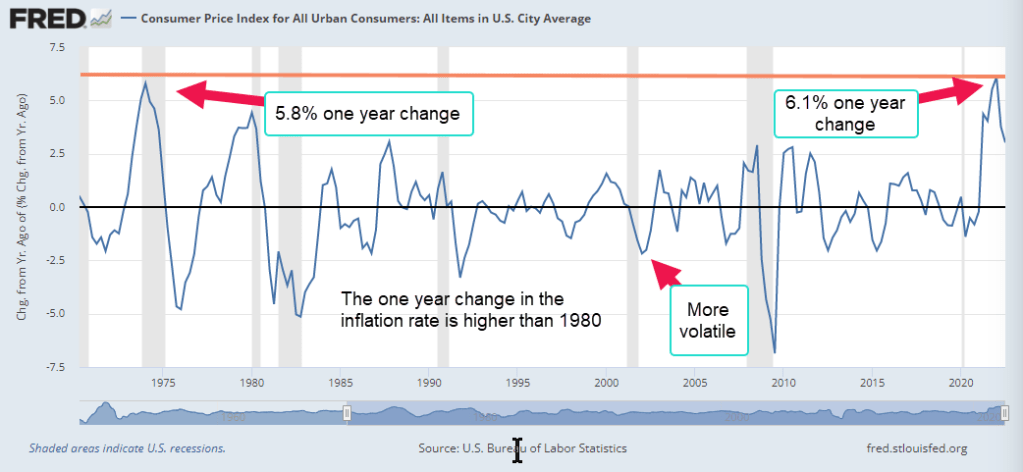
There are several series of inflation and each offers a different perspective on annual price changes. Each month the Bureau of Labor Statistics publishes a headline number CPI-U, or Urban index, which estimates the annualized price change for urban dwellers of all ages. It also publishes a CPI-W or Worker index, which is focused on the spending priorities of working families. Yet another series is an index that the Federal Reserve uses to establish a longer term trend for price changes. This week the Fed enacted a rate increase of .75%, its strongest response to inflation since 1994, to counter the acceleration in price changes.

Working families and the general urban population differ in their spending priorities in transportation costs, household expenses and health insurance (BLS, 2021). Out of every $100 of income, working families spend about $2.40 less on maintaining a household, but $3.80 more on transportation. Being younger, they spend less on health insurance, about $1.50. The difference between the two series indicates which part of the population is bearing the weight of price changes. When transportation costs rise more than housing costs, the difference between the Workers and Urban index is positive.

In 2015-16, increases in senior housing costs caused the difference to go deeply negative. Starting in mid-2021, rising costs for new and used cars produced a positive difference, the highest since WW2. The Russian attack on Ukraine in February accelerated increases in gas prices and working families have borne more of that burden. Rising food costs have an almost equal impact, although working families tend to spend more eating out.

Just as we feel changes in our car speed, we feel changes in inflation. We expect some variation up and down around an average, but expect a balance of up and down. We are sensitive to acceleration, the change in speed, and become alert to too much up or down. Since mid-2021, the monthly acceleration in price changes have been mostly up.

Because pandemics only come along once a century and strangle the global economy, it was hard to tease out the underlying trend. Look at the negative drop in inflation in April 2022 on the far right side of the graph. The acceleration in price changes seemed to be easing up. In May 2022, the acceleration turned positive again and that prompted the Fed’s strong move this week.

Price changes in energy and food are both seasonal and volatile. To understand the trend, the Fed looks at yet another CPI index that excludes food and energy. Before the pandemic, the variation around the trend was small.

After the pandemic the variation in inflation was as severe as the early 1980s. Supply chains had been shut down, goods were stacking up at US ports, people were getting vaccinated and were spending money. With a shortage of new cars because of a chip shortage, used car prices increased a historic 45% in June 2021. Veterans in the industry shook their heads in disbelief. What should the Fed do? It has a double mandate of full employment and stable prices. Unemployment was still high at 6% in the spring of 2021. They maintained a zero-interest rate policy. As unemployment fell below 5% in September 2021, they probably should have increased interest rates a little.

Russia’s invasion of Ukraine and China’s month-long shutdown of Shanghai factories this spring threw yet another wrench in the forecast. Families abruptly switched their spending from household to more social spending, services and travel. Airline fares increased 38% in May. The change in spending patterns caught the buying managers at Target, Home Depot and Wal-Mart by surprise and these retail outlets now have excess inventory.

The housing market is experiencing declines as people respond to rising interest rates. The real estate giant Redfin just reported that home sales fell 10% y-o-y in May 2022, down 3% in one month from April (Ellis, 2022). Rising rates will curb the volatility in price changes but they usually cause a recession. Investment spending, both commercial and residential, responds first and that causes a decline in economic activity. Over the past few months the Atlanta Fed has revised their 2022 GDP forecast from over 2% annualized growth to 0%. Each revision has been negative.

During the pandemic, households reduced their spending and have stored up a lot of spending power. There is a lot of untapped equity in homes as well. Higher interest rates will slow residential and commercial investment spending. Inflation may stay elevated if consumption spending remains strong and offsets that decline.

////////////////

Photo by Piret Ilver on Unsplash

BLS. (2022, February 11). Relative importance of components in the Consumer Price Indexes: U.S. city average, December 2021. U.S. Bureau of Labor Statistics. Retrieved June 17, 2022, from https://www.bls.gov/cpi/tables/relative-importance/2021.htm

Ellis, T. (2022, June 17). Home sales post rare May decline as mortgage rates rise. Redfin Real Estate News. Retrieved June 17, 2022, from https://www.redfin.com/news/housing-market-may-home-sales-decline/

House of Money

June 12, 2022

By Stephen Stofka

Economics students learn that money is a complex function, a multi-tool that plays three roles in our lives. Lawyers study the role of money in contracts. Psychologists study how our beliefs and personal history shape our distinct attitude to money. Our use of money embodies our expectations of the future and our perceptions of risk. The financial crisis demonstrated that money connects us and separates us. The struggle between cooperation and distrust is the foundation of our experiment in democracy.

Money is the Swiss army knife of most societies. As a medium of exchange, it saves us the cost of matching our needs. We can store our labor in a unit of money, then trade it for the things we want. The law regards an exchange of money as a “consideration” that distinguishes a contract from a gift. Current Supreme Court precedent has held that money is speech. Because we use money to store purchasing power, we want it to be a reliable container that doesn’t leak value. Money’s role as a unit of account requires legal institutions to administer the rules of that accounting.

We buy insurance to mitigate risk but to do so we are herded into risk pools based on age, sex or occupation. Those under age 25 pay higher car insurance premiums but lower health insurance premiums. Because they make less money as a group, they have a higher loan default rate and must pay higher borrowing costs. Roofers pay higher workmen’s compensation premiums than police. Heights are more dangerous than criminals. Before Obamacare, health insurance companies charged women of childbearing age higher premiums for individual policies (Pear, 2008). The premiums reflected the higher expected costs of pregnancy regardless of whether a woman had any intention of getting pregnant. We are Borg.

Companies may classify our risk profile but we have a unique relationship with money, a composite of personal experience and inclination. “Me” and “my” are appropriately contained in the word “money” because our attitude toward money is as unique as our fingerprints. In 1984, British psychologist Adrian Furman (1984) led a study to assess people’s attitudes toward money. The questionnaire included 150 questions grouped into five areas that probed the subjects’ beliefs, their political attitudes and affiliations, their sense of autonomy and personal power. An argument about money can be as complex as that questionnaire.

Many political debates involve money. Each party tries to gain control of the public purse to fund its priorities. After 9-11, the debate over money intensified. The hijackers had attacked a money center as a symbol of American hegemony. While Americans debated the justification for an invasion of Iraq, the budget surplus of the late Clinton years evaporated. For some voters, the choice was a stark one – spend money to blow up people in a foreign land or spend it to strengthen American communities. To calm his critics, Mr. Bush promised that Iraq would repay American war expenses with its oil revenues. This was one of several follies that turned voter sentiment toward Democrats in 2008.

The financial crisis showed us the complex nature of money and tested the values that we attach to money. In the last months of a flailing Bush Presidency, the crisis exposed the corruption, greed and stupidity of the country’s largest financial institutions. Billions of taxpayer money had created and fed a thicket of regulatory agencies that were either corrupt or incompetent. The crisis ignited a strong moral outrage that intensified when Democrats fought to pass Obamacare.

The debate may have ebbed during the decade that followed but the Republican tax cuts of 2017 reignited public disdain and distrust. While many American families struggled to recover from the crisis, the politicians and their rich patrons fattened their fortunes.

Money is the heart of the American experience. The American confederacy of colonies that had won independence from Britain could not pay its debts or borrow money. The writing of the Constitution was sparked by the urgent desire to resolve that crisis or risk becoming subjects again of a colonial power. To reach consensus, the colonies had to overcome their distrust of a central government with the power to levy taxes. The colonies distrusted each other and the regional coalitions that might take the reins of that central government. The founders built their distrust into the Constitution and its governing institutions. In grade school we learn them as “checks and balances,” a euphemistic phrase for distrust.

On social media we argue about the many aspects of money. Our experiment in democracy will be over when Americans stop having spirited discussions about money.

////////////////

Photo by Kostiantyn Li on Unsplash

Furnham, A. (1984). Many sides of the coin: The psychology of money usage. Personality and Individual Differences, 5(5), 501–509. https://doi.org/10.1016/0191-8869(84)90025-4

Pear, R. (2008, October 30). Women buying health policies pay a penalty. The New York Times. Retrieved June 7, 2022, from https://www.nytimes.com/2008/10/30/us/30insure.html