The Individual, Common and General Welfare

August 29, 2021

by Stephen Stofka

In the short version of Monopoly, the property deeds are shuffled and dealt out to the players. Some think that God does the same with our talents and circumstances and that it our duty to play with what we are given. They argue that the proper role of government is to provide for the common welfare, like defense, police, schools and infrastructure. Some take a more secular view, arguing that the hands dealt are largely the result of past policies and practices, the good, bad and quite ugly. Given this history, government has a duty to correct these inequities. They argue that government should take an active role in improving individual welfare to raise the general welfare. Moderates argue that a mixture of individual and common welfare programs will best improve the general welfare but they disagree on priorities.

According to the Bureau of Economic Analysis, federal assistance for education, welfare and housing has increased 3 times since 1960 as a percent of GDP. During that period, health care spending at the federal level has increased 9 times; at the state and local level it has increased 3 times. To help offset these increases, federal spending on defense has declined by 67%. What distinguishes all these increases in spending is that they are targeted toward individual welfare in the hopes that an improvement in individual welfare will raise the level of general welfare.

State spending on the common welfare like education and transportation have both declined 25%. After several decades of this shift in strategy, our schools, roads, water and sewer systems are in bad repair because state revenues as a percent of GDP have changed little in the past fifty years while spending on individual welfare has increased. The $3.5 trillion infrastructure bill being debated in Washington targets that neglected common infrastructure.

The spending mix of families has changed as well. In 1964, 33 cents of every family’s expenses was spent on food. Today, it is only 13 cents, a drop of 67%. Despite that decrease in food spending, 1 out of 12 families relies on food stamps, the SNAP program, to help feed their families. Why is that? In the past four decades housing costs as a percent of GDP have gone up 30% (CRS, 2021). Since housing is the largest monthly expense for most families, this sizeable increase has significantly lowered individual welfare. Government programs help alleviate that stress.

During the Depression, a shared suffering prompted a shift in the role of government from public projects, the common welfare, to individual welfare. Many New Deal programs incorporated both elements in their design. Electric generating projects like the Hoover Dam and Tennessee Valley Authority (TVA) were built by men who sent part of their government paychecks to their families to help with food and housing expenses. A contribution to the common welfare helped relieve individual suffering. During that era, the Roosevelt administration and Democratic Congress initiated the Social Security program, requiring working Americans to contribute to a common fund which would be used to pay benefits to contributors when they retired. Those payroll tax contributions were the price of admission to the benefits of the program.

At that time, only states, local communities and private charities administered welfare programs. These were benefits paid to families based on their need, not an admission fee of contributions to the program. In the 1960s, the Johnson administration and Democratic Congress ushered in the Great Society programs that firmly established a precedent that raising individual welfare increased the general welfare. In the late 1970s, Democratic President Jimmy Carter fought this expansive role of government but his sentiments were countered by the liberal wing of his party, particularly the powerful House Speaker Tip O’Neill, a strong believer in the government’s power to correct social problems (Cuomo, 2021).

Conservatives argue that federal programs designed to increase individual welfare exceed the boundaries set out in Article 1, Section 8. Such programs may weaken the supports provided by family, church and local community (O’Neil, 2021, 106). They do not incentivize people to change their behavior. The programs encourage people to cast their vote for those politicians who promise more benefits, making the voting process a transaction, not a civic endorsement of a voter’s values. At a fundraiser in the closing weeks of the 2012 Presidential Election, Republican candidate Mitt Romney commented that the 47% of Americans who paid no income tax were the base constituency of the Democratic Party (Moorhead, 2012). His implication that half of Americans were moochers was a blow to his campaign.

Liberals argue that the “general welfare” clause of the Constitution implies a government duty to improve individual welfare. They counter that many people in poor communities do not have informal support networks to lean on. Many people did not choose their circumstances and their decisions, whether prudent or ill-advised, are not based on gaining access to a government program. Farmers, business owners and executives also vote for government programs like subsidies, lower taxes, and less regulation. All voters are motivated in part by their self-interest.

How do individual, common and general welfares interact? What is meant by the general welfare? What does it consist of? Shortly after the Constitution was presented to the states for ratification, anti-Federalists argued that “providing for the … general welfare” imposed few constraints on the federal government’s ability to tax the people to fund that general welfare (Debates). Americans continue to argue the merits of these programs and the role of government in their lives.

////////////////

Notes:

Photo by Camylla Battani on Unsplash

Congressional Research Service (CRS). (2021, May 3). Introduction to U.S. Economy: Housing market. Retrieved August 28, 2021, from https://sgp.fas.org/crs/misc/IF11327.pdf

Cuomo, M. M. (2001, March 11). The Last Liberal. Retrieved August 28, 2021, from https://archive.nytimes.com/www.nytimes.com/books/01/03/11/reviews/010311.11cuomot.html

Debates. “Centinel,” the pen name of Samuel Bryan, and “Brutus” were among several anti-Federalists who protested the insertion of the “general welfare” clause in the Constitution.  See Centinel I and Brutus V editorials.

Moorhead, M. (2012, September 18). PolitiFact – Mitt Romney says 47 percent of Americans pay no income tax. Retrieved August 28, 2021, from https://www.politifact.com/factchecks/2012/sep/18/mitt-romney/romney-says-47-percent-americans-pay-no-income-tax/

The Defiant and Compliant

August 22, 2021

by Steve Stofka

Most of the people showing up at the nation’s emergency rooms desperate for air are unvaccinated. For various and diverse reasons they decided not to get vaccinated. Some think that the vaccines were developed too fast. Others are waiting for all the facts. Some think the vaccines were not tested enough on people of color. Some don’t trust scientists or government. Others suspect a conspiracy. We have become a nation of two groups: the defiant and the compliant.

In Ayn Rand’s novel Atlas Shrugged the nation adopts totalitarian socialist policies similar to the Communist regime of the Soviet Union. Ayn Rand was only 20 when she emigrated to the U.S. in 1925, a year after the death of Vladimir Lenin (Anthem, n.d.). Throughout her career, she adopted a libertarian stance in opposition to the totalitarian planned economy of the new Soviet Union. In Atlas Shrugged, several captains of key industries demonstrate their defiance of the new regime by refusing to comply with the state’s demands for individual sacrifice on the altar of the common good. They shrug.

At hospitals around the country, but particularly in southern states, nurses are leaving. In some hospital systems, a third of nursing positions are vacant (Jacobs, 2021). Many nurses are frustrated by the recent surge in unvaccinated patients, those defiant ones who took their chances, then arrive at emergency rooms and expect that hospitals and their staff will devote themselves to round the clock care. The defiant ones rely on the compliance of others.

In Rand’s romantic account, the pursuit of self-interest has no negative externalities. The heroes who defect have extraordinary talent. In the real world of the pandemic, it is ordinary people who no longer want or can handle the stress of caring for people who didn’t care for themselves or those around them. They are tired of coming to work and having dirt and objects thrown at them by the defiant ones. The nurses are shrugging and leaving.

The defiant ones championed individual freedom over collective responsibility but they championed their freedom, a selfish freedom of the few. The self-styled freedom fighters hoped that hospital workers would value compassion and compliance more than their personal freedom. As more hospital workers quit, the defiant ones reach out and say, “You need to stay and be compassionate. My needs are more important than your freedom or your mental health.”

A civil society depends on voluntary compliance by a large majority of the people. We may complain about the rules but we regard the government as a legitimate maker of rules. The defiant ones may respect the force of the state but do not acknowledge the legitimacy of state institutions. In their eyes, the sovereignty of the individual is paramount and the individual has no moral obligation to abide by any rule they do not approve. As the number of defiant ones grows during a pandemic, the norms and resources of a civil society break down. As southern states test those civil boundaries, there might be less dangerous places to visit.

////////////////

Photo by Ani Kolleshi on Unsplash

Anthem – Ayn Rand Biography. (n.d.). Retrieved August 21, 2021, from https://www.cliffsnotes.com/literature/a/anthem/ayn-rand-biography

Jacobs, A. (2021, August 21). ‘Nursing is in Crisis’: Staff Shortages Put Patients at Risk. Retrieved August 21, 2021, from https://www.nytimes.com/2021/08/21/health/covid-nursing-shortage-delta.html

Chains of Corruption

August 15, 2021

by Steve Stofka

This week the Taliban accelerated their months-long takeover of Afghanistan, a country where the American people have spent almost $1 trillion in the past two decades (BBC News, 2021). As the insurgents command large cities there are daily reports of atrocities committed to enforce the Taliban’s extremist interpretation of the Koran, particularly women’s dress codes and smartphones (Gibbons-Neff, Shah, & Huylebroek, 2021). People are asking why is there so little resistance to the Taliban? American taxpayers have helped bolster the Afghan military to 300,000. Couldn’t they fight a Taliban insurgency of less than 100,000? American taxpayers have spent a lot of money to build an Afghan air force, much of which is now in the hands of the Taliban. What happened?

A short answer is corruption. A slightly longer answer is that no amount of money can build strong institutions of trust and fairness among a people in less than two decades. One indication of corruption is the ease of doing business in a country. In 2018, the World Bank ranked Afghanistan 173rd out of 189 countries (FRED, 2021). As a comparison, Zimbabwe and Nigeria, two countries famous for the corruption in government at all levels, rank 140th and 131st  in ease of doing business. The U.S. is ranked 6th, a rule of trust, law and order that most Americans take for granted.

The Afghan people are bound together by the chains of bribery. People must pay bribes in addition to the normal fees to get electricity turned on, to get an ID card, or to open up a small shop (Keefe, 2015). Corruption becomes the dominant institution, creating a culture of predator and prey. There is no incentive to improve public service because the waiting list for those services supports the livelihood of public officials dependent on the bribe system. Those able and willing to pay a generous bribe to a utility worker can get their electric service turned on in a week. Less generous customers might wait six months. Those with any public authority prey on everyone else and there is competition for those positions of authority. To keep a position, a public official kicks back part of their monthly take in bribes to their supervisor and the money flows to the top of the government “food” chain (Filkins, 2009). In 2010, Mohammed Bouazizi lit himself on fire to protest a similar system in Tunisia in North Africa.

Reporters stationed in Afghanistan report that there may be only 60,000 soldiers actually serving in uniform. The rest are on the payroll because they know someone who knows someone. Those in uniform have little food or ammo, the money for those goods disappearing into someone’s pocket.

American taxpayers have paid for a lot of improvement as well as death in Afghanistan. GDP is five times higher in 2019 than it was in 2000. In 1980, literacy was 18%. In 2010, it was 30%. In fifty years, the fertility rate has declined by almost half and the infant mortality rate plunged to a sixth of what it was in 1962, when 1 out of 4 Afghan infants died. Life expectancy at birth has increased from 32 years in 1960 to 65 years in 2018 (FRED, 2021). Much of the progress has occurred after the U.S. invasion, a testament to the American commitment to the well-being and security of the Afghan people.

There is no magic formula for building strong institutions of trust and law among a people. The British built an extensive bureaucracy to administer India, but the interpersonal culture of India turned that formal institutional structure into the infamous “license raj” system that exists today. Despite decades of effort and political promises, that corruption hinders growth in India, which is ranked 63rd in ease of doing business. Imagine what it is like in Afghanistan with its rank of 173rd.  Instead of focusing on the money Americans have spent in Afghanistan, lets be grateful that we enjoy an environment of trust, law and order that is not perfect but better than most countries.

//////////////

Photo by Claudio Schwarz on Unsplash

BBC News. (2021, July 06). Afghanistan war: What has the conflict cost the US? Retrieved August 14, 2021, from https://www.bbc.com/news/world-47391821.

FRED – Federal Reserve. (2021). Various series on Afghanistan. Retrieved August 14, 2021, from https://fred.stlouisfed.org. Note: search for Afghanistan

Filkins, D. (2009, January 02). Afghan corruption: Everything for sale. Retrieved August 14, 2021, from https://www.nytimes.com/2009/01/02/world/asia/02iht-corrupt.1.19050534.html

Gibbons-Neff, T., Shah, T., & Huylebroek, J. (2021, February 15). The Taliban close in on Afghan Cities, pushing the country to the brink. Retrieved August 14, 2021, from https://www.nytimes.com/2021/02/15/world/asia/taliban-afghanistan.html

Keefe, P. R. (2015, January 19). Corruption and Revolt. New Yorker. doi:http://emiguel.econ.berkeley.edu/assets/assets/miguel_media/387/The_New_Yorker_Corruption_and_Revolt___Does_Tolerating_Graft_Undermine_National_Security.pdf

Obligate Growth

This week Goldman Sachs announced that they were raising the starting salaries for entry level analysts to $110,000 from $85,000. When I heard that on the radio, I remembered the bailout of Goldman Sachs a dozen years ago. I thought of the many hospital workers who have risked their lives during the Covid crisis. Most were not making that kind of money. Under capitalism, market transactions direct resources but do they signal a society’s values?

In Sustainable Capitalism, John Ikerd (2005, 4) calls for a balance of our self-interest with our common-interests, citing the classical economists like Adam Smith who recognized that a market system must work within the ethical bounds of society (2005, 4). There is no point to capitalism if the wealth that the system can generate does not improve the general well-being of a society. Capitalism directs resources but only for goods where two parties can agree on a value. It’s hard to find common agreement on the value of many public or common goods. The infrastructure bill being negotiated in Congress this year bears witness to that reality. What is the value of a well-lit street, improved cable systems, safer electrical generation and the many public goods that we take for granted?

Capitalism evolved to assemble and deploy investment for shipping ventures, and to diffuse the extreme risk of shipping goods across oceans. In the 18th century as many as half of all ships returning to England laden with goods from India were lost at sea. Most ventures were launched without insurance. In the 17th century, insurers often went insolvent and could not cover a great loss (Johns 1958, 126). Many did not know how to price risk. In 1720, Lloyds of London and the Royal Exchange were formed to spread the risk. During the American Revolution the British government contracted out the shipping of armaments and British troops to the colonies. In 1780, a series of sea battles between the British, Spanish and French fleets severely damaged the West Indian fleet and caused great losses to underwriters (Johns 1958, 126). Loss is a good teacher of better risk management.

The underlying principle of capitalism is constant growth. In these early centuries the destruction of capital provided a natural constraint. In the 19th century, inflation from government money printing was another natural constraint (Formaini, n.d.). The capital grew but it bought less. The growth of most populations hits the bounds of their environment. Rabbits run out of food and the population periodically crashes. In the last century following World War 2, economists thought that countries who adopted democracy and capitalism would develop into thriving markets for capital. After key losses, capital managers became reluctant to deploy investment into poor countries without infrastructure, institutions and respect for private property.

Decades later, economists and political scientists now question that growth hypothesis. According to that theory, India and some former African colonies should be thriving. They are not. Given the global constraints of growth, the competition between capitals produces a concentration of capital in fewer multi-national corporations. Countries become segregated into two groups: those whose people are still very much engaged in agriculture and those whose people are engaged in services and to a lesser degree industrialization.

Agriculture is an economic trap because it is seasonal. Farmers harvest a particular crop at the same time and their competition drives the prices down. That is good for everyone except the farmers. Weather events can affect an entire region whose economy is dependent on crop production. As more farmers give up or lose their farms, large corporations take over the land. Their size and dispersal across several regions diffuses risk just as the insurance pools brokered through Lloyds of London in the 18th century.

As capital flows become more concentrated, the pool of those who benefit becomes smaller and smaller. Adam Smith’s “invisible hand” no longer spreads a general sense of well-being to the greater community. A few industries, like finance, prosper while many struggle and scrabble for the remains.

Those on Wall Street make a lot of money, but it is highly competitive and stressful. When Goldman Sachs did an internal survey of entry-level analysts at their firm, those analysts reported working an average of 95 hours a week to meet the upswell of client demand as the Covid vaccine led to a lifting of restrictions (McCaffrey 2021). Many reported physical side-effects from the long hours and stress. That $110,000 a year works out to $23 an hour. The median pay for a plumber is $28 an hour. Those entry level analysts suddenly don’t look like titans of industry. Many have student debt. They live in New York City with its high cost of living. Many probably thought that, if they could hang on for a year or two, their load would lighten and all their study and hard work would pay off. They are on capitalism’s hamster wheel. How long can the wheel keep turning?

///////////////

Photo by dylan nolte on Unsplash

Bureau of Labor Statistics (2021). U.S. Department of Labor, Occupational Outlook Handbook, Plumbers, Pipefitters, and Steamfitters. Available from https://www.bls.gov/ooh/construction-and-extraction/plumbers-pipefitters-and-steamfitters.htm (visited July 17, 2021).

Formaini, R. L. (n.d.). David Ricardo Theory of Free International Trade (2nd ed., Vol. 9) (Federal Reserve Bank of Dallas). Dallas, TX: Federal Reserve.

Ikerd, J. (2005). Sustainable Capitalism [Scholarly project]. In University of Missouri. Retrieved August 06, 2021, from https://faculty.missouri.edu/ikerdj/papers/WIMadisonSustainCapitalism.pdf

John, A. H. (1958). The London Assurance company and the marine insurance market of the eighteenth century. Economica, 25(98), 126. doi:10.2307/2551021

McCaffrey, O. (2021, August 02). Goldman Sachs Is Giving Entry-Level Bankers a Nearly 30% Raise. Retrieved August 07, 2021, from https://www.wsj.com/articles/goldman-sachs-is-giving-entry-level-bankers-a-nearly-30-raise-11627930285

Thug

August 1, 2021

by Steve Stofka

Following the Civil War, the Democratic Party welcomed a new breed of thug organized under the name of the Ku Klux Klan. Clad in white hoods and bed sheets, they looked like characters in a Punch and Judy show. Using fear, torture and fire they attacked black people in the South. They used intimidation and poll taxes to discourage blacks from participating in their own government. The Democratic Party hugged the thugs.

In 1954, the Supreme Court decided the Brown v. Board of Education case (Oyez, 2021) and held that segregated schools were not equal. In 1956, a Clinton, TN school was the first high school to attempt integration. The sons and grandsons of the KKK thugs can be seen throwing rocks at black girls trying to go to school (LOC, 2004).

Ten years later, former Texas Senator and now President Lyndon Johnson signed the Civil Rights Act and the Fair Housing Act to help give black people an equal opportunity to participate in politics, and the liberty to compete in the economy without prejudice. He tried to kick the thugs out of the Democratic Party and that bugged the thugs.

Dubbed the “Southern Strategy” Presidential candidate Richard Nixon welcomed them to the Republican Party. Instead of throwing rocks, Nixon proposed vouchers and other taxpayer funds that would help white parents in working class neighborhoods send their children to white only schools (Brown, 2004, 191-2). It was to be called “school choice.” In 1971, Nixon even proposed a Constitutional Amendment to reverse a Supreme Court decision to integrate schools.

“The Democrats don’t care about working people anymore,” became the refrain of voters who switched their allegiance from the Democratic to the Republican Party. In the 1980s President Reagan led a conservative movement that nurtured an intellectual thuggery. The actor Michael Douglas’ rallying cry of “Greed is good!” in the 1987 movie Wall Street portrayed this new-style thug. A 40-something Donald Trump, coddled from birth and protected by bodyguards and lawyers, liked the brashness. He portrayed brash.

Thirty years later Mr. Trump was brash enough to take on a phalanx of Republican Presidential candidates. He was a thug with a mug and spoke to the thugs in the party, saying any damn thing he wanted to because he was a smug thug. Thugs throw rocks at little girls. They grab women’s privates with impunity because they are not bound by the rules of decency. Mr. Trump promised his supporters a wall to keep out the Others. His supporters’ kids wouldn’t have to go to school with those Other kids. When he became President, he appointed an Education Secretary who championed school choice, and for four years he kept trying to build his Big Beautiful wall.

After he lost the election, the thug did not shrug. Rather, he remembered a line from actor Jimmy Cagney, “You dirty rat,” and complained, “Those thugs bugged the polls.” He called his supporters to the White House on January 6th  to take out the dirty rats who had stolen the election from him, including his own Vice-President, Mike Pence. The Presidency was his territory, see, and those Other guys was muscling in on his territory. Mr. Trump called on his supporters to take back the territory and they broke open the doors to Congress.  

Convinced that democracy produces populist thugs like Mr. Trump, the Founding Fathers set up a republic to insulate the institutions of law and government from public passions. After much argument and compromise, they would not let people even vote directly for their own President. Today we elect members of an Electoral College who elect the President. Two years after the drafting of the Constitution in 1787, the French people stormed the Bastille in Paris and ten years of Revolutionary fervor and terror followed. Answering critics, Alexander Hamilton and James Madison pointed to the anarchy that erupted in France as a demonstration that people could not be trusted with the power of a fully democratic state. January 6th was yet another reminder of that truth.

//////////////

Photo by Martin Zaenkert on Unsplash

Brown, F. (2004). Nixon’s “Southern strategy” and forces against Brown. The Journal of Negro Education, 73(3), 191. doi:10.2307/4129605

Library of Congress (LOC). (2004, November 13). Brown v. board at Fifty: “with an Even hand” the aftermath. Retrieved July 31, 2021, from http://www.loc.gov/exhibits/brown/brown-aftermath.html#obj121C

Oyez. (2021). Brown v. Board of Education. Retrieved July 31, 2021, from https://www.oyez.org/cases/1940-1955/347us483

Grade School History

July 25, 2021

by Steve Stofka

My mother taught fifth-grade for many years. As I was packing away her school texts for a library donation, I browsed her American history book.  I was surprised that the teaching of history had not changed much since I was a child decades earlier. “It leaves out a lot of the ugly,” I said.

She thought about that for a moment. “They are fifth-graders. There are a lot of immigrants with different cultural histories,” she said. “We teach citizenship and history.”

She went on to explain that the school board chose a text that highlights the rights and duties of citizens, the benefits of negotiation and trade, and the tragedy of war, when people stop talking.

“I just browsed the text but it seems to let white people off the hook for a lot of stuff that happened,” I said. I mentioned the part where Indians and colonists argued over land rights. “The settlers exploited the Indians, claiming the land when they got one minor chief to sign an ‘x’ on a piece of paper,” I said.

She thought about that. “I wonder if a 5th grader would understand the subtlety of that. We’re trying to get them not to call each other names and push each other down. The height differences in the boys are starting to emerge.”

“That warped view of history will stay with them for the rest of their lives,” I said. “Founding Fathers, yadda-yadda-yadda. Freedom and equality for all. They fought tooth and nail with each other. Jefferson wrote about self-evident truths then kept slaves.”

“I think the school board wants the children to learn those aspirational ideals,” she said. “Contradiction, meanness and dishonesty the kids can see every day in their community, on the TV, perhaps in their families. They don’t need to be taught about those things.”

“They need to understand those conflicts and betrayals,” I said. “It would help them understand.”

She shook her head. “No, they wouldn’t. Not at that age. We don’t teach trigonometry to 5th graders because they wouldn’t understand. We teach a simplified version of history for the same reason.”

“It makes history seem remote from their lives,” I protested. “Its why a lot of kids don’t care about history.”

“History happened before they were born,” she said. “For them, history is remote. Some children probably learn more history as part of their religious upbringing. It’s a connection with the past.” She paused. “There might be an old textbook upstairs in one of the bedrooms. You might compare texts from when you were in school.”

I didn’t find an old grade school textbook on American history, but there was a 4th grade math text. Math teaching begins on a base of arithmetic and the four rules of addition, subtraction, multiplication and division, then uses those skills to teach what can be called mathematics – algebra, geometry, trigonometry and calculus. I wonder if we will ever develop a method of study to teach history in a similar manner. If someone did, would the school board approve?

//////////////////

Photo by British Library on Unsplash

Typology

July 18, 2021

By Steve Stofka

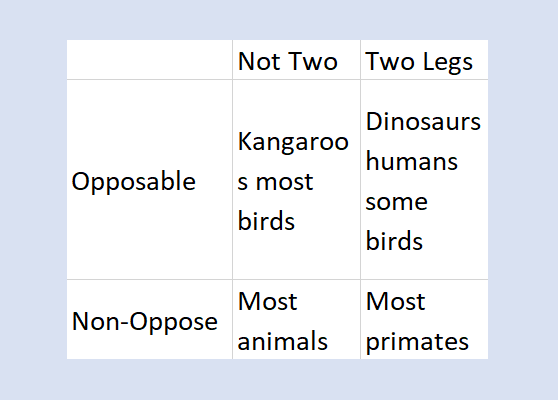
To understand the dynamics of an issue, economists and policy analysts use a typology or matrix of two characteristics and their opposites. Sounds boring but it can be fun, as I’ll show. Grouping by traits or lack of them sometimes reveals an interesting relationship that we might have never considered. Economists and policy makers are often confronted with problems that are difficult to analyze. By looking at the world through a typology, a person or group may see a relationship that was not apparent. As a simple demonstration, let’s use the characteristics of animals with and without opposable digits and those who walk on two legs or not. Does some combination of these traits or lack of traits tell us anything?

A typology forces us to clarify what we mean by a characteristic. What is an opposable digit? There are animals with pseudo-opposable, fully opposable, and long opposable thumbs (Untamed Science, n.d.). What does it mean to walk on two legs? I grouped primates other than humans into a separate category because they don’t customarily walk on two legs. Their pelvis structure is designed for four leg locomotion. However, if locomotion is my test, then horses are two-legged, moving two separate feet at a time either diagonally or on the same side of their body (AMNH, n.d.). Using a locomotion criteria, humans and many birds are now one-legged animals. Not happy with that, I decide not to use locomotion as a criteria but whether an animal normally stands on two legs. I clarify my distinctions.

This exercise can help a group brainstorm any problem. It can be serious or silly. People with curly hair as one characteristic. People who wear sandals and those that don’t. By drawing a typology matrix, we begin to notice people with curly hair and sandals. Do perms count as curly hair? Are clogs counted as sandals? Kids, try this exercise while waiting in line at a theme park this summer.

Economists use this method to classify and analyze different goods and services. Goods are said to be excludable by the seller or provider, and rival or not in consumption. What does that mean? If I eat a candy bar, no one else can eat that candy bar. It is rival in consumption. The seller can charge a price for me to consume the candy bar, making the candy bar excludable.

Using this typology, economists identify toll goods, those which people can use at the same time without rivalry but require an entry fee to use the good. Anyone who has sat in rush hour traffic on a highway might argue that there is a lot of rivalry. This typology helps us identify capacity.

A concert or an airline flight are examples of private goods that can be consumed simultaneously but they are rival because each seat that is sold reduces the ability of other people to attend that concert or take that flight. These private goods share a characteristic with pooled goods.

Because many natural resources are pooled goods, this type of good comes up frequently in the analysis of environmental issues. A person who catches a fish at a lake reduces the number of fish available for other fishermen to catch. States usually restrict access to the lake or require licenses to make this good excludable and manage the capacity. Some whale species became endangered when there was no restriction placed on their capture and killing. Pooled goods must be managed for sustainability, the capacity of that good or animal to replenish itself.

Public goods present problems that must be managed. Civil defense is an example of a good that is consumed simultaneously by everyone and cannot be excluded. Much of public policy involves public or pooled goods. Are police services a public good or a pooled good? If police officers are handling a call at one location, they are not available for others so they are a pooled good.

Typologies help us think about a problem and perhaps question our perspective on an issue by forcing us to narrow our definitions of characteristics. We may come no closer to solving or managing the problem but the new insights we gain can trigger some aha moments, particularly in group brainstorms.

//////////////////////

Photo by Henry & Co. on Unsplash

AMNH. (n.d.). Gaits: AMNH. Retrieved July 18, 2021, from https://www.amnh.org/exhibitions/horse/how-we-shaped-horses-how-horses-shaped-us/trade-and-transportation/gaits

Untamed Science. (n.d.). The Primate Order Explained: Monkeys, Apes, Lemurs… Retrieved July 18, 2021, from https://untamedscience.com/order/primates/

Competition

July 11, 2021

by Steve Stofka

This week President Biden issued an executive order (White House, 2021) to counter the trend toward corporate consolidation and oligarchy that has arisen during the past decades. I appreciated that the report contained links to the outside data sources they are using. After almost six months in office, Mr. Biden has signed 51 orders, almost half of them rescinding the orders of former President Trump (National Archives, 2021). In 2017, Mr. Trump signed 55 orders total but only eight of those were rescinding orders. The pace of orders slows after the first several months in office. I’ll review some highlights from this order.

For the past decade inflation has been below the Fed’s 2% target but the trend toward consolidation in some key industries gives those few companies that dominate an industry greater pricing power. Modern Farmer reported that 80% of the meatpacking industry is controlled by just four companies (Nosowitz, 2020). In 2000, the top 20 home builders controlled 15% of the market. Today it is 30%. Mr. Biden’s order notes that mark-ups, the charges over a company’s cost, have tripled in recent years. Since 2010, Federal Reserve data (2021) shows that after-tax profits have increased almost 50%, substantiating the claim of higher markups. In the past decade, low interest and rising profits have fueled a tripling of the stock market.

For the ten years following 9-11, after-tax profits also tripled, despite the worst financial crisis since the Great Depression in the 1930s. Many financial companies lined up at the corporate soup kitchen in Congress and were bailed out. Homeowners and workers went hungry while Congress paid bonuses to the same speculators that sparked the crisis (Story & Dash, 2009). Sorry, folks, we had to honor the contracts, the politicians in Washington said. It’s the law. Who helped write the laws? The corporations that got bailed out.

The order notes the growing increase of non-compete agreements for new job hires, making it more difficult to move to a more attractive job. It references data from the Economics Innovation Group (EIG, 2021) that the rate of new business formation has sunk by half in the past fifty years. The shift of manufacturing to China has also contributed to the overall decline.

The report notes the upswell in occupational licensing requirements over the past several decades. Licensing appears to be about public safety and some of it is. The states have come to depend on the revenue from the licensing fees and it avoids having to raise some taxes on voters. Trade schools that certify beauticians and other occupations like the tuition revenue they receive. Established business like licensing because it keeps out competition. The benefits are widespread and the costs are concentrated to those seeking careers in those occupations, many of them blue collar and little political power.

There are many faults in our federalist system that an executive order cannot remedy because the Constitution gives a lot of power to the states. What it can do is bring more attention to these anti-competitive practices. New Zealand and Singapore top the World Bank’s list of countries with low obstacles to doing business. The U.S. is sixth, just behind S. Korea and a few places ahead of Norway.

Americans believe in American exceptionalism but the Nordic countries keep beating us in various international categories. People say “You Americans. You should be more like the Nordic countries!” Suck on it, Norway, Finland and Sweden. We are ahead of you in ease of doing business. Next year we’re going to take on S. Korea and after that, tiny Denmark. There is nobody more capitalism loving than America and we’re going to prove it by stopping some of these anti-competitive practices!

/////////////////

Photo by Pietro Mattia on Unsplash

EIG. (2020, June 29). Dynamism in retreat. Retrieved July 11, 2021, from https://eig.org/dynamism

Federal Reserve. (2021, June 24). Corporate profits after TAX (without IVA And ccadj). Retrieved July 11, 2021, from https://fred.stlouisfed.org/series/CP.

National Archives. (2021). Federal Register: Executive orders. Retrieved July 11, 2021, from https://www.federalregister.gov/presidential-documents/executive-orders/joe-biden/2021

Nosowitz, D. (2020, June 09). DOJ reportedly Subpoenas ‘Big Four’ Meatpackers. Retrieved July 11, 2021, from https://modernfarmer.com/2020/06/doj-reportedly-subpoenas-big-four-meatpackers/

Story, L., & Dash, E. (2009, July 30). Bankers reaped lavish bonuses during bailouts. Retrieved July 11, 2021, from https://www.nytimes.com/2009/07/31/business/31pay.html

Van Dam, A. (2019, October 19). Increasingly, economists find, homebuilding in fewer hands. Retrieved July 11, 2021, from https://www.providencejournal.com/news/20191019/increasingly-economists-find-homebuilding-in-fewer-hands

White House. (2021, July 09). FACT sheet: Executive order on promoting competition in the American economy. Retrieved July 11, 2021, from https://www.whitehouse.gov/briefing-room/statements-releases/2021/07/09/fact-sheet-executive-order-on-promoting-competition-in-the-american-economy/

True Independence

July 4, 2021

by Steve Stofka

On this Independence Day holiday. I’ll add a few historical tidbits I read recently. Beginning in 1775, Americans fought with each other, with the British and Indians. It was our first civil war. Even the British were shocked at the atrocities that Patriots committed on other Americans. From New York to South Carolina, farmers who wanted to remain neutral were regarded as traitors, Loyalists who favored the monarchy. In their outrage, colonial militias pillaged farms and crops, burned homes and families. Farmers in New York fled to Canada.

In the middle of this civil war, the colonies published the Declaration of Independence. It was carefully edited so that it fit on one printed page and could be posted on tavern and courthouse doors. John Adams, who would become the second President of the United States twenty years after the Declaration, called it a “Theatrical Show” (Taylor, 2021, p. 160).

The mood for independence quickened at the publication of Thomas Paine’s Common Sense in January 1776. At the time of its publication, the author was anonymous and many thought it was Adams who had written it (McCullough, 2008, p. 83). Adams was rather critical of the Biblical claims made in Common Sense, but he recognized the emotional appeal of its plain spoken diatribe against monarchy.

A declaration on independence would give the colonies some legitimacy in the eyes of France and Spain, who might be able to help the desperate colonies. Unlike some of his peers in the Continental Congress, Adams thought the war against Britain might drag on for ten years. When British General Cornwallis surrendered at Yorktown eight years later, half of Washington’s army troops were French. The navy that closed off Cornwallis’ retreat was French (Taylor, 2021, p. 294). In the struggle of global empire, anything that weakened Britain was in the best interest of both France and Spain.

The majority of American colonists did not want independence. A third of the population were Loyalists who appreciated the Parliamentary order and military protection of British rule. A third of the population didn’t care. A  third wanted independence (Taylor, 2021, p. 212). As in the later civil war, many small farmers resented the big plantations owners who bought their way out of the war, paying a fee to avoid military service for themselves and their sons.

In 5th grade history class, we don’t learn many of the messy details of our history. The school boards want to avoid controversy; teachers want to avoid conflict between students. They prefer textbooks that emphasize the tragedy of war and praise negotiation to settle differences. After all, the teachers are repeatedly encouraging students to “use their words.” Even in high school, much of the ugliness and confusion is left out. In a full historical account, there are few clear moral lessons.

When we read some of these details as adults, some of think it is “revisionist” history because that information conflicts with the child’s view of history we were taught. In the 1992 movie A Few Good Men Jack Nicholson says, “You can’t handle the truth!” It’s true. We were taught a romanticized version of history, carefully edited to make sense to young people.

Some adults hold onto their cherished myths the way the Peanuts character Linus cuddled his blanket. They are today’s Loyalists – loyal to the monarchical rule and order of myth. Some of us declared independence from those myths and welcome the historical accounts, beautiful or ugly. We celebrate our independence from fanciful myth.

///////////////

Photo by Darix Garcia on Unsplash

McCullough, D. (2008). John Adams. New York: Simon & Schuster.

Taylor, A. (2021). American republics: A continental history of the United States, 1783-1850. New York, NY: W. W. Norton & Company.

A Bridge Between Us

June 27, 2021

by Steve Stofka

We are social creatures, our brains wired for comparing our situation with those around us. Children look only at the height of liquid in a glass and reason that the higher level is “more.” We understand tall and big and a lot. As our brains mature, our primitive understanding of equity evolves – a little. This week, a coalition of Senators reached an agreement in principle to spend money on infrastructure, a solution that has frustrated several presidents before Biden.

In 2007 the I-35W bridge in Minnesota collapsed. In March 2009, at the lowest point in the financial crisis, the American Society of Civil Engineers released their quadrennial report card on the nation’s infrastructure (2009). During the decade, infrastructure had slipped from a ‘D+’ to a ‘D.’ With millions out of work, the public and then President Obama hoped that the Congress could assemble an infrastructure bill. Couldn’t the government give money on a per capita basis to each state and let them spend the money on needed repairs and building projects? Less populous states argued against that idea. In the end, nothing happened.

In 1985, Congressman James Howard and Colorado Senator Gary Hart introduced versions of a National Infrastructure Act that died in the Committee on Environment and Public Works. In the decade from 1971-81, Howard noted that spending on infrastructure had declined by 50% (1985). Republicans held the Senate and Presidency; Democrats held the House. Other infrastructure bills have died in that same committee.

The U.S. built the nation’s interstate highways to deploy weapon systems in case of an attack from Soviet Russia. Without that direct threat, our elected representatives have been unable to coordinate unified action. Our federalist system promotes impotence, an antiquated political structure that will cause the U.S. to take a back seat on the global stage, according to China’s leader Xi Jinping. After fifty years of ineptitude, will the U.S. Congress and White House prove Xi wrong?

////////////

Photo by Manny Ribera on Unsplash

American Society of Civil Engineers (ASCE). (2009). 2009 report card for America’s infrastructure. doi:10.1061/9780784410370

Howard, J. (1985, January 01). The national infrastructure act. Retrieved June 26, 2021, from https://cedb.asce.org/CEDBsearch/record.jsp?dockey=0043747