A Tale of Caution

January 31, 2021

by Steve Stofka

The trading in GameStop (GME) has spurred romantic visions; a mob of peasants has stormed the castle and the nobles have fled! Huzzah! This love of the romantic convinced a bunch of peasants to storm the Capitol on January 6th. We are human beings; we love stories. The truth is less appealing or ordinary.

At a press conferences this week, the well-prepared and even-tempered White House Press Secretary, Jen Psaki, was asked if President Biden planned to speak to the issue of the volatile trading in GameStop (GME). She said that it was a new age; the President was not going to speak to issues he had no expertise in. Imagine that. We will miss the enjoyment of watching former President Trump standing in the White House driveway and opining to reporters on every topic under the sun.

Reporter: “Mr. President, what’s your source on that?”

Mr. Trump: “My mind. I have a very smart mind.”

Without the daily source of ridicule that Mr. Trump provided, comedians are having to write new material.

But I digress. GameStop. Twenty-five years ago, internet stocks were taking off. Message boards at AOL, CompuServe and others lit up with stories of “Ten baggers,” the holy grail of stock investing. Buy a stock for a $1 and watch it rise to $10. Those in Bitcoin have experienced the heady feeling.

That romance incentivized peasants to join the Crusades; there was gold in Solomon’s Temple at Jerusalem. Thousands poured into the California gold fields in the hopes of striking it rich. The people who get rich are the ones selling pickaxes and panning tools to the miners. The gold is not in the hills but in the people digging up the hills.

On message boards in the 1990s we learned about options. Instead of buying Microsoft stock, an investor can buy options to buy Microsoft’s stock. If Microsoft’s stock is selling for $25, it costs $2500 to buy a 100 shares, the minimum lot. At that time, buying less than a 100 shares cost a lot more in commissions. If an option were selling for $1, an investor could buy 2500 options! If the price went up $5 you could quintuple your money. Imagine making $10,000 in a few weeks.

People quit their jobs to day trade. The successful ones were cautious, taking profits quickly, not taking too many risks. Someone with a family to feed and rent to pay must be responsible. A modestly successful trader can convince themselves that they have a well-balanced strategy.

About a year before the internet stock bubble blew up, someone posted a rather long post on a message board. Since he was in the options business, a family member had asked him for his advice. Aware for the first time that inexperienced retail traders were taking positions, he offered his advice, which I will paraphrase. A few points stuck with me.

Options are tools. 94% of options trades expire worthless. Professional traders use options like car insurance. Yes, there are some companies who take risks, but most of those in the business use options to mitigate risk.

Understand that multi-national companies pour hundreds of thousands of dollars into news gathering, sophisticated computers and programming by very smart people to develop and deploy options strategies. They are on the other side of the trade.

A retail trader may get lucky. The prospects for Company A improve, the stock goes up and the trader makes money. A company using options aims to make money whether the prospects for Company A improve or deteriorate. A successful racetrack makes money no matter what horse wins.

Gamblers at a racetrack can rush the window in the closing moments before a race begins and cause the track to lose money on that race because the track doesn’t have the time to change the odds to layoff the bets. With the advent of the internet, a group of retail options traders could do the same with a hedge fund, who can’t lay off the bets fast enough. It could be done but it would be difficult.

25 years later, it has become much easier for gamblers to rush the betting window. The success of those traders will no doubt inspire others to try the same strategy. An industry which uses options to mitigate risk on trillions of dollars will not let a few retail traders upset that market for long, so don’t gamble with the rent money.

/////////////

Photo by Kay on Unsplash

Forgiveness

January 24, 2021

by Steve Stofka

Some members of the Democratic Party have called for a forgiveness of all student debt, which the Federal Reserve estimates at more than $1.7 trillion, which has doubled since the onset of the financial crisis and recession in 2007-8. On the campaign trail, President Biden seemed receptive to a forgiveness of $10,000 as a uniform application of policy (Urban, 2020).

Many of us react instinctually to debt forgiveness, ready to condemn the idea outright because we were taught as children to pay our debts. The ancient Greeks committed individuals and families to slavery for failure to pay their debts (ABI, n.d.). The Romans allowed creditors to dismember debtors. American colonists had debtors flogged, ears cut off and imprisoned.

Our laws have become more forgiving in the past three centuries, but the attitudes of many Americans have not improved as much. In the depths of the 2009 recession, CNBC reporter Rick Santelli criticized a mortgage debt relief program and ignited a storm of passion that contributed to the formation of the Tea Party movement. Will a student debt forgiveness program arouse similar sentiments?

A week before Congress passed the CARES act on March 27, 2020, Education Secretary Betsy DeVos suspended payments on federal student loans payments (DOE, 2021). The CARES act formalized that suspension but only for six months. President Trump then directed her to continue the suspension of payments and waiver of interest. President Biden has continued that policy until September 2021.

Who got the loan money? Some of it went to for-profit institutions. Students at for-profit institutions total two million, less than 5% of the 42 million students enrolled in higher education (Bennett et al., 2010). During the financial crisis, for-profits received a lot of criticism for abusive recruitment practices, low graduation rates, high default rates and poor student outcomes. Under tightened regulations during the Obama administration, several lost eligibility for federal student loans and subsequently shut down.

Ok, goes the argument, some students got a bad deal. Shouldn’t they still have to honor their contracts? What if the government forgave all debts involving a product or service which did not perform as promised? The buyer would no longer have to be diligent about quality. Eventually the quality of goods and services would decrease. Those who use this argument see debt forgiveness of any kind as a slippery slope to the downfall of the entire economy and the impoverishment of society.

The bulk of the $1.7 trillion of outstanding debt was paid to public educational institutions, who have raised tuition far above the general rate of inflation. Since 1985, inflation adjusted tuition has doubled (NCES, 2021). Over the past two decades, states have cut back their funding for higher education, throwing the extra burden onto students. In analyzing the shift, Douglas Webber found that the student burden had tripled since 2000 (2017).

Where did the money go? To state institutions. Imagine each student wearing a backpack loaded with 10 pounds of debt. State governments took 20 pounds of weight off their books and put it in the backpacks of the students, those least able to bear that burden. A forgiveness of debt, total or partial, would take some or all that weight out of the backpacks of each student and put it on the Federal balance sheet.

At its core, debt is about justice, a subject that we struggle to discuss rationally because we are social animals who process the subject of fairness with our monkey brains. In 18th century England, the punishment for crimes, including debt, was in proportion to the outrage of society at the criminal. In a more rational approach, the philosopher and legislator Jeremy Bentham introduced a “felicity calculus” that would guide legislators and judges to enact punishments that were proportional to the consequences of a crime and the profit of the crime to the criminal.

Our laws no longer treat debtors as criminals, but in the case of a student’s debt, how is society to judge the profit that a student will earn over a lifetime from their education? On average they will make a higher income and pay higher taxes. If all student debt is forgiven, one student will receive a benefit of $100,000 while another will receive a $30,000 benefit. Is that just? I personally think a $10,000 uniform forgiveness is more just. A debt forgiven cannot be unforgiven; moderation is the key.

We can never agree on issues of distribution of benefits. Small children argue whether they got the same amount of chocolate milk if the glasses are shaped differently. In the parable of the workers in the vineyard, workers who only worked one hour received the same amount of money as those who had worked all day. Is that fair? The landowner insisted that it was his money to do whatever he wanted.

In a democracy, we have an instinctual sense that the Federal government’s money does not belong to the government. Some of us claim an equal say in how that money is spent, whether we pay a small amount or a large amount of federal tax. Some of us decide the justice of debt forgiveness as though the debt was owed to us personally. Some of us don’t see this as a personal issue; the federal debt is as remote as the Andromeda galaxy. Those two groups cannot agree.

In a democracy, we argue about the rules. We compete to elect the people who make the rules. Half of us like the rules; half don’t. A democracy survives only as long as each half can forgive the other half for their tyranny while they were in the majority. As long as each half feels that they are getting a turn at making the rules, there is a grudging tolerance, if not forgiveness, and a democracy survives. When one half of the people feel as though they are shut out of the rule making process, the fighting starts. If we can’t practice some forgiveness we don’t deserve a democracy. Tyranny and aristocracy are the political choices of those who don’t forgive. I’ll take democracy.

///////////////////

Notes:

Photo by Pang Yuhao on Unsplash

American Bankruptcy Institute (ABI). (n.d.). A (Very) Brief History of Bankruptcy and Debt in the West. Retrieved January 23, 2021, from https://www.abi.org/feed-item/a-very-brief-history-of-bankruptcy-and-debt-in-the-west

Bennett, D., Lucchesi, A., & Vedder, R. (2010, June 30). For-Profit Higher Education: Growth, Innovation and Regulation. Retrieved January 23, 2021, from https://eric.ed.gov/?id=ED536282

NCES. (2021). The NCES Fast Facts Tool provides quick answers to many education questions (National Center for Education Statistics). Retrieved January 23, 2021, from https://nces.ed.gov/fastfacts/display.asp?id=76

Urban Institute & Brookings Institute, Tax Policy Center (Urban). (2020, October 15). An Updated Analysis of Former Vic President Biden’s Tax Proposals. [PDF]. Retrieved from https://www.urban.org/sites/default/files/publication/103075/an_updated_analysis_of_former_vice_president_bidens_tax_proposals_1.pdf

U.S. Dept. of Education (DOE). (2021). Coronavirus and Forbearance Info for Students, Borrowers, and Parents. Retrieved January 23, 2021, from https://studentaid.gov/announcements-events/coronavirus

Webber, D. A. (2017). State divestment and tuition at public institutions. Economics of Education Review, 60, 1-4. doi:10.1016/j.econedurev.2017.07.007

The Lion’s Roar

January 17, 2021

by Steve Stofka

After encouraging a rush on the Capitol building, the man whom the Russians helped get elected in 2016 is stepping down. 25,000 troops have been deployed to protect the area around the seat of power during Inauguration week, turning Washington, D.C. into a green zone like that of Baghdad in the aftermath of the Iraq invasion in 2003.

Around the country, governors have deployed troops to protect state capitols against threats of violence. At a news conference this week, Ohio’s governor was asked how many groups had applied for permits to peacefully demonstrate. His answer – none.  He promised an aggressive response from troops stationed around the capitol in Columbus.

On the C-Span call-in show Washington Journal some callers made an equivalence between BLM protestors defacing statues and breaking into stores with the assault on Congress. Fox News posted a graphic comparing the summation of hundreds of summer protests with one event on January 6th, pointing out that Jan. 6th wasn’t so bad. Hundreds equals one.

The Russians had a small influence in Mr. Trump’s 2016 election. The media – mainstream and not so mainstream – gave him the megaphone, the broadcast time and let him roar. Anderson Cooper of CNN explained that he was available when other presidential candidates were not. Media channels need to fill airtime and retain viewers. That’s the way it is.

Mr. Trump’s entire presidency has been a media feast. He likens himself to a lion, paying particular attention to his mane. He spent four years roaring his thoughts and emotions on social media, then watched them echoed on Fox News an hour later. He surrounded himself with sycophants seduced by the chance to pull the strings of the nation’s dancing puppets. He gloried in his power to dominate but lamented the fact that his pride of supporters were so low class. A great lion deserves a good pride.

By his own account, he was the greatest president. He was certainly a president without precedent. Being impeached twice in one term earns him a place in the history books. He inherited a low unemployment rate of 4.6% from the previous administration and, before the Covid crisis, helped lower it to 3.6%. Presidents have far less influence over the broad economy, but they are the ones that wear the crown of roses when the economy is good, and the dunce cap when it is not so good.

During the four years of the Trump administration, the country will likely come close to the $6.8T deficits that it accumulated under eight years of President Obama. Mr. Trump inherited a healthy economy from his predecessor but wanted robust growth, besting some of the growth during the Reagan years. He gambled that big tax cuts for the wealthy would induce them to invest in more domestic manufacturing, that the economic growth would compensate for the loss of tax revenue. It didn’t.  

Christian Nationalists applauded him for moving the capital of Israel to Jerusalem and appointing a roster of right-wing judges to the courts. Their project is to turn the U.S. into a theocracy like Israel, Iran, and Iraq, ruled by leaders of one religious sect. Mr. Trump was a warrior king, like David, and like that ancient Biblical figure, was driven by his character flaws. Instead of white KKK bedsheets, his followers donned horns and capes and grabbed pitchforks as they stormed the castle of Congress, determined to turn the Capitol into the cathedral of a white Christian nation, the New Jerusalem.

Mr. Trump certainly got our attention. Americans are a hard-working bunch, yet we found time to jab him with rancor or praise his pitchfork rhetoric. He was either a menace or mensch. His was not a neighborly disposition; he shoveled coal into the flames that power the engine of American politics.

After touching the snarling beast that hides within our body politic, we now turn to a more measured man, Mr. Biden, in the hopes that there is some sense of cooperation left in our soul.  We see our Capitol surrounded by barriers and remember the words that Mr. Rogers sang, “Won’t you be my neighbor?”

/////////////////

Photo by Catherine Merlin on Unsplash

The Conservative Project

January 10, 2021

by Steve Stofka

In response to the storming of the Capitol building on Wednesday, a Republican Congressman attacked the actions of the rioters as the opposite of conservative values. In his mind, those values were respect for law and order, a strong military, personal responsibility and freedom, fiscal responsibility, limited government, free markets, and respect for traditional institutions. As I will show, these principles form a wish list of unattainable ideals because one principle subverts another. Without a cohesive supporting structure, conservatism suffers from the same ills as utopian philosophies.

I’ll cover two of these principles: responsibility and freedom. Responsibility can’t incorporate freedom without limiting it in some way. Responsibility is a social covenant – the limiting principle of freedom. All too often, we protect our own freedom and restrict the freedom of others. Some conservatives who believe in personal freedom reject a responsibility for others. The wearing of masks has highlighted this issue. Freedom without responsibility is anarchy.

Too often we reach for solutions that restrict the freedoms of those who are not “us.” Conservatives who advocate for individual freedom reject liberty for those who believe differently than they do. They define human life as the joining of two microscopic cells at conception, then admit no freedom to those who define human life differently. In their support of a progressive income tax, liberals favor the institutional freedom of government over the individual freedom to reap the rewards of one’s labor. Each of us points to the mote in our neighbor’s eye, oblivious to the faults of our own arguments, principles, and perceptions.

At its heart democracy is a contest to control the rule making process. It is prone to mob rule, the changing of the rules to advantage a particular group of people. The conservative Pennsylvania state legislature changed the rules shortly before the election so that mail-in ballots could not be counted until after the polling station ballots were counted. They encouraged Republican voters in the state, most of them rural and with shorter lines at polling stations, to vote in person. On election night, they presented results that excluded most Democratic mail in ballots and later claimed that only ballots cast in person were legitimate. Was this motived by some conservative principle? No, it was prompted by political survival.

Mitch McConnell, the Republican Senate Leader, is a political strategist above all else. He has pointed out that Republicans have not held a filibuster proof majority in the Senate for more than a hundred years. The shift of the population from rural to urban areas has led Republicans to adopt street fighting legal and political tactics to command a voice in state and federal politics. For decades, some states resisted redrawing their voting districts so that rural communities would have far more power than their dwindling population.  Freedom is power. The first principle of a political party is to survive, and to do that conservatives have had to curtail the freedom of others so that they can maintain their own freedom and power.

Both the conservative and liberal projects exclude inconvenient aspects of current events because reality is complex and inconvenient for partisan purposes. Like a scientist who makes simplifying assumptions to model a process, political factions distort events to justify their perceptions and beliefs – if facts don’t fit their political narrative, change the facts.

The master fact-shaper is Rupert Murdoch. Over the first five years of building the news bubble called Fox News, he lost almost a half-billion dollars. The network’s audience is less than a fifth of just one major network, but its controversial hosts leverage their impact by taking controversial positions.

Seeing the success of the Fox model, One America Network has presented an even more polarized version of events, hoping to pull viewers away from Fox. Politicians are wary of a challenge from a small cadre on the extreme wing of each side, so they embrace the extreme to avoid “getting primaried.” In the fractured media landscape, some are imitating that polarizing process, rushing to the extremes to gain an audience.

The Republican Party was the champion of anti-slavery during the Civil War. Members of that party now want to preserve the statues of Confederate generals who fought to protect slavery. Why? After the Civil War, the cause of the Confederacy was repackaged by Southern elites as a cultural and historical institution; conservatives defend some cultural institutions while rejecting others as invalid. They champion the family and the institution of marriage but get divorced as much as the rest of the population. They support the Constitution’s protection of religious institutions if they are Christian, but barely tolerate its protection of other religions.

Unlike the liberal philosophy, the conservative project must ever be a reactionary ideology, a cadre of self-proclaimed elitists who resist the normal and healthy change of human institutions. Like utopian philosophies, its goal is stasis.

Although conservatism espouses freedom, it cannot incorporate the liberty of the human will into its philosophy. Without that freedom, personal responsibility is but a set of behavioral rules, conventions imposed on the majority by a minority. It is a strategy, not a philosophy. Because it cannot absorb change, it is a lifeless shell that other ideologies inhabit for a time, then discard, like the hermit crab.

In the 19th century, Republicans first found and inhabited the shell. In the past forty years Libertarian groups, Christian groups, the Tea Party, and conspiracy theorists have donned the empty shells of conservatism, only to be frustrated by the very rigidity of the ideology. Those who are comfortable in the shell are the political strategists like Mitch McConnell who use it quite ably as a shield from political attack.

//////////////////

Photo by Jan Zikán on Unsplash

A Public Sense of Duty

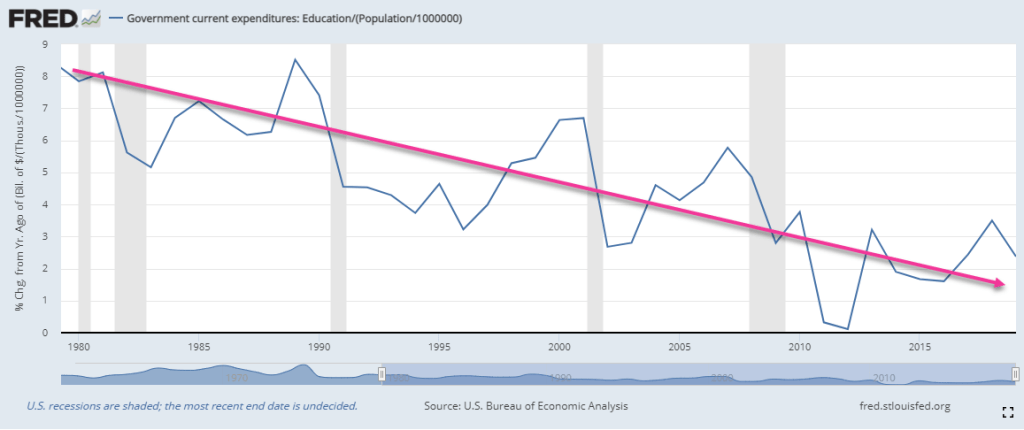
Each New Year we renew our hope in the future, but have we lost our sense of duty to the future? Following World War 2, the U.S. and Russia engaged in a protracted Cold War of competing ideologies. We fought proxy wars in Vietnam and Indochina, South and Central America. Instrumental to the battle against Communism, America invested in our children’s education.

In 1978, the homeowners of California revolted against the rising property taxes that funded public schools. Since then, our per capita spending on children and young adults has steadily declined.

China’s spending on education has risen dramatically in the past two decades but it still lags the U.S. in spending as a percent of GDP. For how long? Do Americans have the “fire in the belly,” that focused desire to best the enemy, that we did seventy years ago?

In our technological society, the level of education of one’s parents has become a class distinction. The National Center for Children in Poverty (NCCP) reports that 80% of low-income families are headed by parents without a high school diploma. With a high school diploma, kids still have a 60% probability of being born into a low-income family (NCCP, 2021).

A child born in a middle-class suburb will receive a better education than one born in a poor neighborhood, where many residents are renters. Property taxes fund public schools, but landlords don’t live in those neighborhoods and want low property taxes. They have an influential voice in local politics.

Two years ago, I wrote about the post-war surge in college degrees (Stofka, 2018). Before WW2, only 5% of children earned college degrees; more than a third of children now earn college degrees (NCES, 1993). Is our society paying for that learning and experience? Despite their educational skills, teachers in charter schools make the same $53K average as all employees in private industry (NCES, 2020, Table 5). The pay in charter schools is 15% less than public schools (Table 5); that may explain the much higher ratio of black and Hispanic teachers in charter schools (Table 1).

An NCES survey in 2003-4 showed a national student teacher ratio of almost 15. The ratio in a 2018 survey was 21 students per teacher (NCES, 2020). Our educational system is asking our teachers to do more, to have a bigger and more expensive skill set, but does not pay them for their talent and hard work.

Construction workers average $63K per year, higher than public school teachers (BLS Series CES2000000011). 50% of teachers in traditional public schools have a master’s degree, in charter schools it is 39% (Table 4). Do half of all construction workers have a master’s degree? No, of course not. Why does our society value a painter or a carpenter more than a public-school teacher?

Construction workers provide mostly private goods, where private parties benefit from their work. Teachers provide public goods; the immediate benefit is only to the parents of the children in school. The provisioning of public goods and the caretaking of natural resources are only possible when a community has a sense of public duty. Has it declined in the past few decades?

Americans once built a sense of community in opposition to the common enemy of Communism. Covid-19 might have been that common enemy; it has highlighted just how fractured our society is. The common enemy is us, our neighbors, our professionals, and institutions.

The erosion of trust began in the 1960s but culminated in the financial crisis a decade ago. We learned that our institutions were run by pirates, whose duty was chiefly to other pirates, the elites who knew how to work the system. Under President Obama, Attorney-General Eric Holder did not want to waste public money on prosecuting financial crimes when there was a small chance of conviction. Neither he nor Mr. Obama understood the damage of that policy. The American people watched as the pirates were let off with a slap on the hand. Washington was awash with scoundrels.

In 2016, Americans elected an outsider, a pirate in the real estate industry who pledged to rid Washington of pirates. The Trump administration proved to be little more than a carousel of pirates. The Senate, in a shambles under the leadership of Mitch McConnell, held few confirmation hearings for department chiefs. Why bother? Most had temporary titles as acting heads of departments and agencies for a few months before another Twitter outrage from the pirate in chief tossed them overboard.

President-elect Joe Biden can avoid the policies of the Trump administration that so undermined the trust of the American people, but can he avoid those policies of the Obama administration which caused many Americans to abandon any hope for fairness in Federal policy? When public trust and public duty are so greatly diminished, the country declines – its spirit, its institutions and its infrastructure. Will we – can we – recapture that sense of public duty?

////////

Photo by Dan Russo on Unsplash

NCCP. (2021). United States Demographics of Low-Income Children. Retrieved January 02, 2021, from https://www.nccp.org/demographic/?state=US

NCES. (1993, January). 120 Years of American Education: A Statistical Portrait. Retrieved January 02, 2021, from https://nces.ed.gov/pubs93/93442.pdf#page=17

NCES. (2020, September). Characteristics of Public and Private Elementary and Secondary School Teachers in the United States. Retrieved January 02, 2021, from https://nces.ed.gov/pubs2020/2020142rev.pdf

Stofka, S. (2018, June 12). Study Dollars. Retrieved January 02, 2021, from https://innocentinvestor.com/2018/06/10/study-dollars/

A Test of Democracy

December 27, 2020

by Steve Stofka

In 2008, Barack Obama won almost 25% of counties, a high percentage for a Democratic candidate. In 2016 and 2020, a sixth of counties voted for a Democratic President. Though a small percentage, those counties represented more than 2/3rds of the nation’s GDP. The most productive part of our economy votes Democratic, but a county electoral map looks mostly red. How can that be?

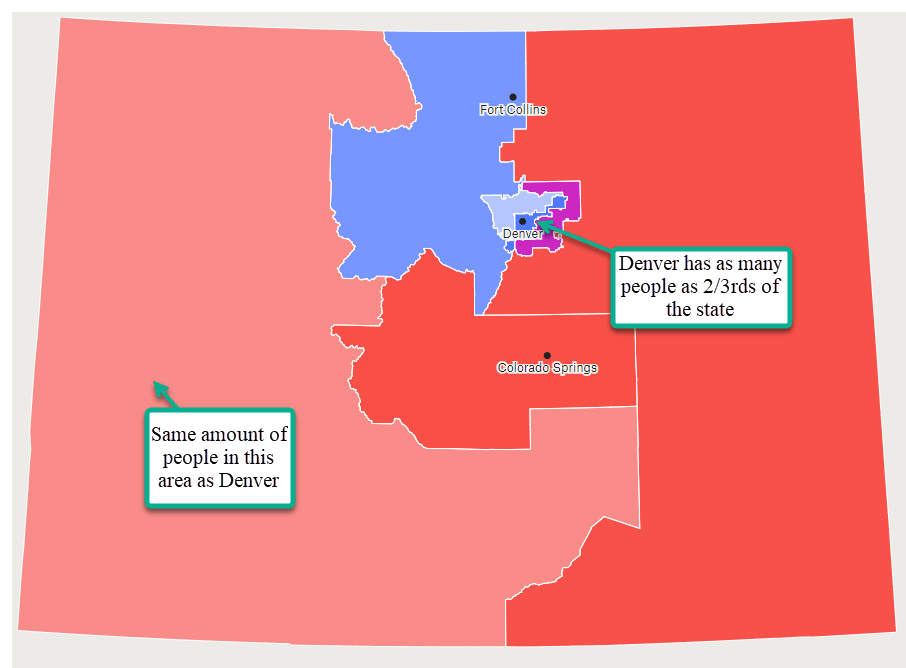
More than half of the U.S. population lives in less than 5% of counties (Census Bureau, 2019). A county electoral map gives the same weight to a county in Colorado with a few hundred people as it does to L.A. county which has 10,000,000 inhabitants. A person looking at that map gets the impression that “most of the country” votes Republican but land doesn’t vote – people do.

A more accurate electoral map is by congressional district like this one at FiveThirtyEight (2018). Voting districts are assigned by population, not land area. I’ll copy their Colorado map to illustrate the point. There are as many people living in a few square miles in Denver as there are in more than half the state.

As the population concentrates close to urban areas, a county-by-county analysis reveals some long-term trends. Historian David Kennedy recently noted a shift in sentiment over the past four decades (2020). In 1980, 13% of counties were dubbed “landslide” counties in which the Presidential candidate won by 20% or more of the vote. By 2000, 19% of counties voted that way. In the 2020 election, more than 50% of counties were landslide.

Kennedy referred to Bill Bishop’s 2009 book The Big Sort which described how Americans were moving to places where they lived with others whose political sentiments were like their own (2009). For more than a century, we have been moving from the country to the city. After World War 2, the automobile gave us the freedom to move further away from where we work. We like living with people who resemble us.

A trend that has been going on for a century is likely to continue. Those hoping that election tensions will ease in the future will be disappointed. Although social media helps spread election conspiracy theories, Americans are fond of such theories. Those on the left side of the aisle were convinced that the governor of Ohio stole the 2004 election for George Bush (Weiss, 2020). That was on the heels of the 2000 election which Florida governor Jeb Bush stole for his brother George.

Each election begins in earnest on inauguration day. Immediately after President Obama’s inauguration in 2009, Mitch McConnell succinctly summed up his job as the Senate’s Minority Leader – his job was to make sure Obama was a one-term President. With the nation deep in a financial crisis and millions of people out of work, Democrats condemned McConnell’s remark.

From the first day of President Bush’s presidency in 2001, Democrats rallied and protested the boy made king by an activist Supreme Court. In a 5-4 decision, five supposedly conservative justices tossed aside conservative jurisprudence and voted to overthrow the decision of Florida’s Supreme Court. Henry Monaghan argued against the hundreds of legal scholars who condemned the court’s jurisprudence. The first few pages summarize the circumstances of that election and the many criticisms of the court’s decision (2003).

Eighty years ago, FDR wielded his executive pen like a sword to cut through any Congressional opposition from those on either side of the Congressional aisle. In his 3-1/2 terms, he signed more than 3000 orders, a record that will likely never be broken. Today, our Presidents rule by executive order. Each President spends his first year undoing the executive orders of the last President if that President was from the other party. Without the consistency of law, the American people lose respect for the law, regarding it as little more than personal whim.

The Constitution gives the President the power to grant pardons for Federal crimes. Each President’s use of the pardon power demonstrates that personal sentiment and political alliances matter more than justice. After President H.W. Bush pardoned all the co-conspirators in the Iran-Contra scandal, the American people began to lose faith in the law.

The Supreme Court’s 2000 Bush v. Gore decision reinforced the notion that America was like the old European nations, a country of patronage and favor, not one of law. Mr. Bush disregarded good judgment, the law, and his own intelligence services to justify an attack on Iraq in response to the 9-11 tragedy. Business scandals punctuated the first four years of his administration. His re-election in 2004 convinced many Americans that corruption, not competence, was the American way. Mr. Bush’s second term reinforced that impression.

President Obama’s political rhetoric was strong and even-tempered, but his policy response to the financial crisis was weak and un-tempered. Within two years the American people chose political paralysis, wresting control of state governments from Democrats and handing the House to the Republicans. Like Mr. Bush before him, Mr. Obama found fault with others, not himself.

After electing an unseasoned backbench Senator Obama to office, the American people elected a TV star to the Presidency. Why not? America, the competent, has become a country of fools. Why would we not elect New York City’s leading buffoon?

Each day more people die of Covid than lost their lives in 9-11. The country now turns from the Jester to a seasoned former Senator, Mr. Biden, to lead the country. Unlike Mr. Obama and Mr. Trump, Mr. Biden is not in love with his own rhetoric or his judgment. Can he restore competence to the White House? Perhaps.

What he can’t do is restore the competence of the voters, who love their opinions more than their interests. Regardless of his success or his policies, half the country will condemn him because we have sorted ourselves into them and us. James Madison, the chief architect of the Constitution, worried most about the rise of factions because that is what brought down the Roman empire. We fought a Civil War and have not been a United States since then. We are transforming ourselves into a type of European confederation, divided into regional, rural, and urban interests, clutching our contempt for our fellow Americans to our hearts. Is this the century when we finally abandon the experiment of the United States?

/////////////////

Photo by Den on Unsplash

Bishop, B. (2009). The big sort: Why the clustering of like-minded America is tearing us apart. Boston: Mariner Books. [Kindle price $1.81 from https://www.amazon.com/Big-Sort-Clustering-Like-Minded-America/dp/0547237723/ref=sr_1_1

FiveThirtyEight. (2018, January 25). The Atlas Of Redistricting. Retrieved December 25, 2020, from https://projects.fivethirtyeight.com/redistricting-maps/

Kennedy, D. (2020, December 9). David Kennedy: The Future of Democracy in America. Retrieved December 25, 2020, from https://www.commonwealthclub.org/events/archive/podcast/david-kennedy-future-democracy-america

Henry P. Monaghan, Supreme Court Review of State-Court Determinations of State Law in Constitutional Cases, 103 COLUM. L. REV. 1919 (2003). Available at: https://scholarship.law.columbia.edu/faculty_scholarship/164

US Census Bureau. (2019, May 23). Big and Small America. Retrieved December 25, 2020, from https://www.census.gov/library/stories/2017/10/big-and-small-counties.html

Weiss, J. (2020, December 21). What Happened to the Democrats Who Never Accepted Bush’s Election. Retrieved December 25, 2020, from https://www.politico.com/news/magazine/2020/12/19/2004-kerry-election-fraud-2020-448604

A Coin of the Realm

December 20, 2020

by Steve Stofka

As bitcoin surged past $20,000 in value this past week, I wondered what the world would look like if bitcoin were the dominant medium of exchange on our planet. A little more than a decade ago the algorithm behind bitcoin was invented. From its inception, the supply of bitcoin was limited. Although it may function as a medium of exchange, its fixed quantity makes it ideal for buying – not being – currency.

When a currency is limited, the value of that currency increases, a matter of supply and demand. The goods and services that the currency buys fall in value, a process called deflation. It is the opposite of inflation or rising prices.

Limited currencies encourage saving, not spending. Bitcoin savers are called “hodlers” after a typo for advice to “hold” the currency on a message board in 2013 (Frankenfeld, 2020). In a deflationary environment, that is the best strategy because the currency will buy more next year. It pays to delay consumption. Businesses put off buying equipment that will make them more productive. People who own equipment are motivated to sell it before it loses even more value. These two impulses cause a deflationary spiral. At the bottom of that spiral, everything sells for dirt cheap.

A version of this happened during the Great Depression eighty years ago. In the years after the 1929 stock market crash, the central bank was, believe it or not, worried about inflation and limited the supply of money (Friedman, 1968). The central bank turned a sharp correction into a severe depression. Knowing that perverse history, former Fed chief, Ben Bernanke, assured Congress that the central bank would not make the same mistake in response to the 2008 financial crisis.

Let’s imagine a world where bitcoin is the medium of exchange. Because your car is eight years old, you anticipate more repairs. Is now the time to buy? The local dealership is offering a reliable car for 1 bitcoin, but you remember that just a few years ago, that same car sold for 1.5 bitcoin. If you wait until next year, you can probably get it for maybe ¾ bitcoin. You decide to drive your old car for another year.

A lot of people make that same decision and hold off buying new cars. Auto repair shops see an increase in business because people are repairing their cars instead of buying new. Car dealers, anxious to move cars off their lot because they owe the bank for those cars, lower prices even more. This induces some people to buy new cars, but it convinces even more people that their prediction was true; it is better to wait.

Car dealers start slowing their purchases from the factories, cause some factories to close. Those workers lose their jobs; why don’t all those workers just become car mechanics? First, car factories employ a concentrated workforce; auto repair shops are dispersed across a wide area. Second, building new cars and repairing old cars take two different sets of skills. Some workers will make the transition, but many won’t.

Because there are fewer cars being made, the price for new cars doesn’t fall as fast. People who had expected the price for a particular model car to fall to ½ bitcoin are disappointed. Some decide to buy now because car repair rates have gone up faster than new car prices are going down. But some people look around at the people losing their jobs and decide to play it safe. The buying power of the bitcoin currency holds steady for a while.

Uncertain about the growth of auto sales, auto manufacturers close more factories. The reasoning is simple. Although bitcoin as steadied in buying power, they anticipate that the currency will continue to grow faster than profits from making cars. As more auto factory workers lose their jobs, people become more cautious and hold off buying. The anticipation of future deflation contributes to further deflation.

For those who remember the hyperinflation of the 1970s, inflation does the same thing. That is why central banks are wary of a strong tendency toward inflation or deflation. They are self-reinforcing phenomena.

Let’s step out of the world where bitcoin is the global medium of exchange and back into the present world. What is bitcoin? Its limited quantity makes it like a collectible – a fine painting, or an old coin, but is not a collectible because there needs to be an agreement of the blockchain before anyone can buy a bitcoin. You can buy a painting without that consensus.

Its ability to act as a medium of exchange makes it like a currency, but it is not a currency because it doesn’t have a critical feature of a sustainable currency. As a unit of account, it behaves like an asset or commodity itself, not a ledger of account for a commodity. A stable and sustainable currency is an asset of the larger community, not just a store of value for an individual.  

So, what is bitcoin? It is a hybrid animal like the platypus, part bird and part mammal. Like the platypus, bitcoin is a species best suited to an island ecology. Bitcoin advocates point to the number of asset and hedge funds buying bitcoin as a demonstration of its growing acceptance as a global currency. Some funds have added bitcoin to their portfolios because it is a specialty, part of a broad asset mix. Like the platypus, it will only survive in a protected environment. Protected by? A stable currency like the dollar.

////////////

Photo by Bermix Studio on Unsplash

Frankenfield, J. (2020, August 29). HODL. Retrieved December 18, 2020, from https://www.investopedia.com/terms/h/hodl.asp

Friedman, M. (1968). The Role of Monetary Policy. American Economic Review, 58(1). https://www.aeaweb.org/aer/top20/58.1.1-17.pdf. p.3.

Dueling Dancers

December 13, 2020

by Steve Stofka

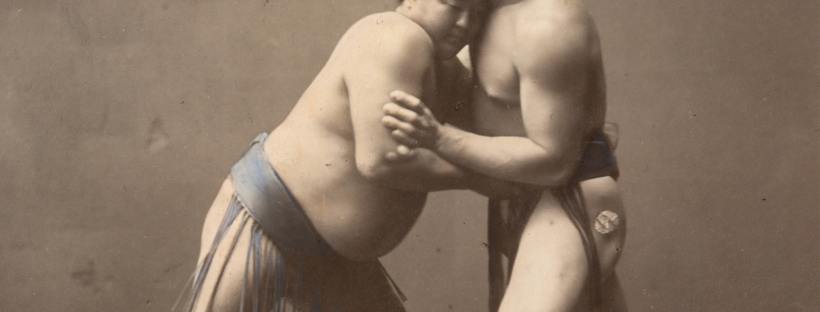
As I read and listen to arguments on both sides of an issue, they fall into two categories: the ontological and the utilitarian. Those terms make our arguments sound erudite and rational. In the wrestling match of ideas and opinions, we need shorter names that will fit on a wrestler’s robe: the Onts and the Utis. This fight has been going on a long time.

If you are an Ont, you argue about the nature of things. Most of the time, you try to gain the upper hand in defining an issue. If someone is new to this country and is hungry or homeless, you might argue that people who have just arrived here are not entitled to government benefits. They may be human beings, but you narrowly describe them as free riders, something which is of great interest to Onts, who see everyone else’s free riding, but not their own.

The Ont does not think city governments should tolerate homeless people on downtown streets. Onts have characterized homeless people as drug addicts and self-indulgent people who should get a job or sit in jail making license plates. Homeless people command a lot of city services, particularly visits to the local emergency room. Taxes support the well-being of free riders, a divisive issue with Onts.

Onts are concerned about moral hazard, the inducement to take on more risk when a person doesn’t have to suffer the consequences. If an Ont gave a homeless person some money, that person would probably spend it on drugs, putting themselves further at risk. The Ont is doing a noble act by not encouraging the ruinous behavior of a homeless person.

If you are a Uti, you think that the practical solution is the right solution in an imperfect world. You care about the homeless person because you care about yourself and can’t stand the thought that you live in a society that would permit such human tragedy. Do you go downtown and hand out some of your savings to those homeless people to show you care? Well, maybe that wouldn’t be practical, you tell yourself.

A Uti recognizes moral hazard but doesn’t crusade against it the way that an Ont does. People put themselves at risk because they don’t bear the consequences of their risky behavior. Yes, we’d like to minimize that, but we don’t want to put others at even more risk because the community ultimately bears the consequences of their risky behavior.

A Uti lives in the real world, an imperfect version of the imagined utopia of the Ont. Yes, things are supposed to work a certain way, but “frictions” – messy entanglements – interfere with the perfect. The Uti wields his scythe, cutting the harvest while the Ont hoists his pickaxe and joins the crusade against the unholy.

A thousand years ago, Pope Urban II called on Christians in Europe to free the Holy Land from the Muslim infidels. The Pope appears on his balcony above the faithful crowds at the Vatican. At his rallies, President Trump emerges from his big plane and speaks to the devoted crowd. Think of President Trump wearing a pope hat embroidered with “MMGA” – Make Me Great Again.

Like the crusades of old, 136 Congressmen joined the army behind Texas’ attempt to get the Supreme Court to nullify the electoral votes of four battleground states. The court told them to turn in their pickaxes and go home. An Ont clings to their conviction that their solution is right even when it is not practical. If challenged, an Ont redefines the issue.

The practical problem that an Ont wants to solve is how to be right on every issue. The Ont is a Uti in disguise. The Uti use an Ont maneuver when they define the practical solution as the right solution in an imperfect world.

When both wrestlers in any argument take their robes off, it is difficult to tell them apart. As the two wrestlers circle each other, bystanders cheer on their favorite fighter but it is the bystanders who get hurt in a tangle between two political heavyweights. Media companies profit hugely; we are both the unpaid performers and the spectators of the political and cultural circus.

Who knew that philosophy could be so much fun?

/////////////////

Photo by The New York Public Library on Unsplash

Alt Belief

December 6, 2020

by Steve Stofka

Cognitive dissonance controls our political sensibilities. We speak in cryptic code and listen only to those whose code we understand. Our understanding is the standard by which we judge all other versions of reality. There is a dedicated band of people determined to preserve out of fashion ideas and explanations. Life would be easier if the people who disagreed with us would change their minds.

Listening to Washington Journal on C-Span this past week, I realized why my sensibilities lie with the Democratic Party. I can argue with their ideas, some of which I do not agree with. A Republican Congressman said that the government has no right to dictate the personal behavior of people, even though that behavior might kill people. On the other hand, the government does have the right to dictate the personal behavior of women on the chance that they might kill their fetus. My head exploded and I moved on to something else.

Several decades ago, Republican voices used to make more sense. Either the party has changed, or I have. Is this any way to discover my political allegiances? American politics is driven more by disaffection. The enemy of my enemy is not my friend, but more like my foxhole companion on the political battlefield. Both sides of the political aisle would benefit more if they cooperated, but it pays to compete, or to defect as it is known in Game Theory. If the other side says 2+2=4, then our side will claim the answer is 5. Rally ’round the flag, boys. In this prisoner’s game, the American public is forced to play along.

The American people and the members of Congress, but especially the Senate, live in different realities. Many families cannot pay their rent; the lines at food pantries stretch for many blocks; 20% of retail businesses have closed their doors; depression, drugs and suicide are increasing. Lounging in their Roman baths, our Republican Senators argue the ontological points of another aide package. Republican led states, dependent on energy or tourism, are begging their party for help. Senate Majority Leader McConnell wraps his white tunic about him, bids his slaves to draw his bath, and refuses to budge.

It’s always the other fella who is living in an alternate reality. When Einstein first noticed that, he built himself a theory. Some people thought he was living in an alternative reality, but after a century, most agree that his explanation was a good one. E=mc2 is as well-known as the 2600-year-old Pythagorean theorem a2 + b2 = c2.

Many alternate realities die as people come to agree on things. There are a few people who won’t let an explanation die. The earth is still flat. The moon landing was a hoax. So is Covid. Massive voter fraud gave Joe Biden a 7 million vote victory over Donald Trump. I used to think that ideas changed one death at a time. Now I’m not so sure. Some ideas are stubborn.

People and mules have much in common. We respond better to carrots in front of us instead of whips behind us. Why then do people on each side of the political aisle whip each other with words? Did we all run out of carrots?

People fix their minds on something and never change. That’s a conservative. Facts will not budge them from their ideological foxholes. The economist John Maynard Keynes said that he changed his mind when presented with new facts. That’s a liberal. They respond to the whip of facts and the carrot of something better.

We begin life with no fixed ideas. Our parents and the people around us put their ideas in our heads. Some of them grow, some fall out. People get mad at us when the ideas they planted don’t take hold in our minds. As adults, we learn that lesson at the Thanksgiving dinner table.

We are more comfortable when we are with those who share a common perspective. Perhaps we think God controls every detail of our lives, or that [insert name here] is part of a conspiracy that controls every detail of our lives.

No matter how different political and religious institutions are, they want us to believe what they believe. That is the problem: getting others to believe what we believe. We believe that what we believe is not a belief, but reality. Your belief is a belief. You see that, don’t you?  

/////////////////

Photo by K. Mitch Hodge on Unsplash

Our Dues

November 29, 2020

by Steve Stofka

In the vacant greenspace near my childhood home some kids built a makeshift treehouse using cardboard and pieces of plywood. My brother and I occasionally played baseball and football with these guys, but we didn’t hang out all the time. I pulled myself up and sat in the treehouse, surveying the area from this private space.

One of the kids lived across the street from the tree and came running over. We needed to pay dues to use the tree. How much? Half of my week’s allowance. Too much. My little brother for free. How come he gets in free and I have to pay? They used a ladder to get the plywood up there. If the tree house had a ladder, maybe it would be worth it. No ladder. Negotiations broke down, but we respected their space.  

A few weeks later, a city crew mowed the tall grass, weeds, and flowers, and removed the treehouse. Even though the space was public, the public didn’t own the space, my dad explained; the city owned it. “Who did the city buy it from?” I asked my dad. He shrugged and guessed it was the Indians.

As a kid I struggled to understand the difference between owning something and using something. We could use public spaces, but we couldn’t dispose of them, like selling them to someone else. The example everyone used was the Brooklyn Bridge. Any person who offers to sell you the bridge is trying to cheat you.

As a result of this, many of us associated ownership with responsibility. If the city owns the Brooklyn Bridge, then the city is responsible for the bridge. Many people extended this association to other common goods: our schools, roads, parks, museums, hospitals, and libraries; and to public goods: the air we breathe, the water we drink; and to our natural resources: our forests, national parks and seashores. We could use them, but some government was responsible for them.

The Buddhist, Christian and Jewish traditions charge us to help the poor. Despite this moral tradition, too many of us believe that the poor are responsible for their own condition. Why? If it’s their problem, we don’t have responsibility. If it is not their problem, it’s the “city’s” responsibility. What a wonderful relief to have dodged that problem!

We have many programs to help the poor; despite this, thousands of poor crowd our downtown streets. Driven by crime and power struggles in other nations, poor people come to our country to make a better life for themselves.

This week the Supreme Court will hear arguments whether the Trump administration can exclude illegal immigrants from the census count. If the court rules in favor of the administration’s position, New York, Florida, Texas, and California will lose representation and Federal funding for programs that help the poor.

Like many of our common resources, people can attend their local church without contributing to the collection basket. However, members of the congregation are supposed to put money in the collection basket, not take it out. Should the same rules apply to the people of an entire nation?

Most of us are net takers from the collection plate because we benefit from the institutional wealth accumulated by our society, the congregation. We do not own the wealth, but we use the wealth without paying our dues. Instead we store those savings inside of us in different forms: education, skills, health and a respect for law. Undeveloped countries do not pass the collection basket around; it stays in the inner sanctum away from the prying fingers of the congregation.

The urbanization of the American population has taken place over the past 150 years; in China it has happened in the past 20 years. Freed from the need to grow our daily food from the land where we live, we have congregated in the cities, where we can tap the wealth of our institutions.

An entire set of property rights had to be negotiated for any of us to have access to a familiar institution: the internet. Institutions are built on incentives and regulations; without incentives, an institution becomes weak. Without regulations, corrupt. When regulations overwhelm the incentives, the institution becomes a yoke; the concentration of political power within Executive agencies is an example. When incentives control the institution, it becomes a rampaging monster; slavery was an example.

Many of us are distrustful of institutions; we may dislike our growing dependence on them. The American myth was built on the self-reliant individual as exemplified by the actor John Wayne. Most westerns dwell on the romantic individual, not the quotidian institutions that supported that individual. How did the wood get to the prairie to build the cabin? How did the guns, the saddles and all the accoutrements of the cowboy get made? A network of connected industry and artisans.

In the past century we have established several institutions whose benefits are accessible only by those who have paid a lifetime of dues: Social Security and Medicare. These are built on the Catholic Clubhouse model for admission to heaven: pay dues for most of a lifetime before admission to the benefits of the clubhouse.

The fitness club model lets a person access all the benefits of the club from the moment they start paying dues. The Universal Basic Income (UBI) plan is such a model in disguise (Yang, 2020). Wait, what?! One of the features of UBI is that people start getting money from the federal government even if they don’t pay federal income taxes. Where’s the dues, dude?

The funding for the program comes from a 10% VAT tax, a value added tax on many goods and services. It is a sales tax added at the production point, not at the transaction point, so it is added to the cost of goods. Because most people spend all their income, the UBI payment is put back into the economy. The dues and the UBI payment happen simultaneously.

Imagine a fitness club which pays its patrons $10 a month to join the club, the amount of the monthly dues. Why would they do that? The gym equipment is part of a network that generates electricity while the patrons work out; they generate the power for the club each month. How does the club make money? The patrons are more productive away from the gym and earn more income. The businesses that surround the gym get more sales from the gym patrons and pay a fee to the gym. The city makes no additional sales tax from the gym but makes a great deal more tax from the surrounding businesses.

Can a business model like the UBI be successful? Yes. It promotes local business growth, reduces uncertainty for firms and people, and circulates money in the economy. It incentivizes micro businesses to take a risk and boost the fortunes of local communities. In supporting the financial fitness of our communities, it promotes the fitness of our families.

////////////////

Photo by Fidel Fernando on Unsplash

Yang, A. (2020). The Freedom Dividend, Defined – Yang2020 – Andrew Yang for President. Retrieved November 28, 2020, from https://www.yang2020.com/what-is-freedom-dividend-faq/