The Urban Refugee Crisis

Photo by Julie Ricard on Unsplash

September 13, 2020

by Steve Stofka

In popular urban areas, affordable housing has been a persistent problem. Housing costs can consume 50% or more of a working person’s pay. Urban residents have become refugees in their own city, living in tents on downtown sidewalks.

Homeless tent “cities” in urban areas were already a problem, and the Covid crisis has exacerbated the situation. The tent areas are a breeding ground for 19th century diseases like cholera and typhus (Gorman, 2019).

The free market has not been able to solve this problem. Wanting to maximize his return on a property investment, a developer has more incentive to build luxury units than lower cost condos or apartments. Are they greedy and rapacious? Let’s take the developer out of the equation. Imagine telling a farmer that they must dedicate part of their land to growing more affordable wheat when rye is twice the price. In front of capitol buildings in mid-west states, there would be tractor protests by farmers. So why should it be different with a developer? They have an asset, an input, and want to get the most out of that asset.

Cities have tried several solutions with poor results. Santa Monica, a destination city in California, passed a rule that 30% of new multi-family housing had to be affordable units. Residential building has come to a halt (SCAG, 2019).

The city and state of California have passed funding laws to support affordable housing, but it is expensive (Camner, 2020). In popular coastal states where taxes are already high, a proposal of affordable housing subsidies to developers arouses ugly passions.

Affordable housing is a negative externality, a cost not borne by the developer or the buyer of a upclass condo or townhome. Perhaps there should be a fee on each unit? The cost of the externality is so expensive that the high per unit fee would limit sales of new units and raise little revenue to build affordable housing.

Let’s suppose that a couple buys a new condo from a developer. The couple has paid in the 75th percentile of housing prices in that area, but they enjoy ocean views and the cultural and social amenities of the neighborhood. In front of their new condo complex, several homeless people pitch tents on the public sidewalks. The couple is outraged. For the price they have paid, they reason that they should not have to endure the sights and behaviors of the homeless. The couple complains to the developer and the city. An urban economist would understand that the couple shares some tiny responsibility for the homeless problem but they, and their fellow residents, are bearing the costs out of proportion to their responsibility.

If there were a way to cut up and distribute the homeless problem among all the residents of an area, the problem might not be so noticeable. Fortunately, we live in a society that does not dismember human beings to achieve a perfectly equitable distribution of society’s costs. There will always be what biologists call a “clustered” distribution of homeless people.

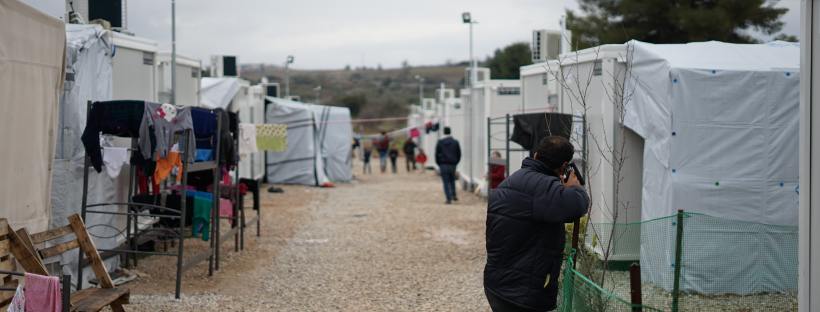
Planned refugee camps have better health conditions than tents thrown up on a sidewalk. Should a city like Santa Monica accept the clustering problem and house their homeless in urban refugee camps? The city could provide better sanitary conditions and perhaps build a clinic at the refugee camp that would relieve downtown emergency rooms of attending to the many medical needs of the homeless.

In want of a perfect solution, our society has created an ever worsening problem. If the homeless can abide living clustered together with little privacy and no sanitation on a public sidewalk, then they would certainly abide a tented refugee camp with a bit more order, sanitation and medical facilities nearby.

/////////////

Notes:

Camner, L. (2020, February 10). Santa Monica’s affordable housing policies have failed -. Retrieved September 11, 2020, from https://www.smdp.com/housing-policies-have-failed/185877

Gorman, A. (2019, March 11). Medieval Diseases Are Infecting California’s Homeless. Retrieved September 11, 2020, from https://www.theatlantic.com/health/archive/2019/03/typhus-tuberculosis-medieval-diseases-spreading-homeless/584380/

Southern California Association of Governments (SCAG). (2019). Profile of the City of Santa Monica, p. 12. Retrieved from https://www.scag.ca.gov/Documents/SantaMonica.pdf


Bridge the Gap?

Photo by Ragnar Vorel on Unsplash

September 6, 2020

by Steve Stofka

What issues are your priorities this election? For more than thirty years Pew Research has surveyed people about their priorities. For the first time in 2019 a majority of 765 respondents answered that there is a “great deal” of difference in where each party stands, up from 25% in 1987 (Pew Research, 2020). I’ve included the full list at the end.

In January 2019, soon after the midterm elections Pew surveyed 1500 adults (Jones, 2020). I don’t know why the abortion/free choice debate is not on the issue list since that single issue may decide some voters. I’m particularly interested in the large gaps in those priorities among those who lean Democrat or Republican. I’ll start with gaps of 25%. For instance, terrorism is a concern for 80% of Republicans but only 55% of Democrats. Other Republican priorities are Immigration, the Military and Crime.

As you can see, these are fear issues. Should a person in a town of 2000 be more concerned about terrorism than a resident of NYC? Of course not, but it is what it is. People vote out of fear and hope, but fear probably wins the wrestling match, especially among Republican voters who are not hopey, changey voters, as former VP candidate Sarah Palin noted (Gonyea, 2010).

The issue of crime illustrates the conflicting complexities of these issues. It is a 60% priority for Republicans, who are in suburban and rural areas where there is less crime, and a 40% priority for Democrats, who are in dense urban areas where there is a higher incidence of crime. Because crime is much lower than in past decades, this issue has slipped as a priority for Democrats (FBI, n.d.).  

Two of the highest Democrat priorites – Cimate Change and the Environment – have a huge gap of 50% with Republican voters. Democrat politicians have not been able to make these two fear issues personal for Republicans. If they could, they would draw more voters to their side on this issue. 25% gaps exist on issues of the Poor and Needy, Health Care, Education and Race Relations. Rural Republican voters are more likely to be poor and needy, but this is not a fear issue for them (USDA, n.d.).

What strategy would a politician or political consultant advise? Run toward the base? If so, one would emphasize these issues where there are large gaps between the two primary factions in this country. The President has largely adopted this strategy. Republican voters are more inclined to fall in line and the President is relying on this party loyalty even if they don’t like him personally.

Some issues where there is a smaller gap between factions are the economy, the budget deficit, jobs, global trade, drug addiction, transportation, Social Security and Medicare.

A politician reaching out to voters on the fence in this election would focus on these issues. Joe Biden hits the jobs theme, the budget deficit, and protecting Social Security and Medicare to appeal to voters who have had their fill of the President’s divisiveness.

In the coming two months, candidates may adjust their strategies. In the 2016 election, Hillary Clinton may not have addressed these shared concerns as well and it cost her the election.  Governing comes after winning an election. In politics, winning is packaging the concerns and identities of voters into an appealing, if not attractive, box that will get them to come out and vote.

What are your priorities this election season? Are you a multi-issue voter, a single issue voter, a party voter regardless of the issues? Here’s the Pew survey list of 18 issues: terrorism, immigration, military, crime, climate change, environment, poor and needy, race relations, health care, education, economy, Social Security, Medicare, jobs, drug addiction, transportation, global trade, and the budget deficit.

///////////////

Notes:

FBI. (n.d.). Crime rates in the United States, 2008 – 2018. Retrieved September 05, 2020, from https://crime-data-explorer.fr.cloud.gov/explorer/national/united-states/crime

Gonyea, D. (2010, February 07). ‘How’s That Hopey, Changey Stuff?’ Palin Asks. Retrieved September 05, 2020, from https://www.npr.org/templates/story/story.php?storyId=123462728

Jones, B. (2020, August 26). Republicans and Democrats have grown further apart on what the nation’s top priorities should be. Retrieved September 05, 2020, from https://www.pewresearch.org/fact-tank/2019/02/05/republicans-and-democrats-have-grown-further-apart-on-what-the-nations-top-priorities-should-be/

Pew Research Center. (2020, August 21). Public’s 2019 Priorities: Economy, Health Care, Education and Security All Near Top of List. Retrieved September 05, 2020, from https://www.pewresearch.org/politics/2019/01/24/publics-2019-priorities-economy-health-care-education-and-security-all-near-top-of-list/

U.S.D.A. (n.d.). Rural Poverty & Well-Being. Retrieved September 05, 2020, from https://www.ers.usda.gov/topics/rural-economy-population/rural-poverty-well-being/

Thumbs Up?

August 30, 2020

by Steve Stofka

I tuned into the Republican National Convention (RNC) for a short time and learned that everything is ok. 175,000 people dead from COVID – ok. Millions of people out of work – ok. Older folks losing their retirement savings and a lifetime of sweat equity as their businesses close – ok. Seniors unable to get their medications and prescriptions on time – ok. People lined up at food banks – ok. People sitting on their furniture after being evicted – OK.

Black men being shot down for non-compliance to police orders – ok. Peaceful and violent protests in cities around the country  – ok. Food left rotting in the fields – ok. Growers can’t get H-2B visas to hire foreign workers and Americans don’t want the jobs – ok. More suicides, especially by former military – ok. More domestic abuse – ok. More drug abuse – ok.

The White House – our house – used for political grandstanding- that’s ok. This week American soldiers in an MRAP in Syria sideswiped and injured by Russian soldiers – that’s ok. The president is pulling troops out. Deficits of many trillions of dollars – ok.

As long as the stock market is up, it’s all ok.

In Shakespearean tragedies a powerful man – always a man – is brought down by one fatal flaw of character. Circumstance exposes the flaw. Othello, Hamlet, Macbeth, Richard III, King Lear. English students are asked to identify the fatal flaw and explain their choice. Students are asked to privately imagine themselves in a position of power. What would be their fatal flaw?

Can a great nation have a fatal flaw? James Madison and Alexander Hamilton worried that democracy would lead to mob rule and bring down our country. Thomas Jefferson worried that regional interests would create a ruling aristocracy and a nation ruled by monarchy. I watched a few minutes of the White House pomp on Thursday night. Our president embodies both fears of our founders. 

//////////////////

Notes:

Photo by Max Muselmann on Unsplash

The Wrong Medicine

August 23, 2020

by Steve Stofka

During this pandemic, the Federal Reserve has been supportive of the asset markets and the government’s stimulus and relief programs. It’s immediate response was to lower interest rates, a boon for home buyers. This week we learned that home sales had rebounded 25% in July and are up 7% over last year at this time. Low interest rates have benefited homebuyers but penalized savers and pension funds who must generate a current income flow from their savings base.

During the 1930s Depression, the economist John Maynard Keynes argued that, because people want to hoard during a downturn, a central bank should maintain an interest level sufficient to induce people to deposit their money in banks (Keynes, 1936). Government-insured savings accounts helped solve that confidence problem. Keynes’ language and sentence construction are laborious, leading some people to think that Keynes argued for a policy of ultra-low rates during economic declines. He did not. Low interest rates are not a Keynesian solution.

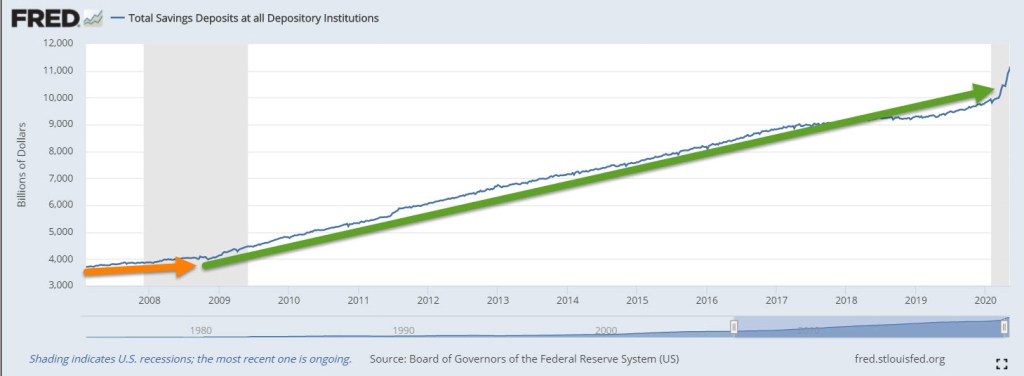
Despite the low rates, the amount of savings has doubled since the financial crisis in September 2008. There is a distinctive change in savings behavior at that important point.

With a savings base of $11 trillion, every 1% decrease in interest rates is a transfer of income of $110 billion from savers to borrowers. Who is the largest borrower? The government. Aren’t low interest rates good for businesses? No, Keynes argued rather unartfully in Chapter 15. Borrowing is a long-term decision, and subject to error. When interest rates are particularly low, like 2%, there is no wiggle room for error in the expectations of businesses who might borrow. For homebuyers, expectations of future business conditions are a small factor.

During an economic decline, people and businesses are guided more by short-term decisions. When interest rates are low like today, banks don’t want to lend because they aren’t confident in the flow of deposits to maintain their liquidity. Banks need that flow of deposits to meet the outflow of money when they make loans (Coppola, 2017). Entrepreneurs are reluctant to borrow for expansion because they are not confident in the accuracy of their long-term expectations. They borrow to pay back more predictable future obligations, particularly current and future stock grants to their key employees. Borrowing money to fund stock grants does not create jobs but helps inflate stock prices.

Keynes badly underestimated the political forces that guide a central bank’s decision making. As it did a decade ago, the Federal Reserve has lowered interest rates to near-zero, the opposite of Keynes’ prescription. Low interest rates do not benefit bank stocks, which have declined by 25% and more. A select group of technology stocks are booming as people consume more digital services at work and play. Borrowing by businesses jumped in response to the CARES act but many businesses kept those borrowed funds liquid to avoid insolvency during this crisis. We can expect slow growth as consumers and businesses continue to make short-term decisions, and asset markets are warped by central bank policy.

//////////////

Notes:

Photo by Christina Victoria Craft on Unsplash

Coppola, F. (2017, November 01). Bank Capital And Liquidity: Sorting Out The Muddle. Forbes Magazine. Retrieved August 15, 2020, from https://www.forbes.com/sites/francescoppola/2017/10/31/bank-capital-and-liquidity-sorting-out-the-muddle/

Keynes, J. M. (1936). The general theory of employment interest and money (p. 124). New York, NY: Harcourt, Brace & World.

The Long and Short Run

August 16, 2020

by Steve Stofka

Gold is at an all-time high. Like wheat and other commodities, it pays no interest. Gold’s price moves up or down based on expectations about the value of money used to buy gold. If inflation is expected to increase, the price of gold will go up. Eight years ago, after several rounds of quantitative easing by central banks, gold traders bet that inflation would rise. It didn’t, and the price of gold declined by a third.

Since mid-February, the U.S. central bank has pumped almost $3 trillion of liquidity into the economy (Federal Reserve, 2020). Numbers like that hardly seem real. Let’s look at it another way. The overnight interest rate is so low that it is essentially zero – like gold. People around the world regard U.S. money and Treasury debt as safe assets – like gold. Imagine that the central bank went to Fort Knox, loaded up 1.5 billion troy ounces of gold – about 103 million pounds – in gold coins and dropped them on everyone in the U.S. There are about 190,000 tonnes (2204 lbs./tonne) of gold in the world, a 70-year supply at current production. A helicopter drop of gold would be almost 47,000 tonnes, or 25% of the world supply. It would take five C-5 cargo planes to haul all that.

Milton Friedman was an economist who believed in the quantity theory of money. His model of money and inflation held “inflation is always and everywhere a monetary phenomenon.” If the growth of money was greater than the growth of the economy, inflation resulted. The data from the past decade has refuted this model. Former chairman of the Federal Reserve Ben Bernanke noted that the evidence suggests that economists do not fully understand the causes of inflation (C-Span, 2020, July). He was including himself in that group of economists because he had been an advocate of that model (Fiebiger & LaVoie, 2020).

What has the Federal Reserve and the government done to navigate the difficult path created by this pandemic? Helicopter Money for businesses and consumers. Lots of toilet tissue, so to speak. No reason to hoard, folks. There’s plenty. They have followed the first of John Maynard Keynes’ prescriptions for a downturn. The government should spend money. Why? It is the only economic actor that can make long-term decisions. Everyone else is focused on the short term.  Keynes badly mis-estimated the short-term thinking of politicians, particularly in an election year.

Will the flood of money cause inflation as gold bugs assert? Some point to the recent rise in food prices as evidence of inflationary forces. However, the July Consumer report indicates only a 1% annual rise in prices, half of the Fed’s 2% inflation target. The rise in food prices this spring was probably a temporary phenomenon. It suggests that the Fed is fighting deflation, as Ben Bernanke noted this past April (C-Span, 2020 April).

Since March, government spending has helped millions of American families stay afloat during this pandemic. Congress has gone home without extending unemployment relief and other programs. Many families are being used as election year hostages by both sides. House Democrats put their cards on the table three months ago. Republicans in the Senate and White House have dawdled and delayed. Faced with a chaotic consensus in his own coalition, Senate Majority Leader McConnell has largely abdicated control of the Senate to the White House and the wishy-washy whims of the President.

We return to where we began – gold. It is neither debt, equity nor land. As a commodity, only a small part is used each year. It has been used as a medium of exchange and a store of value. Except for a few years during and after the Civil War, gold held the same price from 1850 until the 1929 Depression – $20.67. In the long run, longer than a person’s retirement, gold is good store of value. In the ninety years since the Great Depression began, the price of gold has grown 100 times. Yet it is still lower than its price in 1980. The U.S. dollar does not hold its value over several decades, but it is predictable in the near-term. In a tumultuous world, predictability is valuable. The dollar has become the new gold.

//////////////////////

Photo by Lucas Benjamin on Unsplash

C-Span. (2020, April 7). Firefighting. Retrieved August 12, 2020, from https://www.c-span.org/video/?471049-1%2Ffirefighting (00:21:15).

C-Span. (2020, July 18). Ben Bernanke and Janet Yellen Testify on COVID-19 Economic Inequities. Retrieved August 12, 2020, from https://www.c-span.org/video/?473950-1%2Fben-bernanke-janet-yellen-testify-covid-19-economic-inequities (01:35:20)

Federal Reserve. (2020, July 29). Recent Balance Sheet Trends. Retrieved August 12, 2020, from https://www.federalreserve.gov/monetarypolicy/bst_recenttrends.htm

Fiebiger, B., & LaVoie, M. (2020, March 4). Helicopter Ben, Monetarism, The New Keynesian Credit View and Loanable Funds. Retrieved August 12, 2020, from https://www.tandfonline.com/doi/abs/10.1080/00213624.2020.1720567?journalCode=mjei20

The Two 10%

August 9, 2020

by Steve Stofka

In the past three months the stock market has been on a tear. The last time we’ve seen such a rise? 1938. People are day trading on the Robinhood platform. Hop aboard the gravy train and party like it’s 1999, near the height of the dot-com bubble.

According to the Federal Reserve, the top half of households in this country own 99% of the stock market. The top 10% own a whopping 87% of the market. So why do many news outlets broadcast updates on the stock market  every hour?

Share of Equity Ownership by Wealth Percentile

A second group of 10% is unemployed, according to the unemployment report released Friday. House Democrats passed a $3 trillion bill in May. Republicans and the White House have been worried that too many Americans are going to get fat and lazy if the federal government continues to support the unemployed with extra benefits. They have fought among themselves about a stimulus package, and 15 Republican Senators – half their caucus – don’t want to do anything more for the American people. The Senators who are up for election this year do want to pass something but want to appear frugal at the same time – a difficult task.  

The richest 10% are doing fine. This week the NY State’s Attorney General announced a suit to terminate the non-profit status of the NRA and dissolve the organization. Their investigation has been going on for more than a year. In September 2019, House Ways and Means Committee member Brad Schneider revealed several allegations against NRA executives (2019). Whether the IRS had already begun an investigation at that time is unclear.  The NRA has paid exorbitant expenses for their executives, including Wayne LaPierre, the public spokesman and VP of the organization. These include homes, yachts, and private jets for them and their families. The executives billed the “expenses” to the NRA’s ad agency, Ackerman McQueen, who then submitted bills with little detail to the NRA, which paid the ad agency.

Dues to the organization have been declining since Donald Trump was elected president. Gun manufacturers have relied on scare tactics to sell their products and have been big supporters of the NRA. Since the election of Trump, sales have declined. Two years ago, the oldest gun manufacturer, Remington, declared bankruptcy. As NRA revenues fell, the abuses came to light when the organization fell behind on payments to the ad agency. Influential members devoted to the mission of the organization have been appalled at the corruption.

Mr. Trump has signaled his support for the organization. Like all Presidential hopefuls, his financial affairs came under scrutiny. The Trump Foundation was later dissolved because of the same self-dealing practices.

The top 10% are always doing fine because they pay an army of lawyers and accountants to legally dodge the rules. Every week, Mr. Trump’s comments indicate how little he knows about any of the laws of this country because the laws don’t apply to him. He is part of the 10% that owns the stock market. When those markets came under stress a few months ago, the Federal Reserve stepped in with massive infusions of liquidity to preserve the assets of that 10%. They are the fire department for the rich.

Who will come to rescue the homes and families in the unfortunate 10% whose extra UI benefits have ended?  

/////////////////////

Notes:

Photo by Fritz Benning on Unsplash

Schneider, B. (2019, October 09). NRA’s Actions “Absolutely” Raise Questions on Tax-Exempt Status Testifies Non-Profit Tax Expert. Retrieved August 08, 2020, from https://schneider.house.gov/media/press-releases/nra-s-actions-absolutely-raise-questions-tax-exempt-status-testifies-non-profit

The Bargain

August 2, 2020

by Steve Stofka

Deep below the U.S. Capitol Building, several men stand guard outside a door. Inside the room are House Speaker Nancy Pelosi and Senate Majority Leader Mitch McConnell. With each of them is an aide.

“If you can arrange a voice vote to impeach on Monday, my members can deliver the needed two-thirds majority to convict,” the Senator says. “Vice-President Pence will serve out the term. Utah Senator Mitt Romney has agreed to accept the party’s nomination this August.”

Ms. Pelosi eyes McConnell warily. “We like our chances against Trump. Romney’s a moderate that a lot of Republican voters – maybe even some Democratic voters – will welcome. I need more.”

McConnell clears his throat. “I’ll reduce the liability protections for big businesses, but my members will not budge on lawsuit protections for smaller businesses. This is something your own members can get behind. Who doesn’t like small business in America?”

Pelosi motions to her aide who hands her a summary of the second relief bill that the House passed in May. She glances at it. McConnell fights the smile that tugs at the left corner of his mouth. Pelosi is not fooling him. The paper is a sham. She’s got her demands memorized.

“Revoke the SALT provision in the tax bill,” Pelosi says. McConnell shakes his head. “We’re in the middle of a pandemic, for God’s sake, Mitch. We can argue it out in the next Congress. One year of relief. One year only.”

“You agree to the one trillion package we passed this week,” McConnell says.

“We passed a three trillion dollar bill back in May and your members and the White House couldn’t agree on how much the American people should suffer,” Pelosi accuses him.

“Unlike your coalition, Nancy, ours comes from a lot of diverse areas from all over the country,” McConnell argues. “They have a wide range of concerns and perspectives.”

“White concerns, white perspectives,” Pelosi shoots back. “I need more help for state and local governments.”

“States like Illinois and New Jersey have underfunded their public pension plans for years,” McConnell says. “We’re not using the Covid crisis to bail out corrupt state politicians with no fiscal discipline.”

“We’ll set up a joint oversight committee to monitor how the states and cities spend the money,” Pelosi offers.

“Money is fungible,” McConnell says. “No way to properly monitor it. I’ve got too many members from small states who have struggled for years to attract good talent for city and state government. They couldn’t offer fancy pension packages. They were responsible. Their pension funds are not badly underfunded like Illinois. They just won’t go for it.”

“I’ll take SALT off the table and meet you two-thirds of the way on aid to the states and cities. You’ll look like a tough negotiator, but I’ll have to go back to my members and tell them that I gave away $1.5 trillion in aid that they voted for in May. You want to build fighter jets that the Air Force doesn’t want and yet you’re taking money away from students and teachers? That will be a good campaign ad this fall.”

“Not negotiable, Nancy. My members will take their chances with Trump if I give in on the military aid. Too many communities depend on that production. I’ll go halfway on aid to state and local governments.”

Pelosi turns to her aide. “How much is the final package?” McConnell knows that she has calculated exactly what the figure is. The aide says $1.6 trillion. Pelosi holds out her hand and they shake. “I’ll make the announcement at 9 A.M. on Monday.” She and the aide leave the room.

“Stop, stop, stop,” my wife says as she shakes me awake. “You’re yelling ‘you won’t believe it!’ over and over.”

It’s still dark out but the first half-light of early dawn is in the sky. Boy, it seemed so real. I sit up.

“This is not like you,” she says. “What won’t I believe?”

I give her a hug. “Never mind. Sorry I woke you.” I lay down and go back to sleep.

////////////////////////////

Photo by Austin Kehmeier on Unsplash

Moral Hazard

July 26, 2020

by Steve Stofka

This week additional unemployment benefits will cease but Senate Republicans and the White House announced that they could not agree among themselves about the appropriate course of action for a second stimulus bill. What is the problem? Many Republicans think that an extra $600 a week in unemployment benefits rewards people for not working. The issue is a familiar one to policymakers and economists: moral hazard.

Moral hazard arises when party A has no incentive to do X because party B will pay the cost. In this example, Party A = a taxpayer. X = go to work. Party B = the federal government. An insurance policy illustrates the problem of moral hazard. If an insurance company – called the principal – provided comprehensive insurance for a house, the homeowner – the agent – would have less incentive to maintain the property because the owner bears little of the cost of repair. Comprehensive is the key word. There must be some cost to the insured. Moral hazard was evident during the financial crisis over a decade ago. Financial traders made a lot of money by taking risks. When those risks blew up, taxpayers picked up the bill for the loss.

Another key ingredient of moral hazard is asymmetry of information. In a purchase transaction, the seller – the one receiving the money – knows more about the item being sold than the buyer – the one paying out the money. Laws and regulations attempt to minimize the asymmetry, but it is an inherent feature of a transaction. In a principal-agent model, the agent – a babysitter or the CEO of a public company – knows more than the principal – the parents or the stockholders. The principal must trust the agent to some degree and monitor the agent to some degree.

With that bit of background, let’s return to the issue of extended unemployment benefits. Who is the agent and who is the principal? Republican leaders think of themselves as the principal, as though it was their money that they are paying out. In their thinking, we, the taxpayers, are the agents who cannot be fully trusted. If Republicans pay people unemployment benefits, how do they know that people will look for a job?

This concern demonstrates the patriarchy that is the core ideology of the Republican Party. Lawmakers are not the parents, or the principals. In a democratic republic, lawmakers are the agents of the citizens. We worry about the moral character of our representatives, not the other way around. We, the citizens, are the principals.

Senator McConnell says that he is acting on behalf of taxpayers. Which taxpayers is he referring to? The ones who will be unable to pay their mortgage or their rent next month? The taxpayers of the future? He wasn’t concerned about them when Republicans passed their tax bill a few years ago. That tax bill was meant to appease the stakeholders, the big moneyed interests that are the real principals in this country. In effect, we, the citizens, are but their agents.

230 years ago, American colonialists rebelled against the aristocracy that controlled the economy and politics of Britain and its colonies. Here we are again. Senator McConnell is one of the most powerful men in this country because he is an agent for the American aristocracy. For one day a year, citizens act as principals by voting. Sensing that the tide of sentiment is going against Republicans in this election, Republican lawmakers and the White House are trying every legal maneuver to deny the vote to as many people as possible.

The moral hazard is when the agent takes effective control from the principal. That is the government of Venezuela under Nicolás Maduro. The Republican party proclaims that they are the champions of “small government.” What those two words mean is government by a small elite. If you prefer an impotent and passive role as a citizen, vote Republican this fall. If you want a more robust government which acts like an agent of the people, make another choice.

//////////////////

Photo by Esteban Lopez on Unsplash

Pandemic Detour

July 19, 2020

by Steve Stofka

World War 1 and the flu epidemic that followed was the death knell for the 19th century. Previous epidemics ended the Middle Ages in the 14th century and the Renaissance in the 17th century. Pandemics are permanent detours onto an alternative route through time. Will historians regard the Covid pandemic as the close of the 20th century? Depends on what happens in the next hundred years. History travels slow as a tortoise. The present is as fast as Achilles and eventually overtakes the past.

Pandemics cleanse the politics of the age. Both political parties have fractured in the past two decades. Will this pandemic close the coffin on one or both parties? In name, no. Both parties have a duopoly on voting in each state so sub-groups within each party try to take over the party apparatus. The 2016 election was a takeover of the Republican Party by conservative media, legal and political interests that have been fighting for control of the party since the 1980s.

President Trump is the poster boy of that effort. Conservative groups needed someone to sign off on judicial appointments and other legislation. They preferred someone with little experience, who was impressionable and a bit dim for the rigors of the office. They got more buffoon than they bargained for. If he becomes a one-term President, the people, organizations and money that put him in power will fight their long game – to gut or eliminate most of the federal bureaucracy. The few Federal government institutions left will be the military, a slim State department, domestic policing agencies like the DEA and the Border Patrol, the Treasury, IRS and the courts. In a strict conservative view, defense, enforcement, monetary authority and justice are the only legitimate functions of a federal government.

Each pandemic is a challenge to competing visions of the future. Conservative groups have patience, resolve, and money. If they have their way, the 20th century will have been a political experiment in American socialism that began when progressives gained political power at the start of the last century. The 21st century will return the country to its founding principles.

Liberals envision a more expansive role for a central government. Should there be a limit to the role of government in our daily lives and where should it be set? Without a limiting principle, liberal groups struggle to develop a concise and cohesive philosophy. Perhaps that is the strength of a liberal viewpoint.

Americans have been fighting each other for far longer than they have fought with the rest of the world. In a country with diverse cultural backgrounds, social and political tension is inevitable. The 1918 epidemic helped reshape the country but did not end this grand experiment in republican democracy. Let’s hope that the 2020 pandemic doesn’t change the chemistry of this country so drastically that the experiment ends.

/////////////

Notes:

Photo by 35mm on Unsplash

Public and Private Law

July 11, 2020

by Steve Stofka

A recent Tik-Tok video shows a woman berating some unseen worker at a dental office. The problem? The woman is not wearing a mask and is not allowed past the reception desk for her appointment. She claims to know the law and is going to sue them. She does have intimate knowledge of a private law that she carries around in her head. She is Queen of her own private island. Public law and the courts disagree with her, but many of us live by two laws – the public and the private.

This is a good jumping off point for a discussion on the freedoms of private businesses. In 1960, in Greensboro North Carolina, four black university students staged a sit-in at a Woolworth’s 5&10c store which would not serve them at the lunch counter. Woolworth was well within their rights at this time. It was the southern way.

Over the next few weeks, the number of people grew and attracted national attention, including President Eisenhower. White residents staged a counter protest which turned violent. Boycotts of other stores began and caused substantial sales losses to Woolworth. A few months later, Woolworth desegregated their lunch counters. Discrimination in places that served the public was made illegal with the passage of the Civil Rights Act four years later.

Generally, a business has the freedom to screen their customers based on a criteria that applies to everyone. Restaurants often post “No shoes, no shirt, no service,” and may add “no mask” to that list. Inebriated customers at beach communities sometimes protest about the “no shirt” provision. This is America, man. I have my rights! The bouncer ushers the customer out the door or the proprietor calls the police.

We understand that religious communities have a set of laws different from civil law. People who object to a woman’s right to an abortion may do so based on a 19th century papal proclamation that life began at conception (McGarry, 2013). That papal bull overturned centuries of Catholic teaching.

At a campsite near Lake City, Florida, I was first introduced to an alternate interpretation of civil law, but one based on a historical, not religious, foundation. Following the Civil War, the 13th, 14th and 15th amendments were passed over the objections of many southerners who felt that the North was an occupier in their land (Foner, 2020). These amendments had been forced on the southern states. Within a decade, southern states passed Jim Crow laws that undid much of the three amendments.

Under this interpretation, I was informed, Supreme Court decisions based on these coercive amendments were “illegal and void” under the exclusionary rule. This included the court’s 1954 ruling that desegregated public schools and the Roe v. Wade decision that invalidated state laws that prohibited abortion. Crazy talk? The exclusionary rule relates to the admissibility of evidence, not the validity of court decisions (Web Solutions, n.d.). That private interpretation of the law certainly guides the actions and attitudes of too many.

The 1968 Fair Housing Act hoped to end many decades of housing discrimination in state and federal law. Instead, it pushed the discrimination underground (McGhee, 2018). A real estate agent might be hesitant to show a house to a black couple in a white neighborhood. She wants to get referrals from neighbors or other agents, who might wonder: Can she not navigate the subtle dynamics of filtering out less optimum clients? Keep silent. Two laws – public and private.

As discussed last week, all states require people to wear seat belts. The NHTSA reports that almost half of those killed a few years ago were not wearing seat belts (NHTSA, n.d.). But what about the law of personal freedom? It is written in the Constitution, man! I have my rights! Life, liberty and the pursuit of happiness. The phrase is a declaration of intent and sentiment found in the Declaration of Independence, not the Constitution. It has no force of public law but is the cornerstone of private law.

There are laws against dumping but many contractors will dispose of remodel trash in dumpsters to save the time and expense of driving to the city dump. According to a contractor’s private interpretation of the law, it’s not really dumping because the debris is going into a container. Private law vs. public law.

Let’s now revisit the woman in the video who yelled at the worker in the dentist’s office. Under contract law or maybe it is appointment law, she made an appointment with the dentist and she showed up on time so the dentist has to see her. Those are the only facts that matter. Aren’t we all angry when other people do not recognize the same private laws that we carry around in our heads? Does someone else have the same personal freedom that I do – to form a private interpretation of the Constitution? Well, of course. But if they are wrong, then no they don’t, man. That’s in my private Constitution.

////////////

Notes:

Photo by Thomas Kelley on Unsplash

Foner, E. (2020, April 03). Reconstruction. Retrieved July 11, 2020, from https://www.britannica.com/event/Reconstruction-United-States-history

McGarry, P. (2013, July 01). Catholic Church teaching on abortion dates from 1869. Irish Times. Retrieved July 11, 2020, from https://www.irishtimes.com/news/social-affairs/religion-and-beliefs/catholic-church-teaching-on-abortion-dates-from-1869-1.1449517

McGhee, F. (2018, December 04). The Most Important Housing Law Passed in 1968 Wasn’t the Fair Housing Act. Retrieved July 11, 2020, from https://shelterforce.org/2018/09/05/the-most-important-housing-law-passed-in-1968-wasnt-the-fair-housing-act/

NHTSA. (2020, January 15). Seat Belts. Retrieved July 11, 2020, from https://www.nhtsa.gov/risky-driving/seat-belts

Web Solutions. (n.d.). Search and Seizure – The Exclusionary Rule And The Fruit Of The Poisonous Tree Doctrine. Retrieved July 11, 2020, from https://law.jrank.org/pages/10054/Search-Seizure-Exclusionary-Rule-Fruit-Poisonous-Tree-Doctrine.html.

Wikipedia. (2020, June 15). Greensboro sit-ins. Retrieved July 12, 2020, from https://en.wikipedia.org/wiki/Greensboro_sit-ins