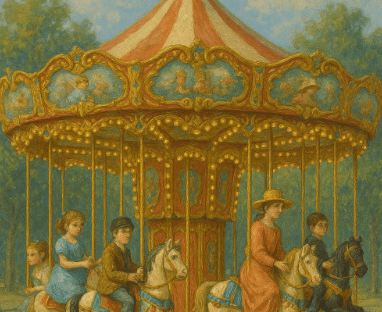
A Debate on Tariffs

by Stephen Stofka

This is 12th in a series of debates on various issues. The debates are voiced by Abel, a Wilsonian with a faith that government can ameliorate social and economic injustices to improve society’s welfare, and Cain, who believes that individual autonomy, the free market and the price system promote the greatest good.

This week, Abel began the conversation. “Toward the end of our conversation last week, you mentioned the shift of voter sentiment toward the right.”

Cain nodded, “Yes, the New York Times analyzed the change in election results from the 2020 election and it showed a shift toward the Republican Party in most counties (Source – NY Times).”

Abel interrupted, “Voters shifted left in the 2020 election. For the past twenty years, sentiment seesaws left and right with each election. Voters are so evenly divided that a slight shift can have a dramatic effect on party control of government.”

Cain argued, “This time is different. The voters want change. The neoliberal wing of the Republican Party has been discredited and driven out after two failed wars and a permissive trade policy that boosted China’s economy at the expense of American jobs. Gary Gerstle (2022, pg. 2) writes that it was the financial crisis that triggered the fall of the neoliberal order. President Trump is trying to undo the mistakes of that neoliberal ideology.”

Abel frowned. “I’ve read that book. Gerstle also noted that neoliberal policies were responsible for a lowering of the barriers to free trade (pg. 5). Tariffs and borders, for example. Trump is on a mission to rebuild those barriers. That will only hurt trade and weaken American business and consumers.”

Cain shook his head. “Open borders allowed for the smuggling of drugs and people across our southern and northern borders. The costs of open borders outweigh the benefits.”

Abel sighed. “25% tariffs on imports from Mexico and Canada are going to fuel inflation and hurt consumers. Both countries have said they will retaliate. We export a lot of grains to Canada. That will hurt our farmers.”

Cain argued, “In 2002, President Bush raised tariffs on steel and aluminum imports to as much as 30%. A year later, after complaints to the WTO, Bush ended the tariffs. Trump is made of stronger stuff. These countries are not doing enough to curb drug and people smuggling. It may not be an explicit violation of trade rules, but it violates the spirit of those rules.”

Abel replied, “Bush did that to save jobs in the steel industry. Instead of stemming the flow of jobs to other countries, the tariffs caused the loss of 200,000 manufacturing jobs (Source). Trump’s tariffs are going to raise unemployment and cost consumers.”

Cain rolled his eyes. “We’re not going to agree on this. We have got to restore our nation’s manufacturing capacity and the supply chains that support production that is vital to our security. China controls a lot of essential minerals used in the production of electronics. They are actively pursuing alliances with African countries to lock up essential mineral resources. This is economic warfare, and we have to take measures to defend ourselves.”

Abel frowned. “Tariffs lead to trade wars. Trump is acting like he has a mandate. He won with the lowest margin of the popular vote in the past four decades – just 1.5%. He didn’t even get a majority of the votes (Source). In 2016, he got fewer votes than Hillary Clinton. Contrast that with Obama, who had a 7.2% margin of victory in 2008, and Biden who won by 4.5% in 2020. Voters for Trump are going to wake up and find that they have been screwed.”

Cain argued, “Democrats always use the popular vote as a measure of voter approval. States with a less concentrated population provide the resources that are vital to the economy and security of this country. Those states supply the food, the beef, the fuel that people in urban areas rely on. It’s an economic symbiosis. The producers and workers in rural areas should not be put at a disadvantage simply because their production requires more land. The Electoral College balances the inequities that result from a popular vote.”

Abel scratched his chin. “Tariffs are going to hurt the rural producers and workers that voted for Trump. Those red rural states already depend on the coastal blue states for federal benefits like farm and oil subsidies, Medicaid and welfare and they resent it. They imagine that Trump will revitalize rural economies so that they are more like it was in the 1950s when relative wages were higher. It was the unions who bargained for those higher wages and benefits. Without unions in the private sector, wages in rural counties will remain low.”

Cain raised an eyebrow. “Unions abused their power and companies became less competitive. Unions sometimes enforced rules among their members with violence or intimidation in the workplace (Source). They invite free riding. ‘Shirkers’ are paid at the same rate as productive employees. It’s bad for morale and makes workers less productive as a whole. An employee in a union has two bosses – the shop steward and the employer. The employer wants the employee to work at their best. The shop steward might want an employee to slow down so as not to raise the employer’s expectations.”

Abel cocked his head slightly. “Free riding is a collective action problem that is not unique to labor unions. They empowered workers in negotiations with large companies who wielded extraordinary power in the labor market. In some counties, a company was a monopsony, the main source of employment for everyone in that region.”

Cain argued, “The government is the largest employer in the country employing over 23 million at various levels (Source). Walmart, the largest private employer, has just over 2 million workers (Source). Unions have taken over the public sector.”

Abel interrupted. “Let me stop you there. The BLS just released their annual survey of union membership. It’s less than a third in the public sector (Source).”

Cain nodded. “OK, perhaps I overstated the percentage. Still, public sector membership is five times what it is in the private sector. Unions may give workers more bargaining power, higher wages and more benefits. Who pays for all that? Taxpayers. Our public schools are not teaching essential reading and math skills. Fewer police officers on the street. Potholes go unfilled. What are taxpayers getting for their money? Screwed.”

Abel scoffed. “Elementary school teachers generally make less than the average wage in their local economy. In Denver, an elementary school teacher averages almost $54,000 (Source). The average in private industry is more than $80,000 (Source).”

Cain argued, “Ok, so maybe elementary school teachers in Denver are underpaid. Their main funding source is local property taxes. In the whole metro area though, federal government employees make $2128 a week (Source). That’s far above the average weekly wage of $1721 in the private sector (Source).”

Abel shrugged a shoulder. “Look, Denver is a regional hub. There is a higher proportion of tech employees in the federal workforce in Denver than the private sector. State government employees make just $2 more than the average (Source).”

Cain frowned. “If the mix of jobs and talent was similar to the private sector, then their union is not very effective at negotiating pay.”

Abel showed some impatience. “Your group doesn’t like unions. I get that. Incorporation is a collaboration of capital for investor profits. A union is a collaboration of workers for better pay and working conditions. Capitalism has been so successful because it turns the free riding problem into an advantage.”

Cain laughed. “You’re saying something good about capitalism? Go on.”

Abel smiled. “Small investors, holders of common stock in a company, enjoy the same return on their capital as the giant hedge fund who may own a substantial stake in the company. Because they have so much at stake, large investors take an active role in monitoring or directing management decisions. The small investors freeride on those efforts.”

Cain nodded. “That’s an interesting perspective. I still don’t think that unions are needed to negotiate for workers. Worker productivity and demand will support higher wages.”

Abel sighed. “In theory. This is the real world, not a freshman class in economics. If capital can collaborate to gain bargaining power, workers must collaborate to match that power.”

Cain motioned his impatience. “We started out talking about tariffs and now we’re talking about unions.”

Abel laughed. “We are exploring different perspectives. We will never come to an agreement unless we try to understand each other’s positions on these issues.”

Cain nodded. “See you next week then.”   

///////////////////

Image by ChatGPT

Gerstle, G. (2022). The rise and fall of the neoliberal order America and the world in the free market era. Oxford University Press.

The American Federation of Government Employees represents 800,000 of two million federal employees (Source). The American Federation of State, County and Municipal Employees represents more than 1.3 million workers (Source).

A Debate on a VAT tax

January 26, 2025

by Stephen Stofka

This is 11th in a series of debates on various issues. The debates are voiced by Abel, a Wilsonian with a faith that government can ameliorate social and economic injustices to improve society’s welfare, and Cain, who believes that individual autonomy, the free market and the price system promote the greatest good.

The notes at the end give more context to the arguments.

Cain began this week’s conversation. “We left off last week discussing alternatives to the income tax. Before we entertain alternatives, can we agree that the income tax should be abolished at the same time the country adopts a new scheme of taxation?”

Abel cleared his throat. “I’m not so sure about that. Can an alternative tax scheme raise the same amount of revenue?”

Cain raised an eyebrow. “If it didn’t, that would be more money for private consumption and investment.”

Abel grimaced. “That’s playing with fire. The country is already running persistent deficits. If there was a significant difference in revenue, it could seriously weaken the dollar.”

Cain said, “Our group favors a consumption tax to replace the income tax. They were the main source of federal revenue until the passage of the 16th Amendment in 1913.”

Abel shook his head. “Consumption taxes didn’t raise enough money to pay off Civil War debts and the pensions promised to veterans and their families. In the early 20th century, society was becoming more complex. There was a greater role for government. The greatest improvements in health and life span came in those decades. Public sanitation measures and vaccines reduced water borne illnesses and contagious diseases.”

Cain argued, “I agree that there was a greater role for government. It’s just gone too far. Particularly the role of the federal government in our lives. A consumption tax broadens the tax base. Gives voters a stake in the government’s spending.”

Abel nodded. “There are several types of consumption tax. Many developed countries use a VAT or value added tax, but it is a supplemental to an income tax.”

Cain’s displeasure was obvious. “Our group would not support another tax. Also, with a VAT, politicians are tempted to fiddle with the type of items subject to the tax. It invites interest groups to lobby for exclusions from the tax. That’s what goes on in Britain and many European countries. We advocate a tax that reduces favoritism.”

Abel argued, “Any tax scheme invites favoritism. For instance, Colorado has a flat income tax but many exclusions from income that are not included in federal income. Pensions, social security and charitable contributions are just a few examples.”

Cain shook his head. “A credible alternative would have to make alteration as difficult as possible for Congress – just like the Constitution is.”

Abel sighed. “Specific language makes compromise difficult. The law is full of words that are open to interpretation like ‘reasonable’ and ‘appropriate.’ Section 8 of Article 1 of the Constitution stipulates that the Congress provide for the ‘common Defence and general Welfare.’ What does the word ‘general’ mean in that context? It’s clearly not the common welfare or the founders would not have agreed on the insertion of the word ‘general.’ To this day, our two groups have been arguing about the scope of powers authorized  by those two words.”

Cain tilted his head slightly. “Ok, granted it’s not easy. We are not striving for perfection, only clearly defined terms and transparency. No more backroom deals in Washington.”

Abel frowned. “Look, people and the institutions they create are too complicated for simple solutions. The only reason that the Constitution exists in a difficult to alter form is the small number of people who had a hand in its creation.”

Cain scoffed. “Each state had to ratify the Constitution and the Bill of Rights. In 1787, the Virginia legislature had 168 Senators and delegates. Today Virginia has only 140 members to represent a population that is sixteen times as large. Believe me, there was plenty of vociferous debate. The Constitution is a series of compromises hammered out in Philadelphia but reflecting the sentiments of those in the individual states.”

Abel interrupted, “The few who could vote. Men with property. The sentiments of the Declaration of Independence were noble and democratic, but this country’s Constitution was founded on governance by an aristocracy. After a bitterly fought Civil War, the passage of the 14th Amendment expressed the democratic sentiments that the founders could not embody in the original Constitution.”

Cain laughed. “Once again, we are getting off the topic. Our group wants specific, not broad, taxation powers that limit Congress and the President. It’s a principal-agent problem. We have to keep our elected representatives, our agents, on a short leash, or they will satisfy their own interests more than they do the people they represent. The text of the 16th Amendment was too broad and invited the corruption and complexity the tax code has become after more than a hundred years.”

Abel looked puzzled. “Your group wants an amendment with specific language?”

Cain nodded. “Yes, an amendment revoking the 16th Amendment and installing a consumption tax of some sort.”

Abel asked, “What about new home sales? They are included in GDP, but the consumption happens over years. The Bureau of Labor Statistics calculates an ‘imputed rent’ that a homeowner pays and collects each month. It’s based on market rents in that area.”

Cain shook his head. “It can be simple. The language of the amendment would target the revenue as a percentage of GDP. The means to get to that target would be left up to Congress.”

Abel looked interested. “Go on, tell me more about that.”

Cain continued, “Our group supports a national sales tax or VAT to replace the income tax. In 2023, the federal government collected $2.56 trillion in individual income taxes on a GDP of $27.2 trillion. That’s 9.2% of GDP. Let’s say a thirty-year average is 10% to make the math easy. A VAT or some other consumption tax rate could be adjusted each year based on quarterly GDP estimates that the government already does. That would not be cumbersome wording.”

Abel showed concern. “Your group strives for simplicity like it was the Holy Grail. In 2018, the Congressional Budget Office estimated the revenues from a VAT over a ten-year period. They noted that a broad tax base includes only 66% of personal consumption expenditures and those account for only 67% of GDP. Multiply those together and the tax base is only 44% of GDP. To collect the same revenue as individual income taxes, the tax rate would have to be 21% or so, not 10%.”

Cain counted on his fingers. “One, it would broaden the base so that more voters have skin in the game. Two, it would protect everyone’s privacy. Three, it would set clear and transparent limits on politicians in Washington. It’s well worth the price.”

Abel shook his head. “To abolish all tracking of income, all of the states would have to agree to a VAT to collect their taxes. What about Social Security taxes collected? For the past 15 years, those tax revenues have been 6.5% of GDP. The tax rate would have to be 36% to account for Social Security taxes. Add in state income taxes and the tax rate would be over 40%. Adding in state and local sales tax could bring the total tax bite to 50%.”

Cain argued, “Look at Britain. It has an income tax rate that starts at 20% and a VAT rate of 20%. A middle-income person could pay 60% total tax. The average effective tax rate in the U.S. is 15%. Add in 15% for the employer and employee contributions to FICA taxes. State and local taxes can add up to eight or ten percent. The total tax bite under our current system is close to 40%.”

Abel frowned. “An analysis of 2021 IRS data showed that the bottom 50% of taxpayers paid an average of only 3.3% of gross income, not 15%. Voters will not go for a tax scheme that will place a huge burden on most taxpayers to reduce the tax burden on Elon Musk and the other 1%.”

Cain interrupted. “That’s one of the problems. Half of the voters have so little skin in the game that they let politicians get away with anything. That’s how the budget became so bloated with ‘gimmes.’”

Abel replied, “Well, that’s a discussion for another day. I just don’t think a VAT is a practical alternative as a complete replacement for the individual income tax. Sure, we all like simple but the burden of common costs and the distribution of benefits is too complex for simple policies.”

Cain pursed his lip. “The more complex the policy, the less transparent. In a democracy, transparency is crucial.”

Abel raised an eyebrow. “I agree but I don’t think your group can sell a tax policy that would  increase the tax bite for the lower half of income earners by at least ten to fifteen percent. It might throw the economy into a recession within a year.”

Cain objected, “I think voters can be convinced. This last election has shown that voters are tired of progressive policies.”

Abel smirked. “Trump won the popular vote by 1.6%. The House has a slim majority. The Senate has a 53-seat majority only because Democrats had almost twice as many Senators up for re-election as Republicans. It’s the luck of the draw. It’s certainly not a mandate as Republicans are claiming.”

Cain shook his head. “A lot of traditionally Democratic voters went for Trump. Voter sentiment is shifting.”

Abel smiled. “That’s a discussion for another time.”

Cain turned to go. “See you next week.”

////////////////////

Photo by Mary Farrell on Unsplash

The Tax Foundation explains the difference between a value-added-tax (VAT) and a national sales tax. https://taxfoundation.org/taxedu/glossary/value-added-tax-vat/  The European Union has a quick explainer on how a VAT works https://taxation-customs.ec.europa.eu/taxation/vat/how-does-vat-work_en

This Investopedia article explains several types of consumption tax. https://www.investopedia.com/terms/c/consumption-tax.asp

Abel brought up Colorado’s exclusions from income as an example of the favoritism that exists even in simple flat tax schemes. https://tax.colorado.gov/individual-income-tax-guidance-publications.

The effective tax rate is the tax divided by the adjusted gross income. On form 1040, it is line 24 divided by line 11. Popular tax software programs usually note the effective tax rate on their summary page.

Cain stressed the many legislative debates that ensued during the ratification process. This is a two-book set that contains the Federalist papers and arguments in several state legislatures. https://www.amazon.com/Debate-Constitution-Federalist-Anti-Federalist-Ratification/dp/1598534114/ref=sr_1_1

In response to Abel’s argument that the Constitution was a product of elite sentiments, Cain noted that there was far more representation of each district within a state than there is today. In 1787, the population of Virginia was 420,000 with the caveat that Negro slaves were counted as 3/5ths of a person. The actual population was about 532,000. Today the population is 8.7 million, sixteen times larger, yet the legislature is smaller. Counting Negroes as 3/5 of a person in the Constitution was a compromise about the amount of tax each state had to pay for the nation’s common expenses. Northern states wanted to share common expenses according to the population of each state. Southern states insisted that Negro slaves were property and should not be counted. Counting Negroes as 3/5 of a person was a compromise about money and the burden of taxation. https://csac.history.wisc.edu/2022/08/01/population-and-constitution-making-1774-1792/

Abel argued that a 21% VAT would be needed to replace individual income tax revenue. In 2023, individuals paid $2.56 trillion in income taxes. The CBO estimated that a VAT on a broad base of items would tax only two-thirds of personal consumption expenditures (FRED Series PCE) which was $18.8 trillion in 2023. 66% of $18.8 trillion equals a $12.4 trillion tax base. $2.56 trillion collected divided by a $12.4 trillion tax base equals a 20.6% tax rate. Here is a link to the CBO’s summary https://www.cbo.gov/budget-options/54820  

Taxes collected on Social Security is FRED Series https://fred.stlouisfed.org/seriesBeta/W780RC1Q027SBEA.

Cain compared a 50% tax bite with combined income tax rates and VAT rates in Britain. Income tax rates in Britain start at 20%. https://www.taxesforexpats.com/country-guides/uk/uk-vs-us-taxes.html#part1 The VAT rate is 20% https://taxfoundation.org/data/all/eu/value-added-tax-2024-vat-rates-europe/

A Debate on Income Taxes

January 19, 2025

by Stephen Stofka

This is tenth in a series of debates on various issues. The debates are voiced by Abel, a Wilsonian with a faith that government can ameliorate social and economic injustices to improve society’s welfare, and Cain, who believes that individual autonomy, the free market and the price system promote the greatest good.

Unlike past weeks, Cain began the conversation. “Last week, we left off talking about taxes and the effect of taxes. First of all, I’d like to challenge your group’s support for the progressive income tax system.”

Abel interrupted, “Let me stop you there. If you want to talk about the progressive feature of the current tax system, fine. Neither you or I like the hodge-podge of policy goals and tax shelters that current tax law has become.”

Cain nodded. “That’s fair. Let’s keep our discussion confined to the progressive aspect where the more that a person earns, the higher the percentage of income tax the government takes.”

Abel sighed. “In principle, should every person pay the same percentage of federal income tax? Maybe. Fourteen states have a flat income tax rate. But practice and principle often conflict. Let’s use World War 2 is an example. Winning the war and defending the country was a benefit to every American. Who should pay the most? As a practical matter, the government needs to tap the pockets of the rich in greater proportion than the poor. That’s what the U.S. did for two decades after the end of that war.”

Cain tilted his head. “War is about the nation’s survival. That is the overriding principle that justifies some practical measures. Your group has used war funding as a justification for a progressive income tax since the 16th Amendment was ratified in 1913.”

Abel argued, “A nation’s sovereignty is even more important to rich people because they have more to protect, more to lose should the country be taken over by another nation. During peacetime, government institutions are devoted more to the haves than the have nots. The haves should pay proportionately more.”

Cain shook his head. “I don’t understand your reasoning. The majority of government agencies are dedicated to programs for the poor. In 2022, the federal government spent $592 billion on Medicaid. The states spent another $242 billion. That combined expense was 3% of our country’s entire output and almost as much as we spent on defense, the #1 priority of any country.”

Abel asked in an insistent voice, “Who benefits from all that spending? Investors in the stocks of the companies that supply products and services to the federal government. According to one analysis, investors in the stocks of defense contractors enjoy one of the highest risk adjusted returns of any industry. The government recycles tax dollars into the pockets of the better off. It’s only right that they should pay proportionately more taxes.”

Cain smiled. “The economist Paul Krugman recently posted a CBO graph showing that the effective tax rate on the top 1% is often more than 30%. An analysis of 2021 income tax data by the Tax Foundation showed that the top 1% paid almost half of all income taxes while the bottom half paid just 2.3%. That is nothing more than the government taking money from the most productive members of our country and giving it to the less productive.”

Abel scoffed. “During the Reagan revolution forty years ago, the top tax bracket was lowered from 70% to 28%. Since then, productivity growth has fallen by almost 20%. The data contradicts your favorite beliefs. Lower taxes on the rich does not promote increased investment. What are the rich doing with that extra tax money? Are they investing more in productivity enhancements? No. They are buying big mansions and more toys, spending that will promote stagnating economic growth and a more unequal society, a sick society.”

Cain shook his head. “You talk about ‘extra tax money’ as though the money belonged to the government. Income belongs to the people who earn it, not the government. If someone wants to buy a bigger yacht, that’s their business. Some politicians want to spend other people’s money on their favorite theory of social justice. In 1969, the poverty rate was 12.1%. In 2023, after trillions of dollars spent on means-tested social welfare programs, the poverty rate was 11.1%. The programs have benefitted bureaucrats more than the poor people they were meant to serve.”

Abel argued, “The percent of seniors in poverty is a third of what it was in 1969. The Medicare, Medicaid and other social welfare programs of the 1960s have dramatically improved the lives of the oldest generation.”

Cain replied, “Social Security has been the main contributor to the reduction in poverty among seniors. President Johnson’s Great Society programs to reduce poverty did have an effect in the first five to ten years. After that, the benefits have been negligible. Look, poverty has many causes. Cultural, economic, geographical, political, historical. Politicians can’t just throw money at a complex problem like poverty and expect sustained results.”

Abel nodded. “Understanding a complex problem requires a complex analysis. When economists consider the effect of tax, educational and social programs, they estimate a reduction in poverty of 33% .”

Cain sighed. “Let’s stay focused here on the progressivity of the income tax system. Before these programs were enacted into law in the mid 1960s, tax rates were extremely progressive. They were still strongly progressive for another twenty years. Minor changes in tax law had little effect on poverty during those years. The dramatic reductions in poverty during the 1960s can be attributed to those social programs and a change in the political and social culture. Those short-term benefits have been overwhelmed by the long-term ill effects on our families and our society.”

Abel asked, “Since that tax revolution in 1986, the government has had less revenue to pay for programs. Except for the Clinton years when taxes were raised on the rich, the deficits only get more persistent. Those with higher incomes have the money to support the programs and agencies that form a crucial financial support for many families.”

Cain interrupted, “Whatever those programs do, they don’t alleviate poverty. That’s what the Census Bureau data shows. A progressive income tax system mainly supports the huge political infrastructure in Washington. Congressional subcommittees and a plethora of executive agencies. The government takes more taxes from the rich and the rich fund think tanks and hire lobbyists to get some of that money back or construct the policies they favor.”

Abel shrugged. “So, what’s the answer? A flat percentage for rich and poor alike? That will have a much greater effect on consumption for families in the bottom half of incomes. Is that fair? What should be the measure? The percentage of the tax or the percentage of misery that the tax has on a family?”

Cain smiled. “What’s the alternative? That’s a discussion for another week, I think.”

Abel returned the smile and waved goodbye. “See you next week.”

/////////////////

Image generated by ChatGPT

The Peter G. Peterson Foundation has an analysis of the federal government’s budget here. https://www.pgpf.org/article/budget-explainer-medicaid/ . Combined state and federal expense was $834 billion, 3% of the $26,006 billion in GDP https://fred.stlouisfed.org/series/GDP Defense spending and investment was $930 billion https://fred.stlouisfed.org/series/FDEFX

FRED Chart on productivity https://fred.stlouisfed.org/series/OPHNFB In the period 1948 – 1984, productivity growth averaged 2.35% per year. Since 1985, it has averaged 1.93%, a reduction of 18%.

Census Bureau tables on poverty from 1959-2023. https://www.census.gov/data/tables/time-series/demo/income-poverty/historical-poverty-people.html Table 3 contains data on people by age. From 1969 to 2023, the poverty rate for seniors fell from 25% to less than 10%. For those aged 18 to 64, the poverty rate has actually risen from 8.7% to 10%.

This 2011 NBER article summarizes a paper by economists Gary Englehardt and Jonathan Gruber analyzing the reduction in poverty among seniors in the 20th century. https://www.nber.org/bah/2004number2/social-security-and-elderly-poverty

This Washington Post article examines the long-term effects of the Great Society programs. This section is the war on poverty. https://www.washingtonpost.com/wp-srv/special/national/great-society-at-50/#war-on-poverty A more conservative outlook on the social and moral effects of those programs can be found at https://hc.edu/news-and-events/2017/02/28/great-society-wrought-fifty-years-later-marriage-family-poverty/

A Debate on Subsidies

January 12, 2025

by Stephen Stofka

This is ninth in a series of debates on various issues. The debates are voiced by Abel, a Wilsonian with a faith that government can ameliorate social and economic injustices to improve society’s welfare, and Cain, who believes that individual autonomy, the free market and the price system promote the greatest good.

After a few pleasantries, Abel began, “Last week, we finished talking about the government’s role in the social contract. The scope of that role is the key difference between your group and mine.”

Cain nodded. “Your group thinks of the federal government as an insurance company. Our group tries to keep your group in check. It’s not easy.”

Abel replied, “Your group may believe in a more limited role for government as a general principle, but you advocate policies that contradict that principle. Take housing as an example. It is a private good that is heavily subsidized by the federal government.”

Cain tilted his head in an equivocating manner. “Let me stop you there. Are you asking whether our group supports federal underwriting of thirty-year mortgages? In principle, we shouldn’t. The federal government should have a minimal role in the exchange of private goods. As a practical matter, the entire housing market would collapse if the federal government did not underwrite most mortgages in the U.S.”

Abel interrupted, “But your group doesn’t support the federal government’s student loan program.”

Cain nodded, “That’s right. An education is a different type of good than a house. An education can’t be separated or alienated from a person. A house can. I would prefer that the federal government not be involved in the mortgage market, but few states have the resources to underwrite mortgages. Private banks prefer not to underwrite 30-year mortgages at low interest rates. Only the U.S. and tiny Denmark have 30-year mortgages at fixed interest rates (source).”

Abel said, “But the higher education market would collapse without federal student loans, grants and subsidies. That same practical reasoning supports the federal involvement in underwriting higher education loans.”

Cain shook his head. “Housing has a concrete public aspect to it. Education doesn’t. The Constitution specifies a role for the federal government. It is to provide for the ‘general welfare,’ not private welfare. An education is inseparable from a person’s private welfare.”

Abel objected, “But private welfare contributes to the general welfare. This is a sticking point between our two groups. Your group regards the general welfare as only those goods or services that are available to all. The sum of individual welfare is the general welfare.”

Cain replied, “Look, everyone who wants a subsidy claims that their private welfare will contribute to the public good. Car manufacturers want protective tariffs and subsidized loans, claiming that it will help preserve jobs. Ranchers want below market rates on grazing land for their catttle, claiming that they will be motivated to act as good stewards of that land and help preserve it. College students want subsidized loans and grants on the premise that their improved skills will contribute to a better society, a more productive work force.”

Abel argued, “But your group is more likely to support subsidies for ranchers and farmers.”

Cain shrugged. “The subsidy for grazing fees is about $100 million, according to one estimate. Americans have $7.5 trillion in federally backed mortgages at an interest rate that is at least 5% below market. That’s an indirect annual subsidy to homeowners of $350 billion, with a ‘b.’ Subsidies to farmers and ranchers are like drops in the bucket compared to the subsidies to homeowners. Divide that $350 billion by approximately 50 million federally backed mortgages and each mortgage holder gets an average annual subsidy of $7000. The federal government looks like it has deep pockets. Everyone wants to stick their hand in those pockets. It’s the road to ruin.”

Abel argued, “But the federal government has a long history of handing out subsidies. In the 19th century, they gave out vast tracts of western lands to the railroads for pennies an acre. After the tracks were built the railroads sold the land to developers for many times what the railroads paid. Then the developers sold the land for many times that to homesteaders. Subsidies are a tool of government.”

Cain interrupted, “Tools to achieve what? Policy goals. Who sets those policy goals? The politicians in Washington. What is their policy goal? To get re-elected. How do they get re-elected? By gettting subsidies of some sort for their constituents. What is the sum of those individual efforts by elected officials? A government whose main purpose is giving out subsidies. There has to be some principle in place to limit that kind of largesse.”

Abel asked, “So what? End all subsidies? That is not going to happen. America binds all these regional interests together by handing out subsidies to homeowners, students, farmers, ranchers, people of every business type. In an earlier era, Senate leaders inserted earmarks for those senators who held crucial votes. Former OMB director George Shultz quipped, ‘the budget process was a fight of the parts against the whole and the parts always won.’ (Behn 1977, 109).”

Cain interrupted, “That practice promoted increased spending and deficits. When the government borrows money, that increases the money supply and inflation. Then the Federal Reserve has to fight inflation by adjusting interest rates. Higher interest rates causes a drop in investment which can raise unemployment. There’s just a whole cascade of economic effects.”

Abel argued, “In 2006, John Boehner, the former Speaker of the House, ended all earmarks in the House. Have deficits decreased? No, they have gotten worse. So has the polarization in the Congress and in the country. The public is like a pack of hungry dogs. Give each of them a little bit of meat and they won’t tear each other apart.”

Cain shook his head. “Tell the voters on the campaign trail that they are a bunch of dogs. The problem with your group is a lack of respect for the public and way too much respect for politicians and experts.”

Abel conceded, “Ok, maybe the hungry dogs imagery wasn’t the best, but look at the defense industry. It wields a lot of influence on Capitol Hill and your group is a big supporter of defense contractors. Defense is one of the few legitimate constitutional duties of the federal government, you say. Each individual representative in Congress votes for more defense spending if it will mean more federal tax dollars coming into their state. Each representative competes for defense dollars even if it is wasteful. It’s pork barrel politics.”

Cain said, “The saying goes, ‘something that can’t last forever won’t.’ The country can’t keep running deficits and borrowing money from the private sector. The interest on that debt keeps getting larger every year. It’s unsustainable. Deficit spending is a security issue. If and when a large war breaks out, the country will not be able to muster a strong response.”

Abel nodded. “Our group agrees that deficit spending is a problem. Your group thinks that earmarks are a big part of the problem. We don’t. Pork barrel politics joins people together. All the different constituencies in the country gather together to pull one of two ends of the rope. What we need is higher taxes on upper income households to afford those earmarks.”

Cain shook his head. “Higher taxes reduces investment.”

Abel interrupted, “So your group says. During the 1990s, both taxes and investment increased. In fact, investment increased at the highest pace since World War 2, and we had budget surpluses by the time Clinton left office at the end of the decade. Higher taxes do not reduce investment.”

Cain argued, “Look, the birth of the internet and the computer age was a special case. That exception does not support your case.”

Abel smiled. “Taxes and the effect of taxes is a whole other discussion. See you next time.”

Cain nodded and turned to leave. “Until then.”

///////////////////

Photo by Anna Samoylova on Unsplash

A 2010 analysis by the Congressional Research Service found that few developed countries offer 30-year mortgages at fixed interest rates. https://crsreports.congress.gov/product/pdf/R/R41432/3

An analysis by the Center on Biological Diversity estimated an annual subsidy of $100 million to ranchers in below market rates for grazing fees. https://www.biologicaldiversity.org/programs/public_lands/grazing/pdfs/CostsAndConsequences_01-2015.pdf

Federally backed mortgages rose from $707 billion in 2009 to $5 trillion in 2010 and have risen steadily since then. https://fred.stlouisfed.org/series/BOGZ1FL403065005Q

Behn, Richard. 1977. “The False Dawn of the Sunset Laws.” The Public Interest (Fall): 103-118. doi: https://www.nationalaffairs.com/public_interest/detail/the-false-dawn-of-the-sunset-laws.

The Federal deficit as a percent of GDP https://fred.stlouisfed.org/series/FYFSDFYGDP

Tevlin, S., & Whelan, K. (2000). Explaining the investment boom of the 1990s. SSRN Electronic Journal. https://doi.org/10.2139/ssrn.221415 In the seven-year period 1992-1998, investment growth averaged a record-breaking 11.2%. A copy of the paper can be found at https://www.federalreserve.gov/pubs/feds/2000/200011/200011pap.pdf

A Debate on Vulnerability

This is eighth in a series of debates on various issues. The debates are voiced by Abel, a Wilsonian with a faith that government can ameliorate social and economic injustices to improve society’s  welfare, and Cain, who believes that individual autonomy, the free market and the price system promote the greatest good.

Hope everyone enjoyed their holidays.

Abel began the conversation. “Last week neither of us were happy with the present structure of our government. I thought we could discuss a more fundamental issue, the duty of a government and the duties of its citizens.”

Cain nodded. “At  the Constitutional Convention in 1787, the founding fathers fought bitterly about the duties of a federal government. Over two hundred years later, I don’t think we have come any closer to an agreement on this point.”

Abel said, “The scope of the federal government’s duties have expanded since Roosevelt and the Great Depression.”

Cain argued, “For decades, our group has been fighting that expansion. We have compassion for the vulnerable but caring for them is a proper function of state governments.”

Abel shook his head. “The Jim Crow era and the Depression taught us that state governments may be unwilling or unable to help the vulnerable. During the hundred years after the Civil War, southern states lacked any compassion for their black residents. During the Depression, the ranks of the vulnerable increased beyond the capacity of state governments. FDR and the Democrats recognized that and instituted job and relief programs to lessen the suffering and reassert some moral order.”

Cain replied, “It is still not clear that most of those programs did much good. The economy continued to flounder until this country entered World War 2. The federal government may be able to borrow the resources for relief programs, but Congress and the President try to design a one-size-fits-all solution. Only the states can design programs that are suited to the population, resources and economy of each state. Texas and New York have entirely different resources, cultures and economy.”

Abel argued, “But that variety produces a fragmented policy response. State representatives are easily influenced by well-funded interest groups and dominant voting constituencies that want to bend the rules in their favor. Minority populations can become severely disadvantaged.”

Cain argued, “Because of that fragmentation, it can be costly for interest groups and lobbyists to fund a campaign that encompasses more than a few states. Instead, they consolidate their resources in Washington where they hope to effect a centralized policy. Centralized policymaking promotes more lobbying. As the saying goes, ‘The road to ruin is paved with good intentions.’”

Abel insisted, “Your group prefers a more federalist, splintered approach to policymaking. Historically, that has led to unequal treatment of the citizens who live in a state. That abuse violates the 14th Amendment as well as the principles of equality established in the Declaration of Independence.”

Cain nodded grudgingly. “Yes, there have been instances of abuse. Your group has used that unfortunate history to promote your vision of the federal government as the protector-in-chief of people’s welfare, animals, plants, the air and water. Social welfare programs embody the sentiment ‘From each according to his ability, to each according to his needs.’”

Abel shook his head. “That overstates our group’s position. We value compassion for the vulnerable, many of whom are victims of circumstance, heritage, and the bad luck of being a minority, a historically disfavored group to policymakers.”

Cain argued, “You absolve them of all responsibility for their choices.”

Abel insisted, “Their history as political pariahs and poor economic circumstances influence those choices. Our society bears a heavy burden there. Our group recognizes that.”

Cain said, “You want people to pay for policy mistakes a century or more old. You believe that white people are born with an original sin, guilty of the racist policies of bygone generations. Our group rejects that belief.”

Abel’s tone was more forceful. “Evidence illegally obtained is inadmissible in court. Evidence derived from that evidence is also inadmissible. That is the Fruit of the Poisonous Tree legal doctrine. Riches and advantages derived from property illegally obtained is tainted, yet many of us blithely reject responsibility. How many white people say, ‘Well, I did not steal my advantages or property. I was not yet born when some of these abuses were done. I bear no burden because I belong to a dominant racial, ethnic or cultural group.’”

Cain paused. “Ok, let me ask you. When is the debt paid? If there is a debt, it is finite, so when will it be paid? How much will have to be paid? Who will be assessed for that debt? If a person is 2% white, are they 2% responsible for the debt? Some racist policies were based on that same kind of thinking. A person of ‘mixed blood’ was treated as black and denied a loan or was excluded from buying a house in a certain area. We don’t want to repeat the sins of our fathers, so to speak, in making restitution for the sins of our fathers. The past is past. Let’s move forward.”

Abel argued. “It is not a debt. It is a duty to help the vulnerable, and those who have been wronged. Don’t you see? Some people move forward more slowly because they are weighed down by the policy sins of past generations.”

Cain scoffed, “We may recognize a moral, but not legal, duty to help the vulnerable. The parable of the Good Samaritan comes to mind. Should we legalize that duty and have the government enforce a charitable spirit on everyone? No. As to the abuses of the past, should the federal government give American Indians a lot of land back? Shall we have the National Guard evict a lot of American homeowners? No! The past is past. The Age of Conquest is over. We move forward.”

Abel said, “We can preserve areas like Bears Ears National Monument that is sacred land to an Indian tribe. We can enjoy it in its pristine beauty instead of drilling holes in the ground and installing bobbing black oil pumps.”

Cain shook his head. “Bears Ears is an example of a President overstepping his Constitutional bounds. Resources contained within a state are managed by the state unless Congress mandates otherwise. Congress, not the President. Congress passed a law that designated Yellowstone a National Park. President Grant signed the law that Congress passed.”

Abel argued, “In 1906, Congress passed the Antiquities Act, giving itself and the President the legal authority to designate national parks and monuments. Grand Canyon National Park was created under the authority of that act. Presidents are entirely within the bounds of their designated authority when they dedicate a section of land as a national monument.”

Cain smiled ruefully. “The focus of our argument is wandering. We began by discussing vulnerability and now we are discussing the scope of federal and Presidential authority.”

Abel returned the smile. “Vulnerable lands and artifacts on those lands, vulnerable Indian tribes, their cultures and beliefs. We are still talking about vulnerability.”

Cain replied, “Your group wants to take from those that have and give it to those who have not. Those policies do not raise the overall utility or the flourishing of a society.”

Abel said, “We want to improve the conditions of the least among us. Imagine two kids who have to decide how to divide some chocolate milk. The fairest solution is to have one child pour the milk into each glass, then let the other child get first pick of which glass they want. The child doing the pouring will try to make each quantity as equal as possible. A few decades ago, the philosopher John Rawls argued a similar proposition he called the original position. If we could choose the type of society we wanted to be born into without knowing what our place in that society would be, we would choose a society with a fairly even distribution of resources.”

Cain argued, “To implement those kinds of policies means that society has to take property from some individuals and give it to others. In trying to achieve one form of justice, society commits an injustice, a violation of the rights of private property.”

Abel replied, “Even though there is a violation of private property rights, governments can still attain a more just society. That is the principle behind a progressive income tax system. Take a higher percentage from those who have more and use those funds to help the least among us.”

Cain shook his head. “Not only are such policies a violation of property rights, but they are also a violation of individual privacy. To implement such policies, governments collect a lot of data on their citizens. That kind of personal intrusion is typical of totalitarian governments. George Orwell fictionalized such a government in his book 1984. When governments enact distributive policies, they commit many injustices in the pursuit of justice. The net gain is negative.”

Abel argued, “The U.S. is not the government portrayed in Orwell’s book. You are overstating the case. States and local governments collect much of the information on an individual. Why? So they can tax them. Water boards charge homeowners for the impervious area of their home. City governments regularly assess the value of one’s property for property tax.”

Cain held up his hand in a stop motion. “That’s information on property, not the individual. The amount of information gathered by the IRS is intrusive. Every aspect of a person’s life, including their work and family. It is  typical of totalitarian governments. If there was any doubt that we are living under a totalitarian regime, all we need to do is look at the Covid lockdowns during the pandemic.”

Abel said, “Well, the country needed a unified response to a rapidly spreading pathogen. And yes, I agree that the information gathered is a bit excessive. Taxes are an unfortunate component of the social contract.”

Cain said, “A person’s work shouldn’t be taxed at any rate. It’s immoral.”

Abel shrugged. “Whether it is immoral is a matter of opinion. It’s the law, an amendment that is part of the Constitution. Killing people is immoral. When political leaders perceive a threat to the country’s security, they authorize killing. As this country’s population expanded in the late 19th century, policymakers thought that the inadequacy of revenue from tariffs was weakening the government’s finances to the point where it could become a security threat. An income tax was ruled unconstitutional by the Supreme Court in 1895. Eventually, the states amended the Constitution.”

Cain returned to the totalitarian theme. “Lockdown policies during the pandemic scared a lot of people. They demonstrated the authoritarian reach of this government. Grandparents unable to visit with or care for their grandchildren. Scare tactics like ‘Little Johnny will spread the disease and kill Grandma.’ It was reminiscent of the Red Scare, the fear that left wing ideas would infect people’s minds.”

Abel nodded. “That’s a whole other discussion. Every year the Supreme Court hears cases that test the extent of the police power of the federal and state governments. We’ve wandered off topic again.”

Cain shook his head. “Many of these issues are interwoven or joined together like the threads in a spider’s web. What is fairness? How much control should a government exercise to protect the vulnerable? What should be the extent of the government’s role in the social contract?”

Abel smiled. “I like the spider web image. We pull on one thread and that affects the tension on the other connections in the web. Well, maybe next week we can look at the police power of government.”

Cain replied, “Or tax policy.”

Abel laughed. “I wished we could find something simple to talk about.”

With mock skepticism Cain said, “Like whether the toilet seat should be left up or down.”

Abel smiled. “See you next week.”

Cain waved goodbye.

///////////////

Photo by Ross Sneddon on Unsplash

In March 2009, in the depths of the financial crisis, historian Allan Winkler testified before the U.S. Senate Committee on Banking, Housing, and Urban Affairs on the effect of New Deal policies during the Depression. “The NRA alienated business, and never did encourage private expansion or investment. It may have halted the deflationary spiral, but it failed to create new jobs.” https://www.banking.senate.gov/imo/media/doc/WinklerTestimony33109TheNewDealSenateTestimony.pdf#page=5

In 2016, Barack Obama designated the Bears Ears National Monument in Southern Utah a national monument. Here is a video of some of the landscape from the Patagonia Company. You can read more about the controversy and legal skirmishes here https://www.npr.org/2022/08/24/1119310929/utah-sues-to-stop-restoration-of-boundaries-at-bears-ears-grand-staircase-monument

Exploitation as well as preservation were key motivations behind the passage of the Yellowstone National Park Preservation Act in 1872. https://www.nps.gov/articles/000/president-grant-and-the-yellowstone-national-park-protection-act.htm 

A list of national monuments. https://geojango.com/pages/list-of-national-monuments

In his 1971 book, A Theory of Justice, the philosopher John Rawls argued for a more equal distribution of resources in society. https://en.wikipedia.org/wiki/A_Theory_of_Justice

The precedent underlying the Supreme Court’s 1895 decision that an income tax was unconstitutional. https://taxfoundation.org/blog/today-history-income-tax-ruled-unconstitutional-pollock-v-farmers-loan-trust-co/

More on the Red Scare and McCarthyism. https://millercenter.org/the-presidency/educational-resources/age-of-eisenhower/mcarthyism-red-scare

More on the Fruit of the Poisonous Tree doctrine https://www.law.cornell.edu/wex/fruit_of_the_poisonous_tree

A Debate on Immigration

December 29, 2024

by Stephen Stofka

This is seventh in a series of debates on various issues. The debates are voiced by Abel, a Wilsonian with a faith that government can ameliorate social and economic injustices to improve society’s  welfare, and Cain, who believes that individual autonomy, the free market and the price system promote the greatest good.

Wishing everyone a happy and flourishing New Year.

Abel opened the conversation. “I thought we might talk about immigration this week.”

Cain replied, “You mean illegal immigration.”

Abel said, “Our group doesn’t like calling people illegal. The only illegal act that many of these migrants have committed is crossing the border, a Section 1325 offense. That carries civil, not criminal, penalties.”

Cain shook his head. “You make it sound like a speeding ticket. If your group doesn’t like the term ‘illegal,’ we can refer to them as ‘illegitimate asylum seekers.’ Most of them are not fleeing persecution. They are jumping the immigration line. They are cheaters, taking advantage of the huge backlog in processing asylum claims.”

Abel shrugged. “Everybody cheats. Thousands of people and businesses fraudulently applied for Paycheck Protection checks during the pandemic. The bankers cheated the system and provoked the financial crisis that caused millions of Americans to lose their homes. Then the bankers claimed asylum from their own stupidity and recklessness and the government bailed them out.”

Cain’s expression was grim. “Our group did not approve of bailouts for bankers. It cost taxpayers billions, and they kept their bonuses. None were prosecuted under Obama’s watch.”

Abel argued, “No jail time for fat cats but your group wants to jail vulnerable migrants. Why don’t we put some of the migrants in the penthouses that the bankers bought with taxpayer money? Your group imagines a world where everyone plays by the rules. Like I said, everyone cheats.”

Cain shook his head. “They can wait in the immigration line like millions before them. Think of the people waiting in line outside of the U.S. for their immigration application to be processed. Illegals jump the line and claim asylum as they’ve been told to do by the cartels and coyotes. It’s an insult to those who are playing by the rules.”

Abel said, “Many recent immigrants have been coming from Venezuela. It is a failing state, ranked 28th out of 178 states. Nicaragua, Columbia and Honduras are ranked in the sixties, putting them in the top third of vulnerable states.”

Cain nodded. “So, some of the Central American countries are stressed. Their economy is poor. Maybe there is some gang activity. When Congress passed the asylum law in 1980, the basis for a refugee claim was fear of persecution because a person belonged to some group. Their race, religion, nationality or membership in a social group made them a target. A parent might be worried that a local gang will target her son or daughter. I sympathize but that is not grounds for an asylum claim.”

Abel said, “The U.S. has been an economic leader because of our openness to immigrants. The Census Bureau recently reported that 83% of the net increase in population came from immigration. Our population is getting older. We are having fewer children. Our economic stability depends on immigrants to expand our workforce.”

Cain said, “Look, I agree that immigrants may become net contributors to our society and economy. But that takes a long time. Newly arrived immigrants at the southern border have so many immediate needs. That includes housing, health care and other social services. The kids need education. They make huge demands on a community before they make any notable contribution.”

Abel argued, “Many Americans are descended from immigrants who came from similar circumstances. It takes a lot of desire and gumption to tear up roots and start over in a new country. America became the world’s leader by welcoming people like that.”

Cain shrugged. “No doubt it takes heart, but many of our ancestors came over when governments provided far fewer social services.”

Abel said, “Your group wants to keep a balance sheet for each immigrant. How many services do they use? What taxes do they pay? The sum of a person’s contributions and withdrawals from the community cannot be summed up so easily.”

Cain agreed, “The accounting is not perfect, I’ll admit, but policymakers need some concrete measures to evaluate the policies they implement.”

Abel argued, “Let’s go back to the peak years of European immigration in the late 19th century and early 20th century. Many of those immigrants were exploited by employers and landlords. In the late 19th century, Jacob Riis published pictures of the slum conditions in New York City. Immigrants lived in cramped conditions without proper water or sanitation. They worked in sweat shops and factories where they had few safety protections. Any ‘contributions’ they made to society were skimmed off by unscrupulous employers and landlords.”

Cain was adamant. “You think that kind of exploitation has stopped? Migrants working seasonal harvests under the H-2A visa program are often housed in accommodations with minimal standards. Their status affords them little bargaining power, so they are under the control of the subcontractor who employs them or the farmer that engages the subcontractor. Employers want cheap labor.”

Abel said, “Tighter borders controls in the past few decades have made it impractical for some seasonal workers to follow the harvests in Mexico and the U.S. They have stayed behind in the U.S., supporting their families in Mexico from afar. They pay taxes but are not entitled to retirement benefits even after twenty or thirty years of working in the U.S. If they are cheating the system, they are doing a terrible job. They are funding benefits to native Americans.”

Cain continued, “Your group advocates policies that only encourage labor exploitation, whether you mean to or not. Immigrants increase the supply of labor and lower wages for native Americans. It’s Econ 101. Supply and demand.”

Abel disagreed, “Lower wages would increase the supply of goods and lower prices. That’s also Econ 101. Immigrants increase demand for the very goods they help produce. That increases employment and reduces the unemployment rate for native workers with low-skills.”  

Cain shook his head. “I disagree. At any rate, social services for illegal immigrants are costly. Sanctuary cities like Denver and New York City have discovered just how expensive and disruptive these immigrants can be. The mayors complained when Texas and Arizona sent them some of the thousands of immigrants that cross the border every day. Policymakers in those cities sure got a taste of the problems that border states are dealing with.”

Abel sighed, “It was a political stunt by Abbott, the governor of Texas.”

Cain replied, “Martin Luther leading a bunch of black people across the Edmund Pettus Bridge in Birmingham was also a ‘political stunt.’ A better word is ‘protest.’ Busing illegal immigrants to other cities was a legitimate form of protest for Texas and Arizona.”

Abel argued, “Citizens protesting government abuse is a protest. When one state uses people as a political hot potato with another state, that’s a stunt.”

Cain shook his head. “Texas and Arizona have long complained about federal immigration policy. All those words fell on deaf ears in Washington. Actions do speak louder than words. Liberal states like Colorado and New York woke up to the reality of immigration policy when they had to deal with the problem in a concrete way.”

Abel insisted, “States should be working their policy disagreements out in Congress. Abbott’s stunt was sophomoric and vindictive.”

Cain replied, “Congress has been at a stalemate for years. The states have to take matters into their own hands where and when they can. The immigration system has been broken for years because Congress wants it broken. A persistent problem gives politicians an issue they can campaign on. Why is the minimum wage not indexed to inflation? Because Congress wants to fight over it.”

Abel asked, “So what does your group propose? Close all the borders?”

Cain said, “This country was founded on federalism, a compact between the states. The border states should have more autonomy in border control.”

Abel scoffed. “That won’t work. Immigrants will go to the border state with the most relaxed controls. Once they are in the country, they can move to another border state.”

Cain shook his head. “Make it illegal. If California lets in an illegal, that person has to stay in California for five years or so.”

Abel sighed. “How will the states enforce that? Each state would have to implement border controls on each highway going into their state. It’s not practical. The only practical policy solution is a unified federal response from Congress.”

Cain said, “Then the problem will plague this country forever, particularly Texas, Arizona and California. Congress doesn’t compromise on a solution until it becomes a crisis.”

Abel said, “Now we are getting to the heart of the matter. The two parties have created a political system that cannot craft coherent policies to address our problems. Americans suffer. They get cynical. Only 60% vote in a Presidential election. Only 20% may vote in a primary. Most of them tune out of politics because it’s a maze with no exit.”

Cain’s tone was resolute. “Then we need to fundamentally alter our system. The states need to call for a Constitutional Convention and bypass this dysfunctional Congress.”

Abel said, “That movement grew in popularity during the 1960s and 1970s. It seems to be gaining popularity recently. Maybe that’s the only solution. I’m afraid the two-party system that cripples our policymaking today will subvert a convention.”

Cain turned to leave. “That’s a discussion for another day. In a first ‘past the post’ election system, two parties are inevitable. The convention would have to implement a Parliamentary system, I suppose.”

Abel waved. “See you next week.”

////////////////////

Photo by Greg Bulla on Unsplash

Jacob Riis’ photos uncovered the abuses of immigrants in the Gilded Age. https://www.britannica.com/biography/Jacob-Riis

The Census Bureau’s recent report on population growth. Most of the 1% increase in population came from immigration. https://www.census.gov/newsroom/press-releases/2024/population-estimates-international-migration.html

Many undocumented immigrants are not eligible for federal subsidy programs. A state may allow them to participate in a particular program administered by the state. https://www.nilc.org/resources/overview-immeligfedprograms/

In a 2015 analysis of 2000-2010 data, Andri Chassamboulli and Giovanni Peri found that “increasing deportation rates and tightening border control weakens low-skilled labor markets, increasing unemployment of native low-skilled workers.” The incoming administration assumes that the opposite is true, that tougher border policy will strengthen low-skilled labor markets. https://www.sciencedirect.com/science/article/abs/pii/S1094202515000514

The New York Times related the stories of several aging farm workers. https://www.nytimes.com/2023/12/05/us/aging-undocumented-farmworkers.html

A Colorado Public Radio report on the difficulties and cost of treating newly arrived immigrants. https://www.cpr.org/2024/03/19/colorado-new-immigrant-population-adds-strain-to-hospital-system-already-stretched-thin/

An explainer of the H-2A worker program from the U.S. Citizenship and Immigration Services. https://www.uscis.gov/working-in-the-united-states/temporary-workers/h-2a-temporary-agricultural-workers

The Congressional Research Service investigated the mechanisms of calling a Constitutional Convention and a range of issues that the convention would debate. https://crsreports.congress.gov/product/pdf/R/R42589/15

A Debate on School Vouchers

December 22, 2024

by Stephen Stofka

This is sixth in a series of debates on various issues. The debates are voiced by Abel, a Wilsonian with a faith that government can ameliorate social and economic injustices to improve society’s  welfare, and Cain, who believes that individual autonomy, the free market and the price system promote the greatest good.

Wishing everyone a happy holiday this coming week.

Abel said, “Last week, we spoke about higher education but let’s look at the K-12 system. Your group advocates for school choice and a voucher program. For each school age child, the government gives families a voucher that can be applied to their school of choice.”

Cain replied, “There are a number of voucher programs in various states and studies have found an overall positive effect on student learning.”

Abel argued, “Our group is concerned that the costs outweigh the relatively small benefits. The key feature of those programs is parental freedom, your group says, but those taxpayer dollars are taken from established public schools to fund private schools. If voucher programs are more widely adopted, existing schools will have less money for capital improvements and repairs, forcing some to close. Lower enrollment causes public school districts to consolidate their students and close some. School choice transfers resources from one publicly funded school system to another.”

Cain insisted, “Parents are taxpayers. Many are homeowners whose property taxes are the main source of funding for public schools. Parents should have some control over where their property taxes are being spent. A voucher system allows parents to direct funds to those schools which serve their children best and away from low-performing schools or schools that do not provide a safe environment.”

Abel said, “Our concern is that parents will direct funds to those schools with students from similar backgrounds, effectively segregating the schools. As I mentioned last week, parents might choose schools with a curriculum that does not challenge their child in a particular subject like math.”

Cain shook his head. “Your group has too much faith in ‘experts.’ You readily overlook the many policy mistakes that education experts have made. The ‘new math’ that de-emphasized rote learning of arithmetic is one example. Kids got out of school and couldn’t make change when working in a retail store. In the 1970s, schools tried the ‘open classroom’ concept, a model based on the one-room country schoolhouse. Imagine the noise and distraction when fifty to sixty kids of various grade levels were squeezed into one big room and learning multiple subjects.”  

Abel nodded. “I’ll grant you that there have been policy mistakes. Your group has a faith in the wisdom of crowds. That’s the idea underpinning the free market and democracy. Our group is concerned about what Garret Hardin called the ‘Tragedy of the Commons.” The sum of  individual actions can produce a result that is harmful to the group as a whole. Overgrazing and overfishing are prime examples.”

Cain interrupted, “I’ll grant that the Tragedy of the Commons can be a problem. Our group worries about the ‘Tragedy of Group Think.’ Policymakers of like assumptions, values and policy preferences are attracted to each other like magnets. They implement some policy and overdo it. Their biases and loyalty to their political group make them unable to honestly evaluate the results of their policy. They become increasingly focused on countering any political opposition to their policies.”

Abel shrugged. “Yes, our system of checks and balances can be like a tired defensive line in the fourth quarter. Our group worries that the tragedy of the commons will become more acute as the  population concentrates in urban areas. As our technology and communications become more powerful, there is a greater likelihood that people synchronize their decisions and actions. The sum of those actions creates a negative feedback loop that creates the very circumstances that people fear.”

Cain’s said, “The problem with ‘top-down’ policymaking is that an interest group can influence policy to best meet their self-interest. The teachers’ union is a prime example. They have joined forces with a deep educational bureaucracy to take over the public schools. Administration is no longer responsive to parents’ concerns. When bad teachers get paid to sit and do nothing in so called ‘rubber rooms,’ that is a waste of taxpayer dollars and an insult to hard working parents.”

Abel shrugged, “A few bad teachers make the headlines, and your group uses that as an excuse to condemn all public-school teachers. Does one bad soldier make you condemn all soldiers? No, of course not. Most teachers work hard. They care about the kids. They make personal sacrifices and financial sacrifices.”

Cain objected, “It’s the teachers and administrators spreading their liberal ideology when the schools should be teaching reading and math skills.”

Abel sighed. “Now we are getting to the heart of the debate. How do kids learn to read? By reading. Your group objects to some of the material the kids read in class. Your group wants to hover over teachers’ shoulders, approving or disapproving of each piece of reading material. In 2023, Florida passed a law that allowed anyone in a school district to challenge the appropriateness of a particular book. Schools often remove a challenged book from their shelves while the book is under review. School districts insist the books are not banned – only temporarily removed.”

Cain made a ‘stop’ motion with his hand. “Most of those objections were raised by a single advocacy group. Florida passed a law in 2024 permitting only parents to raise an objection.”

Abel protested, “An advocacy group could enlist the help of a parent and raise an objection. Call it whatever euphemism you want; the policy effectively bans books.”

Cain argued, “Look, the responsibility for rearing children resides primarily with the parents, not the state. Only if the parents are unfit can the state override that fundamental right.”

Abel nodded. “But a school acts on behalf of parents when children are in their custody and care. A school cannot satisfy the preferences and ideologies of every parent who sends their child  to a school.”

Cain answered, “Should an unelected bureaucrat decide what is appropriate material for a library shelf in a K-12 school? Under that system, a small committee of bureaucrats can promote homosexuality or transgender issues, pushing their personal agenda on the community. Our group prefers  that parents make decisions about their children, not some supposed expert.”

Abel replied, “Teachers are promoting tolerance for others who may look or act different than the majority. In a classroom with children from different family structures, cultures and faiths, tolerance is an important character trait. In the Christian tradition, Jesus taught tolerance of those ostracized by their society – the leper and prostitute, for example. The Founding Fathers enshrined tolerance in the First Amendment, protecting speech and religion against government intrusion.”

Cain said, “As public institutions, public schools might have some Constitutional obligations that private schools don’t have. That is why some parents want the option of sending their children to private school.”

Abel interjected, “At taxpayer expense.”

Cain disagreed, “Parents are the taxpayers. Naturally, they don’t want to pay property and sales tax for public schools, then pay again to send their children to a private school.”

Abel argued, “Look, a voucher program is an ‘end-run’ around the Constitutional separation of church and state. The exchange of a voucher between a parent and a school does not obscure the fact that taxpayer money is funding the school. If the school is religious, that is a violation of the First Amendment.”

Cain said, “Is it? The term ‘separation of church and state’ was coined by Thomas Jefferson and is not in the Constitution. The text of the First Amendment is that the government can not inhibit or promote a religion. In a 1971 case, Lemon v Kurtzman, the Supreme Court established the ‘Lemon test’, a three-part test as to whether a particular law violates the Establishment Clause  of the First Amendment. In our opinion, school vouchers pass that test and do not violate the Establishment Clause any more than giving property tax exemptions to religious schools. In a 2002 decision, the court ruled that an Ohio voucher program was legal.”

Abel argued, “That Lemon case was a unanimous 8-0 decision. The 2002 case was decided 5-4. by the same slim conservative majority that handed George Bush the 2000 Presidential election.”

Cain objected, “Supreme Court decisions form legal precedent no matter what the ‘score’ was. The justices on the present court are even more conservative now.”

Abel said, “This year, the South Carolina Supreme Court found that a voucher program violated their state constitution. Obviously, the legality of voucher programs is not settled. To our group, the issue seems more like judicial political preference than judicial precedence.”

Cain replied, “A voucher program may violate the text of a state’s constitution, but it doesn’t violate the federal Establishment Clause.”

Abel raised his hand. “Let’s move on from the legality of it and return to the taxpayer expense aspect. Many private schools are exempt from state and local property taxes so the loss of that tax revenue is a taxpayer expense. Lower attendance in the public school system prompts school districts to consolidate and close some of their schools. Taxpayers have an ongoing expense to maintain or dispose of those buildings. School choice robs Peter to pay Paul, as the saying goes.”

Cain said, “Adopting any new policy of modifying an existing system incurs costs. A public expense may affect some taxpayers differently than others. That is the nature of a public expense and it’s why people often disagree on funding for public improvements. For instance, a district or county allows the building of new subdivisions. Then the county has to build a larger sewage treatment plant to process the extra waste from those residences. When the county proposes a special property tax assessment to pay for the plant, homeowners in older portions of the county object. They feel like most of the cost should fall on those newer homeowners.”

Abel replied, “Your example is about an addition to an existing system. School choice involves replacing, not adding to, existing public schools.”

Cain said, “A distinction without a difference. Often the schools that are closed have served their useful life. In other words, they are fully depreciated and would require a lot of ongoing expense to maintain or upgrade to current building codes. In that sense, private schools save taxpayers the burden of that expense and allow them to sell the property to a buyer who will maximize its usefulness.”

Abel insisted, “Often those closed schools are in low-income areas. A voucher may not fully reimburse a parent who wants to send their child to a more expensive school in a nearby district. School vouchers can further separate families by socio-economic status. Even if vouchers pass the court’s Lemon test, they will not afford all families equal access to the K-12 school system.”

Cain argued, “The vouchers would all be for the same amount within that geographical area. That’s equal access.”

Abel replied, “Equal access is not equal opportunity. The equality of the voucher amounts would not violate the text of the Fourteenth Amendment, but they would violate its spirit of equality.”

Cain turned to leave. “That equality issue is a Pandora’s box of different interpretations. We’ll cover that another time.”

Abel waved. “See you next week.”

/////////////////////

Photo by Julia Morales on Unsplash

New math focused on student comprehension of math concepts rather than rote learning of arithmetic skills like multiplication tables https://en.wikipedia.org/wiki/New_Math. Without fundamental skills in arithmetic, however, students struggled to understand conceptual relationships between quantitative measures.

Here is a recent article on Australia’s current experiment with the open classroom concept. https://en.wikipedia.org/wiki/Open_classroom. Montessori schools have a non-traditional design with class sizes of twenty to thirty students. https://amshq.org/Families/Why-Choose-Montessori/Montessori-FAQs

This Wikipedia article on the Tragedy of the Commons notes that Garret Hardin did not invent the concept but his 1968 article in Science brought widespread attention to the problem. https://en.wikipedia.org/wiki/Tragedy_of_the_commons

This article from the Fordham Institute contains links to several studies of voucher programs in the states. https://fordhaminstitute.org/national/commentary/impact-voucher-programs-deep-dive-research In Troxel v. Granville, 530 U.S. 57 (2000), the Supreme Court held that, under the 14th Amendment, parents have a fundamental right to “oversee the care, custody and control of a child.” https://supreme.justia.com/cases/federal/us/530/57/. Schools have an “in loco parentis” duty to act on behalf of the parents when the child is in the school’s custody, but states cannot supersede the fundamental rights of the parents “until a parent is proven unfit.” See https://www.supremecourt.gov/DocketPDF/20/20-618/162853/20201207145434898_20-616%20Amicus%20Brief%20The%20Justice%20Foundation%20cert%20stage.pdf.

A Debate on Education

December 15, 2024

by Stephen Stofka

This is fifth in a series of debates on various issues. The debates are voiced by Abel, a Wilsonian with a faith that government can ameliorate social and economic injustices to improve society’s welfare, and Cain, who believes that individual autonomy, the free market and the price system promote the greatest good.

Cain said, “Last week, after our discussion on healthcare, you asked what kind of public good our group likes. Education is a proper role for government.”

Abel asked, “Our group thinks both healthcare and education are public goods. Why do you agree on one and not the other?”

Cain replied, “What’s a public good? Something that benefits an entire group of people but the market undersupplies.”

Abel interrupted, “Like healthcare.”

Cain disagreed, “Education is different than healthcare because learned skills are portable and transferable.”

Abel countered, “Our group would argue that healthy people are more productive. Good health is a transferable skill as well.”

Cain shrugged, “I’ll grant you that. But there’s a difference. Education transforms human beings. Healthcare is restorative. Education can be traced to a source that bears the expense of training. Good health has multiple sources.”

Abel interjected, “Wait. Let me get these distinctions you’re making. Transformative versus restorative. Single source versus multiple source. Ok, got it.”

Cain continued, “There’s a cost benefit paradox. Let’s say a company trains some people at their own expense. In the middle ages and Renaissance, a trade or craft guild trained their apprentices. They controlled advancement to the ranks of journeyman and master and where their guild members worked.”

Abel said, “In the 15th century, London public schools taught students basic reading and math skills so they could be admitted to a trade or craft guild. Even then, education was understood as a role of government.”

Cain replied, “Ok, but even under the guild system, the masters paid their apprentices less to recover the costs of training. Let’s imagine a more modern system where guilds do not dictate where a person can work. An employee learns that they can earn more at a competing company whose business model is hiring trained employees from other companies. The training benefits the employees and the competitor but not the company that does the training. No company wants to train their employees unless everyone does it. That’s an ideal role for government.”

Abel replied, “Ok, so your group acknowledges the role of government in providing education. How much education? Who pays for that expense? Those are policy decisions that are outside the price system.”

Cain nodded. “How much meaning how many years? Grade school, high school, college?”

Abel replied, “Yes. I would include trade schools.”

Cain said, “Our group advocates for school choice, a voucher system that allows parents to decide what school is best for their children. Our K-12 system was designed in the 19th century when many parents had little formal education and could not evaluate a school’s practices. That is no longer true.”

Abel argued, “That approach can lower standards. Schools would learn to cater to parents. For instance, a high school might offer a diploma without the need to take geometry or algebra class. A parent whose child was not good in math would be attracted to such a school.”

Cain replied, “There would have to be some standards, of course.”

Abel responded, “But setting standards requires a governing body to set those standards. How are those people appointed? Are they elected? Again, the price system cannot achieve a desired allocation of resources.”

Cain shook his head. “Sure, there will be parents who game the system, but they will be a small minority. Don’t use those few to invalidate an entire framework.”

Abel said, “It’s not just a few. During the 1980s, some online colleges became ‘diploma mills’, enabling students to acquire diplomas with little effort. In some fields like the law, a diploma is a credential that enables a person to get a license to practice the law. That diploma is a direct factor of production. In the humanities, a diploma can be more of a signaling device. In markets like that, the price system invites abuse.”

Cain nodded. “I’ll grant you there is a need for standards.”

Abel continued, “Many of the products we consume are subject to standards that were set by some governing body over a century ago. In the 19th and 20th century, groups like yours with libertarian sentiments opposed such standards.”

Cain said, “OK, I get your point. Our point is that such intervention, which is subject to political ideologies and alliances, should be kept to a minimum.”

Abel replied, “A college certification or degree is not an electrical appliance that can be easily tested. Some trade certifications are only awarded after a hands-on or clinical test. But some disciplines like sociology have no testable application. In that case, only the rigor of the curriculum can be evaluated. A school must submit its curriculum to an accrediting body.”

Cain said, “An who evaluates the accrediting body? The Department of Education. Some advocacy organizations like Veterans Education Success have questioned the legitimacy of an accrediting agency.”

Abel nodded. “Agreed. There will always be a political element in any market. Your group wants to look at the price system in isolation. It is skeptical of government institutions. Our group sees those institutions as vital to functioning markets as umpires are to the game of baseball. The price system cannot survive without strong government institutions that people respect or at least tolerate. When those institutions seem to be biased to a particular group, they lose credibility, and the price system invites abuse.”

Cain replied, “Let’s agree that a market is like a game. It needs some governing body to set the rules, and it needs umpires or referees to make sure players abide by the rules. Our group opposes government agencies setting rules to force a particular outcome. Baseball fans are used to it. The dimensions of the strike zone are changed to advantage batters and promote higher scoring games. That’s fine for an entertainment sport like baseball. It’s not fine for the private economy. Regulators might change the rules to promote a more equal distribution of income. The people who are attracted to government are attracted to power. A rule change is like pulling a big lever on the economic machine.”

Abel shook his head. “There you go again. Your group assumes that people in the market have benign self-serving intentions. You assume that people in government, on the other hand, have suspicious motives. They are villains twirling their long moustaches and plotting the end of a free republic.”

Cain laughed. “There are few adaptable constraints on their behavior. We are not saying that people in the private market are saints. Adam Smith’s point about the invisible hand was that the sum of individual self-serving action promoted an overall good. Each of us serving our own needs acts as a constraint on others.”

Abel interjected, “Adam Smith also pointed out that businessmen were constantly colluding to subvert the price system and the public good.”

Cain nodded. “Fair enough. My point is that politics is a dangerous game because there are so few players. The Constitution specifically gives the House and Senate the ability to set their own rules. State and federal legislatures regularly change those rules to promote their own party power. Gerrymandering congressional districts is an example of changing the dimensions of the strike zone. They change the rules to achieve a specific outcome.”

Abel said, “In the cause of promoting higher education for everyone, policymakers want to change the rules to give everyone a chance at a higher education. That includes funding for school and guidelines that promote more diversity on campus.”

Cain argued, “Like everything else government touches, they make the process of getting financial aid complicated. Many parents and students need help with the labyrinth of information and regulation that the financial aid form – FAFSA – requires.”

Abel replied, “The Department of Education needs to assess the financial need of each student. They want to make sure that a student from a high-income family is not tapping the pool of funds that could be helping a student from a low-income family.”

Cain said, “That’s the problem with needs-based frameworks. Some government agency has to assess a student’s need. Imagine if a restaurant owner charged different prices for a meal based on their customers’ incomes.”

Abel shook his head. “An education is not a restaurant meal. At any rate, colleges and universities usually publish the same price per semester. Based on ability and financial need, a student gets scholarships or grants. If you want to use the restaurant meal analogy, those grants are like having a discount coupon off a meal. The complicated part is figuring out who gets the coupons and how much the coupons are worth. Your group doesn’t like complications.”

Cain replied, “In our economic system, students are aspiring suppliers of skills and knowledge to the marketplace. They attend college to acquire those skills and knowledge. The schools should supply them with those skills and relevant knowledge. I emphasize the word ‘relevant’. The government’s role is not to fund teachers spreading their Marxist ideologies or to be an advocate for gay issues.”

Abel argued, “Students in a sociology class might be interested in a career as a law enforcement officer, public administration or the practice of law. The treatment of gay people in different cultural backgrounds would provide helpful background in their jobs. Remember the 80-20 rule. We use only 20% of what we learn in school to do our job. The other 80% enables us to understand that 20% we do use.”

Cain nodded. “Professors are there to present information, not their normative perspective. They take advantage of students who are at an impressionable age. Too many professors treat the classroom as their personal pulpit. The taxpayers shouldn’t be funding some professor’s personal political religion.”

Abel shook his head. “Taxpayers help fund Christian Colleges and Bible Colleges. Are you suggesting that the government should support some perspectives and censor others?”

Cain said, “Our group believes that states and local communities should have more of a say in how their taxes are spent.”

Abel replied, “Alaska and Rhode Island receive the most in federal grants on a per-capita basis. Residents of New York and California pay the most in taxes. Should taxpayers in New York City have a say in how Alaska spends its federal grants? We are a republic of fifty states. Our finances are interconnected and that creates conflicts in our common and individual interests. Governing those diverse interests makes it difficult to apply a cohesive set of principles.”

Cain argued, “Transparent principles are essential to good governance. Discretionary public policy invites abuse and corruption.”

Abel nodded, “James Madison, the primary architect of the Constitution, thought that conflicts in regional interests would cause the nation to fracture and fail. As rigid as the Constitution is, we keep patching the contracts and alliances that form our union.”

Cain threw up his hands. “We seem no closer to an agreement on education policy.”

Abel replied, “The path to compromise is paved with disagreements.”

Cain nodded. “We’ll talk next week.”

Abel said, “See you then.”

/////////////////////

Photo by The Oregon State University Collections and Archives on Unsplash

A comparison of training done in medieval guilds with the current university system. https://onlinelibrary.wiley.com/doi/full/10.1111/hequ.12305

In 15th century London, public schools taught basic reading and arithmetic skills which were necessary for admittance to the guilds. https://www.thoughtco.com/medieval-child-the-learning-years-1789122

A history of “diploma mills” https://en.wikipedia.org/wiki/Diploma_mills_in_the_United_States. Veterans Education Success advocates for veterans in higher education. Here is a complaint they filed with the Department of Education https://vetsedsuccess.org/our-letter-to-the-department-of-education-on-hlc/

A Debate On Medicare

December 8, 2024

by Stephen Stofka

This is part 4 of a weekly series of debates on various issues, including climate change, pollution, rent control and market failures in general.

Abel said, “I’d like to pick up where we left off last week, talking about monopolies.”

Cain added, “And monopsonies, you said, where there is only one buyer in a specific market.”

Abel nodded. “There is no better example of both monopoly and monopsony than the health care industry. Your group wants to keep government interference in the market to a minimum. In the health care market, it’s just not possible.”

Cain said, “Private companies offer health insurance. Why do we need government?”

Abel replied, “A product might be labeled health insurance, but insurance companies stay in business by selling risk mitigation. Consumers buy an insurance policy to protect them from a large expense. A for-profit insurance company has an obligation to their shareholders first and they use every legal ruse to reduce the amount they pay on medical claims from their customers.”

Cain argued, “We agree that insurers sometimes deny or delay legitimate claims for care. Congress passed Medicare in 1965 to provide low-cost health care to seniors. The government uses less discretion in paying claims but pays below market rates. That system welcomes fraud and abuse. Health and Human Services estimated that the Medicare and Medicaid programs paid out $100 billion in improper payments in 2023.”

Abel nodded. “The price system doesn’t account for dishonesty by private providers. All the more reason why there has to be greater supervision by government agencies to ensure compliance. A frequent police presence incentivizes people to police themselves.”

Cain disagreed, “No, the government has become a monopsony in the healthcare market. Providers are attracted to Medicare because there is such a large pool of buying power. Providers and suppliers are eager – too – eager – to diagnose and treat older people. Those are resources that cannot be spent on younger people.”

Abel countered, “Younger adults in their prime working years use far less health care services than older people. Without government subsidies, an insurance company would need to charge a prohibitively high rate to insure 70-year-olds.”

Cain asserted, “When people or things get old, they require more service. Imagine if the government funded low-cost auto repairs on cars that were more than ten years old. Car makers would be reluctant to develop improvements in newer car models. Why bother? There is more profit in fixing up the old cars.”

Abel protested, “That’s a stupid analogy. People are not cars.”

Cain nodded. “Exactly. My point is that our society is currently spending a lot of money on old people and the diseases that affect old people. That money is not available to help young people, the newer models of people.”

Abel argued, “Your group sees every problem in dollars and cents. Health care is about human dignity and flourishing as well as the alleviation of suffering, especially for older people who have spent a lifetime working and contributing to their community. What is the price of human dignity? The price system is incapable of measuring the value of intangibles that are precious to us. Government’s role is to protect those qualities we hold dear and that takes regular intervention. Government can’t just step in, assign property rights and let the private market and the price system manage the problem.”

Cain shook his head. “As a share of GDP, healthcare spending in this country continues to grow larger. Per capita spending on healthcare has more than doubled since 2001. The Centers for Medicare and Medicaid Services says that the share was 17.3% in 2022. Out of every $6 of economic activity in this country, more than $1 is spent on healthcare.”

Abel explained, “But that’s because the Boomer generation is so large, and many are seniors. Naturally, healthcare spending will rise because older people use more healthcare services.”

Cain replied, “Yeah, but Medicare spending as a share of total healthcare costs was rising before any of the Boomers became eligible for Medicare. In 2001, Medicare spending was just $1 out of every $5 spent on healthcare. By 2011, that share was more than $1 out of every $4 and the first Boomers had just turned 65 and become eligible for Medicare. In 2021, Medicare spending accounted for almost $1 out of every $3 spent on healthcare (FRED chart and data here). Out of $20 spent in the entire economy, the government now spends $1 taking care of old people. And that doesn’t include Medicaid spending on low- income seniors. That is a burden on younger generations.”

Abel said, “Those costs went up in the 2000s after Republicans revised the Medicare Advantage, Part C, program and added a drug benefit, Part D. Obamacare expanded the program even further. The latest annual report to Congress from the  Medicare Payment Advisory Commission found that Medicare Advantage plans paid providers 122% of the amount paid for similar services to Fee-For-Service plans under traditional Medicare.”

Cain replied, “That illustrates my point. When politicians and government agencies try to improve any program, they don’t make the program more efficient. They spend more money. The people who work in government want to codify their principles, their ideals, their sense of fairness into law. Despite their rhetoric, they do not serve the cause of efficiency. They only make things more expensive and more complicated for the people they are supposed to serve.”

Abel countered, “I’ll repeat, your group looks only at the dollars and cents. In 1965, a 65-year-old male could expect to live another 13 years. In 2021, that same male could expect to live another 17 years. Women have had a similar increase of almost four years in life expectancy. The government is spending more on seniors because they are living longer and living better, thanks to the Medicare program. A 70-year-old Boomer today is far healthier and more active than a 70-year-old was in 1965. The price system can not value improvements in the quality or quantity of life.”

Cain argued, “When the government buys almost a third of the entire healthcare market, that’s effectively a monopsony, which distorts the price system. With a functioning market, seniors would pay more for those healthcare services which improved their quality of life. Instead, the government writes the checks, so seniors overconsume healthcare services. Why not? It’s effectively free. That distorts any measure of value that the price system can determine.”

Abel shook his head. “Seniors on fixed incomes have reduced options. There is too much danger that they will forego needed medical care simply because they can’t afford it. For most of their lifetime, they got over respiratory diseases like colds. After an initial visit, injuries like broken bones healed. It may be difficult for seniors to understand that the diseases of old age will not just go away on their own. High blood pressure and heart disease, Type 2 diabetes, arthritis and chronic respiratory problems need active management. Putting off care for a lack of funds only makes those conditions less manageable.”

Cain said, “Educating seniors is the key. Instead, the government treats old people like children. The Medicare program lacks the discipline that private insurance companies bring to the market.”

Abel objected, “A doctor specializing in breast cancer shouldn’t have to justify his recommended course of treatment to some clerk at an insurance company. That’s not a disciplined approach. That’s abuse by an insurance company and people die from that abuse.”

Cain said, “Some unfortunate cases get all the headlines. The government pays out $100 billion in improper payments. That is taxpayer abuse but there is no identifiable victim so that news story runs on page 6. Everyone is so accustomed to government inefficiency and abuse that another example of it causes little outcry. Politicians depend on a voting public that has become numb to the ineptness and unfairness of the political process. Congress has an approval rating of less than 20% but every two years, over 90% of House members are re-elected.  Voters act like they are wind up toys.

Abel sighed. “Your group has a deep skepticism of government. Is that likely to change? Probably not. What’s the point of debating these issues if you have a fundamental distrust of government?”

Cain replied, “Hope. Hope that together we can struggle toward some compromise that can curb the excesses of elected and unelected officials.”

Abel nodded. “Ok, we’ll try again next week. Try to think of a public goods program you like. I can see that Medicare is not one of them.”

Cain replied, “See you then.”

///////////////

Photo by Dominik Lange on Unsplash

Medicare Spending charted by Federal Reserve https://fred.stlouisfed.org/series/W824RC1

Per capita healthcare spending, FRED Series https://fred.stlouisfed.org/series/HLTHSCPCHCS

Medicare spending as a share of total health expenditures https://fred.stlouisfed.org/graph/?g=1BYRn

Period Life Expectancy 2004 – 2021 from the Social Security Administration https://www.ssa.gov/oact/STATS/table4c6.html

Period Life Expectancy 1940 – 2001 from the Social Security Administration https://www.ssa.gov/OACT/TR/TR02/lr5A3-h.html

Series of Gallup surveys rating Congress https://news.gallup.com/poll/1600/congress-public.aspx

Re-election rates for House members https://www.opensecrets.org/elections-overview/reelection-rates

A Kaiser Family Foundation brief on the annual report from the Medicare Payment Advisory Commission https://www.kff.org/medicare/issue-brief/medicare-advantage-in-2024-enrollment-update-and-key-trends/

A report on improper Medicare and Medicaid payments https://www.justice.gov/archives/jm/criminal-resource-manual-976-health-care-fraud-generally

//////////////////

A Debate on Market Failures

December 1, 2024

by Stephen Stofka

This is part of a continuing series of debates on economic and political issues. Substack users can find the past two debates here and here. WordPress and other  users can visit my web site innocentinvestor.com here. Hope everyone had a good Thanksgiving.

This week’s letter focuses on market failures, continuing an ongoing series of debates on economic and political issues. Investopedia describes market failure as “the inefficient allocation of resources that occurs when individuals acting in rational self-interest produce a sub-optimal outcome.” In an idealized market, prices act as signals to consumers and producers, who alter their behavior in response. Those actions affect prices, producing a feedback loop that moves supply and demand toward an equilibrium that maximizes the benefits or minimizes the costs to both consumers and producers (Pindyck & Rubinfeld, 2017, p. 312).

Market failures occur when that equilibrium-seeking process is prevented. Failures occur in markets where:
1) a company has monopoly power,
2) buyers or sellers have incomplete information,
3) there are externalities where the effects of consumption do not fall entirely on the buyer of the product or service. Pollution is a common example,
4) public goods where a good or service benefits the group as a whole but the dynamics of the market result in an undersupply.

Abel began the conversation, “Last week we left off with the housing market in New York City being a prime example of a market failure.”

Cain replied, “That’s right. I said that behind every market failure is a policy failure. The idealized ‘free market’ conveniently excludes political alliances and policy. In that idealized framework, prices coordinate supply and demand. The reality is that policymakers nudge both the supply and demand curves, adopting laws that favor suppliers or consumers.”

Abel said, “So you admit that the unregulated free market model misrepresents reality. Why is your group such a champion of markets with as little regulation as possible?”

Cain responded, “In a representative democracy, policymakers try to maximize their power and influence within the political system. They want to get reelected so the choices they make benefit their constituents.”

Abel interjected, “Yes, but not all of their constituents. Just the most influential, the most powerful.”

Cain nodded. “True enough. Naturally, that interferes with the price system. The political ‘market’ is entirely different than the market for goods and services. The political system has an entirely different cost and benefit structure. Policymakers are rewarded when they conform to the strategies of party leaders, or they bear the cost of being marginalized in committees where policymaking happens.”

Abel countered, “Yes, but its not realistic to analyze the economic system without the influence of the political system. Policymakers grant patents and copyrights, enact bankruptcy laws and thousands of measures that affect property rights. Those rights are the foundation of the economic system.”

Cain argued, “I’ll grant you that. But any assignment of property rights should be done to minimize further political involvement. Let private agents working within the price system make adjustments to circumstances.”

Abel said, “In a 2012 interview Ronald Coase (1910 – 2013) pointed out the price system is expensive because buyers and sellers need to know a lot to reach a bargain. Your group says that policymakers should step in once, make a rule and let buyers and sellers take that rule into account as they negotiate transactions. Those ongoing transaction costs are more expensive than the ongoing cost of regulating the market.”

Cain shook his head. “Our group disagrees. Remember, people don’t obey the letter of the regulations. They are always trying to minimize their costs or maximize their gain within that regulatory framework. Our group favors a system with minimal ongoing political regulation. Let the individuals within the market police themselves.”

Abel asked, “How are people living next to a dry cleaners supposed to police the owners of the dry cleaners? The solvent they use is perchloroethylene, commonly called ‘perc,’ and it’s a toxic air pollutant. The neighbors don’t have the expertise to monitor the equipment at the dry cleaners, to make sure that there are no leaks, and that filtration is installed and adequately maintained.”

Cain responded, “Policymakers can assign responsibility. In a 2013 podcast, economist Don Boudreaux noted that lawmakers usually decide that the person responsible for a harm is the party that has the lowest cost in avoiding or preventing that harm. In this case, the owners of the dry cleaners have a much lower cost than the surrounding neighbors.”

Abel argued, “That establishes the dry cleaners as the responsible party. Some regulatory agency must regularly inspect the establishment to make sure they are in compliance with the law. The price system cannot reach some idealistic equilibrium of perc because the equilibrium point is zero. The supply and demand model is an appropriate tool to analyze a market for goods and services where there is some distribution of benefits and costs. In the case of the dry cleaners, the benefit of using perc is concentrated in the owners of the business. It is a critical component of the service they offer. The costs are widely distributed to the surrounding neighborhood.”

Cain countered, “The use of dry-cleaning chemicals benefits the customers who get their clothes dry-cleaned. The owners of the business are just a distribution point of those benefits. If the benefits were entirely concentrated in the business, there would be no dry-cleaning businesses. There would be no political support for those businesses and lawmakers would ban them. This only proves the point that market failures are a result of policy decisions. In this case it is zoning regulations. Dry cleaners serve a public demand and operate in the vicinity of their customers because the public wants the convenience.”

Abel interjected, “That convenience impacts the health of the people surrounding the dry cleaners whether they get their clothes dry-cleaned or not. Those health consequences are a negative externality that the customers don’t pay for. The price system can’t handle a situation like that.”

Cain objected, “There could be a ‘perc’ charge for every piece of clothing dry-cleaned. That would reduce the volume of business.”

Abel argued, “But there is no way for the business owners to recompense the neighbors for the extra risk of living close to a dry cleaners.”

Cain responded, “In a free market system, residents would pay lower rents and house prices as long as the risks were made public. That would be an indirect benefit.”

Abel replied, “Why must poorer people pay the price of pollution? Who gets the ‘perc’ charge that is added on? The city or state? Certainly not the people affected by it. The price system only accounts for the benefits and costs of the parties to a transaction. The price system simply doesn’t respond to externalities like pollution. What about monopolists? Unlike suppliers in a competitive market monopolists maximize their profits by selling fewer goods at a higher price.”

Cain’s voice was resolute. “That only proves the point that behind every market failure is a policy failure. Companies become monopolists through some set of policies that grants them some exclusive property right. If an industry is profitable, it will attract competitors.”

Abel scoffed. “That’s textbook economics – not the real world. A business may become a leader in an industry because it builds a better widget. Then it buys up its competitors and uses economies of scale to rule an industry. Google and Facebook are good examples.”

Cain argued, “They became monopolists because they bought political influence to systematically eliminate any threats to their dominance. Section 230 gave Google and Facebook immunity from liability for user posts. Lawmakers had good intentions. The internet was new,  and lawmakers wanted to encourage growth. By removing legal constraints, they inadvertently created the ideal environment for monopolists. It’s a recurrent pattern. I’ll adapt Milton Friedman’s remark on inflation and say, ‘Market failures are always and everywhere policy failures.’ Monopolists lobby for laws that enable then protect their market power. Unlike prices, laws are rigid and don’t respond to the changing circumstances of supply and demand.”

Abel said, “Let’s explore more of monopoly power next week. I’m thinking of Joan Robinson’s innovative thinking about monopsony, where there is one buyer and a lot of sellers.”

Cain responded, “And public goods. Let’s not forget those. See you next week.”

///////////////////

Photo by Elena Mozhvilo on Unsplash

Birch, S. (2018). Demand-based models and market failure in health care: Projecting shortages and surpluses in doctors and nurses. Health Economics, Policy and Law, 14(2), 291–294. https://doi.org/10.1017/s1744133118000336

Pindyck, R. S., & Rubinfeld, D. L. (2017). Microeconomics. New York, NY: Pearson Education Limited.

Stern, N., & Stiglitz, J. E. (2021). The social cost of carbon, risk, distribution, market failures: An alternative approach. SSRN Electronic Journal. https://doi.org/10.2139/ssrn.3785806

Friedman’s more repeated quote is “Inflation is always and everywhere a monetary phenomenon.” Less well-known is his remark that “Inflation is the one form of taxation that can be imposed without legislation.” https://en.wikiquote.org/wiki/Milton_Friedman