The Core Work Force

The Bureau of Labor Statistics (BLS) released their monthly Employment Summary this past Friday and the market cheered, the Dow jumping up 100 or so at the open.  The Sunday talk shows have been abuzz about the report, which showed a January gain of 243,000 jobs.  After 5 months of increasing job gains, how improved are Obama’s chances of re-election?  Does the improving job picture cause the Republican Presidential contenders to change course a bit?  Wanting not to appear as though they are rooting against the American economy, do the contenders aim at specific policies of Obama in the coming months?  With the S&P500 index at 1344, some market pundits are whispering the 1500 mark that the S&P could take a run at this year.  Holy moly, macanoli, what a buzz about one labor report!

The labor report is only part of the picture puzzle that shows an improving economy.  The ISM manufacturing report was slightly below expectations but still growing.  Two key components of the index, new orders and backlogs, showed a robust increase, hinting at continuing improvement in the coming months.  The recent durable goods report shows that businesses are building inventories, a sign that expectations are improving.   Retail sales tapered off in December, but Personal Income was slightly above expectations, growing .5% over November.  Caterpillar, the large equipment maker, is looking forward to revenue and profit increases in 2012, reducing earlier concerns of a global recession.  A recent report indicates that the ongoing contraction in China’s manufacturing has slowed and is close to the neutral mark between contraction and growth. 

So, what’s not to like?

Looking past the monthly headline numbers of job growth, let’s look at this country’s core work force, men and women aged 25-54.  The BLS just made several census adjustments which resulted in upward revisions to seasonally adjusted job growth from April to December.  Instead of looking at seasonally adjusted numbers, I’ll take a look at the raw numbers from the BLS employment report for January and compare them to BLS January data for the past ten years.

A unseasonably warm winter throughout much of the U.S. gave a boost to construction jobs in the office building and multi-family residential construction.  Although the construction industry is still far below 2007 levels, that boost shows up in a comparison of employed men aged 25 – 54 from last January to this January. (Click to enlarge in separate tab)

The ongoing attrition in government jobs, which disproportionately employs women, has slowed but is still evident in comparisons with past Januaries.
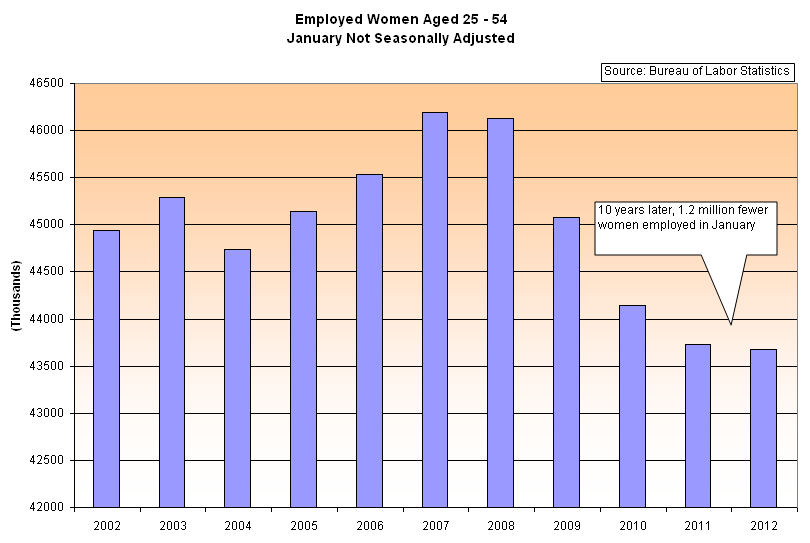
This rather tepid growth, or lack of it, in our core work force is troubling.  This age demographic forms the backbone of a healthy economy, raising children, buying furniture and homes, saving for retirement and their kid’s college. Any job growth is good, but when I see a better improvement in the employment numbers for this group, I will know that we are building a resilient economy, one that can withstand some shocks.  We know of some possible shocks – the probable default of Greece, the ongoing recession in Europe and the possibility of some armed conflict with Iran, to name but three.  The shocks we don’t forsee are what can push our economy off balance.  Last year was a reminder of the impact of unforeseen shocks.  The tsunami  in Japan and the flooding in Thailand not only devastated those countries and their people but impacted supply chains in Asia and consequently sent after shocks throughout the world.

Recently fashionable has been talk of a decoupling of the U.S. and emerging countries’ economies from the sovereign debt and financial troubles in Europe.  If recent history has taught us nothing, it is that much of the world is joined together by interdependent webs of financial conglomerates and the monetary policies of nation states, by the tension between global consumer demand and multi-national supply chains to meet that demand.

200 Day Nudges Higher

The market is a reflection of hope and fear, of world events that affect each of us, our jobs, our families, our schools, churches and neighborhoods.  The 200 day moving average moves through the minute gyrations of the daily market like a great leviathan, changing its course only gradually.  If you are a Star Wars fan, think of the 200 day as The Force.

For the long term investor, it is wise to buy or sell as this average changes direction.  When we compare a month’s (21 trading days) average of the 200 day to the previous month’s average, we can see these changes in direction.  At the onset of the recession in 1990, the S&P 500 index dropped about 17%.  The recession was fairly short but it was a jobless recovery.  From the October 1990 trough to the end of 1993, the index climbed 60%, then paused and stumbled.

Almost 3 years after the recession had officially ended in March 1991, the unemployment rate was still a lofty 6.5%.

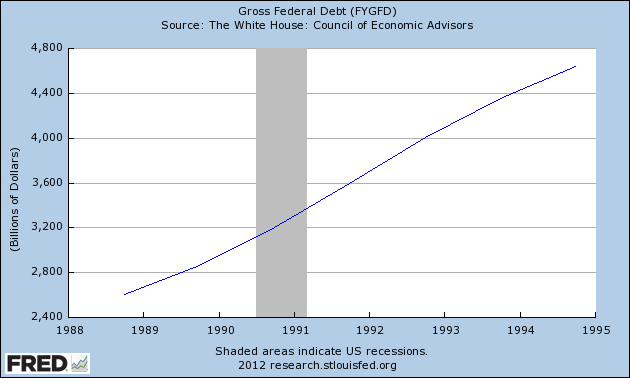
Due in part to the jobless recovery, the federal debt had risen 50% in the four years of 1990 through the end of 1993 and would continue it’s relentless march upwards for several more years.


In 1994, the 200 day average waggled in indecision, barely moving during that summer before nudging upwards in August, then falling again in November, before making its decisive move upwards in 1995.  In six years, the index would more than double.  When the 200 day began to roll over in the fall of 2000, the wise long term investor listened to that slow heartbeat and headed for the exits.  In the middle of May 2003, the 200 day began another 4-1/2 year climb up before rolling over in Jan. 2008.  18 months later, the 200 day began yet another climb after the steep descent of the financial crisis of 2008.  Just this past September, the 200 day signaled exit after a tumultuous summer and before continuing unrest in the fall.

A person investing in the S&P500 index who turned when the 200 day average turned would have made 460%, including dividends, on their money since 1994, 81% in the past ten years and that doesn’t include money that could be made in interest while their money sat safely outside of the market mayhem. 

In the last quarter of 2011, the 200 day moving average had been slightly declining but largely flatlining – unchanged – since the beginning of August. A week ago, it nudged higher.  Will this be like the nudge higher in August 1994 that may reverse in a month or two?  Could be. Although the signals of the 200 day average are relatively few, a prudent investor would monitor the situation every week in case this is a “waggle” and not the beginning of a move up.

Corporate Taxes

Both conservative and “mainstream” media pundits, as well as candidates In the Republican primary debates, assert that U.S. corporations pay a 35% federal income tax rate, “one of the highest in the world.”  After the corporation pays this tax, it distributes dividends to its shareholders, who then pay tax on the dividend.  Capital gains and dividends are taxed at a lower 15% rate, resulting in a net tax of 50% federal tax on corporate profits.  In arguing for lower corporate tax rates and rationalizing the lower rate on dividends, conservatives ask should the federal government get half of corporate profits?

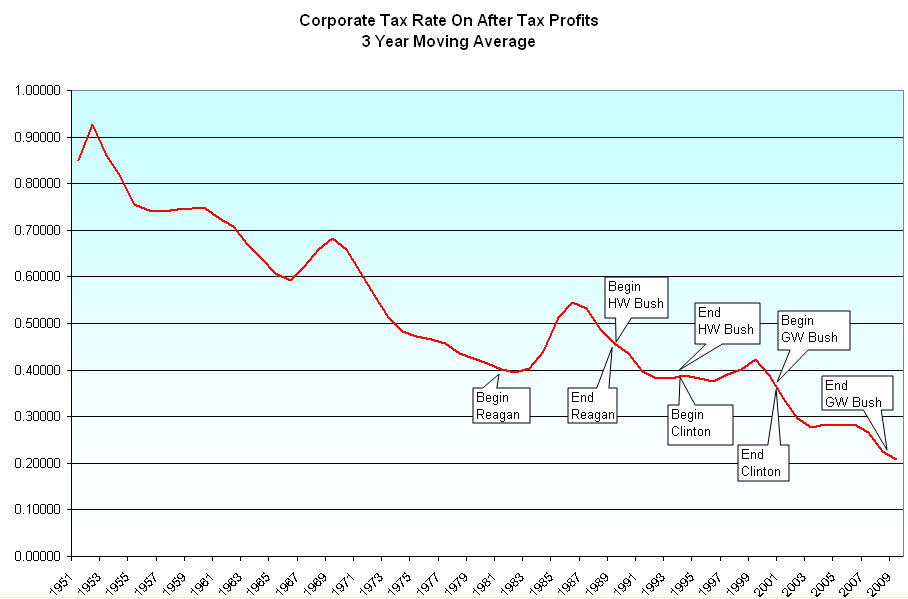
The federal government may get too much of profits but it is not 50%.  The international accounting firm PricewaterhouseCoopers calculated an effective tax rate of 27% in the years 2006 – 2009.  Sixty years of data from the Bureau of Economic Analysis show that the corporate tax rate has declined markedly since World War 2. (Click to enlarge in separate tab)

Using a three moving average highlights the downward trend.  For those in the Ronald Reagan cult, it may come as some surprise to see the “hump” in rates during the Reagan years.

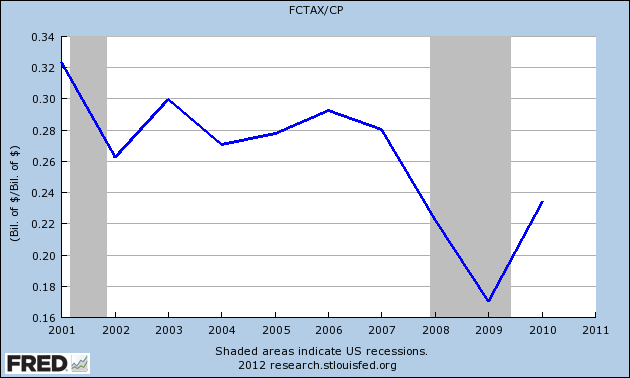
Zooming in on the past ten years, we see an effective tax rate of 30% or less.  Some might explain that the lower average rate is due to smaller corporations who pay less than the 35% tax but IRS data shows that smaller companies who qualify for these lower rates make up less than 10% of corporate profits.

If companies had paid a 35% rate on their profits this past decade, what would they have paid?  Almost a trillion dollars extra in taxes.

When someone mentions the “35% corporate tax rate”, that is the statuatory rate, not the actual rate companies pay.   In 2009, the three year moving average rate had dropped to 21%.  That is a far cry from 35%.  We can have a discussion – or disagreement – about what a fair tax rate is for U.S. companies.  We should at least start that discussion from some realistic data.

Obama Care and Republican Debates

In all the Republican debates, the Presidential candidates vow to repeal the Patient Protection and Affordable Care Act, or Obama Care, pointing specifically to the provision of the bill which mandates that people have health insurance or pay a fine.  Not once can I remember any candidate advocating the repeal of the 1986 Emergency Medical Treatment and Active Labor Act (EMTALA) which mandated that hospitals provide emergency care to anyone regardless of citizenship, their legal status or their ability to pay.  Twenty-five years ago, this law was passed by a Democratic House, a Republican Senate and signed by a Republican President, Ronald Reagan.  The law dictates but provides no funding for its mandate.  Obama Care finally provides a mechanism to fund the 1986 law – a “put up or shut up” provision that a lot of people don’t like.  If Republicans are truly against federal mandates, are truly for more state autonomy, why are they not calling for EMTALA’s repeal?  Although I have not heard Ron Paul recommend repeal of the 1986 law specifically, he has consistently voiced his opinion that the federal government should get out of the medical care business. 

The health care debate is part of a larger issue.  Are we as a people prepared to put up or shut up?  Should hospitals be forced to treat patients?  If so, how to pay for it?  Should Congress be allowed to pass these unfunded mandates?

“Repeal and replace” is an argument I have heard frequently.  Replace with what?  Last March, Bloomberg analyzed various Republican proposals to replace Obama Care and found that it was mostly hot air, saving far less money than the lofty claims.  Again, I ask – are we going to put up or shut up?  Is Ron Paul the only Republican candidate who shows a consistent adherence to principle?  Have we become a nation of people who elect only those politicians who tell us that it really is possible to have our cake and eat it too?  

Recession and the Presidency

On Tuesday, President Obama will give his annual State of the Union address to Congress and the nation.  This past Saturday, South Carolina chose Newt Gingrich, the former Speaker of the House, as the front runner in their Republican primary.  In three grassroots states, Iowa, New Hampshire and South Carolina, primary voters have chosen three different Republican contenders who are vying for the Chief Executive Office.

For the past 150 years, every President except Lyndon Johnson, Jack Kennedy and Bill Clinton has had to contend with recession during their tenure. (NBER Source)  Every Presidential contender promises that they are going to stop the vicious business cycle that inevitably leads to recession.  With the advent of “JIT” – Just In Time Inventory – increasingly adopted by businesses and their suppliers in the mid to late 90s, recessions were pronounced a thing of the past.  No more would there be an excess build of supply by the nation’s businesses, leading to a sagging economy when product demand inevitably fell.  Advances and investments in technology enabled businesses to respond quickly to fluctuations in demand.  As the milennium approached, it was truly the dawning of a new age.

What was dawning was the advent of a secular bear market, a long period of time when the market falls for a few years, struggles up again, then falls, then rises again as fear and hope compete against one another.

A few weeks ago, I noted that in the middle of 2011, we had finally come out of an almost four year  recession.  This was not the official National Bureau of Economic Research end of the recession.  That happened in the middle of 2009.  This mid-2011 recession end was the “How It Feels” variety as real GDP finally gets back and surpasses the level it was at before GDP started its decline.

Below is a graph comparing the official lengths of recession and the “how it feels” recession length and a comparison of the two during each President’s tenure in the past sixty years.  This comparison helps explain the mood of the country when Presidents Ford, Carter and HW Bush lost re-election bids (Ford was actually not up for re-election since he had taken over the Presidency when Nixon resigned in August 1974).  The chart also gives an insight into the success of re-election bids by Eisenhower, Nixon, Reagan, and GW Bush. The economic pain was either less than or about equal to the official figures of economic distress during their presidencies.

As he prepares for his third State of the Union address, the lesson for President Obama is stark.  History unfortunately repeats itself.  It is also a lesson for any Republican Presidential hopeful; the odds are that he will have to contend with a recession during his tenure if he wins election.  On the campaign trail, how many Presidential hopefuls of either party ever broach the subject of what their administration will do during the eventual recession while they are in office?  Better to promise that it won’t happen on their watch.  It will.

Savings Crisis

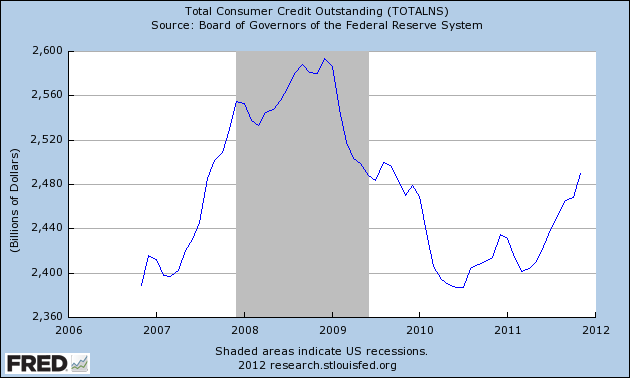
Last week the Commerce Dept reported that consumer credit had grown in November at an annualized rate of 10%. 

The growth consisted mostly of car and truck sales, which shows increasing confidence and pent up demand.

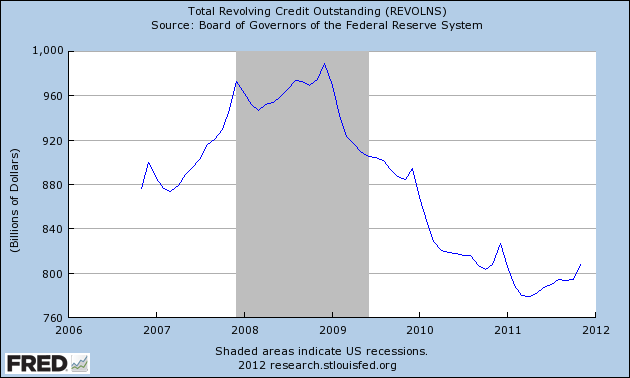
Below is a chart of revolving credit outstanding which excludes auto sales.  As we can see, the American consumer is still struggling.

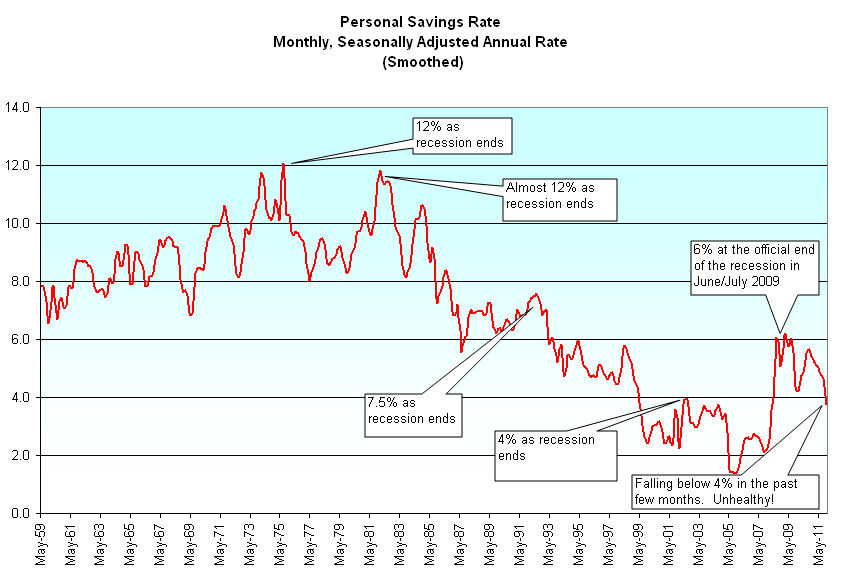
Taking a longer perspective, let’s look at the personal savings rate for the past 50 years.  The savings rate is calculated by subtracting all personal consumption expenses, including interest, from disposable personal income (gross income less taxes).

The savings rate shows the underlying resilience – or lack of it – of the average American household.  Savings helps fuel investment in companies, investment in local, state and federal government bonds.  As our savings fall, we become ever more reliant on foreign money to fuel this country’s debt and growth.

Tidbits

It’s the beginning of the year and I am cleaning up – not the house, but my notes – scribbles of factoids which I, and maybe you will as well, find interesting.  Those of you who like graphs will be disappointed this week.  😦

In 2009, 55% of income in the S&P500 companies was generated overseas.

The Eurozone is set up very similar to the Senate in the U.S.  Despite being 30% of the Euro economy, Germany only has one vote. 

It will cost an estimated $175B for the payroll tax cut in 2012.

A rule of thumb that the Congressional Budget Office (CBO) uses – 1/10% of GDP growth over 10 years = $300B in revenues over 10 years to the Federal Government.

One of the problems with the federal mortgage agencies FHA, Freddie Mac and Fannie Mae is that they buy mortgages which originate in states where there is little or no regulation.  If people want a government agency buying mortgages, why don’t the various states institute such agencies?

A CNN article about doctors going broke:
http://money.cnn.com/2012/01/05/smallbusiness/doctors_broke/index.htm?iid=Popular

This year, 2011, the USDA estimates that for the first time, this country will produce more corn for fuel than for food.

In 2009, total lending by U.S. banks fell 7.4%, the steepest drop since 1942. As of March 15, 2010, approximately half of Obama’s $787 billion stimulus program had been distributed but the flow of federal money into the economy could not keep up with the $700 billion that banks pulled out of the economy in the 6 months from mid-September 2008 to mid-March 2009.

Small companies, those with fewer than 100 employees, accounted for 45% of net jobs created from 1992 through the end of 2007, according to Labor Dept data.

In the U.S., diabetes costs about $174 billion annually in medical costs and lost production In the U.S., according to the American Heart Association.  That is a little more than a 1% impact in a $15 trillion economy, or about 25% of the defense budget.

This past week, Standard and Poors downgraded the credit ratings of nine countries in the Eurozone.  In assessing sovereign credit, Moody’s, another leading credit ratings firm, uses a metric called “debt reversibility margin.”  This measures a government’s ability and willingness to get their debt level under control over the next five to seven years.  Generally, it is the ratio of interest payments on a country’s debt to their revenues with a “benefit of the doubt” margin of 1 – 4% based on the resilience of the country’s economy, its politics and tax policies  When this metric rises above 10%, Moody’s considers a downgrade to the country’s credit rating. 

In 2008 New York spent $16K per student, top in the nation.  It’s student-teacher ratio of 13.1 was the eighth lowest among the 50 states.  From 2000 to 2009, the state added 15,000 teachers as student enrollment fell by 121,000 students.

Global warming is the latest in a series of hoaxes on the American people.  Earlier scams include: smoking can kill you, lead in gasoline and paint is bad for children’s brains, chemical discharges in rivers and lakes are bad for your health, cholesterol is bad for your heart, smog is bad for your lungs, and acid rain is bad for trees and plants. In my lifetime, all of the above have been dismissed by critics at some point as scams on the American public.

In 2010, a USA Today analysis of data from the federal Office of Personnel Management showed that a federal worker makes 77% more than a private sector worker when benefits are included.

In 2010, the Boston Consulting Group issued its Global Wealth Report which found that the top 0.5% of households (those with $5 million or more) owned 21%, or $23 trillion, of global wealth, up from 19%.

A Goldman Sachs analysis of mortgage refinancing found that homeowners took out $358 billion in home equity loans in 2005, the most of any year.

J.P. Morgan Chase and two other banks now hold more than 33% of all U.S. deposits.

Based on 2007 data, the Energy Information Administration reported the various U.S. government subsidies per megawatt hour for the different sources for generating electric power.  Coal got $.44, natural gas received $.25, nuclear enery $1.59 and the whoppers were solar at $24.34 and wind at $23.37 per MWH.  Over the course of a year, at an average consumption of 10,000 KWH per year, a 100 homes will consume a MWH.  In 2010, Google used the equivalent of 260 million homes of electricity.

When enacted in 1916, the income tax affected only the top 2% of incomes.  With the popularity of beards and other creative facial hair statements among younger men, it might be time to resurrect an old Russian revenue raiser – a beard tax.

New York bills Medicaid about $2 million per year for each mentally disabled patient.  The governor is reviewing the state’s billing procedures.

How much do all the tax breaks – or tax expenditures – cost the federal government?  Health Insurance premiums not taxed – $659 billion, mortgage interest deduction – $484 billion, capital gains and dividends taxed at lower rates – $403 billion, pensions – $303 billion, earned income tax credit – $269 billion, charitable donations – $241 billion, state tax deductions – $237 billion, 401K plans – $212 billion, capital gains basis adjustment at death – $194 billion, social security benefits not taxed – $173 billion.  The total is over $3 trillion, or almost the entire federal budget.  If tax breaks were eliminated, the federal debt would be gone in 5 years.

Jobs Report – December

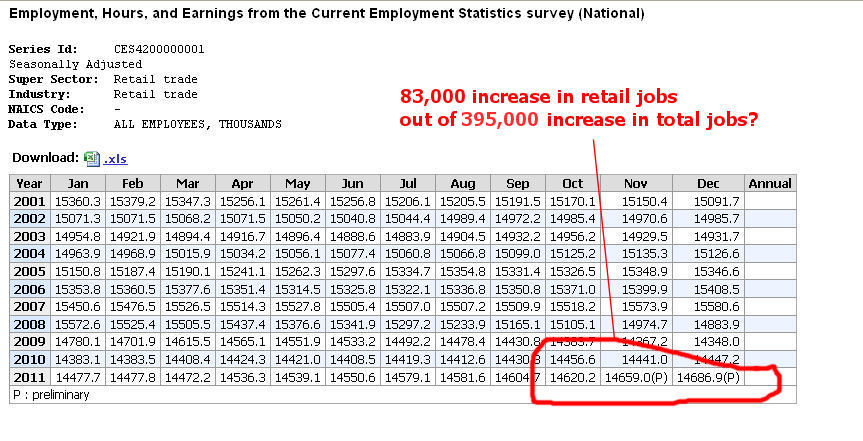
Last Friday, the Bureau of Labor Statistics (BLS) reported that 200,000 jobs were created in December, 412,000 jobs in this last quarter of 2011. A look at the full report and the data behind it raises suspicions.  Why are jobs being rounded off to the nearest 100,000 this past quarter?  We understand that there will be revisions to the data in the months ahead but this gives the impression that there has been a change in the accuracy of the data in the past quarter.

Getting out our data picks, let’s dig down and look at seasonally adjusted retail employment shown on the report.

83,000 retail jobs created in the past quarter.  At first glance that looks like a healthy increase.  So I dropped the above data into a spreadsheet and found that not only is it a healthy increase in retail jobs, it is the best in more than a decade!

Did stores go wild with hiring this holiday season in anticipation of a robust consumer response? This past Thursday, chain stores reported that sales for November and December combined rose 3.3% but this was below 2010’s 3.8% growth. Next Friday we will get the full retail sales report, but indications are that this was not a robust holiday season.

How reliable are the data and the seasonal adjustments that the BLS makes to the data in this area?  I suspect that the BLS is not properly accounting for the holiday surge of hiring for online buying, which increased 15% this year to $35 billion (Source).  BLS methodology is accustomed to dealing with the 4th quarter hiring surge at brick and mortar retail stores but have they changed their methodology to adjust for the relatively new proportion of online sales and the hiring surge needed to meet the holiday demand?

In the months ahead, we may be in for some substantial revisions or surprises in the jobs data.

GDP Growth Curve

In the 10 months till the election in November, we are going to hear a lot of rhetoric about economic issues because this election will be mainly about the economy.  Obama will say that his administration inherited a bad situation, which is true.  How did it get so bad?  Obama will blame greed and a lack of regulation.  He and others of his political beliefs will insist that, given the severity of the crisis, the federal government should have done more – more stimulus, more programs.  He will make the case that these programs are working – just not as fast as hoped.

The Republican nominee will assert that the Obama administration simply does not understand how our economy works.  More policies and regulations only dampen growth by making the economic climate even more uncertain. The nominee will assert that his administration will unleash the entrepreneurial growth that is embedded in the American spirit.

You may believe the former or the latter or believe in a mixture of these two points of view. 

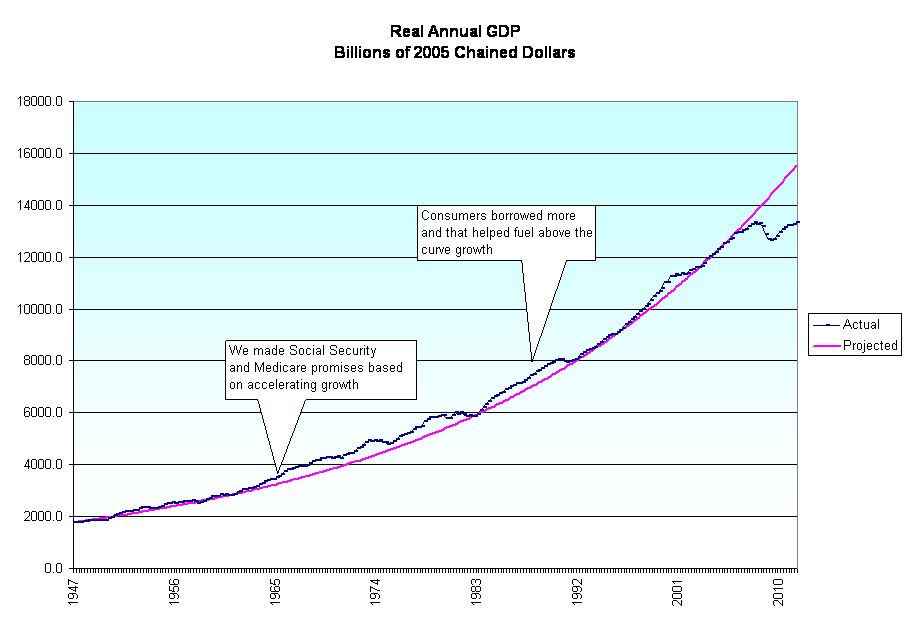
To help understand the big picture, let’s climb high on our flying carpet and look at GDP growth these past sixty years.  From 1947 to mid-2007 we have enjoyed a 3.42% annualized growth rate of real GDP.  According to Census Bureau, our population has grown just a smidge more than 1% per year since 1952.

Using data from the Federal Reserve, below is a chart of actual annualized real GDP and the curve of growth since 1947.  During the 60s, robust manufacturing to supply a recovering Europe and government spending on the Vietnam War helped fuel a higher growth rate.  Democrats ushered in a new era of federal social programs, including Medicare, Medicaid and other social welfare programs.  Prosperity and compassion bred promises.

We’ll come down a bit from the heights and zoom in on the past thirty years.  For some of those years, GDP growth ran slightly above the longer term growth trend.  Consumers increased their borrowing as a percentage of their disposal income, contributing to the above the curve GDP growth.

The recession of the early nineties led to lower taxes for states and municipalities in the middle of the decade.  To balance the books, local politicians negotiated with state and local government employee unions, substituting employee health and retirement benefits – future costs – for pay increases.  Thus, penny pinching bred more promises.

Social Security, Medicare, Medicaid, the Food Stamp program (SNAP), WIC and other transfer programs sprang forth from what is one of the best attributes of human  beings – our compassion. 

In the 1930s, many watched in horror as older people lived their last few years in destitution.  Through no fault of their own, many had lost their life savings when banks had gone under at the start of the Depression. At the time, few lived past 70 years.  Why not create a fund that would collect money from all workers so that a small pension would be available to seniors in their last years? Who would have predicted that social security payments would grow from less than 1% to over 20% of federal spending in 70+ years?

Who knew that spending on a health program for seniors, Medicare, would grow a 100-fold from $5B in 1967 to $500B in 2009?(Source)

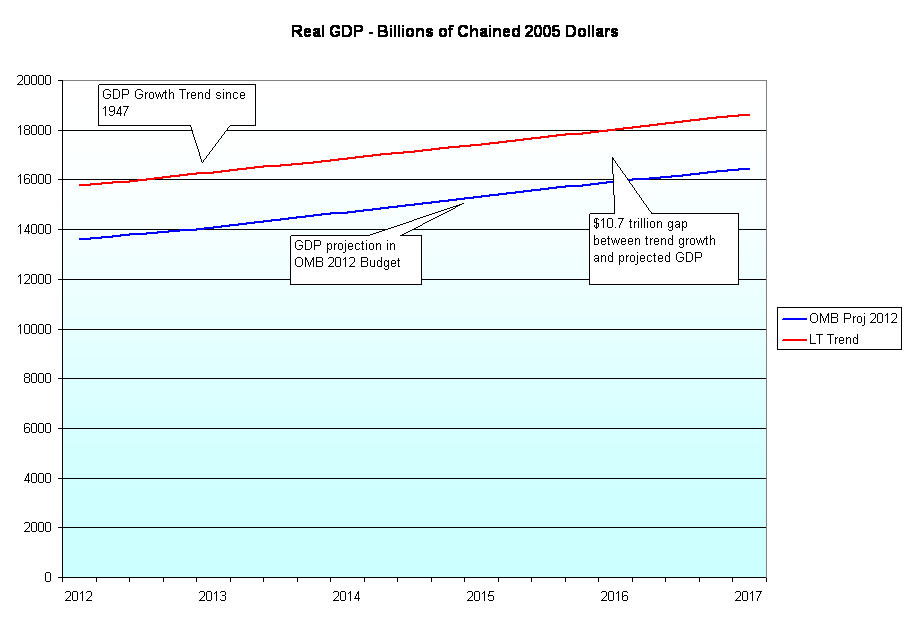
How are we going to pay for these promises?  Each year, the administration makes projections when it presents its budget to the Congress.  For the 2012 budget, the Office of Management and Budget (OMB) at the White House projected real GDP for the next 10 years. The chart below is based on those figures.

As you can see, these are not rosy or dour predictions.  They simply follow the same growth curve this country has had since WW2.  But the implications are enormous.  In the past four years, we have had a $6.5 trillion gap between where the economy should be at and where we are at.  The gap during the next five years will be over $10.7 trillion so that in the space of almost ten years we will have “lost” over $17 trillion in real GDP.

During the election cycle we will hear promises of policies designed to kick start growth but they will be empty promises.  How is anyone running for election or re-election going to significantly increase a growth curve that has been in place for 70 years?  Such a change would require some structural changes to the economy and politics of this country. 

In the past year, the Congress has proved that they are incapable of even small change – other than name changes to their local Post Office.  Each Congressperson, each Senator is loyal to principles, to their party, to their constituents, to the special interests that help them stay in office and, as a body, are not capable of making big changes very quickly.  Yet in the next ten months we will hear how one man – yes, one man, the next President of the U.S. – will make those changes happen.  Millions of Americans will vote, hoping that somehow, some magic way, it could be true.  Millions of Americans won’t vote, disgusted with our political process and despairing that there is any hope for constructive, sensible change in this country.  For those Americans who do vote, it will be a 2 for 1 special.  As in most elections, only half of eligible voters vote, effectively giving each voter a free extra vote.

We are going to have to find a way to talk constructively about graduated spending cuts on programs of compassion as well as programs of fear (defense).  Secondly, we need to have sensible discussions of policy changes which will help nudge the GDP growth curve up just a tiny bit.  The economy of this country is like the Titanic.  No one man or woman, no one Congress can make a big change in course – although there is a machinery of political pundits whose job is to convince you that it is so – just like in the movies. Long term trends are powerful forces, difficult to overcome.  I vote for the person who acknowledges that fact and is willing to sit down at the table and talk turkey.    

New Year Rising

As we start off the new year, things should start to improve in the U.S. economy.  As I mentioned in my “Year in Review” blog last week, the recession is finally almost over.  Real GDP has finally surpassed the level it was back in 2007.

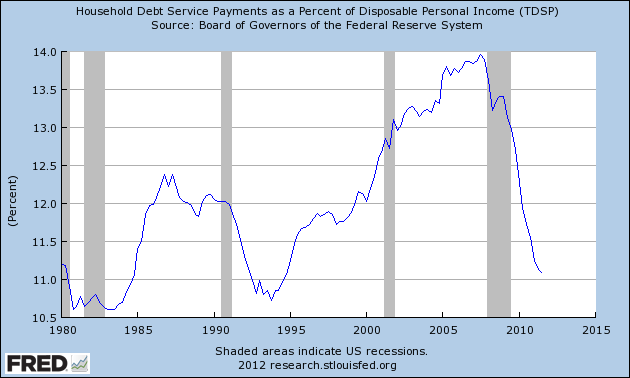
Another indicator that the recession is almost over – household debt as a percentage of disposable income, or income after taxes.  Household debt includes mortgages, car payments, student loans and credit cards.  As the chart below shows, U.S. households have finally paid down, cut back or defaulted on a lot of debt since 2007.  We started to  reduce our debt load during the recession of 2001 but the 9/11 attacks prompted a wave of patriotic purchasing encourged by the Bush administration and aided by easy home refinancing. (Click to enlarge in separate tab)

We are still short of a healthy 14 million in sales of cars and light trucks but sales continue to increase from the depressed levels of late 2009.

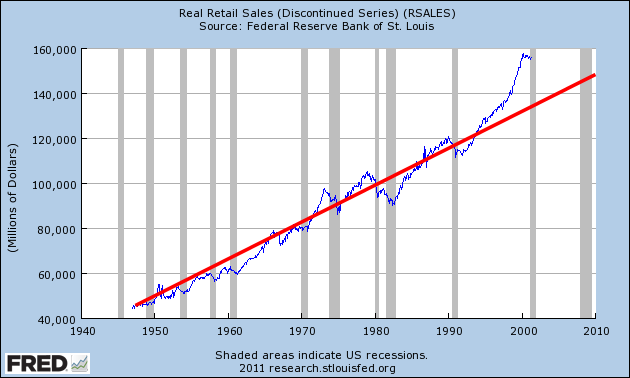
As I noted last week, retail spending is still not back to the levels of 2006 – 2007 but those retail sales were fueled by people charging far more than they could reasonably pay for.  When I look at inflation adjusted, or real, retail sales from 1947 – 2001, the trend line (mine) projects real retail sales in 2011 of about $160B. 

What did we have in 2011?  Over $170B!

Last week I was rather dour in my assessment of this half-assed economy but I was taking a short term view, comparing sales and GDP today to the bloated bubble levels of 2007, an unrealistic comparison.

Construction spending has cratered in the past four years as we wring out the excesses of the past decade.

But when I draw trend lines showing growth we can see just how inflated the construction bubble was from the mid-90s till 2007.

In the past two years we have formed a “bottoming” pattern that indicates that the downward slide in spending has ended.

Well meaning but bad policies, poorly regulated mortgage brokers, consumers eager to get in on the housing gravy train, banks playing 3 card monte with bundled mortgage security products, politicians eager to please and get re-elected – so many factors that led to an overgrown forest.  And then the fire.  Now there are green shoots emerging.

Before you get to singing “Happy Days Are Here Again”, there are some fundamental long term – decades long, long term – concerns and trends that I will look at this weekend after I sharpen my red pencil. 🙂