Productivity And Labor Unions

February 5, 2017

About 10% of all workers, public and private, belong to a union. Today the percentage of private sector employees who are unionized is the same as in 1932, eighty years ago. (Wikipedia) The rise and fall of unon membership looks like the familiar bell curve, with the peak in the 1970s. The causes of the decline are debated but some attribute the erosion of union power as an important factor in wage stagnation.

The major factor is not declining union membership but declining productivity, and that persistent decline has economists and policymakers baffled.  Higher productivity should equal higher wage growth and, in the 30 year post-war period 1948-1977, multi-factor productivity (MFP) annual growth averaged 1.7%. MFP includes both labor and capital inputs. In the 40 year period from 1976-2015, MFP growth averaged about half that rate – .9%.

prodmfp1948-2015

In the debate over the causes of the decline, some contend that all the easy gains were made by 1980.  Productivity is now returning to a centuries long growth trend that is less than 1%. In an October 2016 Bloomberg article, Justin Fox picked apart BLS data to show that growth has been flat in some key manufacturing areas for the past three decades. The ten-fold surge in productivity growth in the tech sector is largely responsible for any growth during the past 30 years. OECD data indicates that other developed countries are experiencing a similar lack of growth (OECD Table) When no one can conclusively demonstrate what the causes are for the decline, policymakers face tough challenges and even tougher debate over the solutions.

//////////////////////////////

LoanGate

LoanGate may the next scandal. A few months ago, the Dept of Education (DoE) revealed that they had seriously undercounted student loan delinqencies because of a programming error. When the Wall St. Journal analyzed the revised data, they found that the majority of students at 25% of all colleges and trade schools in the U.S. had defaulted on their student loan or failed to make any repayment.  (WSJ article)

The Obama administration forced the closure of many private institutions whose students had low repayment rates. In 2015, Corinthian Colleges shuttered the last of its schools and filed for bankruptcy. The revised data show that many more institutions, both public and private, should be shut down.

This latest programming error at the DoE follows other embarrassing episodes during the two Obama terms. In October 2013, the rollout of Obamacare was riddled with programming errors that blocked many applicants from enrolling in a plan with healthcare.gov.

In 2010, the IRS delayed many applications for 501(c)3 tax status from mostly conservative political groups. Lois Lerner, the head of the agency, first claimed that these had been innocent clerical mistakes by an overworked staff, but a series of hearings uncovered the fact that employees at the IRS had acted on their own political feelings and deliberately targeted these groups. (Mother Jones)

In yet another incident, the Office of Personnel and Managment (OPM), the HR dept for thousands of Federal employees, revealed in 2016 a data breach involving 22,000,000 personnel records, including Social Security numbers.  Unchecked programming errors and data breaches erode the public’s faith in public institutions.  That these mistakes happened under a Democratic administration favoring ever bigger public institutions to solve ever bigger social problems is especially embarrassing.

When Obama first took office in 2009, the inflation adjusted total of student debt had quadrupled in the 15 year period (DoE paper – page 1) since 1993. By the time he left office eight years later, student debt had grown ten-fold to $1.3 trillion. The delinquency rate on that debt is 11% but the repayment rate is considered a better predictor of future delinquencies. The revised data reduced the combined repayment rate to a little more than 50% (Inside Higher Ed), far lower than the 75% plus repayment rates of a few decades ago.

The defaults are coming and there will be an inevitable call for a taxpayer bailout.  A popular element of Bernie Sanders’ Presidential platform was that a college education should be free. In the real world, nothing is free, so somebody pays.  Who should pay and how much will further aggravate tensions in an already divided electorate.

///////////////////////////////////

Five Year Rule

A few weeks ago I wrote about the 5-year rule, a backstop to any allocation rule. Any money needed in the next five years should be in stable assets like short to intermediate term bonds, CDs and cash. Why 5 years of income? Why not 2 years or 10 years? Answer: History.

Let’s look back at 80 years in 5 year slices, or what is called 5-year rolling periods. As an example, the years 2000 – 2004 would be a 5-year rolling period. 2001 – 2005 would be the next period, and so on.

Saving me the time and effort of running the data on stock market returns is a blogger at All Financial Matters who put together a table of this very data for the years 1926-2012. The table shows that the SP500 has held or increased its inflation adjusted value (very important that we look at the real value) almost 75% of the time. So the 5-year rule guards against a loss of value the other 25% of the time.

The 5-year rule can apply whenever there are anticipated income needs from our savings: retirement, college expenses, sickness or disability, and even a greater chance of losing our jobs. In a retirement span of 25 years, 6 of those years will fall into that 25% category. The 5-year rule minimum usually kicks in toward the end of retirement when a person’s reserves are lower and prudence is especially important.


Pickup Purchasing Power

April 24, 2016

Relatively stagnant wages and income inequality have become a frequent theme on the campaign trail.  Let’s look at what I’ll call pickup purchasing power to understand the problem.  Sorry.  No graph from the Federal Reserve on this one.

A favorite vehicle among construction workers is the F-150 pickup, a reliable vehicle with room for a toolbox and a trip to the local lumberyard for supplies.  The MSRP of a standard bed 1998 model, available to the public in September 1997, was $14,835 (Source ) In 2016, the MSRP of that same model is $26,430 (Source), a 78% increase, about 3.2% per year.  There have certainly been improvements in that truck model in the past two decades but customers can not order the model without the improvements.  The basic model is the basic model.

Let’s look now at the wages needed to buy that pickup.  In May 1997, shortly before the 1998 F-150 was released to the public, the BLS survey reported average carpenters’ wages of $30,800.  At that time, wages and salaries were about 70.5% of total compensation, or about $43,700 (BLS report).  In the decade before that, wages as a percent of total compensation had declined from 73.3% in 1988 to 70.5% in 1997.  Rising insurance costs and other direct benefits to employees were slowly eating into the net compensation of the average carpenter.

In 2015, the average wage for carpenters was $43,530.  The BLS reported that wages were now 67.7% of the total employment cost, or about $64,300.  In that 18 year period, carpenters’ wages grew 41% but total compensation grew 47%, or 2.1% per year.  The price of that pickup truck, though, grew at 3.2% per year.  That seemingly small difference of 1% per year adds up to a big difference over the years.  That’s the sense of anger that underlies the current election season.  The growth in price of that pickup is only slightly above the average post WW2 inflation rate of 3%.  It is the wages that have fallen behind.

Trump blames the politicians who have given away American jobs with badly negotiated trade agreements that disadvantage Americans.  Trump’s promise to bring those manufacturing jobs back home wins him popular appeal in those communities impacted by the decline in manufacturing.  The loss of manufacturing jobs has left a larger pool of job applicants for construction jobs.  Some of those displaced workers did not have the carpentry skills needed but some were able to work in roles supervised by an experienced carpenter.  The more the supply of job applicants the less upward pressure on wages. If – a big if – some manufacturing jobs do come back to the U.S., it will help spur more growth in carpenter’s wages.

Bernie Sanders blames the fat cats and proposes taxing all but the poorest Americans to distribute income more evenly. His remedies to promote his programs of fairness are far ranging.  Employers who are currently providing health insurance for their employees will probably welcome a 6.2% payroll tax.  On a forty year old employee making $50,000 a year, the $3100 tax is far less cost than an HMO plan. Employers who do not provide such coverage will resent the imposition of more taxes but at least it will be across the board, affecting all competitors within an industry or local market.  Sanders’ healthcare plan also relies on 10% cuts in payments to doctors and hospitals, who are projected to save at least that much in reduced billing costs.

While Trump addresses a specific demographic, a particular segment of the labor market, Sanders proposes broad remedies to a number of problems.  Trump’s appeal will be to those who want a specific fix.  Bring back jobs to our community.  We’ll figure out the rest.  Sanders’ proposals will appeal to voters who have more confidence in government as a problem solver.

///////////////////////////

Oil Stocks

Readers who put some money to work in oil stocks (XLE, VDE for example) in late February, when I noted the historical bargain pricing, might have noticed the almost 20% increase in prices since then.  There are a number of reasons for the surge in price but the buying opportunity has faded with that surge.  Inventories are still high relative to demand.  Recent comprehensive market reports from the IEA require a subscription but last year’s report is available to those interested in a historical snapshot of the supply and demand trends throughout the world.  Until 2014, total demand had slightly exceeded supply.  A glance at the chart shows just how tightly coordinated supply and demand are in this global market. A “glut”in supply may be less than 1% of daily worldwide consumption and it is why prices can shift rather dramatically as traders try to guess both short and long term trends in demand and supply.

Political Promises

February 28, 2016

Heaven on Earth

The tax and spending policies proposed by Presidential contender Bernie Sanders were “vetted” by economist Gerald Friedman.  David and Christina Romer review Friedman’s assumptions and methodology,  finding the former unrealistic and the latter flawed. Christina Romer was former chair of the Council of Ecomic Advisors during the Obama administration.

Friedman assumes that Sanders’ income redistribution policies will spur a lot of demand in the next decade, 37% more than the Congressional Budget forecasts.  Real GDP will grow by 5.3% per year (page 7), erasing the effects of the 2008 financial crisis. Friedman also thinks that the productive capacity of this country is far below its optimum.  Therefore, all that extra demand will not lead to increased inflation, which would naturally put a brake on economic growth.  Employment will increase by 26% from the 2007 peak and, magically, all that extra demand for workers will not cause an increase in wages and inflation.

On page 8, the authors provide some historical context:  “Growth above 5% has certainly happened for a few years, such as coming out of the severe 1982 recession. But what Friedman is predicting is 5.3% growth for 10 years straight. The only time in our history when growth averaged over 5% for a decade was during the recovery from the Great Depression and the years of World War II.”

While GDP growth averaged over 5% during the decade after WW2, it was erratic growth spurred on by the inability of many families to buy many household items during the war.  It included one recession as well as phenomenal growth of 13% in 1950, and is unlikely to be replicated.

But we want to believe, don’t we?

/////////////////////

Labor Force Health Report

Yes, we’re busy so who has time to look at a lot of data to understand whether the world will implode tomorrow?  As an indicator, the health of the labor market is pretty good.  To take the temperature of the labor market we can look at the ratio of active job seekers to job openings.  At an ideal level of 100%, seekers = openings.  In the real world, there are always more job seekers than job openings.  When the percentage of seekers to openings is 200%, it is almost certainly a recession.  The economy rarely produces levels below 150%, which means that there are 3 job seekers for every 2 job openings.

Looks pretty good on a historical basis, doesn’t it?

///////////////////

Women in the Workforce

Fact Check: Women make less than men.  In 2013, the BLS published a survey comparing the full time wages of men and women in the general population and by race.  In 2012, median weekly earnings for women were 81% of men’s.  Black and Hispanic women were higher, at 90% and 88%, but this may be due to the fact that Black and Hispanic men make less than white men.

Education levels have changed dramatically.  In 1970, only 11% of women had a college degree.  In 2012, 38% did, just slightly below the 40% average for the U.S.  A 2010 BLS study found that, in 2009, median weekly earnings of workers with bachelor’s degrees were 1.8 times the average amount earned by those with a high school diploma.  (They are comparing a median to an average to reduce the effect of especially high incomes).

What the BLS notes is that “the comparisons of earnings in this report are on a broad level and do not control for many factors that may be important in explaining earnings differences.”  We will never hear that on the campaign trail.  Academic caveats do not get voters fired up to go out and vote.  If a candidate is running on a platform of fixing income disparity (Democrats), we will hear quoted the report with the most disparity.  Candidates running who claim little disparity (Republicans) will quote a paper whose statistical assumptions minimize income differences.

A more distressing trend is that older women are having to work longer.  8% of women worked beyond retirement age in 1992.  The percentage has almost doubled to 14%.  The BLS estimates that, in ten years, 20% of women will be working past retirement age.

///////////////////////////

Oil Rig Count

Almost half of the oil and gas rigs in the U.S. are located in Texas.  The 60% reduction in Texas rigs reflects the decline in total rigs throughout the U.S., according to Baker Hughes.  Rigs pumping oil account for 3/4 of the rigs shut down.

The oil “glut” is only about 1.5 million barrels of oil per day, less than 2% of the 2016 daily demand of 96 million gallons barrels estimated by the IEA.  Fewer rigs reduce downward price pressures and lately we have seen crude prices rise into the mid-$30s. With a long time horizon of several years or more, a diversified mutual fund or ETF like XLE, VDE or VGENX would likely provide an investor with some dividend income and capital gains. Could prices go lower?  Of course. After falling more than 40% in 2008, the SP500 stood at 900 at the end of December.   Investors who bought at those depressed levels might have felt foolish when the index dropped another 25% in the following months.  Those “fools” have more than doubled their investment in the past 7 years, averaging annual gains greater than 12%.

Income Distributions

February 7th, 2016

Updates on January’s employment report and CWPI are at the end of this post.  Get out your snowboards ’cause we’re going to carve the political half-pipe! (*v*)
(X-Game enthusiasts can click here)

////////////////////////////////

To Be Rich or Not To Be Rich

Every year the IRS takes a statistical snapshot of the almost 150,000,000 (150M) personal tax returns it receives.  There are some interesting tidbits contained in these tables that will put the lie to many a politician’s claim in this election season.  The IRS lists the number of returns for each of some twenty income brackets.  They also list the exemptions claimed for each of these income brackets and let’s turn to that for some interesting insights.

From Table 1.4 we learn that there were 290M exemptions claimed in the 147M tax returns filed in 2013, or almost two exemptions per return.  In 1995 (Table 1, same link as above) the number of exemptions claimed was 237M for 118M returns, exactly two exemptions per return. Exemptions are people that need to be fed, clothed, and housed.

Census Bureau surveys (CPS) over the past few decades show that households are shrinking.  Conservatives assert that median household income has stagnated simply because there are fewer people and workers in households today compared to the past.  If this were true, IRS data would show a greater decrease in exemptions over an 18 year period. We can’t say that one or the other data source is “true,” but that averaging data from the two sources probably gives a more accurate composite of income trends in the data.  Census data probably overcounts households while the IRS undercounts them.  Conservatives who advocate less government support will ignore IRS data that conflicts with their beliefs.

30% of the exemptions were claimed by tax returns with adjusted gross incomes (AGI) of less than $25,000, or less than half the median household income. (AGI is earned income and does not include much of the income received from government social programs.)  Only 2M exemptions, or 2/3 of 1%, were claimed by tax returns with an AGI of $1M or more.  Out of 315 million people in the U.S., there are only two million “fat cats” with incomes above $1,000,000.

Presidential contender Bernie Sanders tells his supporters that he is going to tax the rich to help pay for his programs.  IRS data shows just how few there are to tax to generate money for ambitious social programs. Mr. Sanders says he will get money from the big corporations.  Corporations with lots of well paid lawyers are not going to give up their money peacefully.

Instead, Mr. Sanders’ plans will rely on taxing individuals who can not erect the legal or accounting barricades employed by big corporations.  11% of exemptions were claimed by those making more than $200,000, a larger pool of potential tax money. Doctors, lawyers and other professionals will “Feel the Bern.”  It is not unusual for a middle class married couple in a high cost of living city like New York or Los Angeles to make $200K.  Mr. Sanders has his sights on you.  You are now reclassified as rich.

Here is a well-sourced analysis of the net cost to families.  Most will save money.  Unfortunately, Mr. Sanders made the political mistake of admitting that he would raise taxes, but…  No one paid attention to the “but.”  Should he win the Democratic nomination, Mr. Sanders will “feel the Bern” as Republicans use the phrase against him.  He might have used a phrase like “my plan will lower mandatory payments” to describe the combined effect of higher income taxes and no healthcare insurance payments.

The author calculates that the top 4% will spend a net $21K in extra taxes less savings on health care premiums.  The author probably overstates the effect on those at the top because he uses an average instead of a median, but we could conservatively estimate an additional $10K for those with AGIs in the $200K-$300K range.

****************

Earned Income Tax Credit

The Earned Income Tax Credit (EITC) is  a reverse income tax for low income workers, who get a check from the federal goverment.  For the 2014 tax year, over 27 million returns received about $67 billion from the government for an average of $2400 per receipient (IRS).  In inflation adjusted dollars, this is up 50% from the 2000 average of $1600.  The number of receipients has expanded 50% as well, growing from 18 million to 27 million.  Although Democrats often tout their support for the poor, it is Republican congresses that are largely responsible for expanding this support for low income families.  Republicans may talk tough but are more than willing to reach out a helping hand to those who are giving it their best effort.  There is a practical political consideration as well.  An analysis of IRS data by the Brookings Institute found that, in the past fourteen years, the poor have shifted from urban areas largely controlled by Democrats to the outlying suburbs of metropolitan areas, where Republicans have more support. In short, Republicans are taking care of their voter base.

****************

Constant Weighted Purchasing Index (CWPI)

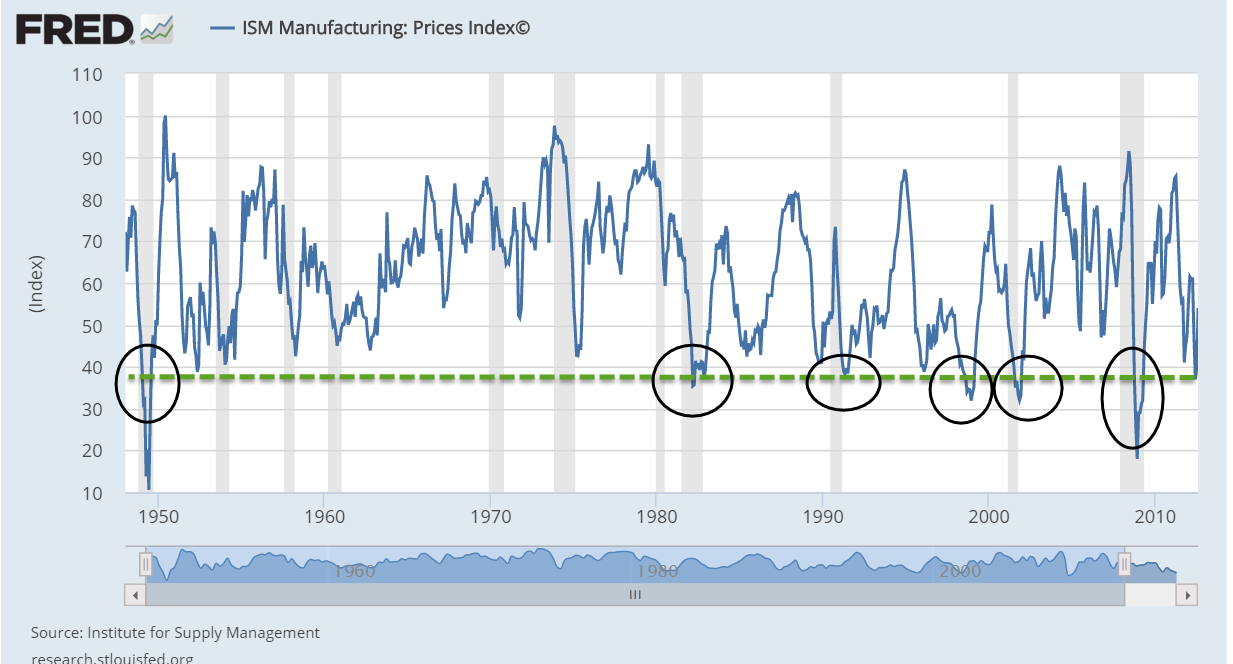
The manufacturing sector, about 15% of the economy, continues to contract slightly, according to the latest Purchasing Manager’s Survey from ISM.  The strong dollar and a slowdown in China have dragged exports down.   Extremely low oil prices have impacted the pricing component of the manufacturing survey, which has reached levels normally seen during a recession.


For some industries, like chemical products, the low oil prices have boosted their profit margins.  Most industries are reporting strong growth or at least staying busy.  Wood, food, beverage and tobacco manufacturers and producers report a sluggish start to the year, as reported to ISM.

The services sectors have weakened somewhat in the latest survey of Purchasing Managers, but are still growing, with a PMI index reading of 53.5.  Above 50 is growing; below 50 is contracting.  The weighted composite of the entire economy, the CWPI, is still growing strongly but the familiar up and down cycle of the recovery is changing.  Both exports and imports are contracting

The composite of employment and new orders in the non-manufacturing sectors has broken  below the 5 year trend.  It may turn back up again as it did in the winter of 2014, but it bears watching.

*************************

Employment

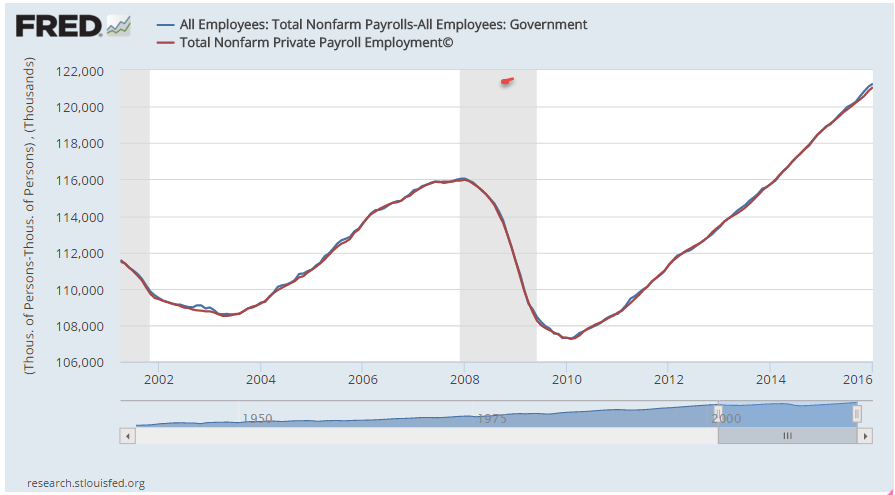
Each month theBureau of Labor Statistics  (BLS) surveys thousands of businesses and government agencies to compute the number of private and public jobs gained or lost during the month.  The payroll processing firm ADP also tallies a change in private jobs based on paychecks generated from thousands of its client businesses.  If we subtract government jobs from the BLS total, we should get a total number of jobs that is close to what ADP tallies.  As we see in the graph below, that is the case.

Economists, policy makers and the media look at the monthly change in that total number of jobs.  This change is miniscule compared to the 121 million private jobs in the U.S.  A historical chart of that monthly change shows that BLS survey numbers are more volatile than ADP.

I find an averaging method reduces the monthly volatility.  I take the change in jobs as reported by the BLS, subtract the  change in government employment, average that result with the ADP report of jobs gained or lost, then add back in the BLS estimate of the change in government employment.  This method produces a resulting monthly change that proves more accurate in time, after the data is subsequently revised by the BLS.  Based on that methodology, jobs gains were close to 175K in January, not the 151K reported by the BLS or the 205K reported by ADP.

There was a lot to like in January’s survey.  The unemployment rate fell below 5%.  Average hourly earnings increased by 1/2%.  Manufacturing jobs added 29,000 jobs, the most since the summer of 2013.  This helped offset the far below average job gains in professional and business services.  Year-over-year growth in the core work force aged 25-54 increased further above 1%.

The bad, or not so good, news: job gains in the retail trade sector accounted for 1/3 of total job gains and were more than twice the past year’s average of retail jobs gained.  Considering that job growth in retail was near zero in December, this may turn out to be a survey glootch.  Food services were another big gainer this past month.  Neither of these sectors pays particularly well.  The jump in manufacturing jobs probably contributed the most to lift the average hourly wage.

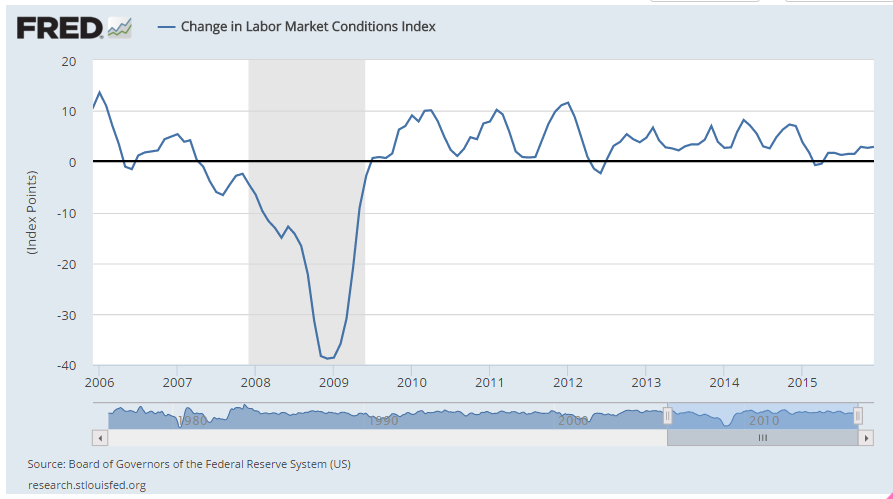
The Labor Market Conditions Index (LMCI) is a cluster of twenty or so employment indicators compiled by the Federal Reserve.  December’s change in the monthly index was almost 3%.  In the forty year history of this index, there has NEVER been a recession when this index was positive.

We are innately poor at judging risk.  We derive indicators and other statistical tools to help us balance that innate human weakness with the strength of mathematical logic.  Still, people do not make money by NOT talking about recession.  NOT talking does not pay commissions, does not generate the buying of put options, expensive annuities, and other financial products designed to make money on the natural gut fears of investors.  Next week I’ll look at the price stability of our portfolios.