February 22, 2026
By Stephen Stofka
On Friday, the Supreme Court announced its decision that President Trump’s tariffs had exceeded the bounds of his authority. Trump has declared that, as President, he has a right to do anything he wants if he thinks it is in the best interests of the United States (Source). Alex Pretti was trying to shield a woman protesting ICE immigration enforcement when he was shot down by border patrol officers (Source). Newly elected mayor of New York City Zohran Mamdani supports the principle that everyone has a right to decent, quality housing (Source). We use the word right to describe a broad set of claims. This week I want to explore the concept of rights.
President Trump claims an authority rather than a right. An authority is attached to a person’s job, or their role in society. Alex Pretti was exercising his First Amendment right at a protest in Minneapolis. Video of the incident shows that his posture to ICE agents was defensive. He was carrying a handgun, thereby exercising his Second Amendment right, but made no move toward his weapon. In wrestling Pretti to the ground, an agent discovered the weapon, yelled that Pretti had a gun, then threw the gun away from the scuffle. Another agent a few steps away shot Pretti in the back several times. The agents clearly did not recognize Pretti’s First or Second Amendment rights.
Both the First and Second Amendment are considered first generation rights. These arerights that prohibit or restrain the government and its agents from taking certain actions. The rest of the Bill of Rights except the Sixth and Seventh have similar characteristics. Some background. A few weeks after President Franklin Roosevelt died on April 12, 1945, nations around the world met in San Francisco to create a framework for a United Nations (Source). A few weeks after that conference, Germany signed a final surrender on May 8, 1945, known today as V.E. Day. Several months later Japan surrendered and the United Nation was formally created on October 24, 1945.
In 1948, the U.N. issued a Universal Declaration of Human Rights, or UDHR, in which they recognized five categories of rights, civil and political, followed by social, economic and cultural (Source). These categories were familiar to political scientists and sociologists but this was the first time that an international body had recognized them. Like the First Amendment, it recognized the natural rights of speech and religious belief, the first generation rights. It also recognized a freedom from want and a freedom from fear that President Franklin Roosevelt included in his State of the Union speech on January 6, 1941 (Source). These are second and third generation rights.
As I noted above, civil and political rights are considered first generation rights. They protect private citizens from government interference and are called negative rights (Source). The first amendment, for example, states that the government shall not prohibit or abridge the freedom of speech. These are restraining verbs. First generation rights assumed that all people had certain natural freedoms, like the freedom of speech and worship. They had a right to privacy from government snooping. The government does not have to provide these freedoms to individuals because they are assumed to exist. Some people insist that these natural rights come from God.
A person might have a right to free speech but the government does not have to provide a printing press to each person. That would be what is called a positive right. The last three rights, social, economic and cultural, are considered second generation rights. They are positive rights stipulating what the government should or must provide. Education is an example. It is difficult to make a direct case for a natural right to public education but human rights organizations advocate for a right to education as an issue of equality, considered a natural law of civic society. The Equal Rights Trust, based in London, has published a guide on how to compose such arguments (Source). However, conservative judges in the U.S. have a distaste for litigation involving economic rights, considering them non-judiciable and best left up to the legislative and executive branches of government (Source).
Second and third generation rights become judiciable when they involve constitutional first generation rights. In a 2020 decision in McGirt v Oklahoma, the Supreme Court ruled that the U.S. Government had never formally disestablished the reservation of the Creek Indians in eastern Oklahoma. That meant that the Creek Indian Reservation had jurisdiction over certain criminal cases, not the state of Oklahoma. The court’s recognition of the 1833 Treaty set a precedent for the sovereignty of other tribes as well. The case was decided on a 5-4 vote when the conservative Justice Gorsuch sided with the four liberal justices on the court. Recognition is the other axis I want to explore this week.
Rights must be recognized. If Gorsuch had agreed with his fellow conservatives, the vote would have gone against the Indians and for the state of Oklahoma. Institutional recognition depends on the ideologies and sympathies of key human beings within an institution. Rights are fragile wisps of thought smoke. Without formal recognition by institutions with power, there are no rights.
Notice that first generation rights generally save the government money because they stipulate that a government not take action. Second generation rights cost the government money since they call for the government to provide certain material comforts. Third generation rights are international accords, or what some call international law (Source). Because there is no central body to enforce international law, these rights depend on cooperation between nations. President Trump has indicated that he doesn’t need international law because he has his own morality and he doesn’t want to hurt anyone (Source). What of the 75 to 100 killed in the capture of Venezuelan leader Nicolas Maduro? (Source) What of the hundreds or thousands of civilians at risk if the U.S. attacks Iran? (Source) Like many leaders who counts the loss of human lives, there is a great deal of discounting included in the count.
The words of the Declaration of Independence recognized an equality that was contradicted by the realities of political rights in the colonies in 1776. The words of the Declaration stated that “that all men are created equal” but those sentiments were merely a composite of popular sentiments, Jefferson wrote (Source). In the latter part of the 18th century, idealist sentiments had to exist within a class system familiar to the founding generation. The rationalist aspirations expressed in the Declaration were goals, not descriptions of political, economic and social life at the time. Perhaps we can read the sentiments of the United Nations’ UDHR with the same understanding.
Excluded from the union of all men were women, those without property, indentured servants, Indians and slaves. In most states, only white men with property who paid taxes were allowed to vote. Over 200 years, these excluded groups were awarded political rights. During the four decades after the Constitution was written in 1787, most states dropped the property qualification for men over 21 to vote.
For many decades, women lobbied for suffrage. Women’s rights activists Elizabeth Cady Stanton and Susan B. Anthony felt that the 15th Amendment granting the vote to black males but not women was an insult to all women. The argument against women voting was that a wife or unmarried daughter would vote however her husband or father told her. This effectively gave married men and men with children an unfair advantage over single men and childless men. In a representative republic, that just wouldn’t be fair, would it? If this reasoning doesn’t make sense to you, it’s because you are living in the 21st century.
In 1857, when the Dred Scott case came before the court, Roger Taney, the Chief Justice of the Supreme Court, thought that he could end the decades-long disagreements over slavery and the rights of slaves. In Taney’s reading of history, slaves had no standing to sue. Six other justices agreed with Taney. In writing the majority opinion, Taney stated, “When the Constitution was adopted, [negroes] were not regarded in any of the States as members of the community which constituted the State, and were not numbered among its ‘people or citizens’” (Source). Case dismissed.
But Taney went further, despite two justices in the majority who urged him to keep it simple. Taney wrote that when the Constitution was written, negroes were regarded as “so far inferior that they had no rights which the white man was bound to respect.” Ouch, an ignominious sentiment that anti-slavery advocates like Thaddeus Stevens used to tarnish Taney’s reputation. But Taney wasn’t done. His reading of historical jurisprudence convinced him that Congress had no constitutional right to prohibit slavery in Federal territories acquired from the French after the Constitution was written. The decision nullified Congress’ legislative power in this regard. Instead of rendering the issue of slavery moot, the Dred Scott decision made it clear to many in the north that civil war was the only way to tame the rebellious southern states. The election of Abraham Lincoln in 1860 made it clear to those in the south that secession was the only remedy. The Dred Scott decision demonstrates that some questions can not be resolved by judicial decree.
In 1973, the court recognized a right to privacy in the Fourteenth Amendment and that right justified the court’s ruling that state laws prohibiting abortion were unconstitutional. At the time, 36 states had laws prohibiting or restricting abortion. Justice Ruth Ginsburg, an advocate for women’s rights, thought the decision was too hasty. Twenty years later, President Clinton appointed her to the Supreme Court. Fifty years later, a decidedly conservative court overturned that recognition.
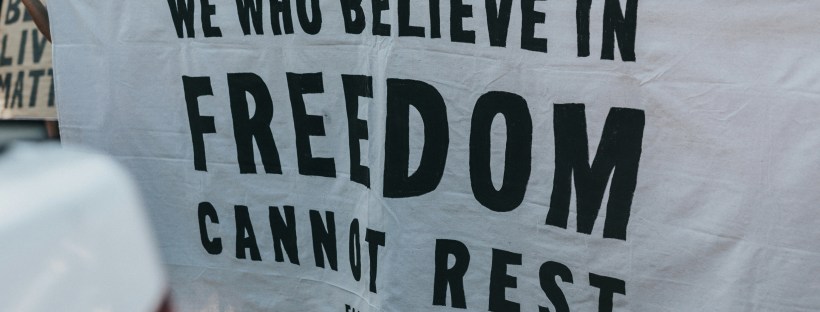
Rights do not exist on some separate plane of existence. They must be recognized by civic institutions. Recognition is an evolving process, not a fixed point in time. It must be maintained and nurtured.Throughout our lives, we must fight to maintain our rights or to win official recognition of other rights that we think are intrinsic to the human experience. I hope to see you next week.
////////////////
Photo by Nathan Dumlao on Unsplash

 Innocent Investor