Bond Time

August 11, 2024

by Stephen Stofka

This week’s letter is about bonds. Many older investors have bond funds in their portfolio because they are told that it adds safety to a portfolio. Like ballast in a ship, bonds reduce volatility when a storm approaches and the water gets choppy. As the Federal Reserve raised rates in the past two years, the bonds in our portfolios acted as a dead weight, producing net negative returns. Why are bond prices so sensitive to changes in interest rates? Why are bonds so weird?

An individual bond is a claim on someone’s debt. A bond fund or ETF is a mixture of individual bonds of various terms to maturity, the length of time to the date when the debt claim ends. These maturities are grouped into three categories: short, medium and long-term. Short-term refers to bonds that mature in less than two years. Bonds with terms of two to ten years are considered intermediate-term and longer than ten years is categorized as long-term.

The length of term is correlated with a bond fund’s sensitivity to interest rate changes. Short-term bonds pay the lowest amount of interest but are the least sensitive to interest rate changes. According to Portfolio Visualizer’s back tester tool, a composite of short-term bonds had an annual return of -0.82% since January 2020. A bond ETF with an intermediate term returned -2.79% annually. Long-term bonds were particularly affected by the rise in interest rates, returning -6.87% annually. I will leave the details in the footnotes.

Why does the price of a debt instrument like a bond react to changes in interest rates? Opportunity cost. If I buy a $1000 mortgage bond paying $50 annually, and shortly after, new mortgage bonds are paying $60 a year, I will have to sell my bond to another buyer for a discount, given the fact that both bonds have the same risk profile and maturity. The income stream on the bond I own cannot compete with the higher income stream from new bonds at the same price.

A bond’s duration is a measure of its price sensitivity to a 1% change in interest rates and is published by financial news outlets like Morningstar, where readers can check the duration of a bond fund or ETF they hold. That number indicates the percentage change in price for each 1% change in interest rates. For readers who want to go deeper into this, Rich Falk-Wallace posted up on X a Bond Math table of forecasted price changes in response to various changes in interest rates.

Using our sailing analogy, the term of a bond is like the height of a mast on a sailboat. A longer-term bond, like a taller mast with more sail exposed to the wind, will get us somewhere faster in calm winds (or pay a higher dividend), but leave us dangerously exposed when wind speed increases. The table mentioned above shows that a 30-year Treasury bond can have suffer a 30% loss in price for a 3% rise in interest rates, a price response of ten times the change in interest rates. Yikes! The leverage effect is even greater when interest rates fall. The table indicates a price rise of 72% for a 30-year Treasury bond when interest rates fall by 3%, an effect that is 24 times the change in rates!

Relative to stocks, price changes in bonds are tame. In 2022, a broad composite of bonds like Vanguard’s BND ETF experienced a 10% decrease in price, and it was historic. A similar decrease in the price of the SP500 stock index is a “correction,” a cause for concern. A 50% decrease in stock prices is historic. The stock market is like riding on a dirt road in a 4×4 jeep. The bond market is like riding in a car on a paved road. We react strongly to any rough patches or potholes.

There is a positive aspect. Depending on your financial situation, it may be prudent for an investor to convert a regular IRA invested in bonds to a Roth IRA. The investor will have to pay income taxes on the capital gains, but those gains have been reduced in the past two years. Once converted to a Roth, any subsequent gains will be tax-free. A Roth IRA has no required annual withdrawal, so an investor has more control over their funds in retirement. Some investors may have what are called unrealized losses in a taxable account that holds bonds, and these could be used to offset gains this year if sold. These are options that some readers may consider and discuss with their financial or tax advisor.

For several decades, interest rates on savings were so low that investors used index funds as a way to earn a higher return on their savings. In the years following the financial crisis, the lack of inflation was more a risk than inflation. In such an environment, investors may have not fully appreciated the difference in risk between bond funds and money market funds. In the decade following the financial crisis, 2008 through 2017, a broad composite of bonds earned 3% or more when savings accounts were paying almost 0% and money market accounts were barely paying 1%. In the last seven years, the return on bond funds has been 1% or so. Investors who piled into longer-term bonds with higher returns were hit hard when the Fed raised interest rates in 2022 and 2023.

A bond’s term to maturity indicates price sensitivity to interest rate changes. An investor’s term to retirement indicates portfolio sensitivity to market conditions and mistakes in judgment. Someone in their thirties can be more aggressive and recover from judgment errors more ably than someone in their sixties. That reality underlies the conventional advice that people should devote a greater portion of their portfolio to bonds when they are older. However, bond investors may have felt like unlucky victims when bond market prices sank in 2022-23. Dramatic market shifts reinforce the rewards of diversification. At the heart of the math on bond duration and risk diversification is an aphorism we learned as kids: don’t put all your eggs in one basket.

//////////////////////

Photo by Christophe Ferron on Unsplash

Bond Notes: Short-term bond ETF: Vanguard’s BSV. Intermediate-term: BIV; long-term: BLV.

Keywords: investing, bonds

Our Perception of Risk

May 12, 2024

by Stephen Stofka

This week’s letter is about our perception of investment risk, and the subjective and objective aspects of risk evaluation. Our journey will take us several hundred years in the past and several decades into the future. The triennial survey of consumer finances indicated that less than half of people nearing retirement have $100,000 in liquid financial assets like savings accounts, stocks and bonds. Half of all working households have no savings, leaving them vulnerable to specific circumstances or a general economic shock. In our 20s, retirement looks remote with many years of work ahead of us. As we near retirement, we look in the other direction, to the past, and wish we had saved more. We confront the reality that we feel today’s needs more urgently than tomorrow’s possibilities. A $100 saving has a $100 impact on our current consumption but is only a faint light compared to the many thousands of dollars we will need in the future. We may not understand the underlying mechanism of saving.

We rely on what is visible to our senses to develop a flow of causality. We press on our car’s gas pedal and go faster, convinced that our action is adding more fuel to the engine. What the pedal controls is not fuel, but the air flow leading into the combustion chambers of the engine. The increased flow of fuel occurs in response to the change in air pressure. Prior to the 1980s cars used carburetors and mechanically employed this process called the Bernoulli principle, the idea that faster moving air induces a lower air pressure, a vacuum effect that sucks fuel toward the engine. Today’s fuel injection systems use air flow sensors that direct a computer to adjust the fuel flow. So, what does this have to do with risk?

Bernoulli’s principle is named after Daniel Bernoulli, the son of a noted Swiss mathematician and the nephew of Jacob Bernoulli, a 17th century mathematician who developed foundational concepts in probability like the Law of Large Numbers. Jacob maintained that people perceived risk in two ways. The first was an objective measure, an estimate of the probability of some event. The second was a subjective measure that depended on each person’s wealth, an inverse relationship. The first is visible, like the pressing of a gas pedal. The second is less visible, like the change in air pressure. Imagine that two people agree to flip a fair coin for a $100 bet. Person A has $1000 in her pocket; person B has $200. The loss or gain of $100 represents only 10% of A’s wealth, but 50% of B’s wealth. Even though the chance of winning or losing is the same for each person, they perceive the outcome differently. Peter Bernstein (1998) presents an engaging narrative of Jacob’s ideas in his book Against the Gods. His trilogy of books on the history of investing, risk and gold will inform and entertain interested lay readers.

Jacob may have identified one subjective element in each person’s evaluation of risk, but a person’s stock of wealth is not the only basis for a subjective estimate of risk. There are retired folks with accumulated savings of a million dollars who keep their money in savings accounts or CDs because they perceive the stock and bond markets as risky. A $10,000 loss in the stock market is only 1% of a million-dollar wealth yet some people perceive that loss in absolute dollars, magnifying the effect of a $10,000 loss. They regard the stock and bond markets as different versions of a casino. That same person might give $10,000 to a grandchild for college or to help buy a car, reasoning that there is an exchange of something that a person values for the $10,000. A person has no sense of receiving anything when their stock portfolio shows a $10,000 decrease. The stock market should have to pay an investor for using her investment, not the other way around. Such perceptions are confirmed during crises when the stock market loses 50% of its value.

Is an investment in the stock market like putting a quarter in a slot machine? Another perspective: an investor is like an investment company selling insurance to the stock market. A century of data shows that the probability of a loss in the stock market in any specific year is about 25%, according to an article in Forbes. In 70 years, the SP500 has doubled every seven years on average. An insurance company relies on Jacob Bernoulli’s Law of Large Numbers and diversification to manage risk. An investor, like any insurance company, will experience losses in some years. In last week’s letter (see note below) I wrote about surplus as a key dynamic factor in market transactions. In most years, an investor with a surplus of funds can “sell” those funds to the market and reap a gain.

Like risk, values in the stock market are based on both objective and subjective components. Sales, profits, dividends and efficiency help anchor a stock’s price movements as objective measures of value. Price responds to changes in these variables. Objective measures also include the variation in a company’s stock as a precise measure of uncertainty. There are various less precise but objective measures of economic and financial risk. Subjective measures include an investor’s need for liquidity, the ability to turn an investment into cash without impacting the price. An investor’s wealth can act as a cushion against fear of loss, a subjective measure discussed earlier.

Index funds have grown in popularity because they take advantage of Jacob Bernoulli’s Law of Large Numbers. By owning partial shares in many companies, an investor reduces the risk exposure to the variation in the fortunes of one company. The SEC might open an investigation into the ABC company, or the company loses an important overseas market, or the company reveals that the profit margins on some of its popular products are decreasing. To an index fund investor, a 10% decrease in that company’s stock price may be barely noticeable. The investor still has a risk of a change in general conditions, like a pandemic, but has dramatically reduced the risk of local conditions specific to one company.

Investors in Bitcoin do not act as an insurance fund for Bitcoin companies who mine Bitcoin. The miners have the surplus and are the sellers of Bitcoin. In the secondary market, the sellers of access to the digital currency market are the two dozen or so ETFs that allow investors to buy interest in a fund that owns bitcoin. Price movement is like a tailless kite flying in a breeze, responding mostly to price forecasts, a characteristic of some derivatives markets. The only objective measure of value and risk is the number of Bitcoin in circulation and the reward for mining new Bitcoin. Bitcoin’s price movement has a high volatility greater than 50% because there is little economic activity that anchors the variation in Bitcoin’s price. Despite the high volatility, an asset manager at an ETF fund makes the case for investing a few percent of a portfolio in a bitcoin ETF. As in our earlier example, the loss or gain depends on the current state of one’s savings.

Understanding the two aspects of risk perception, the objective and subjective, can help us manage our personal risk profile. Through research or the advice of a financial consultant we can understand the objective measures of portfolio risk but there are subjective elements unique to our personal history and disposition. The fear of having to be in a long-term care facility may influence our yearning for safety, regardless of our current health. A parent or relative may have had a similar experience and our primary concern is the protection of our portfolio value. We may feel fragile after the loss of our entire savings in a business venture. We can only become comfortable with our apprehensions by becoming familiar with them.

Next week I will look at our perceptions of other significant factors in our lives, particularly inflation.

/////////////

Photo by 𝓴𝓘𝓡𝓚 𝕝𝔸𝕀 on Unsplash

Keywords: stocks, bonds, risk, investment

Bernstein, P. L. (1998). Against the Gods: the Remarkable Story of Risk. John Wiley & Sons.

In last week’s letter I wrote about surplus as a key dynamic factor in market transactions. A seller of a good or service has a surplus which it values less than the buyer. However, the seller’s cost, including opportunity cost, is more than the cost to the buyer. These two ratios of benefit and cost find an equilibrium in the market that depends on the type of good or service and general conditions.

https://etfdb.com/themes/bitcoin-etfs/

https://www.vaneck.com/us/en/blogs/digital-assets/the-investment-case-for-bitcoin/

Investing, Not Gambling

January 22, 2023

by Stephen Stofka

This week’s post is about expectations, investing and gambling. After last year’s slump in asset prices, investors may be disappointed in the recent performance of their portfolio. A 60/30/10 (U.S. stocks/bonds/cash) had a 3-year return* of 3.65%. A 5-year return was 5.53%, according to Portfolio Visualizer (2023).  Investors tend to weight losses more than they do gains. Following portfolio losses during the financial crisis, many investors turned to more conservative assets, selling their beaten down stocks at a low. Following this past year’s selloff in both bonds and stocks, investors might be tempted to shed both. Let’s take a look at the averages.

Only three years out of the past fifteen has a balanced portfolio had a negative return. When a stock fund loses 35% in a year, investors can feel the loss so deeply that they liken stock investing to gambling. A gamble is a win or lose event with a high return and a low probability of winning, a probability so low that it outpaces any winnings I might get. For example, if I could bet a $1 and win a million, that is a 1,000,000 to 1 leverage. But my chances of winning might be 1 out of 300,000,000. Take that probability and turn it upside to get its inverse of 300,000,000 to 1. Compare that to the leverage and the ratio is 300 to 1. The gambler is at a distinct disadvantage. That’s how lotteries raise money for parks and common areas and how casinos stay profitable.

A prudent portfolio is not a win or lose bet but a series of erratic steps, the familiar model of the random walk. In any year, our expectations should be guided by historical averages, not the last erratic step. In the fifteen years since the year of the financial crisis, the average of the annual returns of a 60/30/10 portfolio, rebalanced annually, was almost 7.2%. (Note: this is slightly higher than the annualized growth rate). A more conservative 50/40/10 asset mix averaged 5.6%. Last year’s portfolio loss of 15.55% was unusual and not likely to be repeated. Investors who were spooked by market losses last year risk losing positive gains in the following years if they let one year’s return dictate their allocation targets.

Losses in both the stock and bond markets last year made rebalancing counterintuitive. In a simplified model, bonds go up when stocks go down. To rebalance, an investor sells some bonds and buys stocks, selling high and buying low. Likewise, when stocks climb, bonds show a negative return. For twenty years, Callan (2023) has charted seven asset classes and their returns, demonstrating the wisdom of asset diversification. In 2021, a mix of large and small cap stocks returned about 21% while a mix of domestic and foreign bonds fell 3-4%, depending on the mix. Rebalancing toward a target allocation, an investor would have sold some stocks and bought bonds. In 2022, both stocks and bonds had approximately similar negative returns. An investor may have found that their allocation changed little except that the cash portion of their portfolio might have grown a bit.

An unusual year like 2022 can distract or confuse an investor’s strategy. A casino or lottery wants to draw our attention to the unusual event – the win – and away from the average – the loss. If gamblers were to focus on the averages, few would play. Investing is the opposite of gambling and our focus should be trained on the averages.

//////////////////////

Photo by Kaysha on Unsplash

*CAGR – compound annual growth rate

Callan. (2023, January 16). Periodic table. Callan. Retrieved January 21, 2023, from https://www.callan.com/periodic-table/ Note: this chart ranks the annual returns of seven asset classes for the past twenty years. Go to the web site, then click the PDF link for the free chart.

Portfolio Visualizer. (2023). Backtest portfolio asset class allocation. Portfolio Visualizer. Retrieved January 20, 2023, from https://www.portfoliovisualizer.com/backtest-asset-class-allocation

Price Illusion

January 8, 2023

by Stephen Stofka

This week’s letter is about price illusions. The past two weeks I have written about the need to sort through past events to find the lessons. The past is a teacher, not a goal. Those who idealize and revere the past must eventually be swept down the drain of time. During this week’s struggle to elect Kevin McCarthy as House Speaker, the more conservative members of the Republican Party voiced their desire to return the country to the past of more than a hundred years ago when the population of 112,000,000 was a third the current size. Instead of learning from the past, we often use elements of history to tell a story. We discard events that do not fit our narrative. Historical analysis serves political interests. Asset analysis suffers from similar distorting strategies.

Technical analysis studies price movements with little regard for the circumstances that prompted the supply and demand, the buying and selling that underlie those movements. I will pick a few such variants at random. Elliott Wave theory bases its interpretation of price movement on the Fibonacci sequence of numbers. Beginning with 1, 1 this number series is constructed from the sum of the previous two numbers in the series. Thus 1 + 1 = 2, 2+1 = 3, and so on. This simple rule produces a sequence found in plant growth and the development of nautilus shells, for example.

Elliot Wave analysis claims that price movements come in waves. Understanding the current position within a wave can help an investor predict subsequent price action. The system is famously prolific in its prophecy, indicating several interpretations. It is better suited to a post hoc narrative. An investor can believe that if they just got better at interpreting the waves, they could time their buying and selling. As the physicist Richard Feynman said, “The first principle is that you must not fool yourself, and you are the easiest person to fool.”

Another technical system relies on the recognition of price trends, identifying those to follow and those that signal a likely reversal. These are visual and geometric, full of rising wedges, head and shoulders price patterns, double tops and bottoms. Much human behavior is repetitive, tempting an investor to perceive a pattern then extend it into the future. The repetition hides the recursive or evolutionary nature of human thinking. Inertia, Newton’s First Law of Motion, may apply to inanimate objects but not to human behavior. Biological systems have built-in dampeners that counteract a stimulus. Without repeated stimulus, the formation of any possible pattern decays.

Price behaves like a biological organism, not an inanimate object. We can see beautiful symmetries in graphical chart analysis but each pattern formation has a unique history. Price is the visible point of a response to events, needs and expectations. Price is a story of people. George Soros, a highly successful investor, constructs a predictive story, then watches price only as a confirmation or refutation of the story. If Soros thinks his story is not unfolding as he predicted, he exits his position.

In school we encountered various branches of mathematics where we were given formulas and plotted data points or intersections, the solutions to a set of equations. Statistics is the reverse of that process. We are given data sets and try to derive formulas to explain relationships within the data. A data set might be the test scores of students before and after the initiation of a certain curriculum. We may represent the test scores on a graph, but the scores reflect a complex set of individual behavior and circumstances, institutional policies, cultural background and economic resources. A statistical analysis tries to include some of these aspects in its findings. A student population is likely more homogenous than the companies in the SP500 stock index who represent a variety of industries. Just as test scores cannot fully explain the efficacy of a school policy or curriculum, asset prices do not reflect the complexity of a day’s events. In our longing for predictability and our fondness of patterns, we prefer analysis that explains price action as a rational sequence of responses to economic, political and financial events. Much financial reporting is happy to oblige.

//////////////////

Photo by FLY:D on Unsplash

Bray and Begone

January 1, 2023

by Stephen Stofka

This week’s letter is about an unusual year and the lessons we can and can’t learn from it. As I wrote last week, we must carefully sift through the unique circumstances in a time series to learn any lessons that we can carry into the future. Sometimes we bray at the passing of an unusual year and continue on our course. Other times, like 9-11 and the 2008 financial crisis, we sort through the debris of an unusual year to understand how we can avoid a repeat occurrence.

What made this year so unusual was the bond market’s loss of almost 13% in addition to the stock market’s loss of 18%. Normally, bonds zig when stocks zag but not this year. This year’s loss in the bond market was the steepest drop ever. This year has been a good test of an investor’s allocation but a long term perspective is encouraging.

During our working years we accumulate assets. In retirement we distribute the price appreciation and income from those assets. In a down market like this past year, a younger investor must balance the opportunity to buy assets at lower prices with the probability they will need liquidity, i.e. cash for living expenses. A basic recommendation is to have six month’s income in cash for emergencies and loss of job. Someone in an executive position might store up to two years of cash or highly liquid investments in anticipation of a much longer job search to find a comparable position.

This past year has tested retired investors who have relied on the historical stability of bond prices. An aggregate bond mix lost 12.8%, surprising investors who may have used bond funds as a substitute for cash funds that paid little interest in the previous years. A bit of historical perspective – in 1994, after five years of relatively low rates, the Fed began raising rates. An intermediate term bond fund lost 4.2%, while an average treasury bond lost 8% that year. The Fed has kept rates far lower and far longer than that five year period and the market reaction has been greater as well. A 60-40 portfolio (60% stocks, 40% bonds) has moderate risk and good long term returns, making it a choice of many money managers. That typical portfolio weighting lost 16.5% this year.

An asset’s ultimate value is measured in the goods and services that they can buy. Today’ retiree might live 20 – 25 years or more, tapping their assets for their income needs. A few months ago, Gupta et al (2022), researchers at McKinsey & Company, found that the SP500 index has returned about 9% since 1994, including the dot-com frenzy of the late 1990s. To measure the purchasing power of the SP500 index over a 23 year period, I adjusted the index by the CPI index in January 2000, near the height of the dot-com bubble. In that span of time, we have endured a dot-com meltdown, the Great Financial Crisis and its slow recovery, followed by a once-in-a-century pandemic and a disruption of the global supply chain. The wide adoption of the internet in commerce has prompted a fundamental shift in jobs and revenue. Despite those disruptions, the purchasing power of stocks has increased 1.8% above annual inflation since 2000. Including an average dividend return of 2.02%, the broad stock market has grown in purchasing power almost 4% every year.

The SP500 index is a compilation of companies that have survived tough economic conditions. Companies that fail the adversity test are discarded from the index and replaced by another company. It is like a game of “King of the Hill” that we played as kids but the stakes and price volatility are far  higher. A broad index of bonds usually offsets that volatility, sacrificing a little return for a big reduction in the value of a portfolio. In the past 23 years, a 500 index fund had a standard deviation – or wag of the tail – of more than 15%. According to Portfolio Visualizer (2022), a simple 60-40 portfolio had less than 10% deviation. That lack of volatility cost .25% per year in return, about the same as the annual cost to insure a house. Investors with a 6-30-10 portfolio, setting aside 10% in cash, paid an additional .25% less return in exchange for a slight reduction in price volatility.

For the first time since records began, bonds did not offset the volatility of stock prices this past year. Depending on their age, health, location and available resources, some investors have a greater tolerance for risk than others. Investors with exactly the same circumstances may perceive their risk differently and comparisons between individuals are difficult and ill-advised. Some investors feel more fragile, giving greater weight to unique outcomes like this past year. Others give more weight to average trends, taking comfort in the probability that this year was an anomaly.

////////////////////////////

Photo by Mary Farrell on Unsplash

Backtest portfolio asset allocation. Portfolio Visualizer. (2022). Retrieved December 31, 2022, from https://www.portfoliovisualizer.com/backtest-portfolio#analysisResults. Stocks: an SP500 index fund. Bond: an intermediate term broad bond fund. Cash: money market.

Gupta , V., Kohn, D., Koller, T., & Rehm, W. (2022, August 4). Markets will be markets: An analysis of long-term returns from the S&P 500. McKinsey & Company. Retrieved December 31, 2022, from https://www.mckinsey.com/capabilities/strategy-and-corporate-finance/our-insights/prime-numbers/markets-will-be-markets-an-analysis-of-long-term-returns-from-the-s-and-p-500

The Spread

May 22, 2022

by Stephen Stofka

Consumer spending during the pandemic and in the post-pandemic recovery has been strong. Inflation adjusted retail sales have averaged 5.6% annual growth since December 2019 (FRED, 2022a). However, the disruptions caused by the once-in-a-century pandemic have made the annual growth rates erratic, particularly those in the spring months when the pandemic hit. In spring 2021, retail sales numbers showed an annual increase of 48% over the previous year. Older Americans had been getting vaccines in the first months of 2021, shops were reopening and people were spending money. The economy was recovering but the size of the recovery was a “base effect.” Retail figures in 2021 were compared to retail sales in March and April 2020 when the economy was largely shut down. The American economy is so large that it is not capable of producing 50% annual growth in real sales.

Because the spring 2021 numbers were so strong, the numbers this spring look shaky. When the April retail numbers were released this week, traders began to mention the word recession and the market sank several percent. When people swarmed into stores in the spring of 2021, Target (Symbol: TGT) reported an increase of 22% in same store sales. A realistic portrayal of a customer behavior trend? No, it was an artifact of the pandemic disruption. In the first quarter of this year, the company reported a slight decline compared to those year-ago numbers. The reaction? The company’s stock fell 25%, an overreaction in a thinly traded market, and its worse loss since October 1987 when the broader stock market fell more than 20% in one day.

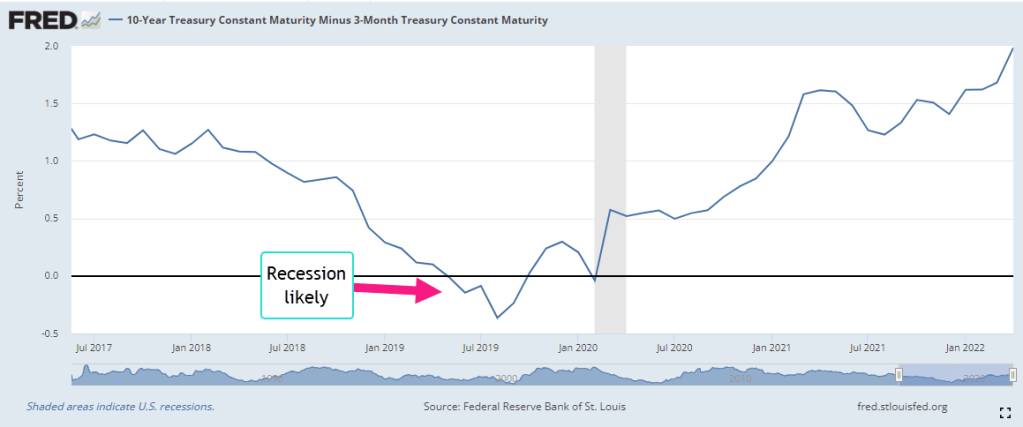
The stock market gets all the headlines each day but it is small in size relative to the bond market where the world’s lifeblood of debt and credit is traded. Over time the differences in interest rates between various debt products indicate trends in investor sentiment. These differences are called spreads. A common spread is a “term spread” between a long-term Treasury bond – say ten years – and a short-term Treasury of three months (FRED, 2022b). Short-term interest rates are usually lower than long-term rates because there is less that can go wrong in the short-term. When that relationship is turned upside down, it indicates a recession is likely in the near-term like a year or so. Why? Financial institutions are now expecting the opposite – that there is more that can go wrong in the short term than in the long term. They will be less likely to extend credit for new investments, business or residential.

For the past forty years, this spread has been a reliable predictor of recessions and it does not confirm the market’s recent concern about a recession. There are a few shortcomings with this indicator. With a wide range of several percent over five years, it has a lot of data “noise” that might obscure an understanding of the stresses building in the bond market and economy. Secondly, Treasury bonds are a small part of the bond market and carry no risk of default. We would like a risk spread between the rates on corporate bonds and those on Treasury bonds. Thirdly, the Federal Reserve has much less influence over corporate bond rates than it does on Treasury bond rates. Comparing corporates and Treasuries would give us a better sense of the broader market sentiment.

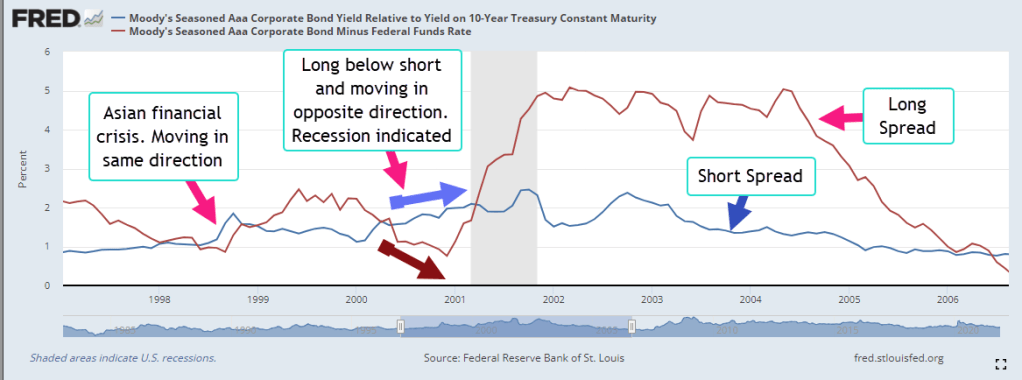
Moody’s Investors Service, a large financial rating company, computes the yield, or annualized interest rate, of an index of highly rated corporate bonds in good standing with a term longer than one year. The yield spread between corporate and long-term Treasury bonds usually lie in a range or channel of 1-1.5%. Like the lane markings on a highway, channels help us navigate data. The upper bound of 1.5% indicates a stress point. Let’s call that the long spread (FRED 2022c).

The Fed Funds rate is an average of rates that banks charge each other for overnight loans and the Federal Reserve tightly manages the range of this rate. For most of the past decade it has been below 1% and has often been close to zero. Let’s call the difference between the yield on corporate debt and the overnight rate the short spread (FRED, 2022d). Most of the time, the short spread is larger than the long spread. Just as with our first indicator of term spread, this relationship flips in the near term preceding a recession. Importantly, they continue to move in opposite directions for a while. The short spread keeps getting smaller while the long spread goes higher. In the graph below is the short recession after the dot-com bust.

In the right side of the graph the pattern will telegraph the coming recession in 2008. The graph below highlights the years after the financial crisis. The short term spread remained elevated above 1.5%, an indication of the persistent stress in the bond market. During Obama’s two terms in office, the short spread fell only once into the “everything is OK” range. Helped by the prospect of tax cuts in 2017, the spread declined to a lasting lull.

In the last half of 2019, the conjunction of these two time-risk spreads indicated a coming recession. The term spread we saw in the first graph also indicated a recession. They suggest that a 2020 recession was likely even if there was no pandemic. The Fed had been raising rates through mid-2019 to curb inflationary trends, then eased back a bit in the final months of that year. Were they seeing signs of economic stress as well?

How would the 2020 Presidential campaign have evolved if there had been no pandemic but a short recession lasting six to nine months? The Republican tax cuts enacted at the end of 2017 would have been shown to be a bust, doing little more than transferring wealth to the already wealthy. Mr. Trump would have certainly blamed the recession on Jerome Powell, the Chairman of the Fed, whom he had appointed. Powell would have been characterized as a Democratic stooge, part of an underground political plot to get Donald Trump out of the White House. The stories of what could have happened are entertainment for a summer’s campfire.

//////////////

Photo by Nadine Shaabana on Unsplash

FRED. 2022a. Federal Reserve Bank of St. Louis, Advance Real Retail and Food Services Sales [RRSFS], retrieved from FRED, Federal Reserve Bank of St. Louis; https://fred.stlouisfed.org/series/RRSFS, May 18, 2022.

FRED. 2022b. Federal Reserve Bank of St. Louis, 10-Year Treasury Constant Maturity Minus 3-Month Treasury Constant Maturity [T10Y3M], retrieved from FRED, Federal Reserve Bank of St. Louis; https://fred.stlouisfed.org/series/T10Y3M, May 19, 2022.

FRED. 2022c. Federal Reserve Bank of St. Louis, Moody’s Seasoned Aaa Corporate Bond Yield Relative to Yield on 10-Year Treasury Constant Maturity [AAA10Y], retrieved from FRED, Federal Reserve Bank of St. Louis; https://fred.stlouisfed.org/series/AAA10Y, May 19, 2022. The “long” spread.

FRED. 2022d. Federal Reserve Bank of St. Louis, Moody’s Seasoned Aaa Corporate Bond Minus Federal Funds Rate [AAAFF], retrieved from FRED, Federal Reserve Bank of St. Louis; https://fred.stlouisfed.org/series/AAAFF, May 19, 2022. The “short” spread.

A Good Decade

January 23, 2022

by Stephen Stofka

As a year-end review I’ll compare risk and returns of the past ten years with the decade before. I submitted several standard portfolios to Portfolio Visualizer. These portfolio metrics are based on broad indexes with a yearly rebalancing. These are broad benchmarks and the performance metrics don’t include fees, taxes and transactions costs that would reduce an investor’s actual returns.

The CAGR is the compounded annual return. Worst Year measures the worry level that an investor might face. The first portfolio might be termed aggressive but would be typical for a person who is more than ten years from retirement. The 60/30/10 is a moderate portfolio allocation and the 50/40/10 is a balanced weighting, more appropriate for those who might need to draw funds from the portfolio.

2012-2021                                           2002-2011                            

Stocks/Bonds/CashCAGRWorst YearCAGRWorst Year
70/25/512.2%-3.6%4.6%-24.6%
60/30/1010.7%-3.0%4.7%-20.6%
50/40/109.4%-2.5%4.9%-16.3%

The last decade stands in stark contrast to its predecessor, which included the great financial crisis of 2008-2009. The 7.5% difference in annual returns between the two decades was worth $106K extra return on a $100K portfolio. The more aggressive 70/25/5 portfolio gained an additional 1.5% during the past “good” decade but had only a .1% lower return during the previous “bad” decade. During that bad decade, however, the aggressive portfolio lost 25% of its value in one year. A 20% drop in value is considered a bear market. For investors with no need to sell any of their portfolio, those were “paper” losses. Some investors needed to tap their portfolio for living expenses in retirement or to recover from job loss. During the recovery from the financial crisis, some older investors continued to work past retirement age to replenish their portfolio. Many of them left the labor force when the pandemic struck. The number of workers over 55 is still 1.2 million less than it was at the onset of the pandemic (FRED Series LNS12024230).

The government learned valuable lessons from its response to the financial crisis in 2008-9. Both the fiscal and monetary response had been too moderate and that prolonged the recovery over many years. When the pandemic struck in March 2020, Congress and the Federal Reserve enacted strong relief measures that protected many families and some businesses from the economic fallout of pandemic restrictions. Occasionally, Congress can come together on a bipartisan basis and accomplish something.

It is unlikely that the 2020s will have the same high returns as the last decade. A younger investor can take a more aggressive stance and rely on the law of averages. Time is on their side. An investor who may need funds from their portfolio in the coming years might check their allocation and rebalance to a more appropriate level of risk.

////////////////

Photo by Markus Winkler on Unsplash

Event and Response

March 15, 2020

by Steve Stofka

The response to an event is part of the event. While driving on the highway this week, I listened to an NPR report on the relatively few deaths from the COVID-19 virus. I passed under a sign telling me that almost 600 people died in my state last year in auto accidents. The number of deaths nationally was almost 39,000. In 2019, we had almost 20% fewer fatalities than 2002 even though we drove 20% more miles during the year (CDOT, 2020). Cars are safer now because the government set safety standards for car manufacturers. Our institutions are strong. We tackle thorny problems and fix them. Was the reaction to this virus a bit too strong?

On Friday, the death toll from the virus climbed to 50. During the winter flu season of 2017-18, the CDC estimated 70,000 deaths (CDC,2020). That’s over 1300 per week. 50 didn’t seem so bad. One person on Twitter thought this panic buying of toilet paper was all silly. Then he went into his grocery store and the shelves were empty of Twix, his comfort chocolate. A bit of black humor. We may need more humor in the weeks to come.

Despite the mortality from flu each season, the world community has built a collective herd immunity to the disease over the past two thousand years. What’s herd immunity? If I have antibodies against a virus, I won’t be a carrier of the virus to someone else. This reduces transmission of the disease. COVID-19 is a new type of coronavirus. No one has built an immunity, so it travels fast.

Six months ago a friend asked me what I thought about the stock market. I told him I thought it was overpriced. Should I sell some of the stocks in my 401K, he asked? I shrugged. What if stocks went down 50% like in 2001 and 2008, I asked? Would you panic? He didn’t really need the money for five years, so probably not, he said. I’d be anxious, he said. Would you be anxious if you had no money in the stock market, I asked? Yeah, he said. I hear about the stock market on the radio, get news about it on my phone. I’d worry there was another crisis like the financial crisis coming. Do you think stocks are going to go down 50%, he asked? I said I have no idea. If I knew the future, I would have to hide away in a cave somewhere because people would want to kidnap me and make me tell them what the future was going to be. The past has already happened and very often we don’t understand what happened. Even if we knew what the future was, we would have trouble understanding it.

The long bull market in stocks ended this week and the SP500 index officially entered a bear market 20% below its recent high. The bull market almost ended in 2018 when the index fell 19% from a recent high but that didn’t count. 19% is not 20%. What about 2011 when the 20% decline occurred during a trading day but recovered enough by the end of the day to be a decline of less than 20%? That didn’t count either because the “official” declaration of a bear market is based on the day’s closing price. If the 20% decline benchmark were based on the yearly closing of the SP500, we still are not in a bear market (only 16.1% down) and didn’t come close in 2018 or 2011.  But that’s not newsworthy, is it?

The financial crisis came about because of a contagion in our financial markets. That led to a contagion of distrust in our institutions in this country and around the world. The current crisis started with a contagion between people that is spreading to our financial markets. This week the Federal Reserve stepped in to stabilize the bond market (Cox, 2020).

U.S. Treasuries are the benchmark for safety around the world. Companies around the world with long term obligations – banks, insurance companies and pension funds – hold U.S. government debt. The key word in that last sentence is “hold.” As fear gripped the market in Monday’s open this week, long term Treasuries surged 10% in price. A lot of buyers wanted safety. In response, companies that would normally hold their Treasury bonds wanted to take advantage of the price increase, so they put some of their bonds on the market. The bond dealers were not equipped to handle this much previously issued long term debt coming to the market. They are accustomed to trading newly issued Treasury debt. They had trouble matching buyers and sellers. Even as the stock market fell 10% on Thursday, the price of long-term Treasury bonds fell 4% in the last few hours of that afternoon. They are supposed to move in opposite directions. Something was wrong. If there were problems in the U.S. Treasury market, it could spread another kind of contagion throughout the bond market. The stock market is like a toy boat floating on the big pond of the bond market. On Friday morning, the Fed announced that they would start buying Treasuries, starting with long-term bonds.

The financial crisis of a decade ago demonstrated that the response to a crisis becomes part of the crisis – for good or bad. A crisis creates a bottleneck which causes unexpected consequences which may need unexpected policy responses. I tell myself that our institutions are strong, that we fix problems. I’m starting to worry more about the people who stock up on a year’s supply of toilet paper. It will not save them from the zombie apocalypse. The zombies eat people, not toilet paper. I thought everyone knew that by now.

///////////////

Notes:

CDC. (2020, January 10). Disease Burden of Influenza. Retrieved from https://www.cdc.gov/flu/about/burden/index.html

Colorado Department of Transportation (CDOT). (2020, February 25). Colorado Fatalities since 2002. [PDF]. Retrieved from https://www.codot.gov/library/traffic/safety-crash-data/fatal-crash-data-city-county/Colorado_Historical_Fatalities_Graphs.pdf/view

Cox, J. (2020, March 14). The Fed to start buying Treasuries Friday across all durations, starting with 30-year bond. CNBC. Retrieved from https://www.cnbc.com/2020/03/13/the-fed-details-moves-to-buy-treasurys-across-all-durations-starting-with-30-year-bond.html

Photo by Jay Heike on Unsplash

Follow the Leaders

January 27, 2019

by Steve Stofka

This week the investment community mourned the death of John Bogle, the founder of Vanguard, the mutual fund giant. He had the crazy idea that mom-and-pop investors should buy a basket of stocks and not attempt to beat the market (Note #1). In 1976, he launched the first SP500 index fund, VFINX, a low-cost “no-brainer” or passive fund. Because people did not want to invest in the idea of earning just average stock returns, the initial launch raised very little money. “Bogle’s folly” now has more than fifty imitators (Note #2).

Vanguard has over $5 trillion under management. Let’s turn to them to answer the age-old question – what percent of my retirement portfolio should be invested in bonds? Bond prices are much less volatile than stocks and stabilize a portfolio’s value. Several decades ago, people retired at 65 and expected to live ten years in retirement. An old rule was that the percentage of bonds and cash should match your age. A 50-year old, for example, should have 50% of their portfolio in bonds and cash. Few advisors today would be so conservative. Many 65-year-olds can expect to live another twenty years or more.

Vanguard, Schwab, Fidelity and Blackrock offer various life cycle funds that have target dates. The most common dates are retirement; i.e. Target 2020, or 2030 or 2040. These funds are composed of shifting portions of stock and bond index funds offered by each investment company. The funds adjust their stock and bond allocations based on those dates. For example, if a 55-year old person bought the Vanguard Retirement Target Date 2020 Fund VTWNX in 2005, it might have been invested 75% stocks and 25% bonds when she bought it. As the date 2020 nears, the stock allocation has decreased to 53% and the bond portion increased to 47%. The greater portion of bonds helps stabilize the value of the portfolio.

In the chart below, I’ve compared the stock and bond allocations of various retirement funds offered by Vanguard (Note #3). Notice that the stock portion of each fund increases as the dates get further away from the present.

vantargetfundscomp

A 46-year old who intends to retire in 2040 when they are 67 might buy a Target 2040 fund which is 84% invested in stocks. The bond allocation is only 16%. Using the old rule, the bond portion would have been 46%.

What happens after that target date is met? The fund continues to adjust its stock/bond allocation towards safety. Over five years, Vanguard adjusts its mix to that of an income portfolio – 30% stocks and 70% bonds (Note #4).

These strategies can guide our own portfolio allocation. I have not checked the allocations of Schwab, Fidelity and others in the industry but I would guess that they have similar allocations for their life cycle funds.

///////////////////////
Notes:

1. History of Vanguard Group
2. More than fifty funds invest in the SP500 index according to Consumer Reports
3. Vanguard’s Target 2020 fund VTWNX , 2025 Fund VTTVX , 2030 Fund VTHRX, 2035 Fund VTTHX, and 2040 Fund VFORX
4. Vanguard’s Income Portfolio VTINX 

Place Your Bets

January 6, 2019

by Steve Stofka

This will be my tenth year writing on the financial markets. As I’ve written in earlier posts, we’ve been sailing in choppy waters this past quarter. In 2018, a portfolio composed of 60% stocks, 30% bonds and 10% cash lost 3%. In 2008, that asset allocation had a negative return of 20% (Note #1). We can expect continued rough weather.

If China’s economy continues to slow, the trade war between the U.S. and China will stall because a slowing global economy will give neither nation enough leverage. Will the Fed stop raising interest rates in response? If there is further confirmation of an economic slowdown, could the Fed start lowering interest rates by mid-2019? Ladies and gentlemen, place your bets.

Thanks to good weather and a strong shopping season, December’s employment reports from both ADP and the BLS were far above expectations (Note #2). Wages grew by more than 3%. Will stronger wage gains cut into corporate profits? Will the Fed continue to raise rates in response to the strong employment numbers and wage gains? Ladies and gentlemen, place your bets.

The global economy has been slowing for some time. After a 37% gain in 2017, a basket of emerging market stocks lost 15% last year. Although China’s service sector is still growing, it’s manufacturing production edged into the contraction zone this past month (Note #3). Home and auto sales have slowed in the U.S. What is the prospect that the U.S. could enter a recession in the next year? Ladies and gentlemen, place your bets.

The partial government showdown continues. The IRS is not processing refunds or answering phones. If it lasts one more week, it will break the record set during the Clinton administration. Trump has said it could go on for a year and he does like to be the best in everything, the best of all time. Could the House Democrats vote for impeachment, then persuade 21 Republican Senators (Note #4) to vote for a conviction and a Mike Pence Presidency? Ladies and gentlemen, place your bets.

When the winds alternate directions, the weather vane gets erratic. This week, the stock market whipsawed down 3% one day and up 3% the next as traders digested the day’s news and changed their bets. Interest rates (the yield) on a 10-year Treasury bond have fallen by a half percent since November 9th. When yields fell by a similar amount in January 2015 and January 2016, stock prices corrected 8% or so before moving higher. Since early December, the stock market has corrected by a similar percentage. Will this time be different? Ladies and gentlemen, place your bets.

Staying 100% in cash as a long-term investment (more than five years) is not betting at all. From a stock market peak in 2007 till now, an all cash “strategy” earned less than 1% annually. A balanced portfolio like the one at the beginning of this article earned a bit less than 6% annually. Older investors may remember the 1990s, when a person could safely earn 6% on a CD. Wave goodbye to those days for now and place your bets.

///////////////////////////

Notes:

  1. Portfolio Visualizer results of a portfolio of 60% VTSMX, 30% VBMFX and 10% Cash
  2. Automatic Data Processing (ADP) showed 271,000 private job gains. The Bureau of Labor Standards (BLS) tallied over 300,000 job gains.
  3. China’s manufacturing output in slight contraction
  4. The Constitution requires two-thirds majority in Senate to convict an impeached President. Currently, there are 46 Democratic Senators and Independents who caucus with Democrats. They would need to convince 21 Republican Senators to vote for conviction to get a 67 Senator super-majority. 22 Republican Senators are up for re-election in 2020 and might be sensitive to public sentiment in their states.