The Law of Averages

February 17th, 2013

The spending sequester, or sequestration, set to take effect March 1st is a series of automatic and indiscriminate spending cuts that was part of the “Grand Bargain” compromise between President Obama, together with a Democratically led Senate, and the House Republicans in the Budget Control Act of August 2011.  The agreeement was rather like a Sword of Damocles, a chopping of spending programs cherished by one party or the other.  The term “sequester” means that there will be some actual spending cuts, not the usual budget and appropriations gimmicks that Congress is fond of. The unpalatable cuts to both defense spending and social programs were supposed to be an incentive for both parties in Congress to come to an agreement on deficit reduction as a condition of raising the debt limit.  It was hoped that the 2012 election would decide which party’s priorities would take precedence and the dominant party could then pass legislation to avoid or modify the sequester.  Instead, the election left the balance of power unchanged.  Republicans had dismissed the probability of the Democrats winning a majority in the House.  There were just too many seats that the Democrats need to gain to accomplish that.  Hoping to take the Presidency and having a good chance of taking control of the Senate in the 2012 elections, Republican lawmakers agreed to the sequester. The 2010 post-census election had put Republicans in charge of crafting voting districts, which enabled them to retain a majority in the House despite losing the total popular vote for House seats in the 2012 election. Several key Senatorial races imploded when Republican candidates made ill-advised (to be charitable) remarks.  Instead of gaining control of the Senate, Republicans lost two Senate seats.  Despite the high unemployment rate and the poor to middling economy, President Obama won re-election.

After navigating a mind numbing maze of previous law and baseline budget projections to arrive at actual spending reduction goals, the sequester will reduce defense spending by $55 billion and non-defense spending by $38 billion in 2013.  While this sounds like a lot of money, this is just 2.4% of the estimated $3.8 trillion in total federal spending in 2013 or a mere .6% of the estimated $16 trillion of this country’s GDP.  This past week the Democratically controlled Senate revealed a plan that would avoid the sequester for 2013.  The plan achieves deficit reduction goals with spending cuts and revenue increases but the revenue increases will probably be unwelcome to the Republican majority in the House.  Despite the rhetoric of calamity coming from either side of the aisle, both parties are anticipating that the sequester will probably take effect in two weeks.

Since mid November the SP500 has risen 12%; except for a sharp decline in the last week of the year in response to fears of the fiscal cliff, the market has climbed steadily.  The market has been largely ignoring the upcoming sequestration. 

More concerning to some is the slowdown in Europe, where the Eurozone economy has contracted for 4 quarters in a row.  Even Germany, the manufacturing and export stalwart of the Eurozone, saw a .6% contraction in the final quarter of 2012.

For many decades, the two prominent parties have been fighting an ideological battle over the role of the Federal government.  The Democratic Party regards the Federal government as largely beneficial and wants a greater role for the Federal government.  They have ushered in many social programs including Social Security, Medicare and Medicaid, programs that are largely on autopilot, beyond the reach of the Appropriations Committee in the House, where a select few can make the law by deciding which programs and federal agencies receive funding.  The philosophy of the Republican Party is that the Federal government is intrinsically a burden and therefore deserves a smaller role.  The Republican Party was out of power in the House for forty years until 1994; as a result, their role consisted largely of blocking or modifying Democratic Party ambitions.  Except for four years from 2007 – 2011, they have controlled the House since 1994 yet often conduct themselves as the opposition party that they were for much of the latter part of the 20th century.

In the tug of war between these two ideologies, the budget has suffered.  A recent report by the non-partisan Congressional Budget Office (CBO) contains a graph of Federal revenue and outlays and their long term averages which clearly pictures the “scrimmage” of ideologies between two yardlines, marked 18% and the 21%.  Republican politicians, together with conservative talk show hosts and commentators, speak of the “traditional” role of the Federal government at 18% of GDP.  This is simply the average of Federal revenues, not its role, for the past fifty years. Revenues have been, on average, 3% below that of Federal spending, which has averaged 21% of GDP.  The “traditional” role of the federal government, then, is to have an average annual deficit of about 3% of GDP.  In a $16 trillion economy, that average deficit is $500 billion.

Republicans simply can not say “no” to the Defense Dept; at times, they have forced spending programs on the Defense Dept that it doesn’t want.  The Democratic Party has become the champion of a hodge podge of Federal social welfare programs.  Neither party proposes taxes that will actually pay for the spending.  For all the Democratic rhetoric about taxing the rich, there simply aren’t enough rich people to pay for that average $500 billion deficit.  Large corporations continue to dominate both parties.  Campaign laws in most states as well as the federal government permit no fundraising in government buildings.  Almost every day, the members of the House and Senate must leave the government building where they work in order to do the daily drudgery of promising favorable legislation to corporations and associations in return for campaign contributions. 

We are still way above the 3% deficit average of the past fifty years.  The CBO projects that this year’s deficit will be 5.2% of GDP, almost half of the 10% deficit in 2009.

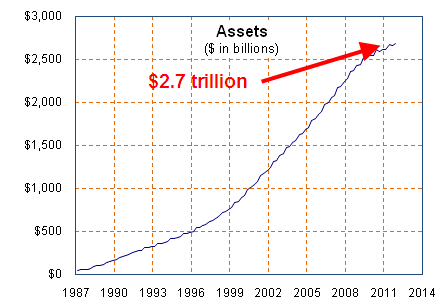
Over the next two decades, that 3% budget deficit average is about to grow larger.  For the past fifty years, the demographic bulge known as the Boomers have been paying into Social Security.  Those taxes have exceeded payments in most years, reducing overall Federal government deficits by .6% of GDP each year (Table 1.2 OMB historical tables, 2013 Budget).  Those surpluses have masked the reality that average annual Federal deficits, excluding Social Security, have been about 3.6% of GDP.  In a $16 trillion economy, that is close to $600 billion.  As the Boomers retire over the next twenty years and are collecting Social Security payments, add in another $100 billion a year as the Boomers draw down the $2.7 trillion dollar Social Security surplus they have built up.
We’re now up to a $700 billion annual deficit based on revenue and spending patterns over the past fifty years.  As the total Federal debt grows, so will the interest costs on that debt.  Over the past seventy years, interest costs have averaged 1.8% of GDP, almost 30% higher than the 1.4% of the past few years (Table 3.1 OMB 2013 Budget)  Ballooning debt levels and rising interest rates could easily add another $100 billion to annual deficits.  We’re now up to $800 billion and growing, based on historical averages.

Republicans will continue to call for spending cuts – it’s their brand.  Democrats will call for more programs and more taxes – but not on the poor and middle class – that’s their brand.  The political and economic tug of war will continue, meaning that uncertainty will be the new normal.  Uncertainty usually leads to lower economic growth which exacerbates social and political tensions which leads to more uncertainty until eventually there will be another crisis. 

In preparation for a cycle of uncertainty and crisis, the prudent investor might ask “What’s my backup plan?”  If you are lucky enough to have a defined benefit pension plan with the company you work for, what is your backup plan if that “defined” benefit is “redefined.”  Well, you might be thinking, my company is so large and dominant in its market that such a possibility is unlikely.  Tell that to the employees of United Airlines, a dominant player in its industry, who lost part, or in some cases, more than half of their benefits when United Airlines shed part of its pension obligations in bankruptcy court.

In the mid nineties, IBM converted its defined benefit plan to a “cash balance” plan, effectively lowering the pension amounts due older workers.  After seven years, a contested lower court decision and a victorious appeal, IBM won their right to do this.  IBM and other large companies have lots of lawyers and accountants trying to figure out legal ways to reduce their liabilities.  How many lawyers and accountants do you have? 

A March 6, 2012 article in the Wall St. Journal reported that “Business groups are urging Congress to let employers put less money into their pension funds, saying that exceptionally low interest rates are forcing them to set aside too much cash.”  I’ll bet your company has more lobbyists in Washington than you do.

These past few years have been a wake up call for those who worked, diligently saved and invested, planning on a certain retirement income based on historical returns of various investments in the stock, bond and CD markets.  Too many people discovered that their backup plan was either to keep working or go back to work, a fact supported by the monthly household survey from the Bureau of Labor Statistics. 

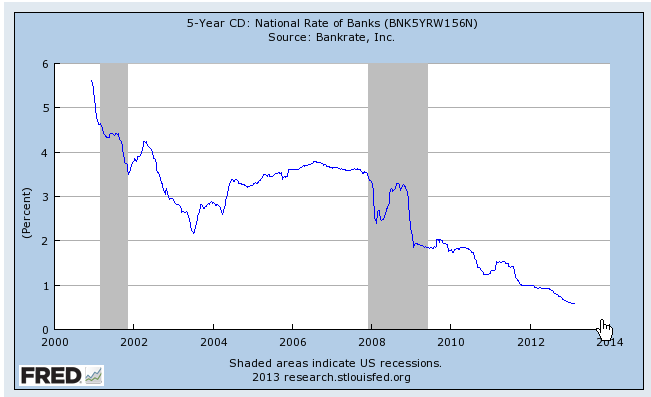
Many retirees built CD “ladders” in federally insured certificates of deposit that paid 4 – 5% interest or more, offering them the safety of their principal and a steady income.  With interest rates for CDs at 1% or less, many retirees have either had to find more risky investments or simply spend less or – there’s that backup plan again – go back to work to make up the difference.
Then there are the folks who planned on selling their home, downsizing and using the difference as an income stream in their retirement years.  Now they wait, hoping that housing values will return to the lofty levels of the mid-2000s or – backup plan again – keep working.

Some people think that the past few years have been an aberration and are waiting for things to get back to normal, or average.  What I’ve tried to show is what those averages have been for the past fifty years and that those averages are better than what we can plan on for the next twenty years.  We certainly can not plan on a vague hope that the folks in Washington will find either a solution or a compromise to a problem that has remained unresolved for the past half century and will continue to worsen in the next two decades.

Fiscal Cliff

Just pulled out of ElectionVille.  Next stop is FiscalCliffe.   Some of us ride in plush seats, some in coach, others stand in the aisles or ride on the roof, but we are all on the train. In the front car are the really plush seats where the President and Congress sit.   They occupy the front car because they are supposed to be looking out for what comes ahead but they spend most of their time arguing with each other. 

“We need to hook up some more cars so that those people riding on the roof can sit in safety,” the President says. 

“We won’t have enough coal for the engines to pull that many cars,” Republicans say.

“We need have those who are sitting in the plush seats pay more,” the President insists.

“They are already paying way more than their fair share,” Republicans counter.

“The passengers on the train have spoken.  They want the plush seats to pay more,” the President responds.

“They kept us in power in the House because the House controls the money.  They trust us to manage the money and we can not betray that trust.  If we make the plush seats pay more, then the plush seats won’t need as many porters and we will lose jobs,” the Republicans parry.

“I am not going to make the other passengers pay more when the plush seats can easily afford a little more,” the President maintains.

In September, I wrote about the coming “fiscal cliff”, a self-imposed austerity program of spending cuts and tax increases that is due to take effect Jan. 1, 2013, unless the President and Congress can agree to some fiscal balancing program.  After all the election talk and negative campaigns now comes the fiscal cliff chatter, which I am now adding to.

We are about $250 billion away from the debt limit of over $16 trillion dollars.  The Treasury will run out of money by the end of this year.  With some financial sleight-of-hand, the Treasury expects that they can make it till February of next year before the debt limit must be raised.  In July and August of 2011, President Obama and the Republican House could not come to an agreement to raise the debt limit and avoid default.  The fiscal cliff of upcoming spending cuts and tax increases became the devil’s bargain that were agreed to in the compromise that led to the raising of the debt limit to its current level.  The President did not want to come back to Congress for more money until after the election.  After the momentum of the 2010 elections, Republicans thought the election just past might give them control of the Senate and the Presidency.  The grand bargain was set to take effect after the 2012 election, each party thinking that the voters would make a clear choice in the elections.  Instead, the voters chose a divided government with the same power balance as before the election.  In short, voters said “Work it out.”

“Grandpa, what’s the pistol cliff?”

I snort a quick laugh and the inner comic in me speaks up.  “It’s a place where we are all going to shoot ourselves in the foot with pistols.”

“Will somebody shoot my foot?” 

I’ve really stuck my foot in it this time.  “No, your feet will be fine.”

“Will mommy be able to walk after her foot gets shot?”

“Your mom is not going to get her foot shot.  No one is going to get shot.  I was just making a joke.”

“I was on a cliff over the ocean this summer and there were big rocks at the bottom on the beach and the water was going ‘whooompf’ all over the rocks.”

“I’ll bet that was pretty,” I say.

“Cliffs won’t hurt us as long as we stay on the path and don’t climb over the rail.”

Amen, I think.

In the early nineties, the Democrats made a deficit cutting bargain with the first President Bush:  in exchange for tax increases, the Democrats would agree to spending cuts – after the recovery from the recession.  The tax increases were put into law and cost President Bush a second term.  The spending cuts that the Democrats promised never came.  In 1994, the Republicans took the House and forced the issue.  The symbol of the Republican Party is an elephant – and elephants don’t forget.  The President and Democratic Senate Majority Leader, Harry Reid, will be in budget negotiations with John Boehner, the Republican House Majority Leader, who was in the House in the early nineties.  Also present will be Mitch McConnell, the Senate Minority Leader, who was in the Senate at that time.  It is doubtful that either of these two Republicans have forgotten.    

Medicare Reform

A week ago, presumed Republican presidential contender Mitt Romney announced his pick for vice-president – Congressman Paul Ryan.  Ryan has authored a budget plan which has passed the Republican house but was stopped in the Democratic Senate.  The addition of Paul Ryan, a man who focuses on policy issues, should elevate the debate between both presidential campaigns and present a clear choice to the voters.  A signature feature of Ryan’s budget is the transition of the Medicare program from a pay for service program to a voucher program; i.e. seniors would be given vouchers to purchase insurance from private insurance companies. During this decade, Medicare expenses are projected  to grow 3.5% per year, while the annual increase in private insurance costs is estimated at 5.4%.  These estimates were compiled by the Kaiser Family Foundation from a number of sources, including the Congressional Budget Office (CBO), the Center for Medicare and Medicaid Services (CMS), Medicare Trustees Report, Census Bureau and others (Source)  The Ryan plan phases in the voucher plan for Medicare so the difference in annual cost increases this decade would not impact anyone – yet.  The plan applies only to those 55 and younger.  In the decade of the 2020s, the difference in annual cost increases would be borne by newly retiring seniors on fixed incomes.

A chart from the Kaiser Family Foundation shows a breakdown of who has paid for medical care for the past fifty years.  I’ve marked it up to show the categories more clearly. (Click to enlarge in separate tab)

In the coming months, we will hear much debate on the Medicare program.  In 2010, the total program cost was $519 billion and increased to $555 billion in 2011, an annual increase of 6.9%.  This was only slightly above the 6.7% growth rate in spending since 1985  (Source).  Medicare costs are projected to rise to $902B in 2020.

Underlying Paul Ryan’s transitioning of Medicare to a private insurance program is the belief that competition in the private market place will reduce the growth in costs.  This cherished assumption has not proved to be the case in the health insurance market, particularly the small business and individual group markets, which have seen annual increases of 10% or more in the past decade.  A June 2012 survey of insurance agents showed that costs were expected to rise from 12 – 20% this year.  My company has seen only one year when the annual increase in our small group insurance plan was less than 10%.  Competitive quotes from other health insurance carriers were even higher.

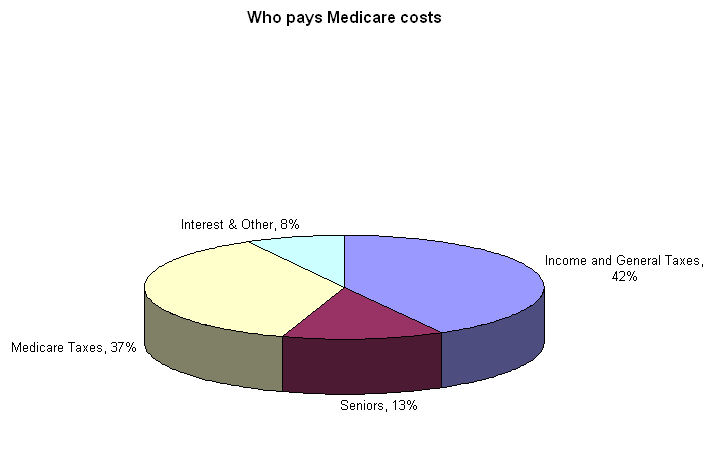
Who pays for Medicare? 

Income and general taxes pay 42%;  seniors pay 13%; Medicare taxes on salary and wages pay for the other 37%.  The total Medicare tax is 2.9%; the employee pays 1.45%; the employer pays the other 1.45%.  The CBO has estimated that the Medicare program will largely stay in the black for the next ten years but admits that its projections depend on whether existing laws or policies remain in place. 

Who benefits from this?  The answer might seem obvious – seniors, of course!  Less obvious is that the Medicare program benefits the children and family of seniors.  Without the Medicare program, many families would need to help support Mom and Dad because of the impact of sky high medical insurance premiums and medical costs on a senior’s fixed income.  

What other solutions are there to the escalating costs in the Medicare program?  We could, God forbid, share the costs of the program out among all taxpayers.  In 2010, the IRS reports that there was $8 trillion in adjusted gross income reported on individual income tax returns (Source)  A 4.6% tax on that amount would have covered the entire expense of the Medicare program, including all Parts – A, B, C and D.

The problem is that voters like government programs but don’t want to pay for them.  Politicians know this and that is why almost half of the cost of the Medicare program comes out of general tax revenues, where they can remain out of sight to most voters on election day.

Should any politician propose that taxpayers actually pay for something they value, they would be pilloried from all sides.  The rich have spent a lot of time and money lobbying to have a large part of their income exempt from Medicare taxes.  Lobbyists for the poor would argue that the poor simply can’t afford it.  AARP would loudly protest that insurance costs to seniors are already too high. The middle class would point to the rich guys and say, “Take it from them.  They can afford it!”

We get the government and the Congress we want and we want fairy tales.  The politicians know we want fairy tales so most of them tell us fairy tales. When the reality check comes, many of get up and say we have to go to the bathroom, then duck out.

I have a lot of respect for Ryan’s sincerity and chutzpah.  I think his solution passes on too many of the cost increases to seniors in the future.  Perhaps some other politicians might take a cue from Ryan and take on other controversial topics like just a teeny-tiny bit of regulation of assault weapons.  Any takers?

Federal Debt By President

There are several “factoids” running around the internet that Obama has run up more debt than all past presidents combined.  According to the Treasury Dept that claim is not true but the run up in debt has been outstanding since Obama took office in January 2009.  When Bush left office, the total debt was 10 trillion.  It was 15.5 trillion at the end of February 2012.

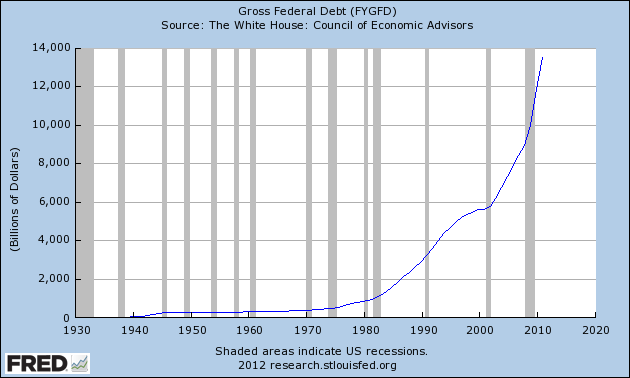
As the graph below illustrates, we have been borrowing lots of money for the past thirty years.

Then I wondered:  after adjusting for inflation,what is the annual increase in federal debt for each President?  Adjusting for inflation allows us to compare apples to apples.  The Federal Reserve supplies us with both data on the debt and a deflator to adjust current dollars to real 2005 dollars.  Obama’s average is computed up to Dec 2011.

Remember, these are inflation adjusted dollars.  The big spending started with Reagan but both parties have become very practiced at developing good explanations for why we have to spend a lot of money. 

Like many, I have thought that the severe downturn has dramatically reduced federal receipts.  As a percentage of GDP, it has – receipts have been coming in at 15 – 16% of GDP, when the long term average is 18 – 19%.  But … bigger government spending has inflated GDP about 10%. What have receipts been over the past decade?  During the Bush years, the Federal government pulled in an average of 2.13 trillion dollars a year in 2005 real dollars.  During the Obama years, the average is 2.0 trillion.  The drop in receipts has been relatively slight.  80 – 85% of the responsibility for the big run up in the debt is spending.

Last week, Senator McCain acknowledged the true cost of defense spending at $1 trillion and it is defense spending that led the Bush administration to run up a $5 trillion dollar deficit in eight years despite four years of robust growth, fueled largely by a real estate bubble.  The bubble burst and the severe fallout from that debacle has prompted even more defense spending – social support programs to defend Americans against lost jobs, lost health insurance and lost home equity.

“Too much spending!” Republicans cry but do not want to cut back on defense spending or agricultural subsidies in rural areas where their support is strongest.  Income tax subsidies are another form of spending, one highlighted by the Simpson-Bowles commission.  In this broken, contentious political climate, neither side of the political aisle can agree on any meaningful reductions in tax subsidies because the voters who put them there can not agree. 

Since neither side can agree on spending cuts, there is only one other solution – higher revenues.  Yes, that’s the punch line.  Funny, isn’t it?  If neither side can agree on spending cuts, they surely can’t agree on where to get higher revenues.

Bleeding heart Democrats cry out for tax justice for the poor while Republicans stand strong for tax justice for the rich.  The Tax Policy Center can find no studies showing that taxes on the rich influence job creation, either positively or negatively.  To conservatives who believe that they do, facts are unimportant.  Conservatives are like football fans – all you gotta do is believe.

Democrats suffer from the same “fact blindness,” disregarding several studies showing that long term unemployment subsidies undercut the confidence and skills of the unemployed, making them less employable the longer they are out of work.  Car and home buying subsidies of the past few years have done little but push forward the buying of cars and homes.  When the subsidy programs expired, so too did the buying of cars and homes.  Despite the demonstrated ineffectiveness of these social subsidies, Democrats continue to propound that they are for the working person.  Another month and another proposal of yet another program for the “vulnerable.”

The moderates of either party have either been voted out of office or left in frustration.  Olympia Snowe, a Republican Senator from Maine, is the latest to quit the carnival show of Congress.  She wrote, “I do find it frustrating, however, that an atmosphere of polarization and ‘my way or the highway’ ideologies has become pervasive in campaigns and in our governing institutions.”

We can not agree on spending cuts and we have two large spending items looming in the near future which will only exacerbate the debate.  The Boomers are just beginning to collect on their deferred annuity program – we know it as Social Security.  They are one kind of bondholder expecting the government to make good on the promises it has made.  The really big bond leviathan is that world wide group of holders of U.S. debt – over $10 trillion in treasury bonds and notes.   We have benefited from the “flight to safety” over the past few years as investors around the globe have bought U.S. debt at ridiculously low rates.  Investors will want a more normal return for their money eventually and when that happens, the annual interest expense on our debt will rise.  These two groups of bondholders with demands and expectations will light the fuse.

If you think the past decade has been contentious, you ain’t seen nothin’ yet.

Deficit Commission

Today the “Super Committee,” charged with finding $1.2 trillion in deficit reduction over the next ten years, announced that they had failed to reach an agreement.  This failure triggers a set of automatic cuts to entitlement programs and defense spending starting in January 2013, over a year away and after the 2012 election.

$1.2 trillion dollars over ten years equals $120 billion dollars per year.  While that is a lot of money, it is only 3.3% of this year’s $3.6 trillion dollar budget.  This super committee could not find 3.3% in spending cuts and/or tax increases.  This was a bi-partisan committee, meaning that either side only had to give up less than 2% in spending cuts/revenue increases to come to the center of an agreement. 

Cash strapped cities and states across this nation are having to make hard choices on taxes, education, police, fire safety,  and community outreach programs that are 5%, 10%, 15%, 20% of their budgets.  Many families are having to make similar cuts in their budgets. Yet our elected representatives in Washington can not come together to find 3.3% in annual spending reductions and revenue. 

Let’s be grateful that these men and women in Washington are not working on our local police force, are not repairing our cars or taking care of our kids, are not putting out fires or fixing our plumbing, are not teaching our kids or doing electrical repairs in our homes. Could these elected representatives change a light bulb?
  

Future Fumbles

Every Christmas, the President and his faithful scribe journey to Camp David near Thurmont, MD. There on the top of the mountain they wait for God to give them the 10 year economic forecast, including the projected GDP and unemployment rate for the nation. In February, or January if the President is leaving office, he presents the tablets of wisdom to Congress in the annual budget. The Congressional Budget Office then uses these projections to score various spending bills and programs, divining their future impact on the budget of the nation.

Actually, the economic forecast is painstakenly crafted each January by the President’s economic advisors, who are locked in a dungeon on the 4th sublevel under the White House, where they tear at each other limbs until the victor emerges from the dungeon gloom with his forecast, which he presents to the President.

In January 2001, just as President Clinton was leaving office, he presented what is called the “Legacy” budget to Congress. It included a robust growth of 5.4% in GDP during the early part of the 2000s, tapering to a 5.1% growth at the end of the decade. This rosy projection was far above the 3% that the nation had experienced during the past thirty years. After 9-11, President Bush’s administration revised growth projections to a more reasonable 2.2% growth for 2002, then forecast a slightly more subdued GDP growth than Clinton had envisioned but never below 5%. So how did these prognostications match up with reality? Below is a chart of projections (Source – last table on the page) and the official GDP numbers as determined by the BEA. (Click to enlarge in a separate tab)

Actual GDP numbers were a bit above Bush’s post 9-11 forecast – until 2009 and 2010. Projected 2009 GDP of $15 trillion was almost a trillion more than what we actually produced. 2010’s performance was more than a trillion below Bush’s forecast 8 years earlier. Federal revenues average about 18% of GDP so each trillion below GDP projections represents $180 billion in revenue that is not going to come into the Treasury as planned. Those plans assume unemployment at less than 6%. As it has climbed to above 9%, the shortage of revenue is even more pronounced.

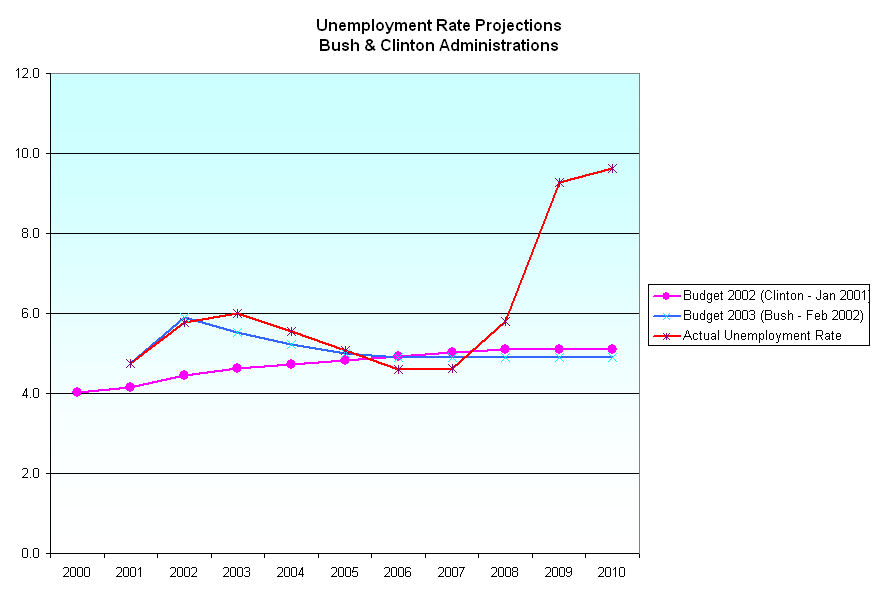
Below is a chart of projected unemployment rates for the past decade and the actual average unemployment rate for each of the past eight years. Clinton’s projections, occurring before 9-11, were rosy. Bush’s post 9-11 projects were fairly accurate. His economic team anticipated a faster rebound after the recession of 2002 but the unemployment rate actually dropped below projections during the heated years when the housing market rose dramatically.

What neither projection could envision was the severe recessionary unemployment of 2008 – 2010. What becomes obvious is that Presidential budget forecasts have not included recessions unless they were ongoing at the time of the forecast. Since recessions occur fairly regularly in an average seven year cycle, it appears that these forecasts are unrealistically optimistic. Since they help determine economic policy, spending on social and defense programs, they should include such a likelihood or we are doomed to be “surprised” at the onset of every recession. Each “surprise” results in a deficit, adding to the total debt of the nation.

Under the current budget process, there is no upside for a President’s economic team to project recessions since it means a projection of less revenues for the government, and thus, less funding for their programs. A more realistic budget process would include at least a mild recession every 7 years. If a President is elected and there has not been a recession in 3 years, then his forecast assumptions should include a recession 4 years in the future. Unrealistic optimism only hurts both the finances and the spirit of our people when recessions occur, revenues fall and programs have to be curtailed or cut.

Fiscal Foolery

Along with the 2012 budget proposal, the Office of Management and Budget at the White House, updates the historical tables of receipts and outlays based on information from the Treasury and other departments.  Below is a chart of 70 years of Federal receipts, including social security tax receipts.  As you can see, we are at near historic lows.  The small spike in receipts in 1969 occurred when the Johnson administration adopted a unified budget which included social security funds, which hid the true cost of the Vietnam War. (Click to enlarge in separate tab)

The chart below shows a 70 year history of total federal outlays, including any social security payments.  Spending in this past year was about the same level as under President Reagan in 1984.  It was too high in 1984 and 2010 but it is not at catastrophic levels, despite what you might hear.  When spending rose under the Reagan administration, Democrats sounded the alarm.  Now it is the Republicans turn to sound the spending siren on the Obama administration.

The problem is both spending and revenue. Spending needs to come down a few percentage points to a historical average of about 20% and revenue needs to increase to historical averages of about 18%. The  chart below shows the 65 year history of the annual surplus or deficit and the current extent of the problem – it’s a big problem.

The longer term problem are those historical averages.  Over several decades a country can not continue to spend 2% more than it collects.  The rational agreement would be to target federal outlays at 19% of GDP and increase revenues to the same amount.  Rational discussion takes leadership and courage, something that has been sorely lacking in Washington.  Our representatives have become poll followers, pandering to voters who turn like a weather vane in the economic wind.   

Fiscal Foolery

The fiscal year of the U.S. Government runs from October to September, preceding the calendar year by three months.  The 2011 fiscal year will start October 2010 and end September 2011.

By early February of each year, the President presents his budget proposal for the coming year, starting October 1st.  The proposal also includes an outline of spending priorities and income projections for the coming five years.  That proposal often becomes a starting point for budget committees in the House and Senate to craft a resolution, which is not a law but a framework of authority for various appropriations bills.  By April 1st the budget committees are supposed to present the resolutions to the full House and Senate for a vote.  Discrepancies between the House and Senate versions of the resolution then have to be worked out in the House, which passes the final resolution.  In 2006, despite majorities in both houses, Republicans were unable to reconcile and pass a budget resolution.

This year, the House Budget Committee passed their resolution to the full House on March 15th.  The Senate resolution didn’t make it out of committee till April 22nd.  On July 1st the House Budget Committee chairman filed a budget resolution that addresses only the coming fiscal year and does not contain a 5 year outline.

This past week Congressional Representatives headed home for the July 4th recess.  Republicans accused the Democrats of passing a budget resolution without an outline.  Democrats answered that the upcoming bipartisan President’s Fiscal Commission’s report, due in December, would outline long term budget proposals which both houses will be voting on. (WSJ article)

Paul Ryan, the Republican ranking member of the House budget committee, answered that the budget passed by House Democrats “does not set congressional priorities; it does not align overall spending, tax, deficit and debt levels; and it does nothing to address the runaway spending of federal entitlement programs.”  (Washington Post op-ed by David Broder)

With elections just a few months away, are Democrats unable to pass a resolution that clearly spells out the doom and gloom of the coming five years?  Probably.  Voters don’t respond well to bad news. A realistic appraisal of the coming years will involve the contradictory necessity of more government stimulus for the economy and spending reductions to bring the budget down.  Voters may say they want less government but many voters don’t want anyone to trim their particular handout, whether it be Social Security, Medicare, farm supports, unemployment payments or tax breaks.

Each month the Congressional Budget Office (CBO) issues a report card on the current fiscal health of the Federal government, budget projections and the estimated effects of various legislative proposals on the budget in the coming years.  The good news is that the deficit this year is less than last year’s red ink.  The bad news is not only that the difference is slight but that the comparison hides some very troubling patterns. 

2009 included expenses for TARP and Fannie Mae and Freddie Mac, the quasi-governmental mortgage giants.  Those expenses are significantly down in 2010, helping to hide the significant increases in spending this year – 11% higher than 2009.  TARP spending is actually a negative, a phantom income that artificially lowers this year’s deficit.  Receipts this year are a bit more than 2009 and spending on health and defense has decreased slightly but various domestic nutrition and food aid programs, collected under the label “Other Activities”, have increased by 9%.  Estimates for June reveal that federal unemployment benefits paid out so far this year have skyrocketed by 50%, from $84bn to $124bn.  

The unemployment rate is unlikely to decrease significantly this year, meaning that there will be pressure on Congress to continue unemployment extension benefits. In the long term, nutrition and food aid programs provide not only humanitarian relief commensurate with the ideals of this country but make budget sense, as they reduce health spending in the future.  As the population ages, Medicare spending is only going to increase.  Until the economy improves significantly, Medicaid spending will continue to grow.  That leaves two areas to reduce the deficit in the coming years.  One – spend less on defense.  Two – increase taxes.  That twin headed serpent is a harsh reality that no politician can ride on in the upcoming election and get elected.

Disposable Personal Income

Disposable personal income is a benchmark that is used to assess aspects of our financial condition, like debt and wealth. What is it? It is gross income, including any transfer payments like Social Security that we receive, less taxes.

Discretionary income is what we have left of disposable income after paying our rent or mortgage, utilities, food and clothing – the essentials. Discretionary implies that we have some choice about whether to spend the money or not. What is discretionary to one person may seem like a necessity to another person. For those of us who are having some financial difficulties, it can be both fruitful and painful to reassess our guidelines for what is a necessity. A cell phone, once regarded as a luxury item, is now considered by many to be a utility like electricity. Is the monthly $100 voice/data plan we are on a necessity or could we get by with a $30 monthly voice plan instead? As I said, these reassessments can be painful.

Some regard a new car every three years a necessity while others view it as a luxury. In any assessment of our personal expenses, it is frightingly easy to lie to ourselves, to convince ourselves that something really is an absolute necessity and to line up several reasons why a particular item is a necessity.

Of the two income benchmarks, disposable personal income (DPI) is easier to measure and to gauge our debt. Household debt, which includes both consumer and residential mortgage debt, was about 80% of disposable personal income during the 1980s and 1990s. Household debt is now 122% of DPI, down from 129%. Americans are saving more but they have quite a ways to go to decrease their debt levels.

Credit Guard has a good guide to personal budgeting.

Sham Accounting

In the past presidential campaign, Mr. Obama and other Democrats pointed to the 90s as an example of their party’s fiscal responsibility. Voters were told that, with President Clinton at the helm, the American economy surged and there was a budget surplus in the last years of Clinton’s presidency.

What surplus? For the fiscal year ending Sept. 30, 1999, the U.S. government reported a $124.4 billion dollar surplus on a cash basis ($72.9 billion on an accrual basis). The Social Security surplus was 124.7 billion. The Medicare Part A surplus was 21.5 billion. The Government, despite all of Vice-President Gore’s rhetoric about a leaner government, still spent $21.8 billion more than it received in 1999.

The Federal government borrows money from the Social Security fund, calls it “income” and reports a budget surplus. Only in America. As long as there has been a surplus in the Social Security fund, both political parties promote this sham accounting and fight against all attempts to adopt a more rational accounting system that reflects the actual realities and liabilities of the Federal government.

When will our elected representatives come to their senses? In the latter part of the next decade, the many years of Social Security surpluses will finally come to an end as the baby boomer generation retires in greater numbers. The Federal government will no longer be able to borrow from the fund and will, in fact, have to start paying the fund back. Those paybacks will hurt the sham budget numbers that both parties dangle in front of voters eyes. Then we will see a growing political movement to have a more realistic system of accounting. These are the same politicians who are currently running a large insurance company, AIG, and will soon be running a car company, General Motors.