The Wrong Medicine

August 23, 2020

by Steve Stofka

During this pandemic, the Federal Reserve has been supportive of the asset markets and the government’s stimulus and relief programs. It’s immediate response was to lower interest rates, a boon for home buyers. This week we learned that home sales had rebounded 25% in July and are up 7% over last year at this time. Low interest rates have benefited homebuyers but penalized savers and pension funds who must generate a current income flow from their savings base.

During the 1930s Depression, the economist John Maynard Keynes argued that, because people want to hoard during a downturn, a central bank should maintain an interest level sufficient to induce people to deposit their money in banks (Keynes, 1936). Government-insured savings accounts helped solve that confidence problem. Keynes’ language and sentence construction are laborious, leading some people to think that Keynes argued for a policy of ultra-low rates during economic declines. He did not. Low interest rates are not a Keynesian solution.

Despite the low rates, the amount of savings has doubled since the financial crisis in September 2008. There is a distinctive change in savings behavior at that important point.
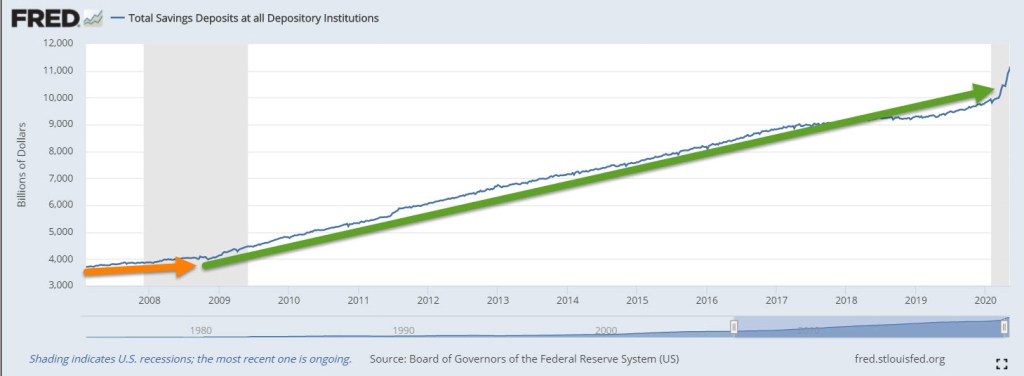
With a savings base of $11 trillion, every 1% decrease in interest rates is a transfer of income of $110 billion from savers to borrowers. Who is the largest borrower? The government. Aren’t low interest rates good for businesses? No, Keynes argued rather unartfully in Chapter 15. Borrowing is a long-term decision, and subject to error. When interest rates are particularly low, like 2%, there is no wiggle room for error in the expectations of businesses who might borrow. For homebuyers, expectations of future business conditions are a small factor.

During an economic decline, people and businesses are guided more by short-term decisions. When interest rates are low like today, banks don’t want to lend because they aren’t confident in the flow of deposits to maintain their liquidity. Banks need that flow of deposits to meet the outflow of money when they make loans (Coppola, 2017). Entrepreneurs are reluctant to borrow for expansion because they are not confident in the accuracy of their long-term expectations. They borrow to pay back more predictable future obligations, particularly current and future stock grants to their key employees. Borrowing money to fund stock grants does not create jobs but helps inflate stock prices.

Keynes badly underestimated the political forces that guide a central bank’s decision making. As it did a decade ago, the Federal Reserve has lowered interest rates to near-zero, the opposite of Keynes’ prescription. Low interest rates do not benefit bank stocks, which have declined by 25% and more. A select group of technology stocks are booming as people consume more digital services at work and play. Borrowing by businesses jumped in response to the CARES act but many businesses kept those borrowed funds liquid to avoid insolvency during this crisis. We can expect slow growth as consumers and businesses continue to make short-term decisions, and asset markets are warped by central bank policy.

//////////////

Notes:

Photo by Christina Victoria Craft on Unsplash

Coppola, F. (2017, November 01). Bank Capital And Liquidity: Sorting Out The Muddle. Forbes Magazine. Retrieved August 15, 2020, from https://www.forbes.com/sites/francescoppola/2017/10/31/bank-capital-and-liquidity-sorting-out-the-muddle/

Keynes, J. M. (1936). The general theory of employment interest and money (p. 124). New York, NY: Harcourt, Brace & World.

The View From Here

May 17, 2020

by Steve Stofka

The editorial page of the Wall St Journal criticized the provision in the CARES act that paid an additional $600 in unemployment benefits to working people told to stay home by their state and local governments (WSJ, 2020). An attack on a policy that supports people during this historic crisis is a personal attack on working families. Some workers are earning more in benefits than they did when working. This offends elitist sympathies. As families overwhelm the resources of food banks nationwide, the country club set worry about the moral hazard of providing an income of basic sustenance to those forced to stay home. What level of hell birthed such sentiments?

When governments order people to stop working, they have a responsibility for monetary damages as well as some compensation for pain and suffering. Some in our country’s aristocracy prefer a system that makes people desperate to work in order to eat and pay their bills. Such workers will be more inclined to compromise their safety and return to work. Who will clean the bathrooms and offices of the executives that own America?

Almost a hundred years ago the German director Fritz Lang painted a dystopian account of social and economic classes in his film “Metropolis.” Each day the workers descended into the underground to keep the machinery of the city running. Above ground, the sons of the elite enjoyed sporting contests and idle pleasures. 

In a past century the elite wore powdered wigs and flared waistcoats to distinguish themselves from the commoners. On the jogging paths in Central Park they might be indistinguishable from other runners. Unlike aliens from another planet the patrician class look human. Their attitudes are not.

State and local governments mandated business closures. Losing a job includes the loss of someone’s employer-sponsored insurance. The $1200 stimulus payment covered one month of COBRA replacement insurance for a family (Garfield, 2020). The elite write these barbaric rules.

To protect themselves, the elite left their tony neighborhoods in crowded Manhattan and Brooklyn (Quealy, 2020). Are they spending quality time at their homes in the Hamptons? The social and economic hierarchy of this world has changed little from the century old society that F. Scott Fitzgerald captured in The Great Gatsby.

As Fitzgerald wrote, the privileged believe that they deserve their entitlements. To criticize such thinking is Socialism or Communism. The elite claim to be the moral standard bearers of the country, the high priests of a religion they call Capitalism. Whatever serves their self-interest is enfolded into that religion. Whatever does not serve their interests is an ism that is un-American. To appease their god, the priests need the sacrifice of thousands of families. Let the subservient workers shed their concerns for their safety and shuffle to their daily toil. So sayeth the precious persons of privilege.

/////////////////////

Photo by Alex Blăjan on Unsplash

Garfield, R., Claxton, G., Damico, A., & Levitt, L. (2020, May 12). Eligibility for ACA Health Coverage Following Job Loss. Kaiser Family Foundation. Retrieved from https://www.kff.org/coronavirus-covid-19/issue-brief/eligibility-for-aca-health-coverage-following-job-loss/. Key highlights by one of the authors https://twitter.com/larry_levitt/status/1261303328425689088?s=21

Quealy, K. (2020, May 15). The Richest Neighborhoods Emptied Out Most as Coronavirus Hit New York City. NY Times. Retrieved from https://www.nytimes.com/interactive/2020/05/15/upshot/who-left-new-york-coronavirus.html

WSJ Editorial Board. (2020, May 14). Opinion | Pelosi’s Presidential Platform. Wall St. Journal.  Retrieved from https://www.wsj.com/articles/pelosis-presidential-platform-11589499163 (Paywall).