The Fuel of Fear

by Steve Stofka

January 12, 2020

The Constitution requires that a census be taken every ten years. The first census in 1790 counted almost four million people. The Census Bureau estimates the population at 330 million now, a hundred-fold increase (Census Bureau, 2019). The Constitution was a hard-fought bargain between representatives of regional interests. Politicians in the North and South distrusted each other. Southern states estimated that they would gain the most population growth in future decades because the growing season was longer in those states, and most people depended on agriculture for their existence. Until those population trends developed, the South worried that the more populous North would dominate Federal policy (Klarman, 2016). Our lives are impacted by the fear and distrust of our founders.

Minority and isolated rural communities are at risk of being undercounted because they distrust government. Minorities may have come from a country where there is good reason to distrust government. Indian tribes have several hundred years of reasons to distrust state and federal governments. Response rates to the census questionnaire vary dramatically. In some of the 3000 counties nationwide, responses are only 20%. In some, the response rate is 80-85% (C-Span, 2020). An advocacy group testifying before the House Oversight and Reform Committee hearing this week estimated that 400,000 Latino children aged 0-4 were not counted in the 2010 census (C-Span, 2020). Pre-school programs for at-risk Latino children receive less funding when the government doesn’t know those children exist.

During the Great Depression, President Franklin Roosevelt and a Congress ruled by the Democratic Party made an abrupt shift in the role of the Federal government. Until then, the policies of state governments had a more direct impact on the lives of most Americans. Today, the Federal government is involved in every aspect of our lives. Census counts determine the distribution of hundreds of billions of Federal tax dollars each year.  Political scammers rely on the fact that minority populations are fearful, and they spread disinformation about the census to fuel that fear and help reduce the population counts of those communities. Because so many federal programs are tied to the census, people who are fully counted in one state benefit if those in a neighboring state are under counted. The counting of people has become a political sport.

Politicians are afraid of losing the jobs they worked hard to get in the first place. Their interests become aligned with companies whose campaign contributions help protect a politician’s position. Some fault the private market for overpriced drugs and high housing costs but it is the failure of policy makers to respond to the interests of the constituents who voted them into office. Politicians respond instead to the wishes of pharmaceutical, energy and real estate companies. A dominant company in an industry does not want competition. They lobby politicians to craft policies that make the market less free to protect their market domination. It is not the role of private companies to respond to a broad constituency of voters. That is the role of politicians, who blame the private market instead of their own public policy. Then they call for more public policy failures to fix private industry. Private industry increases their lobbying and campaign contributions in response.

Humans have a proclivity for fear and are more alert for negative experiences. Psychologists calls it a negativity bias (Cherry, 2019). For good and bad, fear infected our Constitution at the outset and drove the founders to craft a Constitution of compromise. Smaller states feared the majority will of the larger states. The founders feared the power of the British Parliament and the king just as minority populations fear the government today. Driven by fear for their own political survival, politicians sought the support of the few at the expense of the people who voted them into office. Then and now, we fuel our public policies with fear of the other, whoever we think that is. Our country becomes ruled by fear.

//////////////////////

Notes:

Cherry, K. (2019, April 11). What is the Negativity Bias? VeryWellMind. [Web page]. Retrieved from https://www.verywellmind.com/negative-bias-4589618

C-Span. (2020, January 9). Hearing on 2020 Census: Response rates. [Video, Transcript]. Retrieved from https://www.c-span.org/video/?467977-1/hearing-2020-census&start=12401

C-Span. (2020, January 9). Hearing on 2020 Census: Latino children. [Video, Transcript]. Retrieved from https://www.c-span.org/video/?467977-1/hearing-2020-census&start=13069

Klarman, M.J. (2016). The Framers’ Coup: The Making of the United States Constitution. New York: Oxford University Press. Pg. 192.

Photo by Drew Graham on Unsplash

U.S. Census Bureau. (2019, July 1). Quick Facts. [Web page]. Retrieved from https://www.census.gov/quickfacts/fact/table/US/PST045219

Look Back, Look Forward

December 29, 2019

By Steve Stofka

In this last week of 2019, I’ll look way back for a bit of perspective heading into the coming election year. In 1932, voters elected FDR to the Presidency. More significantly, they elected an overwhelming majority of Democrats to the Congress to enable FDR to make big changes. Voters wanted an activist government to fix things.

$2.8 trillion is a lot of money, about 2/3rds of what the federal government spent in 2018 (CBO, 2019). That’s how much inflation-adjusted money depositors lost in bank failures during the Great Depression (Investopedia, n.d.). Imagine if ¾ of all the cash and money in checking accounts just vanished. That’s $2.8 trillion.

The Federal Deposit Insurance Corporation was created in 1933 to protect bank depositors from the loss of their life savings. During the 2008 Great Financial Crisis, Washington Mutual had losses of $307 billion. Depositors lost nothing. That’s activist government.

Republican advocate for a reactive rather than a proactive government – one that has a light regulatory hand. Too often this type of government ignores signs of trouble until a full-blown crisis develops like the 9-11 terrorist attacks or the Great Financial Crisis.

Voters will be asked to decide on which government role they prefer. Advocates for an activist government believe in grand communal solutions, many of which are poorly executed but are better than nothing. Cars, phones, computers and the social media that dominates our public policy discussions were all privately developed solutions that have adapted quickly to user demands. Government solutions are clunky contraptions of conceited ambitions that are slow to evolve as effective solutions. When they finally achieve some efficiency, the problem has changed. Examples include rent control, Social Security, Medicare, and the federal student loan program.

Advocates for a reactive government wait until the situation is near crisis levels, see that no one has created a solution yet and propose a public private partnership (PPP). These programs are not well designed to solve the problem but serve the purpose of funneling public tax dollars into private coffers while policy makers pontificate about free market solutions.  Examples are prisons, toll roads, and university student housing.

Presidents are usually elected for a second term. President H.W. Bush lost his bid for a second term in 1992 because of the lingering effects of a recession.  In 1980, President Jimmy Carter lost his bid for economic reasons as well. Divisions in the Democratic Party over the Vietnam War convinced an unpopular President Lyndon Johnson that he should not run for a second term in 1968. It’s unlikely that we will have a recession next year and that will increase the likelihood that Mr. Trump will be re-elected. Will that influence your financial decisions in any way?

The SP500 has gained 41% since President Trump took office in January 2017. Most of that gain has come in the past year. A record amount of money flowed into equity ETFs in December (Bell, 2019). Are investors chasing the high? Now is a good time for older investors to evaluate the risk-reward profile of their portfolio. An unpleasant task is to imagine what choices you might need to make if the value of your equity holdings were cut in half. That’s what happened in 2001-2002 and again in 2007-2009.  

97% of the U.S. is classified as rural but only 20% of the population lives there (Census Bureau, 2016). The map of the country may be colored a political shade of red, but there are relatively few voters per county. An ever-increasing portion of the people live in the scattered blue and politically purple areas. For decades the children who grew up in rural communities have left and not returned. The political fight for the direction of the country is not between rural and urban populations but between voters in smaller metro areas and suburban communities (Marema, 2019).

///////////////

Notes:

Bell, H. (2019, December 20). ETFs See Record $52B Inflows. [Web page]. Retrieved from https://www.etf.com/sections/weekly-etf-flows/weekly-etf-flows-2019-12-19-2019-12-13

Census Bureau. (2016, December 8). New Census Data Show Differences Between Urban and Rural Populations. [Web page]. Retrieved from https://www.census.gov/newsroom/press-releases/2016/cb16-210.html

Congressional Budget Office. (2019, June 18). The Federal Budget in 2018: An Infographic. [Web page]. Retrieved from https://www.cbo.gov/publication/55342

Investopedia. (n.d.). Bank Failures. [Web page]. Retrieved from https://www.investopedia.com/terms/b/bank-failure.asp

Marema, T. (2019, March 14). Contrary to What You Hear, the Rural-Urban Gap Didn’t Grow in 2018 Election. The Daily Yonder. [Web page]. Retrieved from https://www.dailyyonder.com/contrary-hear-rural-urban-gap-didnt-grow-2018-election/2019/03/14/

Majksner, Nikola. (n.d.). The Battle of Sutjeska Memorial Monument Complex in the Valley of Heroes, Tjentiste, Bosnia and Herzegovina. [Photo]. Retrieved from https://unsplash.com/photos/as_pS7EkK-Y

Income and Poverty

September 21, 2014

A steadily rising market supports our theory that we are astute investors.  Fed Chairwoman Janet Yellen reassured investors that the Fed intends to keep interest rates near zero till at least the middle of 2015. The stock market closed out the week at a new high, edging out the high set two weeks ago.  In an economy fueled largely by consumer spending, median household income is down 8% since 2007.  The Japanese yen broke below $90 this week, a seven year low.  At this week’s meeting in Australia, the financial heads of the G-20 countries are seeing increasing economic strains around the globe but particularly in Europe and Asia. (Bloomberg)  Housing starts and building permits are getting erratic, jumping up one month only to fall precipitously the next.  Using either idle cash or borrowing at historically low interest rates, companies are buying back their own stock at a steady clip to juice per share profits for stockholders.

In a candid moment, many researchers will admit the difficulty of overcoming their own biases.  Investors are subject to the same myopia that afflicts politics and compromises research.  Our biases lead us to ignore or discount some facts.  The most damaging bias most of us have is thinking we have made the right decision.  The justifications for our investment decisions are sound and logical – until later events reveal the folly underlying those decisions.  In the late 1990s, some envisioned the internet marketplace much like a chessboard.  The companies who dominated the center of the board, regardless of the cost, reaped hefty stock evaluations.  It made sense – until it didn’t. Costs matter.  Profits matter.

Soros Fund Management, founded in 1969 by George Soros, has a long track record of generating consistently high returns.  The secret to Soros’ success as an investor is not that he is right most of the time because he isn’t.  Several years ago, his firm estimated that his success ratio was only 53%.  George Soros’ success comes from the fact that he knows he is wrong about half of the time, recognizes when he is wrong, abandons his position and minimizes his losses.  While most of us are not active traders like Soros, we can pay a bit more attention to the balance in our portfolios.  Quarter ending statements will arrive in our mailbox or email inbox in the next few weeks.  It would be a good time to assess portfolio allocations and targets.  A composite bond index (BND as a proxy) is down a few percent since April 2013 while the stock market has risen 33%.  Have we adjusted the balances in our portfolios or is that one of the things that has been on the to-do list for several months?

********************

Census Report

The Census Bureau just released their annual estimate of household income and poverty in the U.S.  Measurements of household income must be taken with a grain of salt, so to speak.  Say that a married couple with $70K in household income split up.  The total income remains the same but the number of households is now two and household income is $35K.

Given those caveats, there are some real bummer stats in the report as well as some surprises.  Real or inflation adjusted median household income was little changed in 2013 and is 8% lower than in 2007.  Median income of white households was $58K in 2013 but for black households, the annual figure was $34K.  The ratio of incomes between these two groups has changed little over the past five decades.  Since the mid 1980s, the income of white households has lost ground when compared to Asian households. Since the mid-90s, the ratio of Hispanic to white household income has risen.

One of the strengths of American society has been the income mobility that our economy generates. The Census Bureau groups incomes by quintiles, like steps on a ladder.  Each step is in 20% increments so that households are ranked in the bottom 20%, top 20% or in between. From 2009 – 2011, 30% of those who were on the lowest rung of the income ladder moved up the ladder.  During that same period, 32% of those at the top of the ladder moved down the ladder.

The poverty rate declined slightly but one in seven households, about 45 million people, is below the poverty threshold.  A continuing complaint about the methodology used in computing the poverty level is that non-cash benefits like subsidized housing, medical care, child care and food stamps are not included in the calculations.  In the early 60s, before the introduction of social welfare programs, almost one in five households were below the threshold.   Remember, the 60s were a boom decade. Various estimates of those who were chronically poor at that time ranged from 10% to 16% of households. In 1969,  several years after the introduction of the Great Society programs, the poverty rate was close to 14% (Source), about the same as it now.

Conservative commentators will make the case that, over the past fifty years, the U.S. has spent some $22 trillion (2013 dollars) on social welfare programs with little progress in alleviating poverty. During the three year period from 2009 – 2011, years of severe economic stress and political games of “chicken,” the Census Bureau reports that almost 32% of households had a spell of poverty lasting two months or more.

The Census Bureau also reports that only 3.5% of households were chronically poor, living under the poverty threshold during the entire three year period.  The low percentage of chronically poor is often ignored by those who are antipathetic to social welfare programs.  In the aftermath of this past recession, one of the most severe economic downturns of the past century, social welfare programs have provided a temporary helping hand up, a shelter against the economic storm, and cut the long term poverty rate to a quarter of what it was during the booming 60s.

Liberals will ignore this success, of course.  Instead they will point to the higher figure of temporary poverty to make the case for more welfare spending. More programs and more spending is the liberal brand.  Conservative pundits should point at the rather low 3.5% figure of the chronically poor and make the point that we don’t need more welfare spending.   But they won’t.  Opposed to income transfers as a matter of principle, conservatives don’t want to acknowledge the success of social welfare programs.

For those readers who don’t have the time to read the full report, a NY Times article provides a summary.

***************************

Lasting longer

When the Social Security system was enacted in the mid thirties, life expectancy for a 60 year old worker was 72.  (Bureau of Labor Statistics Monthly Labor Review, pg. 4)  Many of us don’t realize that the largest gains in life expectancy came in the first decades of 20th century with safer sanitation, drinking water and public health facilities. In 2006, the Census Bureau estimated life expectancy for a 60 year old at 82, an additional ten years of life – and retirement benefits and expenses. A 75 year old male today can expect to live to about 87.

In their 2014 survey of the costs of elderly care, Genworth Financial found that a home health aide in Colorado averages about $50K. A private room in a nursing home costs $92K per year.  At a 4% growth rate, that same private room could cost more than $130K in 2025, when the first cohort of baby boomers reaches 75.  How many seniors will be able to afford such an expense?  Many will push for ever more programs to subsidize the costs of living longer.  Seniors vote so politicians listen.  In Japan, the elderly segment of the population has grown from 5% of the population in the 1950s to 25% of the population. (Wikipedia)  This aging cohort commands an ever larger share of the nation’s resources, contributing to the stagnation in the Japanese economy for the past 20 years.

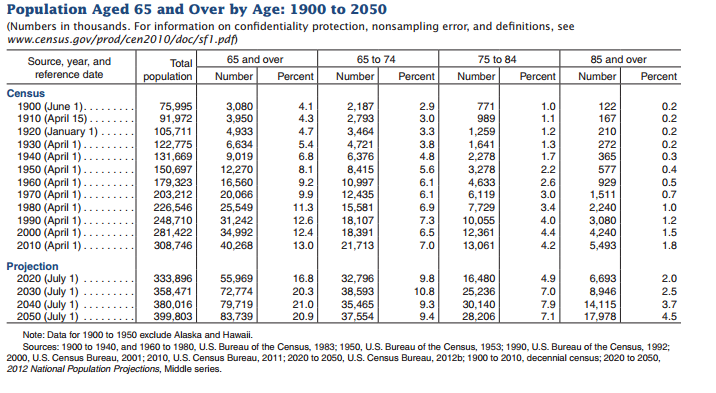
In the U.S. the growth of the elderly population has been less dramatic.  At 9% of the population in 1960, the elderly are expected to almost double to 17% of the population by 2020 (Census Bureau )

****************************
Takeaways

Pay attention to portfolio allocations.  Save money.  You’ll need it one of these days.

Gimme Money

The U.S. Census Bureau released its annual Federal Funds report and the 24/7WallSt web site has done a pictorial analysis of the charts in the report that is a bit more illustrative of the distribution of government funds than the charts in the Census Bureau report.  This long holiday weekend, we can all have fun finding how much per capita our state gets from the Feds. 

David Walker, the former Comptroller under the Bush administration, criticized the accounting methods of the U.S. government, which uses a cash accounting system just like a small lawn mowing company does.  As such, the government shows Social Security taxes as income and Social Security payments as expenses.  This distorts the true fiscal health of this country – a benefit for elected politicians who would prefer that their constituents not know the true picture.