A Bull In A China Shop

August 16, 2015

The big news this week was China’s decision to devalue its currency, the yuan, by 3.5% in two days.  At week’s end, the yuan was about 3% less than what it was at the start of the week.

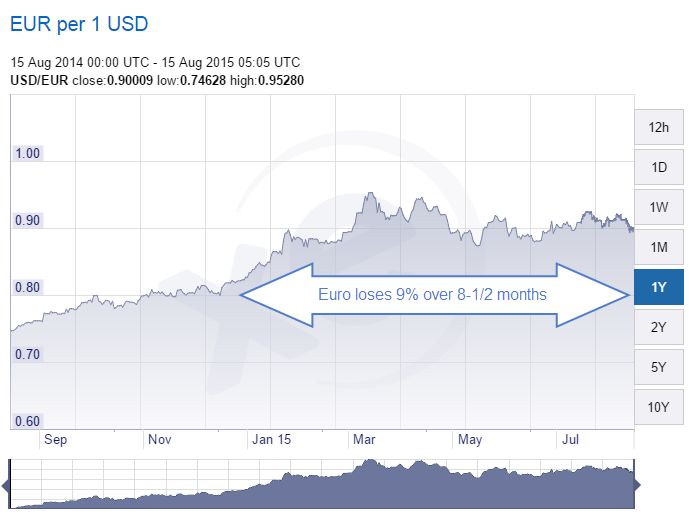
The decline in value came abruptly in  a market that moves in hundredths of a percent, called basis points, each day.  Since the beginning of the year, the euro has lost more than 8% against the dollar but it has done so in little teeny tiny moves.
What prompted China’s central bank to make this devaluation?  China expected a small drop in exports in July, but 8% was far more than expected. (Bloomberg )  The timing of the devaluation couldn’t be worse.  Emerging markets in southeast Asia have had sluggish growth in the past year and depend on exports.  The devaluation of the Yuan makes Chinese exports more competitive.  Vietnam and Malaysia devalued their currencies this week to maintain a competitive edge with China.

Emerging markets have had a rough ride this year.  A popular Vanguard Emerging Markets ETF is down 18% from its high in April.  However, today’s price level is barely below the price in mid-December.
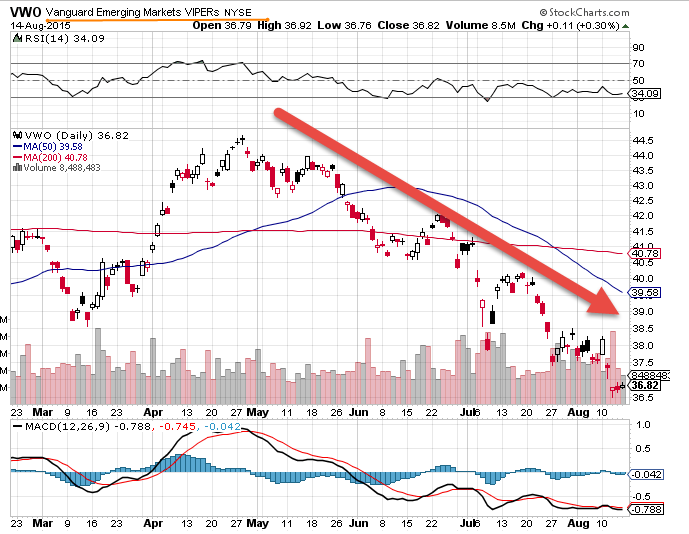
While the SP500 has gone nowhere for the past nine months, emerging markets went on a tear in the beginning of the year, rising about 20% before falling back.  Talking about the SP500…

Dow Jones Death Cross alert!!! This past week the 50 day moving average of the Dow Jones Index crossed below the 200 day average.  The sky is falling.  Run for the hills.  The rhetoric does get a bit dramatic.  Should an investor disregard this signal as so much hocus-pocus?  Brett Arends at MarketWatch suggests that this “indicator” is hogwash. Yes and no.  The Dow Jones is a narrow index composed of just 30 stocks (CNN Money on component performance YTD).  Although it is meant to capture the essentials of the U.S. market, its narrowness makes it an unreliable indicator in some environments.  The oil giants Chevron and Exxon have dropped 23% and 15% respectively, dragging the index down.  There has still not been a death cross in the broader SP500 index.

To investors now over 60, the equity markets of the past 15 years have told a sobering message.  Investors need to either pay some attention or pay someone to pay some attention.  The SP500 stock market index has only recently recovered the inflation adjusted value that it had in 2000.

In nominal, or current, dollars, recoveries from major price declines can often take seven years.  Past recovery periods were 1968 – 1972, 1973 – 1980, 2000 – 2007, and 2007 to early 2013.

Long term trending indicators may be able to help an investor avoid some – emphasize some – of the pain.  For the casual investor, a death cross is a signal to pay a bit more attention to the market on a weekly basis.  All death crosses are not created equal.  Some death crosses are wonderful buying opportunities.  In July 2010, after a two month drop of almost 20%, the 50 day average of the SP500 dropped below the 200 day average, a death cross.  Good time to buy.  Why?  Because it is a death cross coming after a sharp recent drop in price.  The same type of death cross occurred in August 2011 after a steep drop in stock price in late July after the “budget battle” between Obama and Boehner went unresolved.  Good buying opportunity.

In December 2007, a death cross was not a good buying opportunity?  Why?  Because it came after six months of the market seesawing with indecision and no net change in price.  That indicates that there is a shifting sentiment, a lack of confidence among investors.

Some mid-term to long-term strategists use a weekly chart which measures the price at the end of each week, that price that short term traders feel comfortable with as they head into the weekend.  In a bullish or positive market the 12 week, or 3 month, price average stays above the 50 week, or one year, average.  As indecision creeps in the two averages will get close.  Finally, the 50 week average will top out, either gaining nothing or losing just a tiny bit as the 12 week average crosses below.  We’re not there.  We may get there.  Who knows?

Once that weekly cross happens, a long term investor might look at a daily chart.  What is a good rule(s) of thumb to determine whether a death cross is a good buying opportunity, a negative signal, or a palms up, who knows what the heck is going on, signal?

1) Has there been a decline of 15 – 20% (high price to low price) in the past 2 – 3 months? Is today’s price several percent below the 50 day average? Then it is probably a good buying opportunity as I noted above.  It is not always clear cut.  In September 2000, the SP500 began a 12% slide in price that would mark the beginning of a downturn lasting several years.  In mid-October 2000 a death cross occurred.  Was that a large enough slide in price to present a good buying opportunity?  Not really.  The price that day was almost the same as the 50 day average.  The recent drop in price had contributed to the death cross but a longer term re-evaluation of value was also taking place that would cut the SP500 index by 45% toward the end of 2002.

2) If there has been no substantial decline in the past few months, look at the closing price on the day of the death cross.  How many months can you go back to find the same price level and how many times has that price level been tested?  If just a few months, then this is an indeterminate period of indecision that may resolve itself.  Prices may move either higher or lower depending on the resolution.  But, if you can go back six to nine months of price flipping and flopping, then it is a bit more serious.  There may be a spreading questioning of value, a re-positioning of asset balances.  Does it mean sell tomorrow?  No.  It means pay attention.

After several years of declining prices in the years from 2000 – early 2003, the market had a Golden Cross (50 day average rises above 200 day) in May of 2003.  A death cross occurred more than a year later, in August 2004, at the 1095 price level.  That day’s price was close to the 50 day and 200 day average and so was not a standout buying opportunity. The market had first crossed above that price level in December 2003, then retested that level three times on market declines only to rise again.  Might it have been worth waiting a few weeks to check the market’s short term sentiment and see if that price level would hold again?  Probably. As it turned out, the market continued to rise for three more years.

These are not ironclad rules but act as guidelines to help an investor gauge the underlying mood of the market to make more informed investing decisions.
New Home Sales Sink

April 26, 2015

Housing

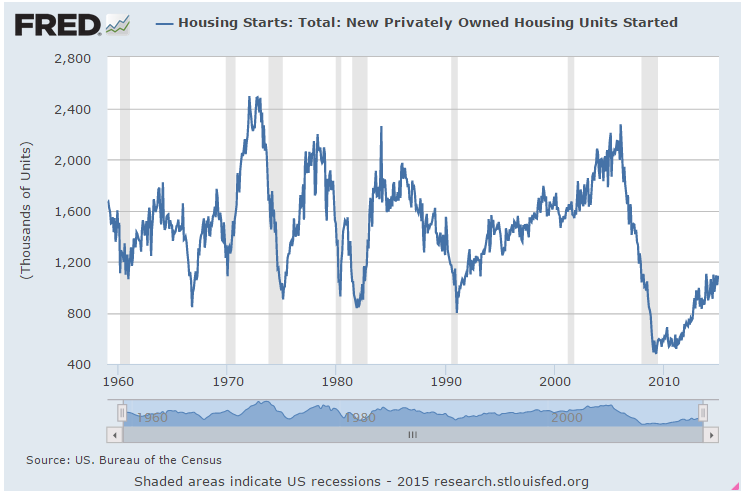
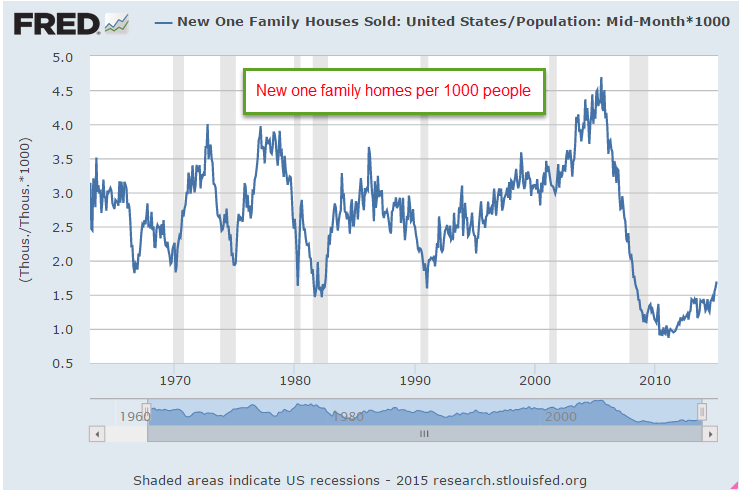
A few months ago sales of new homes per 1000 people climbed above the low water mark set during the back to back recessions of the early 1980s.  In a more normal environment, new home sales would be closer to 800,000, not 500,000.

This past week came the news that new home sales fell more than 11% in March.  The good news is that they were up more than 10% over this month last year.  The supply of new homes is still fairly thin, less than half a year of sales, so builders are unlikely to slow the pace of construction.  As new home sales were climbing this winter, sales of existing homes – 90% of all home sales – languished.  The process flipped in March as existing home sales surged, up 10% year over year.

************************

Long Term or Short Term

Somewhere I read that all investment or savings is a loan.  Loans are short or long term, principle assured or not.  When we deposit money in a checking or savings account, we are loaning the bank money, principle assured.  When we buy shares in an SP500 index mutual fund, we are loaning our hard earned money to “Mr. Market,” as it is sometimes called.  Principle not assured. We hope we get paid back with a decent rate of interest when we need to cash in our loan.  Most of us probably think that this type of investing is long term but, in this model, most stock and bond investments by individual investors are liquid, which is by definition short term.  Every month that a person leaves their money in a stock or bond fund, it is a decision to roll over the loan.  The value of our asset loan depends on the willingness of others to roll over their loans to that same asset market.  Occasionally many lenders to the stock and bond markets shift their concern from return on principal to return of principal and call in their loans.  When phrased this way, we come to understand the inherent fragility of our portfolios.

Because pension and sovereign wealth funds may carry a sizeable position in a market, the entirety of their position is not liquid.  Substantial changes in position will probably affect the price of the asset.  Even in a large position, however, there is a certain amount of liquidity because the fund can sell so many thousand shares of an asset without a material change in the price.  A family’s decision to leave their 401K money in a stock fund in any month, to roll over the loan, joins them at the hip with a sovereign wealth fund in Dubai or CALPERS, the California state employee pension fund.  They are all participants in the short term asset loan market.

In March 2000, at the height of the dot-com boom fifteen years ago, many investors were still loaning money to the NASDAQ market (QQQ).  This past month investors who had bought and held QQQ finally broke even on the nominal value of their loans.   The relatively small dividend payments over the years hardly compensated for the 27% loss of purchasing power during those fifteen years.  

***********************

Taxes

Every facet of our culture seems to get a calendar month, so I guess April is tax month.  In that spirit, let’s look at some historical trends in income taxes.  In 2001, the Congressional Budget Office did an assessment of changes in Federal tax rates by income quintile for the years 1979 – 1997.   These are effective, not marginal, rates.  If someone makes $100K gross and pays $15K in Federal income tax, then their effective rate is 15%.

Effective corporate income tax rates went down for all quintiles while Social Security and Medicare taxes went up for those at all income levels.  The top 20% of incomes saw little change in their effective rates during this 19 year period, while everyone else enjoyed lower rates.  The reason why the top 20% saw little reduction was that their income grew faster than the incomes of those in the other quintiles.

The negative income tax rate for the lowest quintile was due to the adoption of the Earned Income Tax Credit and the increasing generosity of the credit given to low income families. (In 1979, a worker with three children received $1400 in 2012 dollars.  In 2012, they received $5,891, a 400% increase)

*********************

International Currencies

This graphic from the global financial nexus Swift com shows just how much the US dollar and the Euro dominate international trade.  For those of you interested in international currency wars, you might like this Bloomberg article.

Bank analyst Dick Bove thinks that it is unlikely that the Fed will raise interest rates this year.  The U.S. dollar has gained so much strength that a raise in interest rates has too many dangerous implications for other economies and would destabilize global trade.

A well written, informative and entertaining read is James Rickards’ Currency Wars (Amazon).  The author, a former CIA agent, weaves a coherent and interesting narrative that connects a lot of information and events of the past one hundred years.

Financial Obligations

February 22, 2015

Consumer Debt

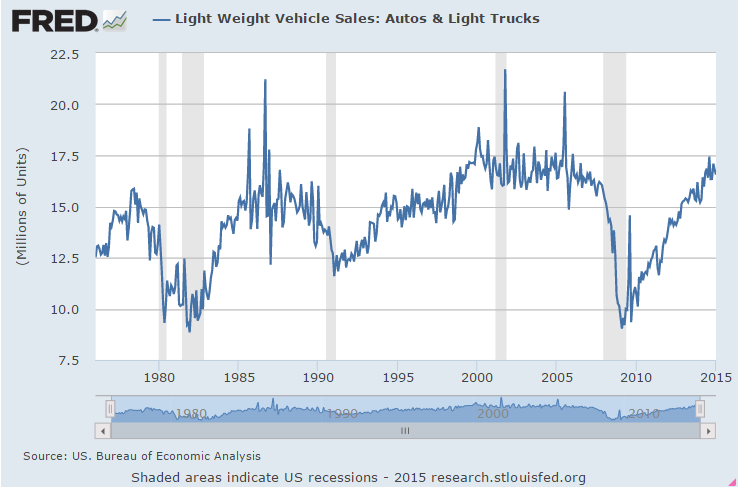
On the one hand, the economy continues to grow steadily and moderately.  Sales of cars and light trucks are strong.

Housing Starts of new homes are slow.  While homebuilders remain confident, there is a noticeable decrease in traffic from first time home buyers.

The debt levels of American households have not reached the nosebleed levels of 2007 before the onset of the financial crisis.  However, they are more than a third higher than 2005 debt levels.

Historically low interest rates have enabled families to leverage their monthly payments into higher debt.  As a percent of disposable income, monthly morgage, credit card and loan payments are the lowest they have ever been since the Federal Reserve started tracking this in 1980. As long as the labor market grows at a moderate pace and interest rates remain low, families are unlikely to default on these higher debt loads.

In addition to household debt, the Federal Reserve includes other obligations – auto leases, rent payments, property taxes and insurance – to arrive at a total Financial Obligations Ratio (FOR), currently about 15%. (Explanation here)  The highest recorded FOR was 18% in 2007. The amount of income devoted to servicing the total of these obligations – 15.28% –  is near historic lows.  (Historical table ) In the past, when this rato has climbed above 17% there has been a recession, a stock market crash, or both.

So there are three components of a family’s monthly obligations: mortgage payments – currently less than 5%; credit card and loans, currently 5.25%; and other obligations, also about 5.25%.  Should interest rates rise in the next two years, credit card and loan payments will rise above the current 5.25% but are unlikely to cause a crisis in household finances.  The percentage of home mortgages which are adjustable have been rising in the past few years but the growing number of these mortgages have been so-called jumbo loans to households with larger incomes. (Daily News  and Wall St. Journal ).  Rising rates will put increasing pressure on homeowners with these types of mortgages but are unlikely to generate a crisis similar to 2008.

**********************

Currency Market

When someone says the dollar is strong, what does that mean?  Investopedia has a fairly concise explanation of the foreign exchange market (Forex) and the history of attempts to structure this market, the largest in the world.

**********************

Medicare Spending

Costs for Medicare and private insurance have grown at annual rates more than double inflation since 1969, as shown in a 2014 analysis of 35 years of Medicare (CMS) data by the Kaiser Family Foundation.  The only good news is that Medicare annual growth has been 2% less than private plans.

The majority of the benefits go to a small group of patients.  “Medicare spending per beneficiary is highly skewed, with the top 10% of beneficiaries in traditional Medicare accounting for 57% of total Medicare spending in 2009—on a per capita basis, more than five times greater than the average across all beneficiaries in traditional Medicare ($55,763 vs. $9,702).”

In its 2013 annual report (highlights) CMS noted that Medicare spending for the past five years had grown at a relatively tame 4% or less – almost double the inflation rate.  This is what passes for good news in federal programs – spending that is only slightly out of control.  Medicaid costs are growing at 6% per year.  Congress and CMS know that they have got to improve spending controls but the players in the health care industry spend a lot of money in Washington so elected and non-elected officials tread carefully when proposing any reforms.

Last month, Health and Human Services (HHS) announced that, by 2018, they would like to make half of Medicare payments to doctors based on the quality of care they provide, not the number of procedures they do.  Under the ACA, 20% of Medicare payments are based on outcomes, not fee for service.  Although HHS says it has saved $700 million over the past two years, few provider organizations meet the guidelines to share in the savings as originally designed.

When Medicare Advantage programs were introduced in 2003, Congress approved additional subsidies to health care providers to reimburse providers for promoting the new plans.  Like all “temporary” subsidies, no one wants to give them up. Because of the subsidies, the plans are relatively low cost and provide a good benefit for the dollar.  Uwe E. Reinhardt, a Princeton professor writing in the NY Times economics blog, referred to a 2010 report on the cost of the popular Medicare Advantage (MA) program: “In 2009, Medicare spent roughly $14 billion more for the beneficiaries enrolled in MA plans than it would have spent if they had stayed in FFS [Fee For Service, or regular] Medicare. To support the extra spending, Part B premiums were higher for all Medicare beneficiaries (including those in FFS).”

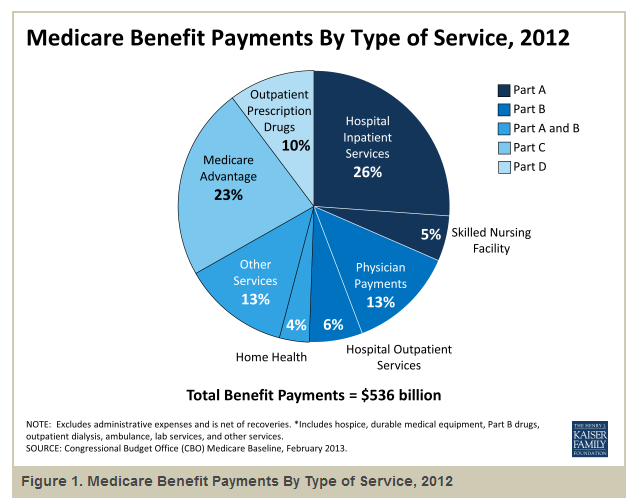
As the population ages, Medicare will consume an ever larger percentage of total health care spending.  CMS noted that Medicare’s portion of health care spending in 2013 has been relatively steady over the past few years. A pie chart from 2009 spending illustrates the cost breakdown.  In 2013, we spent 17.4% of GDP on health care, a figure that has remained stable for a few years.  In 2001, the U.S. spent a shocking (at the time) 13.7% of GDP on health care (CMS Source).