Calibrating the Narrative

October 27, 2019

by Steve Stofka

Mr. Z, the man himself, head of Facebook, showed up in Washington this week to testify before a House committee about privacy and money (C-Span, 2019). Congress is worried about Mark Zuckerberg’s desire to create a digital currency. Several committee members expressed their concern that a private company with a large global influence might wrest control of the world’s currency away from the American government.

Article 1, Section 8 of the Constitution – the enumerated powers section – gave Congress the power “to coin Money, regulate the Value thereof, and of foreign Coin.” The United States has a powerful influence on the international payments system because 52% of transfers are in U.S. dollars (SWIFT, n.d.). The U.S. does not want to give up that global control to Facebook.

As I listened to the exchange between members of Congress and Mr. Zuckerberg, I was reminded that money itself is a narrative. Who gets to dominate that narrative? China and other countries would prefer that U.S. politics did not control the global financial market. When the British controlled the world’s dominant currency, the pound, more than a century ago, the U.S. didn’t like the influence that British leaders had on American lives. The sun never set on the British empire. Now its the U.S. that operates the world’s merry-go-round and the tickets are priced in dollars.

In the digital age Google and Facebook control many of the social and financial exchanges between people around the world. The U.S. government is the 800-pound gorilla in the room and doesn’t like challenges of its dominance. As Facebook and Google get larger and more influential, they become the 600-pound gorillas, but with one important difference. They don’t have an army and a court system like the U.S. does. When Presidential candidate Elizabeth Warren campaigns on breaking up the digital giants because of their monopoly power, those giants pay attention. There is a mood change in Washington that reminds me of the attacks on Microsoft in the 1990s.

We can expect that Facebook and Google will continue their heavy lobbying campaigns and trust in the paralysis of our system of government. The strength of that system lies in the checks and balances built into the Constitution. However, the past decade has shown that those same checks and balances stymie a lot of policy making in Washington. During the worst financial crisis since the Great Depression, it was difficult to enact fiscal policy because that requires legislation which requires consensus, compromise and maturity. Not much of that left in Congress these days.

The chief response to the crisis was handled by a small group of central bankers at the Federal Reserve whose reach is limited by law. Its monetary tools are designed to work with and for banks. Because of that, Wall Street got bailed out during the crisis but not Main Street. Mr. Trump got elected partially on a promise to remedy that situation, particularly in rural America. He was the rainmaker, a billionaire who could get things done that no politician could. No person – even the President of the U.S. – has that much power. Despite the low employment numbers, many communities throughout America have not fully recovered. Mr. Trump’s performance has been theatrical, to say the least. His popular twitter barrage dominates the Washington narrative every day.

And that brings us back to that august body where Mr. Zuckerberg appeared this week. His motives are good, he assured the House committee. A third of the world’s population is unbanked, he noted. Facebook’s promotion of the digital currency Libra and its integration within the Facebook app can help. Calibra is not live yet but the web site will give you a taste of the future (Calibra, n.d.). Concerned about the attention from Congress, large financial institutions like PayPal, Visa and Mastercard have dropped out of the Calibra consortium. Or did Mr. Zuckerberg call it a partnership?

Every criminal organization around the globe is hoping that Mr. Zuckerberg will succeed. Moving $100 bills around is so inconvenient. Mr. Zuckerberg has a solution to help government track down criminal transactions and prevent the digital currency from being used for illegal activities. Law abiding citizens can stay anonymous. How will he accomplish this? It’s a secret. He will tell us soon – very soon.

Even though Calibra will be headquartered in Switzerland, Mr. Zuckerberg promised several times that Facebook will not go through with these digital currency plans until it meets all the concerns of U.S. regulators. There are a lot of regulatory agencies in the U.S. and that very plethora of regulatory bodies contributed to the financial crisis. Investment firms played off one agency against another until they found an agency they liked. Will Mr. Zuckerberg do the same?

Who will control this narrative? The big guns of the U.S. government or the billions of dollars of profit to be had by Facebook if it can scrape just a few pennies per transaction off the trillions of dollars traded around the world each year? My bet is on Mr. Zuckerberg. He is sometimes inartful, but he stumbled on a way into the lives of a few billion people around the world and he has quite artfully capitalized on that.

//////////////////////

Notes:

C-Span. (2019, October 23). Facebook CEO Testimony before House Financial Services Committee. [Web page, Video]. Retrieved from https://www.c-span.org/video/?465293-1/facebook-ceo-testimony-house-financial-services-committee

Calibra. (n.d.). A connected wallet for a connected world. [Web page]. Retrieved from https://calibra.com/

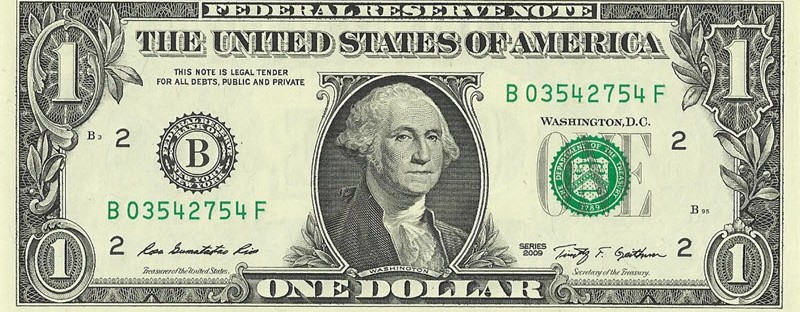
Public Domain. (n.d.) Obverse of United States one dollar bill, series 2009. [Image]. Retrieved from https://commons.wikimedia.org/w/index.php?curid=23332139

SWIFT. (2015, December). Worldwide Currency Usage and Trends. [PDF]. Retrieved from https://www.swift.com/node/19186

Easter Egg

April 5, 2015

On this Easter Sunday, Christians celebrate the Resurrection of Jesus, Jews observe Passover, basketball fans await the final contest of the Final Four and baseball fans look forward to the start of the new season.  After Friday’s disappointing report of job gains in March, investors might be wondering what will happen Monday when markets in the U.S. reopen following Good Friday.  In overseas markets, yields on the 10 year Treasury bond fell on the employment news.  Job gains that were about half of expectations helped allay fears of a June rate increase.  We may see a positive response from both the bond and equity markets on Monday as the time table for rate increases might start in September.  On the other hand, the weekend might allow more rational judgment to prevail. One month’s disappointment does not a trend make.  Year over year gains in employment are especially strong.

April is usually a good month in the stock   market.  Since breaking the 2000 mark in August, the index has neither gained or lost much ground.  Gains in the technology companies that are included in the SP500 (Apple, for example) have been offset by losses in the oil sector of the SP500 (Exxon, Chevron, for example).  Long term Treasuries (TLT) have risen 10% in the past six months, despite the prospect of rising interest rates in 2015.

ICI reports that domestic long term equity mutual funds had an outflow of about $8 billion in March. Investors have not abandoned equity funds by any means but have changed focus. During this past month, $14 billion flowed into world equity funds.   Bond funds continue to post strong inflows – $10 billion in March.

The boomer generation amassed a lot of pension promises through their working years.  Pension funds must balance both equity and bond risk in their investment portfolios  and yet try to meet their assumed growth rates of 7% – 8%.  Caught on the horns of this dilemma, pension funds straddle both the equity and bond markets.  During the past ten years, many have become underfunded because they have not been able to match their projected growth rates.   This delicate balance of risk and reward sets the stage for a catastrophic decline in response to even a relatively small monetary shock because pension funds can not afford to wait out another three or four year decline.  Too many boomers will start cashing in those promises accumulated during the past decades.

The relatively low number of new jobs created in March was probably due to the severe winter in the eastern part of the country.  The BLS revised downward their previous estimates of employment gains in January and February.  Even with the downward revisions and this past month’s relatively anemic 126,000 gains, the average for the quarter is still about 200,000 per month, a particularly strong figure when one considers the impact that plummeting oil prices have had. In the first 3 months of this year, companies in oil and gas exploration have shed 3/4 of the jobs added during all of last year.  The strong dollar makes U.S. exports more expensive and hurts manufacturing.  The employment diffusion index in manufacturing industries dropped below 50, a sign that there is some contraction in the 83 industries included in this index.  However, March’s Manufacturing Purchasing Managers Index showed some slight expansion still and employment in manufacturing is still strong.  Across all private industries, the diffusion index remains strong at 61.4.

Fed chair Janet Yellen has repeatedly said that interest rate decisions will be based on data.  If the data of subsequent months show a resumption of strong growth, an interest rate increase at the FOMC meeting in late July could still be in the cards.  The CWPI composite built on the PMI anticipated a declining trend in growth this winter and spring before resuming an upward climb.  When the non-manufacturing  PMI is released this coming Monday, I’ll update that and show the results in next week’s blog.  Based on the numbers already released, I do anticipate a further decline in March then an evening out in April.  The particularly strong dollar  has cast some doubt on growth predictions, particularly in manufacturing. Both oil and the dollar have made sharp moves in the previous months and it is the rate of change which can be disruptive in an economy.

**********************

Unemployment

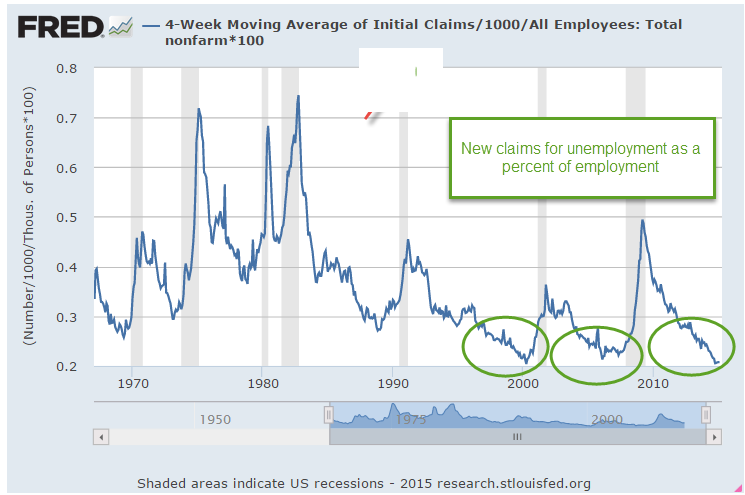
New claims for unemployment were the lowest since the spring of 2000, just as the bubble of the dot-com boom began to deflate.  As a percent of those working, this is the third time since WW2 that new claims have reached these very low levels.  The last two times did not turn out well for the economy or the stock market.

**********************

Oil

Going back through some old notes.  Here’s an October 2009 article where Deutsche Bank estimates the price of oil at $175 in 2016.  2009 was just about the time that newer techniques in horizontal drilling were being developed.  The fracking boom was just about to get underway.  Whether you are an investor or a second baseman, the future is tough to figure out so stay balanced, stay prepared and keep your knees bent.

The Decline of the Dollar?

The U.S. dollar index went up again Friday, approaching $90, as investors fled once again to the safety of the dollar.  The five year chart shows that the dollar is nearing 5 year highs.

The Euro fell below $1.20 on Friday and some are predicting that it could reach parity with the dollar in a few months.  During May, a lot of investors bought an ETF that tracks the Euro, FXE, thinking that the Euro had found bottom, only to be surprised as the Euro continued to fall.

For investors who want to bet on the dollar’s decline Power Shares offers an ETF that gains in value when the dollar’s value declines.  The ticker symbol is UDN and sells for about $24.

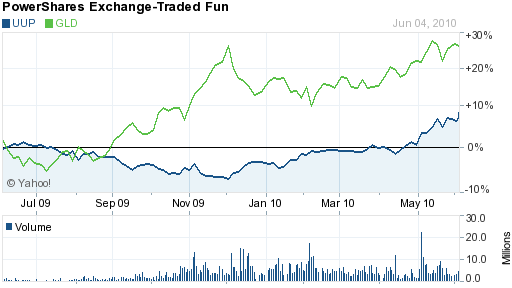
In the past few months the normal inverse relationship between gold and the dollar has changed.  They are now moving in the same, not opposite, directions. UUP below is a bullish ETF linked to the dollar.  GLD is a gold ETF.

What that says to me is that the world’s investors have lately been treating the US dollar as though it were gold – a very disturbing trend.  There is a limited quantity of gold while the dollar is nothing but paper promises from the U.S. government.  However, in the short term, the dollar index could break $100 if the world’s economy seems like it is starting to head into a double dip recession.