A New Set of Rules

August 24, 2025

By Stephen Stofka

Sunday morning and another breakfast with the boys. This week Abel and Cain explore new election rules for electing representatives in the House. The conversations are voiced by Abel, a Wilsonian with a faith that government can ameliorate social and economic injustices to improve society’s welfare, and Cain, who believes that individual autonomy, the free market and the price system promote the greatest good.

Cain opened the conversation. “Did you hear that the Air Canada flight attendants ended their strike?”

Abel shook his head and he unfolded his napkin. “Didn’t know they were on strike. What for?”

Cain replied, “They wanted to be paid for boarding time.”

Abel frowned. “What, they’re not paid until they step on the airplane?”

Cain laughed. “Not them boarding. The passengers.”

Abel tilted his head slightly. “They’re standing there welcoming passengers as they walk on the plane. They’re not paid for that?”

Cain shook his head. “Apparently not. It’s been an ongoing practice for decades. Airlines did not pay flight attendants until the airplane’s doors were closed. A few years back, Delta was the first to pay for boarding time, then American Airlines and Alaska Airlines started similar policies (Source).”

Abel looked incredulous. “How can it be legal to not pay employees when a company requires them to be there?”

Cain sighed. “It’s not. A company I knew got busted for requiring some employees to be at a construction site to unload deliveries but not paying them until the truck showed up and pulled up to the building ready to unload. On a busy site, a delivery truck might have to wait in line.”

Abel asked, “And the employees just stood there waiting and not getting paid?”

Cain nodded. “A state auditor told me he regularly visited companies who shaved time off an employee’s paycheck like that. It’s illegal. The Department of Labor makes two key distinctions based on a 1944 Supreme Court case (Source). There’s a category called ‘engaged to work’ where the employee is under the control of the employer. ”

Abel interrupted, “Flight attendants waiting on a plane while passengers board means they are under the control of the airline, the employer.”

Cain laughed. “Obviously. There’s also the category of ‘waiting to be engaged.’ That’s where the employee is free to do whatever they want.”

Abel smirked. “Let me guess. Airlines have insisted that the flight doesn’t start until the plane’s door is closed. The airlines have paid flight attendants as though the attendants have been waiting to be engaged.”

Cain sighed. “Probably. These past few weeks, we have been talking about changes to election rules. I thought this story was a good example of how often people and companies don’t play by the rules. In a lot of cases, it’s more cost effective to bend the rules, then have your lawyers negotiate a settlement with a regulating agency. We need a new set of rules that encourage people to follow the rules.”

Abel nodded. “Don’t ask permission. A rule we learned as kids.”

Cain continued, “So let’s say all fifty states change their laws to give voters more representation. How likely is that the major political parties will play by the rules? Not likely.”

Abel finished chewing. “Texas is redrawing their districts in mid-decade to get five more seats in the House. Now California is planning to do the same. It’s a race to the bottom that does not represent the will of the people.”

Cain said, “We were talking about that last week. Drawing congressional districts in a straightforward manner. There’s an economics professor at Harvard, Roland Fryer, who suggested making districts as compact as possible while making allowance for county borders (Source). In 2011, he developed an index that measures how much a state’s districts are gerrymandered (Source). A score of 1 is like a benchmark that means that the state has totally compact districts.”

Abel asked, “What does that mean?”

Cain glanced at this phone. “The boundaries of the district have not been tortured to create an advantage for one party. Here’s Fryer: compactness … measures how much voters’ choices can move the scoreboard.’”

Abel nodded. “Like voters actually make a difference.”

Cain replied, “Yeah, parties are spending a lot of money so they want predictable outcomes. They want to minimize competitive races so they redraw district boundaries to move voters around like they are poker chips. A score of three suggests that the districts have been extremely gerrymandered. There are some states with high scores like Tennessee, Texas, New York, Massachusetts and New Jersey. Fryer has a number of state maps so you can see the difference between an ideal and the actual districting in a state (Source).”

Abel sighed. “Trump says he wants to get rid of mail-in ballots. Claims there is massive fraud. No evidence of that, of course. A few isolated cases but not enough to matter. I love the convenience of mail-in voting.”

Cain shook his head. “Yeah, he’s blowing smoke. For Republicans, the problem is that mail-in ballots make it easier to vote in densely populated areas. In less than a decade, the number of polling places has fallen by more than 50% (Source). There are far fewer places to vote in urban areas and minority neighborhoods, where people usually vote Democratic. Georgia closed ten polling places in districts with large black populations (Source). Why? Most black voters pull the lever for Democrats. It’s a game of power.”

Abel sighed. “Reminds me of Garret Hardin’s Tragedy of the Commons. The dominant party in each state has an incentive to gerrymander and to make it more difficult for the other side to gain power. What makes sense to each individual state, though, is bad for what we have in common. It’s eroding the public trust in our political process. If the political process is just a game played by party bosses, that only creates more cynicism and alienation.”

Cain nodded. “Yeah, that’s what I want to reverse. But the fact is that voting is like war. A vote for A is a vote against B. Voters on one side are firing bullets at voters on the other side.”

Abel raised his eyebrows. “Boy, that’s a bleak analogy. Not exactly the rah-rah democracy we learned in school.”

Cain shrugged. “It’s the reality of the voting process. As General Patton said, winning a war is getting the soldiers on the other side to give up their lives for their country (Source).”

Abel smirked. “Voters are not killing each other.”

Cain laughed. “Voters aren’t, but their votes are. It’s a war of attrition. My vote cancels out your vote. That type of thing. We have a winner-take-all system in this country. Voting is about winning, not representation. Just like war. I want to change that. That guy Fryer said that we should have almost 600 House seats to keep up the growth in population over the past century.”

Abel asked, “Yeah, when were the number of House seats capped at 435? I don’t remember that in the Constitution.”

Cain shook his head. “It’s not there in the Constitution. There’s a minimum of 30,000 voters for a representative but there’s no maximum. Congress couldn’t agree on reapportionment after the 1920 census, then capped the number of House seats in 1929 (Source). Today each House seat represents like 750,000 people. There’s 174 million registered voters so that’s about 400,000 voters per House district (Source).”

Abel asked, “What about Great Britain? How many voters does a seat in the House of Commons represent?”

Cain fished in his shirt pocket and withdrew a small piece of paper. “Yeah, get this. The U.K. has less than a third of registered voters, like 48 million. There are 650 seats in the House of Commons, England’s equivalent to our House (Source). That’s about 75,000 voters per seat, less than a fifth of the constituency size in the U.S. Canada has a little over 80,000 per seat. We need a new set of rules. Voters in this country get poor representation because there are too many people per House seat. If there were 600 House seats, that would lower each constituency to about 300,000 voters. It’s better, but not great.”

Abel said, “Voters would get better representation if we had proportional representation. Make the districts bigger and have multi-member districts where several House members represent the district in proportion to the number of votes they receive. This past January, the New York Times had an article comparing what the House would look like under both a single member system like we have now and a multi-member system (Source). Under a proportional representation system, the House would look at lot more like the voters and their political preferences.”

Cain grunted. “Well, you’d have to overturn a 1970s law that made single member districts mandatory for House elections. For the past thirty years, various members have introduced bills to allow multi-member voting. They’ve gone nowhere (Source).”

Abel argued, “Hey, it’s not an amendment to the Constitution. It’s doable.”

Cain asked, “And you’d need a Constitutional Amendment to change that 30,000 minimum. I mean, what if a Libertarian candidate gets a percentage of the vote that represents only 20,000 people? The Constitution says that person cannot be seated, I think. Heck, I’m not a Constitutional scholar.”

Abel shook his head. “Those votes could be apportioned according to the votes the other candidates received. The states could implement that on their own.”

Cain frowned. “Ok, like ranked choice voting does. I like that but, again, the problem is that all the states would need to implement that strategy.”

Abel sighed. “Yeah, that’s a problem. But let’s look at a purple state like Colorado, which has eight House seats split evenly between Democrats and Republicans. The cities along the Front Range vote Democratic but that vote is split among conservative Democrats, what used to be called Blue Dog Democrats, and then there’s liberals, socialists, communists, whatever. A Liberal Party or Socialist Party candidate cannot win a seat under our current system. That stifles the growth of alternative parties that voters might identify with.”

Cain laughed. “That may be a good thing. There are die-hard Communists on the left and staunch John Birchers on the right.”

Abel pushed back his seat and stood. “Yeah, but there’s the 30,000 minimum population rule in the Constitution. A John Birch candidate that represents less than that would have their votes spread around to the other candidates. The system would encourage alternative parties but not fringe parties.”

Cain nodded. “Ok, I like that. I think both of us are aiming for a multi-party system. Even if two parties dominate, other parties have a voice in governance. Australia, Canada, France and Germany have such systems. We fought a war against the British over representation. The system we have now is disempowering voters, making them less engaged.”

Abel laughed as he turned to leave. “Hey, we agree on something. A date that will go down in history.”

Cain smiled. “See you next week.”

///////////////

Image by ChatGPT

A Balance of Power

August 17, 2025

By Stephen Stofka

Sunday morning and another breakfast with the boys. This week Abel and Cain continue to explore a different way to elect a president. The conversations are voiced by Abel, a Wilsonian with a faith that government can ameliorate social and economic injustices to improve society’s welfare, and Cain, who believes that individual autonomy, the free market and the price system promote the greatest good.

After the waitress left with their order, Abel asked, “Remember that idea we were talking about last week? A new way of electing presidents.”

Cain nodded. “Yeah, by congressional district. No popular vote, I think I suggested.”

Abel continued, “This week I compared a winner take all state and one that allots its electors by Congressional district.”

Cain showed interest. “Really. It’s something I’ve been meaning to do. Family stuff has kept me busy. So what did you come up with?”

Abel said, “Well, Nebraska votes by district. They call it the Congressional District Method, which they adopted in 1994 (Source). Each congressional elector is required to vote for the presidential candidate who received the most votes in their district. At-large electors representing the senators vote for the candidate that receives the most votes in the state (Source, page 46, 47).”

Cain frowned. “I was looking to eliminate the popular vote for president entirely. If a Republican House Member is elected, then that vote goes to the Republican presidential candidate. If a Republican Senator is elected …”

Abel interrupted, “Senators are elected every six years. A Senator might not be up for election in that year. What do you do then?”

Cain laughed. “Drop back five and punt. I forgot about that. The class system ensures that there is always one senator from each state up for election every four years, but not both senators (Source).”

Abel stared out the window for a moment as their food arrived. “What if that at-large elector voted according to the majority vote of the districts in the state? Like, if Colorado has eight districts and there was a tie, then the senator who was not up for election would become the tie breaker.”

Cain nodded. “I like that. It’s the same role that the Vice-President plays in the Senate, so it’s in keeping with the spirit of the Constitution. Even better would be a system where the party of the senator who was elected that year determined a tie vote. It would get a lot more voters out to the polls, I think. ”

Abel finished chewing, then asked, “Is that your intent? Get people more engaged in voting?”

Cain replied, “There were two things I was trying to accomplish with this idea. A balance of power between political parties and the people they are supposed to represent. Under the current system, the electoral count distorts the will of the people. For instance, we have a closely divided House, indicating that the will of the people is fairly split. But the electoral count in the 2024 election was 312 to 226 (Source). Sounds like a mandate, doesn’t it? Trump claimed it was a mandate. The guy is a blowhard, but he is not the first presidential winner to claim a mandate based on the electoral count.”

Abel asked, “Are you hoping to restrain politicians? Trump could win by a few electoral votes and he would still claim a mandate. He reports his fantasies about what should be, not any objective reality. He claimed DOGE found $52 billion in savings. An analysis by Politico found that the savings were less than $2 billion (Source).”

Cain shook his head. “I don’t know how much of what Trump says is dementia and how much is braggadocio.”

Abel interrupted. “He opens his mouth and blows thought bubbles like we did as kids with bubble soap and a wand.”

Cain smiled at the thought. “Anyway, the second point of my idea was to give voters more of a sense that they had a voice, give them a greater sense of engagement. Like I said last week, too many voters feel disenfranchised in this winner-take-all system and don’t bother to vote.”

Abel nodded. “That’s what I liked about Nebraska. It’s a red state, but the voters in Omaha vote Democratic and their electoral vote is recorded as such because Nebraska splits its vote.”

Cain frowned. “The Nebraska legislature is talking about ending that system before the next presidential election. Party leaders care only about power, not the will of the people. It’s like Machiavelli said 500 years ago. The majority always wants to persecute the minority. This country was supposed to be different.”

Abel sighed. “The problem is that the U.S. Constitution was written without a thought to political parties. In the House and Senate, party leaders marginalize their rank and file members. Most of them act like ducklings following their mother.”

Cain laughed. “Ducklings? No, they are soldiers following their generals into legislative battle to protect the principles of the American people.”

Abel joined in the laugh. “Get out the flag. Play some patriotic music. Ok, so Kansas is also a red state but they have a winner-take-all system like most states. In 2024, there were only three counties that voted Democrat (Source). Each of those three counties are in different congressional districts and the Democratic vote would not be enough to carry a majority in the district (Source). So, in Kansas, their four district specific electors would have still gone to Republicans.”

Cain nodded. “Ok, but Colorado has eight districts and four districts elected Republican House members. Colorado has winner take all, so those eight electors were pledged to Harris. Why? Because Harris got 54% of the vote in the state (Source). In Kansas, my proposed system would not affect the results. In Colorado, it would have a big effect. Four electors for Trump, four for Harris. Using your idea about the tie breaker, two at-large electoral votes representing the senate seats would have gone to Harris. In the end, Trump would have gotten four votes, Harris six. The point is that the electoral count would reflect the will of the people, not this prejudicial system we have now.”

Abel argued, “Ok, take Colorado. They have already changed their laws to go in the opposite direction. In 2020, they voted to join the National Popular Vote Movement (Source). In other words, Colorado would cast its electoral votes according to the popular vote in the entire country (Source).”

Cain replied, “I think they are going in the wrong direction but that movement shows how much people don’t like the winner-take-all system.”

Abel smirked. “Well, according to Gallup, 58% of people favor a popular vote over the Electoral College (Source). Democrats favor the popular vote. Republicans the Electoral College system.”

Cain asked, “But how many like the winner-take-all system? A bunch of legal scholars wrote a brief presenting a legal challenge to the constitutionality of a winner take all system under the 12th Amendment (Source). Contrary to the spirit of the Twelfth, winner take all disrespects and disregards the will of the people. They noted that, in the 2016 election, almost all of the campaign events occurred in 12 key battleground states. In the 2012 election, almost 100% of TV ads were in a small number of states.”

Abel argued, “And those battleground states want to keep it like that. Lots of advertising revenue every presidential cycle.”

Cain sighed. “Yeah, that too. Anyway, the text of the Twelfth states that the electors should “transmit” the votes of the people (page 24). A winner-take-all system does not do that. The authors made a good case in questioning the constitutionality of these systems.”

Abel argued, “Your idea would eliminate the vote for president and award the vote to the Presidential candidate of that party that won the vote in each congressional district. What if a member of the Communist party won a district and there was no presidential candidate from that party?

Cain replied, “Then the vote would go to the candidate who won the most districts in the state. As we discussed before, ties would be broken as we discussed before.”

Abel sighed. “There’s still a coordination problem. All fifty states would have to change their election laws. Democrats in Colorado wouldn’t want to give up four electors unless the other states enacted a similar scheme.”

Cain frowned. “An amendment to the Constitution is a high bar. We’re back to what we just talked about, a violation of the 12th Amendment. Also, what about the 14th Amendment? I think I brought up that possibility last week.”

Abel said, “A few weeks ago, I had suggested that each party could choose a candidate from each of four regions, then choose a candidate at their nominating convention. I found that there is also a scheme with eight regions (Source). I liked that one. They split the western region into Pacific and Mountain states, which makes more sense.”

Cain nodded as he laid his napkin on the table. “The reason I liked the scheme with four regions is that the electoral votes were more evenly split. Each region had about 130 votes or so. How evenly are votes using the eight region scheme?”

Abel sighed. “Good point. New England, the Great Plains and the Mountain states have far less representation than the other five regions.”

Cain stood up. “The whole idea of the Constitution was a balance of power among political institutions and between those institutions and the will of the people. I think any reforms should incorporate that principle. I like the way we put our heads together on this idea. I got to run and meet my daughter.”

Abel nodded. “Hey, good talk. I’ll see you next week.”

/////////////////////

Image by ChatGPT

A New Turning

August 3, 2025

By Stephen Stofka

Sunday morning and another breakfast with the boys. This week Abel tries out a new political scheme and a rebranding for the Democratic Party. The conversations are voiced by Abel, a Wilsonian with a faith that government can ameliorate social and economic injustices to improve society’s welfare, and Cain, who believes that individual autonomy, the free market and the price system promote the greatest good.

Abel set a small plate on his coffee cup to keep it warm. “It seemed like a lot of familiar names passed away these last two weeks. Some too young.”

Cain unfolded his napkin. “Yeah, Hulk Hogan’s death surprised me. I didn’t know he had leukemia (Source). And then Jamal-Warner’s drowning in Costa Rica (Source). The guy was swimming with his daughter and then boom, gets caught in an undercurrent. No lifeguards (Source).”

Abel replied, “They passed away before their time but it reminded me that the first of the Boomer generation turns 80 next year. Our president is old. The Congress is old. The average age in the Senate is 64 (Source). The average age of the founders was only 45 (Source). It just seems like we need some fresh perspectives and different alliances.”

Cain argued, “Yeah, but they didn’t live as long back in the 18th century.”

Abel shook his head. “No, that was life expectancy at birth. About half of kids died before age five. Those who reached the age of 20 could expect to live to 65 or so (Source). A Boomer born in 1950 would be 20 in 1970. A guy could expect to live to age 70, according to the CDC (Source). That’s only a few years longer.”

Cain looked surprised. “Well, it would take an amendment to specify an upper age limit to run for Congress. I suppose the amendment could exclude re-election age requirements so that current members are grandfathered in. Congress might go for that.”

Abel argued, “A political party could institute a rule like that. An informal rule, of course. The Democrats should adopt that as part of their brand. In 1960, JFK appealed to younger voters. He was in his early forties and attracted voters in their twenties and thirties. Democrats need to reenergize and rebrand. Make the Republicans look like the party of stodgy old men that they are.”

Cain smiled. “I think both parties have become long in the tooth. You’re right. We need new blood.”

Abel paused as their food arrived, then said, “Back in 1997, William Strauss and Neil Howe wrote a book called The Fourth Turning (Amazon). They said that there was a cycle of four generations that lasted eighty to a hundred years. So this was before the Y2K scare in 2000 and 9-11. The authors predicted that the fourth cycle since the American Revolution would start like in 2015 or so. They predicted the start of a Crisis generation starting in 2005, reaching a climax in 2020 and a resolution in 2026 (page 299).”

Cain asked, “Like Trump in 2016 was the start of the fourth cycle? Wow. In 2014, Richard Epstein published The Classical Liberal Constitution (Amazon). He wrote about three stages of governance and constitutional interpretation. The first was from 1789 when they wrote the Constitution to 1865 or so when they passed the Fourteenth Amendment after the Civil War.”

Abel nodded. “Yeah, that was a major upgrade to the Constitution. Before the Fourteenth the protections contained in the Bill of Rights applied only to the federal government, not the states.”

Cain continued, “Then the last ‘age’ was around 1937, when a few key decisions by the Supreme Court established a larger role for the federal government. Epstein is a libertarian who thinks the courts misused the Commerce and General Welfare clauses in the Constitution to expand federal powers.”

Abel asked, “Do you think Trump and the 6-3 majority on the Supreme Court are going to undo the entitlement programs of the past eighty years? Is that the project of the Fourth Turning?”

Cain sighed. “Something has to be done. The country’s debt was huge at the end of WW2, a debt to GDP ratio of 120%. After WW2, politicians could use Cold War rhetoric about fighting Communism to force high marginal tax rates on rich people. Today that debt-to-GDP ratio is the same but I don’t think Congress can reenact 70% tax rates in the current political environment.”

Abel shook his head as he stabbed at a sausage link on his plate. “That’s what I didn’t like about the big bogus bill they just passed. During the financial crisis and the pandemic, tax cuts could be appropriate. Today, the country has low employment and relatively low inflation. Tax cuts are just fuel for inflation. Instead of taxing rich people, the country will go into more debt and sell bonds to rich people. The federal government pays interest on the debt to the rich people. It’s exactly backwards.”

Cain smirked. “The haves get. The have-nots don’t get. Epstein wrote that this country was founded on a grand bargain, the redistribution of wealth from states with more population to those with smaller populations.”

Abel nodded. “Based on equal representation in the Senate.”

Cain agreed. “So, among the 13 original states there were two regions, the northern and southern states. The seven northern states were more populous and their economies were based on cottage industries and manufacturing. The economy of the five slave states was based on agriculture and was less populous. They were like two separate countries who came together for common defense and mutual economic gain.”

Abel asked, “Do you know which were the original southern states?”

Cain groaned as he covered his eyes with both hands. “I’m trying to channel my younger self. Virginia, North Carolina, South Carolina and Georgia. Maryland was a slave state but they didn’t secede, if I remember right (Source).”

Abel lifted his eyebrows in surprise. “Better memory than me. But by the time of the civil war, the country had expanded into a 3rd region, the Midwest. Indiana became a state after the country fought the British in the War of 1812. Iowa was around 1850.”

Cain replied, “Right. And the south was expanding westward as well to keep the balance between slave and non-slave states. Like I said, two countries.”

Abel continued, “Then, after the civil war, the country grew into four regions. There are eleven western states, excluding Hawaii and Alaska. Today, there are four regions, the Northeast, Midwest, West and South (Source).”

Cain looked puzzled. “Ok, good point. So, let’s tie this regional perspective to the ages thing. There were two regions when the Constitution was written. By the time of the Civil War, there were three regions including the Midwest. Then the Civil War amendments. When the Depression started in the 1930s, there were four regions with the western states. Then the role of government expanded. Another big shift. So what’s your idea?”

Abel stirred the little bit of syrup on his plate. “Something big has to change but I’d start small, within a political party. The Democrats could nominate a Presidential candidate from each of the four regions. A candidate from the south would be more conservative. More liberal from the northeast. At a primary convention, the four regions would vote on a candidate.”

Cain asked, “How would they break a tie?”

Abel replied, “Right. Some kind of tie-break rule. It would incentivize the regional factions within the party to bargain with other regions. Democrats would be recognizing the different cultures and interests in each region.”

Cain frowned. “That’s kind of a Parliamentary system within the party.”

Abel nodded. “I think Democrats would put out a more centrist candidate, someone who would have a broad appeal.”

Cain said, “In other words, national politics played at a regional level.”

Abel replied, “Exactly. I was looking at an electoral map the other day. The blue western states, including Alaska and Hawaii, had 130 electoral votes. That’s about a quarter of the 530 electoral votes. Democrats won 83 of those votes in this last election (Source).”

Cain frowned, “That surprises me. I always think of the western states as mostly red.”

Abel nodded. “On the map it looks that way but most of that is empty country and a small number of electoral votes in each state.”

Cain asked, “How many of those 83 votes came from California?”

Abel nodded. “Big impact. Fifty-four votes. They have the most in the country. The western states have some political balance. Not in the south. All Republican. Like I said, a candidate from the southern region within the Democratic Party would probably be more conservative. Someone who could compete in a region with strong Republican sympathies.”

Cain frowned. “So, younger candidates for state and local offices. A different nomination convention for Presidential candidate. Would there still be primaries?”

Abel shrugged. “I don’t know. What do you think? The modern primary system developed after World War 2 (Source). It consumes a lot of time and money. It’s like an ordeal by fire that screens out some otherwise good candidates that don’t want to expose themselves and their families to that ordeal.”

Cain nodded. “Ok, I like that. So what, maybe regional primaries? The downside is that candidates wouldn’t be able to spend much time in rural areas of each state.”

Abel replied, “No system is foolproof. Trump conducted both of his campaigns from the side of a plane. He flies in, holds a rally, and flies out.”

Cain laid his napkin on the table. “Well, I think you’re onto something. The party needs a new brand, new blood.”

Abel sighed. “So does the Republican Party. Unfortunately, that something new was Donald Trump, an extremist who has taken over the party’s dynamics. I hope that the Democrats can avoid the same situation or this country will be crippled.”

Cain slid out of his seat. “Let me think on this. I agree that the primary system is not working. It’s attracting special interests and fringe candidates. If your idea can help solve that, I’m for it.”

Abel looked. “See you next week.”

//////////////////////

Image by ChatGPT

Keywords: primary, election, regions

Fortunate Son

November 10, 2024

By Stephen Stofka

The country has elected a fortunate son for the second time. Throughout his life, Donald has enjoyed the protection of a phalanx of lawyers who have kept him out of jail. A recent decision by the country’s highest court will give him immunity for another four years. His physical condition and cognitive health are declining so rapidly that he likely will not serve out his full term. His much younger Vice-President J.D. Vance will become President and possibly the leader of the MAGA movement for another eight years.

Another take. Former President Donald J. Trump has made the greatest political comeback in the history of this country. Millions of supporters donated money to his legal efforts to defend the integrity of the vote and challenge voter fraud by the Democratic Party. Despite persistent persecution by Democratic prosecutors, Mr. Trump has emerged victorious. In the days leading up to the election, the former President  held many rallies, demonstrating the vitality of a candidate twenty years younger.

Yet another take – a just the facts, ma’am perspective. Presidents with low approval ratings, including Trump in 2020, do not win reelection. This election’s results repeated that trend. James Carville, Clinton’s campaign manager in the 1992 race, coined the famous phrase “It’s the economy, stupid.” Voters showed more concern about inflation and immigration than Trump’s character and demeanor. Voters are especially sensitive to inflation because they feel helpless, and people do not like feeling helpless.

The misery index is the sum of the unemployment rate and the inflation rate. A comfortable reading is about 7%. In 1980, the index was 20% and Jimmy Carter lost his bid for re-election. Bill Clinton and George W. Bush won re-election with misery readings of 8%, and Obama won the 2012 election when the misery index was near 10%. In the fall of this year, the index was below 7%. Perhaps the misery index is not a consistent predictor.

Which is your take on the election results? Each second of our day we download terabytes of information into our brains. We filter out much of that data, then arrange what remains into a version of the world that is uniquely ours. Then we interpret that stimuli, integrating it into our memories along well-worn neural pathways. In that integration process, we reconstruct the world again, discarding the information that conflicts with our previous experience, beliefs and values. We shape what we experience, and our experience shapes us. We may be traveling with others on a train through time, but we have a unique vantage point as we look out the window.

In her book Lost in Math, physicist Sabine Hossenfelder writes, “If a thousand people read a book, they read a thousand different books.” Each voter creates a unique election story. Media analysts focus on different elements of an election, creating their own version of the contest, weaving a narrative of cause and effect. In the telling of the election, we should remember Nassim Taleb’s caution, in Fooled by Randomness, that “past events will always look less random than they were.” Since we are rational creatures, we are both frightened and fooled by randomness. In an evenly divided electorate where a few thousand votes in several key counties can make a difference,  random events can decide the outcome. A snowstorm in a key state in the days before an election, the path of a bullet at an election rally, a decision by a federal judge.

The percentages of the Presidential election votes were no different than 140 million voters flipping a fair coin.. Heads equals a vote from Trump. Tails was a vote for Harris. Did any individual voter flip a coin? Possibly, but unlikely. As a collective, our individual actions can simulate random behavior. Randomness can make us feel helpless, so we act as though our actions have purpose. We act aggressively or assume a false bravado in the face of random mortal danger. Watch the clip from the Deer Hunter where the prisoners are made to play Russian Roulette.

Those who struggle through life may vote for the calm bravado of someone privileged. Ronald Reagan was known as the Teflon President. The public did not hold him responsible for several controversies and scandals that occurred during his eight years in the White House. In 1981 to 1982, the country suffered the worst recession since the Great Depression fifty years earlier. During the 1983 Lebanese civil war, Reagan ignored warnings that the U.S. Marines barrack in Beirut would be vulnerable to attack. The October 23rd bombing resulted in the loss of 241 lives, most of them Marines. . In his 1984 bid for re-election, Reagan won all but one state, a resounding vote of public approval. In 1986, the Iran-Contra scandal, a secretive trade of arms for hostages with Iran, occupied public attention but Reagan escaped any responsibility or public indignation.

Forty years later Donald Trump can wear that moniker, the Teflon President. A slim majority of voters overlooked his many scandals, his felony conviction, and his chaotic management style during the pandemic and most of his first term. Although the Republican Party’s name remains the same, Trump and his followers have erased the legacy of Reagan. The party’s former symbol, an elephant, has been replaced by a red MAGA hat. It has become a party dedicated not to any consistent set of principles but to one person, a fortunate son.

//////////////////

Photo by Danilo Batista on Unsplash

Keywords: misery index, election, recession, inflation

The Tragedy of the Rational Voter

September 29, 2024

By Stephen Stofka

This week’s letter is about voting. Many voters believe that their election choices are rational, based on their values, principles and self-interest. Some economists and political scientists think that our rationality is bounded. We make decisions using heuristics – a “good enough” approach that saves us time and effort. Election choices are guided by self-identification, by tradition, by allegiances. We make irrational decisions but in predictable ways because our choices are anchored by our cultural beliefs, our emotional reactions and cognitive assessment (Pindyck & Rubinfeld, 2017, 261).

Some people are single-issue voters, whose vote is guided by one policy or principle. Their choice of political party may rest on a belief in more government or less government, on more or less taxes, on more or less access to abortion, on more or less tolerance of immigration. The political parties do not want to resolve these hot issues because they drive voters to the polls.

A person’s election choice may be guided more by principal than financial self-interest. A lower income voter might pay little federal income tax but thinks the progressive income tax system is unfair. They vote for a party that promises to make the tax system less progressive even if it means that they may have fewer federal benefits or pay higher taxes. A voter’s choice of presidential party may rest on a local issue like property taxes or zoning regulations. National parties do not control zoning regulations, but they do signal a set of attitudes. Those attitudes help build a coalition of voters who share that perspective.

Let’s imagine that you, dear reader, are not the sort to take shortcuts. Election choices have consequences for an individual’s savings. Remove your Republican or Democratic hat and don the hat of a financial manager who has a fiduciary duty to their savings. If you have watched the TV series Clarkson’s Farm, now in its third season on Amazon Prime, you are aware that Jeremy Clarkson, the owner of the farm, has an experimental spirit and an ambitious imagination. Charlie Ireland, the farm’s land agent, offers a sobering contrast to Jeremy’s enthusiasm. Charlie is familiar with the prices of farm commodities and the average costs to produce those commodities. Charlie can do arithmetic in his head. Jeremy uses a hand-held calculator. Charlie presents Jeremy with a forecast of the disappointing (often) profits that will emerge from the many hours of hard work on a farm. Put on Charlie’s hat. Your goal is to present the facts to yourself, the owner of a farm called your portfolio.

Does the party affiliation of the president have an effect on the returns of the SP500 index? A financial forecast relies on historical data and cannot account for future events. The likelihood of more or less portfolio gain might have no consequence but it is helpful to be prepared. During a 4-year term, what are the expected average yearly gains in a stock index like the SP500? I will start with the presidency of Bill Clinton who began his two-term presidency in January 1993. The worth of a portfolio is what it can buy so I will use an inflation-adjusted index.

Two Democratic presidents, Clinton and Obama, had the highest annual gains. Both Obama and Biden began their terms under severe economic duress after a previous Republican administration. Clinton faced an economy with lackluster employment growth less than 1% following a mild recession two years before he took office. Trump had the third highest annual gains, helped by a relief rally at the prospect that his chaotic term was ending. In the three months after the 2020 election, the index gained 8.25%, an annualized gain of 33%. Now remove the accountant hat and don the voter hat. Does any of this information change your mind? Probably not.

Do you vote for the party that will lower your taxes? Don your accountant hat again and look for the average effective income tax rate. That’s the income taxes paid as a percentage of adjusted gross income. As the table below shows, the effective rate is about 15 – 16% in normal years. A crisis year like the invasion of Iraq, the financial crisis and the pandemic cuts the effective rate by 10%. Incomes and capital gains are reduced. All three crises occurred under a Republican president.

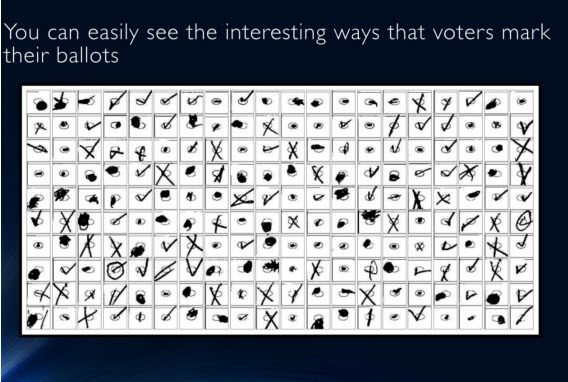
Real life is not a Hollywood script. The evidence is not decisive. We should put our accountants’ hat in the file drawer on election day and use our customary shortcuts. Some voters make one of two alternative choices. Out of disinterest or disgust, some don’t vote. In a presidential election, some undervote, choosing candidates down the ticket but leaving their choice for president blank. The Election Audit Commission (pdf here) notes that an election official may have to inspect a ballot in case automated software cannot read a voter’s mark. Here’s a picture showing the many different ways voters have marked their choices (p. 13).

In the 2012 election, 1% of voters left their presidential choice unmarked, according to a USA Today analysis. In 2016, it was almost double that percentage – 1.9%. Recent polls indicate a tight race between Trump and Harris. As happened in 2016, a small number of voters in several key states could decide the election. In the 2000 Presidential election, several hundred Floridian voters mistakenly marked Buchanan for president instead of Gore. Some realized their mistake, crossed out their initial mark and voted for Gore. This resulted in an overvote for two candidates on the same ballot. In many cases, this voided the voter’s choice entirely.

Over $14 billion was spent in the 2020 election campaign, according to Open Secrets. In a nation of millions of voters, it is irrational that a few thousand voters or less should decide an election. Last week, I referred to John Bates Clark, a 19th century economist, who asked why a small surplus of wheat in the northwest should determine the price of the entire wheat harvest. In a “winner-take-all” fashion, 48 states award all their electoral votes to the candidate who gets the most votes. A few thousand votes may decide all the electoral votes in a state. Why should a person make a rational choice when an idiotic election system neutralizes their careful deliberation?

//////////////////////

Photo by Giorgio Trovato on Unsplash

Pindyck, R. S., & Rubinfeld, D. L. (2017). Microeconomics. Pearson Education Limited.

Expectations and Elections

June 23, 2024

by Stephen Stofka

This week’s letter begins a series on the shaping of Americans’ expectations by the election system. The structure of U.S. political institutions and election rules favor a two-party system that channels voter choice and identification. In this system there are unlikely alliances as voters are corralled into one of two political pens. Voters may feel like the patrons of the Olympia Restaurant, whose meal preferences were bluntly diverted by John Belushi to the only meal choice the restaurant served – cheeseburgers, chips and Pepsi (1978 SNL YouTube clip).  Despite an election cycle that is far longer than those in Parliamentary democracies, voters have less choice, and it is no surprise that average turnout in a U.S. Presidential election is only 60%. In a 2001 election in the U.K. that same percentage of turnout was a hundred year low for the Brits (Clark 2021). In America, party platforms and policy aims are as immaterial as the menu items at the Olympia Restaurant.

The U.S. was set up as a republic of thirteen colonies for their mutual benefit as stated in the Preamble to the Constitution. It is those colonies, now numbering fifty states, who elect the President through the Electoral College. The College was an arcane compromise between those who favored a popular vote and those who wanted the state legislatures to elect the President. The Federalists at the Constitutional Convention hoped that the Electoral College would act as buffer between public passion and the power of the Presidency. At the Constitutional Convention, the Antifederalists objected to the Electoral College but could not offer a more acceptable alternative (Klarman, 2016, p. 367). They argued that a majority of electors was unlikely in a nation of such diverse interests and most Presidential elections would be decided in the House, effectively sidelining the public voice. Their fears were confirmed in the 1800 and 1824 elections.

In each state, the two parties choose a slate of electors for their Presidential candidate. A vote for a candidate is a vote for that candidate’s electors, not the President. In most states, the candidate that gets the most votes in that state gets awarded all of that state’s electors, a winner-take-all system. A Presidential election is a composite of fifty elections that rewards each party for incremental gains as a path to national power. Each party tries to control a state legislature, which constructs the districts within the state and writes some election rules that exclude certain people from voting. Many voting districts are gerrymandered to ensure victory for the party who draws the electoral map (O’Neil et al., 2018, 114). The party in power partitions the voters to maintain the party’s power in the state. Thus, the two parties curb any but the most incremental changes in political power.

Control of a state legislature gives a party greater power in choosing a President. The Constitution gives each state a lot of discretion in the conduct of their elections for national office. Article 1, Section 4 states:

The Times, Places and Manner of holding Elections for Senators and Representatives, shall be prescribed in each State by the Legislature thereof; but the Congress may at any time by Law make or alter such Regulations, except as to the Places of chusing [sic] Senators.

However, the Constitution makes a special provision for a Presidential election. Article II, Section 1 states:

The Congress may determine the Time of chusing[sic] the Electors, and the Day on which they shall give their Votes; which Day shall be the same throughout the United States.

The word “may” indicates an optional power for Congress, not the specific duty conveyed by the word “shall.” May appears only 33 times in the Constitution while shall appears 192 times. This careful wording acknowledged a certain degree of state autonomy even in Presidential elections.

The contentious 2000 Presidential election first introduced the terminology red states and blue states to refer to those states which were reliably Republican or Democrat, respectively. The phrase has become so popular and often used that it seems decades if not centuries old. There are twenty reliably red states, twenty reliably blue states and ten states that lean toward one of the parties or are toss ups. The concerns, interests and perspective of a Democrat voter in a red state are effectively silenced. The same for a Republican voter in a blue state. Voters are like the crowd at a football game. They do not control each team’s strategies or the rules of the game. The framers constructed a system that separates political power and fosters incremental policymaking. There are no “Holy Mary” passes, only a grinding ground game to further the progress of one’s policy goals. Only special interest groups have the ear of the leaders on each political team and are able to achieve their objectives (O’Neil et al., 2018, 125). Marginalized by the two parties, many voters become disinterested, and the control of power becomes increasingly consolidated in a small number of political party operatives and special interests.

That undemocratic result is by design. In a long election cycle, a smaller pool of dependable voters makes the marketing of candidates and ideas less expensive. There simply is not enough money to fund many closely contested state elections so the parties try to construct voting districts that minimize those types of elections. In a two-party system that limits choice, each party appeals to alliances of socioeconomic status, alliances of regional interests, alliances by tradition and those by race, or at least a shared history of grievance. The different expectations and anticipations of the voters within those alliances can make those connections fragile. More on that next week.

///////////////////

Photo by Erik Mclean on Unsplash

Keywords: Constitution, Electoral College, election, red states, blue states

Clark, D. 2021. “Voter Turnout in the UK 1918-2019.” Statista. https://www.statista.com/statistics/1050929/voter-turnout-in-the-uk/ (July 9, 2021).

Klarman, Michael J. 2018. The Framers’ Coup: The Making of the United States Constitution. New York, NY: Oxford University Press.

O’Neil, Patrick H., Karl J. Fields, and Donald Share. 2018. Cases in Comparative Politics. 6th ed. New York: W.W. Norton & Company.

Expectations and Anticipations

June 16, 2024

This week’s letter continues my study of expectations, focusing on the political aspect. While some economists have treated expectation and anticipation as synonyms (the Stockholm school, for one), I want to distinguish between the two. Expectation is planning for or projecting into the future from an observation point in the present. Anticipation is visionary, an imaginative leap into the future in which some event or state has already happened. Anticipation is intuitive; expectation is calculating.

Anticipation invokes our identity and biases as well as our imagination. Political campaigns often target our sense of anticipation with negative advertising that impugns the candidate, then implies that a vote for such a character is an association with that candidate. Imagine how bad things would be if such a person were elected. Do we really want to be associated with someone like that? At a 2008 Presidential debate between Republican candidate John McCain and Democratic candidate Barack Obama, McCain defended Obama’s character against the innuendo spread by right wing TV and talk radio personalities. Much as we deplore negative political advertising, it is effective.

In the game of chess, each player strategizes to take the other’s king. Getting to the other side of the board first does not win the game. One achieves victory by the opponent’s loss. Elections like those in the U.S. are similar to baseball or football. Preventing the opposing team from scoring will not win the game. The victorious team must also make a score. The winner must get more points than the loser, a typical characteristic of a race, which is why our type of elections are called first past the post voting. What makes an election different than a 100-yard dash are the battle tactics employed to weaken an opponent’s efforts to score votes. Successful campaigns strive to get there first while persuading voters to vote NO on their opponent. Campaigns target two separate processes we use to make choices.

One axiom of rational choice theory in economics is a completeness of preferences – that people are able to weigh the costs and benefits of two options and choose the option that maximizes their self interest. We choose an option that provides what we think will give us the most utility. Yes, we make mistakes, but the errors are random. Behavioral economists have challenged the assumption that our choices are rational, pointing out biases that introduce systemic, not random, error in our choices. Losses have a greater impact on our senses than equal gains. Options may be too complex to evaluate fully before making a choice, so we rely on instinct.

 In Chapter 8 of his book, Optimally Irrational, Lionel Page (2023) discusses the debate and presents several examples that test the axiom. Given two grocery lists, could you pick the best option? Consider there might be twenty or more items on the list and a grocery store carries thousands of items. How could any person decide the best option? This past week, after checking out my groceries, I picked up what I thought was the receipt that had fallen out of my pocket. With a glance, I knew it was not mine because there were a few items on the list that I would never buy. I realized then that I could choose between two random grocery lists in less than a minute. I would scan the list for things that I definitely did not like or want. The list that had the fewest of those would be my choice.

When we do have difficulty making choices, it is because we are trying to choose the best, not the worst, option. Page cited (p. 101) an episode of the Big Bang Theory where Sheldon had difficulty choosing between two computer game consoles. He had approached the problem in a very analytical manner typical of Sheldon and was unable to choose. The shortcut, or heuristic, of decision-making that we use in our daily lives is not finding the best, but establishing the worst of two options. We know our dislikes more than our likes because our dislikes amplify the cost of our decisions, helping us choose the cheaper option with less deliberation. Secondly, identifying the worst alternative makes it more probable that we can live with our decision.

A successful political campaign structures its rhetoric to take advantage of this shortcut in decision making. Just before the 1980 election, candidate Ronald Reagan posed a question to President Carter at an October debate: Are you better off than you were four years ago? Despite the word “better” in the question, this was an “identify and reject the worst” choice using both rational expectations and more imaginative anticipations. On the one hand were the empirical realities of high inflation and unemployment, and the energy shortages that voters had experienced during Carter’s term. Voters could form expectations based on that data. Reagan’s term as Governor of California during the 1960s gave voters some basis to form a rational expectation of a Reagan term. However, much was left to voters’ imaginations to construct a post-hoc, or after the fact vision of a Reagan term. This was the anticipation instinct at work. The question helped turn a  close race into a landslide victory for Reagan.

Some voters may not have a clearly defined worst or judge two candidates to be equally worse. Each may have one or two repulsive personal characteristics, political alliances or policy stances. To appeal to those voters, a political campaign offers hope that their candidate will maximize a voter’s income, personal freedom, autonomy or other circumstance like the health of the community a voter lives in. The negative approach targets the cost calculation that voters make. The positive approach appeals to the benefit calculation, but the negative approach is the more powerful. The disadvantage of the negative approach is that it can persuade voters to abstain from voting. In a national campaign for President, a voter’s abstention is neutral, but a lack of turnout can be a decisive factor in local races where a small number of voters can be the tipping point of a political victory.

I hope I have made a clear distinction between expectations and anticipations. When a person stands in the present and plans ahead for some state or event, she is expecting. When a person stands in an imagined future and looks back at an event, she is anticipating. I will take a closer look at the unintentional political alliances between voters as a result of the symbiosis between expectations and anticipations.

/////////////////////

Photo by Ahmed Almakhzanji on Unsplash

Keywords: campaign, election, choice, anticipation, expectation

Page, L. (2023). Optimally irrational: The good reasons we behave the way we do. Cambridge University Press.

Survey Signals

February 11, 2024

by Stephen Stofka

This week’s letter takes a detour toward political polling. NBC News recently posted a story summarizing its latest opinion poll on the overall state of the country and the favorability of presidential candidates. Hart Research Associates regularly conducts this poll for NBC News and asks the question “All in all, do you think things in the nation are generally headed in the right direction, or do you feel that things are off on the wrong track?” One of the reporters at NBC News was kind enough to post the survey data on a central repository, and included in Hart’s survey data were the results of past surveys. A visual depiction of those survey trends contradicted some of my beliefs.

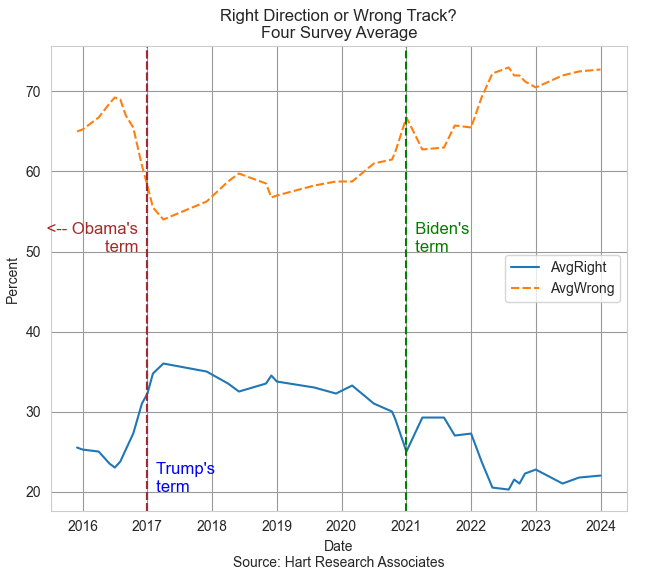
For a decade, the majority of survey respondents regularly answered that they don’t like the direction the country is going. More than half of these surveys were conducted among registered voters only and it doesn’t matter who the President is. The wrong track responses outnumber those who think the country is on the right track. In the graph below I’ve charted a four survey average to smooth the trends in the results. The orange dotted line is the percentage of those who answered wrong track. The blue line indicates those who answered right direction. Less than 10% of respondents have a mixed opinion or are not sure and I did not include those responses in the graph.

Toward the end of Obama’s second term, the percentage of wrong direction responses declined to about 55% before Trump took office in January 2017. From there, the survey responses became increasingly pessimistic. In the final year of Trump’s term negative sentiment shot up in reaction to the pandemic and it kept rising during Biden’s term. The percentage of those with a negative outlook this past month is over 70%, but just a few percent higher than a peak toward the end of Obama’s second term.

Favorability

Given such pessimism about the direction of the country, it is no surprise that a President’s favorability ratings rarely exceed 50%. Survey respondents were routinely asked to rate their feelings toward several public figures. Although both Biden and Trump are subjects of this question for more than a decade, I focused on the responses while both men were in office. The survey has five categories of feelings, from very positive to very negative. I chose just the two favorable categories, very positive and somewhat positive. A chart of the response numbers indicates stark differences in the trend of feelings toward each person. I’ll begin with Joe Biden.

In the first few months of Biden’s term, the sum of positive responses increased from 44% to 50%. Although the Democrats had a political trifecta, their majorities in the House and Senate were slim and prevented passage of controversial legislation like comprehensive immigration reform. The realities of the political process dampened the ardor of progressives who hoped for reforms in immigration, as well as education and child care. The level of moderate feelings, those who answered they were somewhat positive toward Biden, remained anchored at about 20%.

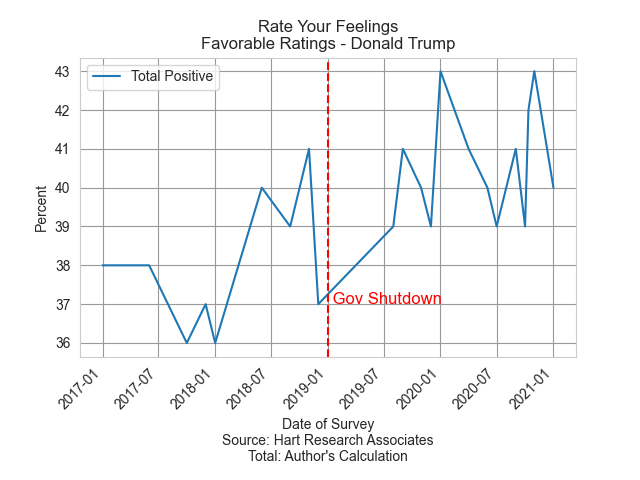
Unlike Biden, the percent of respondents with very positive feelings toward Trump continued to grow during Trump’s term. His disruptive style won him more appeal from ardent supporters than he lost among moderates. Trump’s overall favorability increased slightly during his term from 38% to 40%. Unlike Biden, Trump has a zealous voter base which affords him room to make reckless political postures.

In contrast, Biden’s support is more tempered and results oriented. After an initial positive rating among half of respondents in the early months his very positive ratings in this survey dropped by almost half. The passage of the Inflation Reduction Act in August 2022 helped revive his favorability ratings but the bloom faded after the Republicans won a slim majority in the House a few months later. For Democratic voters, policy choices trump party and person loyalty. With little prospect of further legislative gains in a divided Congress, voter enthusiasm waned.

Party loyalty has long been a central characteristic of Republican voters. Like an operator switching a train track, Trump has steered that loyalty to himself as a person. As such his favorability has been more resilient. In November 2018, midway through Trump’s term in office, the Democrats won the House Majority. Just before Christmas, the Republican-led Congress and Trump were unable to pass an Appropriations bill or a Continuing Resolution. The federal government shut down all non-essential services for a month, the longest government shutdown on record. Trump’s favorability ratings should have taken a hit.

Unlike Biden, Trump’s favorability increased in reaction to the shutdown and the swing of power in the House to Democrats. A wing of the Republican Party, fervent and defiant, continue to fight for control of the party and its agenda. Trump is their champion. The party has evolved from a party holding the political center – think of Mitt Romney – to a reactionary movement of None of the Above. No taxes, no immigration, no Obamacare, and no restrictions on guns to name some prominent issues. Nikki Haley, a Republican challenger to Trump, lost the Nevada primary to a candidate on the ballot named None of these candidates.

After the January 6th riot at the Capitol, fervent support for Trump waned. By June of 2023, survey responses of  very positive had dropped by half to a low of 17 and his total positive sentiment was less than Biden’s numbers. His success in the upcoming election will depend on whether he can re-engage strong sentiment among Republican voters.

These polls demonstrate the strength of Trump’s support in the party. Those in the Republican caucus are afraid of a primary challenge that will cost them their seat. In 2014, the Republican House Majority Leader, Eric Cantor, lost a primary to a Tea Party challenger who received a boost from conservative media. Trump wields a big trumpet and blows it daily. As any parent of a two-year old knows, saying no is easier than making choices that involve compromise. With only a slim majority in the House, loyalty to Trump has made it difficult for Republicans to pass any legislation in the House. Republican congressman Chip Roy from Texas worries that his party will have few accomplishments to attract voters in the upcoming election. However, voters in the coming election will likely cast a rejection vote as in Not Trump or Not Biden. The media will be bombarded with even more negative advertising than usual. Grab a big box of popcorn and settle in.

//////////////

Photo by Emily Morter on Unsplash

Keywords: election, survey, opinion poll, ratings, favorability

Pocketbook Ratios

January 21, 2024

by Stephen Stofka

Thanks to an alert reader I corrected an error in the example given in the notes at the end.

This week’s letter is about the cost of necessities, particularly shelter, in terms of personal income. Biden’s term has been one of historic job growth and low unemployment. Inflation-adjusted income per capita has risen a total of 6.1% since December 2019, far more than the four-year gain of 2.9% during the years of the financial crisis. Yet there is a persistent gloom on both mainstream and social media and Biden’s approval rating of 41% is the same as Trump’s average during his four-year term. Even though there are fewer economic facts to support this dour sentiment, a number of voters are focusing on the negatives rather than the positives.

I will look at three key ratios of spending to income – shelter, food and transportation – to see if they give any clues to an incumbent President’s re-election success (a link to these series and an example is in the notes). Despite an unpopular war in Iraq, George Bush won re-election in 2004 when those ratios were either falling, a good sign, or stable. Obama won re-election in 2012 when the shelter ratio was at a historic low. However, the food and transportation ratios were uncomfortably near historic highs. These ratios cannot be used as stand-alone predictors of an election but perhaps they can give us a glimpse into voter sentiments as we count down toward the election in November.

A mid-year 2023 Gallup poll found that almost half of Democrats were becoming more hopeful about their personal finances. Republicans and self-identified Independents expressed little confidence at that time. As inflation eased in the second half of 2023, December’s monthly survey of consumer sentiment conducted by the U. of Michigan indicated an improving sentiment among Republicans. The surprise is that there was little change in the expectations of Independents, who now comprise 41% of voters, according to Gallup. There is a stark 30 point difference in consumer sentiment between Democrats and the other two groups. A recent paper presents  evidence that the economic expectations of voters shift according to their political affiliations. A Republican might have low expectations when a Democrat is in office, then quickly do an about face as soon as a Republican President comes into office.

Shelter is the largest expense in a household budget. Prudential money management uses personal income as a yardstick. According to the National Foundation for Credit Counseling, the cost of shelter should be no more than 30% of your gross income. Shelter costs include utilities, property taxes or fees like parking or HOA charges. Let’s look at an example in the Denver metro area where the median monthly rate for a 2BR apartment is $1900. Using the 30% guideline, a household would need to gross $76,000 a year. In 2022 the median household income in Denver was $84,000, above the national average of $75,000. At least in Denver, median incomes are outpacing the rising cost of shelter. What about the rest of the country?

The Bureau of Labor Statistics (BLS) calculates an Employment Cost Index that includes wages, taxes, pension plan contributions and health care insurance associated with employment. I will use that as a yardstick of income. The BLS also builds an index of shelter costs. Comparing the change in the ratio of shelter costs to income can help us understand why households might feel pinched despite a softening of general inflation in 2023. In the graph below, a rise of .02 or 2% might mean a “pinch” of $40 a month to a median household, as I show in the notes.

Biden and Trump began their terms with similar ratios, although Biden’s was slightly higher. Until the pandemic in early 2020, housing costs outpaced income growth. Throughout Biden’s first year, the ratio stalled. Some states froze rent increases and most states did not lift their eviction bans until the end of July 2021. In 2022, rent, mortgage payments and utility costs increased at a far faster pace than incomes. Look at the jump in the graph below.

An economy is broader than any presidential administration yet voters hold a president accountable for changes in key economic areas of their lives. Food is the third highest category of spending and those costs rose sharply in relation to income.

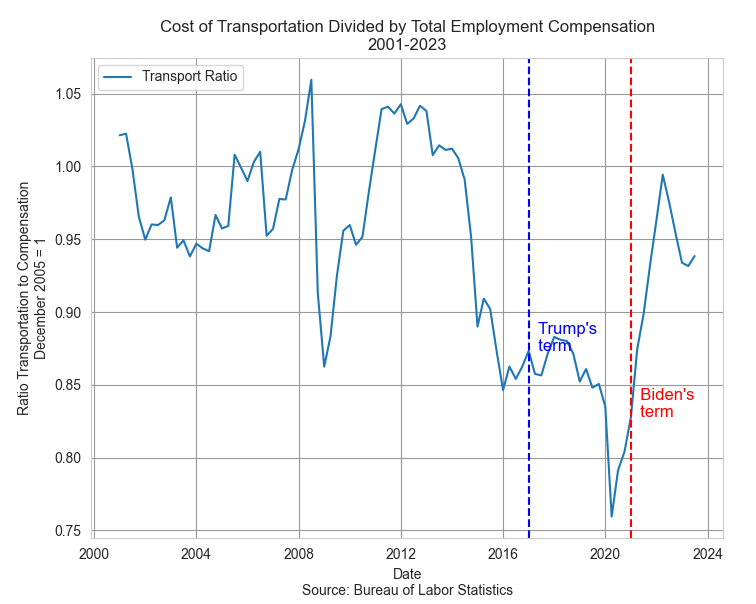
Transportation costs represent the second highest category of spending. These costs have risen far less than income but what people notice are changes in price, particularly if those changes happen over a short period of time. In the first months of the pandemic during the Trump administration, refineries around the world shut down or reduced production. A surge in demand in 2021 caused gas prices to rise. Despite the rise, transportation costs are still less of a burden than they were during the Bush or Obama presidencies.

Neither Biden nor Trump were responsible for increased fuel costs but it happened on Biden’s “watch” and voters tend to hold their leaders responsible for the price of housing, gas and food. In the quest for votes, a presidential candidate will often imply that they can control the price of a global commodity like oil. The opening of national monument land in Utah to oil drilling has a negligible effect on the price of oil but a president can claim to be doing something. Our political system has survived because it encourages political posturing but requires compromise and cooperation to get anything done. This limits the damage that can be done by 535 overconfident politicians in Congress.

Voters have such a low trust of Congress that they naturally pin their hopes and fears on a president. Some are single-issue voters for whom economic indicators have little influence. For some voters party affiliation is integrated with their personal identity and they will ignore economic indicators that don’t confirm their identity. Some voters are less dogmatic and more pragmatic, but respond only to a worsening in their economic circumstances. Such voters will reject an incumbent or party in the hope that a change of regime will improve circumstances. Even though economic indicators are not direct predictors of re-election success they do indicate voter enthusiasm for and against an incumbent. They can help explain voter turnout in an election year. A decrease in these ratios in the next three quarters will mean an increase in the economic well-being of Biden supporters and give them a reason to come out in November.

///////////

Photo by Money Knack on Unsplash

Keywords: food, transportation, housing, shelter, income, election

You can view all three ratios here at the Federal Reserve’s database
https://fred.stlouisfed.org/graph/?g=1ejaY

Example: A household grosses $80,000 income including employer taxes and insurance. They pay $24,000 in rent, or 30% of their total gross compensation. Over a short period of time, their income goes up 8% and their rent goes up 10%. The ratio of the shelter index to the income index has gone up from 1 to 1.0185 (1.10 / 1.08). The increase in income has been $6400; the increase in annual rent has been $2400. $2400 / $6400 = 37.5% of the increase in income is now being spent on rent, up from the 30% before the increase. Had the rent and income increased the same 8%, the rent increase would have been only $1920 annually, not the $2400 in our example. That extra $480 in annual rent is $40 a month that a family has to squeeze from somewhere. They feel the pinch.    

A Twist of History

October 8, 2023

by Stephen Stofka

This week’s letter examines the deployment of the COVID-19 vaccine in 2021 and the passage of the 3rd stimulus plan on March 11, 2021, six weeks after President Biden took office. This past week Katalin Kariko and Drew Weissman were awarded the Nobel Prize in Medicine or Physiology for their work in developing the mRNA vaccine. Republicans have blamed Biden and that stimulus as being a major contributor to inflation, claiming that the government handed out too much purchasing power as the economy was recovering. We tell history in hindsight so that it has what statisticians call a survivorship bias. At each point in the narrative there were several possibilities that did not happen.

Biden came into office just weeks after protesters, spurred on by Trump’s rhetoric of “We fight like hell,” stormed the Capitol. Many businesses, deemed non-essential, remained closed. Despite two large stimulus payments and several relief plans, GDP growth in the fourth quarter was flat at just 0.56% annualized. Like any President coming into office, Biden wanted to make his mark. With narrow majorities in the House and Senate, his party could steer legislation to the finish line. A third rescue plan was politically feasible and advantageous. Was it economically prudent? In hindsight, we make judgments. Decisions are made in the fog of foresight.

In February 2021, just a few weeks after Biden took office, vaccines first became available to vulnerable populations – seniors and the immunocompromised. There are three phases – Phase 1, 2, 3 – that a drug goes through before approval. Normally, Phase 3 alone takes one – four years. In February 2021 the approved vaccines had been through all three phases in less than a year. The mRNA vaccine was an entirely new development process and had never been approved for human use. In short, there was a lot that could have gone wrong. In addition to those concerns was the possibility that the disease might mutate enough to render some vaccine varieties impotent.

More than a decade earlier Biden had been Vice-President when the administration did not push for enough stimulus. Critics on both sides of the aisle worried that further support programs after the financial crisis would spur inflation. Instead, inflation remained stubbornly low and the economy idled in low gear. Biden was not about to make the same mistake again.

What if the vaccines had not been successful or successful enough to hinder the further spread of Covid? The economy would have remain partially shuttered and people in both parties would have been grateful for the third stimulus, demanding even more stimulus payments and other relief measures. Thankfully, that didn’t happen. We often shape our memories of historical events to confirm our choices and to support our opinions. We cut out those events that contradict the coherence of our narrative. We create a history that has shared elements with others of our political persuasion but each history is unique to us alone. We bring that unique set of memories into the voting booth each election and help create our country’s history.

/////////////

Photo by Thomas Kelley on Unsplash

Keywords: stimulus, inflation, Covid-19, vaccine, election