A Balance of Power

August 17, 2025

By Stephen Stofka

Sunday morning and another breakfast with the boys. This week Abel and Cain continue to explore a different way to elect a president. The conversations are voiced by Abel, a Wilsonian with a faith that government can ameliorate social and economic injustices to improve society’s welfare, and Cain, who believes that individual autonomy, the free market and the price system promote the greatest good.

After the waitress left with their order, Abel asked, “Remember that idea we were talking about last week? A new way of electing presidents.”

Cain nodded. “Yeah, by congressional district. No popular vote, I think I suggested.”

Abel continued, “This week I compared a winner take all state and one that allots its electors by Congressional district.”

Cain showed interest. “Really. It’s something I’ve been meaning to do. Family stuff has kept me busy. So what did you come up with?”

Abel said, “Well, Nebraska votes by district. They call it the Congressional District Method, which they adopted in 1994 (Source). Each congressional elector is required to vote for the presidential candidate who received the most votes in their district. At-large electors representing the senators vote for the candidate that receives the most votes in the state (Source, page 46, 47).”

Cain frowned. “I was looking to eliminate the popular vote for president entirely. If a Republican House Member is elected, then that vote goes to the Republican presidential candidate. If a Republican Senator is elected …”

Abel interrupted, “Senators are elected every six years. A Senator might not be up for election in that year. What do you do then?”

Cain laughed. “Drop back five and punt. I forgot about that. The class system ensures that there is always one senator from each state up for election every four years, but not both senators (Source).”

Abel stared out the window for a moment as their food arrived. “What if that at-large elector voted according to the majority vote of the districts in the state? Like, if Colorado has eight districts and there was a tie, then the senator who was not up for election would become the tie breaker.”

Cain nodded. “I like that. It’s the same role that the Vice-President plays in the Senate, so it’s in keeping with the spirit of the Constitution. Even better would be a system where the party of the senator who was elected that year determined a tie vote. It would get a lot more voters out to the polls, I think. ”

Abel finished chewing, then asked, “Is that your intent? Get people more engaged in voting?”

Cain replied, “There were two things I was trying to accomplish with this idea. A balance of power between political parties and the people they are supposed to represent. Under the current system, the electoral count distorts the will of the people. For instance, we have a closely divided House, indicating that the will of the people is fairly split. But the electoral count in the 2024 election was 312 to 226 (Source). Sounds like a mandate, doesn’t it? Trump claimed it was a mandate. The guy is a blowhard, but he is not the first presidential winner to claim a mandate based on the electoral count.”

Abel asked, “Are you hoping to restrain politicians? Trump could win by a few electoral votes and he would still claim a mandate. He reports his fantasies about what should be, not any objective reality. He claimed DOGE found $52 billion in savings. An analysis by Politico found that the savings were less than $2 billion (Source).”

Cain shook his head. “I don’t know how much of what Trump says is dementia and how much is braggadocio.”

Abel interrupted. “He opens his mouth and blows thought bubbles like we did as kids with bubble soap and a wand.”

Cain smiled at the thought. “Anyway, the second point of my idea was to give voters more of a sense that they had a voice, give them a greater sense of engagement. Like I said last week, too many voters feel disenfranchised in this winner-take-all system and don’t bother to vote.”

Abel nodded. “That’s what I liked about Nebraska. It’s a red state, but the voters in Omaha vote Democratic and their electoral vote is recorded as such because Nebraska splits its vote.”

Cain frowned. “The Nebraska legislature is talking about ending that system before the next presidential election. Party leaders care only about power, not the will of the people. It’s like Machiavelli said 500 years ago. The majority always wants to persecute the minority. This country was supposed to be different.”

Abel sighed. “The problem is that the U.S. Constitution was written without a thought to political parties. In the House and Senate, party leaders marginalize their rank and file members. Most of them act like ducklings following their mother.”

Cain laughed. “Ducklings? No, they are soldiers following their generals into legislative battle to protect the principles of the American people.”

Abel joined in the laugh. “Get out the flag. Play some patriotic music. Ok, so Kansas is also a red state but they have a winner-take-all system like most states. In 2024, there were only three counties that voted Democrat (Source). Each of those three counties are in different congressional districts and the Democratic vote would not be enough to carry a majority in the district (Source). So, in Kansas, their four district specific electors would have still gone to Republicans.”

Cain nodded. “Ok, but Colorado has eight districts and four districts elected Republican House members. Colorado has winner take all, so those eight electors were pledged to Harris. Why? Because Harris got 54% of the vote in the state (Source). In Kansas, my proposed system would not affect the results. In Colorado, it would have a big effect. Four electors for Trump, four for Harris. Using your idea about the tie breaker, two at-large electoral votes representing the senate seats would have gone to Harris. In the end, Trump would have gotten four votes, Harris six. The point is that the electoral count would reflect the will of the people, not this prejudicial system we have now.”

Abel argued, “Ok, take Colorado. They have already changed their laws to go in the opposite direction. In 2020, they voted to join the National Popular Vote Movement (Source). In other words, Colorado would cast its electoral votes according to the popular vote in the entire country (Source).”

Cain replied, “I think they are going in the wrong direction but that movement shows how much people don’t like the winner-take-all system.”

Abel smirked. “Well, according to Gallup, 58% of people favor a popular vote over the Electoral College (Source). Democrats favor the popular vote. Republicans the Electoral College system.”

Cain asked, “But how many like the winner-take-all system? A bunch of legal scholars wrote a brief presenting a legal challenge to the constitutionality of a winner take all system under the 12th Amendment (Source). Contrary to the spirit of the Twelfth, winner take all disrespects and disregards the will of the people. They noted that, in the 2016 election, almost all of the campaign events occurred in 12 key battleground states. In the 2012 election, almost 100% of TV ads were in a small number of states.”

Abel argued, “And those battleground states want to keep it like that. Lots of advertising revenue every presidential cycle.”

Cain sighed. “Yeah, that too. Anyway, the text of the Twelfth states that the electors should “transmit” the votes of the people (page 24). A winner-take-all system does not do that. The authors made a good case in questioning the constitutionality of these systems.”

Abel argued, “Your idea would eliminate the vote for president and award the vote to the Presidential candidate of that party that won the vote in each congressional district. What if a member of the Communist party won a district and there was no presidential candidate from that party?

Cain replied, “Then the vote would go to the candidate who won the most districts in the state. As we discussed before, ties would be broken as we discussed before.”

Abel sighed. “There’s still a coordination problem. All fifty states would have to change their election laws. Democrats in Colorado wouldn’t want to give up four electors unless the other states enacted a similar scheme.”

Cain frowned. “An amendment to the Constitution is a high bar. We’re back to what we just talked about, a violation of the 12th Amendment. Also, what about the 14th Amendment? I think I brought up that possibility last week.”

Abel said, “A few weeks ago, I had suggested that each party could choose a candidate from each of four regions, then choose a candidate at their nominating convention. I found that there is also a scheme with eight regions (Source). I liked that one. They split the western region into Pacific and Mountain states, which makes more sense.”

Cain nodded as he laid his napkin on the table. “The reason I liked the scheme with four regions is that the electoral votes were more evenly split. Each region had about 130 votes or so. How evenly are votes using the eight region scheme?”

Abel sighed. “Good point. New England, the Great Plains and the Mountain states have far less representation than the other five regions.”

Cain stood up. “The whole idea of the Constitution was a balance of power among political institutions and between those institutions and the will of the people. I think any reforms should incorporate that principle. I like the way we put our heads together on this idea. I got to run and meet my daughter.”

Abel nodded. “Hey, good talk. I’ll see you next week.”

/////////////////////

Image by ChatGPT
A Way Forward

August 10, 2025

By Stephen Stofka

Sunday morning and another breakfast with the boys. This week Abel and Cain try to separate facts from evidence and restore trust among the American people. The conversations are voiced by Abel, a Wilsonian with a faith that government can ameliorate social and economic injustices to improve society’s welfare, and Cain, who believes that individual autonomy, the free market and the price system promote the greatest good.

Abel laid his napkin on his lap. “A recent survey by Pew Research found that 80% of people thought that voters in both political parties can’t agree on basic facts (Source). No wonder there is so much distrust in this country. It got me to wondering what is the distinction between facts and evidence?”

Cain stirred his coffee. “Good question. We often treat the two words as synonyms. Evidence supports facts. I think of a fact as something that is verified by evidence.”

Abel interrupted, “Yeah, but eyewitness testimony is evidence and that is often unreliable (Source).”

Cain smiled. “The witness, though, regards their testimony as fact. Raises the question, if evidence is not reliable, how truthful are facts? If I am inclined to accept something as fact, I don’t need much evidence. If I am skeptical, then no amount of evidence is enough to convince me of a fact.”

Abel looked at his phone. “On that point, here’s Dirk Nies, a director of a research institute in Virginia who wrote into the British Medical Journal a few years back. He made an interesting distinction between facts and evidence. He said, ‘Facts have no purpose or agenda associated with them. Evidence always does.’ And further on he says that we select evidence as a subset of available facts (Source).”

Cain raised his eyebrows. “But politics is all about agenda. If you use that distinction, then there are few facts. Everything is just evidence.”

Abel argued, “Well, not really. ‘Donald Trump is president right now.’ That’s a fact with no agenda. It’s just a statement. ‘It’s hotter than average this summer.’ Another fact.”

Cain nodded. “Right, but if I use the fact that it’s hotter than normal to support a claim that climate change is real, then that fact is evidence to support my claim. The distinction between facts and evidence is not so clear. No wonder we use those two words interchangeably.”

Abel sighed. “The worst fear I have is another civil war.”

Cain raised his eyebrows. “You’re that worried? I guess it wouldn’t be unusual. Then whoever wins the war writes the history (Source).”

Abel said, “If I present a piece of evidence to support my claim, you might disregard it. Let’s say I claim that Trump is making inflation worse, the exact opposite of what he campaigned on. For instance, the average price of eggs was $2.60 in the first half of last year. I picked up a dozen brown eggs this week and it was $5.29. Those are facts.”

Cain shook his head. “Is last year’s average price a fact or evidence? How were those prices gathered? Lawyers try to discredit evidence or witnesses that hurts their client’s case. A Trump supporter might question the data.”

Abel interrupted, “Like tobacco companies who tried every trick in the book to discredit research showing smoking was dangerous.”

Cain nodded. “Good point. A tobacco company is trying to protect its profits. What is a political partisan trying to protect? Their beliefs, preference and opinions. That can lead people to question anything that challenges those beliefs. So, who figured up last year’s average price of eggs? Was their methodology valid? Was there some political agenda?”

Abel sighed. “It was the BLS, the same agency that produced the employment figures that Trump didn’t like so he fired the head of the agency. An agency, I might add, that Republicans have praised for its objectivity and methodology until a week ago when Trump didn’t like their figures.”

Cain shrugged. “Look, I agree with you. I’m just saying that we all become lawyers when we get into political discussions with people who don’t agree with us. We try to filter out or discredit evidence that attacks our beliefs and opinions. They are like our clients or children. We are protecting them from attack.”

Abel laughed. “So how do we manage to have these discussions? We keep it reasonable, I think.”

Cain smiled. “We’ve known each other a long time. We agree to disagree. I was listening to the Hasan Minhaj podcast a few weeks ago and he was having a conversation with Neil DeGrasse Tyson (Source).  He asked Neil, ‘Is the glass half empty or half full?’ Neil answered that if you are filling up the glass, then it is half full. If you are emptying the glass, it’s half empty.”

Abel asked, “Yeah, but what if an observer comes along on a glass that has water up to the halfway mark? There is no one else around. Half empty or half full?”

Cain smiled. “Good point. Neil assumed that we know the process, but we don’t. If Democrats are in power, Democrats see the glass as half full because they think they are filling the glass. Republicans, however, see the Democrats as making things less so they see the glass as half empty. It’s the same phenomenon when Republicans are in power.”

Abel nodded. “So the process is the context. Nies, that guy we discussed earlier, said that relevance is a characteristic of evidence, not facts.”

Cain looked hesitant. “Yeah, but we can only understand things in context. Einstein’s thought experiment of the man in a closed elevator who doesn’t know whether the elevator is resting on earth or accelerating out in the depths of space (Source).”

Abel shook his head. “But imagine we’re all in the elevator together and arguing over which is true. If we all decide we’re on earth, there’s a hope that someone may come and open the elevator door. If we’re in space, we’re doomed. We may begin tearing each other apart.”

Cain frowned. “Reminds me of William Golding’s novel Lord of the Flies. I hope they still assign that book in high school.”

Abel laughed. “I don’t know. There’s a cool interview with Golding and how the novel got rescued from the reject pile (Source). Anyway, last week, I was proposing that the Democratic Party choose a presidential candidate from each of four regions in the country. The winning candidate for each party would be chosen at a national convention. I thought it might attract more moderate candidates and a consensus within the party.”

Cain replied, “I thought it was a good idea. Grouping people by regions has its problems but its as good a way to divide up various interests as any. Better than the identity politics that has taken over the Democratic Party. How did those four regions vote in the last election? Last week, you said the southern states were all red and the western states voted blue. What about the other regions?”

Abel replied, “Southern states voted all red except for Virginia. Northeastern states were mostly blue except for Pennsylvania. The midwestern states were mostly red except for Illinois and Minnesota (Source). The four states with the most electoral votes are fairly predictable. California and New York are 82 electoral votes for Democrats. That’s almost a third of the votes needed to win the presidency. Texas and Florida are 70 votes for the Republicans, more than a quarter of the votes needed. It’s the states like Arizona, Pennsylvania and Nevada that decide these elections. They went for Biden in 2020, then Trump in 2024. Arizona and Pennsylvania went for Trump in 2016.”

Cain grunted with displeasure. “That’s what I don’t like. A relatively small number of people in a few key states decide a presidential election. The results depend on people who usually only vote in presidential elections. We’ve got to figure out a better system.”

Abel was puzzled. “You just said that you liked that regional system.”

Cain replied, “I liked that but your suggestion was within a political party. You know, a way that the party would choose a national candidate. I’m thinking of a change in the way that we elect presidents. I don’t like the way that each party has essentially captured the electoral votes in each state. They override the will of the people, the whole purpose of voting. Each House district should be able to have their vote counted for president. One vote per house district and senate seat.”

Abel argued, “But we would still need an Electoral College or else we would need to amend the Constitution. I was surprised to learn that the Electoral College has been consistently unpopular over the past 200 years. The public doesn’t like it and Congress has submitted over 700 proposals to amend or abolish the Electoral College (Source). I don’t think we can devise a representative system without an amendment.”

Cain shook his head. “Maybe there’s a way. Currently, the legislature in each state decides how the electoral votes for the state will be awarded (Source). In most states, electoral votes are awarded on a ‘winner-take-all’ basis. Whichever candidate gets the most votes, gets all the electoral votes. I think Maine and Nebraska are the exceptions.”

Abel frowned. “So you are proposing that if the voters of District 1 in Iowa choose a presidential candidate, then the elector for that district would cast their vote for that candidate. The problem is that the Constitution gives each state control of their electoral process.”

Cain interrupted, “Right but with exceptions for practices that discriminate against voters.”

Abel sighed. “Your system would involve all 50 states changing their election laws. Forget about that. The only alternative is a Constitutional amendment.”

Cain squinted. “Maybe not. If the Supreme Court ruled that the current practice of choosing electors was discriminatory in some way, then there would be no amendment needed.”

Abel rolled his eyes. “Congress might just pass an amendment to overrule that decision to preserve party power under the current system.”

Cain shook his head. “I don’t think so. I think voters would prefer that their district has a direct say in choosing the president. As it is now, voters in a rural district in a blue state like Colorado have no voice. The electoral vote that represents their district goes to a party and a candidate that they don’t like. Likewise, big city voters who vote blue in a red state suffer the same abuse. It’s perverse. It’s discriminatory.”

Abel nodded. “Ok, let’s say that electoral votes are cast according to the votes for House and Senate. There’s even more incentive for state legislatures to gerrymander house districts and that further marginalizes the minority.”

Cain winced. “Yeah, you might be right. The party system is so corrupt. I hate the idea of party elites having a voice in choosing a party’s presidential candidate. In 2016, ‘superdelegates’ represented 15% of the Democratic Party’s delegates at their nominating convention (Source). Republicans have about half that percentage and they have less discretion in how they vote but it’s still a problem (Source). Gives me a bad taste in my mouth.”

Abel argued, “Any alternative has to appear neutral to the two dominant parties. It’s hard to do. There would have to be an amendment that restricts gerrymandering. A computer could do the redistricting every decade that the Constitution requires. A simple rule like each district should have the smallest perimeter that encloses the representative population.”

Cain sighed. “Ok, let’s say that were to happen. Each party would propose a candidate chosen from each of the four regions in the country. A nominating convention for each party would choose a candidate. Electoral votes are cast by the House and Senate members who are elected.”

Abel asked, “So no more popular vote for President?”

Cain nodded. “Not directly. What’s the point? Yale University analyzed 2020 election data and found that less than 2% of voters split their ticket (Source).”

Abel asked, “So most Republican voters rarely vote for a Democratic president?”

Cain nodded. “And vice-versa. And this system I’m thinking of is not a radical change. A Republican candidate would have been elected in 2024 anyway because Republicans won more House and Senate seats. Democrats would have won in 2020 and Republicans in 2016 (Source). Nothing would have changed.”

Abel asked, “What’s the point?”

Cain replied, “More moderate candidates under the regional system you proposed. Then, using the new system for electing the president, voters in each district would have their vote counted. It’s transparent. No more guessing voters’ choices like what happened in Florida in the 2000 election.”

Abel smirked. “Yeah, one person on the Supreme Court cast the deciding vote for George Bush.”

Cain looked into the distance over Abel’s shoulder. “Whether you favored Bush or Gore, the Supreme Court should not get to decide the President. That decision was like a blot on this country’s soul, like a skin necrosis that grows until it eventually destroys a person.”

Abel’s eyes widened. “That’s a bit Shakespearian, don’t you think?”

Cain nodded. “Maybe a bit dramatic but what is happening to the people of this country is dramatic. Since that election, people don’t trust each other. Then the lies that got us into the Iraq war. Then the financial crisis and the elites in Washington bailed out the banks while hardworking homeowners lost their houses. Social media came along and amplified that distrust. Then the pandemic. The distrust is gnawing at our public spirit. We’ve got to have more transparency. I’m not saying that will fix things but it’s a step in that direction.”

Abel frowned as he pushed his chair back and laid his napkin on the table.. “One more thought. In every election, there are always several undecided House seats. The results of a presidential election could hinge on those.”

Cain shrugged. “Throw the undecided races out. In 2024, the deadline was December 11th (Source). If a House or Senate race is undecided by then, it doesn’t count for either party.”

Abel stood up. “Let me think about that. I agree with you. We’ve got to do something to restore the public trust. Look, I’ll see you next week.”

Cain smiled. “See you then.”

//////////////////

Image by ChatGPT5

Note: here is the text of the 12th Amendment (Source) and the history and interpretation of the 12th at the Constitution Center (Source).

How We Choose

October 27, 2024

By Stephen Stofka

This week’s letter is about our vote, our political perceptions and institutions. This past week, an NPR reporter asked an undecided voter in Pennsylvania which candidate they were leaning to. The voter responded that he did not like the way the Biden administration had handled inflation. Since Harris was part of that administration, he was leaning toward Trump. The NPR reporter did not present the voter with the information that it was Fed Chairman Jerome Powell, appointed by Trump, who had been chiefly responsible for the government’s response to inflation. Would this new information have an effect on the voter’s thinking? Would the voter hold Trump partly responsible for the surge of inflation during the pandemic recovery? That dialog was never developed. I have noticed that reporters from the British Broadcasting Corporation (BBC) develop a more proactive dialog with those they interview. The resulting interviews are more lively and informative than those conducted by reporters in U.S. news media.

Candidates in presidential elections frame issues to elevate them from the temporary to the eternal. In The Commanding Heights, Daniel Yergin and Joseph Stanislaw (1998) tell the story of Samuel Insull, a tycoon in the electricity industry during the 1920s, who wanted to build a sprawling infrastructure that would supply electricity to every home and business in America. His empire collapsed during the Depression and investors lost 99% of their capital. Franklin Roosevelt (FDR) ran on a campaign that included a promise “’to get’ the Insulls” (p. 47). FDR had elevated a case of speculation and overreach into an eternal battle where the rich preyed on the poor. His administration pursued the tycoon as he sought refuge in various European countries. Finally, Greece extradited the man back to the U.S. where he stood trial for fraud. Prosecutors could not convince a jury that Insull was guilty of anything more than ambition. His investors were mostly professionals, people who hoped to capitalize on that ambition. The jury speedily exonerated Insull.

One voter in Pennsylvania explained to the same NPR reporter that he needed to sit down and study the issues. Political campaigns must craft an issue complicated by dense details and conflicting principles into a clear and simple tale that appeals to the emotions and morals of voters. There are four aspects of most issues: the practical, the moral, the intellectual and the emotional. Repeated studies of patients whose right and left brains have been separated by accident or surgery indicate that each of these aspects is processed by different parts of our brain. To reduce our “brain load” we use shortcuts in our reasoning process to guide us through a jungle of complexity. I will note that Nelson et al. (2013) found little biological evidence for the idea that the processing of various tasks are localized to either half of the brain.

Steckler et al. (2017) found that many of us determine an action’s morality based on intention rather than outcome. Their research indicated that we process those types of moral judgments with our right brain. Many researchers have concluded that emotional responses are mainly generated in the right brain (Gainotti, 2019). Sorting through the practical details and isolating the principles involved in an issue involve the left side of the brain. We don’t carry a handy little tool in our pocket to consider these various aspects to get to the heart of the matter. After a long day at work, it is tiring just to think about the more complex issues. To keep it simple, political campaigns play to just one aspect, but not to the practical details where the momentum of a campaign narrative can get lost.

Political campaigns are sales campaigns. Central to sales practice is the KISS principle – Keep it simple, Stupid. The lessons of history are too nuanced and contradictory for a sales campaign. Candidates try to hypnotize voters with one or two shiny issues. They target the right brain which has a prominent role in emotional and moral judgments. They make up details to support their emotional or moral argument. Anything to stoke outrage, anger and moral condemnation. Simple and short lies with little or no evidence work the best. Scapegoat a minority group. Immigrants eating pets. Jews sacrificing Christian children. Catholic voters wanting to make Catholicism the national religion. In southern states, many black men were lynched after a hasty accusation of  raping a white woman.

Voters are beset with distortions from opposing campaigns. Most of the evidence for or against a candidate overwhelms many voters so they concentrate on a few key details. They rely on their own party affiliation, a few key media sources, a family member or a friend. Campaign rules do not prohibit lying and candidates have little to gain from nuance or truth. A Congressional Research Service analysis found that 36% of current House members and 51% of Senate members are lawyers. They have learned how to shape facts and issues into a convincing argument.

America was founded by the wealthy to be a plutocratic republic with the trappings of a democracy. To preserve a plutocratic Constitution, the founders made it difficult to amend the rules. The Electoral College was designed to check the popular will. The rules of the Senate and House concentrate power in a small elite of party leaders and committee chairs. In a plutocracy, the wealthy find it easier to influence a small number of legislators holding the reins of public policy. Election campaigns in America are longer and more expensive than in any other democracy. An Open Secrets analysis found that total spending in the 2020 election surpassed $14 billion, doubling the money spent in the 2016 election. Much of that money comes from wealthy patrons who wish to align public policy to their priorities and principles. Candidates are the messengers of the rich, conveying a message from the upper echelon of our society to the rest of us. That hypnotic message is your vote matters.

///////////////////

Photo by Victoriano Izquierdo on Unsplash

Keywords: Electoral College, Constitution, vote

Gainotti, G. (2019). The role of the right hemisphere in emotional and behavioral disorders of patients with frontotemporal lobar degeneration: An updated review. Frontiers in Aging Neuroscience, 11. https://doi.org/10.3389/fnagi.2019.00055

Nielsen, J. A., Zielinski, B. A., Ferguson, M. A., Lainhart, J. E., & Anderson, J. S. (2013). An evaluation of the left-brain vs. right-brain hypothesis with resting state functional connectivity magnetic resonance imaging. PLoS ONE, 8(8). https://doi.org/10.1371/journal.pone.0071275

Steckler, C. M., Hamlin, J. K., Miller, M. B., King, D., & Kingstone, A. (2017). Moral judgement by the disconnected left and right cerebral hemispheres: A Split-Brain Investigation. Royal Society Open Science, 4(7), 170172. https://doi.org/10.1098/rsos.170172. Available

Yergin, D., & Stanislaw, J. (1998). The commanding heights: The battle between government and the marketplace that is remaking the modern world. Simon & Schuster.

The Tragedy of the Rational Voter

September 29, 2024

By Stephen Stofka

This week’s letter is about voting. Many voters believe that their election choices are rational, based on their values, principles and self-interest. Some economists and political scientists think that our rationality is bounded. We make decisions using heuristics – a “good enough” approach that saves us time and effort. Election choices are guided by self-identification, by tradition, by allegiances. We make irrational decisions but in predictable ways because our choices are anchored by our cultural beliefs, our emotional reactions and cognitive assessment (Pindyck & Rubinfeld, 2017, 261).

Some people are single-issue voters, whose vote is guided by one policy or principle. Their choice of political party may rest on a belief in more government or less government, on more or less taxes, on more or less access to abortion, on more or less tolerance of immigration. The political parties do not want to resolve these hot issues because they drive voters to the polls.

A person’s election choice may be guided more by principal than financial self-interest. A lower income voter might pay little federal income tax but thinks the progressive income tax system is unfair. They vote for a party that promises to make the tax system less progressive even if it means that they may have fewer federal benefits or pay higher taxes. A voter’s choice of presidential party may rest on a local issue like property taxes or zoning regulations. National parties do not control zoning regulations, but they do signal a set of attitudes. Those attitudes help build a coalition of voters who share that perspective.

Let’s imagine that you, dear reader, are not the sort to take shortcuts. Election choices have consequences for an individual’s savings. Remove your Republican or Democratic hat and don the hat of a financial manager who has a fiduciary duty to their savings. If you have watched the TV series Clarkson’s Farm, now in its third season on Amazon Prime, you are aware that Jeremy Clarkson, the owner of the farm, has an experimental spirit and an ambitious imagination. Charlie Ireland, the farm’s land agent, offers a sobering contrast to Jeremy’s enthusiasm. Charlie is familiar with the prices of farm commodities and the average costs to produce those commodities. Charlie can do arithmetic in his head. Jeremy uses a hand-held calculator. Charlie presents Jeremy with a forecast of the disappointing (often) profits that will emerge from the many hours of hard work on a farm. Put on Charlie’s hat. Your goal is to present the facts to yourself, the owner of a farm called your portfolio.

Does the party affiliation of the president have an effect on the returns of the SP500 index? A financial forecast relies on historical data and cannot account for future events. The likelihood of more or less portfolio gain might have no consequence but it is helpful to be prepared. During a 4-year term, what are the expected average yearly gains in a stock index like the SP500? I will start with the presidency of Bill Clinton who began his two-term presidency in January 1993. The worth of a portfolio is what it can buy so I will use an inflation-adjusted index.

Two Democratic presidents, Clinton and Obama, had the highest annual gains. Both Obama and Biden began their terms under severe economic duress after a previous Republican administration. Clinton faced an economy with lackluster employment growth less than 1% following a mild recession two years before he took office. Trump had the third highest annual gains, helped by a relief rally at the prospect that his chaotic term was ending. In the three months after the 2020 election, the index gained 8.25%, an annualized gain of 33%. Now remove the accountant hat and don the voter hat. Does any of this information change your mind? Probably not.

Do you vote for the party that will lower your taxes? Don your accountant hat again and look for the average effective income tax rate. That’s the income taxes paid as a percentage of adjusted gross income. As the table below shows, the effective rate is about 15 – 16% in normal years. A crisis year like the invasion of Iraq, the financial crisis and the pandemic cuts the effective rate by 10%. Incomes and capital gains are reduced. All three crises occurred under a Republican president.

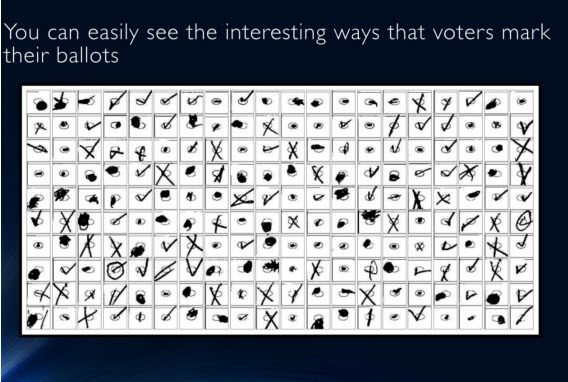
Real life is not a Hollywood script. The evidence is not decisive. We should put our accountants’ hat in the file drawer on election day and use our customary shortcuts. Some voters make one of two alternative choices. Out of disinterest or disgust, some don’t vote. In a presidential election, some undervote, choosing candidates down the ticket but leaving their choice for president blank. The Election Audit Commission (pdf here) notes that an election official may have to inspect a ballot in case automated software cannot read a voter’s mark. Here’s a picture showing the many different ways voters have marked their choices (p. 13).

In the 2012 election, 1% of voters left their presidential choice unmarked, according to a USA Today analysis. In 2016, it was almost double that percentage – 1.9%. Recent polls indicate a tight race between Trump and Harris. As happened in 2016, a small number of voters in several key states could decide the election. In the 2000 Presidential election, several hundred Floridian voters mistakenly marked Buchanan for president instead of Gore. Some realized their mistake, crossed out their initial mark and voted for Gore. This resulted in an overvote for two candidates on the same ballot. In many cases, this voided the voter’s choice entirely.

Over $14 billion was spent in the 2020 election campaign, according to Open Secrets. In a nation of millions of voters, it is irrational that a few thousand voters or less should decide an election. Last week, I referred to John Bates Clark, a 19th century economist, who asked why a small surplus of wheat in the northwest should determine the price of the entire wheat harvest. In a “winner-take-all” fashion, 48 states award all their electoral votes to the candidate who gets the most votes. A few thousand votes may decide all the electoral votes in a state. Why should a person make a rational choice when an idiotic election system neutralizes their careful deliberation?

//////////////////////

Photo by Giorgio Trovato on Unsplash

Pindyck, R. S., & Rubinfeld, D. L. (2017). Microeconomics. Pearson Education Limited.

Expectations and Elections

June 23, 2024

by Stephen Stofka

This week’s letter begins a series on the shaping of Americans’ expectations by the election system. The structure of U.S. political institutions and election rules favor a two-party system that channels voter choice and identification. In this system there are unlikely alliances as voters are corralled into one of two political pens. Voters may feel like the patrons of the Olympia Restaurant, whose meal preferences were bluntly diverted by John Belushi to the only meal choice the restaurant served – cheeseburgers, chips and Pepsi (1978 SNL YouTube clip).  Despite an election cycle that is far longer than those in Parliamentary democracies, voters have less choice, and it is no surprise that average turnout in a U.S. Presidential election is only 60%. In a 2001 election in the U.K. that same percentage of turnout was a hundred year low for the Brits (Clark 2021). In America, party platforms and policy aims are as immaterial as the menu items at the Olympia Restaurant.

The U.S. was set up as a republic of thirteen colonies for their mutual benefit as stated in the Preamble to the Constitution. It is those colonies, now numbering fifty states, who elect the President through the Electoral College. The College was an arcane compromise between those who favored a popular vote and those who wanted the state legislatures to elect the President. The Federalists at the Constitutional Convention hoped that the Electoral College would act as buffer between public passion and the power of the Presidency. At the Constitutional Convention, the Antifederalists objected to the Electoral College but could not offer a more acceptable alternative (Klarman, 2016, p. 367). They argued that a majority of electors was unlikely in a nation of such diverse interests and most Presidential elections would be decided in the House, effectively sidelining the public voice. Their fears were confirmed in the 1800 and 1824 elections.

In each state, the two parties choose a slate of electors for their Presidential candidate. A vote for a candidate is a vote for that candidate’s electors, not the President. In most states, the candidate that gets the most votes in that state gets awarded all of that state’s electors, a winner-take-all system. A Presidential election is a composite of fifty elections that rewards each party for incremental gains as a path to national power. Each party tries to control a state legislature, which constructs the districts within the state and writes some election rules that exclude certain people from voting. Many voting districts are gerrymandered to ensure victory for the party who draws the electoral map (O’Neil et al., 2018, 114). The party in power partitions the voters to maintain the party’s power in the state. Thus, the two parties curb any but the most incremental changes in political power.

Control of a state legislature gives a party greater power in choosing a President. The Constitution gives each state a lot of discretion in the conduct of their elections for national office. Article 1, Section 4 states:

The Times, Places and Manner of holding Elections for Senators and Representatives, shall be prescribed in each State by the Legislature thereof; but the Congress may at any time by Law make or alter such Regulations, except as to the Places of chusing [sic] Senators.

However, the Constitution makes a special provision for a Presidential election. Article II, Section 1 states:

The Congress may determine the Time of chusing[sic] the Electors, and the Day on which they shall give their Votes; which Day shall be the same throughout the United States.

The word “may” indicates an optional power for Congress, not the specific duty conveyed by the word “shall.” May appears only 33 times in the Constitution while shall appears 192 times. This careful wording acknowledged a certain degree of state autonomy even in Presidential elections.

The contentious 2000 Presidential election first introduced the terminology red states and blue states to refer to those states which were reliably Republican or Democrat, respectively. The phrase has become so popular and often used that it seems decades if not centuries old. There are twenty reliably red states, twenty reliably blue states and ten states that lean toward one of the parties or are toss ups. The concerns, interests and perspective of a Democrat voter in a red state are effectively silenced. The same for a Republican voter in a blue state. Voters are like the crowd at a football game. They do not control each team’s strategies or the rules of the game. The framers constructed a system that separates political power and fosters incremental policymaking. There are no “Holy Mary” passes, only a grinding ground game to further the progress of one’s policy goals. Only special interest groups have the ear of the leaders on each political team and are able to achieve their objectives (O’Neil et al., 2018, 125). Marginalized by the two parties, many voters become disinterested, and the control of power becomes increasingly consolidated in a small number of political party operatives and special interests.

That undemocratic result is by design. In a long election cycle, a smaller pool of dependable voters makes the marketing of candidates and ideas less expensive. There simply is not enough money to fund many closely contested state elections so the parties try to construct voting districts that minimize those types of elections. In a two-party system that limits choice, each party appeals to alliances of socioeconomic status, alliances of regional interests, alliances by tradition and those by race, or at least a shared history of grievance. The different expectations and anticipations of the voters within those alliances can make those connections fragile. More on that next week.

///////////////////

Photo by Erik Mclean on Unsplash

Keywords: Constitution, Electoral College, election, red states, blue states

Clark, D. 2021. “Voter Turnout in the UK 1918-2019.” Statista. https://www.statista.com/statistics/1050929/voter-turnout-in-the-uk/ (July 9, 2021).

Klarman, Michael J. 2018. The Framers’ Coup: The Making of the United States Constitution. New York, NY: Oxford University Press.

O’Neil, Patrick H., Karl J. Fields, and Donald Share. 2018. Cases in Comparative Politics. 6th ed. New York: W.W. Norton & Company.