The Carousel of Political Appointees

February 9, 2025

by Stephen Stofka

This Super Bowl weekend, I’ll take a short break from the debate series and take a brief look at the Federal workforce. Next week I hope to have a debate on the Central Power of the Federal Government.

Since Donald Trump took the oath of office on January 20th, he has enlisted Elon Musk to head an effort to trim the civilian federal workforce (CFW). These employees do not include the men and women serving in the Armed Forces. Musk leads an unofficial department called the Department of Government Efficiency (DOGE) designated by President Trump to root out “waste, fraud and abuse.” Several lawsuits have challenged the authority and methods of DOGE to make personnel decisions. Several DOGE employees have access to personal credit and medical information but have not passed a background check (Source). This is a fluid situation sparking controversies each day. I wanted to understand the structure of the CFW as a context for this evolving story.

CFW employees fall into one of two categories: competitive service workers who must pass examinations to be hired and advance within the organization, and political appointees who are excepted from such requirements. The former are permanent or career employees and serve under several Presidential administrations regardless of the party of the President. This system promotes stability within a shifting political environment and was a response to the former system of patronage. The latter are temporary employees and leave the CFW when a new President takes office. Within each classification, there are several subcategories. For interested readers, I will list the various classes of employees in the notes.

Last summer the Partnership for Public Service published an analysis of 2023 data from the Office of Personnel and Management (OPM), the HR agency of the of the federal government (Source). There were over two million permanent full-time employees in the CFW, an increase of 140,000, or 7% from 2019 levels. OPM lists the current level of the CFW at 2.2 million (Source). The majority of the increase was in response to the Bipartisan Infrastructure Law passed in 2021, the first year of the Biden administration, when the Democrats held a “trifecta,” all three branches of government. The law benefited both red and blue states but has been criticized for the embarrassing flaws in its implementation.

The bill contained $42 billion to expand internet access, particularly to rural areas. Nothing has been connected yet. Over $7 billion was earmarked for electric vehicle charging stations but fewer than fifty have been built. To provide some comparison, consider the case of a Denver suburb that hired HDR, a private company, to complete a full renovation of a county library, expand the building and construct four charging stations (Source). HDR completed the project in three years, roughly the same time period since the passage of the 2021 law. Federal projects are plagued with a cumbersome process that makes delays inevitable and diminishes public confidence in the competence of the federal government. When President Trump and Elon Musk claim that they can fix the problem, their supporters believe them.

President Trump would like to undo much of what his predecessor, President Biden, accomplished. Trump could argue that he is simply resizing the CFW to pre-pandemic levels. According to the Partnership for Public Service, 71% of the CFW is defense or national security related. Twenty-one percent of federal employees are in the Department of Veterans Affairs (Source). Cuts to those programs will be unpopular with MAGA supporters and Republican lawmakers. Fifteen percent are medical personnel, some hired during the Covid crisis, and might become a target for dismissal. Many of those provide medical service to active military and veterans. USAID and the EPA have long been targets of Republican condemnation. Trump says he wants to close USAID. The EPA could be next. In response to several lawsuits, the courts will have to decide whether the executive branch has any authority to eliminate a department or agency created by Congress.

Excluding Postal Service workers, there are 2.2 million employees in the CFW (Source). Only 9000 are political appointees and listed in the OPM’s Plum Book (Source). President Trump wants to follow through on an executive order he signed just before the 2020 election that was rescinded by Biden (Source). That order envisioned a plan to convert 50,000 federal employees into a new type of political appointee called Schedule F that would be loyal to Trump’s policies (Source).  

In his first term, Trump became convinced that career civil service employees were sabotaging the policies of his administration. Political appointees carrying out the policies of then President Trump were frustrated by the delaying tactics of career employees who may not have agreed with those policies (Source). Many career employees have done their jobs for both Democratic and Republican administrations. They would claim that they are loyal to the law, not to any one President. Although Trump took an oath to uphold and faithfully execute the laws, his loyalty is to his opinion and vision, not the law. He follows the tradition of President Nixon, who believed that the three branches of government are not co-equal. Nixon regarded his interpretation of the law as the law.

The appointment system is bit complicated but is designed to balance power and interests. President Trump is used to running a family business and does not like checks and balances because they diminish his power. On the other hand, voters elected the President, and he should be able to have some confidence in the personnel who execute public policy. Career civil service employees are a welcome alternative to the patronage system that existed in the 19th and early part of the 20th century. However, a large class of employees with virtual tenure can become insulated from the public will. Those employees can develop a culture that is resistant to policy changes. Within the context of a CFW of more than two million employees, shifting the status of 50,000 employees can seem modest to some. Does the executive have the authority? Will the courts and Congress stand by while the executive alters a workforce structure constructed by Congress?

///////////////////

Image by ChatGPT

The first type of position are presidential appointees with Senate confirmation (PAS). These positions promote a balance of power between Senators and the President.

The second type of position are Presidential appointees that do not need Senate confirmation. This gives the President the autonomy to build an executive team that will implement the policies he wants. These make up 5% of appointees.

The Senior Executive SES-NA and SES-GEN appointees make up half of the SES class and almost half of all 9000 appointees. The other half of SES employees are filled by career appointees on a competitive basis to ensure some impartiality.

The Schedule C (SC or SL) positions allow agency heads to place key policymakers with some expertise in an agency but only after approval by the Office of Personnel Management, a check on political discretion (Source).

The Schedule C (XS) statutory positions legislated by Congress strike a balance of Presidential discretion and Congressional policymaking. Most of these positions are in agencies with financial functions or international jurisdictions like USAID. They are GS-15 or lower and Congress has exempted them from competitive hiring (Source).

A Debate on Tariffs

by Stephen Stofka

This is 12th in a series of debates on various issues. The debates are voiced by Abel, a Wilsonian with a faith that government can ameliorate social and economic injustices to improve society’s welfare, and Cain, who believes that individual autonomy, the free market and the price system promote the greatest good.

This week, Abel began the conversation. “Toward the end of our conversation last week, you mentioned the shift of voter sentiment toward the right.”

Cain nodded, “Yes, the New York Times analyzed the change in election results from the 2020 election and it showed a shift toward the Republican Party in most counties (Source – NY Times).”

Abel interrupted, “Voters shifted left in the 2020 election. For the past twenty years, sentiment seesaws left and right with each election. Voters are so evenly divided that a slight shift can have a dramatic effect on party control of government.”

Cain argued, “This time is different. The voters want change. The neoliberal wing of the Republican Party has been discredited and driven out after two failed wars and a permissive trade policy that boosted China’s economy at the expense of American jobs. Gary Gerstle (2022, pg. 2) writes that it was the financial crisis that triggered the fall of the neoliberal order. President Trump is trying to undo the mistakes of that neoliberal ideology.”

Abel frowned. “I’ve read that book. Gerstle also noted that neoliberal policies were responsible for a lowering of the barriers to free trade (pg. 5). Tariffs and borders, for example. Trump is on a mission to rebuild those barriers. That will only hurt trade and weaken American business and consumers.”

Cain shook his head. “Open borders allowed for the smuggling of drugs and people across our southern and northern borders. The costs of open borders outweigh the benefits.”

Abel sighed. “25% tariffs on imports from Mexico and Canada are going to fuel inflation and hurt consumers. Both countries have said they will retaliate. We export a lot of grains to Canada. That will hurt our farmers.”

Cain argued, “In 2002, President Bush raised tariffs on steel and aluminum imports to as much as 30%. A year later, after complaints to the WTO, Bush ended the tariffs. Trump is made of stronger stuff. These countries are not doing enough to curb drug and people smuggling. It may not be an explicit violation of trade rules, but it violates the spirit of those rules.”

Abel replied, “Bush did that to save jobs in the steel industry. Instead of stemming the flow of jobs to other countries, the tariffs caused the loss of 200,000 manufacturing jobs (Source). Trump’s tariffs are going to raise unemployment and cost consumers.”

Cain rolled his eyes. “We’re not going to agree on this. We have got to restore our nation’s manufacturing capacity and the supply chains that support production that is vital to our security. China controls a lot of essential minerals used in the production of electronics. They are actively pursuing alliances with African countries to lock up essential mineral resources. This is economic warfare, and we have to take measures to defend ourselves.”

Abel frowned. “Tariffs lead to trade wars. Trump is acting like he has a mandate. He won with the lowest margin of the popular vote in the past four decades – just 1.5%. He didn’t even get a majority of the votes (Source). In 2016, he got fewer votes than Hillary Clinton. Contrast that with Obama, who had a 7.2% margin of victory in 2008, and Biden who won by 4.5% in 2020. Voters for Trump are going to wake up and find that they have been screwed.”

Cain argued, “Democrats always use the popular vote as a measure of voter approval. States with a less concentrated population provide the resources that are vital to the economy and security of this country. Those states supply the food, the beef, the fuel that people in urban areas rely on. It’s an economic symbiosis. The producers and workers in rural areas should not be put at a disadvantage simply because their production requires more land. The Electoral College balances the inequities that result from a popular vote.”

Abel scratched his chin. “Tariffs are going to hurt the rural producers and workers that voted for Trump. Those red rural states already depend on the coastal blue states for federal benefits like farm and oil subsidies, Medicaid and welfare and they resent it. They imagine that Trump will revitalize rural economies so that they are more like it was in the 1950s when relative wages were higher. It was the unions who bargained for those higher wages and benefits. Without unions in the private sector, wages in rural counties will remain low.”

Cain raised an eyebrow. “Unions abused their power and companies became less competitive. Unions sometimes enforced rules among their members with violence or intimidation in the workplace (Source). They invite free riding. ‘Shirkers’ are paid at the same rate as productive employees. It’s bad for morale and makes workers less productive as a whole. An employee in a union has two bosses – the shop steward and the employer. The employer wants the employee to work at their best. The shop steward might want an employee to slow down so as not to raise the employer’s expectations.”

Abel cocked his head slightly. “Free riding is a collective action problem that is not unique to labor unions. They empowered workers in negotiations with large companies who wielded extraordinary power in the labor market. In some counties, a company was a monopsony, the main source of employment for everyone in that region.”

Cain argued, “The government is the largest employer in the country employing over 23 million at various levels (Source). Walmart, the largest private employer, has just over 2 million workers (Source). Unions have taken over the public sector.”

Abel interrupted. “Let me stop you there. The BLS just released their annual survey of union membership. It’s less than a third in the public sector (Source).”

Cain nodded. “OK, perhaps I overstated the percentage. Still, public sector membership is five times what it is in the private sector. Unions may give workers more bargaining power, higher wages and more benefits. Who pays for all that? Taxpayers. Our public schools are not teaching essential reading and math skills. Fewer police officers on the street. Potholes go unfilled. What are taxpayers getting for their money? Screwed.”

Abel scoffed. “Elementary school teachers generally make less than the average wage in their local economy. In Denver, an elementary school teacher averages almost $54,000 (Source). The average in private industry is more than $80,000 (Source).”

Cain argued, “Ok, so maybe elementary school teachers in Denver are underpaid. Their main funding source is local property taxes. In the whole metro area though, federal government employees make $2128 a week (Source). That’s far above the average weekly wage of $1721 in the private sector (Source).”

Abel shrugged a shoulder. “Look, Denver is a regional hub. There is a higher proportion of tech employees in the federal workforce in Denver than the private sector. State government employees make just $2 more than the average (Source).”

Cain frowned. “If the mix of jobs and talent was similar to the private sector, then their union is not very effective at negotiating pay.”

Abel showed some impatience. “Your group doesn’t like unions. I get that. Incorporation is a collaboration of capital for investor profits. A union is a collaboration of workers for better pay and working conditions. Capitalism has been so successful because it turns the free riding problem into an advantage.”

Cain laughed. “You’re saying something good about capitalism? Go on.”

Abel smiled. “Small investors, holders of common stock in a company, enjoy the same return on their capital as the giant hedge fund who may own a substantial stake in the company. Because they have so much at stake, large investors take an active role in monitoring or directing management decisions. The small investors freeride on those efforts.”

Cain nodded. “That’s an interesting perspective. I still don’t think that unions are needed to negotiate for workers. Worker productivity and demand will support higher wages.”

Abel sighed. “In theory. This is the real world, not a freshman class in economics. If capital can collaborate to gain bargaining power, workers must collaborate to match that power.”

Cain motioned his impatience. “We started out talking about tariffs and now we’re talking about unions.”

Abel laughed. “We are exploring different perspectives. We will never come to an agreement unless we try to understand each other’s positions on these issues.”

Cain nodded. “See you next week then.”   

///////////////////

Image by ChatGPT

Gerstle, G. (2022). The rise and fall of the neoliberal order America and the world in the free market era. Oxford University Press.

The American Federation of Government Employees represents 800,000 of two million federal employees (Source). The American Federation of State, County and Municipal Employees represents more than 1.3 million workers (Source).

Historic Employment Boom

September 10, 2023

by Stephen Stofka

This week’s letter is about the mix of full-time and part-time workers and what it tells us about the economy. Although unemployment remains below 4%, it rose slightly, according to the most recent unemployment report. This was a good sign, however, because much of that increase was due to formerly discouraged people returning to the labor force and looking for a job. This economy is producing historic employment numbers. Let’s dig in.

I’ll be looking at ratios of workers to the working age population so I’ll discuss that briefly before heading into the data. The Bureau of Labor Statistics now defines the working age population as someone 16 years and older. According to that definition, a 90 year old person is working age. The U.S. is part of the OECD group of developed countries, which uses a more traditional definition of the working age population as 15 to 64.  I am going to use the OECD definition to make historic comparisons more accurate. Two-thirds of this working age population is employed full or part time.

The percent of working age people who are employed full time – the red line in the chart below – is about 64%, a historic high that has eclipsed the economic boom of the late 1990s.

Only 2% of working age people are working part time.

The ratio of full-time workers to part-time workers reveals the strength of the economy. When it is high, employers have the confidence to commit resources to full-time workers, including better benefit packages. Workers have more bargaining power. The chart below shows the peaks in that ratio since the 1960s. A rise in investment accompanied each period. Defense spending led the surge in the 1960s. Investment in technology was a major driver of emploment growth in the 1990s. Spending on infrastructure has been a key driver of growth since the pandemic.

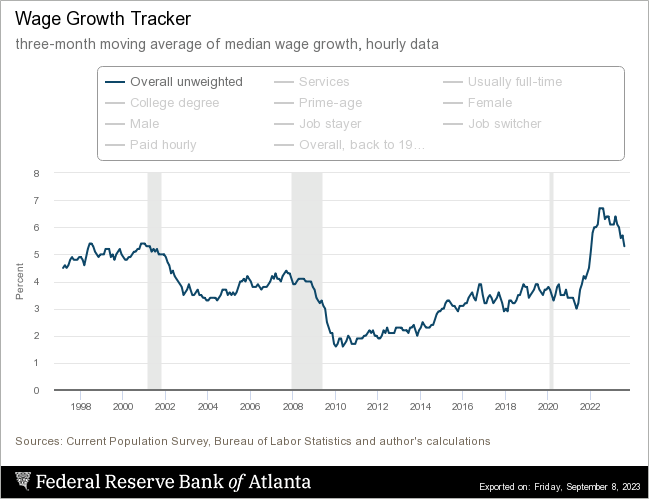
In the post-pandemic recovery, employers have sharply increased wages to fill positions, as shown below by the Atlanta Fed’s wage growth tracker. The decrease in wage growth during the past year is more typical of recessions but without a recession. In the chart below, note that today’s wage growth is one percent higher than the peak during the strong labor market of the late 1990s.   

The greater the number of full-time workers, the more the federal government receives in FICA taxes, reducing the yearly deficit in the Social Security Trust Funds. Since the early 1980s, income tax rates have been indexed to inflation but social security taxes have not. Only the earnings subject to social security, the earnings cap, is indexed. According to the latest Trustees report, the drain on the trust fund last year was $22 billion, less than 1% of the $2.8 trillion fund, but a drain, nevertheless. The first of the historically large Boomer generation were eligible for retirement almost a decade ago. The last of that generation will be eligible for retirement in eight years. The era of annual surpluses in the trust funds is over. During the past decade, outlays increased at a 4.5% annual pace while tax collections increased at a 5.3% rate. This was a welcome change of pace from the previous decade 2003 through 2012 when social security tax collections grew at only 3.6% annually, while outlays grew at a 5.4% rate.

The financial crisis had a deep negative impact on the trust funds and the current estimate is that the trust funds will be depleted in 2034. After that date, retirees will not receive full benefits without some legislation to provide additional funding. In 1990, the trustees estimated a depletion date of 2043, almost nine years later than today’s estimate. These long-range forecasts necessitate many assumptions about economic growth and benefits and such forecasts cannot anticipate outlier events like the financial crisis. There is a lot of catching up to do. We need all the boom we can get.

/////////////////

Photo by bruce mars on Unsplash

Keywords: social security, taxes, employment, wages

Note: In the past twenty years, the number of working Americans who are older than 65 has jumped from four million to 11 million, or 6.5% of the labor force.

A Labor-Output Ratio

February 19, 2023

by Stephen Stofka

When analyzing the economies of some developing countries, economists refer to a “resource curse,” a commodity like oil or minerals that a country can sell on the global market. In a developing country, that commodity may become the main source of foreign currency, used to pay for imports of other goods. The extraction of that resource requires capital investment which usually comes from outside the country. If the production of that resource is not nationalized, most of the profits leave the country.

There are a few big winners and a lot of losers. This uneven ratio promotes economic and social inequality. Political instability arises as people within the country want to get a hold on those resources. Some politicians promise to use the profits from the resource to benefit everyone but those who seize power benefit the most. Political priorities determine economic decisions and the production of that resource becomes inefficient.

A key factor in the “resource curse” is that its contribution to GDP is usually far above its contribution to employment. If a mining sector accounts for 2% of employment but contributes 10% to GDP, the ratio of employment / GDP % equals 2%/10%, or 0.2. Ratios that are far below 1 do not promote a healthy economy. Industries that are closer to a 1-1 ratio will produce a more well rounded and vibrant economy because employed people spend their earnings in other sectors of the economy – a diffusion effect. Some economists might say that a low ratio means that capital is being used more efficiently and attracts capital investment. However, that efficiency comes at an undesirable social and economic cost.

 Let’s look at some examples in the U.S. The construction industry contributes 3.9% to GDP (blue line in the graph below) but accounts for 5.1% of employment (red line). Notice that this is the opposite of the example I gave above. The 1.31 ratio of employment/GDP is above 1, meaning that the industry employs more people for the direct value that it adds to the economy.  Construction spending includes remodels and building additions but does not include maintenance and repair (Census Bureau, n.d.). In the chart below, look at how closely GDP and employment move together. The divergence in the two series since the pandemic indicates the distortions in the housing market because of rising interest rates. Builders have put projects on hold but employment in the sector is still rising because of the tight labor market.

The finance sector’s share of the economy has grown since the financial crisis yet employment has remained steady – or stuck, depending on one’s perspective. The great financial crisis put stress on banks, big and small, but the government bailed out only the “systemically important” banks, leaving smaller regional banks to fend for themselves. The larger banks absorbed many smaller banks, leading to a consolidation in the industry. That consolidation and investments in technology helped the sector become more efficient. The ratio is about 0.75, above the 0.2 ratio in the example I gave earlier. I labeled the lines because the colors are reversed.

Retail employs a lot of people relative to its contribution to GDP. The ratio is about 1.65. Does that mean retail is an inefficient use of capital? Retail sales taxes pay for many of the city services we enjoy and take for granted. Retail is the glue that holds our communities together.

The manufacturing sector employs fewer people in relation to its GDP contribution. It’s ratio is 0.77, about the same as finance.

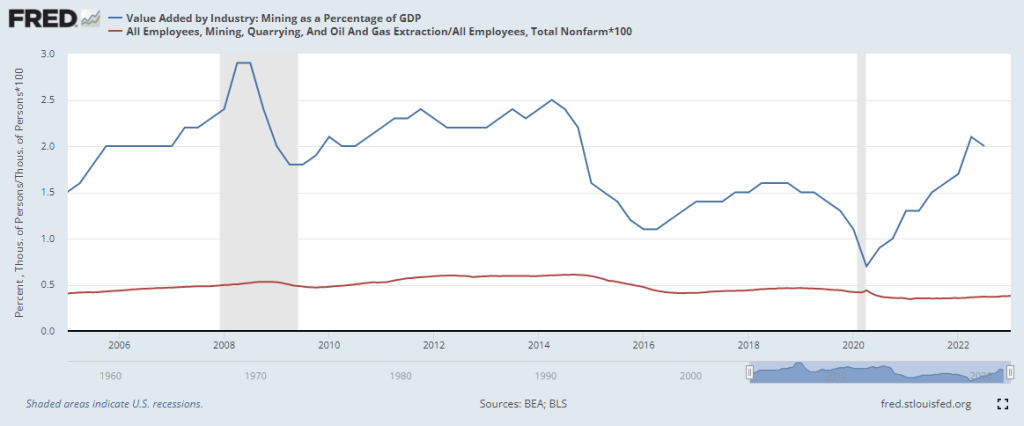
As I noted earlier, the mining sector is capital intensive with a high ratio of GDP to employment. This sector includes gas and oil extraction. In the U.S. that ratio averages about 0.33 but it is erratic global demand. Look at the effect during the pandemic. In our diversified economy, the mining sector contributes only a small amount, like 2%. In a developing country like Namibia in southern Africa, mining accounts for 10% of GDP. In the pandemic year, the demand for minerals declined and Namibia’s economy fell 8%.

Lastly, I will include the contribution of health care, education and social services, which contribute 7.5% to GDP but employ almost a quarter of all workers. Since the financial crisis and the passage of Obamacare, this composite sector contributes an additional 1% to GDP. These sectors include many public goods and services that form the backbone of our society. The 3.0 ratio is the inverse of the mining sector.

To summarize, the construction, retail, health care and education sectors have a ratio above 1. They employ more people for each percentage unit of output. The finance, manufacturing, mining, oil and gas sectors have ratios less than 1, employing fewer people per percentage unit of output. For readers interested in the GDP contribution of other industries, the Federal Reserve maintains a list of charts, linked here [https://fred.stlouisfed.org/release?rid=331].

//////////////////

Photo by Camylla Battani on Unsplash

Census Bureau. (2019, April 15). Construction spending – definitions. United States Census Bureau. Retrieved February 16, 2023, from https://www.census.gov/construction/c30/definitions.html

U.S. Bureau of Economic Analysis, Value Added by Industry: Construction as a Percentage of GDP [VAPGDPC], retrieved from FRED, Federal Reserve Bank of St. Louis; https://fred.stlouisfed.org/series/VAPGDPC, February 12, 2023.

U.S. Bureau of Labor Statistics, All Employees, Construction [USCONS], retrieved from FRED, Federal Reserve Bank of St. Louis; https://fred.stlouisfed.org/series/USCONS, February 12, 2023.

U.S. Bureau of Labor Statistics, All Employees, Total Nonfarm [PAYEMS], retrieved from FRED, Federal Reserve Bank of St. Louis; https://fred.stlouisfed.org/series/PAYEMS, February 12, 2023.

I will not do a complete reference for each series. Here’s the identifiers for each series: Finance Value Added – VAPGDPFI. Employment in finance – USFIRE. Construction employees – USCONS. Retail Value Added – VAPGDPR. Retail Employees – USTRADE. Manufacturing Value Added – VAPGDPMA. Manufacturing Employees – MANEMP. Education, Health Care, Social Services Value Added – VAPGDPHCSA. Employment is a composite of 4 series. Mining Value Added – VAPGDPM. Mining Employment – CES1021000001

The Old, Young and Middle

October 9, 2022

by Stephen Stofka

This week I’ll compare inflation-adjusted or real spending on Social Security and K-12 education with wage growth. I was surprised to learn that the number of people in both programs are the same. I’ll begin with Friday’s employment report because the market’s reaction to it indicates the erratic – but rational – thinking that higher inflation can trigger. Job gains of 263,000 were in line with expectations, but the unemployment rate went down by .1% because people stopped looking for jobs. Three years ago a .1% move would be discarded as a survey error. The unemployment rate is derived from a survey of households, not businesses, and often exaggerates any move up or down. In today’s volatile market, traders are skittish, employing algorithms that don’t care about the extent of a move, only whether it is up or down. Short term options trading leverages both money and time and they are now almost half of the options market. A minus sign might trigger a sell, a plus sign a buy. The number after that plus or minus is less important. A trader might have taken a position forecasting a slight uptick in the unemployment rate. No increase or a decrease = sell and minimize losses. This is reactive trading, not economic evaluation.

This week’s ADP report of private job gains showed a decline of 7,000. Averaged together job gains were only 116,000 in September and has shown a distinct downward response to the Fed’s raising of interest rates. The historical average of the two surveys has been the more accurate after revisions. More disappointing for workers is that wage growth has been more than 3% below the inflation rate.

While workers’ wages are not keeping up with inflation, social security recipients will likely get a COLA (cost-of-living-adjustment) raise of about 8.6% this year. By law, the COLA calculation compares this year’s average third quarter CPI to last year’s third quarter average. September’s CPI report will be released Thursday, October 13th, finalizing this year’s 3rd quarter and the final adjustment percentage. It will be the largest increase since 1981’s adjustment of 11.3%, according to the Social Security Administration (2022).

An eternal theme in the Republican platform is the privatization of Social Security before it goes broke. A few weeks before the election, some Republicans will undoubtedly use the COLA adjustment to call for Social Security privatization. They will claim that higher payments will inevitably lead to the insolvency of the fund. Retirees will get partial payments or no payments.

Former House Speaker and Republican Vice-Presidential candidate, Paul Ryan once asked Alan Greenspan, then Chairman of the Fed and a fellow conservative, a leading question meant to demonstrate the insolvency of Social Security. Wouldn’t personal retirement accounts (privatized Social Security accounts) make the retirement system more financially secure? In his dry tone, Greenspan answered that “there is nothing to prevent the Federal Government from creating as much money as it wants and paying it to somebody” (C-Span, 2005). Ryan, a champion of privatization, was disappointed in the answer.

Why then do we have the trust funds? The Social Security system is “Pay-Go.” The taxes of current workers pay for the benefits to retired workers. When the program was created almost 90 years ago, President Roosevelt (FDR) thought that Republicans – and some conservative southern Democrats – would be more hesitant to cancel the program if funds were – on paper at least – dedicated to the program and called “insurance.” Republicans challenged the program up to the Supreme Court on the basis that the Federal government had no Constitutional right to force people to pay into a retirement program. The Court ruled that, even if the program was called “insurance,” it was a tax and the government had the right to tax incomes. Read the 16th Amendment. The unfairness in the system was that the first generation of recipients paid little into the system for the benefits they received when they retired. Today, the average retiree receives $1673 a month, or $20K per year (SSA, 2022). Let’s compare that to spending on K-12 education.

The U.S. has about the same number of K-12 students as it does retirees who are collecting Social Security – a bit more than 50 million. Social Security is a federal program. K-12 education is funded at the state and local level with only 8% federal funding. The federal government has deep pockets. State and local governments have shallow pockets with many demands from their constituents. In 2019, federal, state and local governments spent $765B, or $15,120 per pupil in 2019 (Hanson, 2022). That’s 75% of what we spend on retirees. Have we shifted too many resources to seniors from children?

Retirees have paid Social Security taxes for their entire working lives and feel that those funds have been set aside for them. The federal government doesn’t have to provide goods and services to retirees. Even the task of computing and remitting Social Security taxes is done by businesses – by law and for free. The accounting is a business expense. State and local governments must provide real resources. These include schools and facilities, teachers and lunches, school nurses and security guards.

Education competes with other essential services. The 2008 financial crisis and the slow recovery “put a hurt” in most state and local budgets. Since 2008, the national average of real per pupil funding has increased only 6% (Hanson, 2022). For most of that time, inflation has been low. Imagine what a sustained period of high inflation might do. Let’s look back at the last period – the 1970s and early 1980s.

Higher inflation wakes us up. Even when inflation is low, workers are squeezed, having to support children and retirees. Inflation increases the budget squeeze so workers pay closer attention to personal budgets and public policies. In the high inflation decade of the 1970s the public discovered that income and real estate taxes were not indexed to inflation. Rising wages caused people to go into higher tax brackets even when their real wages had barely moved. Tax laws were changed in the 1980s.

Ever rising real estate taxes in California made it difficult for retired homeowners on fixed incomes to stay in their homes. A growing taxpayer revolt rose up in many states. In 1978, California voters approved Proposition 13 which limited annual increases in taxes. Real estate taxes are the largest source of funding for schools so today California spends 10% less than the national average on K-12 students. Will today’s higher inflation provoke some sweeping policy changes?

Knowing past history, the Fed can’t let high inflation get entrenched in the economy for long. People will demand policy and institutional changes. Next week I’ll look at consumer psychology during high inflation periods.

////////////////////////

Photo by CDC on Unsplash

C-Span. (2005, March 3). User Clip: Alan Greenspan answers Paul Ryan. C-Span. Retrieved October 7, 2022, from https://www.c-span.org/video/?c4923562%2Fuser-clip-alan-greenspan-answers-paul-ryan

Hanson, Melanie. “U.S. Public Education Spending Statistics” EducationData.org, June 15, 2022, https://educationdata.org/public-education-spending-statistics

Social Security Administration. (2022). Cost of Living Adjustments. Cost-Of-Living Adjustments. Retrieved October 7, 2022, from https://www.ssa.gov/oact/cola/colaseries.html

SSA: Social Security Administration. (2022, August). Monthly Statistical Snapshot, August 2022. Research, Statistics & Policy Analysis. Retrieved October 7, 2022, from https://www.ssa.gov/policy/docs/quickfacts/stat_snapshot/

////////////////////////

50595238

Labor Trends

September 4, 2022

by Stephen Stofka

On this Labor Day Weekend I’ll review some current employment numbers and look at a historic trend whose results surprised me. The August employment report released this past Friday buoyed the stock market. Job gains remained strong but moderated from the half million jobs gained in July. The slowing gains indicated a predicted response to rising interest rates. Had the number of job gains risen to 600,000 for example, the market might have sold off. Why? Currently the market is predicting a rise in rates to a range of 3.5 – 4.0% in the next year. A labor market resistant to rising rates would have implied that the Fed would have to set rates even higher to cool inflation. Secondly, the unemployment rate rose .2% to 3.7%, another indication that rising rates are having a modest effect on employment. Modest is the key word.

The participation rate – the percentage of working age people who are working or looking for work – rose slightly to 62.4%, still 1% below pre-pandemic levels. Reopening classrooms and the further relaxing of pandemic restrictions are contributing factors. Additional family members may be joining the workforce to cope with rising household expenses. The number of marginally attached workers – those who want a job but haven’t actively looked for a job in the past month – declined to 5.5 million, still a half million above pre-pandemic levels. These “discouraged” workers remain below 1% of the labor force, a level indicating a strong labor market. President Obama inherited an economy in crisis and the percent of discouraged workers declined to nearly 1% but not below. As the rate fell below 1% in the first months of the Trump presidency, Mr. Trump cheerfully took credit. A politician and his followers blow their horns to encourage others others to join their coalition.

Surprises

A 17,000 employment gain in financial jobs surprised me. Rising interest rates have lowered mortgage applications and I thought the employment numbers for the financial industry would decline. Lastly, weekly earnings are up over 5.6% but have not kept up with inflation. Unemployment numbers are low, job openings are high. Why don’t workers have more pricing power?

A Historic View

Earlier this week I was looking at labor slumps since World War 2. These slumps are periods at least six months long. They start when the number of workers first declines. They end when employment finally surpasses its previous high. Employment first declines about two months after the start of a recession, as the NBER later determines it*, so it is a lagging indicator.

I split the period 1950-2022 into two 36 year periods. The first period lasted from 1950-1986; the second period from 1986-2022. In the first period there were 7 recessions and employment slumps. In the second period there were 4 recessions and slumps. Even though there were more recessions in the first period, the number of months of sagging employment was far less than the second period, 131 vs 168. No doubt that was due to the 75 month long slump of the Great Recession. That’s an extra three years of a lackluster job market which affected demand for workers and the pay they could command. In the chart below I have sketched the labor slumps. Economic recessions have a lasting impact on the labor market.

In the first period, the longest slump lasted 26 months during the early 1980s recession when the unemployment rate rose above 10% and inflation was in the teens. That began in September 1981 and lasted until November 1983. In the second period, the job market sagged during the Great Recession for 75 months, from February 2008 until May 2014. The least severe slump was this last one, beginning in April 2020 and ending in April 2022. The recession in 2001 lasted only 6 months but the labor slump lasted 40 months, from June 2001 until October 2004, just before the 2004 election.

Wages

More prolonged slumps affect wages. In the chart below the BLS compares nominal and inflation-adjusted median weekly earnings over the past twenty years. The real earnings of workers have barely risen because they are not sharing in the productivity gains of the past decades. The earnings gap between men and women has varied little during that time.

Contributing Factors

Why are labor slumps lasting longer during this later period? There are many contributing factors. When there was a larger manufacturing base recessions were more frequent but workers were brought back to work more quickly. The two recessions of the 2000s made that decade the hardest on workers. The two labor slumps totaled more than five years during the decade.

The 1970s gets a bad rap but it was the 1950s which had the second largest number of months when employment sagged – a total of 3.5 years. Standing five decades apart, the 2000s and 1950s had very different economic and family structures. Fewer women worked in that post war decade. The waiting period for unemployment insurance was twice as long and benefits lasted less than four months. These were inducements for workers to find any kind of work to support their families. Union membership was much higher in the 1950s so workers could rely on those benefits while unemployed. They would not have wanted to lose their union membership so they might have worked off the books for cash while they waited for hiring to pick up at the same company or the same industry. Like so many economic trends, the interaction between factors is complex and not readily identifiable.

Conclusion

Reckless speculation was the main contributor to the two recessions in the 2000s. Financial shenanigans played a smaller role in the slump of the early 1990s. The increased length of these slumps in the last four decades supports an argument that our economy has lost too much of its manufacturing base and is out of balance. There is too much financial speculation and not enough actual production. The federal deficit has increased so much in the past two decades because the private economy cannot generate enough growth on its own.

//////////////

Photo by Patrick Schneider on Unsplash

*The NBER marks only the decline portion of a general economic slump so the gray shaded areas will be shorter than the labor slump. However, the chart illustrates the prolonged effect that an economic decline has on the labor market.

BLS. (2022). Median usual weekly earnings of full-time wage and salary workers by sex. U.S. Bureau of Labor Statistics. Retrieved September 2, 2022, from https://www.bls.gov/charts/usual-weekly-earnings/usual-weekly-earnings-over-time-total-men-women.htm

Price, D. N. (1985, October). Unemployment insurance, then and now, 1935–85. Social Security Administration. Retrieved September 3, 2022, from https://www.ssa.gov/policy/docs/ssb/v48n10/v48n10p22.pdf

A Virtuous Cycle

August 7, 2022

by Stephen Stofka

July’s employment survey (BLS, 2022) reported a half-million job gains and marked a milestone – the recovery of all the jobs lost during the pandemic. In addition, earlier employment gains were revised higher by 28,000. The BLS survey indicated that only 7.1% of employees worked remotely, a surprising contrast to the amount of attention that the media gives teleworking. Last week, I discussed the dating of recessions. With this report, it is unlikely that the dating committee at the NBER will dub this a recession. Consumption, income, employment and investment are the pillars of this economy and they are doing well, contributing to the current inflationary trends.

Annual gains in private investment topped 18% in the second quarter, besting the 16% gain in 2012:Q1 a decade ago (series notes at end). Businesses invest in people, driving up employment gains. In the graph below, I multiplied the annual gain in employment by 4 to show the correlation between investment and employment.

Higher employment leads to higher incomes. Just as employment has returned to pre-pandemic levels, real (inflation-adjusted) disposable incomes are now at pre-pandemic levels. Disposable income includes government transfers like social security and pandemic stimulus checks. The last stimulus checks went out in March/April 2021, more than a year ago. It’s a good bet that these are sustainable income numbers produced by economic growth, not the result of special  transfer payments.

Higher incomes lead to higher spending. Real (inflation-adjusted) consumption spending marked an annual gain of 1.57% in June and is now up 4.5% over pre-pandemic levels. Consumers have made an abrupt shift from buying goods to buying services. Real sales at restaurants are now 10% above pre-pandemic levels.

To keep up with high demand for goods and clogged shipping ports during the pandemic, Target and Wal-Mart ordered extra and now have more inventory than they would like. Their loss is the travel and leisure industry’s gain. Marriott Hotels (2022) reported a surge in demand this year. In the U.S. and Canada, their leisure traffic is 15% above pre-pandemic levels and their revenue per room is about the same as in 2019.

Higher incomes usually lead to higher savings. In the decade before the pandemic, households saved 6-7% of disposable income. In 2020 and 2021, the savings rate averaged a whopping 20% and 12%. Most of that higher savings was done by households with higher incomes. Congress could have passed a CARES act that sent stimulus payments only to those with lower incomes, but they chose not to. Those additional savings became investment and that brings us full circle to the higher investment and employment – a virtuous cycle that Adam Smith wrote about more than two hundred years ago.

////////////////////

Photo by Markolf von Ketelhodt on Unsplash

BLS. (2022, August 5). Employment situation summary – 2022 M07 results. U.S. Bureau of Labor Statistics. Retrieved August 5, 2022, from https://www.bls.gov/news.release/empsit.nr0.htm

Marriott Internatonal. (2022, August 2). Marriott International Reports Outstanding Second Quarter 2022 results and resumes share repurchases. Marriott International Newscenter (US). Retrieved August 5, 2022, from https://news.marriott.com/news/2022/08/02/marriott-international-reports-outstanding-second-quarter-2022-results-and-resumes-share-repurchases

U.S. Bureau of Economic Analysis, Gross Private Domestic Investment [GPDI], retrieved from FRED, Federal Reserve Bank of St. Louis; https://fred.stlouisfed.org/series/GPDI, August 5, 2022.

U.S. Bureau of Economic Analysis, Real Personal Consumption Expenditures [PCEC96], retrieved from FRED, Federal Reserve Bank of St. Louis; https://fred.stlouisfed.org/series/PCEC96, August 4, 2022.

U.S. Bureau of Economic Analysis, Real Disposable Personal Income [DSPIC96], retrieved from FRED, Federal Reserve Bank of St. Louis; https://fred.stlouisfed.org/series/DSPIC96, August 4, 2022.

U.S. Bureau of Economic Analysis, Personal saving as a percentage of disposable personal income [A072RC1Q156SBEA], retrieved from FRED, Federal Reserve Bank of St. Louis; https://fred.stlouisfed.org/series/A072RC1Q156SBEA, August 4, 2022.

U.S. Census Bureau, Advance Retail Sales: Food Services and Drinking Places [RSFSDP], retrieved from FRED, Federal Reserve Bank of St. Louis; https://fred.stlouisfed.org/series/RSFSDP, August 5, 2022. Note: I adjusted for inflation using the CPI.

 U.S. Bureau of Labor Statistics, All Employees, Total Nonfarm [PAYEMS], retrieved from FRED, Federal Reserve Bank of St. Louis; https://fred.stlouisfed.org/series/PAYEMS, August 5, 2022.

Oil and Inflation Diverge

July 10, 2022

by Stephen Stofka

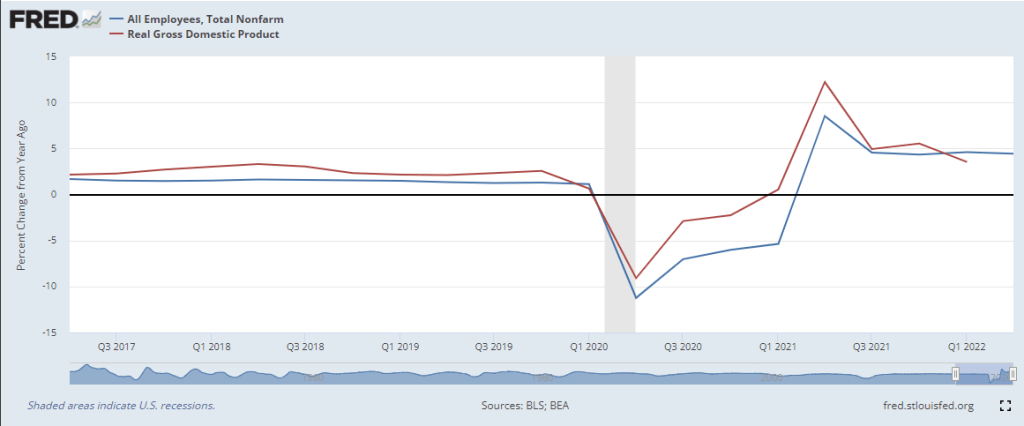
The jobs report this past Friday surprised to the upside, showing a monthly gain of 372,000 jobs, far above the 250,000 expected gain. This is one of three indicators I wrote about last week. The positive job gains lowers the chances of a coming recession but the Atlanta Fed is now projecting a 2nd quarter decline of 2% in real GDP. As some economists have noted, it is unusual to have strong positive employment growth and negative GDP growth. In the graph below is the percent change in employment (blue line) and real GDP (red line). Since labor accounts for the majority of production costs, the two series move closely together.

Historically, employment growth (blue line) is declining before recessions. Here is a look at the period before the 2008-9 recession.

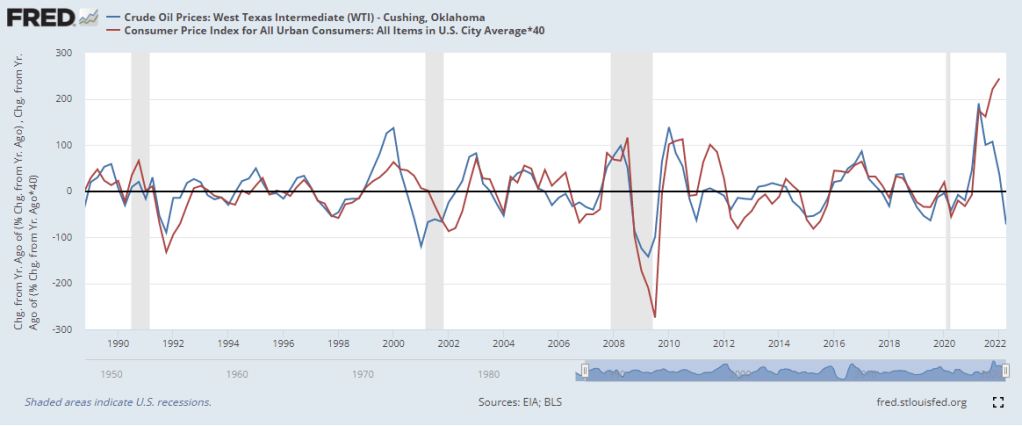
Let’s turn to another prominent concern – inflation. When the price of oil declined below $100 this past week, some economists interpreted that as a sign of decreased demand and a greater likelihood of recession. The price of oil factors into the production of most goods, even the electricity that comes into our homes. In the graph below I’ve charted the acceleration in the price of oil and prices in general. The magnitude is less important than the direction. Most of the time, the direction of each is the same.

Now I want to focus on recent years. As the economy recovered from pandemic restrictions in 2021, the changes in both series shot higher as expected. In the past year, the acceleration in oil prices (blue line) has declined while the acceleration in general prices has gone up.

The divergence is unusual and indicates that inflation is grounded more in supply disruptions and pent up demand than in the price of oil. I’m guessing that the Fed has noticed a similar trend. To appreciate how unusual this divergence is, let’s go back to the 1970s when the price of a barrel of oil went from $3 to $34. Even though the price movement was extreme, the acceleration in oil prices and the general price level moved in the same direction.

There is no shortage of opinions about Fed monetary policy and the Biden administration’s fiscal policy. The second stimulus payments went out in the first two weeks of 2021 under the Trump administration. Retail sales rose 5% that month, but fell 2% in February. Inflation in February was 1.7%, below the Fed’s target of 2%. On March 11, 2021, six weeks after taking the oath of office, Joe Biden signed the American Rescue Plan and in late March a third round of stimulus payments went out. Retail sales rose 11% in March but most of that increase happened before people received their payment. The odd thing is that there was little change in retail sales in the following months. This is one of many oddities surrounding this pandemic.

The general adult population received vaccines in April, May and June. Inflation rose above 5% by June 2021, then leveled off through September. In the graph above, the acceleration in oil prices and the general price level began to show a divergence. In the last three months of 2021, inflation started climbing while the acceleration in oil started falling. Why? It had never happened before.

Russia’s invasion of Ukraine has aggravated the situation and no one is happy. Xcel Energy, the public utility in my area, has raised electricity prices by 42% over last year; natural gas prices by 14%. The Fed’s next FOMC meeting is July 26-27 and the market is pricing in a 97% chance that the Fed will raise interest rates by another .75%, moving the federal funds effective rate near 2%. From 1954-2008, the average rate was 5.65%. From 1988-2008, the rate averaged 4.71%. Since 2008, the rate has averaged .62%. Near zero interest rates are abnormal.

Can the Fed retrain investors and consumers expectations toward a 3-4% federal funds rate in line with historical averages? The Fed conducts a lot of research but the current circumstances are unusual and the data shows conflicting trends. In a few years with the benefit of hindsight and firm, revised data, an economist can devote a few chapters if not an entire book to the past two years.

///////////

Photo by Tim Johnson on Unsplash

Missing Workers

September 26, 2021

by Steve Stofka

As I am out and about I’ve noticed the Help Wanted signs posted in storefront windows. $15 per hour reads the sign at the gas station near me. Why were there so many of these signs, I wondered? The latest Job Openings report reported a 50% increase in job openings, accounting for about 2.5 million jobs. I dusted off my Sherlock Holmes hat, found my magnifying glass and set out to look for the missing workers.

In the latest employment report from the Bureau of Labor Statistics (BLS) there are 6.3 million fewer people working today than in February 2020, just before the first alarming reports of Covid hospitalizations and deaths in New York City. Digging through many series of labor data, the missing workers are spread throughout the population. What was most surprising to me were those segments of the population where workers are not missing.

After the Great Financial Crisis, employment among workers older than 65 surged, almost doubling to 11 million strong by 2020, when the pandemic struck. 1 out of every 12 workers was over 65. For the past decade, economists have identified several reasons for the surge – people lost homes or had their savings significantly lowered. The Boomers didn’t save enough during their working years. Active Boomers did not want to retire. Employers preferred older workers with more reliable work habits than younger workers.

Before the pandemic, 1 out of 4 older people were working. The number of people in this age group has grown by 2 million during the pandemic. If that employment trend had continued, we would expect that 1/2 million workers continued to work. Instead, the number of older workers fell by 600,000. Many older workers who staffed jobs at retail establishments decided to forgo the risk of getting sick. Almost a million workers near retirement, those aged 55 and above, have taken early retirement or simply not returned to work out of fear of getting sick. So far that has accounted for more than two million workers, leaving 4 million unaccounted for.  

The next place I went to look was younger workers who would no doubt be playing video games and enjoying the sweet life. According to recent BLS and Census Bureau surveys, however, the number of workers aged 16-24 is about the same now as it was before the pandemic. Workers aged 16-19 have actually increased by 200,000.

That left only the core work force aged 25-54. Before the pandemic, 4 out of 5 people in this age group were working. In April 2020, it fell to 70% but has recovered to 78%, the same as in October 2016, on the eve of the 2016 election. I don’t remember seeing a lot of Help Wanted signs then. Because the core work force makes up 2/3rds of the 150 million employed, a few percentage points adds up to a lot of workers. Before the pandemic there were about 101 million workers in this age group. Today that number is 98 million, a decline of 3 million workers.

Adding in some known reporting errors and seasonal adjustments account for the bulk of the missing workers but there are some curious anomalies. The number of people who report that they are working part-time because they couldn’t find full-time work is about the same level as it was before the pandemic. Yet many fast food establishments have Help Wanted signs for full and part-time workers. I am guessing that many applicants would prefer not to have jobs in customer service where they are constantly exposed to people on a face-to-face basis.

I sometimes hear that young people don’t want jobs, that they are sitting at home playing video games and collecting extended unemployment benefits. Misinformation and unsubstantiated opinion never take a day off.

Safety Net or Trap?

June 13, 2021

by Steve Stofka

It has been 200 years since the cloth mills in Massachusetts instituted the “Lowell system,” employing young women and taking half of their pay for company provided room and board (Taylor, 2021, p. 234). 100 years ago, the states ratified the 16th Amendment, permitting the federal government to tax all income, including worker’s wages and salaries. 70 years ago, the government instituted payroll withholding. Today 145 million American workers receive salaries or wages, of which 30% is withheld by employers and sent to the federal government (Bird, 2021). Have we all effectively become government employees leased out to employers?

“Shan gao, huangdi yuan” is an ancient Chinese saying that reflected the attitude of many Chinese toward a central authority: “The mountains are high, and the emperor is far away.” Until the enactment of the 16th Amendment in 1913, most Americans felt the same. In Article 1, Section 8, the framers of the Constitution built a corral around the power of the federal government. The ink was barely dry on the document when Federalists like Hamilton argued for an interpretation of the Constitutional language that would give the federal government more power. In the next two decades, the Supreme Court headed by John Marshall, an appointee of Federalist President John Adams, did just that (Taylor, p. 54). During his 35-year tenure as Chief Justice, the decisions of the Marshall court effectively restated the Constitution.

Still, the federal government’s reach was limited enough that it took an amendment to that Constitution to permit the federal government to tax U.S. citizens directly. Richard Byrd, a delegate from Virginia and an opponent of the 16th Amendment, warned that “A hand from Washington will be stretched out and placed upon every man’s business; the eye of the Federal inspector will be in every man’s counting house . .” (Tax Analysts, 2021). He warned that the new amendment would feed the growth of a Washington bureaucracy remote from the interests of ordinary people. Many of those living today have great-great grandparents who voted for that amendment. Why did they consent?

When the 16th amendment to the constitution was ratified more than a century ago, the IRS enacted a system of withholding. Employers complained and the withholding provision was repealed a few years later in 1917 (Higgs, 2007). Most people who did owe taxes paid only 1% in quarterly installments the year after they incurred the tax burden. During WW2, the federal government wanted more revenue to support the massive wartime spending, and instituted withholding for income taxes.

The federal government employs almost 9 million workers (Hill, 2020), about 6% of the total workforce, but its effective reach is so enormous that employers today only borrow workers from the federal government. Each employer must abide by so many employment regulations that even a small business has to dedicate at least one person to administering regulations. The hiring of an employee initiates an implicit contract not between the employer and employee, but between the employer and the federal government. The employer faces stiff penalties for violating any provisions of that implicit contract. How has the tentacled reach of the federal government affected employees?

Like the young women at the Lowell mills, workers are not allowed to touch their pay until taxes, insurance and fees have been withdrawn. Some taxes are silent, withdrawn by lowering gross pay. After state and local taxes and the employee portion of health insurance is deducted, a worker today may be left with only half their pay. Unlike the women at the Lowell mills, the federal government does not provide room and board for most workers. As Richard Byrd warned a century ago, a federal government is only remotely concerned about those needs. Instead, it takes from the worker in the now and gives back to the worker in the future after forty years or more of work – a pension and medical care after retirement.

In addition to future needs, a worker’s taxes feed a bureaucracy that safeguards the security, wealth and needs of the upper 20%, and selected regional interests. Like the Chinese emperor, the $1 trillion spent on current military needs and past military promises seems far away from the daily security needs of most Americans. That spending  supports local economies in some regions and may be the key economic base in some rural communities who strongly support military spending to maintain a global empire. After all, their local economic security depends on such spending.

Larger than Amazon’s football sized warehouses is the largest warehouse in the nation run by the federal government. It is bounded not by walls but by a web zealously tended by lawyers and regulators, and inescapable for most employees and employers. The restrictions and harsh working conditions of the Lowell mills strike us today as paternalistic exploitation. The parents of the young women welcomed the discipline and extra money that their daughters earned. The hard work instilled moral character in the women before they returned home to marry a local lad.

Many of us today welcome the paternal oversight of the federal government as a safety net. The children of our children 200 years from now will certainly regard this age differently. Will they see the complex net of laws that bind employees and employers as a safety net or a trap?

///////////////

Photo by Fikri Rasyid on Unsplash

Bird, B. (2021, May 26). How much does the average American pay in taxes? Retrieved June 11, 2021, from https://www.thebalance.com/what-the-average-american-pays-in-taxes-4768594.

Higgs, R. (2007). Wartime Origins of Modern Income-Tax Withholding. The Freeman, (November). Retrieved from https://admin.fee.org/files/doclib/1107higgs.pdf. Also, see IRS history Timeline (2021) and LOC (2012).

Hill, F. (2020, November 05). Public service and the federal government. Retrieved June 11, 2021, from https://www.brookings.edu/policy2020/votervital/public-service-and-the-federal-government/

IRS. (2021). IRS history Timeline. Retrieved June 10, 2021, from https://www.irs.gov/irs-history-timeline

Library of Congress (LOC). (2012). History of the US income tax. Retrieved June 10, 2021, from https://www.loc.gov/rr/business/hottopic/irs_history.html

Tax Analysts. (2021a). The Income Tax Arrives. Retrieved from http://www.taxhistory.org/www/website.nsf/Web/THM1901?OpenDocument. For PDFs of original tax forms that your great-great-grandparents might have filed, see

 U.S. 1040 Tax Forms, 1913 to 2006. Retrieved from http://www.taxhistory.org/www/website.nsf/Web/1040TaxForms?OpenDocument

Taylor, A. (2021). American republics: A continental history of the United States, 1783-1850. New York, NY: W. W. Norton & Company.