Personal Debt

April 15, 2018

by Steve Stofka

Until the financial crisis, I thought that other people’s debt was their problem. In 2008, debt became a nation’s problem and a national conversation with two aspects – the moral and the practical. Moral conversations are not confined to church; they drive our politics and policy. Many laws contain some language to contain moral hazard, which is the danger that language loopholes in a law or policy promote the opposite of the intended effect of the law. This is particularly true of many entitlement policies. Let’s leave the moral conversation for another day and turn to the practical aspects of current policy.

Bankers learned their lesson during the financial crisis, didn’t they? Maybe not. A decade of absurdly low interest rates has starved those who depend on the income earned by owning debt. Even a savings account is money loaned to a bank, a debt that the bank must pay to the account holder. In their hunger for income, investors have turned to less prudent debt products. So long as the economy remains strong, no worries.

A fifth of conventional mortgages are going to people whose total debt load, including the mortgage, is more than 45% of their pre-tax income. By comparison, at the market’s exuberant peak in late 2007, 35% of conventional mortgages were going to such households, who were especially vulnerable when monthly job gains turned negative in early 2008.

The real estate analytics firm Core Logic also reports that Fannie Mae has started backing mortgages to those with total debt loads up to 50%. FICA, federal, state and local income taxes can amount to 25% of a paycheck (Princeton Study). Add in 45% of that gross pay for mortgage and debt payments, and there is only 30% left for food, gas, home repairs and utilities, child care, etc.

I’ll convert these percentages to dollars to illustrate the point. A couple grossing $80,000 might have a take home pay of $60,000. The couple has $36,000 in mortgage and other debt payments (45% of $80,000). They have $24,000, or $2000 a month for everything else. This couple is vulnerable to a change in their circumstances: a layoff or a cut back in hours, some unexpected expense or injury.

For those who get a conventional loan despite their heavy debt load, where is the money coming from? Banks suffered huge losses during the financial crisis. The Federal Reserve tightened capital requirements for banks’ loan portfolios, forcing them to improve the overall quality of their debt. As a result, banks turned away from their most lucrative customers – subprime borrowers and those with heavy debt loads who must pay higher interest on their loans. Profits in the financial industry fell dramatically. A broad composite of financial stocks (XLF) has still not regained the price levels of 2007.

The banking industry employs some very smart people. What solution did they create? The big banks now loan money to non-financial companies who loan the money to subprime borrowers. After bundling the consumer loans into securities, the non-financial companies use the proceeds to pay the big banks back. In seven years this kind of borrowing has expanded seven times to $350 billion. Doesn’t this look like the kind of behavior that almost took down the financial system in 2008? The banks say that this system isolates them from exposure to subprime borrowers. If large scale job losses cause a lot of loan defaults, it is the investors who will bear the pain, not the banks. Same song, different lyrics.

The 2008 financial crisis is best summed up with a chart from the Federal Reserve. In the post WW2 economy, the weekly earnings of British workers rose steadily. The growth is especially strong when compared to the earlier decades of the 19th and 20th centuries. In 2008, earnings peaked.
WeeklyEarnUK

Developed countries depend on the steady growth of tax receipts generated by weekly earnings. An assumption of 3% real GDP growth underlies the health and continuation of post-war social welfare policies. For more than a decade, the U.S. and U.K. have had less than 2% GDP growth.  Both governments have had to borrow heavily to fund their social support programs.  How long can they increase their debt at such a rapid pace?

I am reminded of a time more than 40 years ago when New York City held a regularly scheduled auction to sell  bonds to fund their already swollen debt load.  None of the banks showed up to bid for the bonds.  The city is the financial center of the world.  The lack of interest stunned city officials.  To avoid a messy bankruptcy, the city turned to the Federal government for a loan (NY Times).

The Federal government is not a city or state, of course. It has extraordinary legal and monetary power, and its bonds are a safe haven around the world.  But there could come a time when investors demand higher interest for those bonds and the rising annual interest on the debt squeezes spending on other domestic programs.

Debt causes stress.  Stress causes anxiety.  Anxiety weakens confidence in the future and causes investment to shrink. Falling investment leads to slower job growth. That causes profits and weekly earnings to fall which reduces tax receipts to the government.  That increases debt further, and the cycle continues.  Other people’s debt is everyone’s problem after all.

Debt and Housing

March 18, 2018

by Steve Stofka

Republicans used to care about yearly budget deficits when Obama was President. Since Obama left office, the budget deficit is up 20%. As a percentage of GDP, 2017’s deficit was above the forty-year average of deficits (Treasury Dept press release).  At the end of the Obama term, the gross federal debt was 77% of GDP. In ten years, the Congressional Budget Office estimates that percentage will be over 90%. (Spreadsheet ) That estimate does not include the lower revenues from the tax cuts passed in December.

During the two Bush terms, Republican deficit hawks, genuinely concerned about budget deficits, were overruled by a majority of Republicans who paid only political lip service to common sense budgeting.

The Federal Government’s fiscal year runs from October to September. At the end of February, the fiscal year was five months old. According to the Treasury’s monthly budget statement, this fiscal year’s deficit has gone up 10%. Because of the tax cut passed in December, payroll tax collections are down. Because of higher interest rates, the government paid an extra $40 billion on the federal debt in the first five months of this fiscal year, which began October 2017. $40 billion is half of the food stamp program. Debt matters. The government is going into more debt to pay the interest on the existing debt.

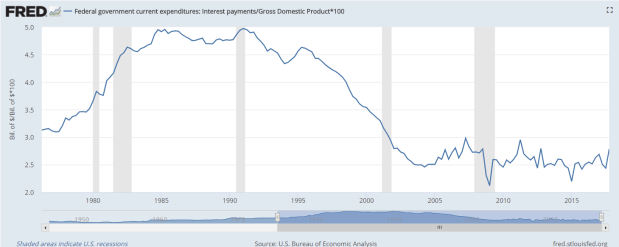
The government paid $550 billion in interest last year and is estimated to pay over $600 billion this year. That is just a $100 billion less than the defense budget. Because interest rates are historically low, the interest as a percent of GDP is low. We cannot expect that they will remain low.

InterestPctGDP

Interest rates were low in the 1950s. By 1970, they were over 7% and had climbed to 14% by 1980. Since the financial crisis ten years ago, central banks in China, Europe and the U.S. have been buying government debt. Central banks don’t demand higher interest. As their role diminishes, price-sensitive buyers like pension funds and households will demand higher interest rates (Bloomberg article). Recent Treasury debt auctions have been lightly subscribed, and the Fed is having to step in as a buyer to artificially make a market. Remember, the Fed is just another pants pocket of the Federal Government. In essence, the Federal Government is buying its own debt.   What can’t continue forever, won’t.

///////////////////

Housing

Have you gotten the impression that the housing market is going gangbusters? As a percent of GDP, housing investment is double what it was at the lows of the recession. The bad news is that current levels are near the historic lows of the post WW2 economy.

ResInvest

On the other hand, housing affordability has hit all time lows. A prudent rule of thumb is that a person or family should not spend more than 25% of their income on housing. A corollary of that rule is that a household should not buy a home that is more than 4 times their annual income. At 5.2, the current ratio is far above a prudent rule of thumb.

HousingIncomeRuleOf4

Government debt levels make the government, and us, vulnerable to any loss of confidence.  Low housing investment makes the economy less resilient.  High housing costs make it more difficult for families to save.  In a downturn, more families must turn to government for benefits.  Saddled with high debt levels and interest payments, government is less able and willing to extend benefits. The cycle turns vicious.


Intervention

August 27, 2017

Pew Research surveyed four generations of Americans, from the oldest Americans who are part of the Silent Generation, those who grew up during the Great Depression, to the Millennials, those born between the years 1983 – 2002. Pew asked the respondents to list ten events (not their own) or trends that happened during their lifetime that had the most influence on the country. 9-11 was at the top of the list for all four generations. Obama’s election, the tech revolution and the Iraq/Afghanistan war were the other events common on each list. Some differences among the generations were understandable. Some were a surprise to me. The Great Recession/Financial Crisis of 2008 was only on the Millennials list. Many in this generation were in the early stages of their careers when the recession began. Here is a link to the survey results. Perhaps you would like to make your own list. Keep in mind that the events must have happened during your lifetime.

I don’t think that the Boomer generation understands the long-term impact of the Great Recession. In another decade, many will discover how vulnerable the financial crisis left all of us, not just the Millennials. As we’ll see below, the crisis may be over but the response to the crisis is ongoing.

One of the trends common to each generation’s list was the tech revolution, which has reshaped much of the economy just as the last tech revolution did in the 1920s. The widespread use of electricity, radio and telephone in that decade transformed almost every sector of the economy and accelerated the mass migration of the labor force from the farm to the city.

Like today, a small number of people made great fortunes. Like today, the top 1% of incomes accounted for about 15% of all income (Saez, Piketty). The GINI index, a statistical measure of inequality of any data set, has risen significantly since 1967 (Federal Reserve). The GINI index ranges from 0, perfect equality, to 1, perfect inequality. Incomes in the U.S. are more equal than South Africa, Columbia and Haiti (Wikipedia) but we are last among developed countries.

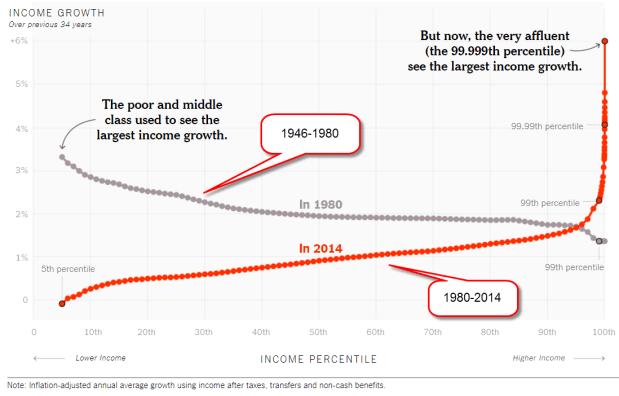
For several decades, Thomas Piketty and Emmanuel Saez have collected the aggregate income and tax data of developed countries. Piketty is the author of Capital in the Twenty-First Century (Capital), which I reviewed here.  A recent NY Times article referenced a report from Piketty and Saez comparing the growth of after-tax, inflation-adjusted incomes from 1946-1980 (gray line labeled 1980) and 1980-2014 (red line labeled 2014). I’ve marked up their graph a bit.

IncomeGrowth1947-2014
The authors calculated net incomes after taxes and transfers to determine the effect of tax and social policies on income distribution. Transfers include social welfare programs like Social Security, TANF, and unemployment. Census Bureau surveys of household income include pre-tax income and it is these surveys which form the basis for the calculation of the GINI index and other statistical measures of inequality.

I am guessing that Piketty and Saez used their database of IRS post-tax income data then adjusted for transfer income based on Census Bureau surveys. The Census Bureau notes that people underreport their incomes on these surveys.  Is the IRS data more reliable?  Probably, but people do hide income from the IRS. Both Piketty and the Census Bureau note that the data does not capture non-cash benefits like food stamps, housing subsidies, etc.

From 1947 to the early 1960s, the very rich paid income tax rates of 90% so that would seem to explain the after-tax income data from Piketty and Saez. The federal government took a lot of money from the very rich, paid off war debts, built highways, flew to the moon and built a big defense network to fight the Cold War.  Those infrastructure projects employed the working class at a wage that lifted them into the middle class. So that should be the end of the story. High taxes on the rich led to more equality of after-tax income.

But that doesn’t explain the pre-tax income data from the Census Bureau. The very rich simply made less money or they learned how to hide it because of the extremely high tax rates.  In the Bahamas and Caymans, there grew a powerful financial industry devoted to hiding income and wealth from the taxman. In the first years of his administration, President Kennedy, a Democrat, understood that the extremely high tax rates were hurting investment, incentives and economic growth.  He proposed lowering both individual and corporate rates but could not get his proposal through the Congress before he died.  Johnson did push it through a few months after Kennedy’s death. The rate on the top incomes fell from 91% to 70%, still rather high by today’s standards.

An important component of income growth in the post war period from 1947-1970 was the lack of competition from other developed countries who had to rebuild their industries following World War 2. These two decades were the first when the government began collecting a lot of data, and this unusual period then became the base for many political arguments. Liberal politicians like Bernie Sanders and Elizabeth Warren advocate policies that they promise will return us to the trends of that period. It is unlikely that any policies, no matter how dramatic, could accomplish that because the rest of the world is no longer recovering from a World War.

We could enact a network of social support policies that resemble those in Europe but could we get used to a 10% unemployment rate that is customary in France? For thirty years beginning in the early 1980s, even Germany, the powerhouse of the Eurozone, had an unemployment rate that exceeded 8%. At that rate, many Americans think the economy is broken. Despite 17 quarters of growth, unemployment in the Eurozone is still 9.1%. Half of unemployed workers in the Eurozone have been unemployed for more than a year. In America, that rate of long term unemployed is only 13% (WSJ paywall).

The post-war period was marked by high tax rates and high federal spending, a period of robust government fiscal policy.  The federal government intervenes in the economy via a second channel – the monetary policy conducted by the central bank.  The Federal Reserve lowers and raises interest rates, and adjusts the effective money supply by the purchase or sale of Treasury debt.

The 1940s, 1970s and 2000s were periods of high intervention in both fiscal and monetary policy. The FDR, Truman, Eisenhower, Johnson and Nixon administrations exerted much pressure on the Fed to help finance war campaigns and the Cold War. In 1977, the Congress ensured more independence to the Federal Reserve by setting two, and only two, clear objectives that were to guide the Fed’s monetary policy in the future: healthy employment and stable inflation.

A rough guide to the level of central bank intervention is the interest rate set by the Fed. When rates are less than inflation, the Fed is probably doing too much in response to some acute or protracted crisis.

EffFundsRate-Infation

Let’s look at an odd – or not – coincidence. I’ll turn to the total return from stocks to understand the effects of central bank policies. There are two components to total return: 1) price appreciation, and 2) dividends. When price appreciation is more than 50% of total return, economic growth and company profits are doing well. Future profit growth looks good and more money comes into the market and drives up prices. When dividends account for more than half of total return, as it did in the 1940s and 1970s, both GDP and company profit growth are weak. Both decades were marked by heavy central bank and government intervention in the economy.

Here’s a link to an article showing the total return on stocks by decade. During the 2000s, the total return from stocks was below zero. An average annual return of 1.5% from dividends could not offset an annual loss of 2.4% in price appreciation. Hubris and political pressure following 9-11 led Fed Chairman Alan Greenspan to make several ill-advised interest-rate moves in the early 2000s that helped fuel the housing boom and the ensuing financial crisis. His successor, Ben Bernanke, continued the policy of heavy intervention. Following the financial crisis, the Fed kept interest rates near zero for nine years and has only recently begun a program of gradually increasing its key interest rate.

The price gains of the 2010s have lifted the average annual return of the past 18 years to 7.4%, and the portion from dividends is exactly half of that, at 3.72% per year.  It has taken extraordinary monetary policy to rescue investors, to achieve balanced returns  that are about average from our stock investments.  Some investors are betting that the Fed will always come to the rescue of asset prices.  That same gamble pushed the country to the financial crisis when the government did not rescue Lehman Brothers in September 2008.

The financial crisis should have been on each generation’s list.  Within ten years it will be.  It is still crouched in the tall grass.

///////////////////////////

Debt

Happy days are here again.  Yes, girls and boys, it’s time to raise the debt ceiling!  By the end of September, the Treasury will run out of money to pay bills unless the debt ceiling is raised. This past week, President Trump hinted/threatened that he would not sign a debt increase bill unless it included money to build the wall between the U.S. and Mexico.

The Congress has not had a budget agreement in several years and is unlikely to enact one this year. People may sound tough on debt but a Pew Research study
showed that a majority do not want to cut government programs, including Medicaid.

Liberal economists insist that government debt levels don’t matter if the interest on the debt can be paid. This article from Pew Research shows the historically low rate on the federal debt. However, Moody’s reports that the U.S. government pays the highest interest as a percentage of revenue among developed countries. As a percent of GDP, we are 4th at 2.5%.

The Un-Recovery Machine

December 4, 2016

I’ve titled this week’s blog “The Un-Recovery Machine” for a reason I’ll explain toward the end of the blog as I look at the lack of growth in household income for the past 16 years.  Lastly, I will show how easy peasy it is to do a year end portfolio review. First, I’ll look at the latest job figures and a quick five year summary of a few key stats of stewardship under the Obama administration.

The economy added 180,000 jobs in November, close to estimates.  Obama will leave office with an average monthly gain of 206,000 jobs over the past five years, a strong track record. The president has a minor influence on the number of jobs created each month but each president is judged by job growth regardless.  We need to have a donkey to pin the tail on when something goes wrong.

The real surprise this month was the drop of .3% in the unemployment rate to 4.6%.  Some not so smart analysts attributed the drop to discouraged workers who dropped out of the labor force.  However, the number of dropouts in November was the same as October when the unemployment rate declined only .1%.  Seasonal factors, Christmas jobs and variations in survey data may have contributed to the discrepancy.  What is clear is that the greatest number of those who are dropping out of the labor force are the increasing numbers of boomers who are retiring every month. I’ll look further at this in a moment.

The number of involuntary part-timers has dropped from 2.5 million five years ago to 1.9 million, about 1.3% of workers. This is a lower percentage than the 1970s, the 1980s, and the first half of the 1990s.  It is only when the tech boom and housing bubble grew in the late 90s and 2000s that this percentage was lower.

Growth in the core work force is a strong 1.5%, a good sign.  These are the workers aged 25-54 who are building families, careers and businesses.  The change in the Labor Market Conditions Index (LMCI) turned positive again in October.  This is a composite labor index of twenty indicators that the Federal Reserve uses to judge the overall health of the labor market.  They have not released November’s LMCI yet.  This index showed negative growth for the first part of the year and was the chief reason why the Fed did not raise interest rates earlier this year.

The quit rate is back to pre-recession levels at a strong 2.1%.  This is the number of employees who have voluntarily quit their jobs in the past month and is used to gauge the confidence of workers in finding another job quickly. The highest this reading has ever been was 2.6% just as the dot com boom was ending in 2001.  Too much confidence. When the housing boom was frothing in the mid-2000s, the quit rate was typically 2.3%, a level of over-confidence. 2.1% seems strong without being too much.

Another unwelcome surprise this month was a .03 decline in the average hourly wage of private workers.  On the heels of a welcome .11 increase in October, this decline was disappointing. One month’s increase or decrease of a few cents is statistical noise.  The year-over-year increase gives the longer term trend.  For the past five years, the yearly increase in wages has been unable to get above 2.5%, which was the annual growth in November.

The greatest challenge that the incoming president will face is the ever growing ranks of Boomers who are retiring.  In 2007, the number of those Not in the Labor Force was 78 million.  These are adults who can legally work but are not looking for work, and includes retirees, discouraged job applicants, women staying home with the kids, and those going to college.  That number has now grown to 95 million, an increase of 2 million workers per year, and will only keep growing as the 80 million strong boomer generation continues to retire each month.   The millenials, those aged 16 to 34, are a larger generation than the boomers but will not fully offset the number of retirees till the first half of the 2020s.  If any president can explain this in very simple terms, it is Donald Trump, who has mastered the art of communicating a message in short bursts.

//////////////////////////

Construction and Local Employment

Construction employment matters.  When growth in this one relatively small sector drops below the growth of all employment, that signals a weakness in the overall economy that indicates a good probability of recession within the year.  It’s not an ironclad law like the 2nd law of thermodynamics but has proven to be a reliable rule of thumb for the past forty years.  Fortunately, the economy is still showing healthy growth in construction employment that has outpaced broader job gains for the past four years.

The puzzle is why construction spending is an economic weathervane.  It has fallen from 11% of GDP in the 1960s to slightly over 6% of GDP today. (Graph )   Yet when this  relatively small part of the economy stops singing, there’s something amiss.

Real construction spending (in 2016 dollars) is currently at a healthy level of $175K per employee, 16% above the low of $151K in the spring of 2011.  Although we have declined slightly in the past year, the average is about the same level as late 2006 – 2007 and is above the spending of the 1990s.  As a rule of thumb in the construction industry, an employee is going to average 33% in wages and salaries. That doesn’t include the cost of employee benefits, insurance and taxes which will bring the total cost of the employee above 40% of the total cost.   So, if spending is $175K, we can guesstimate that the average worker is making about $58K.  When I check with the BLS, the average weekly earnings in construction is $1120, or almost $58K.  As a side note: that 40% employee cost is used by some contractors as a rule of thumb for a bid total when estimating a job.

During the recession many workers dropped out of the trades.  Older workers with beat up bodies cut back on hours, went on disability or took early retirement.  Younger workers who saw the layoffs and lack of construction employment during the recession turned their sights to other fields.  Workers who do come into the trades find that the physical transition takes some getting used to.  Even workers in their twenties discover that muscles and joints working 8 – 10 hours a day need some time to adapt.

The average workweek hours for construction workers hit at a 70 year high in December 2015 and is still near those highs at 39.8 hrs a week.  In some areas the lack of applicants for construction jobs is constraining growth.  In Denver, construction jobs grew by almost 20% in the past year and that surge is helping to attract  workers from other states.  The unemployment rate in Denver is 2.9%, below the 3.5% in the entire state.  (BLS Denver  Colorado)  This pattern is not confined to Colorado. Very often economic growth may be strong in the cities but weak and faltering in rural communities throughout the state.  For decades this has caused some resentment in rural communities who feel that politicians in the cities dominate policy making in each state.

Local employment

The Civilian Labor Force, those working and actively wanting work, is growing in all states except Alaska, Louisiana, Minnesota, New Jersey, New York, Nebraska, Nevada, Oklahoma and Wyoming (BLS here if you want to look up your city or state stats).  Some of the changes may be demographic.  I suspect that is the case in New York and New Jersey. The decline in some states are those related to resource extraction.  Employment in states with coal mining and oil production has taken a hit in the past two years.  In Colorado, the 11% gain in construction jobs has offset a 12% decrease in mining jobs.

/////////////////////////////

Household Income

On a more sobering note…In 1999 real median household income touched a high $58,000 annually.  Sixteen years later that median was $56,500, a decline of about 3%.  There’s a lot of pain out there.

For readers unfamiliar with the terminology, “real” means inflation adjusted.  “Median” is the halfway point.  Half of all incomes are above the median, half below.  Economists and market analysts prefer to use the median as a measure of both incomes and house prices to avoid having a small number of large incomes or expensive houses give an inaccurate picture of the data.

Both parties can take responsibility for this – two Republican administrations (Bush) and two Democratic (Obama) terms. There have been a number of different party configurations in the Presidency, House and Senate, so neither party can reasonably lay the blame at the other party’s feet.  The “new” more idealogically pure Republicans  in the House regard the “old” Republicans of the two Bush terms as traitors to conservative ideals.  Never mind that a lot of those “old” silly Republicans are still taking up room in the House.

Both parties have borrowed and spent a lot of money but little has flowed down to the American worker.  So much for the imaginativeness of trickle down economic theory.  When George Bush assumed office in January 2001, the Federal Public debt totalled $5.6 trillion.  When he left office in January 2009, the debt had almost doubled to $10.7 trillion.  Under Obama’s two terms, the debt nearly doubled again, crossing the $19.4 trillion mark in June 2016.  $14 trillion dollars of Federal borrowing and spending since early 2001 has not helped lift the incomes of American families.  It is a damning indictment of both major parties who have lost touch with the everyday concerns of many American families.

Can Donald Trump be the catalyst that miraculously turns the Washington whirlpool of money into an effective machine?  Doubtful, but let’s stay hopeful. 535 Congressmen and Senators, each with an outlook, a constituency, and an agenda funded by a coalition of lobbyists, are going to fight against giving up control.  Spend the money on my constituents. they will say.  Republicans throw out the phrase “limited government” to their base voters who whuff, whuff and chow down.  Once elected, many Republican politicians are as controlling as their Democratic counterparts, only in different areas of our lives. A Republican controlled government will push for more regulations on women’s health, regulations on people’s moral and social behaviors, a proposal to reinstitute the draft, and threats to private companies who move jobs out of the U.S.   Donald Trump recently enacted Bernie Sanders’ prescription for keeping jobs in America.  He no doubt threatened Carrier’s parent corporation, United Technologies, that they would lose defense contracts if Carrier moved all those 1000 jobs to Mexico.

So Donald Trump, the leader of the Republican Party, is following a socialist play book.  We are going to see more of this because Trump is the leader of the Trump party, not wedded to any particular ideology.  He is a transactional leader who plays any card in the deck to win, regardless of suit. Chaining oneself to ideals is a good way to drown in the political soup.

Republicans in Washington have consistently betrayed conservative ideals of financial responsibility and a smaller government imprint on the daily lives of the American people.  Democratic politicians cluck, cluck about progressive principles but Democratic voters find that their leaders have left them a pile of chicken poop. Unlike Republican voters, Democrats haven’t developed the organizational skills to make personnel changes in party primaries. Both parties are infected with old ideas, loyalties and prejudices.

Because of this, retail investors – plain old folks saving for their retirement – can expect increased volatility in the next two years.  We may look back with fondness at these last two years, a peaceful time of few accomplishments in Washington, and a sideways market in stocks and bonds.  A balanced portfolio will help weather the volatility.

Mutual fund companies and investment brokers track this information for us and we can access it fairly easily online at the company’s website.  Even if we have several places where we keep our funds, it is a relatively simple paper and pencil process to calculate our total allotment to various investments. We don’t need to be precise.  We are not launching a rocket to Mars.

If I have $198,192.15 at Merry Mutual and they say I have 70% stocks and 30% bonds, I can write down $140 in stocks, $60 in bonds.   Then over to my 401K at the Ready Retirement Company to find out that I have $201,323.39 balance, with 80% stocks and real estate funds and 20% bonds.  I write down $160 for stocks and $40 for bonds.  Then over to my savings account at Safety Savings where I have $39,178.64, which I include with my bonds.  I write down $40.  Finally, over to my CDs at the First Best Bank in my neighborhood where I have $32,378.14 in CDs of various maturities.  I include those with my bonds and write down $32. Maybe I have an insurance policy with some paid up value that I want to include in my bonds.

So, adding it all up, my stocks (more risk) are $140 + $160 = $300.  My bonds/cash (less risk) are $60 + $40 + $40 + $32 = $172.  $300 + $172 = $472 total portfolio value.  $300 stocks / $472 total = .635 which is about 64%.  So I have a 64% / 36% stock / bond split and I have figured this out without expensive software, or an investment advisor.

Depending on my comfort level, knowledge and expertise I may want some software or some advice from a professional but I know where my allocation lies.  I am on the risky side of a perfectly balanced (50% / 50%) portfolio and how do I feel about that?  If I do talk to an advisor or a friend I can tell them up front what my allocation is and we will have a much more informed conversation.

Heaven On Earth

May 31, 2015

Although the unemployment rate has fallen below 5.5%, the labor participation rate is still rather low and wage growth is slow, prompting renewed calls for government stimulus. A 2010 article laid out the justifications for more government borrowing to spur the economy. Let’s review a few points made by these economists.

“Spending by the federal government always creates new money in the system, while taxation destroys it.”

The nature of money and the government’s relationship to money is certainly beyond the scope of a blog post. In short, money in all its forms is a claim. A central bank (called the Federal Reserve in the U.S.) is a government created institution which regulates and administers the supply of money and credit within a country, and manages the reserves of foreign currencies held within that country.  It acts as the government’s banker and is the lender of last resort both to the public and the government.  If the public will not buy all of the debt issued by the Treasury of a government, the central bank steps in and buys it, a practice known as “printing money” although there is no new money printed.

In a fiat (unbacked by any hard metal or asset) money system, a sovereign government has the power to create and destroy money claims at will.  As the 2010 article notes, all taxation is a destruction of money.  A $100 tax voids a taxpayer’s ability to make a $100 claim for some good or service.   A thief takes money with no promises.  A government takes money with some implied promise or threat but no exchange of value at the time of the taking.  Taxation is not an exchange, but a taking, a destroying, like letting a little bit of air out of a balloon.  As long as the government pumps in the same amount of air that it took out, the size of the balloon changes only in proportion to the change in population.

In 1960, two economists, Gurley and Shaw, coined the terms Inside Money and Outside Money to capture this unique license of government (Federal Reserve paper on this subject). Treasury bills and forms of government debt are claims on government, and termed outside money, as in outside the private marketplace. Money exchanges between people and companies in the private sector are termed inside money. Each dollar of inside money represents a debt by someone else within the private sector.  When government spends more than it taxes, it borrows and pumps outside money into the private sector balloon. Many of us might think inflation is the net change in the size of the balloon but it might be more helpful to imagine that the size of the balloon, or volume, is the size of the population and grows slowly and constantly, about 1% in the U.S.  Inflation, then, is a measure of the pressure inside the balloon. (Boyles’ Law  and other fun facts with gases)

Various economists in this article asserted that the government should pump more outside air into the balloon, which will cause the economy, the molecules inside the balloon, to speed up.  Is there any limit to the amount of outside money that a government can pump into the balloon?

“[A] government cannot become insolvent with respect to obligations in its own currency.”

If a government can make up money out of thin air, why not just give $100K to each of the 300 million citizens in the U.S.?  People who couldn’t afford a newer car could buy one, which would boost the sales of car manufacturers. New homes, new appliances, vacation trips – a shot in the arm for so many industries. Unemployment would practically vanish. Imported goods into the U.S. would soar, helping the workers and businesses in other countries.  People could pay off their credit card and student loan debts but banks might suffer because not as many people would want loans.  Stock prices would soar in value as families searched for a place to invest some of their windfall.  People who had already owned stocks and other assets before the boon would see their net worth increase exponentially.  Housing prices would climb as more people could afford to buy a house.

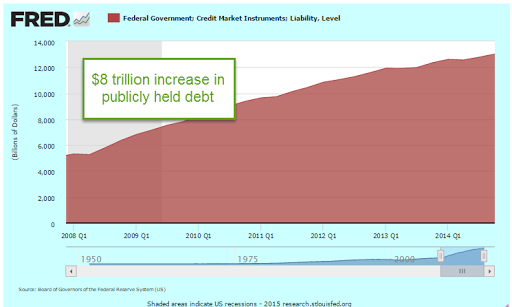
What about inflation?  Well, the government has already pumped in $8 trillion since the recession started in late 2007.

$8 trillion divided by a 300 million population is almost $27,000 per person.  Contrary to predictions of runaway inflation, it has been moderate or below the 2% target rate.  In fact, if we use the method of calculating inflation used in the Eurozone, we have had deflation in the first quarter of this year.   So any inflationary effect from a one time $100K boon would be less than disastrous.  Even if inflation climbed to a 1990s level, about 4 – 5%, what is the harm?

Most of us instinctively look at this scheme, furrow our brow, and get suspicious.  But why?  Why can’t a government with a fiat money system simply create heaven on earth?

Stay tuned till next week….

Economic Porridge

August 31, 2014

As summer comes to a close and the sun drifts south for the winter, the porridge is not too hot or too cold.

********************

Coincident Index

The index of Leading Indicators came out last week, showing increased strength in the economy.  Despite its name, this  index has been notoriously poor as a predictor of economic activity.  The Philadelphia branch of the Federal Reserve compiles an index of Coincident Activity in the 50 states, then combines that data into an index for the country.

This index is in the healthy zone and rising. When the year-over-year percent change in this index drops below 2.5%, the economy has historically been on the brink of recession.  The index turns up near the end of the recession, and until the index climbs back above the 2.5% level, an investor should be watchful for any subsequent declines in the index.

As with any historical series, we are looking at revised data.  When this index was published in mid-2011, the percent change in the index was -7% at the recession’s end in mid-2009.  Notice that the percent drop in the current chart is a bit less than 5%.  This may be due to revisions in the data or the methodology used to compile the index.

**************************

Disposable Income

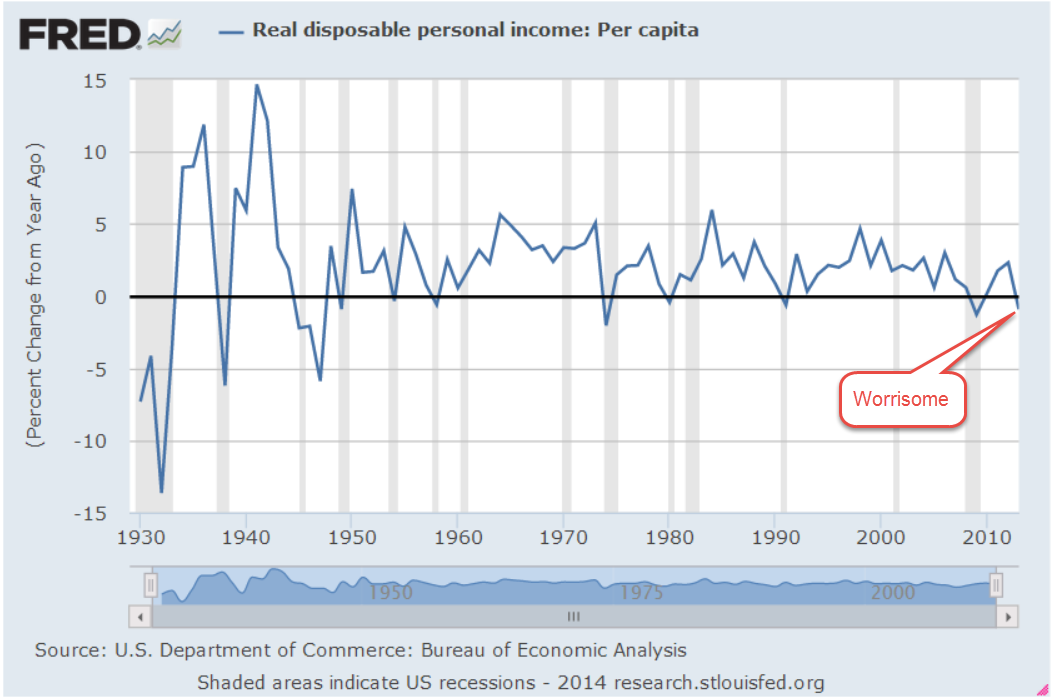
The Bureau of Economic Analysis (BEA) produces a number of annual series, which it updates through the year as more complete data from the previous year is received.  2013 per capita real disposable income, or what is left after taxes, was revised upward by .2% at the end of July but still shows a negative drop in income for 2013.  While all recessions are not accompanied by a negative change in disposable income, a negative change has coincided with ALL recessions since the series began at the start of the 1930s Depression.

Many positive economic indicators make it highly unlikely that we are either in or on the brink of recession.  Clearly something has changed.  Something that has routinely not been counted in disposable personal income is having some positive effect on the economy.  In 2004, the BEA published a paper comparing the methodology they use to count personal income and a measure of income, called money income, that the Census Bureau uses.  What both measures don’t count in their income measures are capital gains.

Unlike BEA’s measure of personal income, CPS money income excludes employer contributions to government employee retirement plans and to private health and pension funds, lumps-sum payments except those received as part of earnings, certain in-kind transfer payments—such as Medicare, Medicaid, and food stamps—and imputed income. Money income includes, but personal income excludes, personal contributions for social insurance, income from government employee retirement plans and from private pensions and annuities, and income from interpersonal transfers, such as child support. (Source)

Analysis (Excel file) of 2012 tax forms by the IRS shows $620 billion in capital gains that year, about 5% of the $12,384 billion in disposable personal income counted by the BEA.  An acknowledged flaw in the counting of disposable income is that the total reflects the taxes that individuals pay on the capital gains (deducted from income) but not the capital gains that generated that taxable income.  Although 2013 data is not yet available from the IRS, total personal income taxes collected rose 16%.  We can suppose that the 30% rise in the stock market generated substantial capital gains income.

*************************

Interest

Every year the Federal Government collects taxes and spends money.  Most years, the spending is more than the taxes collected – a deficit.  The public debt is the accumulation of those annual deficits.  It does not include money “borrowed” from the Social Security trust fund as well as other intra-governmental debt, which add another third to the public debt.  (Treasury FAQ)  This larger number is called the gross debt.  At the end of 2012, the public debt was more than GDP for the first time.

The Federal Reserve owns about 15% of the public debt.  But wait, you might say, isn’t the Federal Reserve just part of the government?  Well, yes it is.  Even the so-called public debt is not so public.  How did the Federal Reserve buy that  government debt?  By magic – digital magic.  There is a lot of deliberation, of course, but the actual buying of government debt is done with a few dozen keystrokes.  Back in ye olden days, a government with a spending problem would have to melt down some of its gold reserves, add in some cheaper metal to the mix and make new coins.  It is so much easier now for a government to go to war or to give out goodies to businesses and people.

Despite the high debt level, the percent of federal revenues to pay the interest on that debt is relatively low, slightly above the average percentage in the 1950s and 1960s but far below the nosebleed percentages of the 1980s and 1990s.

As the boomer generation continues to retire, the Federal Government is going to exchange intra-governmental debt, i.e. the money the government owes to the Social Security trust funds, for public debt.  As long as 1) the world continues to buy this debt,  and 2) interest rates stay low, the impact of the interest cost on the annual budget is reasonable.  However, the higher the debt level, the more we depend on these conditions being true.

************************

Watch the Percentages

As the SP500 touched and crossed the 2000 mark this week, some investors wondered whether the herd is about to go over the cliff.  The blue line in the chart below is the 10 month relative strength (RSI) of the SP500.  The red line is the 10 month RSI of a Vanguard fund that invests in long term corporate and government bonds.  Readings above 70 indicate a strong market for the security. A reading of 50 is neutral and 30 indicates a weak market for the security. The longer the RSI stays above 70, the greater the likelihood that the security is getting over-bought.

Long term bonds tend to move in the opposite direction of the stock market.  While they may both muddle along in the zone between 30 and 70, it is unusual for both of them to be particularly strong or weak at the same time.  We see a period in 1998 during the Asian financial crisis when they were both strong.  They were both weak in the fall of 2008 when the global financial crisis hit.  Long term bonds are again about to share the strong zone with the stock market.

Let’s zoom out even further to get a really long perspective.  Since November 2013, the SP500 index has been more than 30% above its 4 year average – a relatively rare occurrence.  It happened in 1954 – 1956 after the end of the Korean War, again in December of 1980, during the summer months of 1983, the beginning of 1986 to the October 1987 crash, and from the beginning of 1996 through September 2000.

In the summer of 2000, the fall from grace was rather severe and extended.  In most cases, including the crash of 1987, losses were minimal a year after the index dropped back below the 30% threshold.  When the market “gets ahead of itself” by this much, it indicates an optimism brought on by some distortion.  It does not mean that an investor should panic but it is likely that returns will be rather flat over the following year.

The index rarely gets 30% below its 4 year average and each time these have proven to be excellent buying opportunities.  The fall of 1974, the winter months of 2002 – 2003, and the big daddy of them all, March 2009, when the index fell almost 40% below its 4 year average.

************************

GDP

The Bureau of Economic Analysis (BEA) released the 2nd estimate of 2nd quarter GDP growth and surprised to the upside, revising the inital 4.0% annual growth rate to 4.2%.  As I noted a month ago, the first estimate of 2nd quarter growth included a 1.7% upward kick because of a build up of inventory, which seemed a bit high.  The BEA did revise inventory growth down to 1.4% but the decrease was more than offset primarily by increases in nonresidential investment. A version of GDP called Final Sales of Domestic Product does not include inventory changes.  As we can see in the graph below, the year-over-year percent gain is in the Goldilocks zone – not strong, but not weak.

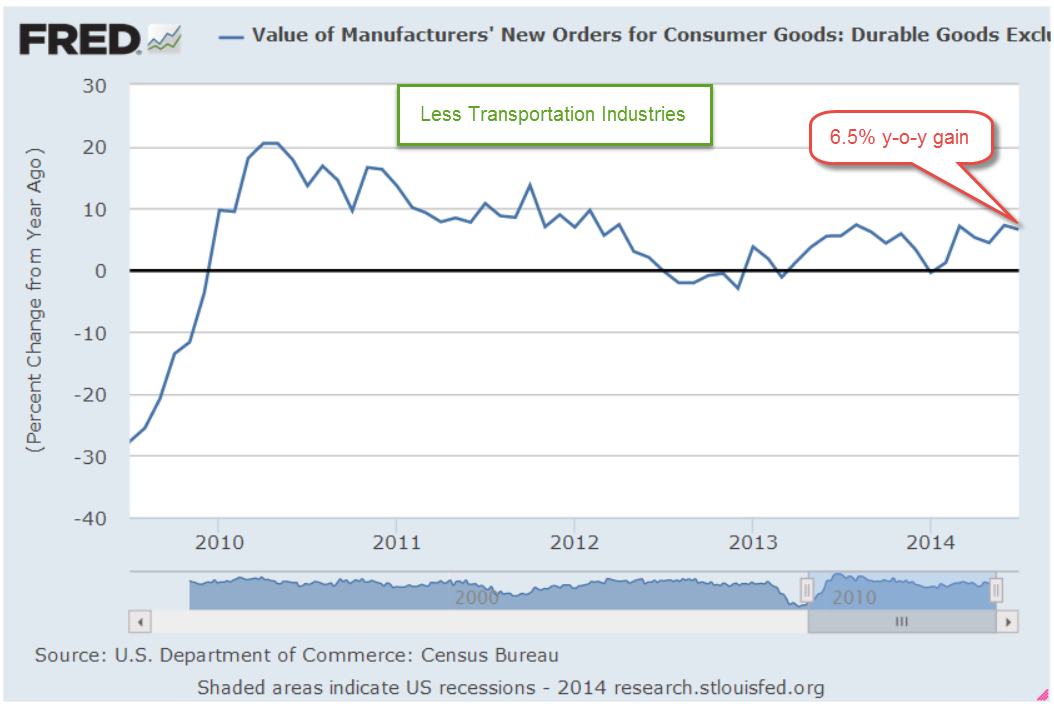
New orders for durable goods that exclude the more volatile transportation industries, airlines and automobiles, showed a healthy 6.5% y-o-y increase in July.  Like the Final Sales figures above, this is sustainable growth.

***********************

Takeaways

Economic indicators are positive but market prices may have already anticipated most of the positive, leaving investors with little to gain over the following twelve months.

Investing, New Orders, Small Business

December 4th, 2013

This will be a mid-week post of various items I thought were interesting.  The private payroll processor ADP is showing private employment growth 215,000, about 15% above expectations.  This weekend, I’ll cover the employment situation and some long term trends.

***************************
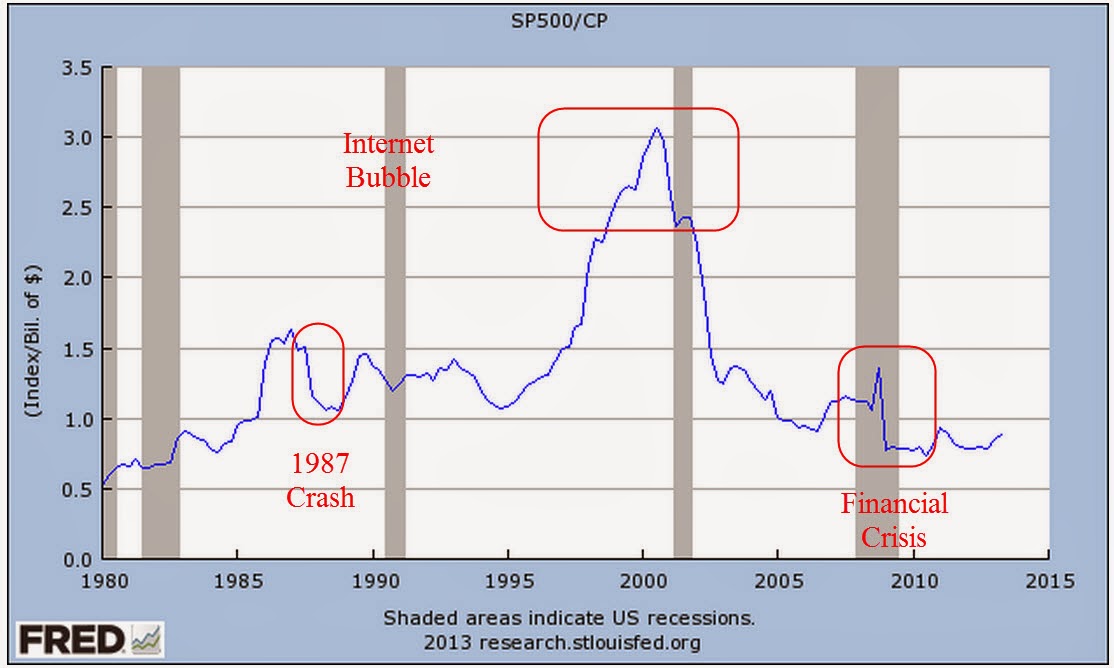
When we buy bonds, we are buying someone’s debt. Really what we are buying is the likelihood that they will pay that debt.  When we buy stocks, we are buying someone’s profits – or the future prospects of those profits.  The S&P500 is an index of the 500 largest domestic corporations.  The BEA tracks the profits of all domestic corporations, not just the 500 largest, before tax adjustments. It is rather interesting to look at the ratio of the SP500 index to corporate profits, in billions.

Using this metric, the exuberance of the internet bubble is striking, far surpassing the housing bubble of the 2000s. It was a time when investment was high in the new digital economy.  The ingenuity of man had finally overcome the business cycle.   The ratio of stock prices to profits didn’t matter because profits were about to go through the roof, man!

Well, it would take a while but eventually profits did go through the roof.  It took a few years.  As a percentage of the nation’s GDP, corporation profits are near 11%.

So pick the story you want to tell.  1) Stocks are undervalued based on historical ratios of prices to profits.  2) Stocks are going to crash because corporate profits are too much a percentage of the economy, an unsustainable situation.  Both narratives are out there in the business press.

*************************************************

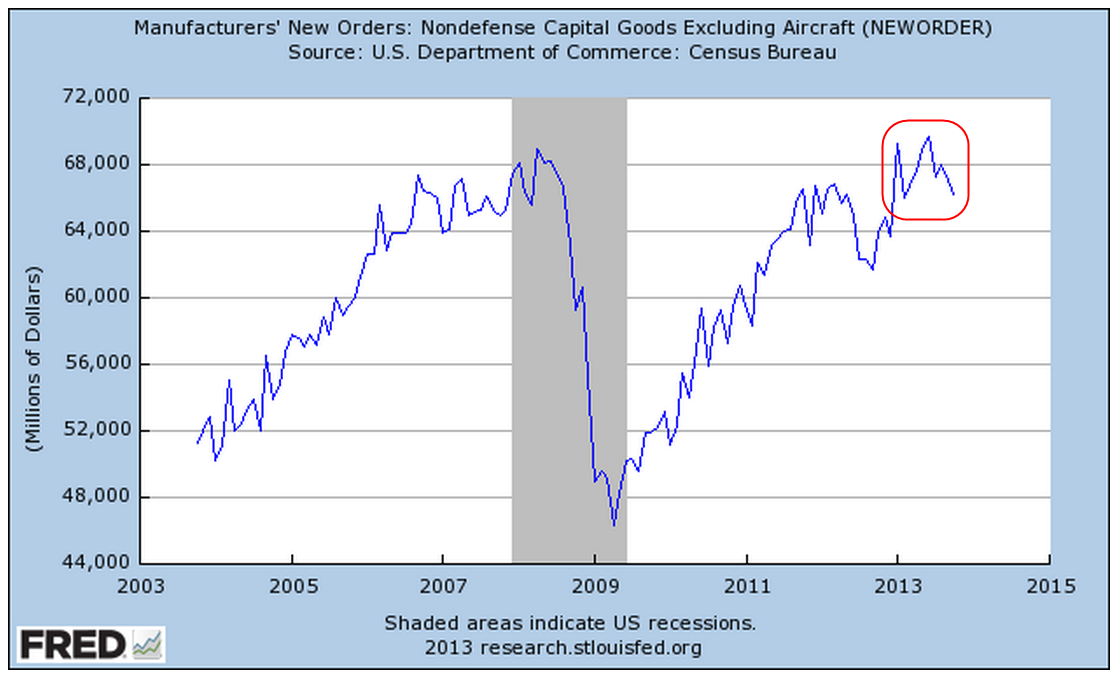
New orders for non-defense capital goods excluding aircraft has been declining of late.

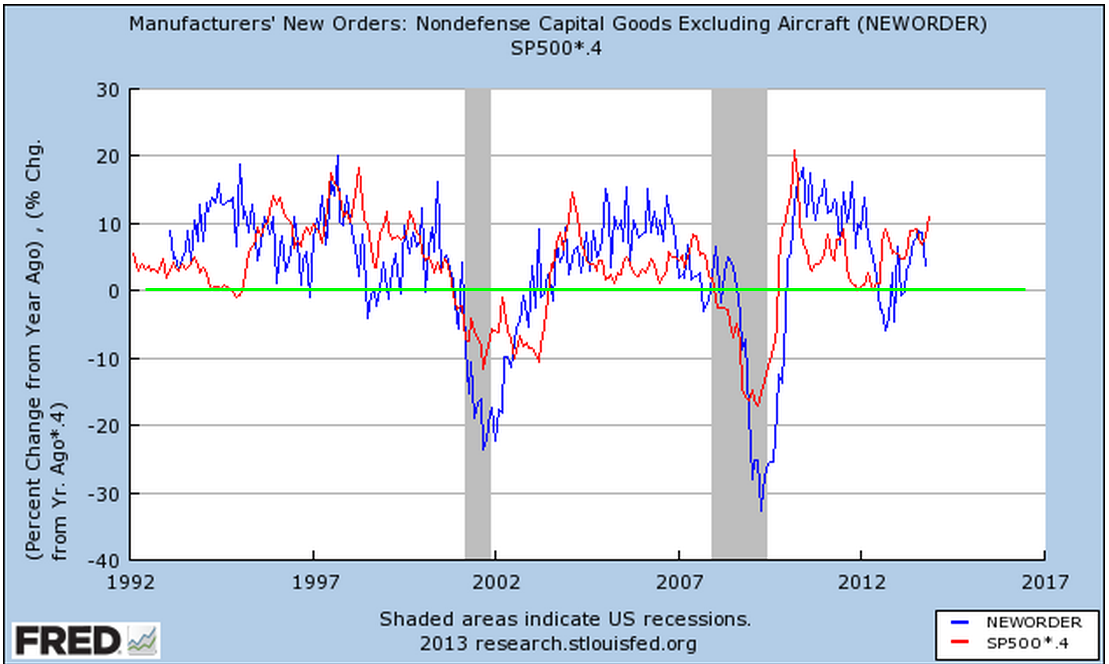
Below is a chart showing the year over year percent gains in new orders and the SP500 index.  There is a loose correlation.  The stock market is usually responding to predictions of future activity as well as political and financial news.   I modified the changes in the SP500 by a little more than half to show the overall trend.

******************************************

In 2012, households finally surpassed 2007 levels of net worth.   In the past five years, household assets have risen by a third, more than $14 trillion dollars. More than half of that increase is the rise in stock asset values. In that same period, liabilities have decreased slightly from the $20 trillion.  All of the decrease and more is in mortgages.  This table shows the unsustainable growth in net worth during the housing boom.

Check out the growth in household debt during the housing boom.  Over 10% per year!  Now look at the growth in Federal debt.  There are only two years where it falls below 5%.  Someone once said something like “What can’t go on forever, won’t”.  How long can a government increase its debt 4x, 5x, 10x the rate of inflation or the rate of economic growth?

***********************************

A short and very informative book on investing by William Bernstein.

Deep Risk: How History Informs Portfolio Design (Investing for Adults)
William Bernstein

*************************************

Words of caution:

“A government big enough to give you everything you want is a government big enough to take from you everything you have.” – Gerald Ford

****************************************

Gallup’s survey of consumer spending in November was the strongest November in 5 years.  On the other hand, early reports of the y-o-y gains in retail spending over the 4 day Thanksgiving weekend indicated a meager 2.3%, barely above inflation.  Same store sales at department stores declined -2.8% in the Thanksgiving/Black Friday week, although they are up 2.5% year over year.  As I wrote about two weeks ago, online shopping is now a significant portion, 20%, of total retail sales.  A more complete feel for the consumer’s mood must include sales on Cyber Monday, the Monday after Thanksgiving.  These showed exceptional gains of 17% over last year’s numbers.

****************************************

ISM’s Manufacturing index was 57.3, the strongest in 2-1/2 years.  I’ll update the CWI after I input today’s numbers from the non-manufacturing report.  I was expecting a slight tapering in the composite.  As we saw a few weeks ago, there has been a positive wavelike action and it appeared as though the economy had hit a crest in October.

****************************************

In 2010, the Census Bureau reported that there were 5.7 million employers (those with payroll, as opposed to sole proprietors), a decrease of 300,000 from the 6 million employers the Census Bureau counted in 2007.  About 5.1 million employers had less than 20 employees and accounted for 14% of the $5 trillion in payroll. Those small to mid-size companies with 20 to 99 employees accounted for another 14% of payroll.  Mega-employers, those with 500 or more employees, paid out about 57% of total payroll in 2010 and constitute a little more than half of private employment.  These large employers naturally have more influence on policy makers in Washington and in state capitols throughout the nation.

 *****************************************

The National Federation of Independent Businesses’ (NFIB) recent monthly survey reported a fairly sharp decline in sentiment among small business owners. A hopeful sign in this report is the improvement in expectations for future sales.  Sentiment was particularly depressed over the shenanigans in Washington and pessimism towards the regulatory environmnent is near all time highs. A blend of small cap stocks has risen about 36% in the past year.  Small cap value stocks have soared 40%.

*****************************************
An interesting historical note from the Social Security administration.  As  preamble, Social Security taxes are collected and put in a “separate” accounting fund before they are immediately “borrowed” for the general spending needs of the Federal government.

 President Roosevelt strenuously objected to any attempt to introduce general revenue funding into the program. His famous quote on the importance of the payroll taxes was: “We put those payroll contributions there so as to give the contributors a legal, moral, and political right to collect their pensions and unemployment benefits. With those taxes in there, no damn politician can ever scrap my social security program.” 

In 1937, the Supreme Court ruled that the Social Security Act was constitutional.  The majority opinion, penned by Justice Cardozo: “The hope behind this statute [the Social Security Act] is to save men and women from the rigors of the poor house as well as from the haunting fear that such a lot awaits them when journey’s end is near.”

**************************************

Quite often, our auto or homeowner’s insurance company changes insurance plans on us.  The insurance company sends us a notice that, due to legislative changes or revised company policy, there is a new codicil to all insurance contracts.  Premiums may go up.  The insurance company’s liability may be reduced. Your old plan is being cancelled and reissued with a “-1A” after the policy number. Some of us may skim read the new changes, most of us shrug and sign the new contract and that is the end of the story.  Imagine the headlines: “MINIMUM DEDUCTIBLE RAISED TO 1% OF HOME’S VALUE.  ALL HOMEOWNERS’ INSURANCE CONTRACTS CANCELLED.”  This is what happens.  The old insurance contract is no longer available.

What is the response when the same thing happens to private health insurance  plans under Obamacare?  “Obamacare Forces over 800,000 in N.J. to change insurance plans” is the bold caption of one news story.  People who are unsympathetic to the new health care law will not make the distinction between “insurance plan” and “insurance carrier.”

The Madness of Methodology

April 28th, 2013

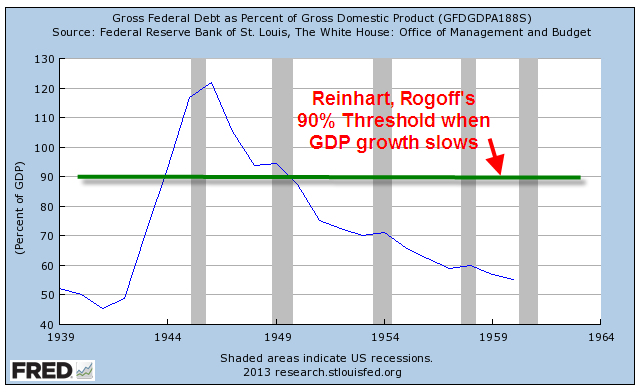
A fight between economists is not as exciting as a dinosaur smackdown (Jurassic Park), but the controversy can be as damaging.  Politicians and pundits love to trot out those economic studies and theories which justify their actions or political point of view.  In 2009, two economists Carmen Reinhart and Kenneth Rogoff (now affectionately known as RR), published a study which showed that a country’s GDP growth becomes slightly negative when its debt grows above 90% of its GDP.  The study was cited by many politicians and pundits in Europe and the US, including VP candidate Paul Ryan, as they proposed various forms of austerity to curb the explosive growth of national debt.

Here’s what the debt to GDP ratio looked like 1940 – 1960

In the years 1947 – 1959, we had an annualized growth rate of 3.6% but a strong component of this growth was our strategic advantage in exports, being the manufacturing capital of the world after much of the production capacity of the developed world was destroyed in WW2.

Here’s what it looks like now; the same spike of debt.

But we have lost the advantage of being the leading manufacturer.

Given the assignment of replicating an existing economic study, Thomas Herndon, a PhD candidate at UMass, discovered some glaring spreadsheet errors in the original data set compiled by RR.  You can read an Alternet article summarizing the details here.

Some quick background.  There are two categories of economic policies.  Fiscal policy encompasses taxing and spending measures by a government.  Monetary policy is conducted by a country’s central bank and are targeted at the supply of money and interest rates.  Economists argue over which policy is more effective in a given circumstance.  Each of us goes about our daily lives under the influence of both fiscal and monetary policy. 

During the 1930s depression, the economist John Maynard Keynes proposed that governments borrow and spend money during recessions to make up for the lack of aggregate demand in the economy.  After the economy recovered, governments would then raise taxes to pay back the borrowed money.  Another leading economist, James Buchanan, predicted that nations who followed Keynes’ ideas would have permanent deficits.  While Keynes’ economic model was elegant, Buchanan argued that there was no incentive for a politician to raise taxes.

In 1963, with the publication of A Monetary History of the U.S., economists Milton Friedman and Anna Schwartz argued that the Depression had been largely a result of failed monetary policy by central banks.  During the 1970s, when government fiscal policies of increasing intervention in the economy failed to ingnite growth or curb inflation, Keynes’ policies fell into disfavor. 

The age old debate about the effectiveness of fiscal and monetary policy never dies. The recession that began in 2008 revived Keynes’ ideas.  In the late 1990s and early 2000s, economist Paul Krugman and Federal Reserve chairman Ben Bernanke were proponents of monetary solutions for Japan’s moribund economy.  As the world economy imploded in 2008, both men changed course and became advocates for fiscal policy as the most effective solution for the country’s economic woes.

In a recently published paper UMass professors Michael Ash and Robert Pollin (Herndon’s advisors), explained their methodology and took RR to task for their lack of follow up on incomplete data analysis after several years.  What they had missed was a follow up paper by RR in February 2011 and another published in the summer of 2012.  In these papers, RR modified their initial findings, saying that GDP growth slowed but did not necessarily turn negative.

In a WSJ blog post , RR answered the critique from the UMass Professors.  They admitted their spreadsheet error but reaffirmed their other assumptions in the study and their amended conclusions.

Paul Krugman weighed in (or waded in?), voicing his disappointment with RR’s methodology and their conclusion.  Krugman does make a point oft repeated in the social studies: correlation is not causation.  Does high debt cause slow GDP growth?  Or, does slow GDP growth cause high debt?  Or can we say that there is some indication that they accompany each other?
At Econbrowser, U. Cal professor James Hamilton, reviewed RR’s methodology and Ash and Pollin’s critique. (Link)  To which, Professors Ash and Pollin responded with some good points.

Ash and Pollin have made the original data available.  Some have accused RR of purposefully leaving five countries out of their data, saying that these five countries would have weakened or invalidated their findings.  The Excel file shows that this was a simple – but dumb – mistake, not some nefarious plan by RR.  The countries left out are on the last five worksheets which are arranged in alphabetical order.  What surprises many is that two prominent economists could publish a paper based on work that had so little verification before publication. 

What I question is RR’s decision to include many of the smaller countries at all in their analysis.  Finland and Ireland each have less than 2% of the GDP of the U.S. 

What I do hope is that this controversy will spur more analysis of the relationship between a nation’s debt load and its economic growth.  What I am afraid of is that this will discourage researchers from sharing their working data.  Reinhart and Rogoff are to be highly commended for doing so.

Blossoms and Blight

March 24th, 2013

The Blossoms

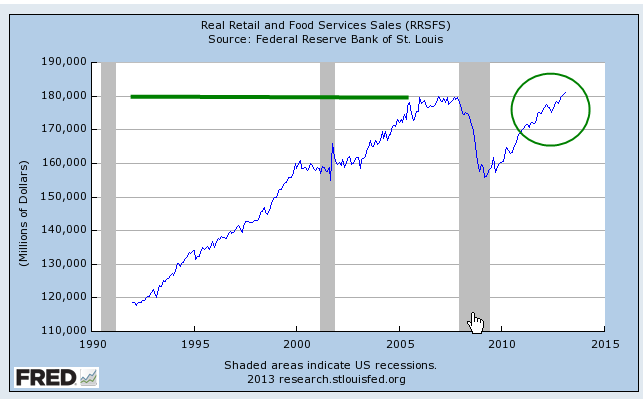
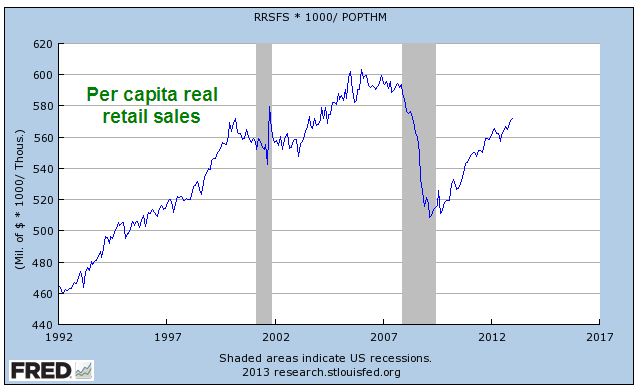
There have been a number of encouraging reports these past several months, helping to fuel new highs in the popular SP500 stock index.  After falling off dramatically five years ago, real (inflation adjusted) retail sales finally surpassed 2007 levels.

Housing prices around the country are on the mend.  Although the purchase only home price index is still below the vaulted levels of the bubble years, it is exactly where it would have been if there had been no bubble and housing prices had grown at their customary 3 – 4% per year.

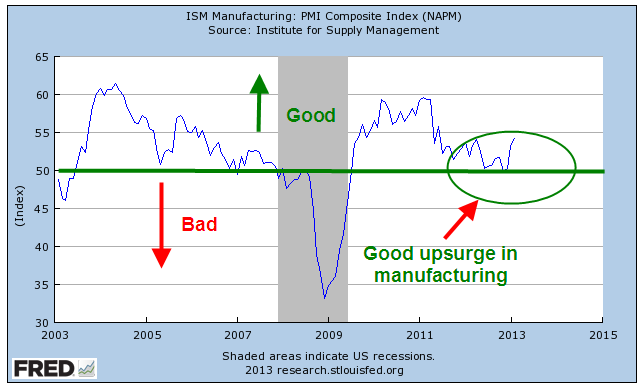
In recent months, the manufacturing sector of the economy has surged upward, rebounding from weakness in the latter part of 2012.  For the past year, the Eurozone has been in or near recession, yet some are hopeful that increased demand in this country and some emerging markets are helping to balance the contractionary influence of decreased demand in the Eurozone.  Let’s hope that this surge in the first part of the year does not fade as it did in 2012.

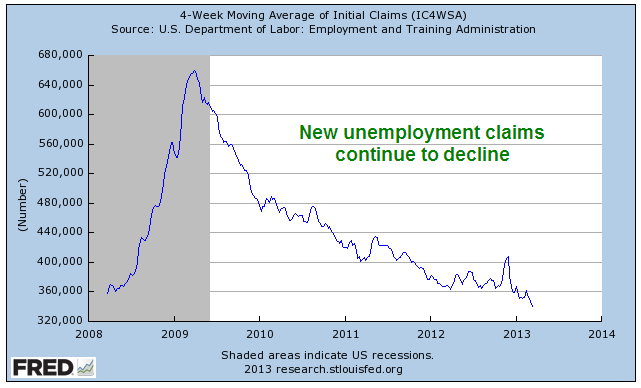
New claims for unemployment continue to decline. 

The Blight

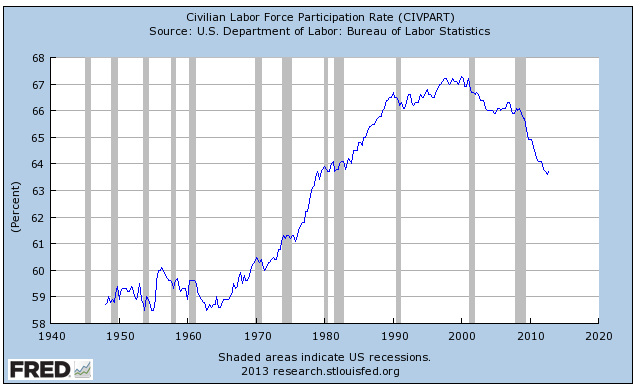
But a 7.7% unemployment rate and a record 14 million disabled (SSA Source) show that the labor market is still sick.  The percent of working age people who are working, or the participation rate, continues to drift downward.

While the steadily improving retail sales indicate growing consumer confidence, per capita purchases are about where they were in the late 1990s, 15 years ago.

While consumers have been shedding debt, state and local governments continue to hold large levels of debt which does not include promised pension and health care benefits to retirees.

Federal Spending continues to outpace receipts, adding to the debt at a rate of more than 4% per year. At that rate the debt will double in about 18 years, reaching $30 trillion in 2030.  As a percent of the entire economy of the country, the deficit or annual shortfall between spending and revenues is still about 7%.
 

As housing prices recover and households either pay down or shed debt in foreclosure or bankruptcy, household balance sheets are looking better. What has happened in the past five years is a massive shift of household debt to the balance sheets of local, state and federal governments.

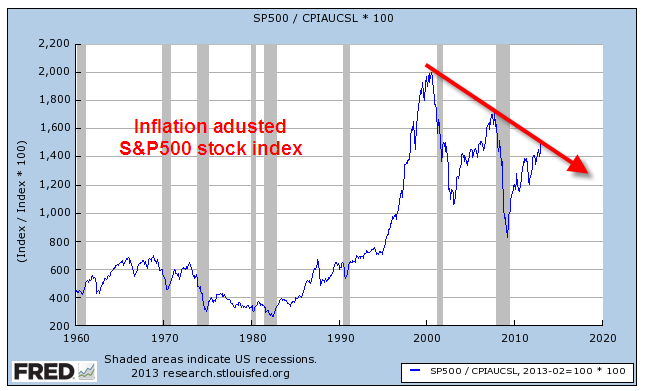
The blossoms catch our eye, inspiring hope, causing some to not notice the blight.  But the stock market, the barometer of millions of watching eyes, tells a more complete story.  While the stock market has shown renewed optimism in the past several months, its inflation adjusted value indicates a more tempered enthusiasm for the long term future of the economy and corporate profits.

The Law of Averages

February 17th, 2013

The spending sequester, or sequestration, set to take effect March 1st is a series of automatic and indiscriminate spending cuts that was part of the “Grand Bargain” compromise between President Obama, together with a Democratically led Senate, and the House Republicans in the Budget Control Act of August 2011.  The agreeement was rather like a Sword of Damocles, a chopping of spending programs cherished by one party or the other.  The term “sequester” means that there will be some actual spending cuts, not the usual budget and appropriations gimmicks that Congress is fond of. The unpalatable cuts to both defense spending and social programs were supposed to be an incentive for both parties in Congress to come to an agreement on deficit reduction as a condition of raising the debt limit.  It was hoped that the 2012 election would decide which party’s priorities would take precedence and the dominant party could then pass legislation to avoid or modify the sequester.  Instead, the election left the balance of power unchanged.  Republicans had dismissed the probability of the Democrats winning a majority in the House.  There were just too many seats that the Democrats need to gain to accomplish that.  Hoping to take the Presidency and having a good chance of taking control of the Senate in the 2012 elections, Republican lawmakers agreed to the sequester. The 2010 post-census election had put Republicans in charge of crafting voting districts, which enabled them to retain a majority in the House despite losing the total popular vote for House seats in the 2012 election. Several key Senatorial races imploded when Republican candidates made ill-advised (to be charitable) remarks.  Instead of gaining control of the Senate, Republicans lost two Senate seats.  Despite the high unemployment rate and the poor to middling economy, President Obama won re-election.

After navigating a mind numbing maze of previous law and baseline budget projections to arrive at actual spending reduction goals, the sequester will reduce defense spending by $55 billion and non-defense spending by $38 billion in 2013.  While this sounds like a lot of money, this is just 2.4% of the estimated $3.8 trillion in total federal spending in 2013 or a mere .6% of the estimated $16 trillion of this country’s GDP.  This past week the Democratically controlled Senate revealed a plan that would avoid the sequester for 2013.  The plan achieves deficit reduction goals with spending cuts and revenue increases but the revenue increases will probably be unwelcome to the Republican majority in the House.  Despite the rhetoric of calamity coming from either side of the aisle, both parties are anticipating that the sequester will probably take effect in two weeks.

Since mid November the SP500 has risen 12%; except for a sharp decline in the last week of the year in response to fears of the fiscal cliff, the market has climbed steadily.  The market has been largely ignoring the upcoming sequestration. 
More concerning to some is the slowdown in Europe, where the Eurozone economy has contracted for 4 quarters in a row.  Even Germany, the manufacturing and export stalwart of the Eurozone, saw a .6% contraction in the final quarter of 2012.

For many decades, the two prominent parties have been fighting an ideological battle over the role of the Federal government.  The Democratic Party regards the Federal government as largely beneficial and wants a greater role for the Federal government.  They have ushered in many social programs including Social Security, Medicare and Medicaid, programs that are largely on autopilot, beyond the reach of the Appropriations Committee in the House, where a select few can make the law by deciding which programs and federal agencies receive funding.  The philosophy of the Republican Party is that the Federal government is intrinsically a burden and therefore deserves a smaller role.  The Republican Party was out of power in the House for forty years until 1994; as a result, their role consisted largely of blocking or modifying Democratic Party ambitions.  Except for four years from 2007 – 2011, they have controlled the House since 1994 yet often conduct themselves as the opposition party that they were for much of the latter part of the 20th century.

In the tug of war between these two ideologies, the budget has suffered.  A recent report by the non-partisan Congressional Budget Office (CBO) contains a graph of Federal revenue and outlays and their long term averages which clearly pictures the “scrimmage” of ideologies between two yardlines, marked 18% and the 21%.  Republican politicians, together with conservative talk show hosts and commentators, speak of the “traditional” role of the Federal government at 18% of GDP.  This is simply the average of Federal revenues, not its role, for the past fifty years. Revenues have been, on average, 3% below that of Federal spending, which has averaged 21% of GDP.  The “traditional” role of the federal government, then, is to have an average annual deficit of about 3% of GDP.  In a $16 trillion economy, that average deficit is $500 billion.
Republicans simply can not say “no” to the Defense Dept; at times, they have forced spending programs on the Defense Dept that it doesn’t want.  The Democratic Party has become the champion of a hodge podge of Federal social welfare programs.  Neither party proposes taxes that will actually pay for the spending.  For all the Democratic rhetoric about taxing the rich, there simply aren’t enough rich people to pay for that average $500 billion deficit.  Large corporations continue to dominate both parties.  Campaign laws in most states as well as the federal government permit no fundraising in government buildings.  Almost every day, the members of the House and Senate must leave the government building where they work in order to do the daily drudgery of promising favorable legislation to corporations and associations in return for campaign contributions. 

We are still way above the 3% deficit average of the past fifty years.  The CBO projects that this year’s deficit will be 5.2% of GDP, almost half of the 10% deficit in 2009.

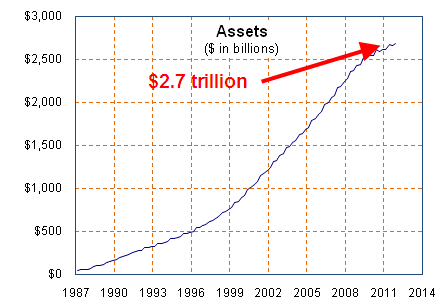
Over the next two decades, that 3% budget deficit average is about to grow larger.  For the past fifty years, the demographic bulge known as the Boomers have been paying into Social Security.  Those taxes have exceeded payments in most years, reducing overall Federal government deficits by .6% of GDP each year (Table 1.2 OMB historical tables, 2013 Budget).  Those surpluses have masked the reality that average annual Federal deficits, excluding Social Security, have been about 3.6% of GDP.  In a $16 trillion economy, that is close to $600 billion.  As the Boomers retire over the next twenty years and are collecting Social Security payments, add in another $100 billion a year as the Boomers draw down the $2.7 trillion dollar Social Security surplus they have built up.

We’re now up to a $700 billion annual deficit based on revenue and spending patterns over the past fifty years.  As the total Federal debt grows, so will the interest costs on that debt.  Over the past seventy years, interest costs have averaged 1.8% of GDP, almost 30% higher than the 1.4% of the past few years (Table 3.1 OMB 2013 Budget)  Ballooning debt levels and rising interest rates could easily add another $100 billion to annual deficits.  We’re now up to $800 billion and growing, based on historical averages.

Republicans will continue to call for spending cuts – it’s their brand.  Democrats will call for more programs and more taxes – but not on the poor and middle class – that’s their brand.  The political and economic tug of war will continue, meaning that uncertainty will be the new normal.  Uncertainty usually leads to lower economic growth which exacerbates social and political tensions which leads to more uncertainty until eventually there will be another crisis. 

In preparation for a cycle of uncertainty and crisis, the prudent investor might ask “What’s my backup plan?”  If you are lucky enough to have a defined benefit pension plan with the company you work for, what is your backup plan if that “defined” benefit is “redefined.”  Well, you might be thinking, my company is so large and dominant in its market that such a possibility is unlikely.  Tell that to the employees of United Airlines, a dominant player in its industry, who lost part, or in some cases, more than half of their benefits when United Airlines shed part of its pension obligations in bankruptcy court.

In the mid nineties, IBM converted its defined benefit plan to a “cash balance” plan, effectively lowering the pension amounts due older workers.  After seven years, a contested lower court decision and a victorious appeal, IBM won their right to do this.  IBM and other large companies have lots of lawyers and accountants trying to figure out legal ways to reduce their liabilities.  How many lawyers and accountants do you have? 

A March 6, 2012 article in the Wall St. Journal reported that “Business groups are urging Congress to let employers put less money into their pension funds, saying that exceptionally low interest rates are forcing them to set aside too much cash.”  I’ll bet your company has more lobbyists in Washington than you do.

These past few years have been a wake up call for those who worked, diligently saved and invested, planning on a certain retirement income based on historical returns of various investments in the stock, bond and CD markets.  Too many people discovered that their backup plan was either to keep working or go back to work, a fact supported by the monthly household survey from the Bureau of Labor Statistics. 

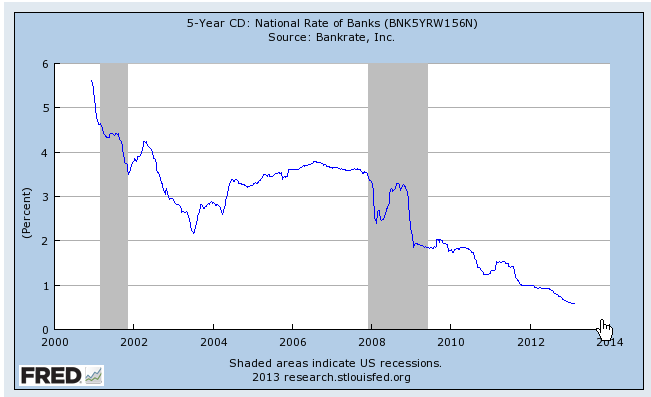
Many retirees built CD “ladders” in federally insured certificates of deposit that paid 4 – 5% interest or more, offering them the safety of their principal and a steady income.  With interest rates for CDs at 1% or less, many retirees have either had to find more risky investments or simply spend less or – there’s that backup plan again – go back to work to make up the difference.

Then there are the folks who planned on selling their home, downsizing and using the difference as an income stream in their retirement years.  Now they wait, hoping that housing values will return to the lofty levels of the mid-2000s or – backup plan again – keep working.

Some people think that the past few years have been an aberration and are waiting for things to get back to normal, or average.  What I’ve tried to show is what those averages have been for the past fifty years and that those averages are better than what we can plan on for the next twenty years.  We certainly can not plan on a vague hope that the folks in Washington will find either a solution or a compromise to a problem that has remained unresolved for the past half century and will continue to worsen in the next two decades.