A Debate on Presidential Power

February 16, 2025

by Stephen Stofka

This is part of a series on centralized power. This week’s debate is about the power of the President relative to the other branches of the federal government. The debates are voiced by Abel, a Wilsonian with a faith that government can ameliorate social and economic injustices to improve society’s welfare, and Cain, who believes that individual autonomy, the free market and the price system promote the greatest good.

Abel began the conversation. “Our country is founded on the principle of federalism, a sharing of power between the states and a centralized government in Washington. In that central authority are three branches that balance and check each other’s ambitions for power. It looks like Trump is challenging those restraints.”

Cain shrugged. “The Speaker of the House doesn’t seem worried. The Congress hasn’t been able to get anything done. It’s been almost thirty years since Congress completed a full budget (Source – pdf). The executive branch is stuck with the burden of implementing years of legislative compromises. It is entirely appropriate that the President clean up the mess.”

Abel shook his head in disbelief. “Trump is taking control of the purse, a power given to Congress by the Constitution. Doesn’t it worry you that a Democratic president could simply undo any laws passed by a Republican legislature?”

Cain looked puzzled. “If the President gets out of line, the Constitution gives Congress the power to impeach the President.”

Abel laughed. “Trump has already been impeached twice. Never in the history of this country has the Senate convicted a President. Impeachment is an empty threat. After the Supreme Court’s decision to grant the President immunity from criminal prosecution, the President can act like a king.”

Cain frowned. “FDR expanded the scope of the executive when he took office in 1933. Did your group sound the alarm then? Did you cry ‘Constitutional crisis’ when Roosevelt threatened to pack the Supreme Court to get his way? No, your group stood by silently as Roosevelt upended 150 years of tradition. This President is trying to undo that shameful legacy, to return this country to its founding roots.”

Abel showed his disdain. “He is undoing a century of building government institutions that help people, that protect people from the power of large corporations. This is not the America of the 18th century.”

Cain argued, “They are inefficient government institutions that swear allegiance not to the people they serve but Washington lobbyists and their own internal processes. We have a spending crisis. The Constitution gives the President the executive power. Alexander Hamilton argued for a strong executive and President Trump embodies Hamilton’s vision.”

Abel sighed. “You’re talking about the unitary executive theory. Advocates for that theory take Hamilton out of context. He wanted to convince those in the state legislatures that the strong executive in the proposed Constitution was preferred to the weak plural executive that had been defined in the Articles of Confederation. Hamilton was not advocating for a President with all the powers of a king. The country had fought seven bloody years to rid themselves of a king.”

Cain shook his head. “Look, Washington and Jefferson set the example. They were strong Presidents who sat at the top of the executive hierarchy. They didn’t ask Congress for permission. They defined their role as the chief executive of the laws.”

Abel interrupted. “Ok, but the executive branch was small in the early 19th century. Employees worked at the whim of the President. As the country grew, there needed to be more stability in the executive work force. Congress wanted more control or supervision of the various departments. After all, it is Congress who writes the laws. Congress represents the people. The President is the people’s agent, executing the laws that the representatives of the people have passed.”

Cain held up his hand. “Look, you’re describing a clerk, not the leader of a country. Hamilton was arguing for a leader with enough power to meet threats from other countries led by monarchs with absolute power.”

Abel argued, “That was another century when even the mightiest rulers had relatively little firepower at their command. We have invented weapons that are too destructive to put at any person’s command. There have to be checks and balances within the executive just as there are within the legislative and judicial branches.”

Cain shook his head. “The more destructive the weapons, the more we need a strong leader with the authority and power to act decisively to answer any threats from other countries.”

Abel frowned. “There has to be checks and balances within each branch. That’s especially true for the executive. All previous empires have fallen because one person gained too much power. Rome, Persia, Egypt, and Byzantium come to mind. There are too many temptations. A President with control of the Bureau of Labor Statistics would be able to adjust the monthly unemployment numbers or inflation report to make his administration look good. Argentina did this for seven years (Source). China, Venezuela and Hungary do it. He could disallow the counting of some of the population by the Census Bureau to reduce some grant funding for states who did not vote for him.

Cain scoffed. “There are checks and balances between Congress and the Executive. If a President were to ‘cook the books,’ that information would be leaked. The Congress could impeach the President.”

Abel’s expression was stern. “When the founders wrote the impeachment rules, they envisioned a system without political parties. In a party system, the President is the leader of the party. Impeachment is not a check. If the House is the same party as the President, they dare not bring their leader up on impeachment charges. A Democratic-led House would not impeach Andrew Jackson in 1833. All the anti-Jacksonian majority in the Senate could do was censure Jackson.”

 Cain argued, “In 1868, the Republican-led House impeached Andrew Johnson.”

Abel shook his head. “Johnson was a Democrat who ran with Lincoln on a third-party ticket called the Union Party (Source).”

Cain’s tone of voice was conceding. “Ok, maybe impeachment is not the ideal check on a President. But they pay attention to popular opinion. If the public is outraged, they will complain to their representatives. Presidents care about public opinion.”

Abel showed a wry smile. “George Bush’s poll numbers fell as low as 25% (Source). What did that accomplish? There is an entire phalanx of advisors who shield the President from disheartening news. A President lives in an information bubble designed to protect his self-confidence.”

Cain argued, “Well, there are no checks on the Supreme Court. They have lifetime tenure and the last one to be impeached was in 1805 (Source). They control their own agenda. The House and Senate make up their own rules (Source) and have no internal Constitutional checks. In the Senate, the Majority Leader controls all the floor time. If he doesn’t want some legislation brought to the floor, it isn’t considered. The President should have the same authority over officials in the executive branch. He should be able to direct them on how he wants the law executed. His decisions should not be subject to review by a court.”

Abel frowned. “You’re describing the unitary executive theory again. It grants the President most of the powers of a king. We know that Hamilton, Jefferson, Madison and the other founders did not want a king. This country rejected rule by the whim of one person, the king. We are a nation of laws, not whims. Trump and Musk are two rich crackpots who dance to the music of their own whims. The wolves in Russia and China are licking their chops. By the time Trump is done, this country will be weaker.”

Cain scoffed. “This country was already weak. That’s what the President is trying to fix. The country has $36 trillion dollars in debt. We’re spending more on interest than we do on defense. We play mister nice guy, letting other countries take advantage of our charity, then vote against our interests in the U.N. DOGE is going to trim the discretionary items in the budget then look to implement fraud controls in mandatory spending programs like Medicare and Medicaid. Trump has shown he’s a tough negotiator.”

Abel laughed. “Trump changes his mind from day to day, from week to week. It’s a sign of weakness that Putin and Xi will take advantage of.”

Cain shook his head. “The President dances like Muhammed Ali in the ring. That’s what we need. A fighter who keeps other countries hesitant to make any aggressive moves. That’s the road to a cautious peace.”

Abel sighed. “It’s only a few weeks since Trump took office. He will leave a trail of chaos and carnage and half of the people in this country won’t hold him responsible.”

Cain laughed. “And the other half of the country thinks he’s the devil. That says more about all of us than it does President Trump. We’ll talk next week.”

//////////////////

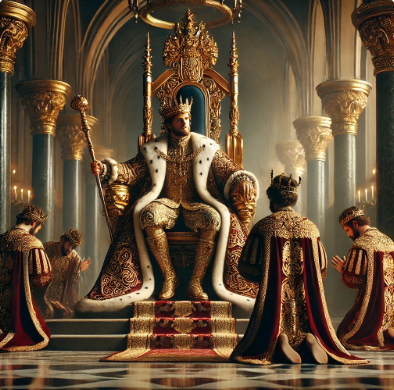
Image by ChatGPT

The scene is set in a grand hall with tall columns, chandeliers, and intricate tapestries. A majestic king is seated on a grand throne, dressed in luxurious royal robes adorned with gold and jewels. Several people kneel before him in deep reverence, wearing medieval-style clothing.

A Debate on Vulnerability

This is eighth in a series of debates on various issues. The debates are voiced by Abel, a Wilsonian with a faith that government can ameliorate social and economic injustices to improve society’s  welfare, and Cain, who believes that individual autonomy, the free market and the price system promote the greatest good.

Hope everyone enjoyed their holidays.

Abel began the conversation. “Last week neither of us were happy with the present structure of our government. I thought we could discuss a more fundamental issue, the duty of a government and the duties of its citizens.”

Cain nodded. “At  the Constitutional Convention in 1787, the founding fathers fought bitterly about the duties of a federal government. Over two hundred years later, I don’t think we have come any closer to an agreement on this point.”

Abel said, “The scope of the federal government’s duties have expanded since Roosevelt and the Great Depression.”

Cain argued, “For decades, our group has been fighting that expansion. We have compassion for the vulnerable but caring for them is a proper function of state governments.”

Abel shook his head. “The Jim Crow era and the Depression taught us that state governments may be unwilling or unable to help the vulnerable. During the hundred years after the Civil War, southern states lacked any compassion for their black residents. During the Depression, the ranks of the vulnerable increased beyond the capacity of state governments. FDR and the Democrats recognized that and instituted job and relief programs to lessen the suffering and reassert some moral order.”

Cain replied, “It is still not clear that most of those programs did much good. The economy continued to flounder until this country entered World War 2. The federal government may be able to borrow the resources for relief programs, but Congress and the President try to design a one-size-fits-all solution. Only the states can design programs that are suited to the population, resources and economy of each state. Texas and New York have entirely different resources, cultures and economy.”

Abel argued, “But that variety produces a fragmented policy response. State representatives are easily influenced by well-funded interest groups and dominant voting constituencies that want to bend the rules in their favor. Minority populations can become severely disadvantaged.”

Cain argued, “Because of that fragmentation, it can be costly for interest groups and lobbyists to fund a campaign that encompasses more than a few states. Instead, they consolidate their resources in Washington where they hope to effect a centralized policy. Centralized policymaking promotes more lobbying. As the saying goes, ‘The road to ruin is paved with good intentions.’”

Abel insisted, “Your group prefers a more federalist, splintered approach to policymaking. Historically, that has led to unequal treatment of the citizens who live in a state. That abuse violates the 14th Amendment as well as the principles of equality established in the Declaration of Independence.”

Cain nodded grudgingly. “Yes, there have been instances of abuse. Your group has used that unfortunate history to promote your vision of the federal government as the protector-in-chief of people’s welfare, animals, plants, the air and water. Social welfare programs embody the sentiment ‘From each according to his ability, to each according to his needs.’”

Abel shook his head. “That overstates our group’s position. We value compassion for the vulnerable, many of whom are victims of circumstance, heritage, and the bad luck of being a minority, a historically disfavored group to policymakers.”

Cain argued, “You absolve them of all responsibility for their choices.”

Abel insisted, “Their history as political pariahs and poor economic circumstances influence those choices. Our society bears a heavy burden there. Our group recognizes that.”

Cain said, “You want people to pay for policy mistakes a century or more old. You believe that white people are born with an original sin, guilty of the racist policies of bygone generations. Our group rejects that belief.”

Abel’s tone was more forceful. “Evidence illegally obtained is inadmissible in court. Evidence derived from that evidence is also inadmissible. That is the Fruit of the Poisonous Tree legal doctrine. Riches and advantages derived from property illegally obtained is tainted, yet many of us blithely reject responsibility. How many white people say, ‘Well, I did not steal my advantages or property. I was not yet born when some of these abuses were done. I bear no burden because I belong to a dominant racial, ethnic or cultural group.’”

Cain paused. “Ok, let me ask you. When is the debt paid? If there is a debt, it is finite, so when will it be paid? How much will have to be paid? Who will be assessed for that debt? If a person is 2% white, are they 2% responsible for the debt? Some racist policies were based on that same kind of thinking. A person of ‘mixed blood’ was treated as black and denied a loan or was excluded from buying a house in a certain area. We don’t want to repeat the sins of our fathers, so to speak, in making restitution for the sins of our fathers. The past is past. Let’s move forward.”

Abel argued. “It is not a debt. It is a duty to help the vulnerable, and those who have been wronged. Don’t you see? Some people move forward more slowly because they are weighed down by the policy sins of past generations.”

Cain scoffed, “We may recognize a moral, but not legal, duty to help the vulnerable. The parable of the Good Samaritan comes to mind. Should we legalize that duty and have the government enforce a charitable spirit on everyone? No. As to the abuses of the past, should the federal government give American Indians a lot of land back? Shall we have the National Guard evict a lot of American homeowners? No! The past is past. The Age of Conquest is over. We move forward.”

Abel said, “We can preserve areas like Bears Ears National Monument that is sacred land to an Indian tribe. We can enjoy it in its pristine beauty instead of drilling holes in the ground and installing bobbing black oil pumps.”

Cain shook his head. “Bears Ears is an example of a President overstepping his Constitutional bounds. Resources contained within a state are managed by the state unless Congress mandates otherwise. Congress, not the President. Congress passed a law that designated Yellowstone a National Park. President Grant signed the law that Congress passed.”

Abel argued, “In 1906, Congress passed the Antiquities Act, giving itself and the President the legal authority to designate national parks and monuments. Grand Canyon National Park was created under the authority of that act. Presidents are entirely within the bounds of their designated authority when they dedicate a section of land as a national monument.”

Cain smiled ruefully. “The focus of our argument is wandering. We began by discussing vulnerability and now we are discussing the scope of federal and Presidential authority.”

Abel returned the smile. “Vulnerable lands and artifacts on those lands, vulnerable Indian tribes, their cultures and beliefs. We are still talking about vulnerability.”

Cain replied, “Your group wants to take from those that have and give it to those who have not. Those policies do not raise the overall utility or the flourishing of a society.”

Abel said, “We want to improve the conditions of the least among us. Imagine two kids who have to decide how to divide some chocolate milk. The fairest solution is to have one child pour the milk into each glass, then let the other child get first pick of which glass they want. The child doing the pouring will try to make each quantity as equal as possible. A few decades ago, the philosopher John Rawls argued a similar proposition he called the original position. If we could choose the type of society we wanted to be born into without knowing what our place in that society would be, we would choose a society with a fairly even distribution of resources.”

Cain argued, “To implement those kinds of policies means that society has to take property from some individuals and give it to others. In trying to achieve one form of justice, society commits an injustice, a violation of the rights of private property.”

Abel replied, “Even though there is a violation of private property rights, governments can still attain a more just society. That is the principle behind a progressive income tax system. Take a higher percentage from those who have more and use those funds to help the least among us.”

Cain shook his head. “Not only are such policies a violation of property rights, but they are also a violation of individual privacy. To implement such policies, governments collect a lot of data on their citizens. That kind of personal intrusion is typical of totalitarian governments. George Orwell fictionalized such a government in his book 1984. When governments enact distributive policies, they commit many injustices in the pursuit of justice. The net gain is negative.”

Abel argued, “The U.S. is not the government portrayed in Orwell’s book. You are overstating the case. States and local governments collect much of the information on an individual. Why? So they can tax them. Water boards charge homeowners for the impervious area of their home. City governments regularly assess the value of one’s property for property tax.”

Cain held up his hand in a stop motion. “That’s information on property, not the individual. The amount of information gathered by the IRS is intrusive. Every aspect of a person’s life, including their work and family. It is  typical of totalitarian governments. If there was any doubt that we are living under a totalitarian regime, all we need to do is look at the Covid lockdowns during the pandemic.”

Abel said, “Well, the country needed a unified response to a rapidly spreading pathogen. And yes, I agree that the information gathered is a bit excessive. Taxes are an unfortunate component of the social contract.”

Cain said, “A person’s work shouldn’t be taxed at any rate. It’s immoral.”

Abel shrugged. “Whether it is immoral is a matter of opinion. It’s the law, an amendment that is part of the Constitution. Killing people is immoral. When political leaders perceive a threat to the country’s security, they authorize killing. As this country’s population expanded in the late 19th century, policymakers thought that the inadequacy of revenue from tariffs was weakening the government’s finances to the point where it could become a security threat. An income tax was ruled unconstitutional by the Supreme Court in 1895. Eventually, the states amended the Constitution.”

Cain returned to the totalitarian theme. “Lockdown policies during the pandemic scared a lot of people. They demonstrated the authoritarian reach of this government. Grandparents unable to visit with or care for their grandchildren. Scare tactics like ‘Little Johnny will spread the disease and kill Grandma.’ It was reminiscent of the Red Scare, the fear that left wing ideas would infect people’s minds.”

Abel nodded. “That’s a whole other discussion. Every year the Supreme Court hears cases that test the extent of the police power of the federal and state governments. We’ve wandered off topic again.”

Cain shook his head. “Many of these issues are interwoven or joined together like the threads in a spider’s web. What is fairness? How much control should a government exercise to protect the vulnerable? What should be the extent of the government’s role in the social contract?”

Abel smiled. “I like the spider web image. We pull on one thread and that affects the tension on the other connections in the web. Well, maybe next week we can look at the police power of government.”

Cain replied, “Or tax policy.”

Abel laughed. “I wished we could find something simple to talk about.”

With mock skepticism Cain said, “Like whether the toilet seat should be left up or down.”

Abel smiled. “See you next week.”

Cain waved goodbye.

///////////////

Photo by Ross Sneddon on Unsplash

In March 2009, in the depths of the financial crisis, historian Allan Winkler testified before the U.S. Senate Committee on Banking, Housing, and Urban Affairs on the effect of New Deal policies during the Depression. “The NRA alienated business, and never did encourage private expansion or investment. It may have halted the deflationary spiral, but it failed to create new jobs.” https://www.banking.senate.gov/imo/media/doc/WinklerTestimony33109TheNewDealSenateTestimony.pdf#page=5

In 2016, Barack Obama designated the Bears Ears National Monument in Southern Utah a national monument. Here is a video of some of the landscape from the Patagonia Company. You can read more about the controversy and legal skirmishes here https://www.npr.org/2022/08/24/1119310929/utah-sues-to-stop-restoration-of-boundaries-at-bears-ears-grand-staircase-monument

Exploitation as well as preservation were key motivations behind the passage of the Yellowstone National Park Preservation Act in 1872. https://www.nps.gov/articles/000/president-grant-and-the-yellowstone-national-park-protection-act.htm 

A list of national monuments. https://geojango.com/pages/list-of-national-monuments

In his 1971 book, A Theory of Justice, the philosopher John Rawls argued for a more equal distribution of resources in society. https://en.wikipedia.org/wiki/A_Theory_of_Justice

The precedent underlying the Supreme Court’s 1895 decision that an income tax was unconstitutional. https://taxfoundation.org/blog/today-history-income-tax-ruled-unconstitutional-pollock-v-farmers-loan-trust-co/

More on the Red Scare and McCarthyism. https://millercenter.org/the-presidency/educational-resources/age-of-eisenhower/mcarthyism-red-scare

More on the Fruit of the Poisonous Tree doctrine https://www.law.cornell.edu/wex/fruit_of_the_poisonous_tree