A Money Evolution

December 11, 2022

by Stephen Stofka

This week’s letter is about biological and monetary evolution. Darwin proposed that biological evolution is a process of adaptation to one’s environment. Herbert Spencer, a contemporary, coined the phrase “survival of the fittest” and Darwin adopted it but came to regret it. His theory argued that species survived not because they were the strongest or most able but because they fit the environment. Sean Carrol (2006) titled his book The Making of the Fittest but his book could have been more appropriately titled The Making of What Fits. The genetic process does not produce a series of super species because such a species would overwhelm or consume its environment. A species develops attributes that help it cope with its genetic defects and this adaptation helps it find a niche within its environment. 

As an example, the skin of dogs and cats cannot synthesize Vitamin D from sunlight. They must get it from their diet, from other creatures who can store Vitamin D (Zafalon et al., 2020). Dogs and cats partnered with a species who provides a steady diet of meat directly or indirectly. People store grain which attracts rodents and small mammals, a source of Vitamin D for cats and dogs. Cats and dogs have a far greater range and sensitivity of hearing and seeing, making them excellent sentries and hunters of small animals. Money is not a species, but a direct mechanism of exchange and an indirect property relationship. Still it has and continues to evolve.

Gold and other “hard” currencies have survived for centuries. Gold is durable yet malleable but so is iron which people have made into tools since the first cities and towns formed many millennia ago. Iron is a common element but in metal form, it oxidizes. Gold does not, but it is found in few places on earth, a characteristic defect that humans adopted as a money. However, the inflexible supply of gold produces deflation, a rise in its exchange value and a fall in the price of goods. Because of this, gold does not adapt well to growing economies. Investors are hesitant to support new ventures if the price of their produced goods are likely to fall. In Part 2, Chapter 2 of the Wealth of Nations Adam Smith noted the critical shortage of hard currency in the growing economies of the American colonies. In 1764 Parliament had passed a law making the issue of paper money illegal and this rightly angered the colonists. Because they were unrepresented in Britain’s Parliament, they had no say in policymaking.

Paper or fiat money solves the supply problem of hard currency. However, it’s characteristic defect is the opposite of hard currency – inflation brought on by the supply of too much money. That apparent ease of supply is deceptive. Fiat money requires a framework of financial institutions, a number of supervisory institutions to monitor the system and an enforcement force to punish counterfeiters. These institutional costs offset the relatively inexpensive cost of fiat money. To respond to inflation a central bank can increase the price of future money or credit. A sixty year regression of a key interest rate, the Federal Funds rate, and inflation shows that they respond to each other.

The model for Bitcoin (specifically, not just any digital currency) is more organic, exhibiting an S-curve growth path like rabbit populations and anything that is bounded by the resources of its environment. Bitcoin enthusiasts tout its strength as an exchange mechanism without the enabling framework of central bank and a network of financial institutions. It is democratic and trustless. Critics point out that the broader digital currency market is riddled with manipulators like Sam Bankman-Fried, the CEO of FTX and co-owner of Alameda Research, both of which owe billions to depositors. SBF has agreed to testify this coming Wednesday at both House and Senate committee hearings. Bitcoin advocates counterargue that crises unfold regularly in the current fractional reserve banking system because it is subject to fraud and poor risk management.

 Unlike fiat money, Bitcoin and gold share the characteristic defect of deflation. A rising exchange value of gold or Bitcoin attracts investors who support mining ventures for more gold or Bitcoin. When supply meets or exceeds demand, the exchange value falls and the miners may not be able to repay their loans.  Robert Stevens (2022) at Yahoo! Finance details the debt crisis of several Bitcoin miners who borrowed heavily to finance the purchase of mining machines during the crypto bull market but held onto what they mined. Clean Spark is a miner that sold more than two-thirds of what they mined. While the more aggressive firms may default on their loans, those like Clean Spark with cash can buy a mining machine for 10 cents on the dollar.

Like fiat money, Bitcoin exchange requires a global electronic and communications network. The mining of Bitcoin requires a vast network of suppliers of mining machines and a less expensive supply of electricity like hydropower or nuclear, both of which are in far greater supply than gold. Although Bitcoin is not physical, its shared location means that it is impervious to fire and easily portable. Like the U.S. Constitution, the rigidity of Bitcoin’s supply model gives it stability but makes it an inflexible instrument to address economic or social change.

Fiat money and gold have evolved together because they have opposite defects that complement each other. Fiat money depends on a trust in a government authority, is easily portable and tends toward inflation. Gold is physical and durable, does not rely on trust and tends toward deflation. Bitcoin is a mule, sharing characteristic defects with both fiat money and gold. Bitcoin shares gold’s tendency toward deflation, but is not physical. Bitcoin cannot replace gold until it can be made durable like gold. Bitcoin is more easily transported than fiat money but does not rely on trust in an authority. Bitcoin cannot replace fiat money unless it can be made to tend toward inflation. In the next century, fiat money, Bitcoin and gold may evolve together without replacing each other.

///////////////

Photo by Krista Mangulsone on Unsplash

Stevens, R. (2022, December 9). Bitcoin miners took on billions in debt to “pump their stock,” leading to a crypto catastrophe. Yahoo! Finance. Retrieved December 9, 2022, from https://finance.yahoo.com/news/bitcoin-miners-took-billions-debt-113000061.html

Zafalon, R. V., Ruberti, B., Rentas, M. F., Amaral, A. R., Vendramini, T. H., Chacar, F. C., Kogika, M. M., & Brunetto, M. A. (2020). The role of vitamin D in small animal bone metabolism. Metabolites, 10(12), 496. https://doi.org/10.3390/metabo10120496


Fortress of Trust

April 17, 2022

by Stephen Stofka

Adherents of the Bitcoin digital technology tout it as both a payment system and a store of value, two of the three functions of a form of money. In September 2021 El Salvador adopted Bitcoin as an official currency as a measure to reduce dependence on the dollar. After six months, customers and vendors, even those devoted hawkers of wares on Bitcoin Beach, have been disappointed in the results (Brigida & Schwartz, 2022). Gadi Schwartz, a reporter for NBC News (Video, 2022) related that few vendors take bitcoin anymore because it was not reliable. He and his film crew found a restaurant that did accept Bitcoin. They paid with Bitcoin but the transaction did not go through and, after ten minutes, they paid cash. Later they learned that the Bitcoin account had been deducted on their end but not at the restaurant’s end.

Bitcoin advocates point to recent inflation numbers as they make their case for a digital currency and against a fiat currency. Like gold, bitcoin does not grow enough to meet the growing needs of population and production technology. In the 18th century Adam Smith first noted the lack of gold available for the amount of economic activity in the American colonies. The use of gold as the dominant currency led to a number of crises and panics during America’s Gilded Age in the late 19th century.

Under a fiat currency regime, money can grow as needed. Price stability and prudent management of money and interest rates becomes the prime duty of a government and its central bank. To that end, the Fed sets a target of 2% annual inflation, which is the error term in calculating the change in prices and the comparison of utility we get from goods and services over time. We have all noticed the dramatic rise in prices at the grocery store and gas station but the 10 year average of annual inflation is right at the Fed’s target of 2% (FRED Series PCEPI). For years following the financial crisis in 2008, we became comfortable with disinflation, the slowing down of any price appreciation. Getting back to average inflation should not be so abrupt but the extraordinary slump in global production during the pandemic was abrupt.

Bitcoin boosters argue that a digital currency regime would curtail the government borrowing that fuels inflation, the borrowing that funds continual wars. That borrowing also funded the stimulus relief during the pandemic and kept millions safe in their homes and not hungry on the streets. The flexibility of fiat currencies can be good and bad. Currencies can be classified by time – the past and the future – and their flexibility in time. Gold and bitcoin are based on past effort and are proof of the work required to mine the currency, but both are inconvenient to use as such. The inhabitants on the island of Yap in the South Pacific mined limestone into round discs taller than a person. That proof-of-work, a highly immobile stone, became the island’s money. At the end of this post, check out the photo at the end of this Planet Money article (Goldstein & Kestenbaum, 2010).

From the earliest use of gold, people deposited their gold with a goldsmith who gave them a receipt for the gold. People then traded the receipts, not the gold (Cecchetti & Schoenholtz, 2021, 272). The gold was based on past effort but the receipts were based on the future – a promise by the goldsmith to redeem the receipt for gold. A fiat currency like the U.S. dollar is a receipt based on a promise as well. Few of us realize that the dollar in our pockets is a loan to the Federal Reserve as it appears on the Fed’s balance sheet. Want your loan paid back? Go to any bank, give them your dollar and they will give you a replacement dollar. The words on the back of a dollar bill may say In God We Trust but the dollar bill itself is a token of trust in the stability of the U.S. as a country.

As the NBC News crew learned in El Salvador, bitcoin may be proof-of-work in concept but it is not proof-of-trust in practice. The U.S. Fed stores the largest hoard of gold in the world. Like the large stones on the island of Yap, that accumulation of wealth is proof-of-work, proof-of-stability, and proof-of-trust. The proof-of-work is of the past. The proof-of-stability is the bridge from past to future. The proof-of-trust is a faith in the future.

/////////////

Photo by Donald Giannatti on Unsplash

Brigida, A.-C., & Schwartz, L. (2022, March 15). Six months in, El Salvador’s Bitcoin Gamble is crumbling. Rest of World. Retrieved April 16, 2022, from https://restofworld.org/2022/el-salvador-bitcoin/

Cecchetti, S. G., & Schoenholtz, K. L. (2021). Money, banking, and Financial Markets. McGraw-Hill.

Goldstein, J., & Kestenbaum, D. (2010, December 10). The island of Stone Money. NPR. Retrieved April 16, 2022, from https://www.npr.org/sections/money/2011/02/15/131934618/the-island-of-stone-money

NBC News. (2022, April 13). El Salvador adopted Bitcoin as a national currency. here’s how it’s going. NBCNews.com. Retrieved April 16, 2022, from https://www.nbcnews.com/nightly-news/video/el-salvador-adopted-bitcoin-as-a-national-currency-here-s-how-it-s-going-137673285897

The Billionaire Ballot

February 16, 2020

by Steve Stofka

“Dad, can I get a new bike?”

“What do you think money grows on trees?”

“No. If it grew on trees, I wouldn’t ask you for a new bike. I’d ask for a ladder so I could pick my own money.” A great comeback that I never said. No new bike. I could still dream of being President someday.

My dad was born before the Great Depression, a time when money lived in the ground. In 1849, people went crazy when they learned that there was gold in the dirt of California (PBS, n.d.). It’s God’s will, some said. In 1876, eight years after the Federal government signed a treaty with the Sioux Indians, gold was discovered in the Black Hills of North Dakota. Sorry, Sioux Indians, but you’ll have to move (NPS, n.d.). 

It took labor and money to dig up money when it lived in the ground. Now it lives in the digital “cloud.” Are we inherently distrustful of money that can be created with the push of a finger on a computer terminal? Seems too easy. We are 50 years into a system that is untethered from any practical restraint. The Federal Reserve guides their monetary policy according to goals set by a law passed at the height of inflation in the 1970s. They do not have to dig up dirt to get more money. They don’t have to keep gold or silver reserves. It seems like the same magical thinking of a kid who dreams about becoming President.

Presidential candidates must work hard to generate enthusiasm and donations of time and money to fuel their campaigns. A successful candidate for the Presidency usually finds a phrase that resonates with supporters.  In 2008, former President Obama used “Yes, we can” and various combinations of “Change” (List of U.S. presidential campaign slogans, 2020). President Trump used “Make America Great Again” during his 2016 campaign. His current slogan is “Keep America Great.” I heard Presidential candidate Sen. Elizabeth Warren sound out “Fighting Back” at a Virginia rally this past Thursday (C-Span, 2020). Mike Bloomberg has blanketed media with the phrase “Mike will get it done” (Mike Bloomberg, 2020).

In 2016, Marco Rubio and other Republican candidates complained that the inexperienced Donald Trump could buy the party’s nomination with his vast resources. Mr. Trump had promised to spend $100 million of his own money and spent $65 million in the final accounting (Peters & Storey, 2016). This was only half of the $121 million in inflation adjusted dollars that Ross Perot spent on his Presidential campaign in 1992 (Boaz, 2019).

Enter Mike Bloomberg. In the few months since he announced his candidacy, his campaign has spent $400 million (Burns & Kulish, 2020). His political spending is dwarfed by his charitable giving. In 2019, Mr. Bloomberg’s foundation donated more than $3 billion to charity. Unlike President Trump, Mr. Bloomberg has demonstrated his business acumen and has past political experience in the mud pit of New York City politics. He is used to the tough bargaining and political alliances that consume Washington. Mr. Trump knows only intimidation, not bargaining. He is the Twitter version of Venezuela’s former President, Hugo Chavez, who used radio to attack his political enemies.

What entices these billionaires to want a high stress job in Washington? What lies in the ground in Washington is not gold, but great power and reputation. Under FDR in 1932, the Democrats first began to consolidate political power in Washington. World War 2 and the Cold War helped grow that power base. So did the Federal programs of social support – Social Security, Medicare, Medicaid and countless others. Beginning in the 1960s, Congress began to grant the President more executive power to conduct war and administer the growing array of Federal agencies.

As the power of the Presidency grew, each Presidential campaign attracted more money. Through a series of campaign reform bills, Congress attempted to regulate the flow of money into politics. In the past decade, two recent Supreme Court decisions have undone many campaign regulations (Ballotpedia, n.d).

The discovery of gold in California and South Dakota attracted many prospectors who worked hard to grab the prize. Like today’s Presidential candidates, many miners did not have the resources necessary to capitalize on the opportunity. Well-funded companies like Homestake Mining proved successful. This is the era we are in now. Little Johnny or Mary can put away their dreams of being President. Is that good for the country?

////////////////

Notes:

Ballotpedia. (n.d.). Bipartisan Campaign Reform Act. Retrieved from https://ballotpedia.org/Bipartisan_Campaign_Reform_Act

Boaz, D. (2019, July 9). RIP Ross Perot, the Billionaire Who Ran for President. Retrieved from https://www.cato.org/blog/rip-ross-perot-billionaire-who-ran-president. Mr. Perot spent $65 million, or about $121 million in current dollars.

Burns, A., & Kulish, N. (2020, February 15). Bloomberg’s Billions: How the Candidate Built an Empire of Influence. Retrieved from https://www.nytimes.com/interactive/2020/02/15/us/politics/michael-bloomberg-spending.html

C-Span. (2020, February 14). Senator Elizabeth Warren Campaigns in Arlington, Virginia. Retrieved from https://www.c-span.org/video/?469313-1/senator-elizabeth-warren-campaigns-arlington-virginia (43:08).

List of U.S. presidential campaign slogans. (2020, February 14). Retrieved from https://en.wikipedia.org/wiki/List_of_U.S._presidential_campaign_slogans

Mike Bloomberg 2020. (2020). Mike Bloomberg for President: Official 2020 Campaign Website. Retrieved February 14, 2020, from https://www.mikebloomberg.com/

Peters, J. W., & Shorey, R. (2016, December 9). Trump Spent Far Less Than Clinton, but Paid His Companies Well. Retrieved from https://www.nytimes.com/2016/12/09/us/politics/campaign-spending-donald-trump-hillary-clinton.html

Photo by annie bolin on Unsplash

The Nature of Money

March 31, 2019

by Steve Stofka

Modern Monetary Theory (MMT) helps us understand the funding flows between a sovereign government and a nation’s economy. I’ve included some resources in the notes below (Note #1). This analysis focuses on the private sector to help readers put the federal debt in perspective. In short, some annual deficits are to be expected as the cost of running a nation.

What is money? It is a collection of  government IOUs that represent the exchange of real assets, either now or in the past. Wealth is either real assets or the accumulation of IOUs, i.e. the past exchanges of real assets. When a sovereign government – I’ll call it SovGov, the ‘o’ pronounced like the ‘o’ in love – borrows from the private sector, it entices the holders of IOUs to give up their wealth in exchange for an annuity, i.e. a portion of their wealth returned to them with a small amount of interest. A loan is the temporal transfer of real assets from the past to the present and future. This is one way that SovGovs reabsorb IOUs out of the private economy. In effect, they distribute the historical exchange of real assets into the present.

What is a government purchase? When a SovGov buys a widget from the ABC company, it also borrows wealth, a real asset that was produced in the past, even if that good was produced only yesterday. The SovGov never pays back the loan. It issues money, an IOU, to the ABC company who then uses that IOU to pay employees and buy other goods. A SovGov pays back its IOUs with more IOUs. That is an important point. In capitalist economies, a SovGov exchanges real goods for an IOU only when the government acts like a private party, i.e. an entrance fee to a national park. Real goods are produced by the private economy and loaned to the SovGov.

What is inflation? When an economy does not produce enough real goods to match the money it loans to the SovGov, inflation results. Imagine an economy that builds ten chairs, a representation of real goods. If a SovGov pays for ten people to sit in those ten chairs, the economy stays in equilibrium. When a SovGov pays for eleven people to sit in those ten chairs, and the economy does not have enough unemployed carpenters or wood to build an eleventh chair, then a game of musical chairs begins. In the competition for chairs, the IOUs that the private economy holds lose value. Inflation is a game of musical chairs, i.e. too much money competing for too few real resources.

A key component of MMT framework is a Job Guarantee program, ensuring that there are not eleven people competing for ten jobs (Note #2). Labor is a real resource. When the private economy cannot provide full employment, the SovGov offers a job to anyone wanting one. By fully utilizing labor capacity, the SovGov keeps inflation in check. The  idea that the government should fill any employment slack was developed and promoted by economist John Maynard Keynes in his 1936 book The General Theory of Employment, Money and Interest.

The first way a SovGov vacuums up past IOUs is by borrowing, i.e. issuing new IOUs. I discussed this earlier. A SovGov also reduces the number of IOUs outstanding through taxation, by which the private sector returns most of those IOUs to the SovGov.

Let’s compare these two methods of reducing IOUs. In Chapter 3 of The Wealth of Nations, Adam Smith wrote that government borrowing “destroys more old capital … and hinders less the accumulation or acquisition of new capital” (Note #3). Borrowing draws from the pool of past IOUs; taxation draws more from the current year’s stock of IOUs. Further, Smith noted that there is a social welfare component to government borrowing. By drawing from stocks of old capital it allows current producers to repair the inequalities and waste that allowed those holders of old capital to accumulate wealth. He wrote, “Under the system of funding [government borrowing], the frugality and industry of private people can more easily repair the breaches which the waste and extravagance of government may occasionally make in the general capital of the society.”

Borrowing draws IOUs from past production, while taxation vacuums up IOUs from current production. Since World War 2, the private sector has returned almost $96 in taxes for every $100 of federal IOUs. Since January 1947, the private sector has loaned the federal government $371 trillion dollars of real goods, the total of federal expenditures (Note #4). What does the federal government still owe out of that $371 trillion? $15.5 trillion, or 4.17% (Note #5). If the private sector were indeed a commercial bank, it would expect operating expenses of 3%, or $11.1 trillion (Note #6). What real assets does the private sector have for the difference of $4.4 trillion in the past 70 years? A national highway system and the best equipped military in the world are just two prominent assets.

The federal government spends about 17-20% of GDP, far lower than the average of OECD countries (Note #7). That is important because the accumulated Federal debt of $15.5 trillion is only .9% of the $1.7 quadrillion of GDP produced by the private sector since January 1947. Our grandchildren have not inherited a crushing debt, as some have called it. In the next forty years, the U.S. economy will produce about $2 quadrillion of GDP (Note #8). If tomorrow’s generations are as frugal as past generations, they will generate another $18 trillion of debt.

Adam Smith called a nation’s debt “unemployed capital,” a more apt term. The obligation of a productive nation is to put unemployed capital to work for the community. Under the current international system of national accounting, there is no way to account for the accumulated net value of real assets, or the communal operating expenses of the private economy. Without a proper accounting of those items, we engage in noisy arguments about the size of the debt.

In next week’s blog, I’ll examine the inflation pressures of government debt. I’ll review the Federal Reserve’s QE programs and why it has struggled to hit its target inflation rate of 2%. We’ll revisit a proposal by John Maynard Keynes that was discarded by later economists.

////////////////////

Notes:
1. A video presentation of SovGov funding by Stephanie Kelton . For more in depth reading,  I suggest Modern Monetary Theory by L. Randall Wray, and Macroeconomics by William Mitchell, L. Randall Wray and Martin Watts.

2. L. Randall Wray wrote a short 7 page paper on the Job Guarantee program . A more comprehensive 56-page proposal can be found here 

3. Adam Smith’s The Wealth of Nations was published in 1776, the year that the U.S. declared independence from Britain. Smith invented the field of economics. The book runs 900 pages and is available on Kindle for $.99

4. Federal Expenditures FGEXPND series at FRED.

5. At the end of 1946, the Gross Federal Debt held by the public was $242 billion (FYGFDPUB series at FRED). Today, that debt total is $15,750 billion, or almost $16 trillion dollars. The difference is $15.5 trillion. The debt held by the public does not include debt that the Federal government owes itself for the Social Security and Medicare “funds.” Under these PayGo pension systems, those funds are nothing more than internal accounting entries.

6. In 2017, the Federal Reserve estimated interest and non-interest expenses for all commercial banks at 3% (Table 2, Column 3).

7. Germany’s government, the leading country in the European Union, spends 44% of its GDP Source

8. Assuming GDP growth averages 2.5% during the next forty years.

9. International Accounting Standards Board (IASB) sets standards for public sector accounting.


Heaven On Earth

May 31, 2015

Although the unemployment rate has fallen below 5.5%, the labor participation rate is still rather low and wage growth is slow, prompting renewed calls for government stimulus. A 2010 article laid out the justifications for more government borrowing to spur the economy. Let’s review a few points made by these economists.

“Spending by the federal government always creates new money in the system, while taxation destroys it.”

The nature of money and the government’s relationship to money is certainly beyond the scope of a blog post. In short, money in all its forms is a claim. A central bank (called the Federal Reserve in the U.S.) is a government created institution which regulates and administers the supply of money and credit within a country, and manages the reserves of foreign currencies held within that country.  It acts as the government’s banker and is the lender of last resort both to the public and the government.  If the public will not buy all of the debt issued by the Treasury of a government, the central bank steps in and buys it, a practice known as “printing money” although there is no new money printed.

In a fiat (unbacked by any hard metal or asset) money system, a sovereign government has the power to create and destroy money claims at will.  As the 2010 article notes, all taxation is a destruction of money.  A $100 tax voids a taxpayer’s ability to make a $100 claim for some good or service.   A thief takes money with no promises.  A government takes money with some implied promise or threat but no exchange of value at the time of the taking.  Taxation is not an exchange, but a taking, a destroying, like letting a little bit of air out of a balloon.  As long as the government pumps in the same amount of air that it took out, the size of the balloon changes only in proportion to the change in population.

In 1960, two economists, Gurley and Shaw, coined the terms Inside Money and Outside Money to capture this unique license of government (Federal Reserve paper on this subject). Treasury bills and forms of government debt are claims on government, and termed outside money, as in outside the private marketplace. Money exchanges between people and companies in the private sector are termed inside money. Each dollar of inside money represents a debt by someone else within the private sector.  When government spends more than it taxes, it borrows and pumps outside money into the private sector balloon. Many of us might think inflation is the net change in the size of the balloon but it might be more helpful to imagine that the size of the balloon, or volume, is the size of the population and grows slowly and constantly, about 1% in the U.S.  Inflation, then, is a measure of the pressure inside the balloon. (Boyles’ Law  and other fun facts with gases)

Various economists in this article asserted that the government should pump more outside air into the balloon, which will cause the economy, the molecules inside the balloon, to speed up.  Is there any limit to the amount of outside money that a government can pump into the balloon?

“[A] government cannot become insolvent with respect to obligations in its own currency.”

If a government can make up money out of thin air, why not just give $100K to each of the 300 million citizens in the U.S.?  People who couldn’t afford a newer car could buy one, which would boost the sales of car manufacturers. New homes, new appliances, vacation trips – a shot in the arm for so many industries. Unemployment would practically vanish. Imported goods into the U.S. would soar, helping the workers and businesses in other countries.  People could pay off their credit card and student loan debts but banks might suffer because not as many people would want loans.  Stock prices would soar in value as families searched for a place to invest some of their windfall.  People who had already owned stocks and other assets before the boon would see their net worth increase exponentially.  Housing prices would climb as more people could afford to buy a house.

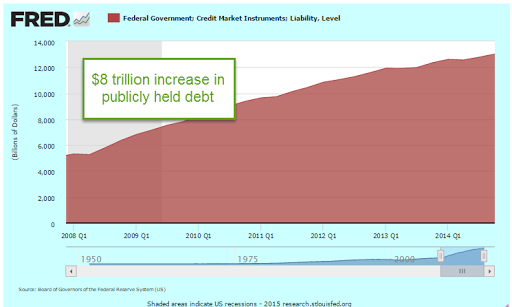
What about inflation?  Well, the government has already pumped in $8 trillion since the recession started in late 2007.

$8 trillion divided by a 300 million population is almost $27,000 per person.  Contrary to predictions of runaway inflation, it has been moderate or below the 2% target rate.  In fact, if we use the method of calculating inflation used in the Eurozone, we have had deflation in the first quarter of this year.   So any inflationary effect from a one time $100K boon would be less than disastrous.  Even if inflation climbed to a 1990s level, about 4 – 5%, what is the harm?

Most of us instinctively look at this scheme, furrow our brow, and get suspicious.  But why?  Why can’t a government with a fiat money system simply create heaven on earth?

Stay tuned till next week….