A Divided Country

July 6, 2025

By Stephen Stofka

Happy 4th to everyone. Despite the holiday weekend, the boys squeeze in a Sunday morning breakfast. The conversations are voiced by Abel, a Wilsonian with a faith that government can ameliorate social and economic injustices to improve society’s welfare, and Cain, who believes that individual autonomy, the free market and the price system promote the greatest good.

Cain settled into his seat as the busser set two glasses of water on the table. “We need another system of government.”

Abel gave him a questioning look. “They haven’t even brought the coffee yet, and you are rewriting the Constitution? I need to fasten my seat belt for this discussion.”

Cain laughed. “I’m disgusted with the corruption that is embedded in Senate rules. This monstrosity of a bill, what I call the ‘Big Bogus Bill.’ Senate Republicans bought Senator Murkowski’s vote, the critical vote, by exempting Alaska from some of the provisions in the bill (Source).”

Abel smiled. “This is the party you voted for. There are only  a few, like Rand Paul, Murkowski and Collins in Maine that are independent. The rest are automatons playing follow the leader. They are supposed to represent the interests of the people in their state, not the interests of their party leaders.”

Cain frowned. “Democratic leaders did the same thing in 2010 as they tried to get the Obamacare bill across the finish line.”

Abel interrupted, “That’s what this whole thing is about. Trump and the Republicans tried to repeal Obamacare in Trump’s first term. The House tried like fifty times. The repeal got so close, then John McCain gave his own party the thumbs down in the Senate vote on the repeal (Source). Now  Trump and the MAGA crowd are determined to undo as much of the ACA as they can.”

Cain frowned. “It’s a long standing grievance. Republicans have never had a filibuster proof majority in the Senate since the 17th Amendment instituted popular voting for Senate seats.”

Abel interrupted, “Well, it needed reform. Having the state legislatures elect their senators invited too much corruption. Senators were basically buying their seats.”

Cain nodded. “Good point. But it also allowed the states to check a President. I think we have lost that. We saw it this week when Trump threatened to primary Senator Tillis from North Carolina if he didn’t vote for the bill.”

Abel replied, “And Tillis told him to take a hike, basically. He said he wasn’t going to run again anyway. He’s disgusted by his own party acting like the President’s obedient pets. Trump was born with a silver spoon and yet he wants to take Medicaid away from a lot of people, including those in North Carolina. Tillis works for the people of North Carolina, not the spoiled brat in the White House.”

Cain sighed. “Too many wealthy people in the halls of power if you ask me. What was I, oh yeah, the filibuster. Every time that the Democrats get a filibuster proof majority, they pass a huge intergenerational social program that is not subject to the regular appropriations process. When people vote Republicans into power, Republicans have one hand tied. That’s not fair to the people who voted them into power. It’s like playing a game and the other player gets to make all the important rules.”

Abel argued, “Republicans have fought every one of those programs all the way up to the Supreme Court and lost every time.”

Cain nodded. “Republicans are still angry that John Roberts, the Chief Justice, voted with the liberals that the ACA was constitutional. A few months later, Obama defeated Romney, one of the old guard in the Republican Party. A few years later, Donald Trump appeared as the avenging angel (Source). He took on primary candidates from every faction of the party and won.”

Abel looked skyward. “Come on, this is not a Die Hard movie.”

Cain laughed. “That’s where you’re wrong. To some voters, Trump was like the tip of the spear, the leader of a resistance movement against big government.”

Abel frowned. “An agent of chaos who will destroy the Republican Party and the conservative values it has stood for. Is helping people that bad to so many Republicans?”

Cain smirked. “Democrats design programs that are not effective at helping the poor. We talked about that last week. The data supports my claim. These programs cost far more than the projected costs and the Democrats want to raise taxes on successful people to mask Democrat incompetence.”

Abel chuckled. “Yeah, right. Republicans promised that the Iraq war would pay for itself.”

Cain interrupted, “They expected that the revenue from more efficient oil production would defray a lot of costs, but they never promised that the war would pay for itself (Source).”

Abel replied, “Ok, you want to torture this like a lawyer? A lot of the American public was led to believe that the costs would be far less. How’s that?”

Cain argued, “Goes to prove my point. Policymakers and politicians have difficulty making projections. The Iraq war cost more than anticipated. That’s the nature of war. The war lasted like eight years. Look at the schemes the Democrats cook up. The programs have an infinite time horizon, so it’s impossible to project future costs with any accuracy. Democrats passed Medicare in 1965. Their leaders in the House Ways and Means Committee projected that the program would cost $9 billion a year by 1990. The actual cost was $67 billion (Source). So, either they were incompetent or lying. I suspect it was both.”

Abel asked, “So, what would you do? Cancel Social Security, Medicare, Medicaid, and other entitlement programs? While you are at it, why don’t you cancel the income tax amendment?”

Cain sighed. “Obviously, it’s not practical, but it’s not right that one party has dominated spending priorities for so many decades. It’s been sixty years since Medicare began. A lot of seniors think that payroll taxes and Medicare premiums pay for their care, but that’s not the case. Over a third of the costs are paid for by taxpayers out of general tax revenues. In 2023, that was $360 billion.”

Abel argued, “Those costs skyrocketed after the Republicans added Medicare Advantage and Prescription benefits to the program. Those two parts, Part C and D, cost more than half of Medicare spending. And why were those added? To help Bush win re-election in 2004. So I don’t want to listen to Republican sob stories about Democratic social programs. These programs mostly help people in red states who are older and poorer.”

Cain argued, “Look, you talk about Trump destroying the Republican Party? It was Bush and the old guard Republicans like Cheney who destroyed the party. They started acting like Democrats, passing legislation to get votes.”

Abel smirked. “Did it ever occur to you that it might actually be about helping people?”

Cain nodded. “Yes, it occurred to me. This is a country of many countries, too diverse for some one-size-fits-all program designed in Washington. The Constitution gives Congress the power to provide for the general welfare, not particular benefits given out to some individuals and not others. Only those programs, like national defense, the courts and the Post Office, which benefit everyone.”

Abel replied, “There’s always been a disagreement about what the general welfare clause in the Constitution means. In 1937, the Supreme Court noted as much when they found that the Social Security Act was constitutional. The court did not think it was their place to overrule the reasonable judgment of the legislature (Source). That is a prominent feature of the current court’s conservative majority. That the court should stay within its bounds.”

Cain nodded. “Ok, I’ll grant you that last point.. However, there are many of us who disagree with that broad interpretation of the general welfare clause. The fact that ‘common Defense’ and ‘general welfare’ are linked together in the same phrase is evidence that a narrow interpretation is appropriate.”

Abel asked, “Do you think this 6-3 conservative majority will overturn precedent and find the Social Security Act unconstitutional? They already overturned centuries of gun law with the Heller decision. They overturned decades of campaign finance law with the Citizens United decision. They overturned decades of abortion law with the Dobbs decision. I mean, why not go after Social Security, Medicare and Medicaid?”

Cain replied, “I think they would be mindful of both precedent and the consequences.”

Abel argued, “They didn’t care about the consequences in the Dobbs case with abortion. They didn’t care about the consequences of giving blanket immunity to Trump in last year’s decision (Source). The conservative justices are like politicians in any majority. It’s hard to see past their own principles and prejudices. In the Dred Scott decision that provoked the Civil War, Chief Justice Taney adopted a narrow originalist interpretation of the words ‘citizen’ and ‘territory’ in the Constitution. That led him to conclude that Negroes could not be citizens and that Congress had no authority to make laws for the Missouri Territory (Source).”

Cain raised his eyebrows. “Oh, I forgot that. He declared the Missouri Compromise unconstitutional.”

Abel asked, “Grade school test. When was the Missouri Compromise?”

Cain laughed as he raised his hand. “1820.”

Abel smiled. “Very good! You get a gold star.”

Cain sighed. “So much memorization back in those days.”

Abel replied, “Before we had librarians in our pockets. Anyway, the Missouri Compromise avoided secession and civil war in 1820. So, it should have been a good guess that voiding that compromise would aggravate tensions and lead to civil war, but Taney didn’t see it. He thought the court had resolved the issue once and for all. That’s my point. The logical application of our principles can lead us to disregard the consequences of our thinking. I’m afraid this court will follow a path of reasoning that will tear this nation apart, just like Taney did with the Dred Scott decision.”

Cain stared into his coffee cup, then looked at Abel. “That’s dark. You know, I wanted to get your feedback on the abortion ruling by the Wisconsin Supreme Court this week, but I promised my daughter I would join them on a picnic at the lake.”

Abel nodded. “And the Big, Beautiful Bill that passed this week.”

Cain smiled. “I’m still working through that bloated bill, but I thought it was clever the way Republicans had structured the bill so that the tax cuts happen in 2025 and 2026. The benefit cuts happen after the midterm election next year.”

Abel shook his head. “There are about 79 million people on Medicaid (Source). The Congressional Budget Office estimates that this bill will cause 12 million to lose their coverage (Source).”

Cain argued, “Yeah, but Medicaid enrollment already dropped 12 million after the expiration of the pandemic entitlements (Source). The world didn’t come to an end. So let’s say that Medicaid enrollment falls to 67 million. That’s still 20% above the levels of 2013 just before Obamacare kicked in (Source).”

Abel sighed. “It seems like so little gain for all the political upheaval it has caused.”

Cain shrugged. “Democrats probably could have accomplished that with small tweaks to the system. But no. As always, they wanted to completely rewrite policy in this country.”

Abel frowned. “So the tax goodies happen right away? People are going to be doing their 2025 taxes next spring and will see all these goodies. Manipulating public opinion just before the primaries start (Source).”

Cain slid out of his seat. “That’s politics. By stalling the benefit cuts, they avoid any repercussions before the election.”

Abel shook his head. “Seems so corrupt.”

Cain nodded as he turned to go. “It’s a game of power. That’s a big flaw in democratic systems. I still think we should have government by small tribunals.”

Abel laughed. “That’s basically how the Constitution was written. Anyway, see you next week. I think it’s my turn to pick up the check.”

///////////////////

Image by ChatGPT

Economic Cracks

February 17, 2019

by Steve Stofka

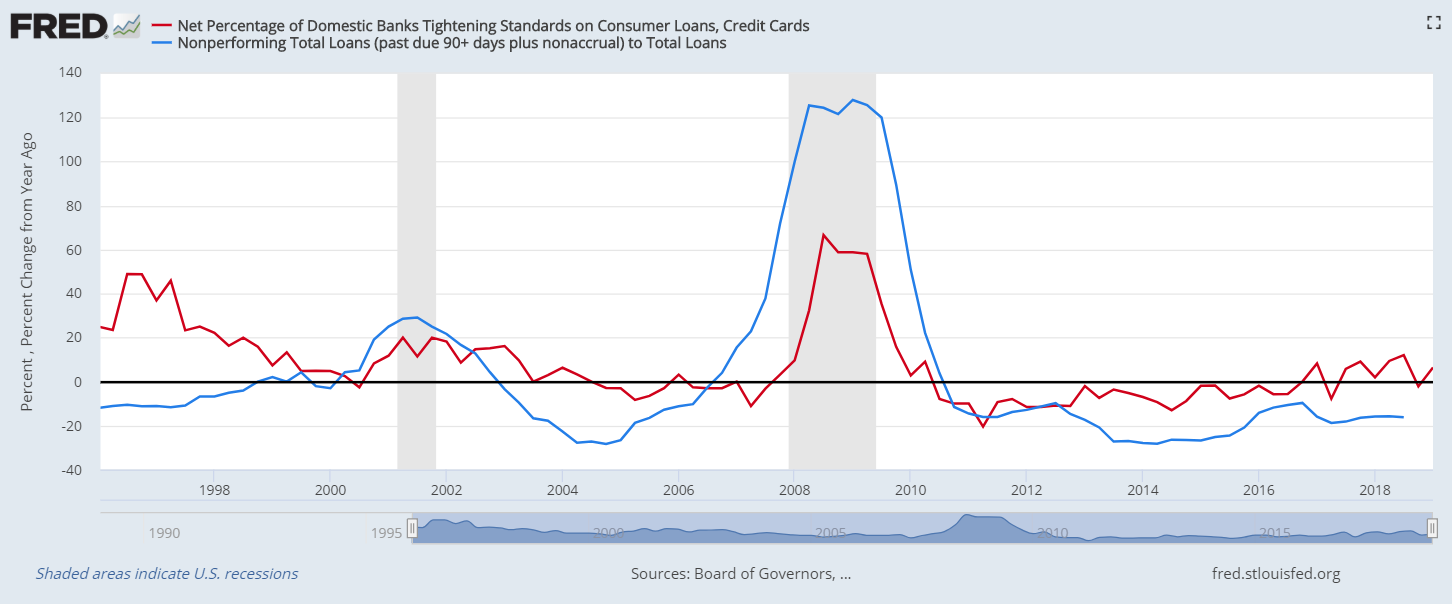
As the recovery enters its tenth year, there are signs of strain. As debtors struggle to pay their loans in a weakening economy, the percentage of non-performing loans increases.  The current rate of one percent indicates a healthy economy (Note #1). When the annual change in the rate of delinquency increases, that has been a reliable indicator that the economy is growing stagnant. Here’s a chart of the percent change in non-performing loans. A change above zero has preceded the last three recessions.

Non-PerfLoansChange

Let’s add one more series to the graph to help us understand the cycle of consumer credit. In the graph below, the red series is the percentage of banks tightening lending standards. Notice how the banks respond to a rise in delinquencies by being more selective in their credit criteria. Eventually, this tightening of credit leads to a recession. The cycle is as natural as the ocean currents that distribute heat around the planet.

NonPerfBankTighten

The financial news agency Bloomberg reports that delinquent auto loans are the highest since 2012 (Note #2). Bankrate reports that credit card debt has risen since last year. Less than half of people surveyed have emergency funds (Note #3).

December’s retail sales report, released only this week because of the government shutdown, showed a surprising decline of 1% from November. Have some consumers reached their limit? Retail sales, adjusted for inflation and population growth, does not show the strain so far. Look at the period from late 2015 through late 2016 when sales growth consistently slowed below 1%. That was a key factor that cost Hillary Clinton the election. Trump turned voter dissatisfaction into an electoral victory in the Midwest.

RetailRealAdjPop

Politicians ride to power on the anger of voters. In 1994, Republicans overcame forty years of Democratic rule in the House by promising less regulation and lower taxes in a “Contract with America.” When the Supreme Court decided the 2000 election in favor of a Republican president, they enacted tax cuts to reverse the tax increases passed by Democrats in 1993. In 2006, voters were angry with the incompetent Bush administration and reinstalled Democrats in the House.

In the depths of the Financial Crisis in 2008, Democrats rode a wave of anger, despair and hope to take the White House and command a filibuster proof majority in the Senate for the first time since the post-Watergate Congress thirty years earlier. Such a rare majority indicated that voters strongly wanted a solution to the crisis (Note #3). The Obama administration and Democratic Congress protected the financial and insurance industries while ordinary people lost their homes and their savings. The one piece of legislation that emerged from that majority was Obamacare, the bastard child of back alley compromises between mainstream Democrats and the health care industry. Few who voted for it knew what was in the bill.

In 2010, Republicans rode the anger wave of the Tea Party caucus to retake the House. With an equal number of Senate seats up for re-election, Republicans took six seats from Democrats and ended their filibuster proof majority (Note #4). In 2014, voters handed the Senate back to Republicans, then gave the reins entirely to the Republicans with the election of Donald Trump to the presidency in 2016.

In 2018, Democrats rode a wave of anger to take back control of the House. Social media campaigns whip up indignation to fan the flames of voter anger in the hopes that Democrats can at least take back the presidency in 2020. Voters may not be in enough economic distress to give Democrats control of the Senate in 2020, but it is the Republicans who have the most seats up for re-election this coming Senate cycle (Note #4).

Credit expands and contracts in a seasonal multi-year cycle. Banks are tightening in response to higher delinquencies. Will the timing of the credit cycle coincide with the 2020 election?

///////////////////////////

Notes:
1. In 2016, China, Japan and Germany had rates below 2%; the U.K. and Canada had less than 1%. On the high side, Greece had 36%; Italy had 17%, and Spain had 7%.
2. Why are so many people delinquent on auto loans? Bloomberg
3. In 1964, the Supreme Court forced the states to redistrict their state legislatures based on population changes. For fifty years, Democrats were sometimes able to forge filibuster proof Senate majorities because racist Southern states were effectively one party Democratic states. Reynolds v. Sims . Since the ratification of the 17th Amendment in 1914, Republicans have never had a filibuster proof majority
4. A third of Senators are up for election every two years so party advantage shifts with every election cycle.

Retail, Housing, The Fed And More

Last week I pointed to several contradictory outlooks for sales in the upcoming holiday season.  Bill McBride at Calculated Risk has several charts on the import and export volume at the port of Los Angeles.  The import data indicates that businesses were buying goods in late summer and the fall in anticipation of a good holiday season.  Both Home Depot and Best Buy reported better than expected earnings on Tuesday but Best Buy’s sales were less than expected.  The company cited increasing pressure from online retailers.  E-Commerce continues to take an ever increasing share of the retail sales market.

Amazon is now making more money selling other vendors’ products than it does its own.  Vendors typically turn over much of the sales, shipping and billing process to Amazon.  Businesses, including mine, are increasingly turning to Amazon for parts or supplies.  Why?  Amazon has become an easy to search portal for so many vendors and the prices are competitive.  Why spend time searching the web for long discontinued parts when Amazon has already done that?  What is even more surprising is the enormous volume of third party items that Amazon now stocks and, surprisingly, the items are received from Amazon, not the vendor.

On Wednesday, the monthly report of retail sales showed a .4% month on month gain, causing analysts at Morgan Stanley to reverse their earlier dour opinion of the coming holiday season.  The year over year gain is at 4% but retailers that target lower income consumers are experiencing some difficulties.  J.C. Penney reported sales and earnings that were disappointing.  After an earlier upbeat report from the home improvement chain Home Depot, Lowe’s reported strong sales and earnings, confirming the continuing strength in this sector.  Later in the week, Target issued a disappointing earnings report.  Will the ongoing decline in gas prices leave working class families with enough extra cash in their wallets this Christmas season?  Wal-Mart, Target and J. C. Penney hope so.

**************************
[Revised to clarify the two separate housing indexes below]

 October’s housing market index reading of 54 from the National Assoc of Homebuilders indicated continuing strength in the new home market.  This index is a composite of factors, including sales, inventory, builder expectations and traffic.  The series, like the industrial reports, is indexed so that 50 is the neutral mark, indicating no net growth.  Although the overall index has declined from the summer peak, both sales and expectations are in the strong to robust growth.

The Federal Housing Finance Agency tracks an index of home prices (only).  Major markets on both the east and west coasts are still below the bubble peaks of 2005 – 2006.

From 1983 to 1999, the average house cost 13 to 15 years worth of rent.  This baseline is a good rule of thumb when pricing out houses.  In 2006, at the height of the housing bubble, houses were selling for 25 years worth of the average monthly rental.  Los Angeles experienced a much greater price inflation during the 2000s than either SF or NYC.  Although the nationwide economy is growing steadily but slowly, Los Angeles has responded to the strong growth in manufacturing throughout the country. Asking rents for industrial properties in L.A. are rocketing upward this year, accelerating from the strong three year growth and exceeding the price levels of 2007.

http://www.loopnet.com/xNet/MainSite/Tools/WidgetHTML.aspx?WidgetType=50&CountryCode=US&StateCode=CA&State=California&CityName=Los+Angeles&SiteID=1&TrendTypeID=2&PropertyTypeID=40&ListingType=LEASE&PropertyType=Industrial&TrendType=Asking%20Rent Available Office and Industrial property in the LA area is at multi-year lows.

http://www.loopnet.com/xNet/MainSite/Tools/WidgetHTML.aspx?WidgetType=50&CountryCode=US&StateCode=CA&State=California&CityName=Los+Angeles&SiteID=1&TrendTypeID=5&PropertyTypeID=80&ListingType=LEASE&PropertyType=Office&TrendType=No.%20of%20Spaces

Los Angeles, CA Market Trends

**************************

http://www.loopnet.com/xNet/MainSite/Tools/WidgetHTML.aspx?WidgetType=50&CountryCode=US&StateCode=CA&State=California&CityName=Los+Angeles&SiteID=1&TrendTypeID=5&PropertyTypeID=40&ListingType=LEASE&PropertyType=Industrial&TrendType=No.%20of%20Spaces
The Consumer Price Index released Wednesday showed a tiny decrease in inflation for the month.  The year over year change was 1.7%, indicating that demand at many levels is positive but weak so that there is little pressure on prices.  On Thursday, the Producer Price Index (PPI) confirmed that the supply chain is experiencing very low upward pressure.

***************************

The PMI Flash Index, a preview of the upcoming report on the manufacturing sector, confirmed the continuing growth in the manufacturing sector.

***************************

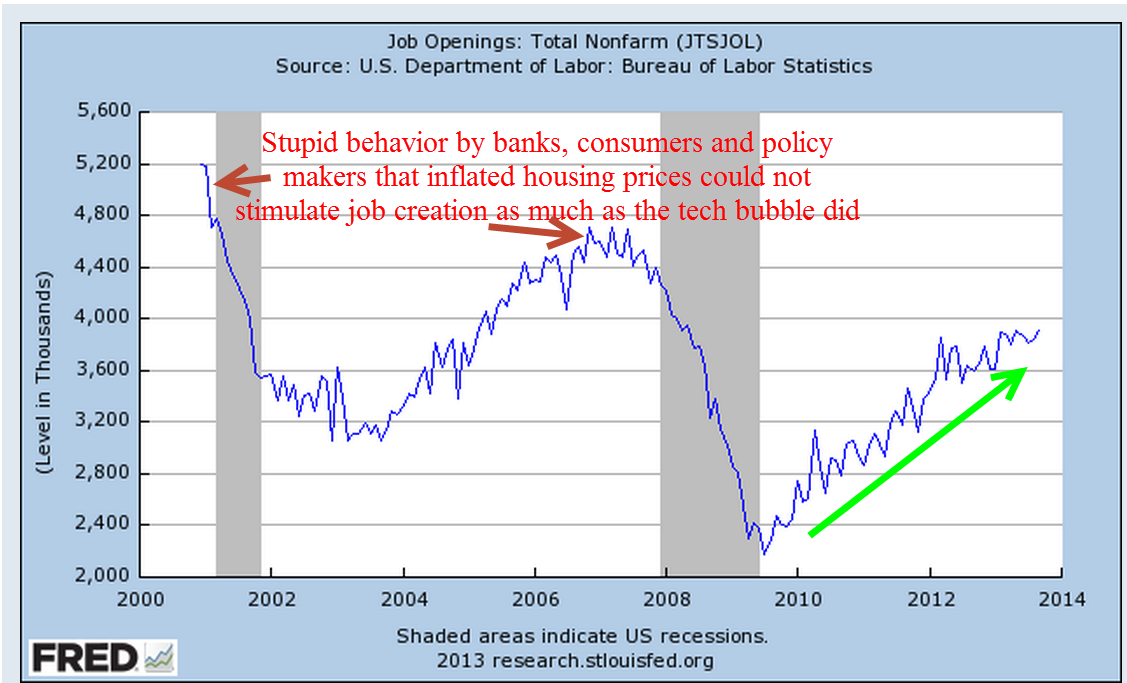
The Job Openings and Labor Turnover Survey (JOLTS) by the BLS was released on Friday.  Unlike the timeliness of the monthly Employment report, this one lags by a month but does provide a more comprehensive analysis of the growth or decline in the labor market.  The BLS surveys employers at the end of the month, September in this case, for job openings and layoffs.  A job opening can be full time, part time, seasonal or temporary so the data can be skewed by seasonality factors.  The longer term trend, though, is apparent.

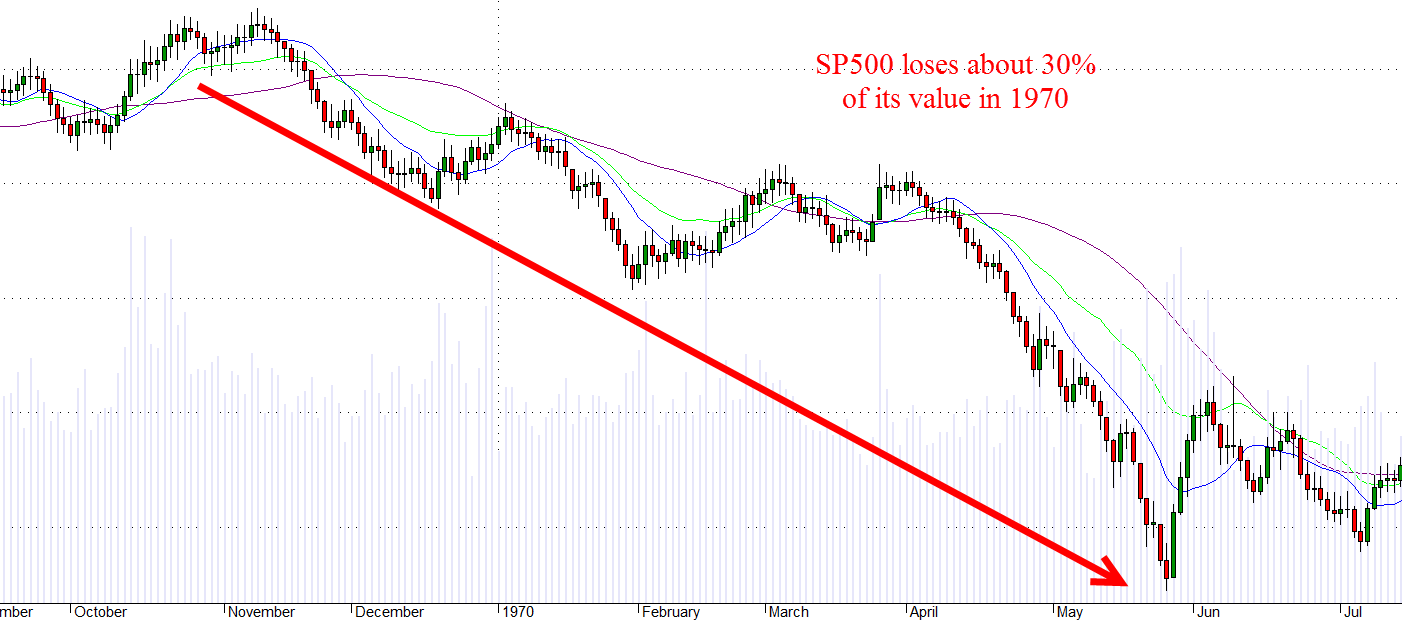
It may be several more years before job openings reach the level attained during the tech boom of the late ’90s.  Like the gold fever of the mid-19th century, investors poured money into a lot of ventures with little more than a napkin sized business plan.  This pattern of bubble and bust is fairly typical when game changing technologies emerge.  The spread of the telegraph and railroads led to horrific recessions in the late 19th century, culminating in the depression of 1893-94.  The rise of radio in the 1920s prompted speculative fever that contributed mightily to the crash of 1929, setting the stage for the bad monetary policy and haphazaard fiscal policies that fed the depression of the 1930s.  In the 1960s, a rush of investment in airlines and war funding helped fuel a frenzy of speculation that crashed in 1970.

******************************

In Washington this week, the Senate voted to change the rules for Senate confirmation of most executive and judicial appointments, the so called “nuclear option” that requires only a majority vote for confirmation.  This modification of the filibuster rule should have been done ten years ago when then Democratic Senate Minority Leader Tom Daschle led filibusters to block many of George Bush’s appointments.  Since then, the Senate has grown ever more dysfunctional, incapable of even ordering pizza.  Under the elitist filibuster rules, each Senator could act like a despot or one of the “Knights who say ‘Nee’!” in the comic movie “Monty Python and the Holy Grail.”  A Senator representing 300,000 people in Wyoming could nix or delay an executive appointment – this in a country of over 300 million. Sounds a bit like England in the 1770s. A lot of people died in the Revolutionary War so that America would not be a country ruled by a despot, be it a king or a Senator.

*******************************

The rule change makes the confirmation of Janet Yellen as the next chair of the Federal Reserve a near certainty. In a speech at the Cato Institute’s Annual Monetary Conference, Charles Plosser, President of the Philadelphia branch of the Federal Reserve, made a good case for some restraint by the Federal Reserve – not in the amount of debt the Fed purchases but the type of debt:

“[The Federal Reserve’s] purchase [of] specific (non-Treasury) assets amounted to a form of credit allocation, which targets specific industries, sectors, or firms. These credit policies cross the boundary from monetary policy and venture into the realm of fiscal policy.”

Mr. Plosser would rather see politicians, not central bankers, decide which industries to favor through bailouts or loan purchases.  In a democratic republic like ours, if the politicians in Washington want to bailout banks or the housing sector, they can do so by issuing general debt obligations, Treasuries, which the Federal Reserve can buy.  Gridlock in Washington has prevented them from reaching any consensus about these policies, leaving it up to the Federal Reserve to act in their place, to make political decisions which compromises the neutral stance that a central bank should have.

Now, we might say that the result is the same so what’s the big deal?  Knowing that Fed chairman Ben Bernanke would come to the rescue has allowed politicians to not make difficult compromises.  Why should they?   If Congress does less, the Fed does more.  Because it can be so difficult to enact their agenda through the political process, Presidents and political parties turn to the Fed as the fourth branch of government.

Plosser also questions the dual target of both inflation and unemployment that the Fed has assumed as its mandate.  The law states that the Fed should enact monetary policy that is “commensurate” with the “long run potential to increase production.”  Since the recession began in 2008, the Fed has adopted a series of “QE” short term measures designed to decrease unemployment and Plosser’s view is that these are not part of the job description.  Plosser will be a voting member in 2014.  His vote of restraint is unlikely to hold much sway with Janet Yellen, who is ready to keep the cornucopia money machine flowing.

****************************

In the Wall St. Journal’s Washwire Blog, Elizabeth Williamson writes that the White House is conducting a self-assessment in the wake of the health-law launch, “recognizing that administration officials missed warning signs and put too much trust in their management practices.”   What on earth has given this administration any reason to trust their management practices?  Was it their management of the attack on the U.S. consulate in Benghazi in September 2012?  Or perhaps the “red line” that President Obama drew with Syria, promising a military response if Syria used chemical weapons against its own people?  Or the terribly mismanaged mortgage relief program, HAMP, that former Treasury Secretary Tim Geithner put in place?

This is only a partial list of the persistently poor management practices that have marked this administration.  It began with the poor preparation in advance of the March 2009 meeting with the nation’s largest banks, leading Obama and Geithner to offer generous terms to the banks when the banks would have accepted any terms in order to stay alive.  The crafting of the stimulus bill was an example of indecisive leadership and management at one of those rare times in history when both houses of Congress were controlled by the President’s party.  Using a basketball analogy, the administration blew a layup.

Now comes the news that the Obama administration wants to exempt some union health care plans from a “reinsurance tax” – about $63 per person per year – that all plans under the ACA health care law pay.  How will they do this?  By a carefully worded exemption that applies only to self-administered health plans.  A little background.  Many big companies self-insure and hire an administrator like Blue Cross to take care of the details.  Under the Taft-Hartley act passed after World War 2, employers often in the same industry may collectively construct or join what is essentially a health insurance trust, offering their employees insurance through the trust.  These plans are called “Taft-Hartley Multi-employer Health and Welfare Plans” and are really a benefit in the construction trade because they enable smaller employers to offer employees – usually these are unionized employees – a health plan at more affordable rates, taking advantage of the larger pool of insured offered by the trust.  It also enables employees to move from one company to another and retain their health insurance.  The plans are defined as self-administered even though the trust may contract out the details of daily management to a third party.   So here is a plan that fills a need and offers a benefit to both employers and employees.  Labor unions, like everyone else, want special treatment, of course, so they have been lobbying for an exemption from this rather small tax.  In September the Huffington Post reported that the unions were having little success in lobbying for another exemption – the ability of these plans to qualify for subsidies as though they were individual health care plans.

With a history of spineless leadership from an Obama administration that can’t say no but can’t say yes either, unions will continue to press for special treatment.  Finally, even they may get disgusted with an administration that can’t take a stand.

Like the Durango-Silverton narrow gauge train, the stock market chugs up the hill.  Production, sales and employment reports are either strong or not too bad or neutral but not bad.  Short, mid and long term volatility measures are subdued.  Gold has been drifting steadily down, nearing the lows of July.  Of course, some say that the time to get worried is when no one is worried.

The biggest worry for many in the coming week may be a dry turkey, or a heated discussion about politics.  Do pass the sweet potatoes if asked even if that so-and-so relative of yours is dumber than the potato.  Happy Turkey Day!