Problems and Solutions

October 15, 2023

by Stephen Stofka

This week’s letter is about how we process information. I’ll cover everything from investing and FTX to Sesame Street so buckle in. This week’s topic was prompted with my exchange with two people at an online help desk. People who handle a lot of email probably skim the emails they receive without paying too much attention to the details. As a result they become less responsive to customer inquiries and problems. Tuck that word responsive into your pocket. It is a key feature of interpersonal relationships and how web pages are supposed to respond to our mouse clicks and keyboard strokes.

In a complex society, there are many principal-agent relationships. We rely on other people to intermediate a problem we are having. We do not have the knowledge or the capability to reach a solution by ourselves. Often these roles are formalized and licensed. The agent must have some training and testing. Examples include a doctor, electrician, an insurance agent, a real estate or securities broker. However, we often engage with people for which there is no standard of training or testing. People on a help desk – customer service reps – are examples of this type of agent. They may have received training by the company they work for but there is no formal standard. It is up to each company to decide how to spend its resources.

Two weeks ago I had a legal matter with a large bank and wanted to know if I needed a type of notarized affidavit or was there a simpler solution. The person I reached at customer service did not know the answer but repeated the gist of the problem back to me, indicating that they understood the nature of my problem. After thirty seconds of waiting she came back with an answer that was appropriate to the problem I stated, confirming that the person had listened and understood my problem. Within minutes the problem was resolved and I could see confirmation of the solution. This past week I had a technical problem with a computer program. The online customer service rep could neither help me resolve the problem nor respond appropriately to the problem I presented. A second service rep was also unresponsive. This company touts itself as a leader in responsive technology and design. A search within a customer forum suggested a solution which worked.

I have been a customer service rep and trained reps in the days before the widespread use of computers. We wrote out general classes of problems that customers had and the questions that needed to be asked to determine a path toward resolution. A rep might fail to recognize that a specific problem belonged to a general set of similar problems. They did not know enough about the company’s business to comprehend a suitable classification so that they could reference the correct question and present a way forward to the customer. Companies now have powerful search engines that can empower customer service reps. Are they deploying those tools and training reps properly? I fear not. We can do better.

Being able to classify events and data is a skill that we begin learning early. Those who watched Sesame Street may remember “One of these things is not like the other” drills. Presented with a picture of a dog, a horse, a cow and a bird, which one is not like the others? We learn to compare and contrast, to extract qualities from individual objects that are similar and different. Is the bird different because it has two feet, because it has a beak or because it is small compared to the others? Was the horse different because it had hooves and the others didn’t? Why is that not the best choice? We learn to reason.

As adults we learn to classify cancerous tumors from x-rays, to identify money-making schemes that are too good to be true, to assess the risk of recessions or asset bubbles. Despite extensive training and experience, these are all difficult to classify. A second radiographer reviews a mammogram to reduce diagnostic errors. Every day people fall for a swindle because they cannot see the similarity with other swindles. This week’s trial of FTX founder Sam Bankman-Fried is an example of our vulnerability in this area. Economists and financial advisors are often surprised by recessions and asset bubbles. The financial crisis in 2008 caught many economists off guard. Irving Fisher, a leading economist during the early part of the 20th century, expressed his confidence in the stock market and was fully invested when the stock market crashed in 1929. He lost all his savings and spent the rest of his life in poverty, beholden to some charitable benefactors for a place to live and a respite from debtor’s prison.

As individuals we are not good at processing the amount of information we encounter. In a complex society, the information can be disorienting so we rely on others to help us digest it. Our society and culture provides props that we use as shortcuts, or heuristics, to navigate the load of information. A foundational assumption of economics is that we want to maximize our sense of satisfaction. To do that, we must choose among the resources available to us. We may not know how to achieve the satisfaction we desire but we care about achieving it. Schemers and promoters take advantage of us because we care about our satisfaction. 

Because we rely on others to help us navigate toward greater satisfaction, we are vulnerable to get-rich schemes. We want to be more financially secure so we invest in FTX tokens or pay a monthly fee to get hot stock tips that will turn our meager savings into a comfortable cushion of cash. In our search to satisfy our wants, we don’t think to ask if this solution is easily accessible, why isn’t everyone financially secure? We are told that we are getting in early on an idea and when the idea becomes popular, we will reap the rewards of recognizing a golden opportunity. We may be reminded of Amazon or Microsoft and the astronomical gains of those who invested early and held on.

We must put up with customer service reps that don’t respond appropriately to our questions or problem. We must be on guard against those who promise solutions before we have even presented our problem. Our greatest challenge is that we are both agent and principal in many of our financial affairs. We may not become better informed agents and protect our savings and assets until have we have been hooked like a fish by some promoter.

////////////////

Photo by Jon Tyson on Unsplash

Keywords: utility, satisfaction, classification, diagnosis, swindle, security

The Protected

September 3, 2023

by Stephen Stofka

This week’s letter examines the proliferation of lawyers in America and how they are reducing our economic productivity. In grade school civics class, we were taught that America is a nation of laws; that no one is above the law. Since the 1960s we have become a nation of competing rights, not laws. An army of lawyers stands ready to argue the cause of any business or advocacy group with access to sufficient funds. Those who can afford the legal bills can lengthen legal proceedings against them for a decade or more. Conflicts over land use hamper infrastructure projects and housing reform.

In 2018, Steven Brill, author of Tailspin and many other books, wrote an article in Time magazine titled “How Baby Boomers Broke America.” Brill is a Yale educated lawyer who founded Court TV several decades ago. Brill noted that the best and brightest among us, particularly those in the financial and legal professions, have become part of a protected class. They are shielded from the laws that govern the rest of us, the unprotected class. The professional class claims to have the public’s best interest at heart but it often acts to protect itself first at the expense of the public interest and social mobility.   

In 1951 there were 220,000 lawyers for 155 million people in America, according to the American Bar Association (ABA). That represented a ratio of one lawyer to 700 people. is  In the 1960s and 1970s, Congress passed much social and environmental legislation that left the actual rulemaking up to lawyers at federal and state agencies. During the 1970s, businesses hired many lawyers to thwart the impact of this new legislation. By 1984, the number of lawyers had tripled to 664,000 for a population of 237 million, a ratio of one lawyer to 357 Americans. In an annual address to the ABA that year, Chief Justice Warren Burger remarked on this worrisome trend, warning that society would be overrun by hordes of lawyers. By 2018, there were 1.1 million lawyers for 315 million people in America, the highest number of lawyers per capita in the world. Just five years later, there are now 1.3 million lawyers, a ratio of one lawyer for 255 people.

With the advent of Johnson’s Great Society and the Environmental Protection Act in the 1960s, the burden of regulation grew heavy. Large companies hired lawyers to discover and develop loopholes that created a legal safe harbor from the regulatory machine. Burdened by regulation, smaller companies became less efficient, making them less competitive. Wage gains which might have gone to workers now went to accountants, lawyers, government and insurance fees to protect business owners from the fines and liabilities of the new regulations. Larger companies, able to wield more legal power per dollar of revenue, absorbed their smaller competitors, giving larger companies greater pricing power.

In 2021, the American Bar Association listed 175 members of Congress with law degrees, a third of the 535 members of the House and Senate. By design, bargaining or incompetence Congress writes laws in imprecise language, leaving it up to the legal staff of executive agencies and the courts to determine what Congress meant. There is a public outcry against rule by unelected bureaucrats and judges but in an evenly divided electorate, those unelected officials protect the minority of 49 from the abuses of the majority 51. Computer algorithms enable a slim majority in a state to gerrymander voting districts to give one party representative power that enfeebles the 49% who belong to the other party. Those who control the democratic process control the power.

The growing adoption of computer technology in the late 1980s inspired the hope that automation would reduce the need for lawyers. Instead, compliance and regulatory work has increased each year. A 2017 CNBC article speculated that Artifical Intelligence (AI) might replace lawyers. Its doubtful that lawyers would allow that to happen. They write the rules that protect them from the rules, including the rule of competition. John Dingell, former Congressman from Michigan, once said “If I let you write the substance and you let me write the procedure, I’ll screw you every time.” Like an infestation of grasshoppers in a field of plants, too many lawyers diminish the productive vitality of our economy.

//////////////////

Photo by Wesley Tingey on Unsplash

Keywords: finance, law, lawyers, regulations

A Labor-Output Ratio

February 19, 2023

by Stephen Stofka

When analyzing the economies of some developing countries, economists refer to a “resource curse,” a commodity like oil or minerals that a country can sell on the global market. In a developing country, that commodity may become the main source of foreign currency, used to pay for imports of other goods. The extraction of that resource requires capital investment which usually comes from outside the country. If the production of that resource is not nationalized, most of the profits leave the country.

There are a few big winners and a lot of losers. This uneven ratio promotes economic and social inequality. Political instability arises as people within the country want to get a hold on those resources. Some politicians promise to use the profits from the resource to benefit everyone but those who seize power benefit the most. Political priorities determine economic decisions and the production of that resource becomes inefficient.

A key factor in the “resource curse” is that its contribution to GDP is usually far above its contribution to employment. If a mining sector accounts for 2% of employment but contributes 10% to GDP, the ratio of employment / GDP % equals 2%/10%, or 0.2. Ratios that are far below 1 do not promote a healthy economy. Industries that are closer to a 1-1 ratio will produce a more well rounded and vibrant economy because employed people spend their earnings in other sectors of the economy – a diffusion effect. Some economists might say that a low ratio means that capital is being used more efficiently and attracts capital investment. However, that efficiency comes at an undesirable social and economic cost.

 Let’s look at some examples in the U.S. The construction industry contributes 3.9% to GDP (blue line in the graph below) but accounts for 5.1% of employment (red line). Notice that this is the opposite of the example I gave above. The 1.31 ratio of employment/GDP is above 1, meaning that the industry employs more people for the direct value that it adds to the economy.  Construction spending includes remodels and building additions but does not include maintenance and repair (Census Bureau, n.d.). In the chart below, look at how closely GDP and employment move together. The divergence in the two series since the pandemic indicates the distortions in the housing market because of rising interest rates. Builders have put projects on hold but employment in the sector is still rising because of the tight labor market.

The finance sector’s share of the economy has grown since the financial crisis yet employment has remained steady – or stuck, depending on one’s perspective. The great financial crisis put stress on banks, big and small, but the government bailed out only the “systemically important” banks, leaving smaller regional banks to fend for themselves. The larger banks absorbed many smaller banks, leading to a consolidation in the industry. That consolidation and investments in technology helped the sector become more efficient. The ratio is about 0.75, above the 0.2 ratio in the example I gave earlier. I labeled the lines because the colors are reversed.

Retail employs a lot of people relative to its contribution to GDP. The ratio is about 1.65. Does that mean retail is an inefficient use of capital? Retail sales taxes pay for many of the city services we enjoy and take for granted. Retail is the glue that holds our communities together.

The manufacturing sector employs fewer people in relation to its GDP contribution. It’s ratio is 0.77, about the same as finance.

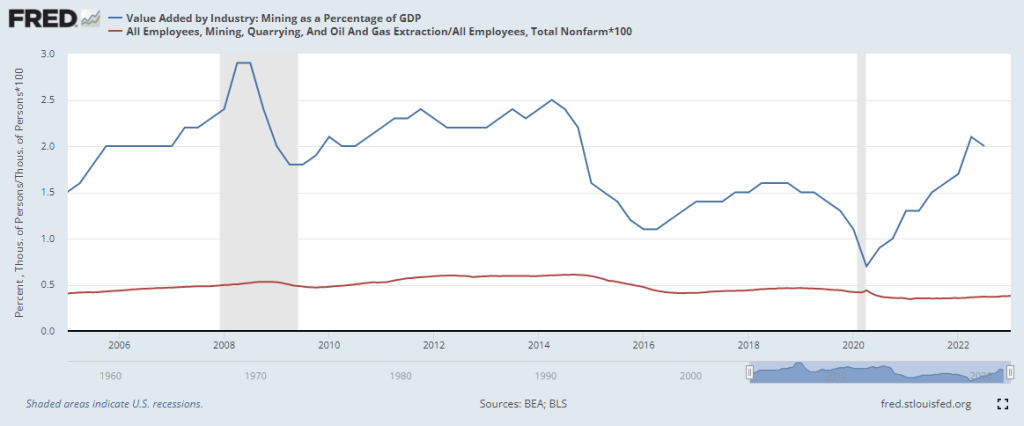
As I noted earlier, the mining sector is capital intensive with a high ratio of GDP to employment. This sector includes gas and oil extraction. In the U.S. that ratio averages about 0.33 but it is erratic global demand. Look at the effect during the pandemic. In our diversified economy, the mining sector contributes only a small amount, like 2%. In a developing country like Namibia in southern Africa, mining accounts for 10% of GDP. In the pandemic year, the demand for minerals declined and Namibia’s economy fell 8%.

Lastly, I will include the contribution of health care, education and social services, which contribute 7.5% to GDP but employ almost a quarter of all workers. Since the financial crisis and the passage of Obamacare, this composite sector contributes an additional 1% to GDP. These sectors include many public goods and services that form the backbone of our society. The 3.0 ratio is the inverse of the mining sector.

To summarize, the construction, retail, health care and education sectors have a ratio above 1. They employ more people for each percentage unit of output. The finance, manufacturing, mining, oil and gas sectors have ratios less than 1, employing fewer people per percentage unit of output. For readers interested in the GDP contribution of other industries, the Federal Reserve maintains a list of charts, linked here [https://fred.stlouisfed.org/release?rid=331].

//////////////////

Photo by Camylla Battani on Unsplash

Census Bureau. (2019, April 15). Construction spending – definitions. United States Census Bureau. Retrieved February 16, 2023, from https://www.census.gov/construction/c30/definitions.html

U.S. Bureau of Economic Analysis, Value Added by Industry: Construction as a Percentage of GDP [VAPGDPC], retrieved from FRED, Federal Reserve Bank of St. Louis; https://fred.stlouisfed.org/series/VAPGDPC, February 12, 2023.

U.S. Bureau of Labor Statistics, All Employees, Construction [USCONS], retrieved from FRED, Federal Reserve Bank of St. Louis; https://fred.stlouisfed.org/series/USCONS, February 12, 2023.

U.S. Bureau of Labor Statistics, All Employees, Total Nonfarm [PAYEMS], retrieved from FRED, Federal Reserve Bank of St. Louis; https://fred.stlouisfed.org/series/PAYEMS, February 12, 2023.

I will not do a complete reference for each series. Here’s the identifiers for each series: Finance Value Added – VAPGDPFI. Employment in finance – USFIRE. Construction employees – USCONS. Retail Value Added – VAPGDPR. Retail Employees – USTRADE. Manufacturing Value Added – VAPGDPMA. Manufacturing Employees – MANEMP. Education, Health Care, Social Services Value Added – VAPGDPHCSA. Employment is a composite of 4 series. Mining Value Added – VAPGDPM. Mining Employment – CES1021000001

Obligate Growth

This week Goldman Sachs announced that they were raising the starting salaries for entry level analysts to $110,000 from $85,000. When I heard that on the radio, I remembered the bailout of Goldman Sachs a dozen years ago. I thought of the many hospital workers who have risked their lives during the Covid crisis. Most were not making that kind of money. Under capitalism, market transactions direct resources but do they signal a society’s values?

In Sustainable Capitalism, John Ikerd (2005, 4) calls for a balance of our self-interest with our common-interests, citing the classical economists like Adam Smith who recognized that a market system must work within the ethical bounds of society (2005, 4). There is no point to capitalism if the wealth that the system can generate does not improve the general well-being of a society. Capitalism directs resources but only for goods where two parties can agree on a value. It’s hard to find common agreement on the value of many public or common goods. The infrastructure bill being negotiated in Congress this year bears witness to that reality. What is the value of a well-lit street, improved cable systems, safer electrical generation and the many public goods that we take for granted?

Capitalism evolved to assemble and deploy investment for shipping ventures, and to diffuse the extreme risk of shipping goods across oceans. In the 18th century as many as half of all ships returning to England laden with goods from India were lost at sea. Most ventures were launched without insurance. In the 17th century, insurers often went insolvent and could not cover a great loss (Johns 1958, 126). Many did not know how to price risk. In 1720, Lloyds of London and the Royal Exchange were formed to spread the risk. During the American Revolution the British government contracted out the shipping of armaments and British troops to the colonies. In 1780, a series of sea battles between the British, Spanish and French fleets severely damaged the West Indian fleet and caused great losses to underwriters (Johns 1958, 126). Loss is a good teacher of better risk management.

The underlying principle of capitalism is constant growth. In these early centuries the destruction of capital provided a natural constraint. In the 19th century, inflation from government money printing was another natural constraint (Formaini, n.d.). The capital grew but it bought less. The growth of most populations hits the bounds of their environment. Rabbits run out of food and the population periodically crashes. In the last century following World War 2, economists thought that countries who adopted democracy and capitalism would develop into thriving markets for capital. After key losses, capital managers became reluctant to deploy investment into poor countries without infrastructure, institutions and respect for private property.

Decades later, economists and political scientists now question that growth hypothesis. According to that theory, India and some former African colonies should be thriving. They are not. Given the global constraints of growth, the competition between capitals produces a concentration of capital in fewer multi-national corporations. Countries become segregated into two groups: those whose people are still very much engaged in agriculture and those whose people are engaged in services and to a lesser degree industrialization.

Agriculture is an economic trap because it is seasonal. Farmers harvest a particular crop at the same time and their competition drives the prices down. That is good for everyone except the farmers. Weather events can affect an entire region whose economy is dependent on crop production. As more farmers give up or lose their farms, large corporations take over the land. Their size and dispersal across several regions diffuses risk just as the insurance pools brokered through Lloyds of London in the 18th century.

As capital flows become more concentrated, the pool of those who benefit becomes smaller and smaller. Adam Smith’s “invisible hand” no longer spreads a general sense of well-being to the greater community. A few industries, like finance, prosper while many struggle and scrabble for the remains.

Those on Wall Street make a lot of money, but it is highly competitive and stressful. When Goldman Sachs did an internal survey of entry-level analysts at their firm, those analysts reported working an average of 95 hours a week to meet the upswell of client demand as the Covid vaccine led to a lifting of restrictions (McCaffrey 2021). Many reported physical side-effects from the long hours and stress. That $110,000 a year works out to $23 an hour. The median pay for a plumber is $28 an hour. Those entry level analysts suddenly don’t look like titans of industry. Many have student debt. They live in New York City with its high cost of living. Many probably thought that, if they could hang on for a year or two, their load would lighten and all their study and hard work would pay off. They are on capitalism’s hamster wheel. How long can the wheel keep turning?

///////////////

Photo by dylan nolte on Unsplash

Bureau of Labor Statistics (2021). U.S. Department of Labor, Occupational Outlook Handbook, Plumbers, Pipefitters, and Steamfitters. Available from https://www.bls.gov/ooh/construction-and-extraction/plumbers-pipefitters-and-steamfitters.htm (visited July 17, 2021).

Formaini, R. L. (n.d.). David Ricardo Theory of Free International Trade (2nd ed., Vol. 9) (Federal Reserve Bank of Dallas). Dallas, TX: Federal Reserve.

Ikerd, J. (2005). Sustainable Capitalism [Scholarly project]. In University of Missouri. Retrieved August 06, 2021, from https://faculty.missouri.edu/ikerdj/papers/WIMadisonSustainCapitalism.pdf

John, A. H. (1958). The London Assurance company and the marine insurance market of the eighteenth century. Economica, 25(98), 126. doi:10.2307/2551021

McCaffrey, O. (2021, August 02). Goldman Sachs Is Giving Entry-Level Bankers a Nearly 30% Raise. Retrieved August 07, 2021, from https://www.wsj.com/articles/goldman-sachs-is-giving-entry-level-bankers-a-nearly-30-raise-11627930285

Financial Regulation

In 1966, Congress passed the Fair Packaging and Labelling Act, which required manufacturers of retail products to list the contents and weights of their products. The food industry fought hard against it. Breakfast cereal makers were accustomed to packing their cereal in big boxes to trick the consumer into thinking that they were getting more product.

In 1969, Congress tried to pass a law mandating unit pricing but the food industry lobbied hard against it and the bill died in the Senate. The reasoning was that consumers could figure out the unit price or the price per ounce of a product by themselves or bring recently introduced battery powered calculators with them when they went shopping. In 1970, some grocery stores began to offer unit pricing as a convenience feature to lure customers. Unit pricing in grocery stores is now commonplace.

Many years ago there was one mortgage product, a 30 year fixed loan, making it fairly easy to compare mortgages. Because easy comparison by a customer is not always good for the seller, mortgage companies competed by introducing a complexity of “points”, closing fees and prepayment penalty packages to distinguish their mortgage product from their competitors.

The 15 year mortgage arose a few decades ago, followed by a variety of mortgage products. This profusion of choices can be a boon to a consumer but it can also be confusing. This variety and confusion is an effective sales tool, making it more difficult for a customer to compare products and prices.

Just as the food industry fought packaging regulations, the financial industry will fight similar regulations on their products. Under proposed financial regulations, teaser rates of “0% interest for 6 months” will have to be followed by plain English of what that teaser rate will reset to in six months. No longer will credit card companies be able to bury the truth in impossibly small print referencing the greater of the LIBOR rate (what’s that?, you ask) or the Federal Reserve discount rate (what’s that?, you ask again). Mortgage companies would have to offer at least 2 – 3 standard products, like a 30 year fixed loan, that a consumer could compare pricing with a competing mortgage company. While this legislation works its tortuous way through Congress, the finance industry will be busy lobbying against it and figuring out how to outsmart it.