Green Incomes


March 10, 2019

by Steve Stofka

Many Americans cross the street if they think a socialist program is walking toward them. We believe that the U.S.A. is the heart of capitalism, but recent history reveals that our financial and legal systems are based on socialism for the very, very rich.

In the past two weeks, I reviewed the infrastructure goals as well as the justice and education goals of the Green New Deal (Note #1). In Part Three this week, I’ll look at the income supports included in the resolution’s economic agenda.

“Guaranteeing a job with a family-sustaining wage.” This is yet another example of clumsy language used to state a goal that some might read as utopian. Some can group the first phrase as ” Guaranteeing a job with a family sustaining wage” meaning that all wages should have a certain minimum. That sounds like the language of Minimum Wage 2.0, but does that mean that each job should be able to support a family of four, or six, or eight?

Others might group the first phrase as “Guaranteeing a job blah, blah, blah” and read the intent as a platform point of a Socialist Manifesto. Is the government going to hand out jobs to everyone that wants one? Only if the government takes over some of the means of production and becomes the nation’s chief employer can it hand out jobs to anyone who wants one. That is the textbook definition of socialism. It is not enough to have good intentions. Clarity of language matters.

Why the clamor for more income redistribution? The real (after inflation) income of poor and working families has lost more than half since 1980. That might not surprise some readers. The trend is even broader and more insidious. Income data from the Congressional Budget Office (CBO) shows that even the top 5% of real incomes have dropped 30%. The real income of a ¼ million families – the very, very rich – have grown in that time. Here are some highlights from the data.

In 2015 and 1980, the number of poor households, or bottom 20%, equaled the number of rich households, or top 20%. In 2015, the government took money from each rich household and gave it to 5-1/4 poor households to raise their income by 65% (Note #2). In 1980, the government took money from each rich household and gave it to 10-1/4 households to raise their income by only 25% (Note #3).

Why did poor households need so much more support in 2015 than they did in 1980? Because their real incomes before transfers and taxes (BTT) lost more than 50% (Note #4). The real BTT incomes of the top 5%, the very rich, have lost more than 30% . It is only the very, very rich, the top 1%, that have fared well in this fight against inflation. Their BTT income has grown 15% in the past 35 years. The bulk of those gains have probably come from the top .1%, or less than ¼ million families.

Why? Where has the money gone? The high interest rates of the 1980s made the dollar so strong that manufacturers began to move their operations to lower cost markets in Asia. Japan kept the value of the yen low relative to the dollar and attracted much of this investment. The Japanese economy and real estate boomed. American exports of manufactured goods declined, and commodity prices crashed, destroying a lot of income producing wealth, particularly in rural areas (Note #5). Bankruptcies during this decade far exceeded those filed during the Financial Crisis ten years ago (Note #6). Older readers may remember the charity concerts to raise money for farmers (Note #7). Today, many commercial buildings in small towns throughout the country stand empty. As rural clinics and nursing homes close, people must move to urban areas where medical services are available (Note #8).

As real incomes declined in the late 1980s, households and governments borrowed to make up for the loss of income. Who did they borrow from? Financial institutions who managed the assets of the very, very rich. As the financial sector grew in proportion to the size of the entire economy, the top managers of financial firms became very, very rich themselves (Note #9).

In the past twenty years, lobbying by the financial sector has quadrupled (Note #10). It paid big dividends during the latest crisis. After the initial bailout by the Bush administration in the fall of 2008, the Obama administration brought in a team led by Robert Rubin, Larry Summers, and Timothy Geithner. The first two helped dismantle the safeguards between deposit banks and investment institutions during the Clinton administration. Geithner was a protégé of Rubin. All were deeply embedded in the interests of the banks, not the creditors and governments who had trusted the judgment of financial managers.

The lack of separation between deposit banks and investment banks helped spread a cancer from the investment banks to banking institutions throughout the world. As Obama’s Treasury Secretary, Geithner continued to protect the bonuses of top managers despite massive losses. To preserve the wealth of the very, very rich, the Federal Reserve loaded up their own balance sheet with toxic bonds bought at full value.

After a 35-year period of rising real incomes and wealth because of favorable fiscal and monetary policy in Washington –
after Washington protected their wealth and income during the financial crisis at the expense of middle-class families who lost their savings and houses –
it is time for the very, very rich to pay taxpayers back.
You have eaten well. Here is the check.

//////////////////

Notes:

1. Politifact article
2. In 2015, the bottom 20% of households (24.3 million) averaged $20,000 in income before taxes and transfer payments. The top 20% (25 million) earned almost $300,000. After taxes and transfer payments, the incomes of the bottom 20% rose 65% to $33,000. CBO report on household income in 2015, updated Nov. 2018
3. Number of households underlying CBO report is in Sheet “1. Demographics” of Supplemental Data spreadsheet linked on last page of report. Dollar amounts are in Sheet “3. Avg HH Income”, of same spreadsheet.
4. The impact of high interest rates on investment and commodities during the 1980s Secrets of the Temple pp.590-604
5. Using BLS calculator to compare CPI January 1980 to January 2016 prices, $1 in 1980 = $3.05 at the end of 2015. Average income amounts from Sheet 3. See Note #3 above.
6. Four decades of bankruptcies chart at Trading Economics
7. Farm aid timeline
8. Nursing centers in rural areas are closing NYT
9. The financial industry’s increasing share of GDP
10. Increase in financial lobbying since 1998

Optimism Reigns

Dec. 11, 2016

For the second week since the election the SP500 index rose more than 3%, reversing a slight loss the previous week.  The SP500 has added 160 points, or 7.6%, in total since the election.  Barring some surprise, the market looks like it will end the year with a 10+% annual gain, all of it in the 6 – 7 weeks after the election. Small cap stocks have risen 17% in the past five weeks.  Buoyed by hopes of looser domestic regulations, and that international capital requirements will be relaxed, financial stocks are up a whopping 20% in the same time.

Having held their Senate majority, Republicans now control both branches of Congress and the Presidency but lack a filibuster proof dominance in the Senate.  They are expected to pass many measures in the Senate using a budget reconciliation process that requires only a simple majority. The promise of tax cuts and fewer regulations has led investment giants Goldman Sachs and Morgan Stanley to increase their estimate of next year’s earnings by $8 – $10.  Multiply that increase in profits by 16x and voila!  – the 160 points that the SP500 has risen since the election.  The forward Price Earnings ratio is now 16-17x.

Speculation is about what will happen.   History is about what has happened. The Shiller CAPE10 PE ratio is calculated by pricing the past ten years of earnings in current year’s dollars, then dividing the average of those inflation adjusted earnings into today’s SP500 index.  The current ratio is 26x, a historically optimistic value.  The Federal Reserve is expected to raise interest rates at their December meeting this coming week.

As buyers have rotated from defensive stocks and bonds to growth equities, prices have declined.  A broad bond index ETF, BND, has lost 3% of its value since the election.  A composite of long term Treasury bonds, TLT, has lost 10% in 5 weeks.  For several years advisors have recommended that investors lighten up on longer dated bonds in anticipation of rising interest rates which cause the price of bond funds to decline.  For 6 years fiscal policy remedies have been thwarted by a lack of cooperation between a Democratic President and a Republican House that must answer to a Tea Party coalition that makes up about a third of Republican House members.  The Federal Reserve has had to carry the load with monetary policy alone.  Both former Chairman Bernanke and curent Chairwoman Yellen have expressed their frustration to Congress.  If Congress can enact some policy changes that stimulate the economy, the Federal Reserve will have room to raise interest rates to a more normal range.

//////////////////////////////

Purchasing Manager’s Index

The latest Purchasing Manager’s Index (PMI) was very upbeat, particularly the service sectors, where employment expanded by 5 points, or 10%, in November.  There hasn’t been a large jump like this since July and February of 2015.  For several months, the combined index of the manufacturing and service sector surveys has languished, still growing but at a lackluster level.  For the first time this year, the Constant Weighted Purchasing Index of both surveys has broken above 60, indicating strong expansion.

The surge upward is welcome, especially after October’s survey of small businesses showed a historically high level of uncertainty among business owners.  This coming Tuesday the National Federation of Independent Businesses (NFIB) will release the results of November’s survey.  How much uncertainty was attributable to the coming (at the time of the October survey) election?  Small businesses account for the majority of new hiring in the U.S. so analysts will be watching the November survey for clues to small business owner sentiment.  Unless there is some improvement in small business sentiment in the coming months, employment gains will be under pressure.

////////////////////////////

Productivity

Occasionally productivity growth, or the output per worker, falters and falls negative for a quarter.  Once every ten or twenty years, growth turns negative for two consecutive quarters as it has this year. Let’s look at the causes.  Productivity may fall briefly if businesses hire additional workers in anticipation of future growth.   Or employers may think that weak sales growth is a temporary situtation and keep employees on the payroll.  In either case, there is a mismatch between output and the number of workers.

During the Great Recession productivity growth did NOT turn negative for two quarters because employers quickly shed workers in response to falling sales.  The last time this double negative occurred was in 1994, when employment struggled to recover from a rather weak recession a few years earlier.  For most of 1994, the market remained flat.  In Congressional elections in November of that year, Republicans took control of the House after 40 years of Democratic majorities.  The market began to rise on the hopes of a Congress more friendly to business.  Previous occurrences were in the midst of the two severe recessions of 1974 and 1982.   As I said, these double negatives are infrequent.


////////////////////////////

The Next Crisis?

The economies of the United States and China are so large that each country naturally exports its problems to the rest of the world.  The causes of the 2008 Financial Crisis were many but one cause was the extremely high capital leverage used by U.S. Banks.  A prudent ratio of reserves to loans is 1-8 or about 12% reserves for the amount of outstanding loans.  Large banks that ran into trouble in 2008 had reserve ratios of 1-30, or about 3%.

Now it is China’s turn.  Many Chinese banks have reported far less loans outstanding to avoid capital reserve requirements.  How did they do this?  By calling loans “investment receivables.”  It sounds absurd, doesn’t it?  Like something that kids would do, as though calling something by another name changes the substance of the thing.  70 years ago George Orwell warned us of this “doublespeak,” as he called it.  Reluctant to toughen up banking standards for fear of creating an economic crisis, the Chinese central bank is planning a gradual move to more prudent standards that will take several years.  However, it is a crisis waiting for a spark.  Here’s a Wall St. Journal article on the topic for those who have access.

/////////////////////////

Employment, Obamacare and the Market

April 13, 2014

Nasdaq, Biotech and the Market

The recent declines in the market have come despite positive reports in employment and  manufacturing in the past few weeks.  Nasdaq market is off about 7% from its high on March 6th and some biotech indexes have lost 8% in the past few weeks. A bellwether in the tech industry is Apple whose stock is down about 9% since the beginning of the year, and 4% in the past few weeks.

The larger market, the SP500, has declined about 4% in the past six trading days, prompting the inevitable “the sky is falling” comments on CNBC.  The decline has not even reached the 5% level of what is considered a normal intermediate correction and already the sky is falling. It sells advertising.  The broader market is at about the same level as mid-January.  Ho-hum news like that does not sell advertising.

Both the tech-heavy Nasdaq and the smaller sub-sector of biotech are attractive to momentum investors who ride a wave of sentiment till the wave appears to be turning back out to sea.  In the broader market, expectations for earnings growth are focused on the second half of the year, not this quarter whose results are expected to be rather lackluster.  The 7-1/2% rise in February and early March might have been a bit frothy.

The aluminum company Alcoa kicks off each earnings season.  Because aluminum in used in so many products Alcoa has become a canary in the coal mine, signalling strength or weakness in the global economy.  On Tuesday, Alcoa reported slightly less revenues than forecast but way overshot profit expectations.  This helped stabilize a market that had lost 2.3% in the past two trading days.

On Thursday, the banking giant JPMorgan announced quarterly profit and revenues that were more than 8% below expectations.  Revenues from mortgages dropped a whopping 68% from last year, while interest income from consumer loans and banking fell 25%.  Investors had been expecting declines but not this severe.  JPMorgan’s stock has lost 5% in the past week, giving it a yield of 2.8% but it may need to come down a bit more to entice wary investors.  Johnson and Johnson, which actually makes tangible things that people need, want and buy every week, pays a yield of 2.7%.  Given the choice and assuming a bit of caution, what would you do?

The banking sector makes up about a sixth of the market value of the SP500, competing with the technology sector for first place (Bloomberg) The technology sector has enriched our lives immensely in the past two decades and deserves to have a significant portion of market value.  The financial sector – not so much.  They are like that one in the family that everyone wishes would just settle down and act responsibly.

****************************

Jolts and New Unemployment Claims 

February’s Job Openings report (JOLTS) recorded a milestone, passing the 4 million mark and – finally, after six years – surpassing the number of job openings at the start of the recession.  The number of Quits shows that there still is not much confidence among employees that they can find a better job if they leave their current employment.

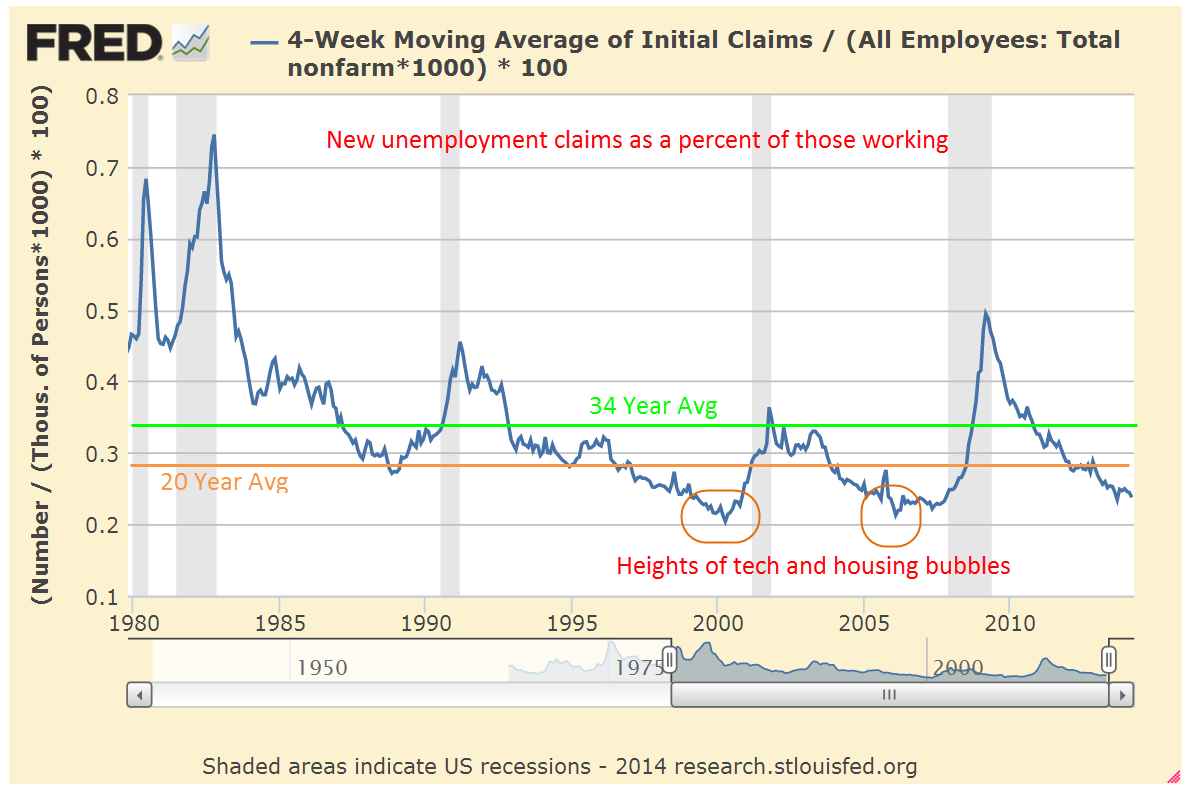
New unemployment claims dropped to 300,000 this week; the steadier 4 week average is at 316,000.  As a percent of the workforce, the number of new claims for unemployment is near historic lows, surpassed only by the tech and housing bubbles.

*******************************

Full-time Employee

A 1986 study of Current Population Survey (CPS) data by the Bureau of Labor Statistics (BLS) found that “well over half of employed Americans work the standard [40 hour] schedule.”  The median hours worked by full time employees changed little at just a bit over 40 hours. The average hours worked by full time employees was 42.5.  The study noted that between 1973 and 1985 the number of full time workers who worked 35 to 39 hours actually declined.

A paper published in 2000 by a BLS economist noted that the Current Population Survey (CPS) that the Census Bureau conducts is the more reliable data when compared to the average work week hours that the BLS publishes each month as part of their Establishment Survey of businesses.  The Establishment survey is taken from employment records but does not properly capture the data on people who work more than one job.  In that survey, a person working two part time jobs at 20 hours each is treated as though they were two people working two part time jobs. The CPS treats that person as one person working 40 hours a week.  Writing in 2000, the author noted that the work week had changed little from 1964 – 1999.

Fast forward to 2013 and the BLS reports that full time workers work an average of 42.5 hours, the same as the 1986 study.  More than 68% of workers reported working 40 or more hours a week.

The House recently passed H.R.2575, titled the “Save American Workers Act of 2014” – I’ll bet the people who write the titles for these bills love their jobs.  I always envision several twenty-somethings sitting in a conference room with pizza and some poetic lubricant and having a “Name That Bill” contest.  I digress.  This bill defines a full time employee as one who works on average 40 hours a week, not the 30 hours currently defined under the Affordable Care Act.

When I first started doing research on this I was biased toward a compromise of 35 hours as the definition of a full time employee.  My gut instinct was that fewer full time employees work a 40 hour week than they did 30 years ago.   The data from the BLS doesn’t support my gut instinct.

******************************

Obamacare

A monthly survey of small businesses by NFIB reported an upswing in confidence in March after a fairly severe decline in February.  That’s the good news.  The bad news is that optimism among small business owners can not seem to break the 95 index since 2007.  According to the U.S. Small Business Administration 2/3rds of new jobs come from small businesses. “Since 1990, as big business eliminated 4 million jobs, small businesses added 8 million new jobs.”

This is the first full year that all the provisions of the ACA, aka Obamacare, take effect.  Millions of small businesses around the country who provide health insurance for their employees are getting their annual business health insurance renewal packages.  For twelve years, my small business has provided health care for employees.  When I received the renewal package a few weeks ago, I was disappointed to find several changes that made comparisons with last year’s costs a bit more difficult.  As an aside, this health insurance carrier has always been the most competitive among five prominent health insurance carriers in the state.

Making the comparison difficult was a change in age banding.  What’s that, you ask?  In my state, business health plans were age banded in 5 year increments; e.g. a 50 year old and a 54 year old would pay the same rate for a particular policy.  Now the age banding is in one year increments.  If I compared the cost for a 45 year old employee last year with the rate for a 46 year old employee this year, the rate increase was a modest 5%.  Not bad.  But if I compare a 48 year old employee’s rate last year with a 49 year old employee this year, costs have risen 11%.   The provider for my company no longer offers the same high deductible ($3000) plan we had, offering a choice between an even higher deductible ($4500) plan or one with a much lower deductible ($1200).  Again, this makes the comparison more difficult.   Changes like this make cost planning more difficult and are less likely to encourage small businesses to bother offering health coverage to their employees.

Out of curiosity, I took a look at 2002 prices. The company long ago abandoned the no deductible plan we had in 2002 simply because it became unaffordable – this was while George Bush was President.  A plan similar to the HMO plan we had in 2002 – $20 copay, $50 specialist, $0 routine physical, no deductible, $2000 Max OOP –  now costs 270% what it did 12 years ago, an annual increase of more than 8%.  An HMO plan as generous as the one we had in 2002 is no longer available, so a more accurate comparison is that health insurance has tripled in twelve years.   It is no wonder that many small businesses either offer no health insurance or cap benefits at a certain amount that reduces the affordability and availability of insurance for many employees.

Until the unemployment rate decreases further, employees and job applicants are unlikely to exert much pressure for benefits from small business employers, a far different scenario than the heady days of the mid-2000s when unemployment was low and employers had to bargain to get decent employees.  There is no one single powerful voice for  many small businesses, other than the NFIB,  which makes it unlikely that Congress or state representatives will get their collective heads out of their butts and address the myriad regulatory and cost burdens that are far more onerous on small business owners.  Because of that we can expect incremental employment gains.

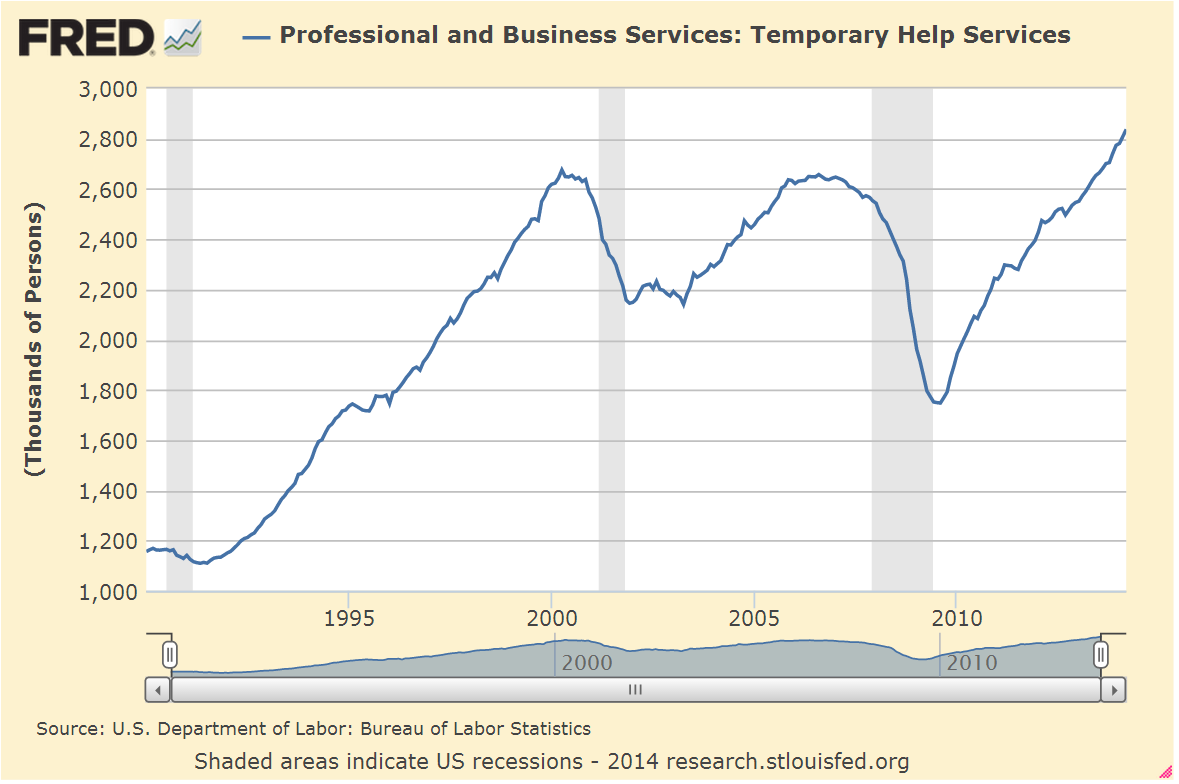
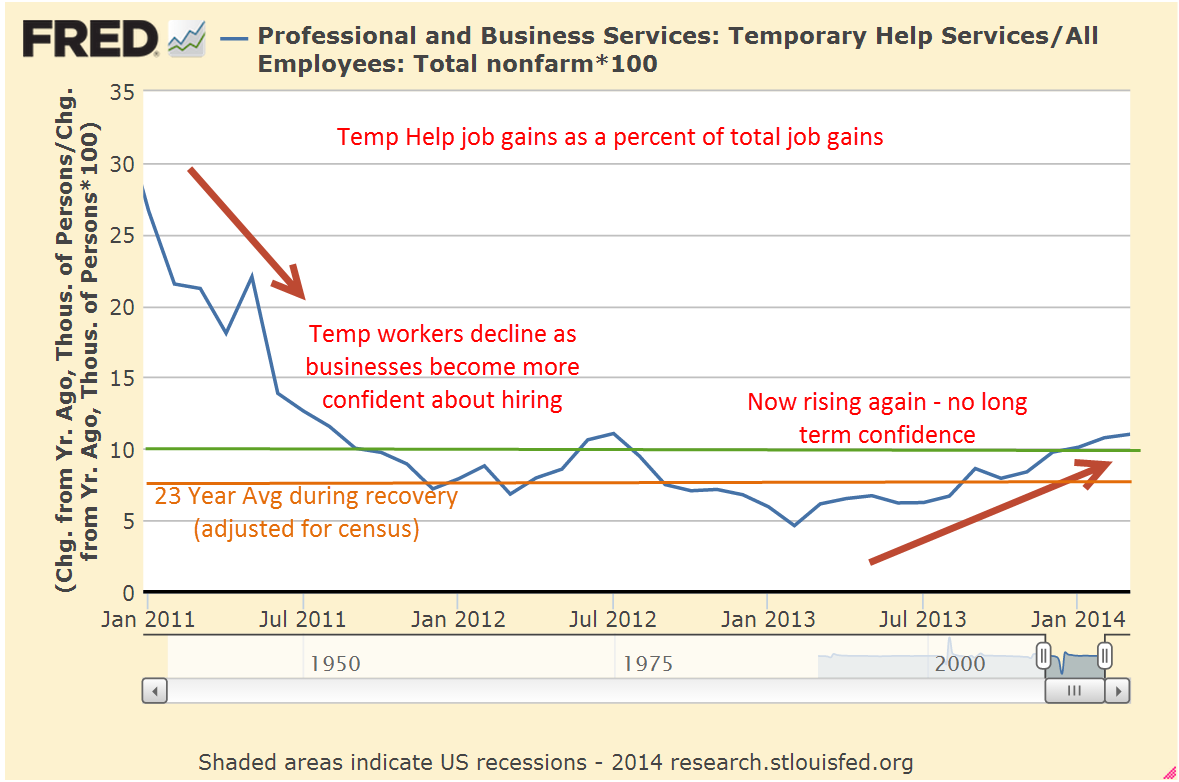
Betraying the lack of long term confidence in the economy and in response to employment burdens, employers increasingly turn to temporary workers, who make up less than 2% of the work force.

As an economy recovers from recession, it is normal for job gains to be distributed unevenly so that the increase in temporary workers is far above their share of the workforce.  Employers are understandably cautious and don’t want to make long term commitments.  Gains in temporary employment as a percent of total job gains should decline below 10%, indicating a stabilizing work force.

For the past two decades of recoveries and relatively healthy growth the average percentage is 7.4% (adjusted for census employment).  The percentage finally fell below this average in early 2012, rose back above it for a few months then stayed under the average till January 2013.  Since February of last year, that percentage has been rising again, crossing above the 10% mark in January, an inexorable evaporation of confidence.

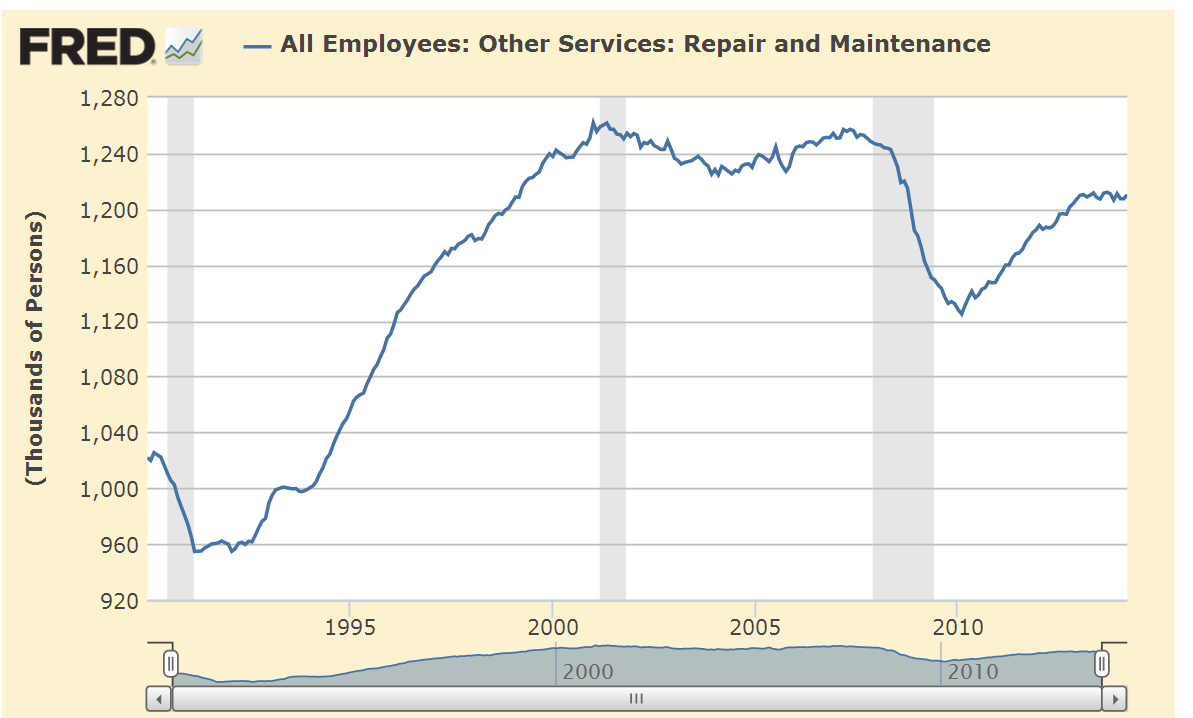
For the past year, repair and maintenance employment has flatlined at 1999 levels, indicating a lack of investment in commercial property and production equipment.

Specialty trade contractors in the construction industries are at 1998 levels despite an increase in population of 40 million.

While not alarming these trends indicate an underlying malaise in the workforce  that will continue to hamper solid growth.  Those ambitious and earnest folks in Washington, eager to make a difference and advance their political careers, continue to create more fixes which make the problem worse.  Imagine a car out of gas.  People out here on Main St. are pushing while the politicians keep hopping in the car to figure out what’s wrong, making the car that much more difficult to push.  At this rate, it is going to be slow going.