Labor Productivity

September 24, 2023

by Stephen Stofka

This week’s letter is about labor productivity. The autoworker’s union (UAW) expanded its strike to 38 parts and distribution plants in the hopes that a wider impact will incentivize further concessions from auto executives. Labor constitutes only 10-15% of the price of a car yet labor disputes may give the impression that rising car prices are entirely or mostly the fault of labor union demand.

For more than 100 years, auto plants of the Big Three automakers have been union shops. Foreign manufacturers like Toyota and Honda have built non-union plants in southern states where union organizers have less influence with policymakers. There are almost a million auto workers now in Mexico where wages have been lower. In 2022, GM Mexico paid its workers between $9.15 and $33.74 an hour, but relatively few auto workers in Mexico make more than $16 per hour.

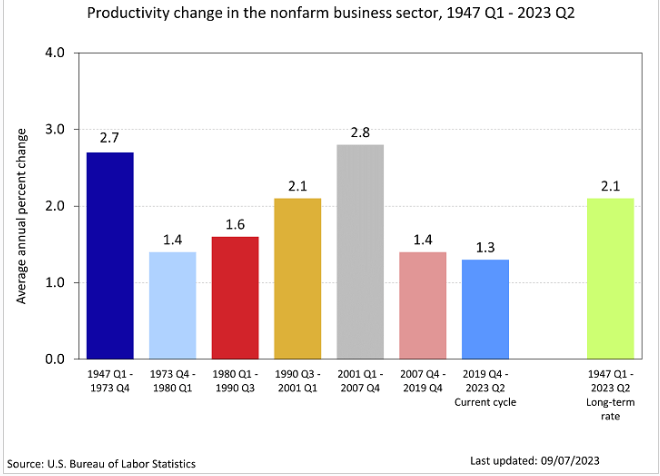
Two weeks ago, the BLS released their productivity figures for the second quarter. Productivity rose faster than labor costs by a good margin – notching a 3.5% annualized gain versus a 2.2% increase in unit labor costs. The manufacturing sector that car manufacturers belong to had a lower productivity gain of 2.9%. In that productivity release the BLS provided a chart grouping productivity gains by decade. The 75-year average is a 2.1% annual growth rate.
An often repeated theme of union workers and workers in general is that wage gains have not kept up with productivity gains. The BLS charted both series since 1973 and the divergence keeps growing by decade. American workers are competing with lower wage workers in Mexico, China and southeast Asia.

The annual gain in Productivity is erratic, rising sharply at the onset of recessions when workers are let go and the total hours worked declines. Recessions reduce the percentage of hours worked far more than the percentage reduction in output. I charted the annual gain in Labor Productivity (FRED Series OPHNFB) to show the effect of these shocks. The pandemic caused a particularly sharp rise and fall, as shown in the red rectangle below.

A five-year chart smooths out the divergences, letting us see the patterns more clearly. The red line in the graph below is the 1.5% current growth rate.
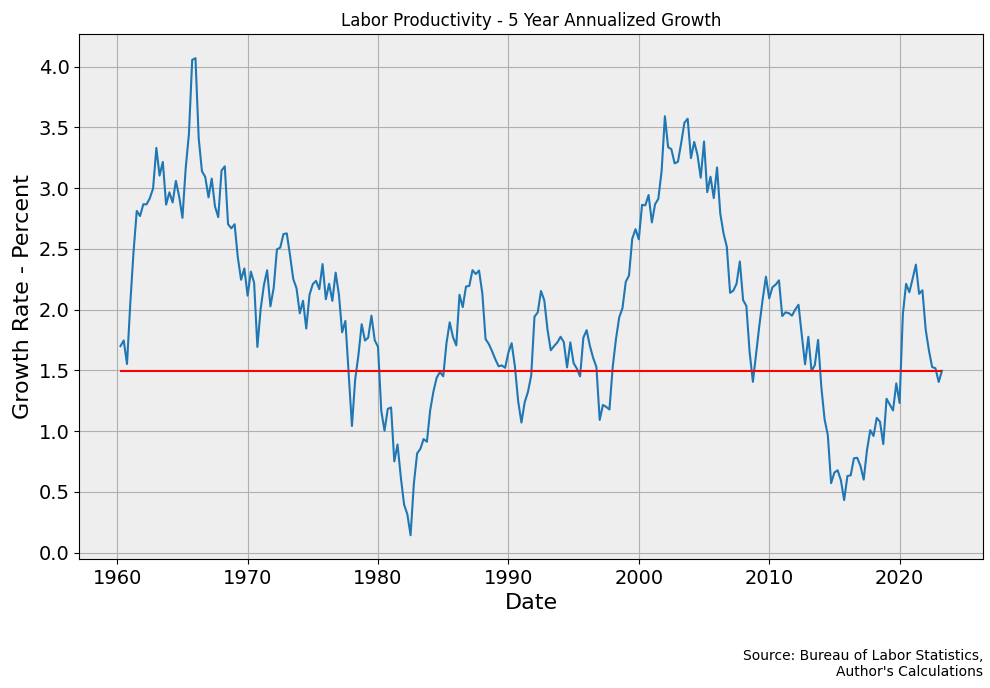
Trends in productivity growth are a medium term process, longer than any Presidential term. Despite that, candidates promise big productivity gains if they are elected. Republican candidates promise that lower taxes will boost productivity because that claim appeals to Republican voters. When productivity growth declined following the Bush tax cuts in 2001, conservatives blamed the stifling effects of regulatory compliance and called for more tax cuts. Democratic politicians promise more subsidies to an industry that is not nimble enough to respond to changing economic circumstances.

There are many factors that contribute to productivity growth. Some economists claimed that lower interest rates after the financial crisis would raise productivity. It fell. Those believers assert that declining productivity growth would have been worse without lower interest rates. This claim also cannot be disproved. Hypothetical situations are the favorite shield of a believer.

Corporate profits are up sharply since the start of the pandemic. For the past year, GM has enjoyed strong profit growth but they have had far too many down quarters since the financial crisis. Ford has fared better but its profit margin of 2.4% is only slightly more than the high-volume, low margin grocery giant Kroger. Stellantis has struggled to make a profit since 2018. For decades, federal and state governments have subsidized these auto giants with tax breaks and loans because the industry as a whole employs 1.7 million workers and contributes more than 10% to GDP. It is an industry where politics and economics are tightly intertwined. The politics clouds the economic analysis and the economics contorts the political calculations.

///////////////

20230924AssemblyLine

Photo by carlos aranda on Unsplash

Keywords: auto industry, GM, Ford, Stellantis, union, UAW, labor, workers, wages

Post-Election Bounce

January 1, 2017

Happy New Year!  How many days will it take before we remember to write the year correctly as 2017, not 2016? It is going to be an interesting year, I bet.  But let’s do a year end review.

Homeownership

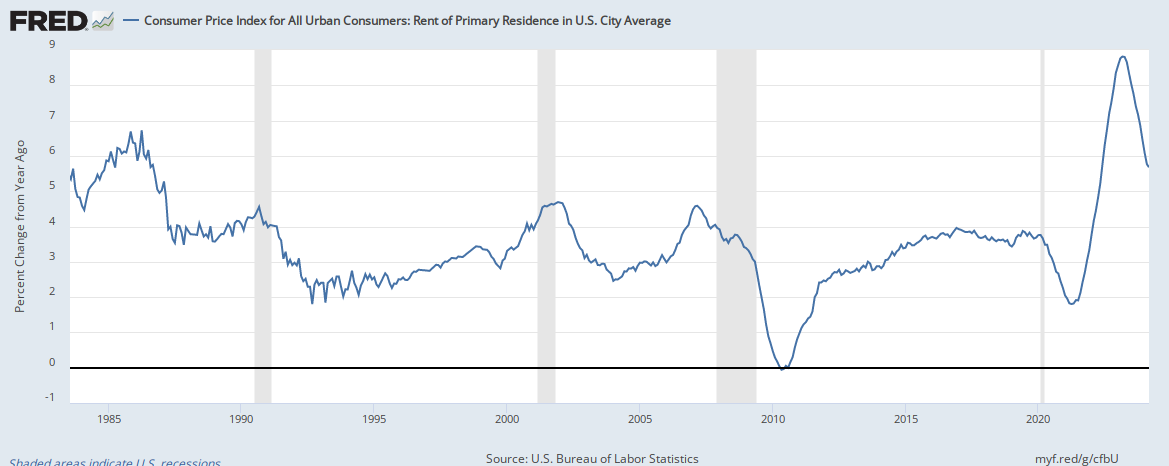
The home ownership rate has fallen near the lows set in 1985 and the mid-1960s at about less than 64%. (Graph)  In 2004, the rate hit a high of 69%.  For the U.S., the sweet spot is probably around 2/3 or 66%.  Most other countries have higher rates of home ownership, including Cuba with a rate of 90%. (Wikipedia article)  Rents in some cities have been growing rapidly.  In the country as a whole, rents have increased almost 4%, about twice the growth in the CPI, the general rate of inflation for all goods and services. (Graph)

Earnings

Real, or inflation-adjusted, weekly earnings of full time workers spiked up during the recession as employers laid off lower paid and less productive workers.  By late 2013, weekly earnings had fallen to 2006 levels and have risen since, finally surpassing that 2009 peak this year.

Core Work Force

Almost every month I look at the changes in the core work force of those aged 25-54 who are in their prime working years, who buy homes for the first time and have families.  These are the formative years when people build their careers, and form product preferences, making them a prime target for advertisers.  The economy depends on this age group.  They fund the benefit systems of Social Security and Medicare by paying taxes without collecting a benefit.  In short, an economy dependent on intergenerational transfers of money needs this core work force to be employed.

For two decades, from 1988 to 2008, the labor participation rate of this age group remained steady at 82% – 83%. (BLS graph) By the summer of 2015, it had fallen to 80%.  A few percent might not seem like much but each percent is about a million workers.  For the past year it has climbed up from that trough, regaining about half of what was lost since the Great Recession.

Consumer Confidence

A post-election bounce in consumer confidence has put it near the levels of 2001, near the end of the dot-com boom and just before 9-11. (Conference Board)  In 2012, the confidence index was almost half what it is today.

Business Sentiment

Small business sentiment has improved significantly since the November election (NFIB Survey).  Almost a quarter of businesses surveyed expect to add more employees, a jump of 2-1/2 times the 9% of businesses who responded positively in the October survey.  In October, 4% of companies expected sales growth in the coming year.  After the election, 20% responded positively.  This jump in sentiment indicates the degree of hope – and expectation – that business owners have built on the election of Donald Trump.

Hope leads to investment and business investment growth has turned negative (Graph). Recession often, but not always, accompanies negative growth. Since 1960, investment growth has turned negative eleven times.  Eight downturns preceded or accompanied recessions.  Let’s hope this renewed hope and some policy changes reverses sentiment.

On the other hand, those expectations may present a challenge to the incoming administration, which has promised some tax reform and regulatory relief. Small business owners will lobby for different reforms than the executives of large businesses.  Regulations of all types hamper small business but large businesses may welcome some regulation which acts as a barrier to entry into a particular market by smaller firms.

Publicly held firms will continue to lobby for repeal or reform of Sarbane Oxley reporting provisions.  For six years, the Obama administration has wanted to roll back these regulations but has been unable to come up with a compromise between the SEC, which regulates publicly traded companies, and Congress.  A Trump administration may finally reform a law that was rushed into place by George Bush and a Republican Congress in response to the Enron scandal.  That scandal grew in part from the Bush administration’s push to deregulate the energy market.

Voters Veer From Side To Side

We have stumbled from an all Republican government in 2002 to an all Democratic government in 2008 and now come full circle again to an all Republican government. Once in power, neither party can resist using economic policy to pick winners and losers.  Every few years the voters throw out the guys in charge and bring the other guys in, hoping that the party that has been out of power will be chastened somewhat.  Within a few months of taking power, each party digs up their old bones and begins to gnaw on them again.  Tax reform, prison reform, justice and fairness for all, climate change, more regulation, less regulation – these bones are well chewed.

Still we keep trying.  The priests and prophets of long ago kingdoms could not govern.  Neither could the kings and queens of empires.  So we have tried government of the people, by the people and for the people and it has been the bloodiest two centuries in human history.  Still we keep hoping.

The Presidential Test

Most presidents are tested in their first year in office.  Kennedy had to grapple with the Soviet threat and Cuba almost as soon as he took office.   Johnson struggled with urban violence, social upheaval and the war in Vietnam.

Nixon confronted a newly resurgent Viet Cong army when he first took office.  His second term began with the Arab oil embargo.  Ford dealt with the aftermath of Watergate and Nixon’s resignation under the threat of impeachment.

Jimmy Carter began his term with the challenges of high inflation and unemployment, and an energy crisis to boot.  Ronald Reagan wrestled with sky-high interest rates and a back to back recession in his early years.  His successor, H.W. Bush, met a Soviet Union near the end of its 70 year history as Gorbachev loosened the reins of Soviet control of eastern European countries and the Berlin Wall collapsed.

After an unsuccessful attempt to reform health care in his first year of office, Clinton suffered in the off year election of 1994.  G. W. Bush had perhaps the worst first year of any modern President – the tragedy of 9-11.  Obama entered office under a full blown global financial crisis.

Despite Putin’s bargaining rhetoric regarding President-elect Donald Trump, every President has to learn the lesson anew – Russia is not our friend.  Trump will have to learn  the same lesson.  China’s territorial claims in the South China sea may prompt an international incident.  N. Korea could launch a missle at S. Korea and start a small war.  Iran, Afghanistan, Iraq and Syria, Israel’s settlements, Palestinian independence – the crises may come from any of these tinderboxes.  We wish the new President well as he hops into the fire.

Recession and the Presidency

On Tuesday, President Obama will give his annual State of the Union address to Congress and the nation.  This past Saturday, South Carolina chose Newt Gingrich, the former Speaker of the House, as the front runner in their Republican primary.  In three grassroots states, Iowa, New Hampshire and South Carolina, primary voters have chosen three different Republican contenders who are vying for the Chief Executive Office.

For the past 150 years, every President except Lyndon Johnson, Jack Kennedy and Bill Clinton has had to contend with recession during their tenure. (NBER Source)  Every Presidential contender promises that they are going to stop the vicious business cycle that inevitably leads to recession.  With the advent of “JIT” – Just In Time Inventory – increasingly adopted by businesses and their suppliers in the mid to late 90s, recessions were pronounced a thing of the past.  No more would there be an excess build of supply by the nation’s businesses, leading to a sagging economy when product demand inevitably fell.  Advances and investments in technology enabled businesses to respond quickly to fluctuations in demand.  As the milennium approached, it was truly the dawning of a new age.

What was dawning was the advent of a secular bear market, a long period of time when the market falls for a few years, struggles up again, then falls, then rises again as fear and hope compete against one another.

A few weeks ago, I noted that in the middle of 2011, we had finally come out of an almost four year  recession.  This was not the official National Bureau of Economic Research end of the recession.  That happened in the middle of 2009.  This mid-2011 recession end was the “How It Feels” variety as real GDP finally gets back and surpasses the level it was at before GDP started its decline.

Below is a graph comparing the official lengths of recession and the “how it feels” recession length and a comparison of the two during each President’s tenure in the past sixty years.  This comparison helps explain the mood of the country when Presidents Ford, Carter and HW Bush lost re-election bids (Ford was actually not up for re-election since he had taken over the Presidency when Nixon resigned in August 1974).  The chart also gives an insight into the success of re-election bids by Eisenhower, Nixon, Reagan, and GW Bush. The economic pain was either less than or about equal to the official figures of economic distress during their presidencies.

As he prepares for his third State of the Union address, the lesson for President Obama is stark.  History unfortunately repeats itself.  It is also a lesson for any Republican Presidential hopeful; the odds are that he will have to contend with a recession during his tenure if he wins election.  On the campaign trail, how many Presidential hopefuls of either party ever broach the subject of what their administration will do during the eventual recession while they are in office?  Better to promise that it won’t happen on their watch.  It will.