Informed Expectations

May 8, 2022

by Stephen Stofka

A second round of the pandemic in key areas of China, continuing bottlenecks at ports and the war in Ukraine have played a key part in the persistence of inflation over the past few months. Supply shocks give companies a chance to raise prices faster than their production costs and increase profits – at first. This gives companies a chance to make up for lost profits during the pandemic. The rise in costs will hurt eventually and companies will blame rising wages.

Some people are blaming the Fed, accusing them of being behind the curve. I’ll present a model that helps readers understand the sequence of events over the past two years. Economists study how events, people and money interact. Like a football coach drawing out a strategy for a defensive backfield, economists use graphs with diagrams of solid and dashed lines with arrows to describe the dynamics of a process. For the layperson, it can be confusing. To make it fun, I sketched the dynamics on a baseball field. The action starts in the spring of 2020 with the runner – the economy – on 3rd base. Governments around the world dampened or shut down their economies to arrest the spread of the Covid-19 virus. I’ll put the graphic up here. Economists will recognize the bases as equilibrium points, and the left and right shifts of demand and supply.
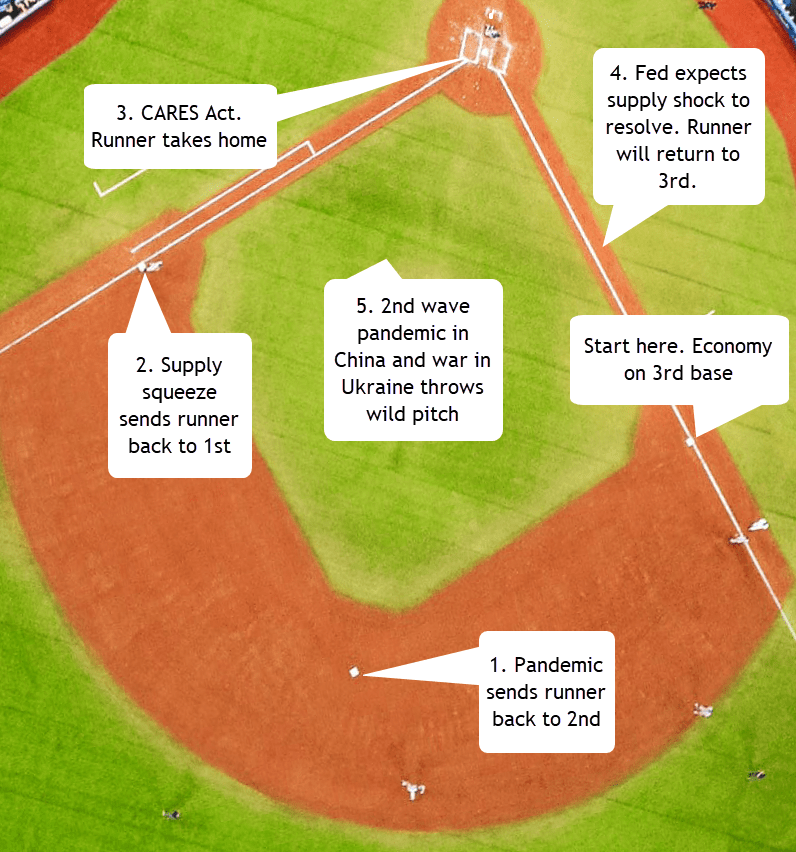
 The pandemic sent the runner to 2nd base, a shift of demand. Supply constraints then sent the economy back to 1st base, a shift of supply. The CARES act and other government support programs could only send the runner to home, a shift of demand. Why not back to 2nd? Let’s keep it simple and say that those are the rules. The Fed’s monetary policy has already consisted of large measures in response to the pandemic. That is on another graph with DD and AA curves that would give a casual reader a headache.

The Fed knew that the economy should be on 3rd – not home base – but expected the supply constraints to resolve enough to shift the economy back to 3rd base. If the Fed took monetary action when it was not needed, the runner might get injured and have to rest. That’s a recession. So the Fed waited, ready to take action if the existing supply chain problems didn’t resolve.

Another wave of pandemic struck key manufacturing areas in China. In the U.S., ports on the west coast and transportation links to those ports were still not working properly. Russia attacked Ukraine, driving up the price of gasoline by more than 50%. Natural gas prices rose 160% (DHHNGSP  https://fred.stlouisfed.org/graph/fredgraph.png?g=P3jr ). As the war continued for several weeks, it became clear that there would be no spring planting of crops in Ukraine, a country that is a global food supplier. Futures prices rose, increasing grocery store prices and exacerbating the sharp rise in oil prices.

The Covid-19 virus, the many people and businesses in the supply chain, and Vladimir Putin did not pay attention to the informed expectations of the Federal Reserve. The Fed is a convenient target for pundits. Before the Fed was created in 1913, people blamed gold and anonymous speculators for panics and price instability. However, anonymous speculators do not show up for Congressional committees. A bar of gold just sits silent in the chair while committee representatives rant on at finance hearings. That’s no fun. The Fed has a chairperson, Jerome Powell, a punching bag for Congress and pundits. Taking verbal abuse is part of the job of being Fed Chair.

Congressional representatives often use charts in the main chamber. An aide slides a cardboard chart on an easel while the Congressperson explains the whole idea in 5 minutes. At a finance subcommittee hearing, Mr. Powell can bring in an easel with a diagram of a baseball field. He can point to the economy on 3rd base and explain the whole process in a simple but more eloquent way than I can. Once the committee members understood the idea, they would apologize to Mr. Powell for their earlier criticism and Washington would be a more peaceful place. If baseball players and managers could resolve their differences this spring, why can’t the folks in Washington? Play ball and a shout out to moms everywhere!

////////

Photo by petr sidorov on Unsplash

Price Connections

March 13, 2022

by Stephen Stofka

As I was waiting for the car to drink its fill at the gas station, I got to thinking about prices. Their role is to convey information about resource availability but prices are not a conversant sort. They grunt monosyllabic phrases, relaying only the information that something has changed. A person who paid not the slightest attention to the news would wonder what happened when they filled up their car.

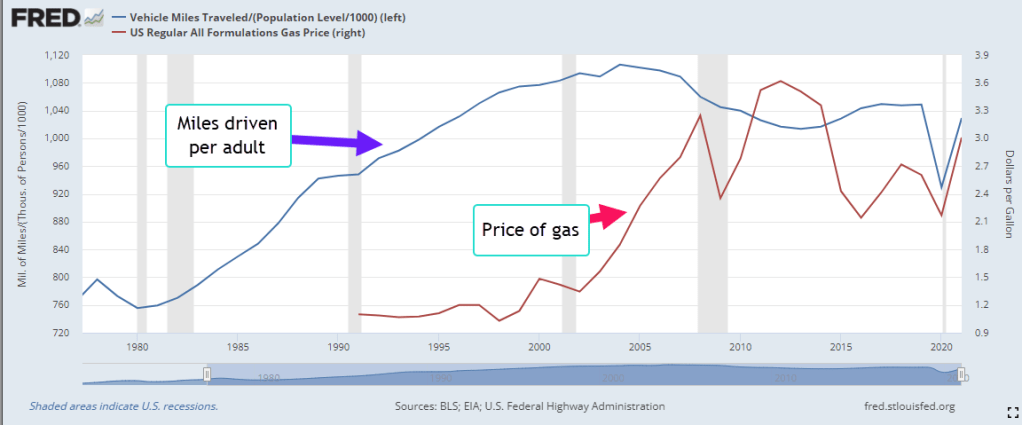
When prices decrease, do we buy more of a good or service? Sometimes. We usually pay attention to prices when they increase. In response, we substitute a cheaper good if we can, smoothing out the price changes. Most of us don’t drive more when gas prices decrease. Annual miles driven per adult have fallen as the large Boomer generation has aged (FRED Series TRFVOLUSM227NFWA/CNP16OV). The oldest of the Boomers passed 55 in the mid-2000s when per capita miles peaked.

Prices may not change as quickly as global conditions. When there is a poor coffee harvest in Brazil, the price of coffee in the grocery store may take several months to respond. Not so with gasoline, a global commodity so vital to the global economic engine that gas prices respond quickly to geopolitical events.

Many countries subsidize or control the price of some goods but too much control and prices no longer relay information between producers and consumers. The U.S. government subsidizes the farmers who grow corn to make the ethanol blended into gasoline. It subsidizes dairy, peanut and cotton farmers. Countries with state owned industries may keep a lid on prices to gain and keep political power. This year Kazakhstan lifted price caps on liquified petroleum gas which most people use to fuel their vehicles. Thousands of citizens protested (Neuman, 2022). In 18th century France, people rioted over the price of bread. Gasoline is today’s bread.

The ancient Greek philosopher Protagoras said that man was the measure of all things. In past centuries, essential food commodities that kept people alive were a yardstick of value. Anyone who has to drive to work or drives for a living feels that way about the price of gasoline. Larger firms that depend on predictable prices use the futures market to smooth gas prices but an independent Uber driver bears the full impact of rising gas prices. Should the U.S. subsidize gas prices for those who depend on the fuel? Those policies, politically popular in countries like Venezuela and Kazakhstan, foster political corruption and weaken the economic system. Why? One group of taxpayers subsidizes another group of taxpayers. The price of gasoline is closely linked with the price of power.

Competitive pricing is a hallmark of capitalism but such pricing minimizes profits. Large companies prefer to set a price which maximizes their profits within a competitive environment where other large firms use the same strategy. The result is an entire aisle in a grocery store filled with breakfast cereals that are priced at 10 times their cost. With the milk subsidies, the cereal becomes more affordable. Developed countries have learned to tame the prices of essential items without keeping those prices in a cage. We want our prices to communicate essential resource allocation information but we want well-behaved prices.

In our modern global economy we have many more goods and services available to us. Multiple sources of food products help lower prices but we are subject to the geopolitical risks of a global economy. The Covid pandemic and the war in Ukraine has reminded us that risks accompany benefits. The Russian people are beginning to experience the isolation of being cut off from the international system of trade, money and assets. Like prices, it is better when we are connected to each other.

////////////

Photo by Clint Adair on Unsplash

Neuman, S. (2022, January 8). There’s chaos in Kazakhstan. here’s what you need to know. NPR. Retrieved March 12, 2022, from https://www.npr.org/2022/01/08/1071198056/theres-chaos-in-kazakhstan-heres-what-you-need-to-know

A Voting Booth

February 6, 2022

By Stephen Stofka

How important are energy prices? British homeowners are paying almost 60% more than last January’s prices to heat their homes with natural gas (https://tradingeconomics.com/commodity/uk-natural-gas). They are upset at government officials and the party in power. In the U.S., the annual January increase to residential consumers was only 2.6% (https://www.eia.gov/dnav/ng/hist/n3010us3m.htm). The UK imports most of their natural gas while US consumers enjoy the benefits of US gas reserves. Americans drive far more than Brits so the weathervane of popular sentiment  in the US is the movement of gasoline prices. In general people don’t like rising prices – period – but when gasoline prices rise faster than paychecks, the public has the sense that something is broken and they want government to fix it. A gas pump can be a voting booth.

During the eight years of slow recovery following the financial crisis in 2008, paychecks struggled to keep up with the rise in gasoline prices. Income growth finally rose above gasoline price growth in the middle of 2016. As incoming Presidents do, Mr. Trump took credit for some of the gains and policies of his predecessor. Until the pandemic struck, paycheck growth stayed above the growth in gasoline prices. These annual growth rates erase most of the seasonality of gasoline prices, which fall in the winter and rise in the spring when the refineries must switch to a more expensive blend for the heat of summer.

That trend took a “wheelie” in the spring of 2020 when the entire country responded to the swell of pandemic deaths in New York City. Headed by a soapbox President with little organizational skill, the Trump administration struggled to cope with the daily demands of the pandemic. Mr. Trump himself cared little for the research his staff brought him. He has admitted that he is not a reader, trusting his instincts more than information. Had he shown more consistency during this singular pandemic, he might have retained enough college educated male voters to tip the 2020 election in his favor. As with many of us, Mr. Trump cannot come to grips with his own failings so he blames others. He has turned that nasty habit of self-deception into an art form of grand deception.

As the chart shows, the annual growth in gasoline prices was far above the growth in paychecks when Mr. Biden took office in the beginning of 2021. Both growth rates reached 10% in the 3rd quarter of last year, but people pay more attention to the sticker price on the pump as they fill up their cars. In the fourth quarter, paycheck growth edged up while gasoline prices growth edged down, a heartening trend if it continues.

Presidents have little effect on gasoline prices, a global commodity dependent on supply and demand around the world and subject to geopolitical tensions. However, the public holds Presidents responsible. If gasoline prices are high, reporters at White House press briefings ask what the administration is going to do about it. Occasionally, they release some of the government’s strategic gasoline reserves to show some action. That release has only a small effect on global prices but it shows the administration’s attention and good intentions. Until the country went off the gold standard during the Depression, each President had to answer for movements in the price of gold. Gasoline powers our daily lives. It is our daily gold.

Mr. Biden is mindful of the electoral beating that Mr. Obama took in the 2010 elections when the Tea Party led a Republican movement to forcefully take the majority gavel from the House Democrats. Most Presidents suffer election losses in the midterms but it was a devastating turnaround in a census year. Mr. Obama was more skilled at rhetoric than taking the tiller of a national political party. As a politician with decades of experience, Mr. Biden is already in campaign mode, moving funds to battleground states to get out the vote in November. He will be mindful of the public’s sensitivity in the final months leading up to the midterms.

Gasoline prices are higher in the summer months and people drive more so they notice high prices. The press is quick to point out Mr. Biden’s low approval ratings, currently in the low 40s. Mr. Biden’s low was Mr. Trump’s high. In a country evenly split between Democrats, Republicans and Independents, a President will struggle to gain and hold a majority favorable public opinion above 50%. According to Gallup (https://news.gallup.com/poll/116500/presidential-approval-ratings-george-bush.aspx) George Bush did not enjoy a majority opinion after 2005, his first year of his second-term. His ratings fell near 30%, lower than Mr. Trump’s lowest ratings. When did those lows come? During the summer months of 2008 when gasoline prices rose above $4 per gallon. Voters carried their sticker shock at the pump into the voting booth a few months later and gave Democrats a resounding majority.

If gasoline prices are moderate this summer, that will give a boost to Democratic chances at the polls but Mr. Biden should be savvy enough not to count on that. He must assume that prices will not be friendly to him or his party this summer. The Republican strategy is to use pocketbook issues to regain a majority in both the House and Senate. Their divisive stance on moral issues only antagonizes Independent voters in the suburbs so Republicans must focus on practical issues. Midterm elections suffer from low turnout. Voters shrug. The party that can energize their voters can command the political field for the next two years. Gasoline prices energize voters.

////////////////////

Photo by Dawn McDonald on Unsplash

Fill ‘er up!

February 23, 2013

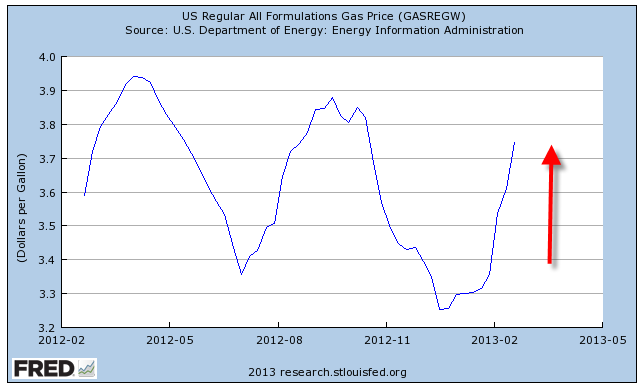
Most of us with cars have noticed the rather dramatic increase in gas prices since the beginning of the year.  I’ll use the all formulations series, which is about 8 – 10 cents cheaper than what a family might pay at the pump.

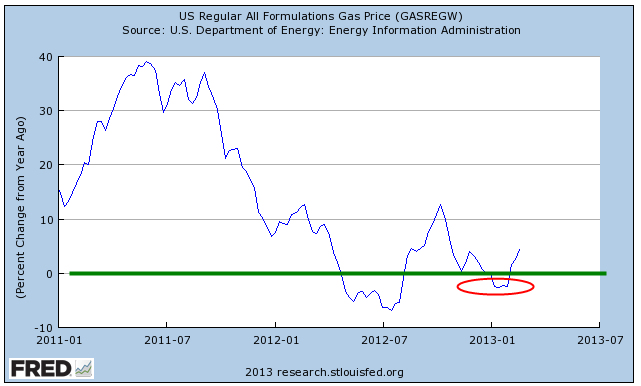
A reason given for the upsurge in prices is that this is a normal seasonal change as refineries shut down to make the change over from a winter gas formulation to a summer gas formulation.  Heavier volatile organic compounds are removed from gas during the summer months to reduce smog.  The resultant decrease in supply therefore leads to an increase in price.  It’s Econ 101.  If that were true, then the year-over-year percent change would be relatively minor at this time of year.  In one of those contradictory anomalies, this year is the only year that the refinery change-over explanation actually fits.  Price changes over the same months in 2012 have been minor.  Notice that in other years, price increases in the early months contradicted the theory.

The change has been particularly noticeable because gas prices decreased to near $3 a gallon toward the end of 2012.  In the Denver area, prices dropped below $3 a gallon, prompting comments in idle conversation.  The average driver uses about 10 gallons a week but out west, where driving distances are greater, that average gas consumption is probably closer to 15 – 17 gallons.  The difference between $3 gas and $4 gas can mean a weekly gas “tax” of $15 or more.  For those of us who use a vehicle for work, the difference can be $30 or more.

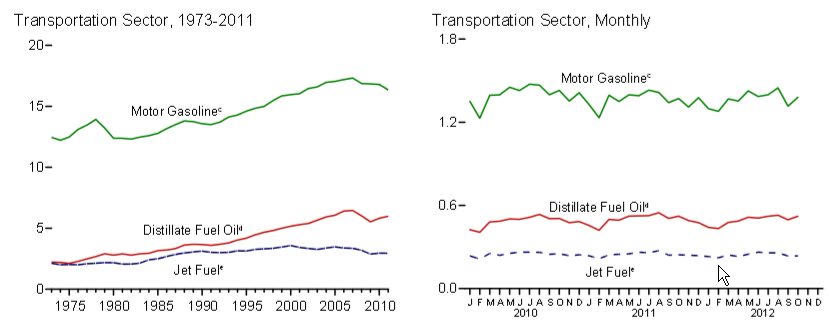
Since the recession began in 2007, our use of gasoline has decreased, ending a multi-decade rise in overall gasoline consumption (EIA Source)

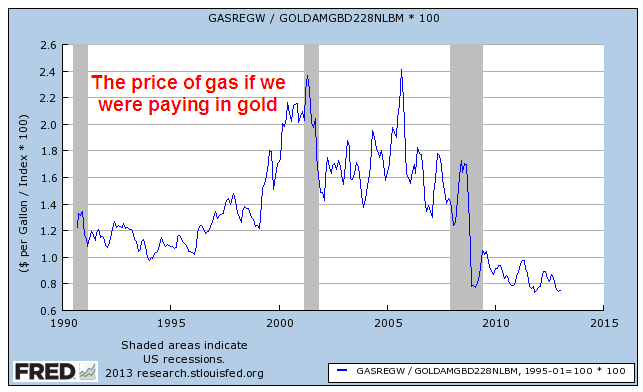
However, since the late nineties average gas prices are rising and have become quite volatile.  So why?  Our gasoline use was increasing during the nineties but prices were flat at a little over a $1 a gallon. Why the big increase in the past 10 – 15 years?  If one were buying gasoline with gold, the price has fallen over the past two decades.

If our consumption has levelled off in the past few years and we are producing more oil in this country, why has the price of gasoline stayed pretty consistently above $3 a gallon?

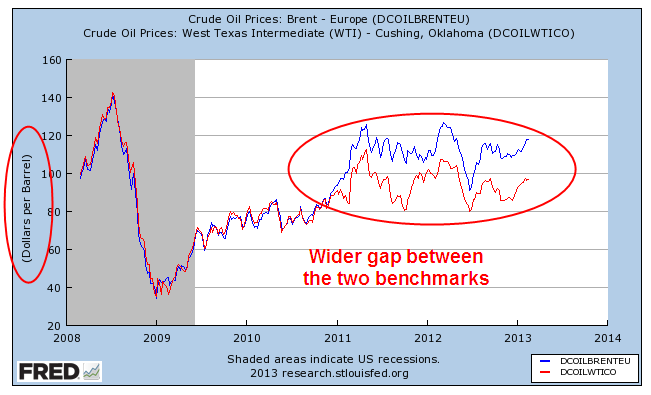
The three main variations of crude oil are heavy (Venezuela, for example), medium (North Sea and MidEast) and light (Texas). The benchmark for medium grade is Brent Crude; for light grade it is West Texas Intermediate (WTI). The two benchmarks have traditionally moved in tandem with Brent Crude trading about $2 above WTI.  Over the past few years, the difference in price between the two benchmarks has widened considerably.  “Fracking” has led to an upsurge in domestic production; production in the North Sea has been steadily declining; tensions in the MidEast and North Africa have contributed a risk premium to medium crude produced in the region.

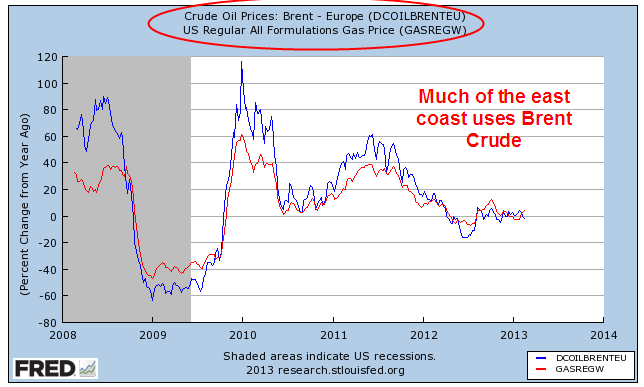
Refineries are set up to process a particular type. Most east coast refineries process Brent Crude; higher transportation costs of domestically produced crude oil over land made it more cost efficient for eastern refineries to import oil from overseas.  Since the majority of the U.S. population lives in the eastern U.S., the majority of the American people use imported gas.  Gas prices move in tandem with the spot price of Brent crude.

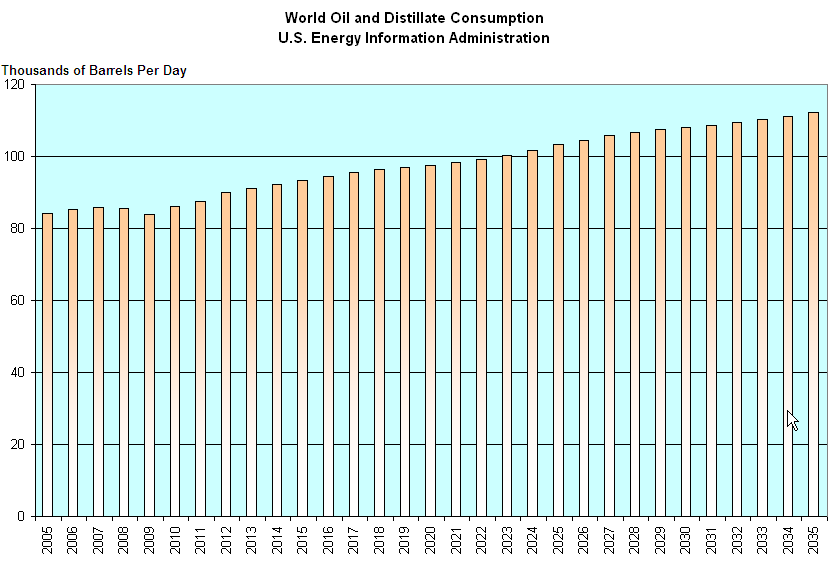
While U.S. oil consumption has declined, world consumption has been rising.

The U.S. Energy Information Administration projects  a slow, steady rise in oil consumption over the next two decades as the standard of living improves.

No magic wand will cause gas prices to decline.  Crude oil and its derivative products are a world commodity and can be shipped inexpensively in large tankers all around the world.

Last week I wrote about the long term trend in federal debt; that it was not a “New Normal” but a continuation of the same old normal of the past several decades.  The continued rise in oil prices is another trend that has become a fixture of our daily lives and will continue to eat at the dollars in our pocketbooks for the foreseeable future.