Bank Money and Hard Money

June 11, 2023

by Stephen Stofka

This week’s post is about money and Adam Smith (2009), the author of the Wealth of Nations, a book that authors sometimes refer to by its acronym – WON. In 2026, it will be the 250 year anniversary of the publication of that work and Smith remains the most cited author in economics literature, according to Avner Offer and Gabriel Söderberg (2019), authors of The Nobel Factor. Smith lived in an age of a metallic or hard currency standard, but one with an active trade in paper or “bank” money. In Part 1, Chapter 4 of WON he attributed the debasement of hard currencies to the “avarice and injustice of princes and sovereign states.” We will see why he thought so.

Smith noted the chief flaw of hard currencies, particularly in an era of increasing industry. The supply of those metals depends on the success of mining operations and the fortunes of ships carrying the metals across the seas. There is either not enough hard currency to support the number of transactions in a country of increasing industry, or there is too much of the metal currency during economic downturns. Paper or bank money acted as a substitute for hard currency. In Part 2, Chapter 2, Smith notes that the exchange of bank money was mostly between wholesalers, not between dealers and consumers. In an age when the revenue of a country depended largely on excise taxes on particular goods and property taxes on landowners, the flow of taxes was mostly between the wealthy and the state.

Like most substitute goods the value of bank money rose when there was a shortage of hard currency, falling again when there was an adequate supply of gold or silver coin. A prince or state stabilized the value of paper money by allowing or stipulating the payment of taxes in paper money. Smith admired the resilience of the working class, a sentiment not shared by others in the higher social classes. When the American colonies drafted their Constitution, only those of means were allowed to vote because they were the primary source of direct government funding. The founders paid little recognition to those on the lower rungs of the socioeconomic ladder who paid few taxes directly to a government.

The working class paid taxes in three indirect forms: 1) higher prices on goods, 2) lower compensation for their labor, and 3) inflation. In an open letter written about 1780, American founder Benjamin Franklin remarked (https://founders.archives.gov/documents/Franklin/01-34-02-0156) that the printing of vast quantities of paper money to fund the American war against Great Britain had caused an explosive hyperinflation. In less than five years, 60 dollars of American paper currency had become equivalent to one dollar in gold. As Smith noted, a country abandons a hard currency standard as soon as it goes to war so that it can fund the war without increasing taxes.   

The developed countries of the world have realized Smith’s vision. Diverse economies with a lot of specialization promote growth. Less developed countries share a common characteristic – the economy is very reliant on agriculture. The growth of the retail trade in developed countries necessitates the increasing use of bank money. Hard currency is neither reliable nor convenient. Smith might attribute the persistent inflation of bank money not to an oversupply of paper money but to a shortage of hard currency. In growing economies, that shortage promotes deflation, benefitting those who have at the expense of those who have not. That is the injustice of hard money.

////////////////

Photo by Zlaťáky.cz on Unsplash

Keywords: Adam Smith ,gold coin, silver coin, hard currency, bank money

Malthus, T. R. (1989). An essay on the principle of population. Cambridge: Cambridge Univ. Pr.

Offer, A., & Söderberg, G. (2019). The nobel factor: The prize in economics, social democracy, and the market turn. Princeton University Press.

Smith, A. (2009). Wealth of Nations. New York: Classic House Books.

The Start of the Beginning

April 7, 2019

by Steve Stofka

In 1971 former President Nixon announced that the U.S. was abandoning the gold standard of fixed exchange that had existed for almost thirty years. Within a short time, other leading nations followed suit. Each nation’s currency simply traded against each other on a global currency, or FX, market.

Since oil was priced in dollars and the world ran on oil, the U.S. dollar became the world’s reserve currency. Each second of every day, millions of US dollars are traded on the international FX markets. The demand for US dollars is strong because we are a productive economy. The euro, yen and British pound are secondary currency benchmarks.

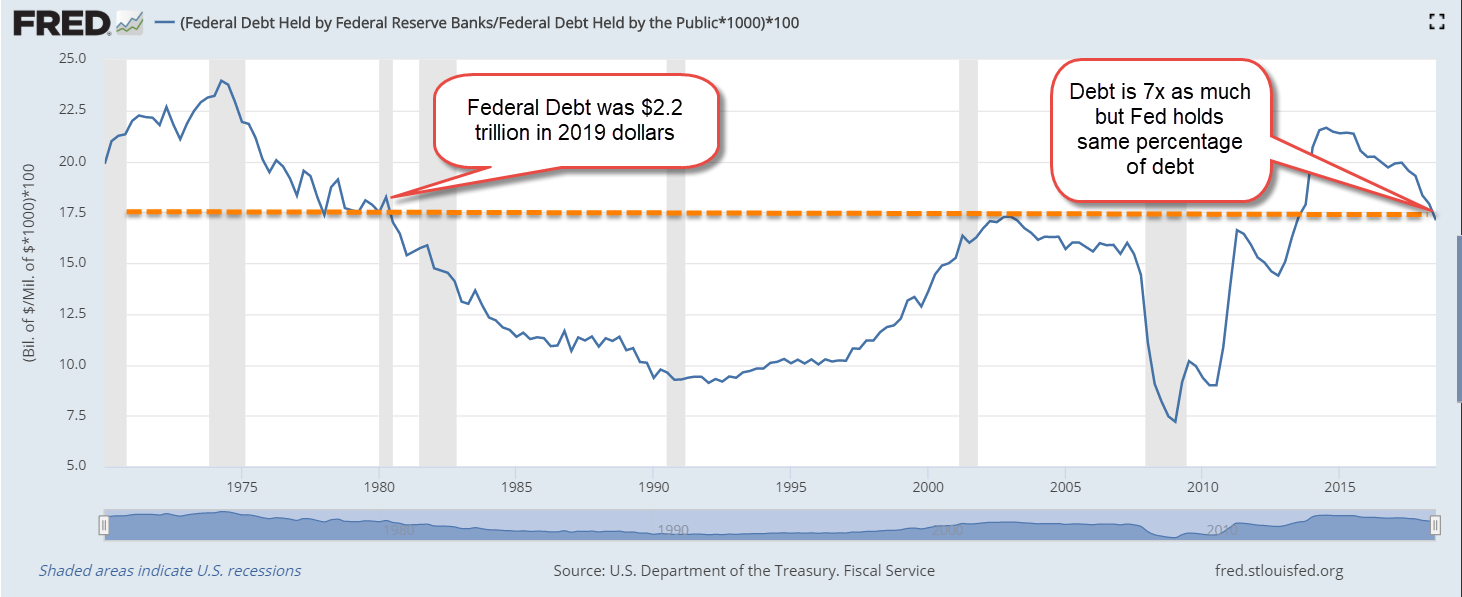
When the U.S. wants to borrow money from the rest of the world, the U.S. Treasury sells notes and bills collectively called “Treasuries” to large domestic and foreign banks who “park” them in their savings accounts at the Federal Reserve (Fed), the U.S. central bank (Note #1). The phrase “printing money” refers to a process where the Federal Reserve, an independent branch of the Federal Government, buys Treasury debt on the secondary market. It may surprise many to learn that the Fed owns the same percentage of U.S. debt as it did in 1980. The debt in real dollars has grown seven times, but the percentage held by the Fed is the same. That is a powerful testament to the global hunger for U.S. debt. Here’s the chart from the Fed’s FRED database.

FedResHoldTreasPctDebt

In 1835, President Andrew Jackson paid off the Federal debt, the one and only time the debt has been erased. It left the country’s banking system in such a weak state that subsequent events caused a panic and recession that lasted for almost a decade (Note #2). Government debt is the private economy’s asset. Paying down that debt reduces those assets.

About a third of the debt of the U.S. is traded around the world like gold. It is better than gold because it pays interest and there are no storage costs. Foreign businesses who borrow in dollars must be careful, however. They suffer when their local currency depreciates against the dollar. They must earn even greater profits to convert their local currency to dollars to make payments on those dollar-denominated loans.

Each auction of Treasury debt is oversubscribed. There isn’t enough debt to meet demand. In a world of uncertainty, the U.S. government has a long history of respect for its monetary obligations. As the reserve currency of the world, the U.S. government can spend at will. Even if there were no longer a line of domestic and foreign buyers for Treasuries, the Federal Reserve could “purchase” the Treasuries, i.e. print money. Let’s look at the difference between borrowing from the private sector and printing money.

When the private sector buys Treasuries, it is effectively trading in old capital that cannot be put to more productive use. That old capital represents the exchange of real goods at some time in the past. In contrast, when the government spends by buying its own debt, i.e. printing money, it is using up the current production of the private sector. This puts upward pressure on prices. Let’s look at a recent example.

Quantitative Easing (QE) was a Fed euphemism for printing money. During the three phases of QE that began in 2009, the Fed bought Treasury debt. That was an inflationary policy that countered price deflation as a result of the Financial Crisis. In August 2009, inflation sank as low as -.8% (Note #3). It was even worse, but inflation measures do not include the dividend yield on money. To many households, inflation felt like -2% (Note #4). The Fed’s first round of QE did provide a jolt that helped drive prices up by 3% and out of the deflationary zone.

During the five years of QE programs, the Fed continued to fight itself. The QE programs pushed prices upwards. Near zero interest rates produced a deflationary counterbalance to the inflationary pressures of printing money. Because inflation measures do not include the yield on money, the Fed could not read the true change in the prices of real goods in the private sector. The economy continues to fall below the Fed’s goal of 2% inflation. There are still too many idle resources.

Leading proponents of Modern Monetary Theory (MMT) remind people that yes, the U.S. can spend at will, but that it must base its borrowing on policy rules to avoid inflation. A key component of MMT is a Job Guarantee (JG) program ensuring employment to anyone who wants a job. A JG program may remind some of the WPA work programs during the Great Depression. Visitors to popular tourist attractions, from Yellowstone Park in Wyoming to Carlsbad Caverns in New Mexico, use facilities built by WPA work crews. Today’s JG program would be quite different. It would be locally administered and targeted toward smaller public works so that the program was flexible.

The U.S. government has borrowed freely to go to war and has never paid that debt back. Proponents of MMT recommend that the U.S. do the same during those times when the private economy cannot support full employment. That policy goal was given to the Fed in the 1970s, but it has never been able to meet the task of full employment through crude monetary tools. With an active program of full employment, the Fed would be left with only one goal – guarding against inflation.

There are two approaches to inflation control: monetary and fiscal. Monetary policy is controlled by the Fed and includes the setting of interest rates. If the Fed’s mandate was reduced to fighting inflation, it could more readily adopt the Taylor rule to set interest rates (Note #4).

Fiscal policy is controlled by Congress. Because taxation drains spending power from the economy, it has a powerful control on inflation. However, changes in tax policy are difficult to implement because taxes arouse passions. We are familiar with the arguments because they are repeated so often. Everyone should pay their “fair share,” whatever that is. Some want a flat tax like a head tax that cities like Denver have enacted. Others want a flat tax rate like some states tax incomes. Others want even more progressive income taxes so that the rich pay more and the middle class pay less. Some claim that income taxes are a government invasion of private property rights.

Because tax changes are difficult to enact, Congress would be slow to respond to changes in inflation. The Fed’s control of interest rates is the more responsive instrument. The JG program would provide stability to the economy and reduce the need for corrective monetary action by the Fed. The program would help uplift those in marginal communities and provide much needed assistance to cities and towns which had to delay public works projects and infrastructure repair because of the Financial Crisis. As sidewalks and streets get fixed and graffiti cleaned, those who live in those areas will take more pride in their town, in their communities, in their families and themselves. This makes not just good economic sense but good spiritual sense. We can start small, but we must start.

////////////////////////
Notes:

1. Twenty to twenty-five times each month, the Treasury auctions U.S. government debt. Many refer to the various forms of bills and notes as “treasuries.” A page on the debt
2. The Panic of 1837
3. The Federal Reserve’s preferred measure of inflation is the Personal Consumption Expenditure Index, PCEPI series.
4. The annual change in the 10-Year Constant Maturity Treasury fell below -1% at the start of the recession in December 2007 and remained below -1% until July 2009. FRED series DGS10. John Maynard Keynes had recommended the inclusion of money’s yield in any index of consumer demand. In his seminal work Foundations of Economic Analysis (1947), economist Paul Samuelson discussed the issue but discarded it (p. 164-5). Later economists did the same.
5. The Taylor rule utility at the Atlanta Federal Reserve.


The Erosion of Inflation

August 13, 2016

What is inflation?  Commonly regarded as the change in prices from one year to the next, we can also define it as the rate at which the value of money declines.  In classical monetary theory, inflation reflects government demand for private savings.  When savings can not meet the demand, immoderate governments create the money they need.  This influx of invented money leads to higher prices and inflation.

Higher inflation encourages borrowers, including governments, since they can pay back loans borrowed in Year 1 with money that is worth less in Year 2.  A person who borrows $100 for a year at 10% interest but with 10% inflation, pays back a total of $110.  But the $110 is only worth 90%, or $99, in purchasing power.  In effect, the lender has paid the borrower for loaning the borrower money.  In a case like this, no one wants to lend money at that interest rate. The lender must charge a higher interest rate, driving up the price of borrowed money in a self-reinforcing tailspin of inflation chasing interest rates chasing inflation.

Deflation, or negative inflation, discourages borrowing for the opposite reason; money borrowed in Year 1 is paid back with money that is worth more in Year 2.  That same $100 borrowed for a year at 10% interest and 10% de-flation is paid back with $110 that now has the purchasing power of $121.  In this example, the borrower effectively pays the lender 21% interest.

I marked up a graph of post-1850 inflation I found here to show several key points in the “hockey stick” of inflation.

The Federal Government borrowed and spent a great deal of money during the Civil War period 1860-65, driving up the rate of inflation.   With a  currency backed by gold and sometimes silver, it took several decades of intermittent deflationary periods to correct for the imbalance of the Civil War.

When the Federal Reserve was created in 1913, the value of a dollar was little changed since 1850.  The Bureau of Labor Statistics doesn’t compile data on inflation before 1913.  After a World War and a severe short recession, a dollar in 1920 was worth half of what it was in  1913 {BLS }

Several years of deflation after the stock market crash restored some of the value to the dollar until the Federal Government began borrowing large sums of money to fund Roosevelt’s New Deal.  Inflation accelerated under the heavy government borrowing for World War 2.

Even though Roosevelt had ended the ready convertibility of dollars to gold during the Depression, several countries wanted cooperation in setting an international monetary standard.  At the Bretton Woods Conference in 1944, a year before the end of World War 2, the price of gold was fixed at $35 per ounce, a dollar benchmark that effectively made the U.S. dollar the world’s reserve currency.
In 1971, the Nixon administration removed that fixed price and allowed the dollar to float in price against gold and other currencies.  Within two years, the rest of the developed world followed suit.  A glance at the chart shows that this is the bend in the hockey stick, the point where cumulative inflation marches relentlessly upwards.

As I noted at the start, some inflation encourages borrowing. The keyword is “some.”  High inflation introduces so much uncertainty into the economy that it becomes debilitating.  Workers can not negotiate wage increases fast enough to keep up with the speed of inflation,, so they reduce their real spending.  Lenders demand high interest rates when they lend money in order to compensate for the declining value of money.  The high rates discourage borrowing and crimp economic activity.

A reasonable and fairly predictable inflation rate allows debt burdened governments to pay back borrowed money with money that has less value. In half a lifetime, from the point in 1973 when most governments freed their currency from a gold standard, the U.S. dollar has lost 80% of its value.  For the first two decades of these past forty years, family income kept pace with that loss of value.  During the last two decades the value of a family’s labor has been transferred to governments whose elected officials devise programs to return some of that transferred value to the most disadvantaged families.

In real terms, personal incomes have more than tripled since 1973 {Graph} but most of those gains were in the twenty-five years ending in 2000 when real personal incomes grew by 135%, a 5% annual pace.  In the sixteen years since 2000, real incomes have risen only 35%, averaging slightly above 2% per year.  When the value of money declines, the only way to save value is to invest money in assets, and only those on the upper half of the income scale have been able to preserve the value of their money in assets.  The lower half on that income scale has struggled.

As the value of money has declined in the past forty years, money invested in assets have gained in value. The press goes goo-goo as the SP500 makes new highs but that is a nominal value.  The inflation adjusted value is barely above its value in 2000 (Table) but has tripled in real value since 1973.  Home prices have not done as well but have gained 50% since 1975 (Graph).  For many families, their house is the majority of their assets and the inflation adjusted Case Shiller home price index is still below the level of ten years ago.

Elections are a competition of ideas for solutions and this election is no different.  The chief theme has been the ever declining value of money and labor, the relentless struggle of those on the lower half of the income scale. Folks on the political left favor ever more government intervention and clamor for more social programs to reduce household expenses, including free college tuition,  childcare and medical care. On the income side, the left calls for a doubling of the minimum wage.  Higher taxes and more debt will pay for these solutions.

Folks on the right side of the political aisle are ruled by an ideology that opposes government solutions, believing that there always exist remedies from the private sector even if there are no proposals for a private solution.  However, even those on the right want more government spending, but of the military kind, where it can most benefit families and economies in rural communities.  Donald Trump is now calling for greater infrastructure spending but this is sure to anger the conservatives in his party.  Folks on the right claim that more spending will be paid for by lower taxes on upper income families and the magic of wishful thinking called optimistic economic assumptions and dynamic budget scoring

For more than four decades, the world has been engaged in an international game of currency manipulation to prevent the fair market pricing of each country’s currency. Nations newly industrializing disregarded or gave a knowing wink to international agreements on labor practices and environmental protections.  Now the populations of the developed countries are aging and their birth rates are falling, particularly those countries in western Europe.  Already high government debt levels are strained by a swell of retiring workers who want the pension benefits they have been promised.  Economic growth that is sluggish or non-existent can not meet the demands for services and benefits, prompting more government borrowing.

Promises in a Presidential campaign are like unicorns.  After the election, the candidate removes the horn and voters realize that what they got was a rather good looking but ordinary horse, not a magical unicorn.  Promises are nevertheless calling cards to a political vision, and the vision of both campaigns is a rally ’round the flag of the domestic economy and American families. Trump’s supporters are endorsing his call for tariffs on imported goods to punish those countries which subsidize their industries and make American products less competitive in price.  Hillary Clinton is now calling for penalties for company inversions, the practice of relocating the legal presence of a business overseas to lower a company’s tax liability.  To rally their troops each candidate promises to fight the international system that threatens the well being of many American families.  However, it is our own government that is part of that system, the war on the value of money, on the value of work.

The Big Picture

Or maybe the title of this post should be “The Big Pitcher”.  No, it’s not about a tall baseball pitcher, but the glass pitchers that central banks around the world hold.  What comes out of the pitcher when the central banks start pouring?  Money.  How do they do that?  It’s magic.  Don’t you wish you had a money pitcher?

Jerry forwarded me an article by someone at Matterhorn Asset Management, a Swiss asset management company that invests primarily in metals as a wealth preservation model so they will have a predisposition to a gloomy outlook because investors’ fears will bring more business to the company.  That said, the article presents a 200 year review and outlook on the mechanics of inflation and rather dire long term predictions for the world economy.

Featuring a 150 year chart on the Consumer Price Index and another one of US Debt to GDP ratio, this 6 page article definitely takes a long view of events in the past in making prognostications of the future. 

A comparison of the 19th and early 20th century with the latter part of the 20th century has to be put in a bit more perspective than this article does.  Electricity is something we take for granted but its effect on our lives has been as profound as the discovery of fire and the invention of cooking.  It is an energy that is readily available to most people in developed countries.  This ready source of energy has radically transformed our society, our productive capacity and our demand for products that use this energy.

In the 1920s, the new industry of radio telecommunications kicked off a bubble in the stock market.  Some predicted that we would walk around with communication devices that we wore on our wrists.  Information would be readily available to all with these cheap and portable two way radios.  It would be another 70 years before this dream would become a reality with the internet and the dawning of the cell phone age.  That in turn prompted another stock bubble in the late nineties.

When countries around the world abandoned the gold standard in the past century, they did so because the supply of gold could not keep up with the rapid expansion of production and demand that accompanied the energy and communication age.  How profound has this expansion been?  Several historians have noted that a person living in Boston in 1780 would have felt familiar with most of what surrounded him in that same city in 1900.  Jump ahead another 50 years to 1950 and that same person would be totally disoriented in a city with electricity, flashing lights, automobiles, subways, TVs, radios and the sheer growth in the population of the city.

The gold standard simply could not accommodate this rapid expansion of economic activity.  However, the gold standard put brakes on the centuries old tendency of sovereign countries to print money or debase the currency.  After abandoning the automatic regulatory mechanism of the gold standard, we have found nothing comparable to provide some restraint on central bankers other than a trust in the wisdom and foresight of those like Ben Bernanke, Chairman of the Federal Reserve.  An entire world of billions of people depends on the wisdom of several hundred individuals making decisions at central banks around the world.  It is a daunting and vulnerable position we find ourselves in.