Poverty and Principles

June 22, 2025

By Stephen Stofka

Sunday morning and another breakfast with the boys as they discuss world events and persistent problems. The conversations are voiced by Abel, a Wilsonian with a faith that government can ameliorate social and economic injustices to improve society’s welfare, and Cain, who believes that individual autonomy, the free market and the price system promote the greatest good.

Cain twirled the rod on the blinds to reduce the sunlight. “Boy, it’s hot this week.”

Abel said, “I can take that side if you want. Nice and shady on this side.”

Cain replied, “Nah, it’s ok. There we go. That’s better. Anyway, did you hear about the Supreme Court’s decision this week? They said that states can pass laws that make it illegal for doctors to prescribe puberty blockers to minors (Source). I thought you would be up in arms about that.”

Abel replied, “I’m not. I thought it was a reach, especially with this conservative court. The plaintiffs in the case wanted to blur the distinction between gender and sex so that they could claim sex discrimination under the Fourteenth Amendment. The Biden administration filed an amicus brief in the case. Come on, Joe. You’re supposed to be a middle of the road guy. You were captured by the progressive wing of your party.”

Cain laughed. “Criticizing Biden? I thought it was performance politics, not legal reasoning. The Trump administration reversed their amicus argument as soon he was elected.”

Abel looked around the restaurant. “Where’s the guy with the coffee and water? Anyway, the N.Y. Times had a magazine article on the history of the case (Source). Ok, there he is.”

Cain settled back in his seat as the busser poured coffee for each of them. “It’s a tough job,” he said. “I bused for a country club when I was like 16 or so. Summer job. Everyone wants to be served as soon as they walk in the door. Anyway, have you heard of WPATH?”

Abel asked, “No. Sounds like a public transportation thing.”

Cain chuckled as he spelled out the acronym. “It’s some psychiatric association for transgender care that issued guidelines for treatment of transgender people in 1979.”

Abel frowned. “That long ago? It seems like its only in the past ten years or so that this has become an issue. Shows how long these things take to come to general attention. So what’s the deal with WPATH?”

Cain replied, “So this professional association revised its guidelines in the late 1990s to ‘permit’ not ‘recommend’ puberty blockers for minors in rare cases. So, get that. Rare cases only. And it was only for minors aged 16 or over. Then in 2012, they relaxed their guidelines to permit treatment in minors under age 16 (Source).”

Abel interrupted, “Maybe that’s why this issue has only come to the public’s attention in the past decade. Ok, so go on.”

Cain said, “In 2022, get this, they revised their guidelines again to ‘endorse,’ not just permit, puberty blockers starting at puberty.”

Abel smirked. “Ah, the step too far.”

Cain nodded. “Exactly. First the policy permitted sex-hormones in rare cases for emotionally disturbed individuals who were almost legal adults. Now it has grown into a recommended procedure for a lot of children who might be only 11 or 12 years old. Some states said no. A state often acts as a surrogate for parental responsibility like at school. It has a right to exercise reasonable prudence.”

Abel smiled when Maria appeared at their table. “Hello, boys. What will it be? The same as usual? Number one over medium, rye toast, and number four with French toast and bacon?”

Abel replied, “How many customers do you have memorized? Absolutely genius. Anyway, can I switch to sausage this week?”

After Maria left with their order, Abel said, “I think they changed their bacon supplier. It used to be thicker. Had a maple taste. Anyway, where were we? Oh, yeah. Gender dysphoria. I didn’t think the science with those treatments was very clear. You know, like effectiveness and long-term side effects.”

Cain nodded. “It’s not. In their 2022 revision, WPATH stated as much (Source). Anyway, that got me to thinking about rights in general, and Robert Nozick’s Theory of Rights.”

Abel asked, “Refresh my memory. Nozick, the libertarian guy?”

Cain replied, “Yeah. In 1974, his book Anarchy, State and Utopia was published. It basically set out the principles of the libertarian movement. His theory of rights was that people should be permitted to do anything that does not violate the rights of others.”

Abel argued, “Yeah, but who decides the bounds of those rights? I mean, women had a right to have an abortion, then the Supreme Court decided they didn’t. Gays did not have a right to marry until the Supreme Court decided they did. We recognize a right to self-defense, ok? But not if you’re resisting arrest. But maybe you do if the officer is using excessive or unlawful force (Source).

Cain smirked. “What’s excessive or unlawful? Like there’s a referee every time someone encounters a police officer.”

Abel nodded. “Right. That’s why bystanders take videos of an arrest with their cell phones. Some kind of public witness.”

Cain continued, “So Nozick argued that a state’s proper role was to enforce the sanctity of individual rights. The courts, a police force, that kind of thing. A federal government should provide for the common defense against foreign powers. You pointed out a big flaw in Nozick’s argument. What are those rights?”

Abel replied, “Yeah, the right to free speech, for instance. Countries set different boundaries on that right. In Britain, the burden of proof is on the defendant, the person accused of committing the libel. In the U.S., it’s the plaintiff, the accuser who has the burden of proof (Source). Two entirely different approaches to defining the limits of a right.”

Cain frowned. “That brings up the subject of what’s called ‘positive’ rights. You know, like FDR’s Four Freedoms. The first two were already in the Constitution. Freedom of speech and worship. But the other two were freedom from want and freedom from fear. So, is it the federal government’s responsibility to ensure those last two freedoms?”

Abel replied, “That is at the heart of the debate for the past eighty years. Is there an obligation to help the poor? If so, whose responsibility is that? In 17th century England, the local parishes administered relief for the poor (Source).”

Cain nodded. “That’s the way it should be in this country. Means tested programs like food stamps, Medicaid, and welfare should be handled by the states or local governments.”

Abel asked, “And pay for it how? In England, they charged an extra poor rate on property owners. So let’s say, a city has an above average rate of poor people and low property values. How is the city going to handle that? What about poor states in the deep south? They rely on federal funding. Mississippi gets like an additional $30 billion a year in federal funds (Source). Without those funds, people would start to migrate to states with more resources. That was a big problem in England.”

Cain argued, “I don’t think there would be a lot of migration. A richer state would be more expensive to live. It’s probably a more competitive job market. Besides, it takes resources to move. Something that a lot of poor people don’t have.”

Abel said, “I just think that policies founded on libertarian principles will have some bad consequences. The bad would overwhelm any good.”

Cain paused as he looked over his coffee cup at Abel. “All these federal programs create a sense of entitlement and dependency. People start making up rights to this, rights to that. Sometimes less is better.”

Abel sighed. “Yeah, kids can do with fewer dolls. That’s what Trump said. Not very charitable.”

Cain stared at his plate, deep in thought. “Taxes were high in the 1980s. I only took home 75% of my pay because of various taxes. I was young and I wasn’t making much. They kept raising the Social Security tax rate because the system was going bust then.”

Abel interrupted, “I agree. It sucked. High inflation, tough to pay bills as it was. Then all these small increases in taxes. It adds up.”

Cain continued, “So, older people were collecting far more than they had paid into the system during the first decades of the program. If they had paid anything, they felt entitled to collect. Social Security had become a big charity program, a transfer of money from the young to the old. That taught me a thing about rights. They had rights. I had none. That’s what it felt like.”

Abel argued, “I was young. I didn’t appreciate that Social Security is essentially an insurance program, an old age insurance program. I mean, old age was an eternity away. Hard to imagine getting wrinkles and ‘turkey neck,’ we called it. I thought old people looked that way because they didn’t get enough vitamins back in the old days.”

Cain laughed. “Ok, good point. We get older. We get a longer term perspective. Can the insurance company, the government, make good on its promises? Did it collect enough in premiums to pay out those promised benefits? No. It’s a badly managed insurance program. Why? Because the premium rates are set by politicians who don’t have the guts to charge an appropriate rate, a tax that is proportionate to the promised benefits. What’s the term? Actuarily sound. That’s why the program is going to run out of money in eight years, and the program will pay out reduced benefits (Source).”

Abel argued, “You call the politicians gutless. Because they are gutless, they will use general funds to make up the difference. They will be forced to, or the voters will throw them out of office.”

Cain asked, “How are they going to do that? This new spending bill reduces taxes even further and increases the deficit each year (Source). No, each side is going to use this issue as a weapon against the other side. Look, Social Security has not been very effective at reducing poverty among seniors. Google dug up an old Census Bureau report from 1966 that shows a poverty level of about 18% among seniors. This was before taking into account Social Security and Medicare and any other programs (Source). Today, after including the income from all those programs, it’s about 15% (Source).”

Abel argued, “Well, a 3% reduction is a lot, I think. Hey, here’s food. Thank you.”

Cain shook some pepper on his eggs. “Hold on. That’s not all. That old report estimated that about 12% of kids under 18 were poor (Source). What is it today? After all the programs, it’s gone up, not down. It’s almost 14% (Source). So, the government is essentially taking from families with young kids and giving it to seniors with no kids. Does that seem fair or effective to you?”

Abel frowned. “You know what I don’t like about your thinking? It’s uncharitable. Why don’t we have more of a sense of community? There were childless couples who had to pay property taxes to fund public schools. We benefited from that but never gave it a thought. Think of it as a game of poker. We throw money into the pot and sometimes we get back more than we put in. The winner of a hand is richer. The other players are poorer.”

Cain swallowed, then replied, “No, I think it’s your attitude that is uncharitable. “There’s all these kids whose outlook and personalities are going to be affected by that poverty for the rest of their lives. Some learn to be passive and helpless. Some rebel and turn to drugs and crime as a way to empower themselves.”

Abel interrupted, “Until they go to jail or get shot by another gang.”

Cain nodded. “Right. This is not a prudent long term strategy, let’s say. In prison, they sit around in a cage. Can’t get more helpless than that. I just think that all these big federal programs have ruined the character of this country. What happened to self-reliance? The states have become little more than departments in a big company taking orders from the bosses in Washington. They send a lot of tax money to Washington, then go crawling to Washington when they need something.”

Abel said, “We were talking about rights before, the so-called positive rights. Freedom from want. Freedom from fear. After eighty years, you are saying that ‘big daddy’ government is a failure?”

Cain nodded. “Exactly. This country doesn’t have a great record on rights. The Declaration cites all these universal rights, but those rights were not universal. Women were excluded. Blacks, American Indians, later the Chinese. Businesses could form trade associations, but labor unions could not go on strike. It wasn’t until the 1937 NLRB decision that the court recognized workers’ right to organize (Source). Women didn’t have the right to vote until 1920.”

Abel argued, “I thought you weren’t a big fan of unions.”

Cain replied, “I might not like the strategies that unions use, but I’m a big fan of consistency. If businesses can engage in quasi-collusion through trade associations, then workers should be able to do the same. I do like right-to-work laws. I don’t think employees should be forced to join a union to be employed at a company.”

Abel asked, “That’s why you don’t like Social Security? In a sense, you’re forced to join, to buy into the insurance program? I mean, that’s part of living in society. We trade some freedom for security. To me, your ideology seems too rigid.”

Cain laughed. “They’re called principles. Your approach seems too arbitrary. Where you conform to the circumstances of the moment.”

Abel smiled. “Marginal thinking. I’m practical. A few weeks ago, we talked about Stephen Breyer’s book on taking a pragmatic approach when evaluating court cases. That’s me. Mr. Practical. So you mentioned the spending bill that’s working its way through Congress.”

Cain smirked. “ The One Big Beautiful Bill Act, as it is now known. They should call it the One Big Bloated Bill.”

Abel interrupted, “They are going to cut back on Medicaid, which is going to hurt a lot of poor people, both kids and seniors. You talked about how much states are spending on Medicaid. A lot of that is on seniors. In California, seniors cost almost twice the state’s average on their Medicaid program (Source). California spends about $90,000 per year for a senior in a nursing home. What’s your plan? Put them out on the street?”

Cain asked, “Do you think that California could handle that load with its own resources?”

Abel nodded. “Sure. The problem is that California kicks in a lot of tax money to the federal government and gets far less back from them. That amounts to $90 billion in a year, a huge hole that California has to fill (Source). New York and Texas have similar holes. The feds take that tax money and give it to rural states that are usually poorer.”

Cain raised his eyebrows. “Is providing health care a state and local thing, or a national thing that the federal government should do?

Abel argued, “Well, health care insurance is a deductible expense for businesses, so that makes it a national issue. Businesses spend money on health insurance for their employees, but people don’t have to declare it as income. It’s the largest subsidy by the federal government to working people and businesses (Source). Why should some working people get a subsidy and others don’t? Is that a violation of the 14th Amendment?”

Cain shook his head. “That’s the problem. The tax deductibility of health insurance was a World War 2 policy. Because there were wage freezes in place during the war, companies wanted a way to attract employees. Health insurance was one of those. Again, we are saddled with the effects of a policy that ‘big government’ FDR started. As soon as the war was over, that program should have ended. Period.”

Abel shrugged. “Yeah, fat chance. It was tax-free money. No one wants to give that up.”

Cain replied, “Exactly my point. These big federal programs are like fishing boats coming back from a big catch. The gulls stay with the boat, wanting an easy meal.”

Abel argued, “Well, companies do the same at the state level.”

Cain smirked. “States must balance their budgets even if it does take some accounting tricks. So states have some constraint. The federal government has no such discipline other than the probability that generous federal transfers will cause inflation.”

Abel shook his head. “There’s like seven rural hospitals that close every year (Source). Remember, that’s with the Medicaid expansions under Obamacare. So, if Medicaid is severely reduced or eliminated, most rural hospitals will fail. I just don’t understand why the representatives of these rural states vote to reduce Medicaid. And for what? To keep giving big tax breaks to billionaires?!”

Cain sighed. “It’s the principle of the thing. Medicaid programs encourage people to drop private insurance in favor of a low cost government program. This ultimately has an effect on the larger market for employer sponsored health plans and drive up private insurance rates. The federal government covers a lot of the cost, but the states still have to cough up like 10% of Medicaid costs and it’s a huge program. Texas spends almost half of its state budget on Medicaid (Source).

Abel whistled softly. “Wow, I didn’t realize it was that much.”

Cain smiled. “You wouldn’t because you mostly consume left wing and mainstream media. Even the blue states struggle to pay their share of Medicaid. New York and California spend almost 40% of their budget on Medicaid. College students complain about the high cost of education but part of the reason for that is the states pick up less of the cost of higher education than they did like forty years ago. Why? Because Medicaid sucks up so much of each state’s budget. So college kids are basically paying for greater access to Medicaid. Is that fair? No, of course not.”

Abel argued, “That’s bogus. State spending on higher education has increased by $2000 per student over the past forty years (Source). That’s after adjusting for inflation. The real problem is that colleges have been raising tuition and housing prices for students at a faster rate than inflation.”

Cain sighed. “Come on. First of all, the schools have had big cost increases because of federal mandates. They have to present the material in a lot of different formats tailored to different learning styles. They have to make allowances for disabilities and special needs. That takes time and resources. The students themselves make it worse. They find a doctor who says they have some learning disability which entitles them to have more time taking tests or completing assignments. Some of those claims are legitimate. Some are simply working the system, trying to gain an advantage. The school has to deal with that.”

Abel argued, “I think a lot of those additional costs are not simply because of federal mandates. Learning has changed. Students spend a lot of time on computers or their phones. The curriculum has to be modified to accommodate that. The cost of housing has increased at a slightly higher rate than overall inflation (Source).”

Cain replied, “Ok, I’ll grant you that. But how much are schools spending on administrative costs? One organization said that those costs had increased by 61% in the twelve years before 2007 (Source). Ok, that’s not inflation adjusted but after accounting for that, administrative costs are going up an additional 2% above inflation. The Department of Education also estimates a growing share for administrative costs, like 16 cents of every dollar in 1980 has now grown to 25 cents of every dollar. These federal programs are not efficient. They rob from Peter to give to Paul. That’s my point. Social Security, Medicaid, and education mandates. Everywhere you look.”

Abel laid his napkin on the table. “I agree with you that a centralized structure has problems. But I think your approach is impractical. We have to live with the decisions that previous generations made. I believe we can patch some of the problems in these programs. Right or wrong, employer-sponsored health care is here to stay. Right or wrong, private insurance companies will not cover the medical risks that come with old age. Right or wrong, people don’t save enough for their retirement. That’s just the way it is.”

Cain settled back in his seat. “I still think that these problems would be better handled at the state or local level. My point is that they are not effective at the federal level.”

Abel stood up. “Half of the states have limited resources. We saw that during the pandemic. Rural hospitals in one state sent their patients to hospitals in other states. Idaho sent patients to Washington (Source). Wyoming sent patients to Colorado. Solutions to any problem have to deal with those hard realities. Does that involve a compromise with principles? Maybe.”

Cain looked up. “You’re ready to go. Maybe we can continue this next week. See you then.”

Abel replied, “It’s a huge problem, isn’t it? See you next week. Where’s the check?”

Cain said, “I think it’s my turn. I can’t remember. You go ahead and I’ll pick it up.”

/////////////////////

Image by ChatGPT in response to a prompt

Note: The standard poverty measure does not include any government transfers like Social Security. The Supplemental Poverty Measure (SPM) includes those transfers. The 1966 study used the conventional poverty measure. The recent poverty measure was the supplemental variety. Cain contrasted the two to show the relatively small reduction in poverty that the sum of government transfers has had over the decades. The 1966 study showed that a significant reduction in poverty before Johnson’s Great Society programs had taken effect. The strong economy of the early 1960s played a significant part (Source).


A Debate On Medicare

December 8, 2024

by Stephen Stofka

This is part 4 of a weekly series of debates on various issues, including climate change, pollution, rent control and market failures in general.

Abel said, “I’d like to pick up where we left off last week, talking about monopolies.”

Cain added, “And monopsonies, you said, where there is only one buyer in a specific market.”

Abel nodded. “There is no better example of both monopoly and monopsony than the health care industry. Your group wants to keep government interference in the market to a minimum. In the health care market, it’s just not possible.”

Cain said, “Private companies offer health insurance. Why do we need government?”

Abel replied, “A product might be labeled health insurance, but insurance companies stay in business by selling risk mitigation. Consumers buy an insurance policy to protect them from a large expense. A for-profit insurance company has an obligation to their shareholders first and they use every legal ruse to reduce the amount they pay on medical claims from their customers.”

Cain argued, “We agree that insurers sometimes deny or delay legitimate claims for care. Congress passed Medicare in 1965 to provide low-cost health care to seniors. The government uses less discretion in paying claims but pays below market rates. That system welcomes fraud and abuse. Health and Human Services estimated that the Medicare and Medicaid programs paid out $100 billion in improper payments in 2023.”

Abel nodded. “The price system doesn’t account for dishonesty by private providers. All the more reason why there has to be greater supervision by government agencies to ensure compliance. A frequent police presence incentivizes people to police themselves.”

Cain disagreed, “No, the government has become a monopsony in the healthcare market. Providers are attracted to Medicare because there is such a large pool of buying power. Providers and suppliers are eager – too – eager – to diagnose and treat older people. Those are resources that cannot be spent on younger people.”

Abel countered, “Younger adults in their prime working years use far less health care services than older people. Without government subsidies, an insurance company would need to charge a prohibitively high rate to insure 70-year-olds.”

Cain asserted, “When people or things get old, they require more service. Imagine if the government funded low-cost auto repairs on cars that were more than ten years old. Car makers would be reluctant to develop improvements in newer car models. Why bother? There is more profit in fixing up the old cars.”

Abel protested, “That’s a stupid analogy. People are not cars.”

Cain nodded. “Exactly. My point is that our society is currently spending a lot of money on old people and the diseases that affect old people. That money is not available to help young people, the newer models of people.”

Abel argued, “Your group sees every problem in dollars and cents. Health care is about human dignity and flourishing as well as the alleviation of suffering, especially for older people who have spent a lifetime working and contributing to their community. What is the price of human dignity? The price system is incapable of measuring the value of intangibles that are precious to us. Government’s role is to protect those qualities we hold dear and that takes regular intervention. Government can’t just step in, assign property rights and let the private market and the price system manage the problem.”

Cain shook his head. “As a share of GDP, healthcare spending in this country continues to grow larger. Per capita spending on healthcare has more than doubled since 2001. The Centers for Medicare and Medicaid Services says that the share was 17.3% in 2022. Out of every $6 of economic activity in this country, more than $1 is spent on healthcare.”

Abel explained, “But that’s because the Boomer generation is so large, and many are seniors. Naturally, healthcare spending will rise because older people use more healthcare services.”

Cain replied, “Yeah, but Medicare spending as a share of total healthcare costs was rising before any of the Boomers became eligible for Medicare. In 2001, Medicare spending was just $1 out of every $5 spent on healthcare. By 2011, that share was more than $1 out of every $4 and the first Boomers had just turned 65 and become eligible for Medicare. In 2021, Medicare spending accounted for almost $1 out of every $3 spent on healthcare (FRED chart and data here). Out of $20 spent in the entire economy, the government now spends $1 taking care of old people. And that doesn’t include Medicaid spending on low- income seniors. That is a burden on younger generations.”

Abel said, “Those costs went up in the 2000s after Republicans revised the Medicare Advantage, Part C, program and added a drug benefit, Part D. Obamacare expanded the program even further. The latest annual report to Congress from the  Medicare Payment Advisory Commission found that Medicare Advantage plans paid providers 122% of the amount paid for similar services to Fee-For-Service plans under traditional Medicare.”

Cain replied, “That illustrates my point. When politicians and government agencies try to improve any program, they don’t make the program more efficient. They spend more money. The people who work in government want to codify their principles, their ideals, their sense of fairness into law. Despite their rhetoric, they do not serve the cause of efficiency. They only make things more expensive and more complicated for the people they are supposed to serve.”

Abel countered, “I’ll repeat, your group looks only at the dollars and cents. In 1965, a 65-year-old male could expect to live another 13 years. In 2021, that same male could expect to live another 17 years. Women have had a similar increase of almost four years in life expectancy. The government is spending more on seniors because they are living longer and living better, thanks to the Medicare program. A 70-year-old Boomer today is far healthier and more active than a 70-year-old was in 1965. The price system can not value improvements in the quality or quantity of life.”

Cain argued, “When the government buys almost a third of the entire healthcare market, that’s effectively a monopsony, which distorts the price system. With a functioning market, seniors would pay more for those healthcare services which improved their quality of life. Instead, the government writes the checks, so seniors overconsume healthcare services. Why not? It’s effectively free. That distorts any measure of value that the price system can determine.”

Abel shook his head. “Seniors on fixed incomes have reduced options. There is too much danger that they will forego needed medical care simply because they can’t afford it. For most of their lifetime, they got over respiratory diseases like colds. After an initial visit, injuries like broken bones healed. It may be difficult for seniors to understand that the diseases of old age will not just go away on their own. High blood pressure and heart disease, Type 2 diabetes, arthritis and chronic respiratory problems need active management. Putting off care for a lack of funds only makes those conditions less manageable.”

Cain said, “Educating seniors is the key. Instead, the government treats old people like children. The Medicare program lacks the discipline that private insurance companies bring to the market.”

Abel objected, “A doctor specializing in breast cancer shouldn’t have to justify his recommended course of treatment to some clerk at an insurance company. That’s not a disciplined approach. That’s abuse by an insurance company and people die from that abuse.”

Cain said, “Some unfortunate cases get all the headlines. The government pays out $100 billion in improper payments. That is taxpayer abuse but there is no identifiable victim so that news story runs on page 6. Everyone is so accustomed to government inefficiency and abuse that another example of it causes little outcry. Politicians depend on a voting public that has become numb to the ineptness and unfairness of the political process. Congress has an approval rating of less than 20% but every two years, over 90% of House members are re-elected.  Voters act like they are wind up toys.

Abel sighed. “Your group has a deep skepticism of government. Is that likely to change? Probably not. What’s the point of debating these issues if you have a fundamental distrust of government?”

Cain replied, “Hope. Hope that together we can struggle toward some compromise that can curb the excesses of elected and unelected officials.”

Abel nodded. “Ok, we’ll try again next week. Try to think of a public goods program you like. I can see that Medicare is not one of them.”

Cain replied, “See you then.”

///////////////

Photo by Dominik Lange on Unsplash

Medicare Spending charted by Federal Reserve https://fred.stlouisfed.org/series/W824RC1

Per capita healthcare spending, FRED Series https://fred.stlouisfed.org/series/HLTHSCPCHCS

Medicare spending as a share of total health expenditures https://fred.stlouisfed.org/graph/?g=1BYRn

Period Life Expectancy 2004 – 2021 from the Social Security Administration https://www.ssa.gov/oact/STATS/table4c6.html

Period Life Expectancy 1940 – 2001 from the Social Security Administration https://www.ssa.gov/OACT/TR/TR02/lr5A3-h.html

Series of Gallup surveys rating Congress https://news.gallup.com/poll/1600/congress-public.aspx

Re-election rates for House members https://www.opensecrets.org/elections-overview/reelection-rates

A Kaiser Family Foundation brief on the annual report from the Medicare Payment Advisory Commission https://www.kff.org/medicare/issue-brief/medicare-advantage-in-2024-enrollment-update-and-key-trends/

A report on improper Medicare and Medicaid payments https://www.justice.gov/archives/jm/criminal-resource-manual-976-health-care-fraud-generally

//////////////////

Changing the Rules

February 18, 2024

by Stephen Stofka

This week’s letter continues to take a historical look at survey data. Every July the polling organization Gallup publishes a mid-year assessment of sentiment toward political institutions like Congress and the President, and the civic institutions that help bind our society together. These include our schools, the medical system and organized religion. Institutions are a set of rules and relationships, of rights and responsibilities. The company provides historical tables of these surveys that show a declining trust in our institutions.

Graphing the positive responses against a background of seminal events like 9-11 and the start of the Iraq war reveals the volatility of the public’s confidence in the president. Over 50% of respondents to Gallup’s survey  expressed a “great deal” or “quite a lot” of confidence in George Bush before and after 9-11.  His ratings fell  sharply after the invasion of Iraq. The justification for the war collapsed when the public learned that there were no WMD, or weapons of mass destruction, in Iraq. By the end of 2006, positive sentiment was just 25%, less than half the results at the start of the Iraq war. In 2007, the Bush administration committed troops to ensure security in the capital city of Baghdad and this helped turn the momentum of the war. The success of this strategy called the surge helped lift confidence in the president. Notice that confidence in Biden’s presidency is about the same as the confidence in the Bush presidency in 2006.

According to Ballotpedia, 94% of Congressional members are re-elected yet survey respondents have a low confidence in Congress as an institution. On a bipartisan vote 22 years ago, Congress authorized the Iraq war. Within a year, confidence ratings sank and have never recovered. Today positive sentiment is less than 10%. The rules of both the House and Senate are designed to let a few key people in either body control the flow of legislation to the floor of each chamber. Party leaders are more concerned about their own power and reputation than the voices of the people who elected the members of the House and Senate. Almost 250 years after fighting the British over taxation without representation we have lots of taxation and little effective representation.

Medical

The Affordable Care Act (ACA) was supposed to restore public confidence in our very expensive and bloated medical system. Judging by the responses to this Gallup survey question, the creation of this bureaucracy in 2010 has had little effect on the public’s confidence in the system as a whole. Many of the provisions in the act known as Obamacare rolled out slowly and the marketplace for insurance did not open until the beginning of 2014. When the online public exchange opened, its inability to handle the surge of applicants was a humiliation for the Obama administration. Despite the improving functionality of the public exchange and the greater access to health insurance, there was little effect on public confidence. In the initial months after the Covid-19 shutdown, confidence spiked but fell again to its former level the following year.  

Schools

Gallup’s 2020 survey of confidence in schools also saw of surge of support that declined to a pre-pandemic average the following year. The decline in confidence began after the onset of the Iraq war and continues to this day. At 26%, positive sentiment is only two-thirds of the level at the start of the Iraq war and matches a low set during Obama’s second term.

Banks

At the height of the housing bubble in 2006, almost 50% of survey respondents expressed strong confidence in banks. In the following two years, confidence plummeted and has barely recovered in the 15 years since.  This lack of confidence may explain the growing support for a digital currency alternative like Bitcoin.

What is the takeaway? A declining confidence in institutions can spark a revolution just as it did in the Progressive era a century ago. As people become discontent with the rules that govern their daily lives, they look to change the institutions that embody those rules. The people within those institutions are regarded as corrupt. Groups turn to violence in an attempt to restore the integrity of those institutions as they perceive it. In the years leading up to World War I, there were hundreds of bombings of prominent buildings and frequent riots to protest working conditions for adults and children, as well as living conditions within America’s growing cities. People were beaten and jailed for wanting freedoms that we now take for granted. Sixty years ago Bob Dylan wrote The Times They Are A-Changin’, heralding an era of protest and reform in the 1960s. This may be another seminal moment when people will demand a change in the rules because the old rules are serving so few.

/////////////////

Photo by Sean Pollock on Unsplash

Keywords: Congress, President, schools, banks, medical, healthcare

Healthcare Inflation

April 9, 2023

by Stephen Stofka

This week’s letter is about health care spending and its effect on inflation. Economists construct a composite price index number out of many components of the economy. While that construction may have a rigorous methodology we struggle to make causal inferences from the data because price movements in an economy are complex.

In 1965 President Johnson signed the law creating the Medicare and Medicaid programs. At that time, health care spending was 6% of total consumer spending. The radical reformers of that age wildly underestimated Medicare’s costs, particularly for inpatient hospital costs. Since the government now paid for the first 90 days of a hospital stay, doctors were encouraged to take a cautious approach and keep a patient in the hospital if there was a chance of infection or accident at home. The deep pockets of the federal government incentivized medical and pharmaceutical companies to develop new drugs and equipment. Hospitals expanded their surgery and rehabilitation units. Doctors increasingly turned to specialization and their numbers tripled from near 90,000 in 1965 to 284,000 in 1990, according to the National Center for Health Workforce Analysis. In 25 years, healthcare spending (https://fred.stlouisfed.org/graph/?g=12f9k) more than doubled as a percent of consumer spending, coming close to 15% of the total. It has risen to 17% in the past decade and now is 16%. Here’s a chart showing the growing contribution of healthcare spending to total consumer spending (blue line) and healthcare inflation’s impact on overall inflation (red line).

Healthcare spending has a large effect on inflation through two channels: first, during recessions healthcare spending does not decline as much as overall consumer spending; second, prices for health care services have grown faster than the prices of many other goods because the demand for healthcare services remains strong and constant. Since 1990 the prices for all goods and services have increased 81%, far less than the 131% of healthcare prices.

During recessions, total consumer spending falls and that puts downward pressure on inflation. But the healthcare component resists that downward pressure. The Federal Reserve, whose job it is to keep prices stable, might delay lowering interest rates because healthcare spending is keeping the price index elevated above the level of all other goods and services. This in turn could prolong the after effects of a recession: less lending and slower gains in employment. This is what happened after the 1990 and 2001 recessions. During the 1990 recession, inflation (the annual change in price) actually rose a bit before falling, spurred on by an 8.5% increase in healthcare prices. By the first quarter of 1991, healthcare was contributing 40% to overall inflation, rising up from 13% in 1989. The same pattern repeated in the 2000-2002 period.

Even though both recessions lasted less than a year, job recovery was slow. The lingering effect of a recession surely cost President George H.W. Bush a chance at a second term. In 1992, both Bill Clinton and Independent candidate Ross Perot reminded voters that the economy was sluggish and it was time for a change of direction. In the 2000s, Bush’s son, George, learned from his father’s misfortune. He urged the passage of tax cut packages and the Medicare Drug program, which helped secure his victory in the 2004 election despite disapproval of the conduct of the war in Iraq.

The ACA, or Obamacare, capped the growth of inpatient Medicare payments at 2% and this helped keep healthcare inflation (https://fred.stlouisfed.org/graph/?g=12f9b)  at or below 2%. Medicaid expansion doubled the contribution level of healthcare prices to overall inflation, but because healthcare inflation was restrained, that helped to contain overall inflation.

The pandemic showed the enduring influence healthcare has on the general price level. When consumer spending had a sharp decline, healthcare prices remained strong. During the 3rd quarter of 2020, healthcare inflation was 2.9% and was responsible for nearly all of the general inflation rate of 1.1%. But here, the paths diverged. As the economy reopened and the general rate of inflation rose during 2021 and 2022, healthcare inflation decreased. That divergence describes the nature of the current overall inflation. It is procyclical, driven by short-to-medium term events, not a fundamental change in the economy.

In a 2017 Federal Reserve Economic Letter, Tim Mahedy and Adam Shapiro (2017) assigned spending categories into two buckets, procyclical and acyclical. Procyclical components that make up 42% of spending are those whose demand and prices vary with the business cycle and changes in employment. These include housing, recreation, food services and some nondurable goods. Acyclical components account for 58% of spending and include healthcare, financial services, many durable goods and transportation. The authors don’t mention energy specifically but I presume that it is an acyclical component of both housing and transportation services.

The pandemic caused shifts within and between these two buckets. During the pandemic demand soared for housing services, but declined for recreation and food services – an example of a shift within the procyclical bucket. We used a lot less energy in our cars but a lot more electricity and gas at home – a shift within the acyclical bucket. We bought a lot of durable goods – a shift between buckets.

I think it is the between  shifts that had the most disruption. Supply chains for acyclical goods and services function on a less flexible timeline that does not anticipate sudden changes. Global shipping rates soared, ports were clogged with traffic, parts inventories were depleted, leading to manufacturing delays and an opportunity for companies to raise prices to make up for decreased profits due to shrinking volumes. With long delays from overseas suppliers, big retailers like Wal-Mart and Target increased their orders. As pandemic restrictions lifted, people shifted their spending again from acyclical durable goods to procyclical recreation and food services.  

Each of us constructs an instinctive index based on our individual buying habits and circumstances. An American who lives for a while over in Europe has to learn to convert Centigrade temperatures to Fahrenheit. Like the CPI price index, there is methodology for making that conversion. However, it is much easier to remember that 0°C is cold, 10°C is cool, 20°C is comfortable,  30° is hot, and 40° is hell. Much of the time we navigate our daily lives without precision, relying on professionals when we do need exactness. Sometimes the professionals can tell us why something is the way it is but sometimes even they can only guess. Complexity is the result of an interlocking causality that is harder to solve than a Rubik’s cube.

///////////////////

Photo by John Barkiple on Unsplash

Mahedy, T., & Shapiro, A. (2017, November 27). What’s down with inflation? San Francisco Fed. Retrieved April 6, 2023, from https://www.frbsf.org/economic-research/publications/economic-letter/2017/november/contribution-to-low-pce-inflation-from-healthcare/

A Labor-Output Ratio

February 19, 2023

by Stephen Stofka

When analyzing the economies of some developing countries, economists refer to a “resource curse,” a commodity like oil or minerals that a country can sell on the global market. In a developing country, that commodity may become the main source of foreign currency, used to pay for imports of other goods. The extraction of that resource requires capital investment which usually comes from outside the country. If the production of that resource is not nationalized, most of the profits leave the country.

There are a few big winners and a lot of losers. This uneven ratio promotes economic and social inequality. Political instability arises as people within the country want to get a hold on those resources. Some politicians promise to use the profits from the resource to benefit everyone but those who seize power benefit the most. Political priorities determine economic decisions and the production of that resource becomes inefficient.

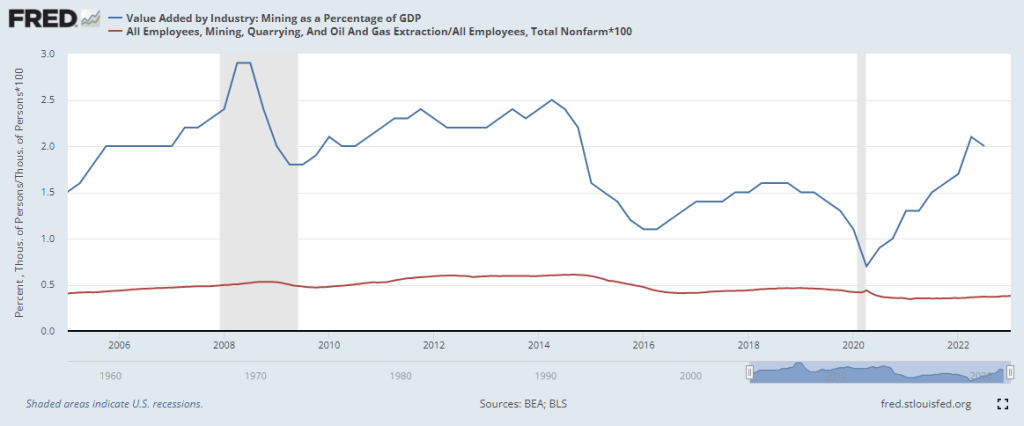
A key factor in the “resource curse” is that its contribution to GDP is usually far above its contribution to employment. If a mining sector accounts for 2% of employment but contributes 10% to GDP, the ratio of employment / GDP % equals 2%/10%, or 0.2. Ratios that are far below 1 do not promote a healthy economy. Industries that are closer to a 1-1 ratio will produce a more well rounded and vibrant economy because employed people spend their earnings in other sectors of the economy – a diffusion effect. Some economists might say that a low ratio means that capital is being used more efficiently and attracts capital investment. However, that efficiency comes at an undesirable social and economic cost.

 Let’s look at some examples in the U.S. The construction industry contributes 3.9% to GDP (blue line in the graph below) but accounts for 5.1% of employment (red line). Notice that this is the opposite of the example I gave above. The 1.31 ratio of employment/GDP is above 1, meaning that the industry employs more people for the direct value that it adds to the economy.  Construction spending includes remodels and building additions but does not include maintenance and repair (Census Bureau, n.d.). In the chart below, look at how closely GDP and employment move together. The divergence in the two series since the pandemic indicates the distortions in the housing market because of rising interest rates. Builders have put projects on hold but employment in the sector is still rising because of the tight labor market.

The finance sector’s share of the economy has grown since the financial crisis yet employment has remained steady – or stuck, depending on one’s perspective. The great financial crisis put stress on banks, big and small, but the government bailed out only the “systemically important” banks, leaving smaller regional banks to fend for themselves. The larger banks absorbed many smaller banks, leading to a consolidation in the industry. That consolidation and investments in technology helped the sector become more efficient. The ratio is about 0.75, above the 0.2 ratio in the example I gave earlier. I labeled the lines because the colors are reversed.

Retail employs a lot of people relative to its contribution to GDP. The ratio is about 1.65. Does that mean retail is an inefficient use of capital? Retail sales taxes pay for many of the city services we enjoy and take for granted. Retail is the glue that holds our communities together.

The manufacturing sector employs fewer people in relation to its GDP contribution. It’s ratio is 0.77, about the same as finance.

As I noted earlier, the mining sector is capital intensive with a high ratio of GDP to employment. This sector includes gas and oil extraction. In the U.S. that ratio averages about 0.33 but it is erratic global demand. Look at the effect during the pandemic. In our diversified economy, the mining sector contributes only a small amount, like 2%. In a developing country like Namibia in southern Africa, mining accounts for 10% of GDP. In the pandemic year, the demand for minerals declined and Namibia’s economy fell 8%.

Lastly, I will include the contribution of health care, education and social services, which contribute 7.5% to GDP but employ almost a quarter of all workers. Since the financial crisis and the passage of Obamacare, this composite sector contributes an additional 1% to GDP. These sectors include many public goods and services that form the backbone of our society. The 3.0 ratio is the inverse of the mining sector.

To summarize, the construction, retail, health care and education sectors have a ratio above 1. They employ more people for each percentage unit of output. The finance, manufacturing, mining, oil and gas sectors have ratios less than 1, employing fewer people per percentage unit of output. For readers interested in the GDP contribution of other industries, the Federal Reserve maintains a list of charts, linked here [https://fred.stlouisfed.org/release?rid=331].

//////////////////

Photo by Camylla Battani on Unsplash

Census Bureau. (2019, April 15). Construction spending – definitions. United States Census Bureau. Retrieved February 16, 2023, from https://www.census.gov/construction/c30/definitions.html

U.S. Bureau of Economic Analysis, Value Added by Industry: Construction as a Percentage of GDP [VAPGDPC], retrieved from FRED, Federal Reserve Bank of St. Louis; https://fred.stlouisfed.org/series/VAPGDPC, February 12, 2023.

U.S. Bureau of Labor Statistics, All Employees, Construction [USCONS], retrieved from FRED, Federal Reserve Bank of St. Louis; https://fred.stlouisfed.org/series/USCONS, February 12, 2023.

U.S. Bureau of Labor Statistics, All Employees, Total Nonfarm [PAYEMS], retrieved from FRED, Federal Reserve Bank of St. Louis; https://fred.stlouisfed.org/series/PAYEMS, February 12, 2023.

I will not do a complete reference for each series. Here’s the identifiers for each series: Finance Value Added – VAPGDPFI. Employment in finance – USFIRE. Construction employees – USCONS. Retail Value Added – VAPGDPR. Retail Employees – USTRADE. Manufacturing Value Added – VAPGDPMA. Manufacturing Employees – MANEMP. Education, Health Care, Social Services Value Added – VAPGDPHCSA. Employment is a composite of 4 series. Mining Value Added – VAPGDPM. Mining Employment – CES1021000001

Bridge the Gap?

Photo by Ragnar Vorel on Unsplash

September 6, 2020

by Steve Stofka

What issues are your priorities this election? For more than thirty years Pew Research has surveyed people about their priorities. For the first time in 2019 a majority of 765 respondents answered that there is a “great deal” of difference in where each party stands, up from 25% in 1987 (Pew Research, 2020). I’ve included the full list at the end.

In January 2019, soon after the midterm elections Pew surveyed 1500 adults (Jones, 2020). I don’t know why the abortion/free choice debate is not on the issue list since that single issue may decide some voters. I’m particularly interested in the large gaps in those priorities among those who lean Democrat or Republican. I’ll start with gaps of 25%. For instance, terrorism is a concern for 80% of Republicans but only 55% of Democrats. Other Republican priorities are Immigration, the Military and Crime.

As you can see, these are fear issues. Should a person in a town of 2000 be more concerned about terrorism than a resident of NYC? Of course not, but it is what it is. People vote out of fear and hope, but fear probably wins the wrestling match, especially among Republican voters who are not hopey, changey voters, as former VP candidate Sarah Palin noted (Gonyea, 2010).

The issue of crime illustrates the conflicting complexities of these issues. It is a 60% priority for Republicans, who are in suburban and rural areas where there is less crime, and a 40% priority for Democrats, who are in dense urban areas where there is a higher incidence of crime. Because crime is much lower than in past decades, this issue has slipped as a priority for Democrats (FBI, n.d.).  

Two of the highest Democrat priorites – Cimate Change and the Environment – have a huge gap of 50% with Republican voters. Democrat politicians have not been able to make these two fear issues personal for Republicans. If they could, they would draw more voters to their side on this issue. 25% gaps exist on issues of the Poor and Needy, Health Care, Education and Race Relations. Rural Republican voters are more likely to be poor and needy, but this is not a fear issue for them (USDA, n.d.).

What strategy would a politician or political consultant advise? Run toward the base? If so, one would emphasize these issues where there are large gaps between the two primary factions in this country. The President has largely adopted this strategy. Republican voters are more inclined to fall in line and the President is relying on this party loyalty even if they don’t like him personally.

Some issues where there is a smaller gap between factions are the economy, the budget deficit, jobs, global trade, drug addiction, transportation, Social Security and Medicare.

A politician reaching out to voters on the fence in this election would focus on these issues. Joe Biden hits the jobs theme, the budget deficit, and protecting Social Security and Medicare to appeal to voters who have had their fill of the President’s divisiveness.

In the coming two months, candidates may adjust their strategies. In the 2016 election, Hillary Clinton may not have addressed these shared concerns as well and it cost her the election.  Governing comes after winning an election. In politics, winning is packaging the concerns and identities of voters into an appealing, if not attractive, box that will get them to come out and vote.

What are your priorities this election season? Are you a multi-issue voter, a single issue voter, a party voter regardless of the issues? Here’s the Pew survey list of 18 issues: terrorism, immigration, military, crime, climate change, environment, poor and needy, race relations, health care, education, economy, Social Security, Medicare, jobs, drug addiction, transportation, global trade, and the budget deficit.

///////////////

Notes:

FBI. (n.d.). Crime rates in the United States, 2008 – 2018. Retrieved September 05, 2020, from https://crime-data-explorer.fr.cloud.gov/explorer/national/united-states/crime

Gonyea, D. (2010, February 07). ‘How’s That Hopey, Changey Stuff?’ Palin Asks. Retrieved September 05, 2020, from https://www.npr.org/templates/story/story.php?storyId=123462728

Jones, B. (2020, August 26). Republicans and Democrats have grown further apart on what the nation’s top priorities should be. Retrieved September 05, 2020, from https://www.pewresearch.org/fact-tank/2019/02/05/republicans-and-democrats-have-grown-further-apart-on-what-the-nations-top-priorities-should-be/

Pew Research Center. (2020, August 21). Public’s 2019 Priorities: Economy, Health Care, Education and Security All Near Top of List. Retrieved September 05, 2020, from https://www.pewresearch.org/politics/2019/01/24/publics-2019-priorities-economy-health-care-education-and-security-all-near-top-of-list/

U.S.D.A. (n.d.). Rural Poverty & Well-Being. Retrieved September 05, 2020, from https://www.ers.usda.gov/topics/rural-economy-population/rural-poverty-well-being/

Reaching Consensus

September 22, 2019

by Steve Stofka

In the early 1980s, scientists at NASA raised the alarm that much of the protective ozone layer over Antarctica was missing. Newspapers and TV carried images of the “ozone hole” (Note #1). In 1987, countries around the world enacted the Montreal Protocol and banned the use of aerosols and chlorofluorocarbons (CFCs). There were some arguments and a few AM radio talk show hosts called the ozone hole a scientific hoax. However, most of the world reached consensus. There will always be crackpots who ride backwards on their horse and claim that everyone is lying about what lies ahead.

Compare those days of yesteryear with today. We have a wide array of media and information outlets. People who can’t make change are self-proclaimed experts on climate change. The Decider-in-Chief can’t reach consensus with himself for more than a day. A slight breeze changes his opinion. Intentionally or not, he has become the Anarchist-in-Chief.

The younger generation is quite upset because they will have to live with the consequences of climate change. The fat cats who make their money proclaiming climate change is a hoax will be dead. Next week there’s a climate summit at U.N. headquarters in NYC. A lot of young people demonstrated in cities around the world this past Friday to let the world know that they are concerned. That’s consensus.

What happened to us in the past thirty years? It’s tougher for us to reach consensus about guns, immigration, climate change, women’s rights, and health care to name a few. Let’s turn to a group of people whose job it is to craft a consensus. In a recent Town Hall Supreme Court Justice Neil Gorsuch pointed out that the nine justices reach unanimous consensus on 40% of the 70 cases that they decide each year. Only the most contentious cases make it to the Supreme Court. 40% unanimity means they agree on many principles. 25-33% of their cases result in a 5-4 decision. Those are the ones that get all the attention. The nine justices who currently sit on the Court were appointed by five different Presidents over the past 25 years. Despite the changing composition of the Court over the past seventy years, those percentages of unanimous decisions and split decisions have remained the same.

Let’s turn to another issue concerning consensus – money. Specifically, digital money like Bitcoin. Some very smart people believe in the future of Bitcoin and the distributed ledger concept that underlies digital money. In this podcast, a fellow with the moniker of Plan B discusses some of the econometrics and mathematics behind Bitcoin (Note #3). However, I think that pricing Bitcoin like a commodity is a mistake.

I take my cue from Adam Smith, the father of economics, who lived during a time and in a country with commodity-based money like gold and silver. Unlike today, paper money was redeemable in precious metal. However, Smith did not regard gold or silver as money. To Smith, the distinguishing feature of money is that it could be used for nothing else but trade between people. Money’s value depends exclusively on consensus, either by voluntary agreement or by the force of government. Using this reasoning, Bitcoin and other digital currencies are money. They have no other use. We can’t make jewelry with Bitcoin, or fill teeth, or plate dishes as we can with gold and silver. The additional uses for gold and silver give it an anchoring value. Bitcoin has an anchoring value of zero.

When people lose confidence in money, they lose consensus over its value. Previous episodes of a loss of confidence in a country’s money include Zimbabwe in the last decade, Yugoslavia in the 1990s, and the sight of people pushing wheelbarrows of money in Germany during the late 1920s.

Like gold, Bitcoin must be mined, a process that takes a lot of electricity and supercomputers but does not give it any value. Ownership in a stock gives the owner a claim on the assets of a company and some legal recourse. Ownership of a digital currency bestows no such rights.

In an age when we cannot reach consensus on ideas like protecting our children at school or the rights a woman has to her own body, we seek consensus with others on more material things like Bitcoin. We seek out information outlets which can provide us with facts shaped to our perspective. When facts don’t fit our model of the way things should be, we bend the facts the way water bends light.

John Bogle, the founder of Vanguard, died recently. He was an advocate of investing in the consensus of value about stocks and bonds. Now we call it index investing. That’s all an index is – a consensus of millions of buyers and sellers about the value of a financial instrument. There are several million owners of Bitcoin – a small consensus. There are several thousand million owners of SP500 stocks. That is a very large consensus, and like a large ship, turns slowly in its course. A small ship, on the other hand, can zip and zig and zag. That’s all well if you need to zig and zag. Many casual investors don’t like too much of that, though. They prefer a steadier ship.

I do hope we can move toward a consensus about the bigger issues, but I honestly don’t know how we get there. In 2008, former President Obama called out “Si, se puede!” but quickly lost his super-consensus in Congress. “No, you can’t!” called out the new majority of House Republicans in 2010. We’ve gotten more divisive since then. Journalist Bill Bishop’s 2008 book “The Big Sort” explained what we were doing to ourselves (Note #4). Maybe he has an answer.

In the next year we are going to spend billions of dollars gloving up, getting on our end of the electoral rope and pulling hard. Our first President, George Washington, was reluctant to serve a second term. Hadn’t he given enough already? In our times, each President looks to a second term as a validation of his leadership during his first term. There’s that word again – consensus.

////////////////////////////

Notes:

  1. Images, video of the ozone hole in 1979 and 2018 from NASA.
  2. We the People podcast from the National Constitution Center
  3. Discussion of bitcoin on this podcast
  4. The Big Sort by Bill Bishop

Job Threats

September 8, 2019

by Steve Stofka

The greater threat to your job – automation or other workers? For thousands of years people have stored their human capital in writing. In some cultures, only a privileged few were allowed access to these “secrets.” The invention of the printing press in the 15th century caused massive unemployment among monks and scribes who copied treasured books by hand.

No, that didn’t happen. Demand for books, particularly the Bible, added many jobs. A symbiosis of knowledge exploded through Europe and parts of Asia. In the network of knowledge, the sciences flourished. The mathematics of chance and the development of calculus spawned the birth of modern physics in Newton’s Principia Mathematica. In the following centuries came the understanding of air and other gases, the physics of fire, electromagnetism and the very structure of stuff. All this human capital was written down in words and equations written in a single language called mathematics.

Books could hold and display the knowledge but couldn’t make the calculations. All that changed when the computer was invented in the mid-20th century. Dancing on pathways etched on silicon circuit boards, electrons simulated the calculations that the human brain had learned.

After defeat by IBM’s Deep Blue chess computer in 1996 (he won the first game), Garry Kasparov realized that computers could become human partners. Crude mechanical computers had automated some tasks during the the 19th and 20th centuries. Now they were ready for some of the tasks of knowledge workers like lawyers (Note #1). Some clerical tasks in the practice of law have been automated but there is still much that relies on judgment gained through experience and “je ne sais quoi” – the subtle weighing of multiple factors that are difficult to write algorithms for.

Thirty years ago, a grocery clerk had to be good at arithmetic – able to multiply four apples times 89 cents per apple and punch in the total on older cash registers. Clerks who could do those calculations quickly and accurately were paid good money.

An accounting clerk in a finance office had to know what calculations to do to get a loan payoff, or to calculate how much credit to extend to a customer. Today a clerk with much less knowledge and training can tab from box to box on a screen and enters the data that the program asks for. Natural language processing is rapidly making even that obsolete. A clerk will simply be able to ask a program a question and it will compute the answer or ask for more information if needed. We used to have to give Google the formula to compute the volume of a sphere. No longer. Ask “what is the volume of a sphere with a radius of 2?” Each year more human capital is being transformed into technology capital.

Some are concerned about the number of jobs that will be lost to automation. The development of the Cotton Gin in the early years of the nineteenth century reduced the number of workers needed to harvest an acre of cotton. Did plantation owners tell their slaves “I don’t need your services any longer?” No. They devoted more acres to the growing of cotton and the demand for slave labor increased.

A few years earlier before the cotton gin, the invention of the Loom greatly improved the efficiency of garment workers. Manufacturers reduced prices of some finished goods, the demand for silk and cotton soared, and employment in the industry grew.

The invention of primitive computers in the middle of the 20th century should have put arithmeticians out of business. Instead the demand increased for people who could do the more difficult or time-consuming computations. Careful but relatively unskilled people could punch in data on a punch card and the computer would tabulate the results. In the 1960s, the demand for business data dramatically increased.

Those in technical professions like lawyers and doctors lobby to protect their jobs not from automation but from other people who could do portions of their job.  In some states, a dental technician cannot fill a cavity. In some states, routine tasks can be performed by a paralegal with less training. They also command lower salaries. In other states, those tasks have to be carried out by a lawyer or with the active supervision of a lawyer.

Some areas of the country are based on a monoculture, an industry that dominates the local economy. The leaders in those industries exert a lot of political influence. A fundamental shift happens when one monoculture competes with another. Many coal workers may be convinced that former President Obama killed the coal industry with burdensome regulations. In 1979, the rock group The Buggles sang “Video Killed the Radio Star;” a similar shift has happened to the coal industry. The surge in lower cost natural gas supplies killed the coal industry. North Dakota against West Virginia and Wyoming. The coal industry’s leaders had less political influence and could not push back against the regulators.

In the 1990s, checkers at Albertson’s went on strike to protest the adoption of scanning technology and UPC codes that were first developed in the 1970s. They were concerned that the store chain would begin hiring lower-paid workers who simply had to pass a grocery item over a scanning screen.

Technological change displaces one type of worker with another type. Millions of workers are doing jobs today that didn’t exist 50 years ago because of technological change. I was at a get-together a few months ago and spoke with a woman who was a social media manager. That’s a job. As the growth of social media has exploded around the world, thousands of new jobs have been created. In the past two decades, programmers have automated some coding. Programmers who could not adapt did lose their jobs but many more jobs were created for those with different or more complicated skills.

What can’t be automated -so far – is people taking care of people. The fact that these are some of the lowest paid professions speaks to the values of our society. Companies pay paltry wages to the people who take care of our parents and grandparents. Those jobs cannot be automated to any great degree. It’s possible that some company will develop a robot that can help an older person into a bathtub or shower, but the process requires many delicate decisions, patience and empathy.

In monoculture economies around the country, some worry that unauthorized immigrants will take lower paying jobs from Americans. Immigrants are more willing to move for a job than Americans. In a county dominated by oil, gas, coal, mining, agricultural or car manufacturing industries, there isn’t much variety in employment and native residents of those towns and cities have something to worry about.

For the whole country, there will not be enough people to fill many lower paying jobs. The Bureau of Labor Statistics estimates that jobs for home health and personal care aides will grow by 36% – rising to almost five million workers. Difficult to keep up with a growth rate far above the 7% average growth of all occupations. Employment for in-facility nursing assistants and orderlies are expected to grow by 9%. Even taking care of our pets will be more difficult – job opportunities for vet assistants are expected to grow by 19%.

If only Congress could set up an immigration program to help our hospitals, clinics, long-term care facilities and home aide programs fill these positions. If only. The H-2B visa program is for temporary jobs only and there are far too few permits issued each year (Note #3). Most of the demand for health care services comes from urban and suburban areas, whose votes have less influence in a rural state where the legislature heeds the wishes of the extractive and “ag” industries. We are not fighting the machines. We are fighting each other.

/////////////////////

 Notes:

  1. Kasparov recounts that match with Deep Blue in the TED talk (transcript)
  2. BLS estimates of employment growth for health care aides
  3. 1H-2B visa program

Country Roads and the Election

May 12, 2019

by Steve Stofka

I spent the past week traveling with my sister to a family reunion near Dallas, Texas. In our travels, we passed through rural counties in southeast Colorado, western Oklahoma, and northwest and central Texas. In contrast to the signs of a brisk economy in the larger cities, some rural communities show signs of stress. Some roads leading off the main route need repair; some houses could use a fresh coat of paint; some stores have delayed maintenance. In some small towns most of the stores remain boarded up ten years after the financial crisis.

Candidates for the 2020 Presidential election must speak to the two Americas. The Americans who produce the food we eat and the power that lights our businesses and homes are not doing as well as those in the urban corridors. Young people in rural America leave for the larger cities to find a job or pursue an education. Older people with medical needs must move to larger cities with hospital facilities available in an emergency.

Let’s turn to a proposal on the list of issues for the 2020 election – an increase in the Federal minimum wage. A person making a minimum wage of $15 an hour in Los Angeles earns a bit more than half of L.A.’s median household income (MHI). She may work 2-1/2 weeks to pay the rent on a one-bedroom apartment (Note #1). The MHI in rural America is about 20% less than the national average. In Limon, Colorado (population less than 1500), the MHI is about half of the national average (Note #2). $15 an hour in Limon is the MHI.

In 2009 and 2010, the Democrats controlled the Presidency, the House and had a filibuster proof majority in the Senate. They could have enacted a federal minimum wage that was indexed to the living costs in each county or state. Why didn’t they fix the problem then? Because Democrats use the minimum wage as an issue to help win elections. If Congress passes a minimum wage of $15 an hour this year, they will have something new to run on in five years – a raise in the minimum wage to $17 an hour. Voters must begin asking their elected representatives for practical and flexible solutions, not political banners like a federal mandated one-size-fits-all $15 minimum wage.

For decades after World War 2, Democratic Party politicians who controlled the House refused to allow legislation that would index tax rates to inflation. This resulted in “bracket creep” where cost of living wage increases put working people in higher tax brackets automatically (Note #3). The problem became acute during the high inflation decade of the 1970s and the issue helped Ronald Reagan take the White House on a promise to fix the problem.

A week ago, I heard a Democratic Senator running for President say that they knew all along that Obamacare was just a start. The program was poorly drafted and poorly implemented and now we learn that Democrats knew all along that it was bad legislation? Will Medicare For All also be built on poor foundations and require a constant stream of legislative and agency fixes? This provides a lot of work for the folks in Washington who draft a lot of agency rules that require a lot of administrative cost to implement. Democrats are fond of federal solutions but show little expertise in managing the inevitable bloated bureaucracy that such solutions entail.

Some Democratic Party candidates are promising to fix the harsh sentencing guidelines that they themselves passed in the 1990s, which fixed sentencing guidelines enacted 25 years earlier by Democratic politicians in the 1960s and 1970s. This party’s platform consists of fixing its earlier mistakes.

According to a Washington Post analysis of election issues (Note #4), some candidates are concerned about corporate power. A Democratic president would have to work with the Senate’s Democratic Leader Chuck Schumer whose main support comes from large financial corporations based in his home state, New York. While a President Elizabeth Warren might propose regulatory curbs on corporate power, Mr. Schumer would be gathering campaign donations from the large banks who needed protection from those same regulations.

Large scale industrial power production has a significant effect on the climate. The few blue states that supported a Democratic candidate for President in the 2016 election also consume most of the final product of that power production. Have any candidates proposed solutions that lower the demand for power? Temperature control systems in commercial buildings could be set to a few degrees warmer in the summer and a few degrees cooler in the winter. That would have a significant impact on carbon production. Some candidates propose solutions that regulate the production and supply of power – not the demand for power. Most of that production occurs in states that supported a Republican candidate in the 2016 election. Proposals to install wind and wave generating stations in Democratic leaning coastal states in the northeast and northwest have been met with local resistance. Voters in the blue states want green solutions to be implemented in the red states, but not inconvenience residents of the blue states. Voters in the red states see through that hypocrisy.

A viable Democratic candidate must convince independent voters who are wary of political solutions from either party.  Donald Trump won the Presidency without visiting rural folks on their home turf. He landed his plane near a staged rally and the folks came from miles around to hear him. Compare that approach with former Republican candidate Rick Santorum who visited many small towns in Iowa in the months before the 2012 Iowa primary. In small restaurants and rural post offices, Santorum listened to the concerns of voters. Trump’s approach was successful. Santorum was not. Go figure.

Trump convinced rural folks that he was going to go to Washington and drain the swamp. This in turn would help the economy in small town America so that those folks could get themselves a new roof, or a new pickup truck, fix the fence or get a few potholes patched. From what I saw, those folks are still waiting. Some rural folks may run out of patience with Trump by next year. The success of any Democratic candidate depends on that.

//////////////////////

Notes:

  1. One week’s take home pay of $550 x 2.5 weeks = $1375. A 1 BR in L.A. averages $1350 L.A. Curbed
  2. Areavibes.Com assessment of Limon, Colorado.
  3. Tax indexing
  4. Washington Post article on various election issues

Promises Made and Unpaid

November 11, 2018

by Steve Stofka

A tip of the hat to veterans on this holiday.

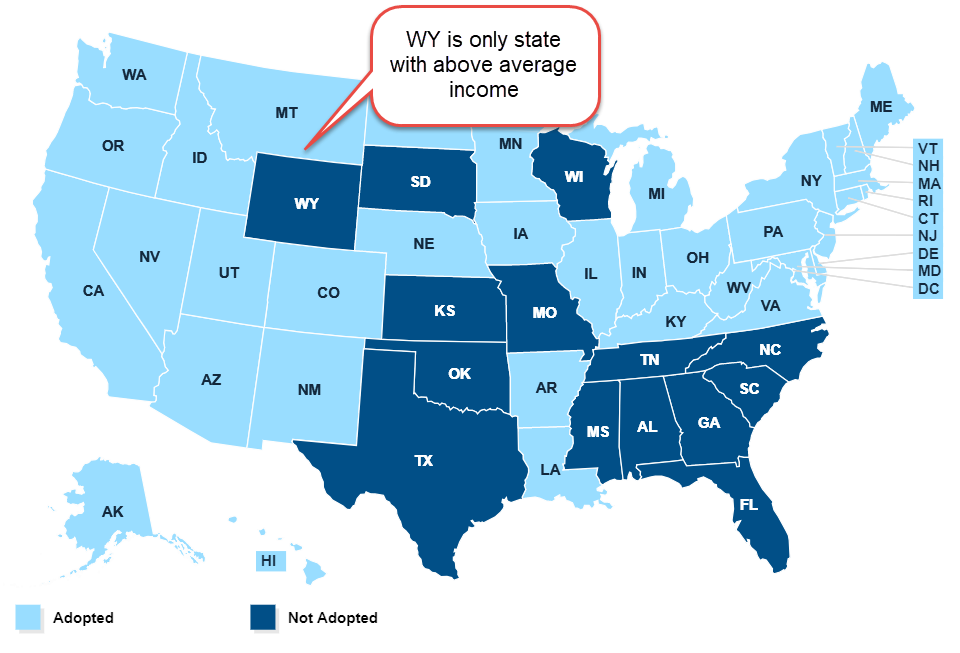
The Kaiser Family Foundation (KFF) regularly updates their map of the states that have not expanded Medicaid under Obamacare (Note #1). Here’s a screen shot.

KaiserMap
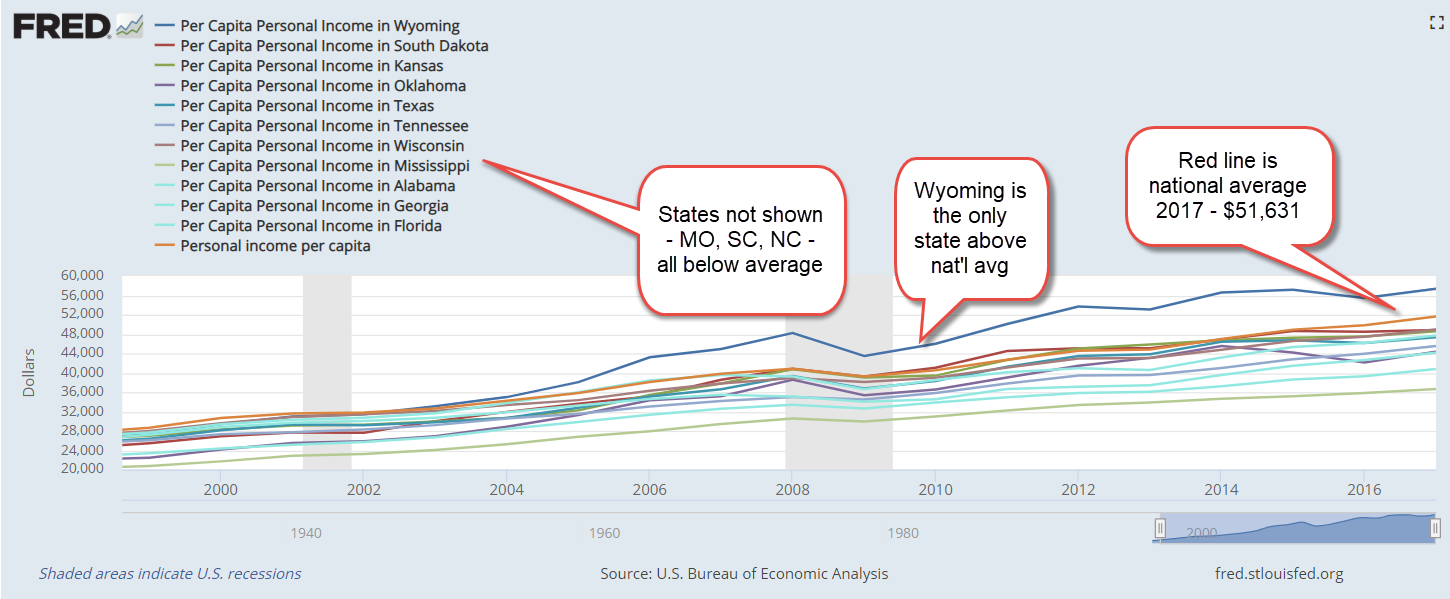
All the non-expansion states except for Wyoming had per capital personal incomes below the national average.

PerCapPersIncByState

Since these states have less per capita income, it is likely that more of the residents in those states qualify for Medicaid. During the initial phase of Obamacare, the Federal government picked up the tab for the additional costs. That share will gradually decrease to 90% in 2020, when the states will have to foot 10% of the expansion costs.

A ten percent share seems light. Why don’t these states expand their Medicaid eligibility? Let’s look beyond accusations of prejudice, which exists in every state.

The populations in most of these states are older. Poor seniors living in nursing homes qualify for traditional Medicaid, which costs each state much more than expansion Medicaid. The national average of state costs is 38%; the Federal government picks up an average of 62% of traditional Medicaid spending. Wyoming pays almost 50%, far above the average. Texas and South Dakota pay 44% and 41%. Oklahoma and Florida pay the average of 38% and the rest of the non-expansion states pay below average (Note #2).

The financial crisis ten years ago crippled state finances for several years and some have still not recovered. Since 2000, average per capita real income in the U.S. has grown only 1.2% per year. Medicaid spending has grown at more than three times that rate (Note #3). Residents in these poorer states have fared worse than the average. Revenues in those state have barely kept up with obligations. Officials in poorer states with older populations anticipate that funding difficulties will continue now that the first of the Boomer generation has turned 70. Given the political pressure to expand, how much longer will some of these states resist expansion?

Thirteen states that have expanded coverage have adopted new revenue sources to fund the additional costs (Note #4). Most states fund their Medicaid spending, original and expansion, out of general revenues which are falling behind state promises. These include infrastructure repairs – roads, bridges, improvements and repairs to schools and other government buildings – as well as pension obligations. Officials of state and local governments made these promises decades ago, when per capita incomes were growing more than 2%. Annualized growth over a twenty-year period has not been above 2% since 2001.

PerCapIncReal

Tax the rich is one solution offered, but that is a short-term solution. In the long-term, higher income growth is the sustainable solution. Until Democratic politicians can craft a coherent policy message that promises to promote stronger economic growth in these states, the voters will reject them.

/////////////////////

Notes:
1. KFF’s map of states that have turned down Medicaid expansion.
2. KFF’s breakdown of Medicaid costs per state.
3. A summary of inflation adjusted Medicaid spending from 2000-2012 showed a 4.1% annual growth rate – pg. 4. A state by state breakdown is on page 35. A 49 page report from Pew Charitable Trust.
4. A recent article showing the various sources of funding that expansion states are using.