A Broader Inclusion

November 27, 2022

by Stephen Stofka

Hope everyone had a good Thanksgiving. This week’s letter is about a type of income that we don’t often think about, how that affects asset values and a proposal to increase homeownership. With left over buying power, people purchase assets in the hope that the buying power of the asset grows faster than inflation. There are two types of assets: those that produce future consumption flows and collectibles whose resale value increases because they are unique, desired and in limited supply. An example of the first type is a house. An example of the second type is a painting. Let’s look at the first type.

House Equals Future Shelter

A house is a present embodiment of current and future shelter. The value of that utility depends on environmental factors like schools, crime, parks, access to recreation, shopping and entertainment. These affect a home’s value and are outside a homeowner’s control. A school district’s rating in 2042 may be quite different than its current rating. Our capitalist system and U.S. tax law favors home ownership in several ways. The monthly shelter utility that a home provides is capitalized into the value of a property. Every consumption requires an income, what economists call an imputed rental income. Two thirds of homes are owned by the person living there (Schnabel, 2022) and a little more than half are mortgage free. Unlike reinvested capital gains in a mutual fund, this imputed income is not taxed to the homeowner. Let me give an example.

If the market rate for renting a similar home were $2000 a month, that is an implicit income to the homeowner. Because there is no state or federal tax on that income, the gross amount of that $2000 would be about $2400. That’s almost $30,000 a year. After monthly costs for taxes, insurance and maintenance, the annual implicit operating income of the property might be $25,000. At a cap rate of 5% (to make the math easy), the capital value of the property is $500,000. Each year, Congress requires the U.S. Treasury to estimate the various tax expenditures like these where Congress excludes certain income items from taxes. The implied income on owning a home is called “imputed rental income” and in 2021 the Treasury (2022) estimated that the income tax not collected was $131 billion. How much is that? A third of the $392 billion paid in interest on the public debt. If we did have to pay taxes on that imputed income, it would lower the value of our homes. For many decades, Congress has not dared to include that implied income.

Mutual Fund Capital Gains

Let’s return to the subject of reinvested capital gains in a taxable mutual fund held outside of an IRA or pension type account. Some of what I am about to say involves tax liability so I will state at the outset that one should consult a tax professional before making any personal buy and sell decisions. When some part of a fund’s holdings are sold, a capital gain is realized from the sale and paid to the investor who owns the mutual fund. If the investor has elected to have dividends and capital gains reinvested, the money is automatically used to repurchase more shares of the mutual fund. The balance of the account may change little but there is a taxable event that has to be included in income when the investor completes their taxes for the year. Many mutual fund holdings recognize capital gains in December.

Mutual fund companies provide the tax basis or unrealized gain/loss for each fund but often do not include that information on the statement. The unrealized gain is the price appreciation has not been taxed yet. For example, the dollar value of a fund may be $50,000 and the unrealized gain $5,000. This is more typical of a managed fund than an index fund which does not adjust its portfolio as frequently as a managed fund. If an investor were to sell the fund to raise cash, they would pay taxes on the $5,000, not the $50,000. The unrealized gain in an index fund might by 70% of the value of the fund. If the fund value is $50,000, the unrealized gain could be $35,000 and the investor would owe taxes on that amount. An investor can minimize their tax liability with a judicious choice of which fund to sell. Again, consult a tax professional for your personal situation.

Affordable Homeownership

Let’s visit an imaginary world where people do not have to pay property taxes outright. Each year they can elect to sell a portion of their property to the city or other taxing authority. Cities sometimes place tax liens on properties when a tax is not paid. This would be like a voluntary lien making the city a temporary part owner of the property until the homeowner sells it.

Imagine that a homeowner owns a home worth $400,000. For ten years, they have elected to have the city deduct an annual $2000 average property tax from the value of the home. Over the ten year period, the accrued sum is $20,000 plus an interest fee that is added to the principal sum of the tax. These voluntary tax liens would be visible to a lending institution so that the sum would lower the home’s value for a HELOC, or second mortgage. The city would report that annual amount each year as an imputed income to the homeowner and the homeowner would have to pay income taxes on it. At a 20% effective federal and state tax rate, the out-of-pocket expense would be about $480 on $2000. After the 2017 tax law TCJA, property taxes are no longer deductible so the homeowner has to earn $2400 to pay the $2000 tax outright. There is a slight change in income tax revenue to the various levels of government. When a home is sold those tax liens would be paid back to the city.

Why don’t we have such a system in place now? In the U.S. private entities own most of the capital. Some people would be uncomfortable knowing that a government authority had some legal claim to their property but they could opt out. In a pre-computer age, the accounting would have been a nightmare. Such a system is feasible today. Mutual fund companies have demonstrated that they can track the complex capital positions of their customers. Cities can do the same.

Such a system would make home ownership more affordable for a lot of people without affecting those homeowners who preferred to pay the property tax outright as we do under the current system. Investment companies would be eager to amortize those voluntary tax liens held by city governments. In the event of another financial crisis, a decline in housing prices and a rise in foreclosures, the city would be first lienholder, first in line to get paid when the property is foreclosed. Interest groups that advocate for affordable housing would be joined with investment and pension companies who wanted to underwrite the bonds for such a program.

A Capitalist System of Greater Inclusion

Some blame our capitalist system for the inequities in our society. The fault lies in us, not the capitalist system. Feudalism, mercantilism, capitalism, socialism, communism and fascism are systems of rules that embody a relationship of individuals to 1) property and the manner of production, both current and future, 2) the society, our families and communities, 3) the government that recognizes those relationships. The capitalist system is the most versatile ever invented and yes, it has been used to exclude people just as the other systems have been used to weaken some classes of people. The capitalist system can be extended to include and strengthen more of us. This homeownership policy could broaden that inclusion.  

////////////////

Photo by Hannah Busing on Unsplash

Schnabel, R. (2022, August 19). Homeownership facts and statistics 2022. Bankrate. Retrieved November 24, 2022, from https://www.bankrate.com/insurance/homeowners-insurance/home-ownership-statistics/

U.S. Treasury . (2022, October 13). Tax expenditures. U.S. Department of the Treasury. Retrieved November 24, 2022, from https://home.treasury.gov/policy-issues/tax-policy/tax-expenditures. Click FY2022 for the current year PDF estimates.
Taxes, Bitcoin, and Housing

December 24, 2017

by Steve Stofka

Merry Christmas! Because of the holidays, I’ll keep it short. A few notes on the tax bill passed this week and some odds and ends I’ve collected.

In the final version of the tax bill, the state and local tax (SALT) deduction was limited to $10,000.  This limitation will hurt those in the coastal “blue” states.  As a group, these states already pay more in Federal taxes than they receive in various Federal programs.  The limit on the SALT deduction will take even more money from blue states and give it to red states. There is a second transfer taking place intra-state.

There are several components to SALT: income, sales and property taxes. According to the Census Bureau’s American Community Survey, almost 50 million households own a home with a mortgage.  Under current tax law, they get to deduct whatever mortgage interest they pay. Rich homeowners take the bulk of the mortgage interest deduction on their million-dollar homes.  50 million households rent. They get to deduct zilch.

For decades, homeowners have been in a protected class and able to deduct their property taxes. Renters have enjoyed no such deduction.  The owner of the building gets the deduction.  Think the owner is sharing that tax largesse by lowering rents?  No. For years, renters have effectively subsidized the tax deduction for their homeowning neighbors. The new tax bill transfers some of that tax burden from renters back to homeowners, putting both types of households on a more even level.

The density of coastal populations requires more infrastructure supplied by states, cities and towns.  Unless there is a natural resource like oil that can be taxed, local jurisdictions need higher taxes to pay for the added infrastructure. Secondly, the population density leads to more competition for land and housing, which causes higher property prices.  Even if New Jersey and Colorado charged the same property tax rate, the higher home prices in New Jersey would result in higher taxes.  But the two states don’t charge the same rate.  New Jersey averages almost twice the property tax rate charged by counties and towns in Colorado.

If you would like to compare property taxes in your state, county, or zip code with others, you can click here (https://smartasset.com/taxes/new-jersey-property-tax-calculator)

Democrats have long championed a graduated income tax, and the more graduated the better. The limit on the SALT deduction effectively levies more tax on those with higher incomes. That is the core principle of a graduated tax. Isn’t that what Democrats want?

//////////////////////////

Bitcoin Bumps

After surging more than 2000% this year, bitcoin has fallen 40% this week, but is still up more than 1400% for the year. 80% of the trading volume this year has come from Asia. Japanese men have turned from leveraged forex trading to bitcoin and other digital currencies. (WSJ article)

As an exchange of value, currencies should be stable. When they are not, they have failed, and it is invariably due to a failure of government policy. Venezuela is a current example. From 2007-2009 Zimbabwe’s currency failed, and even today, they use the U.S. dollar. Germany in the 1920s is probably the most egregious example of a failed currency.

Bitcoin is not a currency. Bitcoin is an asset but barely that. Buyers of bitcoin and other digital “currencies” are buying a share in the “greater fool” theory. Yes, the concept is brilliant. Ledger transaction chains solve many problems in international exchange. But digital transactions take too much energy to serve as a currency. In the time that it takes to validate the transfer of one bitcoin, hundreds of credit card transactions take place.

Bitcoin is not secure. A South Korean bitcoin exchange went bankrupt this month when it was hacked, and its reserves stolen. (CNN article) . Mt. Gox is the most well-known bitcoin hack victim, but there are others (Top 5 Bitcoin Hacks ).

//////////////////////////

Housing Prices to Income Ratio

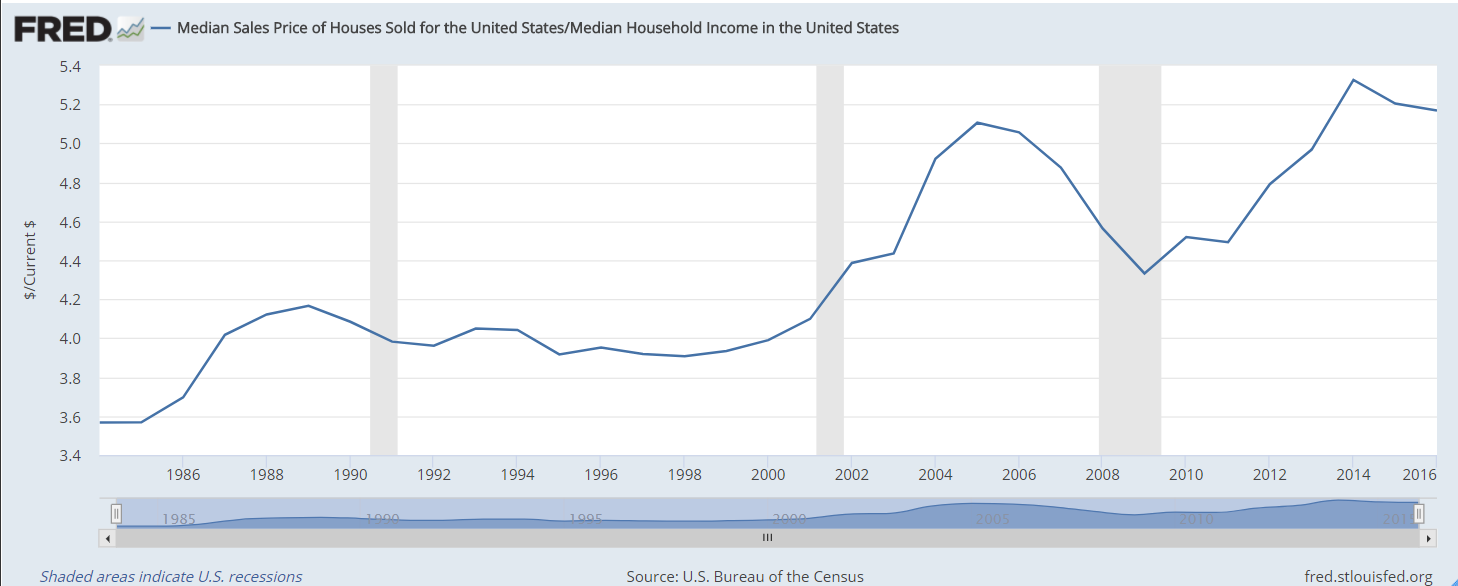
New home sales in October were 10% above estimates. The average price of a new home hit an all-time high of $400K. The median price is $316K, more than five times the median household income. Here’s a graph of that housing price/income ratio for the past thirty years.

HomePriceIncomeRatio

The ratio first broke above 4 in 1987 and steadied for the next 13 years. During the housing bubble in the 2000s, the ratio rose swiftly and crossed above 5. As the bubble popped in 2007 and millions of people defaulted on their loans, the ratio fell as fast as it rose. Since the Financial Crisis, low interest rates have helped fuel another bubble.

The recent Case-Shiller housing index was higher than expected. Home prices are going up 6% per year, twice the rate of increase in incomes.

/////////////////////////

I’ll have more next week on long-term trends in income and inflation. Have a merry and take care of year ending stuff this week! Those with high SALT deductions might consider paying 2018 property taxes in 2017 but there is some question whether the IRS will allow the deduction. See this L.A. Times article.

Post-Election Bounce

January 1, 2017

Happy New Year!  How many days will it take before we remember to write the year correctly as 2017, not 2016? It is going to be an interesting year, I bet.  But let’s do a year end review.

Homeownership

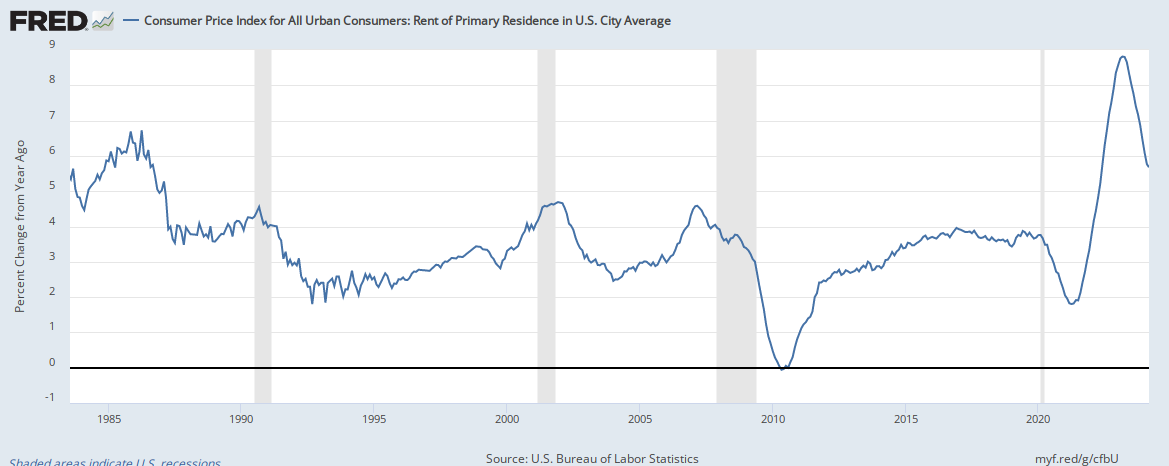
The home ownership rate has fallen near the lows set in 1985 and the mid-1960s at about less than 64%. (Graph)  In 2004, the rate hit a high of 69%.  For the U.S., the sweet spot is probably around 2/3 or 66%.  Most other countries have higher rates of home ownership, including Cuba with a rate of 90%. (Wikipedia article)  Rents in some cities have been growing rapidly.  In the country as a whole, rents have increased almost 4%, about twice the growth in the CPI, the general rate of inflation for all goods and services. (Graph)

Earnings

Real, or inflation-adjusted, weekly earnings of full time workers spiked up during the recession as employers laid off lower paid and less productive workers.  By late 2013, weekly earnings had fallen to 2006 levels and have risen since, finally surpassing that 2009 peak this year.

Core Work Force

Almost every month I look at the changes in the core work force of those aged 25-54 who are in their prime working years, who buy homes for the first time and have families.  These are the formative years when people build their careers, and form product preferences, making them a prime target for advertisers.  The economy depends on this age group.  They fund the benefit systems of Social Security and Medicare by paying taxes without collecting a benefit.  In short, an economy dependent on intergenerational transfers of money needs this core work force to be employed.

For two decades, from 1988 to 2008, the labor participation rate of this age group remained steady at 82% – 83%. (BLS graph) By the summer of 2015, it had fallen to 80%.  A few percent might not seem like much but each percent is about a million workers.  For the past year it has climbed up from that trough, regaining about half of what was lost since the Great Recession.

Consumer Confidence

A post-election bounce in consumer confidence has put it near the levels of 2001, near the end of the dot-com boom and just before 9-11. (Conference Board)  In 2012, the confidence index was almost half what it is today.

Business Sentiment

Small business sentiment has improved significantly since the November election (NFIB Survey).  Almost a quarter of businesses surveyed expect to add more employees, a jump of 2-1/2 times the 9% of businesses who responded positively in the October survey.  In October, 4% of companies expected sales growth in the coming year.  After the election, 20% responded positively.  This jump in sentiment indicates the degree of hope – and expectation – that business owners have built on the election of Donald Trump.

Hope leads to investment and business investment growth has turned negative (Graph). Recession often, but not always, accompanies negative growth. Since 1960, investment growth has turned negative eleven times.  Eight downturns preceded or accompanied recessions.  Let’s hope this renewed hope and some policy changes reverses sentiment.

On the other hand, those expectations may present a challenge to the incoming administration, which has promised some tax reform and regulatory relief. Small business owners will lobby for different reforms than the executives of large businesses.  Regulations of all types hamper small business but large businesses may welcome some regulation which acts as a barrier to entry into a particular market by smaller firms.

Publicly held firms will continue to lobby for repeal or reform of Sarbane Oxley reporting provisions.  For six years, the Obama administration has wanted to roll back these regulations but has been unable to come up with a compromise between the SEC, which regulates publicly traded companies, and Congress.  A Trump administration may finally reform a law that was rushed into place by George Bush and a Republican Congress in response to the Enron scandal.  That scandal grew in part from the Bush administration’s push to deregulate the energy market.

Voters Veer From Side To Side

We have stumbled from an all Republican government in 2002 to an all Democratic government in 2008 and now come full circle again to an all Republican government. Once in power, neither party can resist using economic policy to pick winners and losers.  Every few years the voters throw out the guys in charge and bring the other guys in, hoping that the party that has been out of power will be chastened somewhat.  Within a few months of taking power, each party digs up their old bones and begins to gnaw on them again.  Tax reform, prison reform, justice and fairness for all, climate change, more regulation, less regulation – these bones are well chewed.

Still we keep trying.  The priests and prophets of long ago kingdoms could not govern.  Neither could the kings and queens of empires.  So we have tried government of the people, by the people and for the people and it has been the bloodiest two centuries in human history.  Still we keep hoping.

The Presidential Test

Most presidents are tested in their first year in office.  Kennedy had to grapple with the Soviet threat and Cuba almost as soon as he took office.   Johnson struggled with urban violence, social upheaval and the war in Vietnam.

Nixon confronted a newly resurgent Viet Cong army when he first took office.  His second term began with the Arab oil embargo.  Ford dealt with the aftermath of Watergate and Nixon’s resignation under the threat of impeachment.

Jimmy Carter began his term with the challenges of high inflation and unemployment, and an energy crisis to boot.  Ronald Reagan wrestled with sky-high interest rates and a back to back recession in his early years.  His successor, H.W. Bush, met a Soviet Union near the end of its 70 year history as Gorbachev loosened the reins of Soviet control of eastern European countries and the Berlin Wall collapsed.

After an unsuccessful attempt to reform health care in his first year of office, Clinton suffered in the off year election of 1994.  G. W. Bush had perhaps the worst first year of any modern President – the tragedy of 9-11.  Obama entered office under a full blown global financial crisis.

Despite Putin’s bargaining rhetoric regarding President-elect Donald Trump, every President has to learn the lesson anew – Russia is not our friend.  Trump will have to learn  the same lesson.  China’s territorial claims in the South China sea may prompt an international incident.  N. Korea could launch a missle at S. Korea and start a small war.  Iran, Afghanistan, Iraq and Syria, Israel’s settlements, Palestinian independence – the crises may come from any of these tinderboxes.  We wish the new President well as he hops into the fire.