Priorities and Problem Bundles

April 27, 2025

By Stephen Stofka

This is part of a series on persistent problems. The conversations are voiced by Abel, a Wilsonian with a faith that government can ameliorate social and economic injustices to improve society’s welfare, and Cain, who believes that individual autonomy, the free market and the price system promote the greatest good.

Abel said, “After last week’s conversation on the homeless problem, I wondered about the strategies cities have devised to tackle the problem. I thought Denver and Aurora provided a good contrast. Here are two cities in the metro Denver area that have adopted policies with a different emphasis. They share a common border so imagine you’re standing on one side of a border street. Homeless people on that side of the street get treated one way. Homeless on the other side of the street get dealt with under a different policy.”

Cain smiled, “Well, you had a more productive week than I did. I spent Monday worrying about the consequences if Trump tried to fire Powell, the head of the Federal Reserve. On Tuesday, Trump said the media made too big a deal out of things he said.”

Abel asked, “What did Trump say?”

Cain replied, “That he wanted to fire Powell. Trump’s exact words were ‘his termination cannot come fast enough’ (Source).”

Abel smirked. “Naturally, it’s the media’s fault for broadcasting what Trump says. Anyway, to get back to the homeless problem. Yeah, the mayor of Denver, his name’s Mike Johnston, ran on a campaign of reducing homelessness and took office in July 2023. He immediately announced his administration’s ‘All In Mile High’ program. By the end of that year, the city had bought a hotel and turned it into a shelter for 205 families. Tamarac Shelter it’s called (Source).”

Cain whistled. “A government that got something done in six months. Good for them.”

Abel continued, “By the end of last year, the city had moved 2500 homeless people into housing of some sort (Source). The cost was about $155 million in the 17 months ending in December 2024 (Source). Much of the expense was startup costs, funded by federal grants for the purchase and repair of buildings to house homeless people (Source). The city expects to spend almost $58 million in fiscal year 2025 as ongoing costs to provide housing and support programs for 2000 homeless.”

Cain asked, “How many homeless people does Denver have?”

Abel replied, “A few years ago, they estimated 9000 (Source). That’s less than the 11,000 estimated homeless in 2012 (Source).”

Cain frowned. “So, the city hopes to resolve the problem in the next two years?”

Abel sighed. “Resolve? No. Reduce? Yeah. They estimate that people will spend six to twelve months in the program so I suppose the goal is to show a strong response in the hopes that the problem will ease.”

Cain raised his eyebrows. “Housing is not getting cheaper. That’s going to put some pressure on poorer families who are just one or two paychecks from homelessness. How many of the homeless are these immigrants that got bused up from Texas?”

Abel shook his head. “I don’t know but migrants were the main component of the surge in homelessness in 2022 and 2023.”

Cain nodded. “You said the city estimated a cost of $58 million a year to provide shelter and support services for 2000 homeless people. Napkin math tells me that’s about $30,000 per person. That’s the same amount the federal government spends to house someone in a standard federal prison (Source).  That says something about our priorities and values. In essence, we pay people not to work, whether they commit a federal crime or become homeless.

Abel scoffed. “Well, that’s not exactly giving them money.”

Cain argued, “It’s giving someone money. One man’s expense is another man’s income. That’s the underlying problem. The prison industrial complex naturally promotes more prison time as a solution to crime.”

Abel showed surprise. “You would support more rehab services instead of prison?”

Cain shrugged. “Depends on what the crime is. I don’t think rehab works well with violent people. They have seen violence as a solution to their problems for a long time.”

Abel asked, “That’s not true. Given an opportunity and the right emotional circumstances, an abused wife might kill her husband. Maybe there was not an immediate threat when she killed him, so a jury doesn’t buy her plea of self-defense. She killed him to avoid the likely chance of mortal injury because of her past experiences with her husband.”

Cain nodded. “Maybe you’re right. There’s not a cut and dried rule. Given that each individual’s circumstances are a bit different, I wonder if AI could be used to guide sentencing? An AI could scan through a gazillion histories of court cases involving violent crime, look for patterns that promise a greater chance of success with rehab.”

Abel wiped his mouth with his napkin. “I like that. A more individualistic approach.”

Cain continued, “These damn politicians just don’t think of the long-term consequences of their spending policies. They adopt a ‘tough on crime’ political posture to get re-elected. They support privatization of prisons because private corporations don’t have to be as accountable to the public. Core Civic runs 61 prisons (Source). The GEO Group has 50 facilities in the U.S. that house prisoners and detained migrants for ICE (Source). These are big businesses that are listed on the New York Stock Exchange. GEO had a drop in profit last year because they spent money to build additional capacity for detained migrants.”

Abel’s eyes widened. “Border crossings are at historic lows (Source). GEO can’t be happy about that.”

Cain nodded. “Sure. They’ve invested money. They want to fill those detention facilities. You can bet their lobbyists are bending ears in the White House and Congress. I’m just afraid that cities like Denver are going to promote a similar constituency of companies that provide services for the homeless. Those companies do not want a reduction in homelessness. OK, so what’s Aurora’s approach? You said it was different.”

Abel nodded. “Denver emphasizes a stable home as a priority. Aurora takes a “tough-love” approach that emphasizes work. They have three tiers of assistance. At Tier 1, which is an emergency level, the homeless have shelter but no privacy. They need to work at improving their lives through rehab, volunteer and paid work to earn a spot in Tier 2 housing, which is semi-private, and Tier 3, which is private (Source).

Cain replied, “Yeah, I like that. A program with incentives. In fact, I’d like to see an incentive program for prisoners. They would get basic gruel, a crude bed and a minimum of yard time when they first got into the facility. They would have to prove themselves to get better food, board and time outside their cell.”

Abel frowned. “The prison would need to segregate prisoners by level of accomplishment. The prison kitchen would need to cook separate meals. Housing facilities would need to be segregated. I’ll bet a lot of prisons just don’t have the resources for that. Raise taxes? There would be a lot of pushback from voters for an ‘incentive’ program like that.”

Cain shook his head. “Goes to prove my point. The prison industrial complex wants high recidivism rates. Most of the guys in prison need to have goals set for them. They are there in prison because they wanted something they didn’t deserve. They need to be broken of that habit.”

Abel scoffed. “Robbery, I get your point. Murder? How is that taking something you don’t deserve?”

Cain replied, “Murder is the quintessential example of taking something you don’t deserve. Someone else’s life.”

Abel argued, “That’s an overly simplistic perspective. The abused wife example I gave earlier. What does that have to do with how they are treated in prison?”

Cain put his coffee cup down. “The prison gives them something they haven’t worked to deserve. Food and shelter. That just reinforces the behavior they developed outside of the pen. They are treated better than some prisoners of war who have to build roads or bust rocks for their keep. So, these guys go to war against their society and society rewards them for it by giving them free room and board. No wonder there is such a high rate of recidivism.”

Abel cocked his head. “I don’t see people lining up to get into prison.”

Cain nodded. “Most people don’t like to be caged up like animals in a zoo.”

Abel raised his eyebrows. “The Romans let slaves work their way to freedom (Source). Is that part of  your program?”

Cain shook his head. “I think a lot of states have policies that reduce prison time for good behavior. This could be an adjunct to those programs, I suppose.”

Abel asked, “No, I mean could a prisoner work to have their conviction wiped clean? It would help people looking for a job.”

Cain looked puzzled. “That’s an interesting proposal, but maybe too much of a change? Could a child sex offender get his conviction erased? Would society want that? I don’t know.”

Abel said, “Let’s get back to the homeless. I favor getting them settled into housing first, forming a daily routine, developing a sense of safety before they try various steps to rehabilitation.”

Cain replied, “I like the work first model that Aurora has adopted. Step 13, now called Step Denver, has been using that model with addicts since the early 1980s (Source). They have been dependent on government services for many years. Step provides group housing, but the emphasis is on sobriety and getting a full-time job to break that cycle of dependence (Source). Some of these people have not had a regular job for years. They need to relearn the routines of daily life. Get a paycheck, budget money, go shopping, pay bills.”

Abel argued, “But that program was designed for men only. Women, especially those with kids, need a stable home life. If they have pre-school children, getting a job is a second priority after taking care of their kids. A decade ago, the Colorado Coalition for the Homeless estimated that women made up 45% of the homeless population (Source). You like simple rules, principles that you can apply in all circumstances. That approach doesn’t work in the real world.”

Cain shook his head. “Maybe not but it’s a starting place. In a country with 350 million people, we can’t apply the law based on individual circumstances. The Trump administration is trying a simpler approach in order to expedite immigration policy. Inevitably, the liberal media finds an instance where the application of the law seems unjust because of an individual’s circumstances. Hey, I have a heart. I feel bad for some of those individuals. But student visas and green cards come with restrictions. Sure, those restrictions have often been ignored, but they are there.”

Abel frowned. “There was a dad from Indonesia with a student visa and a pending green card application who was deported because he was convicted of a misdemeanor for spraying graffiti on a semi-truck trailer (Source). The Trump people are treating people like computer programs. They probably search a bunch of databases for immigrants and visa holders who have broken any rule, no matter how slight. A programmer can write a rule and feed that rule into a computer.”

Cain admitted, “Yeah, it’s not perfect, I’ll admit. The DOGE team used a similar methodology. They fired recent hires who have fewer job protections. It didn’t matter what those people did or how critical their jobs were. No matter what method people use to streamline government or any large organization, there are going to be mistakes and injustices.”

Abel asked, “So what are our choices? On the one hand, we can have an incompetent government that can’t get anything done because it tiptoes through a lot of hurdles put up by advocacy groups. On the other hand, we can have a government willing to make some casualties as it enacts policy and hope that we don’t become the victims.”

Cain argued, “You said I was too simplistic. I’d say your alternatives are too simplistic. Look, we invented this complex system of government about a hundred years ago. Each decade, we bolted on policies and procedures until government has become a series of Rube Goldberg machines that are way too complex for the task they must accomplish. Trump is trying to undo some of those machines. It’s not pretty.”

Abel shook his head. “His administration keeps taking things apart before they studied how they were put together. When mistakes come to light, they blame it on ‘politics’ or ‘improper classification of employees.’ Like Trump, DOGE never makes a mistake. It’s always someone else’s fault.”

Cain sighed. “We started out talking about policy solutions for the homeless and now we are discussing problems with redesigning federal government practices. What’s the point?”

Abel’s tone was exasperated. “Governments can’t conduct policy using simple rules because many of the problems that government handles are complex.”

Cain interrupted, “The private marketplace handles complex problems as well. Remember Milton Friedman’s video ‘I, Pencil’(Source)? The manufacturing of a simple pencil uses materials sourced from all over the world. The price system helps coordinate the work of thousands of people and a lot of capital to produce a simple pencil.”

Abel resumed, “That is a good example of a complex problem involving an exchange of goods and services. The buyer of the pencil has one problem to solve. Writing. Government handles problem bundles, where one problem is a container of many, call them sub-problems. What if the pencil had to be used as the rod in a Tinkertoy set as well? The pencil design would have to be more complicated. The lead tip of the pencil would be good for writing but weak for making a connection in a Tinkertoy structure.”

Cain smiled. “I like that.”

Abel continued, “Each problem in the bundle interacts and interferes with other problems in the bundle. It’s like a whack-a-mole game. Solving one problem makes another problem worse. It’s like walking with a bowl full of water. We fall forward to walk. That interferes with keeping the water level in the bowl, so it doesn’t spill. Which is more important? Getting the bowl across the room or spilling as little water as possible? Choosing a priority is a policy decision.”

Cain interrupted, “Ok, I get it. So, Aurora has chosen to get the bowl across the room, to get the homeless working in a productive job, even if that strains the homeless person’s mental or character resources. Denver’s priority is to spill as little water as possible, to keep the homeless person’s personal life stable and level. A go slow approach.”

Abel laughed. “I hadn’t made the connection but OK. It’s like I enjoy the shade tree in my front yard because it blocks the sun during the summer and keeps the house cooler. But it’s messy in the spring when it spreads its seeds and in the fall when it sheds its leaves. The tree’s solution to my need for shade creates other problems. My priority is shade. A lot of government problems are like that, only ten times more complex. That’s why we hand these problems to politicians.”

Cain sighed. “Unfortunately, people vote for politicians who say they have a magic wand that can fix these problems.”

Abel smirked. “Like Trump. He promised to bring prices down, to resolve the war in Ukraine and Gaza. People who don’t pay a lot of attention to politics voted for that illusion. Prices are up and the wars continue. The chaos grows.”

Cain nodded. “We secretly long for simple rules. They help us navigate our personal lives. Why can’t they work for society’s problems?”

Abel looked up. “Jesus thought two rules were sufficient. He was a preacher, not a politician.”

Cain placed his napkin on the table and stood. “A preacher who was put to death by politicians. That’s depressing. Hey, I’ll see you next week.”

Abel smiled. “First week of May. Flower planting time. See you next week.”

//////////////////

Image by ChatGPT in response to the prompt “draw an image of a whack-a-mole box.”

Homeless

April 20, 2025

By Stephen Stofka

This is part of a series on persistent problems. The conversations are voiced by Abel, a Wilsonian with a faith that government can ameliorate social and economic injustices to improve society’s welfare, and Cain, who believes that individual autonomy, the free market and the price system promote the greatest good.

Abel waited until the waiter had finished pouring the coffee, then said, “This week, Trump is threatening to take away Harvard’s tax-exempt status. This country is becoming a banana republic where those in power use the state to go after their political rivals.”

Cain dribbled a small amount of sugar into his coffee then set the sugar packet on the table. “In his first administration, Trump put an excise tax on the biggest universities (Source). Certainly, there are a lot of religious conservatives who resent the denial of tax-exempt status to religious universities like Bob Jones University.”

Abel argued, “That was a long time ago and the issue was whether Bob Jones was a non-profit institution, not that it was religious. Colorado Christian University in Denver is tax-exempt, for example (Source).”

Cain replied, “Last week you talked about Make America Fair Again. One group of people perceive something as unfair, and that grievance helps bind them together. Another group of people faults the first group for being unreasonable, and the first group circles their wagons, convinced that they are being picked on. Remember when a lot of Tea Party groups were denied tax-exempt status?”

Abel nodded. “The IRS didn’t deny their applications, but put them on hold. Any applications with the words Tea Party or patriots in the name (Source). The agency was overwhelmed with 501(c)(4) applications for the 2010 midterms. One of the reasons they were overwhelmed was that Republicans had cut funding to the agency while they were in power.”

Cain set his cup down. “Perfectly rational explanations. Or a conspiracy? Rebutting a grievance with logical arguments is fruitless, yet we continue to do it. Expressing a grievance is a form of signaling to others. Political parties are built on shared grievances as well as shared principles, perspectives and values.”

Abel smiled. “Good point. This country was founded on shared grievances. ‘Abuses and usurpations’ the Declaration of Independence called them, and most of that declaration is filled with grievances, not the noble sentiments about life, liberty and the pursuit of happiness (Source).

Cain waited as the waiter set the food on the table, then said, “So we were going to talk about collective action problems, something other than the latest abuse by the mad king.”

Abel laughed. “That describes him well. His niece, Mary Trump, warned us in Too Much and Never Enough, the book she wrote about her Uncle Donald.”

Cain sighed. “In his second administration, we are discovering how rash he can be. He’s worse than any Democratic president I can recall for his interference in the economy and the market.”

Abel asked, “Worse than a President Bernie Sanders?”

Cain nodded. “Sure. Bernie has some respect for institutional rules. Trump couldn’t care less. Hey, we were going to talk about something other than Trump this week.”

Abel replied, “Right. I’ve been thinking about homelessness. You are always championing the role of incentives. I thought of a policy that would align incentives to allow more permissive zoning.”

Cain reached for his back pocket. “Let me hold onto my wallet.”

Abel laughed. “There are several characteristics of collective action problems and dealing with the homeless has several of those. People resist multi-family development for fear that it will lower the value of their home. Zoning that permits only single-family housing reduces the opportunities for developers to build more housing. A shortage of housing causes home prices and rents to rise, increasing homelessness.”

Cain interrupted, “Less supply, higher housing costs. Classic supply demand response. But rising home prices are a good thing for an existing homeowner. Naturally, they want policies that preserve the value of their asset.”

Abel nodded. “That’s my point. What’s good for each individual homeowner may not be good for society as a whole. Individual benefit, group loss. Garret Hardin pointed that out in his essay Tragedy of the Commons (Source). Each herder has an incentive to graze their animals on common land, land that no one owns. Together, they overgraze the area and there is no grass for anyone.”

Cain frowned. “Residential land is privately owned.”

Abel argued, “But the zoning is like a common resource. Also, homeowners in single-family zoning are contributing to the homeless problem but paying nothing for the extra city resources needed to deal with the problem. So, they are free riding in a sense, another characteristic of collective action problems.”

Cain finished chewing. Wait. Homeless people are the biggest free riders, but you chose to focus on the hard-working homeowners.”

Abel shook his head. “I’m just pointing out the free-riding aspect of the zoning problem.”

Cain argued, “I hate when liberals say the homeless problem is a zoning problem. Zoning is a relatively small part of the problem.”

Abel replied, “Well, let me finish. Third, there’s the public goods aspect. Presumably, everyone in the city benefits from less homelessness and no one can be excluded from those benefits. Less communicable disease. What else? A sense of pride in the city? And fourth, the homeless detract from people’s enjoyment of public parks, so there’s that aspect of the collective action problem.”

Cain put down his fork. “That’s a nice analysis. Let me come at it from a different angle. Incentives. Look at the incentives to be homeless.”

Abel scoffed, “What? Like free rent?”

Cain argued, “Why do homeless people gather in cities? They like the anonymity. It gives them a sense of independence. They rely on medical services far more than the general population (Source). There are outreach programs available to supply them with food, shelter and clothing. In some cases, inexpensive tents (Source). All of that charity makes homelessness at least more tolerable. One part of the solution is to make it less tolerable.”

Abel interrupted, “What? Put them in jail? Refuse them medical service and let them die? Last week, you said that we should build policies around price incentives. This week, you’re saying let’s build policy on a framework of cruelty?”

Cain smirked. “Give me a break. Last week I said that the price system is thousands of experiments in opportunity costs. Give up this to get that.”

Abel nodded. “The trade-offs act as a counterbalancing mechanism. Homeless people are often beyond the bargaining of trade-offs. In the case of addiction, they’ve already traded their family, their job, their stability for the hamster cage of drug addiction. Those with mental health issues may not be capable of recognizing the choices involved in a trade-off. They may hear voices and imagine conspiracies. Then there are those who are working but are too poor to afford rent in an expensive area. They didn’t voluntarily make a choice to become homeless. Circumstances boxed them in.”

Cain shook his head. “Or there own choices boxed them in.”

Abel argued, “So you’re going to punish them for making bad choices? Isn’t homelessness punishment enough?”

Cain frowned. “Why do homeless people tend to congregate in one area? The police allow it. It attracts more advocates for the homeless who bring food and clothes, the support system that enables their homelessness. The city should prevent such encampments. Why doesn’t it? Policy decisions from liberal politicians who follow Marx’s rule of distributing stuff according to need, not ability. They sacrifice the well-being of their hard-working citizens to tolerate homelessness.”

Abel shook his head. “How many cops want to get involved in restraining and removing people who are not right in the head or on some kind of drug? Cops are likely to quit one police force and join one in a neighboring district where the homeless problem is less acute. It’s a complex problem.”

Cain asked, “So what’s your policy solution?”

Abel shrugged. “Not a solution, but something that would address the zoning aspect of the problem. What if there were a property tax charge for every subdistrict in a city that had single-family zoning? People would then be paying annually for a zoning regulation that they think preserves the value of their property. I would call it an equity insurance fee rather than a tax.”

Cain replied, “I live in a neighborhood that is zoned for single-family homes only. So, I would see a separate charge on my property tax bill for that zoning?”

Abel nodded. “Yes. Connecting the annual cost to the benefit you receive from the zoning.”

Cain raised his eyebrows. “How I would react would depend on the percentage change in my property taxes. If it was another $100 a year, I might not object. But you want to make it cost enough that it would encourage homeowners in a single-family zone to lower their resistance to multi-family development.”

Abel nodded. “That’s the point. I don’t know what percentage increase would do that.”

Cain replied, “Essentially, single-family zoning would become a privilege that only those with higher incomes could afford to pay. Last week, you talked about Make America Fair Again. How fair is that policy to homeowners in older, more established neighborhoods? They are more likely to be retired and on fixed incomes. Already, they resent the increase in their property taxes from higher assessed valuations. Now the city is going to impose yet another fee on them.”

Abel sat back in his seat. “No policy can be fair to everyone.”

Cain objected, “What if there is no visible sign of homelessness in a neighborhood? Homeowners may not see the necessity of such a policy. They will be motivated to vote against it. I like the analysis, though. Shows the complexity of these problems. A viable solution would address all four of those aspects.”

Abel agreed, “You always emphasize the relation between prices and incentives. Homeowners are not incentivized to adopt policies that will increase the supply of housing if it will make the value of their property decline.”

Cain replied, “Exactly. Any policy you put in place will act against that natural tendency. You call it an insurance fee, but since it applies to all homeowners in a district, it acts like a tax. Unlike a price, a tax does not obey the natural forces of supply and demand.”

Abel argued, “A tax raises the price and higher prices reduce demand.”

Cain shook his head. “Yeah, but prices react to something real. They react.”

Abel shrugged. “Can’t see the difference. A tax reacts to something real. In this case, it’s homelessness.”

Cain argued, “The tax you are proposing is an incentive, not a reaction. It is a stimulus you hope will get homeowners to adopt a more lenient attitude toward permissive zoning. Take this, for comparison. A city does not impose a sales tax because they hope it will dissuade people from buying goods. The tax is a reaction to city’s need for revenue to fund the services it provides.”

Abel replied, “So called sin taxes are meant as incentives to get people to buy less.”

Cain laughed. “Don’t try to sell your insurance fee as a sin tax. Owning a home isn’t a sin in anyone’s playbook.”

Abel moved his plate aside. “So, Trump’s tariffs are meant as incentives or punishments and they distort the market.”

Cain nodded. “Before the 16th Amendment, tariffs were the chief source of revenue for the federal government. They served other purposes, yes, but they generated much needed revenue. Today, any tariff revenue would be a drop in the bucket. Trump’s tariffs act as carrots and sticks. That may be the extent of all of Trump’s policies. Carrots and sticks.”

Abel frowned. “There are a lot of carrots and sticks in the income tax code. Tax deductions for college expenses, health insurance, retirement contributions. These are all attempts to get people to do more of something that they would naturally. So how can saving for retirement or going to college distort the market?”

Cain replied, “Tax-advantaged plans were introduced in the 1970s (Source). The financial sector manages trillions of dollars in retirement accounts. That gives it more market share and political power.”

Abel asked, “I take it you’re opposed to any tax whose primary purpose is to influence behavior, not collect revenue?”

Cain drew a deep breath. “I do, but I’m a realist. People get into politics because they want to exert their values, their sense of justice on other people. Now we’ve got someone in the White House who takes that to the limit. I worry for the free market system. I worry for democracy.”

Abel raised an eyebrow. “You weren’t worried last November?”

Cain smirked. “You are more of an institutionalist, but I think I trusted in the institutions that have kept this country together for more than two hundred years. The institutional rules as well as the laws. Seeing long-standing practices fall so quickly has made me question the strength of those institutions. In a political sense, I feel homeless.”

Abel asked, “You think there was insider trading going on while Trump flip-flopped on tariff policy?”

Cain nodded. “Sure. The SEC is not going to investigate. It seems like most of the government is being run by acting commissioners without Senate confirmation. Those of us who complained about the complexity of government are getting a chance to see what it is like when a bunch of loyalists run the government.”

Abel stood up. “I am afraid that we are losing the world’s confidence in American institutions, particularly its currency. I’ll see you next week.”

Cain seemed lost in thought for a minute. “Yeah, next week.”

///////////////

Image by ChatGPT in response to the prompt, “draw an image of a tent with a disheveled person poking his head out of the opening of the tent.”

A Debate on Subsidies

January 12, 2025

by Stephen Stofka

This is ninth in a series of debates on various issues. The debates are voiced by Abel, a Wilsonian with a faith that government can ameliorate social and economic injustices to improve society’s welfare, and Cain, who believes that individual autonomy, the free market and the price system promote the greatest good.

After a few pleasantries, Abel began, “Last week, we finished talking about the government’s role in the social contract. The scope of that role is the key difference between your group and mine.”

Cain nodded. “Your group thinks of the federal government as an insurance company. Our group tries to keep your group in check. It’s not easy.”

Abel replied, “Your group may believe in a more limited role for government as a general principle, but you advocate policies that contradict that principle. Take housing as an example. It is a private good that is heavily subsidized by the federal government.”

Cain tilted his head in an equivocating manner. “Let me stop you there. Are you asking whether our group supports federal underwriting of thirty-year mortgages? In principle, we shouldn’t. The federal government should have a minimal role in the exchange of private goods. As a practical matter, the entire housing market would collapse if the federal government did not underwrite most mortgages in the U.S.”

Abel interrupted, “But your group doesn’t support the federal government’s student loan program.”

Cain nodded, “That’s right. An education is a different type of good than a house. An education can’t be separated or alienated from a person. A house can. I would prefer that the federal government not be involved in the mortgage market, but few states have the resources to underwrite mortgages. Private banks prefer not to underwrite 30-year mortgages at low interest rates. Only the U.S. and tiny Denmark have 30-year mortgages at fixed interest rates (source).”

Abel said, “But the higher education market would collapse without federal student loans, grants and subsidies. That same practical reasoning supports the federal involvement in underwriting higher education loans.”

Cain shook his head. “Housing has a concrete public aspect to it. Education doesn’t. The Constitution specifies a role for the federal government. It is to provide for the ‘general welfare,’ not private welfare. An education is inseparable from a person’s private welfare.”

Abel objected, “But private welfare contributes to the general welfare. This is a sticking point between our two groups. Your group regards the general welfare as only those goods or services that are available to all. The sum of individual welfare is the general welfare.”

Cain replied, “Look, everyone who wants a subsidy claims that their private welfare will contribute to the public good. Car manufacturers want protective tariffs and subsidized loans, claiming that it will help preserve jobs. Ranchers want below market rates on grazing land for their catttle, claiming that they will be motivated to act as good stewards of that land and help preserve it. College students want subsidized loans and grants on the premise that their improved skills will contribute to a better society, a more productive work force.”

Abel argued, “But your group is more likely to support subsidies for ranchers and farmers.”

Cain shrugged. “The subsidy for grazing fees is about $100 million, according to one estimate. Americans have $7.5 trillion in federally backed mortgages at an interest rate that is at least 5% below market. That’s an indirect annual subsidy to homeowners of $350 billion, with a ‘b.’ Subsidies to farmers and ranchers are like drops in the bucket compared to the subsidies to homeowners. Divide that $350 billion by approximately 50 million federally backed mortgages and each mortgage holder gets an average annual subsidy of $7000. The federal government looks like it has deep pockets. Everyone wants to stick their hand in those pockets. It’s the road to ruin.”

Abel argued, “But the federal government has a long history of handing out subsidies. In the 19th century, they gave out vast tracts of western lands to the railroads for pennies an acre. After the tracks were built the railroads sold the land to developers for many times what the railroads paid. Then the developers sold the land for many times that to homesteaders. Subsidies are a tool of government.”

Cain interrupted, “Tools to achieve what? Policy goals. Who sets those policy goals? The politicians in Washington. What is their policy goal? To get re-elected. How do they get re-elected? By gettting subsidies of some sort for their constituents. What is the sum of those individual efforts by elected officials? A government whose main purpose is giving out subsidies. There has to be some principle in place to limit that kind of largesse.”

Abel asked, “So what? End all subsidies? That is not going to happen. America binds all these regional interests together by handing out subsidies to homeowners, students, farmers, ranchers, people of every business type. In an earlier era, Senate leaders inserted earmarks for those senators who held crucial votes. Former OMB director George Shultz quipped, ‘the budget process was a fight of the parts against the whole and the parts always won.’ (Behn 1977, 109).”

Cain interrupted, “That practice promoted increased spending and deficits. When the government borrows money, that increases the money supply and inflation. Then the Federal Reserve has to fight inflation by adjusting interest rates. Higher interest rates causes a drop in investment which can raise unemployment. There’s just a whole cascade of economic effects.”

Abel argued, “In 2006, John Boehner, the former Speaker of the House, ended all earmarks in the House. Have deficits decreased? No, they have gotten worse. So has the polarization in the Congress and in the country. The public is like a pack of hungry dogs. Give each of them a little bit of meat and they won’t tear each other apart.”

Cain shook his head. “Tell the voters on the campaign trail that they are a bunch of dogs. The problem with your group is a lack of respect for the public and way too much respect for politicians and experts.”

Abel conceded, “Ok, maybe the hungry dogs imagery wasn’t the best, but look at the defense industry. It wields a lot of influence on Capitol Hill and your group is a big supporter of defense contractors. Defense is one of the few legitimate constitutional duties of the federal government, you say. Each individual representative in Congress votes for more defense spending if it will mean more federal tax dollars coming into their state. Each representative competes for defense dollars even if it is wasteful. It’s pork barrel politics.”

Cain said, “The saying goes, ‘something that can’t last forever won’t.’ The country can’t keep running deficits and borrowing money from the private sector. The interest on that debt keeps getting larger every year. It’s unsustainable. Deficit spending is a security issue. If and when a large war breaks out, the country will not be able to muster a strong response.”

Abel nodded. “Our group agrees that deficit spending is a problem. Your group thinks that earmarks are a big part of the problem. We don’t. Pork barrel politics joins people together. All the different constituencies in the country gather together to pull one of two ends of the rope. What we need is higher taxes on upper income households to afford those earmarks.”

Cain shook his head. “Higher taxes reduces investment.”

Abel interrupted, “So your group says. During the 1990s, both taxes and investment increased. In fact, investment increased at the highest pace since World War 2, and we had budget surpluses by the time Clinton left office at the end of the decade. Higher taxes do not reduce investment.”

Cain argued, “Look, the birth of the internet and the computer age was a special case. That exception does not support your case.”

Abel smiled. “Taxes and the effect of taxes is a whole other discussion. See you next time.”

Cain nodded and turned to leave. “Until then.”

///////////////////

Photo by Anna Samoylova on Unsplash

A 2010 analysis by the Congressional Research Service found that few developed countries offer 30-year mortgages at fixed interest rates. https://crsreports.congress.gov/product/pdf/R/R41432/3

An analysis by the Center on Biological Diversity estimated an annual subsidy of $100 million to ranchers in below market rates for grazing fees. https://www.biologicaldiversity.org/programs/public_lands/grazing/pdfs/CostsAndConsequences_01-2015.pdf

Federally backed mortgages rose from $707 billion in 2009 to $5 trillion in 2010 and have risen steadily since then. https://fred.stlouisfed.org/series/BOGZ1FL403065005Q

Behn, Richard. 1977. “The False Dawn of the Sunset Laws.” The Public Interest (Fall): 103-118. doi: https://www.nationalaffairs.com/public_interest/detail/the-false-dawn-of-the-sunset-laws.

The Federal deficit as a percent of GDP https://fred.stlouisfed.org/series/FYFSDFYGDP

Tevlin, S., & Whelan, K. (2000). Explaining the investment boom of the 1990s. SSRN Electronic Journal. https://doi.org/10.2139/ssrn.221415 In the seven-year period 1992-1998, investment growth averaged a record-breaking 11.2%. A copy of the paper can be found at https://www.federalreserve.gov/pubs/feds/2000/200011/200011pap.pdf

A Debate On Rent Control

November 24, 2024

by Stephen Stofka

This is part of a continuing series of debates on economic and political issues. Substack users can find last week’s debate on climate change here. WordPress and other  users can visit my web site innocentinvestor.com here. Wishing everyone a good Thanksgiving this next week.

This week’s letter is about the price system, continuing an imagined conversation that began with last week’s letter. What is a price? Is it a measure? If so, it is not a good one because prices keep changing from year to year. Let’s imagine a haircut from the same stylist that costs 5% more in 2024 than in 2023. Did the quality of the haircut change? No. the service delivered is the same but not the price. So, what is price? It must be a good in and of itself – a commodity like wheat. A good that “evaporates” like water in the sun. The CPI calculator at the Bureau of Labor Statistics indicates that a $1 in 2024 buys what $0.50 did in 1995. Any interest earned on savings has barely compensated for the loss of buying power (see notes).

And now the conversation between Abel and Cain continues:

After the usual pleasantries, Abel said, “Last week I pointed out market failures where the price system in a free market does not control a negative externality like pollution. Another flaw in the pricing system is its inability to cope with social justice issues. Your group favors policies that emphasize growth. You claim that more growth will benefit everyone, including minorities. What about rent control? Land can’t grow. In densely populated cities like New York, the only way to grow the housing market is to build up. Zoning policies restrict the height of many residential areas, and the current residents prefer it that way.”

Cain replied, “Rent control is a price control and our group does not favor price controls in any form. They distort the supply and demand dynamics of a market. Rent control encourages landlords to make only those repairs which will avoid regulatory fines from housing authorities. The quality of the housing stock declines and that only contributes to the problem. Housing authorities must devote more resources to inspect properties, handle tenant complaints and regulate landlords.”

Abel interrupted, “So what’s your suggestion? In crowded markets like New York, the housing supply is too rigid, so it doesn’t shift to meet demand like in a supply demand model. If prices were allowed to find an equilibrium on their own, many working people would be priced out of the market. They would have to move further away from the city and drive long distances to get to work. This would choke an already overtaxed traffic and transit system. What’s your group’s answer? Let people move to another state? The tri-state area has already become a giant metropolis because families have tried that solution. The problem persists.”

Cain nodded. “Yes, there are choke points where circumstances or political interests constrict supply. The first question politicians should ask is ‘How can we adapt the price system to help manage this particular market?’ If we look at improperly maintained housing as a pollutant, perhaps policymakers could use a permit system or tradeable credits, the same system that has been successful with some pollutants.”

Abel asked, “How would that work? Make available a number of permits to not maintain housing units to safe health and safety standards? Housing can’t be turned into a lab experiment.”

Cain responded, “Each city may devise different pricing solutions. Some may work better than others, allowing competing policy frameworks to be tested in different circumstances. The point is that regulations and rent control should not be the first tool that policymakers reach for.”

Abel asked, “Has anyone used an incentive-based strategy using the price system to tackle the problem of affordable housing in a dense urban area?”

Cain replied, “Not that I am aware of.”

Abel argued, “Proves my point. Some issues cannot be resolved through the price system. People tolerate many inconveniences in a big city because there are many factors that induce them to stay.” Abel ticked them off on each finger, “Jobs, family, public transportation and infrastructure, civic associations with people having similar interests, schools for the kids, sports teams, the availability of internet, public institutions like libraries, internet, parks, museums.”

When Abel paused to take a breath, Cain interjected, “I get your point. A home of some sort in a city gives people access to amenities that are not available in a rural district with 2,000 residents. People want availability to all that stuff and pay as little as possible.”

Abel interrupted, “Are you saying that working people who spend half of their income on a place to live in New York City are freeloaders? It’s the upper income people that employ them who are freeloading. The rich are getting labor at an affordable rate. If working people could charge enough to cover their living expenses, they would get paid a lot more than they do.”

Cain argued, “It’s the rich people who are paying most of the state and local taxes that pays for all those amenities. The rich are subsidizing these institutions that the working class take advantage of.”

Abel said, “The median rent in the Bronx is 60% higher than the national average, according to an analysis by Zumper. The average monthly rent for a 2-BR apartment is almost $3500 and the  Bronx is one of the more affordable of the five counties in New York City. The national median annual wage for warehouse workers is $38,000, according to the BLS. That’s almost $3200 a month. A couple working two blue collar jobs would be spending more than half their gross income on rent. A prudent percentage is 30%, or less than a third of gross income. If New York City policymakers were to require employers to pay 60% above the national average, those warehouse workers would make almost $61,000 a year, or $5100 a month. Two incomes at that wage would total over $10,000 and that $3500 median rent in the Bronx would be about 34% of income.”

Cain dismissed Abel’s argument. “Those New York City employers wouldn’t be able to compete with other companies in surrounding regions with lower costs. They would leave or go out of business. There would be fewer warehouse jobs. That couple would have to compete with others for blue collar jobs. The increased supply of labor competing for jobs would further lower the market wage and make the couple dependent on social welfare programs. The city would have less tax revenue because those warehouse employers have left the city. Less property tax, less income tax, less tax on business income. The city could not afford to pay more benefits and might declare bankruptcy like it did in the mid 1970’s. A complex negative feedback loop. Policymakers who tinker with natural market forces only make the problem worse.”

Abel objected, “If that couple followed the signal of those market forces, they would move to a lower cost area in a nearby state. There would be fewer workers in New York City, driving up wages. As the couple tried to find work, they would drive wages down further in that nearby state. Those lower costs would enable employers to reduce their prices and put the New York City companies out of business.”

Cain responded, “In order to survive, those New York companies would also leave the city. Anyway, capital relocates faster than people. As soon as policymakers announced a law mandating that employers pay premium wages, a lot of blue-collar companies would relocate out of the city. Our blue-collar couple would be out of a job. Just as with a previous scenario, the couple would be dependent on the government for aid. The price system promotes independence.”

Abel protested, “Paying higher rents than the national average does not promote worker independence. A dense housing market is a seller’s market, a landlord’s market. Without some laws in place to protect renters, they would be entirely at the mercy of landlords. Market prices in a dense housing market like New York only promote independence for those with capital and access to capital like landlords.”

Cain shook his head. “Once again, your group and mine can’t agree. Your group blames capitalists for everything.”

Abel replied, “That’s overstating our objections. Capitalists promote a dynamic economy that responds to changing circumstances. But capitalists can’t operate only in the framework of the pricing system. In some markets, price dynamics often make the problem worse. As Keynes and other economists have shown, an unguided free market system can settle at equilibrium points that are below the productive capacity of a nation’s people and businesses. There is no automatic mechanism to move an economy to an optimal equilibrium of productivity.”

Cain turned to go. “Well, our group disagrees. The free-market system promotes growth, and it is growth that generates a productive equilibrium.”

Abel replied, “I know your group believes that, but belief doesn’t make it so. The housing market in New York City is just one example of market failure, the inability of prices to allocate resources. It is one of many.”

Cain replied, “Maybe we should talk about market failures next time we meet. Behind every market failure is a policy failure, believe me.”

Abel responded, “See you next time.”

///////////////////

Photo by Shehan Rodrigo on Unsplash

Buying power note: Inflation has averaged 2.76% annually since 1995. The interest on a 1-year Treasury note (FRED Series DGS1) is similar to a 36-month CD rate and has averaged 2.6%.

The Party Swamp

June 30, 2024

by Stephen Stofka

This week’s letter is on expectations and alliances. After separating voters into two parties, alliances within each of the parties coalesce to form intra-party squabbles. These alliances can form despite radically different approaches to managing problems: analytical and instinctual. Voting for the same candidate might be a person with an instinctive dislike of government and a business owner who estimates the impact of that candidate’s policy preferences on a company’s bottom line. These two different approaches also produce conflict.

In past weeks I have distinguished between expectations and anticipations, the first being more analytical and the second more imaginative or instinctual. The two work symbiotically in our individual lives but that symbiosis becomes outright conflict in a group. Some prefer a more analytical approach to discussing and solving problems while others rely on their gut, their moral compass. Individuals participating in that debate want to convince others to adopt their perspective and values. Perspective evolves over our adult lifetime and its purpose is to protect our values which have evolved since childhood. Attacking a person’s perspective can be perceived as an attack on their values, so we are resistant to persuasion. A variation of a 17th century quote goes, “A man convinced against his will is of the same opinion still.” The trick to persuasion is to insert your argument into another person’s perspective like a key and let them turn the key.  

In the Democrat Party, the center left contends with the radical left who weaponize shame. Advocates of DEI funding and mandates within all public institutions honestly believe that such training will moderate or eliminate racist attitudes. The majority of U.S. colleges and universities require students to take these non-credit classes to graduate. For students with a heavy academic schedule and work commitments, the burden of that mandate multiplies a student’s stress. Those within and without the academic community debate the conflict between these mandates and academic freedom.

Those favoring more spending on affordable housing disagree with voters in the party who prefer the personal space buffer that R-1 Single Family Home zoning gives residents. Proponents of free needle exchange must overcome fears that such tolerance will introduce a moral hazard that promotes more rather than less drug use. Supporters of more resources for  immigrant housing, job and medical services encounter principled opposition from those who are mindful of the resources and money that must be diverted from other programs. Should the needs of newcomers take higher priority than those of long- time residents, particularly the descendants of those African-Americans brought to this country centuries ago? Party leaders struggle to manage these ideological conflicts because these issues permeate the leadership ranks as well.

The Republican Party is more dominant in the ex-urban and rural parts of each state. Party leaders and candidates express strong support for religious faith as a cornerstone of American society. According  to Pew Research, Republicans attend church more often than Democrats or Independents but the majority of Republican voters do not attend church weekly. Like Democrats and Independents, a third of Republicans rarely step inside of a church. Those who believe that public institutions should be secular confront those who think religious principles and doctrine offer the only sound foundation to good governance. A person supporting their argument with Bible verses may truly believe that they are taking an analytical approach. In their belief framework, the Bible is history, recorded by various authors or sources but inspired by God himself. To those devotees, the Bible is fact, not an arbitrary assembling of oral traditions and myths. Two Republican voters, each with very different religious beliefs, practices and priorities still vote for the same candidates and issues. Leaders within the party must negotiate a compromise between Christian compassion and checkbook constraints.

Immigration is a key issue on ideological lines even though most immigrants initially settle down in urban areas where political sentiments skew Democratic. When the labor market is strong in the U.S. relative to other countries, that acts as a draw to legal and illegal immigration. The emphasis is on the “relative to other countries” part. A mismatch in labor market demand between the U.S. and neighboring countries is an important contributor to immigration flows. The strong economy in the late 1990s and early 2000s attracted a surge of immigrants, far more than today’s levels when adjusted for population.

 A recent analysis by the Federal Reserve estimated that restrictive immigration policies from 2017 to 2020 made it moderately more difficult for employers to fill job vacancies.  Farmers and ranchers, a strong Republican cohort, have long lobbied for changes to the H-2A “guest worker” program that would help them meet seasonal worker demand. The number of slots for foreign workers is not enough to meet demand and the application process is burdensome. Employers have similar complaints about the H-2B program for non-agricultural workers, and are heavily used by janitorial and landscaping services. Regardless of the impact of restrictive immigration policies on their businesses, owners may still vote for a candidate who promotes an immigration crackdown.

Jobs and sustainable wages are the cornerstones of family support, individual self-respect and autonomy. Those in rural areas are keenly aware that urban areas offer a more developed communications and transportation network that attracts companies, jobs and talent. For the past several decades, small to medium-sized manufacturing has migrated to foreign markets which offer lower labor costs. The influx of immigrants is yet another potential threat to community stability and resources. Long established immigrants who came to the U.S. through a legal process may not feel welcoming to those who have jumped ahead in the immigration line.   For decades, rural areas have fought to retain businesses and develop more jobs at a sustainable wage. Those who advocate more government spending on infrastructure to attract businesses clash with those having an ideological preference for laissez-faire markets.

Candidates within each party search for and exploit the shifting alliances within their party’s voters. Challenges to incumbents emerge not from the other party but from a primary election by a candidate in their own party. Primary elections attract only a small percent of party faithful whose political passion gives their small numbers a lot of leverage within the party. Fringe candidates with less funding can appeal to special interest groups to further an agenda with a dedicated party base. A candidate can appeal to a single-issue like abortion, immigration, or project a no-nonsense, get-tough persona and attack an incumbent who compromised on a piece of legislation. A Representative must learn to manage different sets of alliances: those in their district and state, and those in Washington. Next week, I will look at several Representatives and how they have navigated relationships of political power within their party.

////////////////////////////

Photo by Ryan Noeker on Unsplash

Invisible Expectations

June 2, 2024

by Stephen Stofka

This week’s letter continues a topic from last week, our expectations of inflation. The high inflation of the 1970s prompted a lot of debate on this topic, and I will try to cover a portion of those ideas. Hypotheses regarding the formation of expectations influence monetary policy and the manner in which the Fed raises interest rates. Different policy approaches reach across the country into the pocketbooks of many Americans. They can mean the loss of many jobs or few jobs, or the viability of buying a home.

The University of Michigan conducts a monthly survey of consumer sentiment in a rotating sample among 500 participants. Respondents are asked to estimate the rate of inflation for the next twelve months (see here, p. 5). Inflation is a rise in the average price of all goods but in casual conversation, we often use the term loosely to refer to a rise in prices of the goods and services that have the most impact on our lives. Each of our estimates are biased but an average of many estimates should approximate a comprehensive survey of the prices of many goods. This BBC five-minute video explains this phenomenon known as The Wisdom of the Crowd when many people try to estimate the number of jelly beans in a mason jar.

The blue line in the graph below is the headline CPI that tracks a basket of goods and excludes expenses like the employer portion of health care insurance. The Fed pays more attention to the PCEPI, the green line in the graph below. That methodology is based on actual expenditures in various sectors of the economy, including employer paid health insurance. Notice how closely the average estimates of inflation approximate this broad measure of price movement. In the April 2024 survey, expectations averaged 3.2%, a big decrease from over 5% in 2022 but a slight rise from 2.9% in March.

How do we form inflation expectations? There are two hypotheses, and they are distinguished by how errors occur in our expectations. Adaptive expectations was a predominant hypothesis until the 1970s. It holds that we revise our forecasts up when actual inflation is higher than we expected, and down when inflation data indicates that our forecast was too high (Blanchard, 2017). Imagine that we are offered a discount at the doctor’s office if we guess our weight within three pounds. We base our guess on a previous weight reading. If it is too low, we lose our discount so the next time we revise our guess higher. Under this hypothesis, our expectations are very much guided by past experience and our forecast errors are systemic. To tame high inflation, monetary policy must act like a shock that induces a recession and alters the expectations of investors and consumers.

In August 1979, during the Carter administration, Paul Volker assumed the position of Fed chair. In October, the Fed raised interest rates 1.5%, then lowered by a half-percent in November, then raised them again by a half-percent in December. In those three months, sales of new one-family homes (HSN1F) dropped 25%. A few months later, in the spring of 1980, came another interest rate shock of a 3.5% increase over two months and new one-family homes sank by 38%. They did not begin to recover until the spring of 1982. This cattle prod approach to taming expectations was influenced by the adaptive expectations hypothesis.

Statistical tests done in the early to mid-1970s showed that we paid much more attention to ongoing conditions than previously thought. This contradicted the notion that our expectations relied mostly on past experience. Two economists, Robert Lucas and Thomas Sargent presented a rational expectations hypothesis claiming that we form the best inflation forecast we can with the information available to us. Rational does not mean perfect. Errors in our forecasts are random and arise from unseen shocks (Humphrey, 1985). The critique against this hypothesis was that people were too naïve or uninformed to form rational expectations. Information frictions blurred the distinction between rational and non-rational (Angeletos et al, 2021).

 Over the past several decades, the rational expectations hypothesis has guided policymaking at the Fed. If the Fed presents a convincing policy commitment to steer inflation toward a particular target, investors will change their behavior in accordance with their belief in the Fed’s commitment. Economist Roger Farmer (2010) has called them self-fulfilling beliefs and devotes a section of his book to rational expectations. Under this regime, the Fed uses steady, incremental rate increases and consistent policy statements to “corral” expectations like a trained sheepdog persistently badgering a flock of sheep to guide them into a holding area. By guiding expectations, monetary policy can tame high inflation without necessarily producing a recession. This has been dubbed a soft landing.

In the spring of 2022, the Fed under Chairman Jerome Powell raised rates a half percent a month, a steady rate to let everyone know that the Fed was serious. From the spring of 2022, the number of new one-family homes did not fall. That was the rational expectations hypothesis at work. The Federal Reserve as sheepdog. As with any comparison, there are a number of other factors. My point here is that ideas about people’s motivations and behavior make a concrete difference in the lives of ordinary people.

We respond to high inflation with behavior that can exacerbate inflation. Next week I will look at several scenarios that illustrate why the Fed is concerned about managing consumer and investor expectations.

///////////////////

Photo by Hassaan Here on Unsplash

Keywords: housing, interest rates, monetary policy, adaptive expectations, rational expectations, inflation

Angeletos, G.-M., Huo, Z., & Sastry, K. A. (2021). Imperfect macroeconomic expectations: Evidence and theory. NBER Macroeconomics Annual, 35, 1–86. https://doi.org/10.1086/712313

Blanchard, O. (2017). Macroeconomics (Seventh ed.). Boston, MA: Pearson Education. p. 337. This is an intermediate economics textbook.

Farmer, R. E. A. (2010). How the economy works: Confidence, crashes and self-fulfilling prophecies. Oxford University Press. This book contains succinct descriptions of various economic theories that have influenced policy and is aimed toward the general reader.

Humphrey, Thomas M., The Early History of the Phillips Curve (1985). Economic Review, vol. 71, no. 5, September/October 1985, pp. 17-24, Available at SSRN: https://ssrn.com/abstract=2118883

Targets of Taxation

April 28, 2024

by Stephen Stofka

The subjects of this week’s letter are home prices, household income and property taxes. The policy of using property tax revenue to fund public education has provoked controversy since the 19th century. Like other social species we are watchful of threats like freeloading to our group’s cohesion, however we determine “our” group. Newcomers to an area are often regarded with suspicion as being freeloaders who get from the group before they have contributed to the common welfare. This suspicion often underlies the heated debates that erupt at local council meetings. I will begin with property valuations, the basis of property taxation.

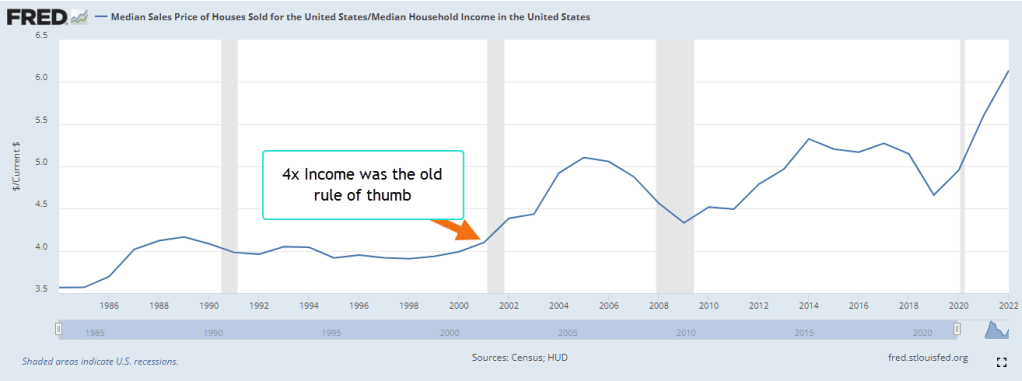
As a young man I was taught not to buy a home that was priced more than four times my income. In 2022, families paid more than six times the median household income, as shown in the chart below. Despite the high prices, mortgage debt service is a tame 10% of the household disposable personal income. Almost 40% of homeowners have a fully paid mortgage, according to Axios. Many homeowners hold mortgages at the historically low rates of the last decade. If higher mortgage rates persist for several years, we may see greater delinquency rates as recent buyers cope with payments that stretch their budget.

Graph shows an increasing ratio of home prices to median household income since 2000.

The Center for Microeconomic Data at the NY Federal Reserve has tracked household finances for more than twenty years. The highest percent of total household debt continues to be mortgage debt at 68% to 70%. Mortgage debt has grown at an annual rate of 3.9%, slightly more than the 3.7% annual increase in owner equivalent rent that I discussed last week. A low 3% of mortgages are more than 30 days delinquent, down from 11% to 12% during the 2008-2009 financial crisis. Only 40,000 people are in foreclosure, less than half the number in 2019. The numbers today are the lowest on record except for the pandemic years of 2020 and 2021 when many foreclosures were halted.

As I discussed last week, property prices reflect the anticipated cash flows from the house during a 30-year mortgage, a process called capitalization. The home buyer replaces the seller in the stream of cash flows from the house. Because property taxes are based on the appraisal values, the taxing authority implicitly bases property taxes on cash flows that a homeowner has not received yet. Each state sets an assessment rate that is a percent of the appraised value of the home. Each taxing authority within the state then charges a dollar amount – the mill value – per thousand of that assessed value. A home with an appraised value of $500,000 and an assessment rate of 8% would have an assessed valuation of $40,000. If the mill levy were $100 per $1000 of assessed value, then the homeowner’s property tax bill would be $4000. The effective property tax rate would be $4000 divided by $500,000, or 0.8%. Investopedia has a longer explanation for interested readers.

Each state taxes property at different rates. Colorado charges ½% of the appraised property value, one of the lowest in the nation. California averages ¾%. Texas averages a whopping 1.74% of home property values but has no income tax. Families earning the median household income and owning a house valued at the median house price in Texas and Colorado pay the same combined property and income tax of $5883 and $5669, respectively. Colorado has a cheaper tax burden despite having an income tax and far higher median house values. The same family living in California would pay $8256, largely because their property tax bill would be about the same as in Texas because the home values are more than double those in Texas. I will leave data sources in the notes.

Many districts give seniors a discount on their property taxes, effectively throwing a higher burden on working homeowners. Some argue that these exemptions should be means tested, effectively lessening or eliminating the discount for seniors with higher incomes. A wave of seniors may move to an inter-urban area that features lower home prices yet is within an hour of vital medical services like a hospital. The higher demand drives up home prices for others who have lived in the area for decades. Secondly, seniors consume more medical services and public accommodations. That requires more public spending, which is shared by the entire community and leads to resentments and contentious public meetings at the local town hall.

The majority of property taxes are used to fund public schools, and it is the largest line item on an individual homeowner’s property tax statement. This system of funding raises principled objections from childless couples and those who privately school their children, but are expected to share the burden of funding public schools. Homeowners have often resented having to fund the schooling of recently arrived immigrants. In the 19th century a wave of immigrants from Catholic Ireland, then Catholic Italy prompted many states with Protestant majorities to pass laws that excluded public funding for schools run by Catholics. Since the 16th century, the two main branches of Christianity had fought bloody civil wars in Europe and Britain. Those who colonized America brought those antagonisms with them.

During the 1970s, the number of encounters at the southern border increased almost ten times, according to the CBP. High inflation and migration of Amerians to western states caused a surge in property valuations and higher property taxes. In 1978, a taxpayer revolt in California led to the passage of Proposition 13 limiting property tax increases. In some school districts, undocumented parents had to pay a fee to enroll their children in public school.

In a 1982 case Plyler v. Doe, a slim 5-4 majority on the Supreme Court ruled that undocumented immigrant children did not have to pay a fee to go to school. The court reasoned that the equal protection clause of the 14th Amendment extended protection to “persons,” not “citizens.” Therefore, a state could not provide public benefits to one child in a school district and not another child because their parents were undocumented. The court interpreted “protection” to include public benefits, a construction that the Connecticut Constitution made explicit in 1818 with the phrase “exclusive public emoluments or privileges from the community.” The conservative majority on the Supreme Court overruled an interpretation of the due process clause in the 14th Amendment that justified the 1972 Roe v. Wade decision. This court might revisit this interpretation of the equal protection clause of the 14th Amendment as well.

Districts with lower property valuations struggle to raise adequate taxes to meet minimum educational standards. They may have to tax homeowners at a higher rate than a neighboring district, raising legal questions about uniformity and proportionality. The disparity in valuation was the subject of the 1997 Claremont decision by the New Hampshire Supreme Court. At the time, local districts provided 75% to 89% of funding for elementary and secondary education. The state’s general fund provided only 8% of school needs. The decision forced the state to distribute tax revenues among districts to meet adequate education standards for all children in the state. A 2017 analysis found that states now provide almost half of public education funding, relying on income tax revenue to smooth disparities in income among districts within each state.

People do not like paying taxes but grudgingly accept them. People elect local officials to decide on spending priorities yet some homeowners object to the way their taxes are spent. On my property tax bill are eleven items which include funding for schools, the city’s bonds, police, fire, libraries and flood control. Homeowners might prefer a questionnaire of thirty categories of spending which allowed them to allocate their tax dollars by percentage when they paid their property tax each year. In my district, a half-percent goes to affordable housing, three percent to social services. Some might prefer 5% or more. A homeowner paying online could elect to answer the questionnaire online. Would homeowners respond? Next week I will begin an exploration of various aspects of consumption, the chief component of our economy.

///////////////////////////

Photo by Museums Victoria on Unsplash

Keywords: housing, home prices, mortgage, property tax

Property taxes by zip code and state can be found at Smart Asset
Median home prices by state are at Bank Rate
Median Sales Price of Homes Sold in the U.S. is FRED Series MSPUS at https://fred.stlouisfed.org/ Median Household Income in the U.S. is series MEHOINUSA646N. The ratio of mortgage payments to disposable personal income can be found here. The home price to property tax ratio can be found here

Home Sweet Housing Service Flow

April 21, 2024

by Stephen Stofka

This week’s letter is about the cash flows we receive from a house and whether we can use those cash flows to help us determine an appropriate price range for a house. While we might not think of a house as a business, the owner is a landlord. Like any business, a house has similar metrics: an initial investment, loans, cash flows, continuing expenses and investment, “sweat equity,” capitalization and profits.

A house offers similar features to a coupon bond with one important difference – the mortgage. When we buy a coupon bond, we pay for the bond outright. The bond pays a series of payments called coupons over the life of the bond, then pays back the principal amount at the end of the bond’s term. What is the coupon we receive from a house? The housing service which is valued at what we could expect to rent the house for. Each year we discount that coupon by the opportunity cost of what that money could earn. As a benchmark rate, I will use the 40-year average rate of 5.5% that a 30-year Treasury bond (FRED Series DGS30) has paid.

As I noted last week, average owner equivalent rent has grown 3.7% each year for the past thirty years. Urban areas drive the growth of housing rents, and the highest growth occurs in the most competitive cities that offer employment and urban amenities. For several decades the city average of owner equivalent rents has been 8 – 15% higher than the median household income in the country as a whole (FRED graph). Incomes are much lower in rural areas and so are the rents and the taxes. Some rural areas offer a picturesque natural setting and recreational opportunities, but the lackluster job market does not attract young families.

Consider a house that might rent for $2000 a month, or $24000 a year. In thirty years, that annual rent will be $68,833, the result of a 3.7% increase in housing rents each year. Using the 30-year Treasury yield of 5.5%, today’s net present value of those rising cash flows from the house is $537,673. I will leave the calculation in the notes along with the address of an online calculator so you can do this yourself. These are long-term averages that can vary by decade. In 2014 the fair market rent for a 2-BR apartment in the Denver metro area rose 20%, according to HUD. Rental prices can respond quickly and dramatically to population migration and underinvestment in multi-family housing.

An investment in a house is partially funded with a mortgage whose principal and interest payments remain stable for the term of the mortgage. Although interest rates are above recent averages, they are about half of what a borrower might pay on a car loan or a margin loan from a broker. Interest on car loans can vary from 6% to 25%, according to Bankrate.com. Vanguard would charge 11% to 14% on a margin loan to buy stock. These are shorter term loans yet charge higher interest rates. Implicit guarantees of mortgages by the federal government give a homeowner the same interest rate on long-term debt as Apple, the second most valuable company in the world. In 2014, Apple paid a rate of 4.45% on its 30-year bonds. The average 30-year mortgage rate (MORTGAGE30US) at that time was 4.36%.

While government support introduces distortions to the housing market, residential investment and strong population growth do not fit a free-market model because land in a dense urban area is not a commodity like farm or ranch lands. Before the Federal Housing Administration was created in 1934, creditors often required a down payment of up to 40% even from those with good income and credit, according to a history published by the Richmond Fed. In the late 19th century, twelve percent of mortgages were underwritten by building and loan associations of the mortgage holders themselves. During stressful economic times, these associations would go bankrupt, leaving homeowners with deficient claims to their property. In all developed countries today, national government policies support home ownership.

Let us say a homeowner buys a home for almost $600,000 as in the example above. After thirty years, the owner will have received the net present value of the purchase price and will have a home that will be worth $2 million (calculation in the notes). However, this does not represent a windfall for the owner. A replacement home will also contain its cash flows for the past thirty years so that similar homes in that area will sell at a similar price. What the owner discovers is that their home’s value is priced like a share in a community resource. They can capture the capital gain in their home while they are alive by buying a home in a different community with a lower-priced resource pool, a strategy often employed by retired folks.

So, future cash flows are capitalized into the price of a house. The homeowner’s profit comes from any spread between the growth in house prices and the growth in market rentals over three decades of ownership. For some people, the true profit is the piece of mind that comes from ownership in a house that is mortgage free. Economic factors and changing tastes can slow the growth of home prices in an area. Crime may have increased; the quality of schools may have declined. Homeowners in these areas can feel trapped because they can not leverage the smaller equity in their home to buy a home in a more expensive area.

While the principal and interest on a mortgage remain stable during the term of the mortgage, taxes, repairs and insurance do not. Next week I will look at property taxes, the annual dues we pay to the county where our property is located.

////////////////////

Photo by Kara Eads on Unsplash

This online calculator allows you to specify the number of cash flows but you need to input each cash flow.

Excel requires less work so you can calculate 30 years of cash flows based on a 3.7% increase in housing rents and an opportunity cost of 5.5% each year. Microsoft has an example of using NPV. In case you do not use Excel often for this kind of work, here are some instructions. In an empty spreadsheet:
In cell A1 enter 1.037. That is the annual growth of housing rents at 3.7%.
In cell B1, enter .055, the interest rate you could earn investing the purchase price of the house in a Treasury bond.
In cell A2, enter 24000, an estimate of the current rental value of the home.
In cell A3, enter the formula “=A2*A$1” without the quotes.
With the caret, grab the right lower corner of cell A3 and drag it down to include cell A31. This will copy the formula to the cells A4:A31.
In cell C1, enter “=NPV(B1, A2:A31)” without the quotes. That is the Net present value.
You can change the starting annual rent in cell A2, vary the discount rate in cell B1, or the growth of housing costs in cell A1. You can select and copy cells A1:C31, then go to cell E31 and paste in the cells. Now you have a side-by-side comparison.

Calculation of future home price: The Case-Shiller national home price index (CSUSHPINSA) has risen an average of 4.25% for the past 35 years.

Landlord and Tenant

April 14, 2024

by Stephen Stofka

This week I will continue my look at housing, focusing on the dual role of homeowners. There are several advantages to owning a home, one of which is a type of self-imposed rent control. Our mortgage payments are fixed for the term of the mortgage, so we do not have to worry about a 10% rent increase from our landlord. We are the landlord, and we are our favorite tenant. While the mortgage payments remain stable, the maintenance costs for the home do not. The house may need a new furnace, hot water heater, updated plumbing or a new sewer line, major expenses that remind us that we are the owners of an investment property.

In this dual role, a  homeowner takes money out of her right tenant’s pocket each month and puts it in her left landlord’s pocket. As landlord, a homeowner does not report that income nor does she report the mortgage payments and expenses necessary to maintain the property. The Census Bureau estimates that homeowners with a mortgage spend $1900 a month. Those without a mortgage spend about $600.

The federal government calls the difference between this implied income and expenses a net imputed rental income and estimated (pdf link) that the tax exclusion saved homeowners $135 billion in 2023 (p. 22).

What is the average yearly tax saving for a homeowner? The Census Bureau estimated that there are 143 million households with an owner-occupancy rate of almost 65%. That results in 93 million owner-occupied homes, making the tax exclusion worth almost $1500 yearly to a homeowner that is not available to a renter. The tax exclusion is worth much more than average to those with higher incomes and more expensive homes.

When we sell the home, we hope to realize a capital gain from the home in addition to the cash flows we received while we were living in the home. After Congress changed the law in 1997, most homeowners do not have to pay tax on the capital gains from their home, an exclusion estimated at $45 billion in 2023. Real estate property is treated differently than other assets under the tax code, an implicit recognition that property ownership has a value to the community where the property is situated. A house attached to the land by a foundation is immoveable and taxed differently than a moveable asset like a car. In fact, a mobile home is taxed similarly to cars while the land the mobile home sits on is taxed like real estate (Investopedia bulletin).

Some assets provide a series of cash flows while we own them; some do not. In the case of a house, an owner’s implied cash flows start as soon as we take possession of the house. The house provides us with a housing service while we live in it. In the Consumer Price Index (CPI) published each month, the Bureau of Labor Statistics (BLS)  includes a calculation of what it calls owner equivalent rent, OER. This is an estimate of what a homeowner would rent out their home to a stranger. The estimate is based on rental prices for similar units in the area, but the calculation uses survey data that is slightly out of date. Some analysts do not think this implied income should be 25% of the CPI calculation, and the Eurozone countries do not include it in their CPI estimates. Below is a chart comparing the EU method, what is called the Harmonized CPI (FRED Series HICP), and the headline CPI (CPIAUCSL) produced by the BLS each month.

Notice the divergence between the two series starting in 2014. During the financial crisis, homebuilders started  the fewest number of multi-family units per capita in modern history. This laid the foundation for the next crisis, and the pandemic sparked a remote work trend that disrupted the customary supply and demand for housing. In the chart below I have charted the number of multifamily units per capita and highlighted the fallout from the S&L Crisis and the financial crisis.

We can see that the rent of a primary residence and the estimate of OER track each other pretty closely. In the following graph I compare the survey of actual rents to the OER estimate and index it to the beginning of 2014 to illustrate the trends more closely. In 2014, rents (redline) began to grow faster than OER, indicating the pricing power migrating to landlords several years after the financial crisis. In the decade that followed, housing costs grew 50%, an annual growth rate of 4%, higher than the 75-year average of 3.6% or the 30-year average of 3.7% (see notes). Most of the above average growth has been in the three-year recovery from the pandemic.

The cost of housing rises faster than the overall price level and faster than incomes. Homeownership limits the actual impact of rising housing costs on an owner’s budget. A homeowner plays the dual role of landlord and tenant and receives favorable tax treatment of imputed income and capital gains. Given these long-term averages, can a buyer calculate the price they would be willing to pay for a home from its future cash flows? I will look at that next week.

///////////////////

Photo by krakenimages on Unsplash

Hui Shan (2011) has written a brief history of the tax treatment of housing capital gains and measured the effect of the 1997 tax law on home sales in the Boston area.

Owner’s Equivalent Rent of primary residence in U.S. City Average is FRED Series CUSR0000SEHC01. Rent of primary residence in U.S. City Average is CUUR0000SEHA.

Annual growth rates: Average annual growth rates are calculated over a rolling 10-year period.

A Home Is a Magic Wallet

April 7, 2024

by Stephen Stofka

In this week’s letter I will explore the various roles that housing plays in our lives. Last week I showed the divergence of household formation and housing supply during the financial crisis. Home builders responded to the downturn in household formation by building fewer homes. Because the recovery after the crisis was slow, the demand for housing did not pick up until 2014. It is then that a mismatch between housing demand and supply started to appear in the national and some local home price indices. This week I will examine the demographics of homebuyers and sellers in recent history and the secret life of every homeowner as a landlord. A home is a magic wallet where money flows come and go.

Data from the National Association of Realtors (NAR) indicates that the median age of home sellers has increased from 46 to 60 since 2009. I will leave NAR data sources in the notes. In the four decades between 1981 and 2019, the median age of home buyers rose by twenty years, from 36 in 1981 to 55 in 2019. The median age of first-time buyers, however, increased by only four years, from 29 to 33. In 1981, the difference in age and accumulated wealth between first-time buyers and all buyers was only seven years. Now that difference has grown to 22 years. First-timers typically buy a home that is 80% of the median selling price of all homes.

In the past four decades, there has been a divergence in wealth between older and younger households. The real wealth of younger households has declined by a third since 1983 while households headed by someone over 65 have enjoyed a near doubling of their real wealth in thirty years. Accompanying that imbalance in growth has been a shift in capital devoted to housing.

The Federal Reserve regularly updates their estimates of the changes in household net wealth. The link is an interactive tool that allows a user to modify the time period of the data portal. The chart below shows the most recent decade of changes in wealth. The lighter green bars are the changes in real estate wealth for households and non-profits and show the large gains in real estate valuations during the pandemic. The blue bars represent equity valuations and demonstrate the volatility of the stock market in response to any crisis, large or small.

The Fed’s data includes various types of debt as a percent of GDP. Twenty years ago, household mortgages were 11-12% of GDP. Today they are 19% of GDP, a huge shift in financial commitment to our homes and neighborhoods. A city average of owner equivalent rent (FRED Series CUSR0000SEHC) averaged an annual gain of 2% during Obama’s eight- year term, 2.8% during Trump’s term, and 6% during the first three years of Biden’s term. Biden has little influence on trends in housing costs, but the art of politics is to use correlation as a weapon against your opponent. People feel the change in trajectory as a burden on their households.

The Bureau of Labor Statistics calculates owner equivalent rent by treating a homeowner as both a landlord and renter. Property taxes, mortgage payments, interest, maintenance and improvements to a home are treated as investments just as though the owner were a landlord. The BLS uses housing surveys to determine the change in rental amounts for different types of units. A sample of homeowners are asked how much they would rent out their home but this guess is used only to establish a proportion of income dedicated to rent, not the actual changes in the rental amounts for that area, as the BLS explains in this FAQ sheet.

Let us suppose that a homeowner has a home that is fully paid for. If the house might rent for $2000 a month and monthly expenses are $500 a month, that would represent $1500 per month in implied net operating income for that homeowner, an annual return of $18,000. A cap rate is the amount of net operating income divided by the property’s net asset value. If similar homes are selling for $450,000 in that area, the homeowner is making 4% on their house’s asset value, slightly less than a 10-year Treasury bond (FRED Series DGS10, for example).

Long-term assets compete with each other for yield, relative to their risk. A property is a riskier investment than a Treasury bond, so investors expect to earn a higher yield from a property. Before the pandemic, 10-year bonds were yielding between 2-3%. Landlords could charge lower rents and still earn more than Treasury bonds. As yields rose for Treasury bonds, property investors must charge higher rents to earn a yield appropriate to the risk or sell the property and invest the money elsewhere.

When we own an asset that provides an income, it is as though the asset owes us. When a home declines in value, we feel a sense of loss. When the housing market turned down in 2007-2008, homeowners expected to get a similar price as the house their neighbor sold in 2006. They used that sale price to determine what their house owed them. In order to get the listing, a real estate agent would agree to list the home for that higher amount, but the property would get few offers. After a period of time, the seller would cancel the listing and wait for the “market to turn around.”

Earlier I noted the dramatic rise in mortgage debt as a percent of GDP. At one-fifth of the economy, that debt represents capital that is not being put to its most efficient use because most homeowners do not regularly evaluate the yield on their homes as professional investors. A higher percent of capital devoted to housing will help sustain higher housing costs and pressure household budgets. I worry that an inefficient use of capital will contribute to a pattern of lower economic growth in the future, stifling income growth. The combination of these two pressures will make it difficult for younger households to thrive. The generational gap will widen, adding more social and political discord to our national conversation.

/////////////////

Photo by Towfiqu barbhuiya on Unsplash

Keywords: mortgage, housing, owner equivalent rent

Notes on median age of sellers: 2009 data is from the NAR and cited in a WSJ article (paywall). Current data is from the NAR FAQs sheet. Jessica Lautz, an economist with NAR, reported the four-decade trend in home buyers. Median home prices of first-time buyers is from a 2017 analysis by the NAR. The comparison of older and younger households comes from a 2016 NAR analysis.

Notes on Federal Reserve data:  The change in mortgage debt as a percent of GDP is in the zip file component z1-nonfin-debt.xls, in the column marked “Noncorporate Mortgages; Percent of GDP.”