Who Writes the Rules?

September 7, 2025

By Stephen Stofka

Sunday morning and another breakfast with the boys. This week Abel and Cain discuss immigration and the limits of Presidential authority. The conversations are voiced by Abel, a Wilsonian with a faith that government can ameliorate social and economic injustices to improve society’s welfare, and Cain, who believes that individual autonomy, the free market and the price system promote the greatest good.

Abel said, “I was reading that the National Parks are so understaffed after all the DOGE cuts, there is no one at the entry stations to collect admission fees. People were stealing artifacts from one exhibit in Yellowstone (Source).”

Cain frowned. “The world will never be rid of free riders. A lot of people on the right view illegal immigrants as free riders. They skip the immigration line, bring their kids here to get free health care, free education and then they say that they don’t want handouts.”

Abel put down his fork. “My whole point was that the Trump administration is losing more money in admission fees than they are saving with these personnel cuts.”

Cain nodded. “I get that. I am drawing an analogy between unrestricted admission to National Parks and unrestricted immigration at the southern border. The Biden administration understaffed border patrol and told officers to help immigrants disobey the law. So which problem is worse? A few thousand people who don’t pay at National Parks this summer or several million people coming into the country, needing medical care, education and legal services? I think we need to keep things in perspective.”

Abel argued, “I think a key distinction of free riding is that a person is not doing anything illegal. They are benefiting from some common resource without contributing to the cost (Source). People who drive into a national park without paying a fee are not breaking the law if the gates are open and there is simply no one there to collect the money. Immigrants seeking asylum are not doing anything illegal.”

Cain replied, “Most of these people are not asylum seekers. They are lying to stay in the country until their case is heard years later. The cartels in Central American countries teach these people what to say. Smuggling people is more profitable than smuggling drugs (Source). The Biden administration was facilitating cartel profits. Trump shut that down.”

Abel smirked. “Despite all the conservative rhetoric about the ‘immigration surge,’ migration in 2023 was less than it was during any year in the Bush administration except one (Source). For most of that time, Republicans held the Presidency, the Senate and the House. So its OK to let immigrants in when Republicans are in power but not so for Democrats. The right wing media has fooled the public and Democrats were too clueless to combat it.”

Cain shrugged. “Bush increased funding for more fencing along the southern border. He called on Congress to pass immigration reform and they just can’t get the job done (Source).”

Abel said, “A big stumbling block is that employers don’t want to be held responsible for any immigration violations. Sometimes, employers hire employees through a staffing agency for seasonal or temporary work (Source). The benefit of this arrangement is that there is some legal distance between the employer and the employees. They technically work for the staffing agency who deals with the immigration stuff like the I-9 form (Source).”

Cain nodded. “The immigration raid at the Hyundai plant in Georgia this week was an example. Most of those who were arrested, it was like almost 500 people, were not employees of Hyundai. They were contractors or subcontractors (Source).”

Abel replied, “Yeah, we talked about this a week or so ago. Employers classify workers as subcontractors to avoid paying employment taxes.”

Cain shook his head. “I think a bigger problem is there are too many immigrant advocacy groups that don’t believe in national borders. Major immigration reform was like in 1986, I think. If immigration policy can’t be resolved over several decades, then there are influential constituencies who don’t want to resolve it.”

Abel laughed. “They are making money from seeking a resolution, not reaching a resolution. And politicians know how to cover their tracks. They can look like they are working on a solution while taking steps to sabotage the effort.”

Cain nodded. “Well, all I know is that these immigrants are costing a lot of money. New York City estimated a cost of $12 billion over three years (Source). Where does that money come from? Reduced services and higher taxes. The Congressional Budget Office released a report this summer estimating the three-year cost of the immigrant surge. A net cost of $9.2 billion in fed, state and local services after accounting for higher sales tax receipts from these immigrants (Source).”

Abel thought a second. “Look, I’ll grant you there are some short term costs but don’t forget the long term gains.”

Cain interrupted, “Any long term gains are offset by higher house prices. Immigrants increase demand for housing. House prices go up. Econ101.”

Abel shrugged. “It’s hard to argue that immigrants are responsible for higher home prices. Another false flag that conservatives raise is that immigrants were taking jobs from Americans. That didn’t happen. By the end of 2021, less than a year into Biden’s presidency, construction employment recovered to its pre-pandemic level. By the time he left office, construction jobs were up more than 600,000 (Source). So that surge had little measurable effect on construction jobs.”

Cain argued, “Conservative economists like Oren Cass argue that illegal immigrants drive down the wages of lower skilled construction employees (Source). The number of employees won’t tell you that.”

Abel checked his phone. “Well, it does show that demand for labor remained strong. Hold on, I looked at wages too. Here it is. The Bureau of Labor Statistics tracks the hourly wages of production and non-supervisory employees. That will give us a good approximate picture of any impact on wages. There was a short time in 2022 when real wages for those employees declined (Source). That was during the inflation surge. It quickly recovered. If there is any effect, it was small. The data just doesn’t support conservatives’ claims about the effect of immigration.”

Cain protested, “Look, the bottom line is that most of these people are lying and jumping the immigration line. The cartels are using people as a distraction from the transport of drugs and guns across the border and taxpayers are indirectly funding the cartels.”

Abel asked, “Do you agree with Trump that he can go after these cartels as though they were terrorists or paramilitary groups? This week, we just blew up a ship in the Caribbean that was supposedly run by the Venezuelan Tren de Aragua gang.”

Cain shrugged. “Hey, I’m not a lawyer but I agree that these cartels act like paramilitary groups. We should treat them as such.”

Abel asked, “No trials? No evidence? No oversight? What if Trump adopts the same policy as Duterte, the former president of the Philippines (Source). Trump could start sending hit squads into American cities to kill drug dealers. Is that OK? Where is the line?”

Cain shook his head. “No, that’s on American soil. That’s entirely different.”

Abel asked, “So a Border Patrol officer could just shoot someone on the Mexico side of the border if he suspected that person of being a cartel member? Like I said, where is the line?”

Cain nodded. “Ok, now you’re sounding like a lawyer. The boat they blew up was in international waters. That’s entirely different.”

Abel sighed. “I don’t know why conservatives hesitate to define boundaries for this President. He pardoned the January 6th rioters that tried to kill members of Congress, including the Vice President. What does this Republican Congress say? Silence. Edmund Burke, the 19th century founder of conservatism, would be ashamed of this Republican Congress. Society is bound together by morals, conventions and institutions as much as laws (Source). This Republican Congress has abandoned those standards for political expediency.”

Cain nodded. “Fear for their personal and political safety, I’d guess. What’s happening is that the MAGA crowd is trying to overturn policies set largely by Democrats when they controlled the House during the twelve years of FDR’s presidency and for forty straight years from 1955 to 1995 (Source). Immigration is a big one. What are the limits of Presidential Authority and can he declare emergencies without consulting Congress? Another contentious issue. Who was the first President to grab extraordinary power after declaring an emergency? FDR, a Democrat (Source). It’s ironic that Trump is using the same mechanisms to undo Democratic policies that began with FDR.”

Abel frowned. “The court ruled against FDR in the Humphrey’s Executor decision. They ruled unanimously President cannot fire members of an independent agency at will (Source). The court has recently loosened that restriction (Source) and Trump wants to fire Powell, the Fed chairman. The question I have is whether a President can undo 80 years of Congressional policy? Who writes the rules, Congress or the President? This court seems like they are ready to confer kingship on the President under this judicial theory of the Unitary Executive. I mean, even if Congress does pass immigration reform, what does it matter if a President can ignore the law?”

Cain argued, “Well, nobody said the President can ignore the law.”

Abel replied, “The court has deferred to the President’s interpretation of the law (Source) and Trump has shown a willful disregard for Congress and the law in general. I mean we all saw him on the debate stage in the 2016 campaign. He has an open disdain for politicians and both parties as institutions. I mean, this guy is not a conservative.”

Cain sighed. “I’ll grant you he has undermined conservative principles and taken over the Republican Party.”

Abel smirked. “And these supposed Christians who support him. Compassion is a hallmark of the New Testament in the Bible. There are too many Christians who lack compassion for anyone outside their group. Immigrants, blacks, liberals, mainstream Republicans even.”

Cain raised his eyebrows. “Their sympathies remind me of Christians during the Crusader era. Lots of fire and retribution. Protect Christendom from the infidels. That type of thing.”

Abel laughed. “Everyone who doesn’t agree with them is an infidel, I guess. There has to be a way to bring all these political groups together in this country or this nation is going down in fifty to a hundred years.”

Cain asked, “Going down or splitting up? We’ve got oceans on both sides, a tremendous amount of resources and weak neighbors to the north and south. I doubt if we are going down.”

Abel smiled as he stood up. “Ok, splitting up. We’re already split along partisan lines. People in one party don’t trust those in the other party. I think that trend will continue. Trump is just precipitating the break up of the country.”

Cain leaned forward. “A few weeks ago, we talked about each party electing candidates from regional partitions with the party. For decades, voters are sorting themselves out by region. Democrats on the Northeast and West coast. Republicans in the Midwest and South (Source). It may be the only way to keep this country together.”

Abel nodded as he moved his chair back and stood. “You may be right. Madison wrote in Federalist 10, I think it was, that the best way to curb the power of factions was to pit them against each other (Source). A ‘fight fire with fire’ approach. That’s why I think the Unitary Executive theory is not in the spirit of the Constitution.”

Cain asked, “Maybe we could talk about that next week. You heading out?”

Abel nodded. “I promised Claire I’d help her move some furniture around this afternoon.”

Cain laughed. “You don’t sound too excited. I’ll see you next week.”

//////////////////

Photo by Seongil Park on Unsplash

Note: Real wages. Average hourly wages are FRED series CES2000000008. The Fed’s favorite inflation gauge is PCEPI series. Subtract the annual percent change of one from the other to get the percent change in real wages.

Two Worlds: Urban and Rural

June 15, 2025

By Stephen Stofka

Happy Father’s Day to the Dads out there. Even though it is Father’s Day, Cain and Abel have their usual Sunday breakfast together.

This is part of a series on persistent problems. The conversations are voiced by Abel, a Wilsonian with a faith that government can ameliorate social and economic injustices to improve society’s welfare, and Cain, who believes that individual autonomy, the free market and the price system promote the greatest good.

Abel settled down in his seat opposite Cain. “There is so much that is happening every week, it’s hard to keep up with it. LA demonstrations, the troops being called out in addition to the guard.”

Cain adjusted the window blinds to reduce the sunlight. “Yeah, there were ICE agents running after migrants in the field in the Central Valley. Imagine having all that gear on and running around in 90 degree heat. But, the farmers were complaining. About 40% of their workers are illegal (Source). Imagine if the crops rot in the ground and voters find empty vegetable displays at the grocery store. On Friday, Trump announced that ICE would no longer target farm workers (Source).”

Abel shook his head. “A 12-year old was left alone when his parents were grabbed and taken away (Source). Talk about a rotten Father’s Day. Then Trump made up some B.S. that criminals who were let in by Biden were applying for the jobs left vacant by the farm workers.”

Cain nodded. “The real battle in this country is between the moderates on either side of the political aisle and the nutjobs on the left and right wings. When I heard that the radical lefties had called Waymo taxis, then lit them on fire, I wondered if I was in a Twilight Zone episode (Source).”

Abel smirked. “Playing right into the hands of the MAGA crowd and the nutjob in the White House.”

Cain chuckled. “I don’t know if Trump is a nutjob. Remember, he outcompeted sixteen rivals in the 2016 race.”

Abel sighed. “It’s the primary voters in either party who are the extremists.”

Cain raised his eyebrows. “Another change ushered in by the Democratic reformists in 1972 (Source). A primary system would let the voters speak. Yeah, right. Often, it’s less than a quarter of eligible voters that turn out for a primary.”

Abel argued, “Wait, so it’s only wackos that vote in primaries? I vote in them.”

Cain made an equivocating hand gesture. “I didn’t say only wackos voted in primaries. But, they are a greater percentage of the small primary turnout. They influence primaries and each party caters to their interests and perspectives. The parties have drifted to the extremes in the past decades.”

Abel sighed. “Ok, let’s call them motivated voters spurred on by interest groups.”

Cain laughed. “You can call them that. I’ll call them wackos. Anyway, back to Trump. He reminds me of the Mule in Asimov’s Foundation series. A person who can control the emotions of others.”

Abel smiled. “Asimov was one of my favorite authors. I loved the Foundation series, the robot books. What, you think Trump is a mutant? I mean, that was science fiction.”

Cain looked into the distance for a moment. “He has a singular personality that draws some people. Do I think he has some emotional telepathic power like the Mule? No. But remember that the Mule assumed the guise of a clown to infiltrate the Foundation, then take it over. A lot of mainstream Republicans looked at Trump as a political buffoon in the 2016 race. He’s taken over the Republican Party just like the Mule did the Foundation.”

Abel raised an eyebrow. “Magnifico was the name the Mule assumed? Some hyperbole there. That’s Trump’s favorite tool.”

Cain nodded. “Magnifico Giganticus. I had to look it up a while ago when the similarity struck me. Physically, there’s little resemblance between Trump and the Mule.”

Abel replied, “In Asimov’s story, he was the anomaly that psycho-historians could not foresee. God, that was great stuff to read when I was a teen.”

Cain smiled. “I remember hearing that Paul Krugman loved the series as well. He said that the whole idea of psychohistory made him interested in studying economics (Source).”

Abel laughed. “If only economists had as much accuracy as the predictions of the psycho-historians. A hologram of Hari Seldon would appear at crisis moments. With his mathematics of history, he had been able to predict when a galactic crisis would occur, so he pre-recorded them before his death.”

Cain mused, “He couldn’t predict the Mule, though. That shook everyone’s faith in Seldon’s wisdom. The Democrats must be feeling like that about now.”

Abel frowned. “The second President in history to be elected in two non-consecutive elections. Cleveland was the first (Source). Until the 2024 election season, I didn’t think anyone had done that before. It’s funny. We had to memorize a succession of Presidents in grade school, but they were just names to me.”

Cain nodded. “Yeah, we often don’t appreciate the story of history until we’re older. I hated all that memorization when I was a kid, but it was good training for our brains.”

Abel sighed. “I get down on some of the kids working in stores because it seems like they can’t remember stuff. They gotta look up everything on their phone or the information gadget that the store gives them. Then, this week, I’m at Home Depot and ask this guy in his mid-twenties for something and he tells me the aisle and the location on the shelf.”

Cain chuckled. “Why do we stereotype people? Saves us time and effort, I suppose. It’s like we have a little theater, a Punch and Judy show playing in our brains. ‘Here’s how the world works,’ we say. People become characters in our internal play.”

Abel set his fork down. “Hey, talk about stereotypes. I meant to tell you about the American Communities Project. They classify the thousands of counties in this country into 15 groups. They have a color-coded interactive map so people can locate their local community (Source). This guy, Michael Bahareen, at The Liberal Patriot on Substack wrote three posts about the characteristics of each group (Source).”

Cain asked, “How do they distinguish the different groups?”

Abel replied, “Voting patterns, that’s one. Their ages, ethnicity, population, dominant industry and values. A lot of data that the Census Bureau gathers every year. Some of the data surprised me. Some didn’t. Like Native American Lands. I knew that the Indians struggled with poverty. I was surprised that counties classed as ‘Working Class Country’ had incomes that were just a few thousand dollars higher than people in Indian country.”

Cain asked, “Where are those counties?”

Abel shrugged. “Funny. All of them except one are in the eastern half of the country. Rural counties in Arkansas, West Virgina, eastern Oklahoma. In the past twenty years, those counties have become solid Republican.”

Cain argued, “So you were surprised at their low incomes? Their cost of living is a lot lower too (Source). I wish these government agencies would quote household incomes in terms of living costs.”

Abel interrupted, “Yeah, but there are a lot of things that don’t have local prices. Like life insurance, computers, cars.”

Cain agreed, “Ok, good point, but local pricing plays a huge part in a family’s finances. Let’s say a family makes $120,000 a year in Los Angeles. They might be paying $60,000 a year in housing costs. That’s $5,000 a month. Heck, it’s 50% of their income. Their income tax bite is higher than the family living in rural Arkansas or Missouri. Let’s say that family makes only $52,000 a year, but their housing costs are $12,000. Which family is more stressed out? The LA family. One of them loses their job and they can’t sleep at night.”

Abel nodded. “Ok, I get your point. But families in urban areas classified as Big Cities are generally healthier than those in Working Class Country. So why is that?”

Cain said, “Probably a lot to do with access to health care. I don’t know. I just wish we had data that allows us to do a better job at comparing incomes and living costs. Your point about computers and cars prices. An F-150 pickup starts at like $40,000 (Source). That’s like nine months of income for someone working in rural Oklahoma, but only five months for someone in L.A.”

Abel interrupted, “So housing costs might be a lot lower in rural areas, but not autos. Do you think that accounts for the political silos in this country? We talked about that last week, I think. Rural people and urban people live in different worlds in a lot of ways.”

Cain nodded. “Sure. Why is that pickup so expensive? Because of environmental and safety rules that the people in big cities voted for. The guy in Podunk, Oklahoma doesn’t want to pay for all that stuff but has no choice. Ford can’t build pickups without all those controls. Naturally, the guy in Oklahoma resents the voters in the big cities. Their priorities dominate and limit his choices and how he spends his money. Is that fair? No, of course not.”

Abel argued, “Well, you claim that the price system can allocate resources. Let’s say we got rid of mandates for environmental and safety controls. Would Ford build a new pickup for $25,000? Is there enough profit for the car manufacturer and dealer at that price? Probably not. What if we undid all the safety regulations? No more air bags or cars designed to absorb the impact of collision. Get rid of all those environmental controls while we are at it. What if you are wrong? Highway deaths skyrocket. Pollution in American cities starts to look like China cities. No one can see through the fog.”

Cain looked over his glasses at Abel. “You done? I’m not proposing anything that radical. I’m saying that we have enough car mandates. If people want air bags, they can pay for them. Let people decide. Let the car makers decide. We don’t need fat cats in Washington forcing their ideologies and priorities on us.”

Abel smirked. “We need some uniformity. Sure, this a diverse country. Geographically, culturally. That’s always been a challenge in this country. But the whole point of the Constitution was a bedrock of uniform laws that would apply to everyone.”

Cain replied, “Yeah, a bedrock, a foundation. The Constitution is only a few pages long. Why? Because the states were supposed to do the bulk of the lawmaking. What do we have now? Lawmakers in Washington, particularly the Democrats, want to keep imposing uniform regulations on all the states. Circumstances are not uniform. Incomes and cost-of-living standards are not uniform. Democratic politicians just don’t get that anymore. They look down on rural counties as they fly from the coast-to-coast. In the 2016 campaign, Clinton called them a ‘basket of deplorables‘ (Source).”

Abel shrugged. “That was just plain stupid politicking. Romney made the same mistake in the 2012 election campaign with his remark that 47% of people voted Democrat because they were dependent on government (Source). I mean, politics is mostly performance, not policy. Stupid remarks are bad performance, but not policy.”

Cain argued, “I agree with you about performance. A bunch of peacocks puffing up their tails.” Abel snorted with laughter and Cain paused. “You all right?”

Abel took a moment. “I started laughing while swallowing. I got this picture of the aristocracy in the French court dressed up in their frills and powdered wigs.”

Cain smiled. “That’s how it seems to working class people and farmers in rural counties. All those mandates. It’s disrespectful, disdainful.”

Abel argued, “A lot of regs are meant to address serious concerns that affect a lot of people. I mean, automobile fatalities averaged 36,000 per year in the 2010s (Source). That was the same as in the 1950s, even though the population doubled. Yeah, those safety features cost money but they save a lot of lives. I mean, I get your point that mandates have a disparate impact on some folks in lower income counties, but this doesn’t help your argument.”

Cain asked, “What about environmental controls? Those mandates addressed the concerns of people in urban areas. People living in a county with fewer than 10,000 people are going to be more concerned with the cost of emission controls, not the effect of those controls.”

Abel sighed. “Look, everyone has a right to breathe fresh air. Lawmakers couldn’t let automakers build two different sets of cars. Those with controls. Those without. I mean, people would just go to a rural county, buy a car without controls and drive it back to the city where they lived. How are the cops going to tell the difference? Cars need uniform laws set in Washington.”  

Cain shook his head. “There could be different license plates. Boom. Someone driving a car without controls in a county that requires them gets pulled over by the cops and their vehicle impounded.”

Abel sighed. “People with low incomes are going to get hit the worst by that policy. What if some farmer in a rural county wants to visit his family in the city? Let’s say his car doesn’t have controls. What is he supposed to do? Rent a car? I know you’re into local autonomy, but this just isn’t suited to it.”

Cain settled back in his seat. “We got by for decades without all these mandates and controls. Then the Democrats started to rewrite all the rules in the 1960s. The Big Daddy economy. Johnson’s Great Society, Medicare, Medicaid and a bunch of rules dictating production decisions.”

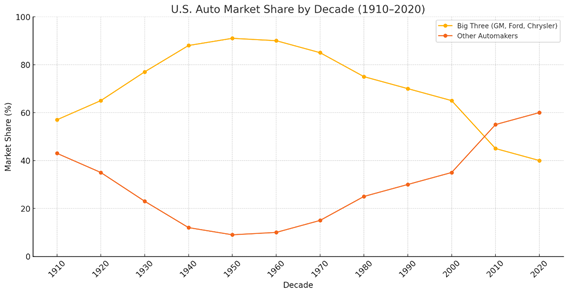
Abel argued, “Remember, for the first half of the century, there were a lot more car manufacturers. Wait, hold on a minute. I took a screenshot of a chart about a week ago. Here it is.

The vertical axis of the graph is marked from zero to 100 percent market share. The horizontal axis is marked in decades from 1900 to 2020. The yellow line depicts the changing share of the automobile market for the Big Three automakers. It rises from 55% in 1910 to 90% in 1950, then declines gradually to 40% in 2020. The orange line shows the changing share of other automakers. It declines from 45% in 1910 to 10% in 1950, then rises to 60% in 2020. The two lines cross in 2007, when the share of other automakers begins to rise over that of the Big Three.

Abel continued, “The dominance of the Big Three was already starting to decline in the 1960s and 1970s. It wasn’t the new mandates but foreign competition coming into the U.S. market.”

Cain whistled softly as he looked at the chart. “I didn’t realize that the majority of cars on the road are now foreign brands.”

Abel interrupted, “Some might be Teslas.”

Cain nodded. “Right. But this shows why a lot of people want to bring manufacturing back to the U.S. What got you into this?”

Abel replied, “I was sitting in traffic and noticed that there were no American brand cars around me. I wondered if that was a trend.”

Cain shook is head. “Our economy is too open to foreign competition, if you ask me.”

Abel argued, “America’s dominance in manufacturing was just the post-war period. The war crippled the industries of Europe and Japan. As they recovered, they began to compete with American autos. My daughter drove a used Honda Civic for like ten years when she was younger. Hardly any repairs. What American car in the 1990s could make a claim like that?”

Cain replied, “Dodge Dart. Slant-6 engine. I drove that thing for over 200,000 miles without putting much money into it. Well, we got to do something. There’s too much difference in incomes between the urban areas and rural counties.”

Abel argued, “A revival in manufacturing won’t help these rural areas. Manufacturing needs supply chains, good roads that are built for truck traffic and well maintained. Infrastructure like cable and fiber. That’s the stuff Biden wanted to build, and Trump wants to cancel.”

Cain looked through the steam rising from his coffee cup. “Well, government is not too efficient at building stuff. They are good at shuffling ones and zeroes, taking money from one person and giving it to someone else. There should have been better incentives for private companies to build infrastructure. More fiber optic in rural areas, for example.”

Abel frowned. “Rural counties with older populations, what ACP categorizes as ‘Graying America,’ make up a small percentage of voters, about 5%, according to the analysis at ACP (Source). Political advertising may pay them lip service and feature them in videos, but they don’t have much power. You talked about counties with less than 10,000 people. That’s like less than a quarter of the counties and less than 2% of the population (Source).”

Cain argued, “I want to look at the research this American Communities Project is doing. It seems to me that there’s like a $25,000 to $30,000 difference in incomes between rural and urban areas. Rural counties are becoming like second or third-world countries. They don’t like it.”

Abel nodded. “I know. Their kids are leaving for better opportunities in more populous areas. I don’t know what the solution is. Democrats have come up with needs based programs to help lower income families in urban areas, but they have ignored rural areas. Of course, Social Security is progressive and that helps older people in rural counties. They earn lower incomes and get proportionately higher benefits. Their Social Security income goes a long way in a rural area.”

Cain interrupted, “It’s not that progressive. Besides, they don’t have easy access to doctors or dentists.”

Abel shrugged. “Right. There’s not enough to attract young talent the way urban areas do. Local autonomy may have suited an 18th century economy based on farming and primitive means of travel. Urban areas permit more connections between goods and services, between people and institutions. Rural communities just don’t.”

Cain argued, “Come on. Rural communities are all about connections.”

Abel replied, “Yeah, among themselves, but not so much with other communities. Look, our society, our economy, it gets more multi-layered. Urban areas have the depth and scope to accommodate that complexity.”

Cain asked, “Well, for all that complexity, we still have to eat. Who is going to grow and harvest our food?”

Abel shrugged. “Robots. Tractors and harvesters become more automated every year. There’s a show called “Clarkson’s Farm” on Amazon Prime, I think. Jeremy Clarkson is big into cars. He did some worldwide tour. He writes. He’s a presenter. Anyway, he decided to take up farming. Great show if you haven’t seen it. Fourth season just finished, I think. Boy, the sophistication of these tractors and harvesters is amazing. That trend will continue.”

Cain asked, “You think AI agents will be driving tractors?”

Abel nodded. “Sure, they’ve already got GPS in these machines.”

Cain argued, “Yeah, but you still need people to repair the machines, to muck out the stalls, whatever else they do on a farm.”

Abel replied, “Robots are picking orders at Amazon (Source). Humans are still doing the packing. It’s happening everywhere.”

Cain laid his napkin on the table next to his plate. “It’s sad. There are already a lot of small farming towns that have too many closed up stores. It’s not just the destruction of capital in a big tech company. I mean, that’s part of progress. It’s the demise of those communities, their social relationships, their religious and cultural institutions.”

Abel sighed. “Ghost towns. Gold and silver mining towns are tourist attractions, a page in history. One day, people may visit main streets in small town, America, and gawk at mom and pop grocery and hardware stores.”

Cain slid out of his seat. “That’s an uncomfortable thought. Well, I gotta go. Something to think about.”

Abel smiled. “Ok, see you next week.”

////////////////

Image by ChatGPT

A Web of Rules and Interpretations

June 1, 2025

By Stephen Stofka

This is part of a series on persistent problems. The conversations are voiced by Abel, a Wilsonian with a faith that government can ameliorate social and economic injustices to improve society’s welfare, and Cain, who believes that individual autonomy, the free market and the price system promote the greatest good.

Abel said, “What caught my attention this week was an article about some woman from Hong Kong being arrested and jailed prior to deportation (Source).”

Cain frowned. “Small Missouri town, wasn’t it?”

Abel nodded. “I forget the name of the town, but it voted heavily for Trump. Like 80%. This woman had lived in the town for twenty years, had a few kids. She worked as a waitress in the local restaurant and was well-liked by the folks in town. The arrest caught the town off guard. One person said they thought Trump was going to go after gang members and criminals, not mothers.”

Cain shrugged. “If I remember right, she had been in some fake marriage like twenty years ago to get a green card.”

Abel replied, “Yeah. She wasn’t convicted or anything. Back in the 1970s, I knew someone who got paid $10,000 to marry a Hungarian woman. That was a lot of money in those days. Hungary was behind the Iron Curtain, so there were a lot of people anxious to get out.”

Cain asked, “What did they do after they got married?”

Abel replied, “Went their separate ways, although they both had the same address. After a few years, they divorced. I think that was paid for, as well.”

Cain said, “Back to that Hong Kong woman. Almost half of the illegal immigrants in this country came in on visas and simply didn’t leave (Source). DHS reported record estimates of overstays in 2022 under the Biden Administration (Source).”

Abel argued, “Yeah, but a lot of those were from Venezuela. It’s basically a failed state. The UN estimated almost 8 million have left the country since 2014 (Source). That’s more than 25% of the 29 million people in the 2010 census.”

Cain frowned. “And the majority are coming here, it seems.”

Abel shook his head. “No, about 85% have gone to South and Central American countries. It’s a strain on the entire hemisphere. Syria is another country with a refugee crisis, but that was the result of a civil war. Almost half the population had to flee because of Assad’s war against his own people (Source). That doesn’t include all the internally displaced people who had to flee their homes and villages. In Venezuela, Maduro has destroyed his country’s economy. If people can’t eat, they got to leave.”

Cain sighed. “If they can leave. Look at Gaza.”

Abel nodded. “The largest prison in the world. A prison with no food. If we start talking about Gaza, my food will get cold.”

Cain said, “A country has to have rules and procedures for who can come in and how long they can stay. Who is a citizen? Who is not?”

Abel argued, “We didn’t have any rules for 80 years. Not until after the Civil War.”

Cain shook his head. “No way. The 1790 Naturalization Act limited citizenship to free white persons only. The Constitution hadn’t even been ratified yet. It’s the first time that the phrase ‘under the jurisdiction of’ appeared. It also included birthright citizenship (Source).”

Abel frowned. “No, that was the 14th Amendment.”

Cain smiled. “No, not for kids born here. Birthright citizenship for children born overseas if their parents were U.S. citizens.”

Abel was surprised. “So certain populations could immigrate here and work here but couldn’t become citizens.”

Cain nodded. “No Muslims, no Chinese. In a few decades, Congress added residency requirements for naturalization. People had to show proof when they entered the country. It was never an open door policy. All that ‘give me your tired, your poor’ stuff.”

Abel replied, “An open door for workers, but a lot of workers couldn’t be citizens.”

Cain raised his eyebrows. “Right. So, during the drafting of the 14th Amendment after the Civil War, the Senators argued over the wording of Section 1. Would the final wording include the children of Chinese immigrants (Source)? They agreed that it would.”

Abel asked, “Why was there a Supreme Court case about it then?”

Cain grunted softly. “This was in 1898, after Congress had passed the Chinese Exclusion Act barring citizenship specifically for all Chinese.”

Abel interrupted, “For like a hundred years, the British and Americans treated China really badly.”

Cain nodded. “And they haven’t forgotten it, either. The case was about Wong Kim Ark. Ark, like Noah’s ark. His parents were legally in the country when he was born but then they returned to China. So, when he was 21, he went back to China to visit them. When he returned to the U.S., authorities claimed that he couldn’t be a citizen and wouldn’t let him back in (Source). The court ruled that the birthright clause in the 14th Amendment gave Ark citizenship.”

Abel said, “And that’s where it’s stood for more than hundred years. Then Trump issued his executive order a few months ago.”

Cain tilted his head. “Not quite. I’ve heard about the ‘jurisdiction’ argument for some time. In 2010, Peter Schuck, a Yale professor, wrote an op-ed in the New York Times explaining some of the arguments against an outright grant of citizenship to anyone born in the U.S. (Source). He mentioned anchor babies. That’s like where a woman crosses the border …”

Abel interrupted, “or overstays a tourist visa like some Chinese women have done.”

Cain nodded. “That too. But anyhow, has a baby shortly after coming into the country. Did the framers of the 14th Amendment mean to include those children? Given the history of immigration laws in this country during the 19th century, that seems unlikely to a lot of people.”

Abel argued, “Even though the parents were here illegally, they were still subject to the jurisdiction of the U.S.”

Cain sighed. “The Ark precedent never settled the question of the parents’ status because Ark’s parents did have a right to live and work in the U.S. at the time their son was born. But what if your parents do not have permission to be here? What does it mean to be ‘subject to the jurisdiction’ of some country? Sure, some sheriff can arrest you and hold you, but the local district has no legal jurisdiction over you the way they would with an American citizen.”

Abel asked, “But we don’t penalize children for the sins or transgressions of their parents. If my parents owe money to some creditor and they die, that debt does not pass on to me.”

Cain agreed. “Schuck mentioned that. He was discussing the arguments on both sides.”

Abel nodded. “Right. Why should the legal status of my parents matter? If I am born in the U.S., badda-bing, I’m a U.S. citizen.”

Cain shrugged. “Depends on how the court reads the phrase “and subject to the jurisdiction thereof’ in Section 1.”

Abel shook his head. “What is a hospital supposed to do when a kid is born? Start checking the status of their parents? It’s a hospital, not an immigration court or the DHS.”

Cain nodded. “Yeah, there’s the practical side. Shuck suggested a compromise where a kid would spend so many years in school, perhaps, before they could become a citizen. Establish a connection to the U.S. Some European countries do that.”

Abel laid his fork down. “What about the status of all the kids that have been born in the past few decades. Are they suddenly going to become stateless?”

Cain shook his head. “Don’t ask me. The conservative justices will be looking at history and tradition at the time of the 14th Amendment.”

Abel’s tone was frustrated. “They’ve overturned Roe. They’ve nullified campaign finance laws in Citizens United. Money is speech! Who knew?”

Cain leaned forward and said in a hushed voice,  “I can hear you.”

Abel settled back in his seat. “Right, sorry. Anyway, the court adopted a whole new reading of the First Amendment in that case. Then they reinterpreted the Second Amendment in the Heller and Bruen decisions. Last year, they gave the President the immunity of a king in their reading of Article 2 of the Constitution. What’s next? Why don’t they just rewrite the entire Constitution?”

Cain smiled. “The Democrats have no one to blame but themselves. They were the ones who did away with the Senate filibuster rule for judges in 2013. Confirmation required only a majority vote, not the sixty votes required for a filibuster.”

Abel argued, “That was because the Republicans were blocking the appointment of many lower court judges as a matter of tactics, not ideology. Harry Reid, the Majority Leader, had no realistic choice.”

Cain replied, “That’s a matter of perception. The Senate is a tit-for-tat institution. When Republicans got the majority, they extended that exclusion from the filibuster to confirmations of  Supreme Court justices.”

Abel looked glum. “Then Trump appointed three extremists to the bench during his first administration.”

Cain asked, “Extremists? Anyway, whose fault was that? People had advised Justice Ginsburg to step down while Obama was in office. She was in her eighties, and had multiple health problems, including cancer (Source). Like a lot of politicians in Washington, she tripped on her big ego. I admire Justice Breyer for stepping down a few years ago while he was still in good health.”

Abel replied, “I read his book Reading the Constitution. He claims that a pragmatic interpretation of the law is better than an originalist or textual reading. He wrote, wait a second, I highlighted it. A jurist should ‘appeal more directly to values than a rules-based approach would advise’ (page 140).”

Cain frowned. “If there are several values, how much weight to give each individual value? Maybe freedom in one decision, civic order in another.”

Abel asked, “So you would argue that Scalia’s approach was more consistent?”

Cain nodded. “Yeah, I think a jurist has to ask themselves ‘what was the purpose of this law when it was written?’”

Abel said, “Breyer mentions that Scalia’s chief concern was the original intent of the law” (page 139). The framers of the Constitution argued over every clause. The final language tried to strike a balance between two principles, or two values. I think that’s what Justice Breyer was getting at.”

Cain asked, “So Breyer would have been looking for two values that needed to be balanced?”

Abel shrugged. “He didn’t say that. It’s more my thought based on what Breyer wrote and James Madison’s account of what the framers argued about during the Constitutional Convention (Source). I was trying to come up with a simple rule of constitutional interpretation. I like the balancing of values test.”

Cain nodded. “I like that method because it reminds me of the balance between supply and demand. My rule about limiting exceptions is when making the law, not interpreting the law. I think I agree with Scalia that justices should try to figure out what was the purpose of the law, the original intent, then come up with a simple rule that can be applied in the circumstances of the case before the court.”

Abel frowned. “You said the rule in the Heller decision wasn’t well constructed. Scalia wrote that decision.”

Cain shrugged. “Just because Scalia wrote it doesn’t mean it meets my test for a good rule.”

Abel argued, “Very often, lawmakers do not want to state the intent of a law. What they do is construct a process, a set of procedural rules to achieve a stated purpose. Take, for example, the 1924 Immigration Act. Republicans wanted to maintain a homogenous population of English and those from northern European countries. They already had a quota system in place, so that it allowed more immigration from those favored countries and restricted those from less desirable countries in southern Europe and other parts of the world.”

Cain shook his head. “Maybe the purpose was not stated, particularly in earlier laws. The justices should be able discern the purpose from auxiliary sources. There would have hearings, Congressional notes, commentary from the press that linked to Congressional sources. That kind of stuff.”

Abel nodded. “I understand. My point is that the purpose of a law can be subject to interpretation. Scalia sold the idea of original intent as a more grounded approach, but it can be a complex interpretation that is mostly grounded by the court’s own biases. That’s what we’re seeing the past decade or so. You didn’t like the reasoning in Heller.”

Cain replied. “No, I didn’t. I liked the conclusion they reached, or at least part of it. The contradictions in the reasoning meant that more cases would come to the court because judges in the lower courts would not be able to apply the precedent consistently.”

Abel interrupted, “Yeah. You said that was the sign of a badly constructed rule or precedent.”

Cain nodded. “Right. Scalia wrote the Heller decision (Source) and he had an ego at least as big as Ginsburg’s. In the Heller decision, Scalia took on the role of English professor, analyzing the grammar construction in the Second Amendment.”

Abel asked, “Did Scalia study English before going to law school?”

Cain shrugged. “I don’t know whether he had any formal training in grammatical construction during the 18th and 19th century.”

Abel replied, “It does seem like a constitutional scholar would have to become familiar with that kind of construction.”

Cain nodded. “Yeah, but a judge would read only a narrow slice of literature from a time period. It hardly makes them an English scholar of that period.”

Abel said, “So back to the Second Amendment.”

Cain continued, “Scalia asserted that the prefatory clause in the Second Amendment, the one about the Militia, does not limit the operative clause stating that individuals have the right to own and bear arms.”

Abel frowned. “Well, a prefatory clause can explain the reasoning for an operative clause. We see that construction in Madison’s notes during the Constitutional Convention (Source). So there’s the original intent of the Second Amendment. End of story. If Scalia was basically going to ignore the prefatory clause about the Militia, then anyone could own a firearm. Convicted felons, crazy people.”

Cain nodded. “In 1791 when the Second Amendment was ratified, states did not ban weapons for those kind of people, although a few towns had some rules against it. Scalia claimed to be a champion of rules (Source), but the lack of rules at that time gave him a problem. If his grammatical analysis did not limit the right to bear arms, states could not legally bar people from owning a gun.”

Abel nodded. “A practical problem. Breyer wrote that originalist interpretations like Scalia’s didn’t look to the consequences of an interpretation (page 128), but this time, you’re saying that Scalia did have to look at that.”

Cain replied, “Sure. The 2008 Heller decision was a 5-4 vote. Remember that Scalia is most noted for his dissents, not his majority opinions (Source). A dissenting opinion can lay out bold principles because it doesn’t need to reach a consensus. This time, Scalia couldn’t afford to lose a vote, so he had to step back from a rigid application of his own rules.”

Abel asked, “You would not have done so?”

Cain replied, “First of all, I would have used some sources on English grammar to validate my grammatical analysis. Did a prefatory clause limit the operative clause in general use at that time? Not just in legal texts, but in newspapers, novels, et cetera. You need more than legal citations. ”

Abel asked, “So how did Scalia resolve his practical problem?”

Cain squinted for a moment. “He asserted a natural limit to all rights based on common law. Blackstone’s commentary on English law notes that no right is absolute (Source). The right of one person can interfere with the right of another person, with the body politic (Source).”

Abel nodded. “Competing interests, in other words. That balancing test I mentioned earlier. Balancing values and interests. So why can’t the state limit a person’s right to carry a gun in the interest of keeping civil order?”

Cain replied, “Yep, that’s a problem and Scalia doesn’t really clarify that competing interest thing.”

Abel asked, “You would have clarified it?”

Cain nodded. “Sure. It doesn’t take a genius to know that the issue of competing interests will come to the court again as the lower courts try to resolve cases involving these interests. And they did.”

Abel said, “The 2022 Bruen decision said that local jurisdictions could not require permits for self-defense outside the home. They had to use historical tradition to support their case.”

Cain replied, “Correct. The court gave deference to the right of self-defense over a competing state or local government interest.”

Abel argued, “But you said that there were few historical cases when the Second Amendment was written. So states would have to use 19th century traditions. What makes the 19th century so special?”

Cain shrugged. “Like I said. The reasoning is a mess. If there is little historical tradition at the time of the amendment’s ratification, that should be the historic tradition.”

Abel smirked. “So, in your world, we would all go around with six-shooters in holsters just like in the Westerns.”

Cain laughed. “Gimme a break. My reasoning wouldn’t ignore consequences the way Scalia does.”

Abel said, “So you do agree with Breyer. You’re a liberal at heart.”

Cain chuckled. “The price system does not ignore consequences. It is a balancing of interests between suppliers and consumers.”

Abel interrupted, “Consumers who are factors in the supply of what they consume.”

Cain nodded. “As workers. Ok, good point. Anyway, there is no price system in the law.”

Abel asked, “Could you invent one?”

Cain looked puzzled. “Could I? Of course not. But that raises a good question. Why didn’t a price system evolve in a democratic system?”

Abel replied, “That’s easy. Everyone gets one vote.”

Cain smiled. “In a competitive market, some people have more of a surplus than others. Resources and wealth are not distributed evenly. Demand is not distributed evenly. It’s that imbalance that spawns the price system. There’s too much balance in a democratic system for a price system to work. Each party tries to tear away at that balance, to make it unstable so that they can exert their will.”

Abel frowned. “So, what? Sell votes?”

Cam shook his head. “No, votes are like money. A medium of exchange for the transfer of power, for authority, for legitimacy.”

Abel asked, “Allocate votes to each voter based on how much power or authority is at stake?”

Cain smiled and slid out of the booth. “It’s certainly something to think about. I will see you next week.”

Abel laughed. “Next week, another episode of Pinky and the Brain, plotting to take over the world.”

Cain laughed. “Or at least try to understand it. My treat this week. See you then.”

//////////////////////

Priorities and Problem Bundles

April 27, 2025

By Stephen Stofka

This is part of a series on persistent problems. The conversations are voiced by Abel, a Wilsonian with a faith that government can ameliorate social and economic injustices to improve society’s welfare, and Cain, who believes that individual autonomy, the free market and the price system promote the greatest good.

Abel said, “After last week’s conversation on the homeless problem, I wondered about the strategies cities have devised to tackle the problem. I thought Denver and Aurora provided a good contrast. Here are two cities in the metro Denver area that have adopted policies with a different emphasis. They share a common border so imagine you’re standing on one side of a border street. Homeless people on that side of the street get treated one way. Homeless on the other side of the street get dealt with under a different policy.”

Cain smiled, “Well, you had a more productive week than I did. I spent Monday worrying about the consequences if Trump tried to fire Powell, the head of the Federal Reserve. On Tuesday, Trump said the media made too big a deal out of things he said.”

Abel asked, “What did Trump say?”

Cain replied, “That he wanted to fire Powell. Trump’s exact words were ‘his termination cannot come fast enough’ (Source).”

Abel smirked. “Naturally, it’s the media’s fault for broadcasting what Trump says. Anyway, to get back to the homeless problem. Yeah, the mayor of Denver, his name’s Mike Johnston, ran on a campaign of reducing homelessness and took office in July 2023. He immediately announced his administration’s ‘All In Mile High’ program. By the end of that year, the city had bought a hotel and turned it into a shelter for 205 families. Tamarac Shelter it’s called (Source).”

Cain whistled. “A government that got something done in six months. Good for them.”

Abel continued, “By the end of last year, the city had moved 2500 homeless people into housing of some sort (Source). The cost was about $155 million in the 17 months ending in December 2024 (Source). Much of the expense was startup costs, funded by federal grants for the purchase and repair of buildings to house homeless people (Source). The city expects to spend almost $58 million in fiscal year 2025 as ongoing costs to provide housing and support programs for 2000 homeless.”

Cain asked, “How many homeless people does Denver have?”

Abel replied, “A few years ago, they estimated 9000 (Source). That’s less than the 11,000 estimated homeless in 2012 (Source).”

Cain frowned. “So, the city hopes to resolve the problem in the next two years?”

Abel sighed. “Resolve? No. Reduce? Yeah. They estimate that people will spend six to twelve months in the program so I suppose the goal is to show a strong response in the hopes that the problem will ease.”

Cain raised his eyebrows. “Housing is not getting cheaper. That’s going to put some pressure on poorer families who are just one or two paychecks from homelessness. How many of the homeless are these immigrants that got bused up from Texas?”

Abel shook his head. “I don’t know but migrants were the main component of the surge in homelessness in 2022 and 2023.”

Cain nodded. “You said the city estimated a cost of $58 million a year to provide shelter and support services for 2000 homeless people. Napkin math tells me that’s about $30,000 per person. That’s the same amount the federal government spends to house someone in a standard federal prison (Source).  That says something about our priorities and values. In essence, we pay people not to work, whether they commit a federal crime or become homeless.

Abel scoffed. “Well, that’s not exactly giving them money.”

Cain argued, “It’s giving someone money. One man’s expense is another man’s income. That’s the underlying problem. The prison industrial complex naturally promotes more prison time as a solution to crime.”

Abel showed surprise. “You would support more rehab services instead of prison?”

Cain shrugged. “Depends on what the crime is. I don’t think rehab works well with violent people. They have seen violence as a solution to their problems for a long time.”

Abel asked, “That’s not true. Given an opportunity and the right emotional circumstances, an abused wife might kill her husband. Maybe there was not an immediate threat when she killed him, so a jury doesn’t buy her plea of self-defense. She killed him to avoid the likely chance of mortal injury because of her past experiences with her husband.”

Cain nodded. “Maybe you’re right. There’s not a cut and dried rule. Given that each individual’s circumstances are a bit different, I wonder if AI could be used to guide sentencing? An AI could scan through a gazillion histories of court cases involving violent crime, look for patterns that promise a greater chance of success with rehab.”

Abel wiped his mouth with his napkin. “I like that. A more individualistic approach.”

Cain continued, “These damn politicians just don’t think of the long-term consequences of their spending policies. They adopt a ‘tough on crime’ political posture to get re-elected. They support privatization of prisons because private corporations don’t have to be as accountable to the public. Core Civic runs 61 prisons (Source). The GEO Group has 50 facilities in the U.S. that house prisoners and detained migrants for ICE (Source). These are big businesses that are listed on the New York Stock Exchange. GEO had a drop in profit last year because they spent money to build additional capacity for detained migrants.”

Abel’s eyes widened. “Border crossings are at historic lows (Source). GEO can’t be happy about that.”

Cain nodded. “Sure. They’ve invested money. They want to fill those detention facilities. You can bet their lobbyists are bending ears in the White House and Congress. I’m just afraid that cities like Denver are going to promote a similar constituency of companies that provide services for the homeless. Those companies do not want a reduction in homelessness. OK, so what’s Aurora’s approach? You said it was different.”

Abel nodded. “Denver emphasizes a stable home as a priority. Aurora takes a “tough-love” approach that emphasizes work. They have three tiers of assistance. At Tier 1, which is an emergency level, the homeless have shelter but no privacy. They need to work at improving their lives through rehab, volunteer and paid work to earn a spot in Tier 2 housing, which is semi-private, and Tier 3, which is private (Source).

Cain replied, “Yeah, I like that. A program with incentives. In fact, I’d like to see an incentive program for prisoners. They would get basic gruel, a crude bed and a minimum of yard time when they first got into the facility. They would have to prove themselves to get better food, board and time outside their cell.”

Abel frowned. “The prison would need to segregate prisoners by level of accomplishment. The prison kitchen would need to cook separate meals. Housing facilities would need to be segregated. I’ll bet a lot of prisons just don’t have the resources for that. Raise taxes? There would be a lot of pushback from voters for an ‘incentive’ program like that.”

Cain shook his head. “Goes to prove my point. The prison industrial complex wants high recidivism rates. Most of the guys in prison need to have goals set for them. They are there in prison because they wanted something they didn’t deserve. They need to be broken of that habit.”

Abel scoffed. “Robbery, I get your point. Murder? How is that taking something you don’t deserve?”

Cain replied, “Murder is the quintessential example of taking something you don’t deserve. Someone else’s life.”

Abel argued, “That’s an overly simplistic perspective. The abused wife example I gave earlier. What does that have to do with how they are treated in prison?”

Cain put his coffee cup down. “The prison gives them something they haven’t worked to deserve. Food and shelter. That just reinforces the behavior they developed outside of the pen. They are treated better than some prisoners of war who have to build roads or bust rocks for their keep. So, these guys go to war against their society and society rewards them for it by giving them free room and board. No wonder there is such a high rate of recidivism.”

Abel cocked his head. “I don’t see people lining up to get into prison.”

Cain nodded. “Most people don’t like to be caged up like animals in a zoo.”

Abel raised his eyebrows. “The Romans let slaves work their way to freedom (Source). Is that part of  your program?”

Cain shook his head. “I think a lot of states have policies that reduce prison time for good behavior. This could be an adjunct to those programs, I suppose.”

Abel asked, “No, I mean could a prisoner work to have their conviction wiped clean? It would help people looking for a job.”

Cain looked puzzled. “That’s an interesting proposal, but maybe too much of a change? Could a child sex offender get his conviction erased? Would society want that? I don’t know.”

Abel said, “Let’s get back to the homeless. I favor getting them settled into housing first, forming a daily routine, developing a sense of safety before they try various steps to rehabilitation.”

Cain replied, “I like the work first model that Aurora has adopted. Step 13, now called Step Denver, has been using that model with addicts since the early 1980s (Source). They have been dependent on government services for many years. Step provides group housing, but the emphasis is on sobriety and getting a full-time job to break that cycle of dependence (Source). Some of these people have not had a regular job for years. They need to relearn the routines of daily life. Get a paycheck, budget money, go shopping, pay bills.”

Abel argued, “But that program was designed for men only. Women, especially those with kids, need a stable home life. If they have pre-school children, getting a job is a second priority after taking care of their kids. A decade ago, the Colorado Coalition for the Homeless estimated that women made up 45% of the homeless population (Source). You like simple rules, principles that you can apply in all circumstances. That approach doesn’t work in the real world.”

Cain shook his head. “Maybe not but it’s a starting place. In a country with 350 million people, we can’t apply the law based on individual circumstances. The Trump administration is trying a simpler approach in order to expedite immigration policy. Inevitably, the liberal media finds an instance where the application of the law seems unjust because of an individual’s circumstances. Hey, I have a heart. I feel bad for some of those individuals. But student visas and green cards come with restrictions. Sure, those restrictions have often been ignored, but they are there.”

Abel frowned. “There was a dad from Indonesia with a student visa and a pending green card application who was deported because he was convicted of a misdemeanor for spraying graffiti on a semi-truck trailer (Source). The Trump people are treating people like computer programs. They probably search a bunch of databases for immigrants and visa holders who have broken any rule, no matter how slight. A programmer can write a rule and feed that rule into a computer.”

Cain admitted, “Yeah, it’s not perfect, I’ll admit. The DOGE team used a similar methodology. They fired recent hires who have fewer job protections. It didn’t matter what those people did or how critical their jobs were. No matter what method people use to streamline government or any large organization, there are going to be mistakes and injustices.”

Abel asked, “So what are our choices? On the one hand, we can have an incompetent government that can’t get anything done because it tiptoes through a lot of hurdles put up by advocacy groups. On the other hand, we can have a government willing to make some casualties as it enacts policy and hope that we don’t become the victims.”

Cain argued, “You said I was too simplistic. I’d say your alternatives are too simplistic. Look, we invented this complex system of government about a hundred years ago. Each decade, we bolted on policies and procedures until government has become a series of Rube Goldberg machines that are way too complex for the task they must accomplish. Trump is trying to undo some of those machines. It’s not pretty.”

Abel shook his head. “His administration keeps taking things apart before they studied how they were put together. When mistakes come to light, they blame it on ‘politics’ or ‘improper classification of employees.’ Like Trump, DOGE never makes a mistake. It’s always someone else’s fault.”

Cain sighed. “We started out talking about policy solutions for the homeless and now we are discussing problems with redesigning federal government practices. What’s the point?”

Abel’s tone was exasperated. “Governments can’t conduct policy using simple rules because many of the problems that government handles are complex.”

Cain interrupted, “The private marketplace handles complex problems as well. Remember Milton Friedman’s video ‘I, Pencil’(Source)? The manufacturing of a simple pencil uses materials sourced from all over the world. The price system helps coordinate the work of thousands of people and a lot of capital to produce a simple pencil.”

Abel resumed, “That is a good example of a complex problem involving an exchange of goods and services. The buyer of the pencil has one problem to solve. Writing. Government handles problem bundles, where one problem is a container of many, call them sub-problems. What if the pencil had to be used as the rod in a Tinkertoy set as well? The pencil design would have to be more complicated. The lead tip of the pencil would be good for writing but weak for making a connection in a Tinkertoy structure.”

Cain smiled. “I like that.”

Abel continued, “Each problem in the bundle interacts and interferes with other problems in the bundle. It’s like a whack-a-mole game. Solving one problem makes another problem worse. It’s like walking with a bowl full of water. We fall forward to walk. That interferes with keeping the water level in the bowl, so it doesn’t spill. Which is more important? Getting the bowl across the room or spilling as little water as possible? Choosing a priority is a policy decision.”

Cain interrupted, “Ok, I get it. So, Aurora has chosen to get the bowl across the room, to get the homeless working in a productive job, even if that strains the homeless person’s mental or character resources. Denver’s priority is to spill as little water as possible, to keep the homeless person’s personal life stable and level. A go slow approach.”

Abel laughed. “I hadn’t made the connection but OK. It’s like I enjoy the shade tree in my front yard because it blocks the sun during the summer and keeps the house cooler. But it’s messy in the spring when it spreads its seeds and in the fall when it sheds its leaves. The tree’s solution to my need for shade creates other problems. My priority is shade. A lot of government problems are like that, only ten times more complex. That’s why we hand these problems to politicians.”

Cain sighed. “Unfortunately, people vote for politicians who say they have a magic wand that can fix these problems.”

Abel smirked. “Like Trump. He promised to bring prices down, to resolve the war in Ukraine and Gaza. People who don’t pay a lot of attention to politics voted for that illusion. Prices are up and the wars continue. The chaos grows.”

Cain nodded. “We secretly long for simple rules. They help us navigate our personal lives. Why can’t they work for society’s problems?”

Abel looked up. “Jesus thought two rules were sufficient. He was a preacher, not a politician.”

Cain placed his napkin on the table and stood. “A preacher who was put to death by politicians. That’s depressing. Hey, I’ll see you next week.”

Abel smiled. “First week of May. Flower planting time. See you next week.”

//////////////////

Image by ChatGPT in response to the prompt “draw an image of a whack-a-mole box.”

A Debate on Immigration

December 29, 2024

by Stephen Stofka

This is seventh in a series of debates on various issues. The debates are voiced by Abel, a Wilsonian with a faith that government can ameliorate social and economic injustices to improve society’s  welfare, and Cain, who believes that individual autonomy, the free market and the price system promote the greatest good.

Wishing everyone a happy and flourishing New Year.

Abel opened the conversation. “I thought we might talk about immigration this week.”

Cain replied, “You mean illegal immigration.”

Abel said, “Our group doesn’t like calling people illegal. The only illegal act that many of these migrants have committed is crossing the border, a Section 1325 offense. That carries civil, not criminal, penalties.”

Cain shook his head. “You make it sound like a speeding ticket. If your group doesn’t like the term ‘illegal,’ we can refer to them as ‘illegitimate asylum seekers.’ Most of them are not fleeing persecution. They are jumping the immigration line. They are cheaters, taking advantage of the huge backlog in processing asylum claims.”

Abel shrugged. “Everybody cheats. Thousands of people and businesses fraudulently applied for Paycheck Protection checks during the pandemic. The bankers cheated the system and provoked the financial crisis that caused millions of Americans to lose their homes. Then the bankers claimed asylum from their own stupidity and recklessness and the government bailed them out.”

Cain’s expression was grim. “Our group did not approve of bailouts for bankers. It cost taxpayers billions, and they kept their bonuses. None were prosecuted under Obama’s watch.”

Abel argued, “No jail time for fat cats but your group wants to jail vulnerable migrants. Why don’t we put some of the migrants in the penthouses that the bankers bought with taxpayer money? Your group imagines a world where everyone plays by the rules. Like I said, everyone cheats.”

Cain shook his head. “They can wait in the immigration line like millions before them. Think of the people waiting in line outside of the U.S. for their immigration application to be processed. Illegals jump the line and claim asylum as they’ve been told to do by the cartels and coyotes. It’s an insult to those who are playing by the rules.”

Abel said, “Many recent immigrants have been coming from Venezuela. It is a failing state, ranked 28th out of 178 states. Nicaragua, Columbia and Honduras are ranked in the sixties, putting them in the top third of vulnerable states.”

Cain nodded. “So, some of the Central American countries are stressed. Their economy is poor. Maybe there is some gang activity. When Congress passed the asylum law in 1980, the basis for a refugee claim was fear of persecution because a person belonged to some group. Their race, religion, nationality or membership in a social group made them a target. A parent might be worried that a local gang will target her son or daughter. I sympathize but that is not grounds for an asylum claim.”

Abel said, “The U.S. has been an economic leader because of our openness to immigrants. The Census Bureau recently reported that 83% of the net increase in population came from immigration. Our population is getting older. We are having fewer children. Our economic stability depends on immigrants to expand our workforce.”

Cain said, “Look, I agree that immigrants may become net contributors to our society and economy. But that takes a long time. Newly arrived immigrants at the southern border have so many immediate needs. That includes housing, health care and other social services. The kids need education. They make huge demands on a community before they make any notable contribution.”

Abel argued, “Many Americans are descended from immigrants who came from similar circumstances. It takes a lot of desire and gumption to tear up roots and start over in a new country. America became the world’s leader by welcoming people like that.”

Cain shrugged. “No doubt it takes heart, but many of our ancestors came over when governments provided far fewer social services.”

Abel said, “Your group wants to keep a balance sheet for each immigrant. How many services do they use? What taxes do they pay? The sum of a person’s contributions and withdrawals from the community cannot be summed up so easily.”

Cain agreed, “The accounting is not perfect, I’ll admit, but policymakers need some concrete measures to evaluate the policies they implement.”

Abel argued, “Let’s go back to the peak years of European immigration in the late 19th century and early 20th century. Many of those immigrants were exploited by employers and landlords. In the late 19th century, Jacob Riis published pictures of the slum conditions in New York City. Immigrants lived in cramped conditions without proper water or sanitation. They worked in sweat shops and factories where they had few safety protections. Any ‘contributions’ they made to society were skimmed off by unscrupulous employers and landlords.”

Cain was adamant. “You think that kind of exploitation has stopped? Migrants working seasonal harvests under the H-2A visa program are often housed in accommodations with minimal standards. Their status affords them little bargaining power, so they are under the control of the subcontractor who employs them or the farmer that engages the subcontractor. Employers want cheap labor.”

Abel said, “Tighter borders controls in the past few decades have made it impractical for some seasonal workers to follow the harvests in Mexico and the U.S. They have stayed behind in the U.S., supporting their families in Mexico from afar. They pay taxes but are not entitled to retirement benefits even after twenty or thirty years of working in the U.S. If they are cheating the system, they are doing a terrible job. They are funding benefits to native Americans.”

Cain continued, “Your group advocates policies that only encourage labor exploitation, whether you mean to or not. Immigrants increase the supply of labor and lower wages for native Americans. It’s Econ 101. Supply and demand.”

Abel disagreed, “Lower wages would increase the supply of goods and lower prices. That’s also Econ 101. Immigrants increase demand for the very goods they help produce. That increases employment and reduces the unemployment rate for native workers with low-skills.”  

Cain shook his head. “I disagree. At any rate, social services for illegal immigrants are costly. Sanctuary cities like Denver and New York City have discovered just how expensive and disruptive these immigrants can be. The mayors complained when Texas and Arizona sent them some of the thousands of immigrants that cross the border every day. Policymakers in those cities sure got a taste of the problems that border states are dealing with.”

Abel sighed, “It was a political stunt by Abbott, the governor of Texas.”

Cain replied, “Martin Luther leading a bunch of black people across the Edmund Pettus Bridge in Birmingham was also a ‘political stunt.’ A better word is ‘protest.’ Busing illegal immigrants to other cities was a legitimate form of protest for Texas and Arizona.”

Abel argued, “Citizens protesting government abuse is a protest. When one state uses people as a political hot potato with another state, that’s a stunt.”

Cain shook his head. “Texas and Arizona have long complained about federal immigration policy. All those words fell on deaf ears in Washington. Actions do speak louder than words. Liberal states like Colorado and New York woke up to the reality of immigration policy when they had to deal with the problem in a concrete way.”

Abel insisted, “States should be working their policy disagreements out in Congress. Abbott’s stunt was sophomoric and vindictive.”

Cain replied, “Congress has been at a stalemate for years. The states have to take matters into their own hands where and when they can. The immigration system has been broken for years because Congress wants it broken. A persistent problem gives politicians an issue they can campaign on. Why is the minimum wage not indexed to inflation? Because Congress wants to fight over it.”

Abel asked, “So what does your group propose? Close all the borders?”

Cain said, “This country was founded on federalism, a compact between the states. The border states should have more autonomy in border control.”

Abel scoffed. “That won’t work. Immigrants will go to the border state with the most relaxed controls. Once they are in the country, they can move to another border state.”

Cain shook his head. “Make it illegal. If California lets in an illegal, that person has to stay in California for five years or so.”

Abel sighed. “How will the states enforce that? Each state would have to implement border controls on each highway going into their state. It’s not practical. The only practical policy solution is a unified federal response from Congress.”

Cain said, “Then the problem will plague this country forever, particularly Texas, Arizona and California. Congress doesn’t compromise on a solution until it becomes a crisis.”

Abel said, “Now we are getting to the heart of the matter. The two parties have created a political system that cannot craft coherent policies to address our problems. Americans suffer. They get cynical. Only 60% vote in a Presidential election. Only 20% may vote in a primary. Most of them tune out of politics because it’s a maze with no exit.”

Cain’s tone was resolute. “Then we need to fundamentally alter our system. The states need to call for a Constitutional Convention and bypass this dysfunctional Congress.”

Abel said, “That movement grew in popularity during the 1960s and 1970s. It seems to be gaining popularity recently. Maybe that’s the only solution. I’m afraid the two-party system that cripples our policymaking today will subvert a convention.”

Cain turned to leave. “That’s a discussion for another day. In a first ‘past the post’ election system, two parties are inevitable. The convention would have to implement a Parliamentary system, I suppose.”

Abel waved. “See you next week.”

////////////////////

Photo by Greg Bulla on Unsplash

Jacob Riis’ photos uncovered the abuses of immigrants in the Gilded Age. https://www.britannica.com/biography/Jacob-Riis

The Census Bureau’s recent report on population growth. Most of the 1% increase in population came from immigration. https://www.census.gov/newsroom/press-releases/2024/population-estimates-international-migration.html

Many undocumented immigrants are not eligible for federal subsidy programs. A state may allow them to participate in a particular program administered by the state. https://www.nilc.org/resources/overview-immeligfedprograms/

In a 2015 analysis of 2000-2010 data, Andri Chassamboulli and Giovanni Peri found that “increasing deportation rates and tightening border control weakens low-skilled labor markets, increasing unemployment of native low-skilled workers.” The incoming administration assumes that the opposite is true, that tougher border policy will strengthen low-skilled labor markets. https://www.sciencedirect.com/science/article/abs/pii/S1094202515000514

The New York Times related the stories of several aging farm workers. https://www.nytimes.com/2023/12/05/us/aging-undocumented-farmworkers.html

A Colorado Public Radio report on the difficulties and cost of treating newly arrived immigrants. https://www.cpr.org/2024/03/19/colorado-new-immigrant-population-adds-strain-to-hospital-system-already-stretched-thin/

An explainer of the H-2A worker program from the U.S. Citizenship and Immigration Services. https://www.uscis.gov/working-in-the-united-states/temporary-workers/h-2a-temporary-agricultural-workers

The Congressional Research Service investigated the mechanisms of calling a Constitutional Convention and a range of issues that the convention would debate. https://crsreports.congress.gov/product/pdf/R/R42589/15

The Party Swamp

June 30, 2024

by Stephen Stofka

This week’s letter is on expectations and alliances. After separating voters into two parties, alliances within each of the parties coalesce to form intra-party squabbles. These alliances can form despite radically different approaches to managing problems: analytical and instinctual. Voting for the same candidate might be a person with an instinctive dislike of government and a business owner who estimates the impact of that candidate’s policy preferences on a company’s bottom line. These two different approaches also produce conflict.

In past weeks I have distinguished between expectations and anticipations, the first being more analytical and the second more imaginative or instinctual. The two work symbiotically in our individual lives but that symbiosis becomes outright conflict in a group. Some prefer a more analytical approach to discussing and solving problems while others rely on their gut, their moral compass. Individuals participating in that debate want to convince others to adopt their perspective and values. Perspective evolves over our adult lifetime and its purpose is to protect our values which have evolved since childhood. Attacking a person’s perspective can be perceived as an attack on their values, so we are resistant to persuasion. A variation of a 17th century quote goes, “A man convinced against his will is of the same opinion still.” The trick to persuasion is to insert your argument into another person’s perspective like a key and let them turn the key.  

In the Democrat Party, the center left contends with the radical left who weaponize shame. Advocates of DEI funding and mandates within all public institutions honestly believe that such training will moderate or eliminate racist attitudes. The majority of U.S. colleges and universities require students to take these non-credit classes to graduate. For students with a heavy academic schedule and work commitments, the burden of that mandate multiplies a student’s stress. Those within and without the academic community debate the conflict between these mandates and academic freedom.

Those favoring more spending on affordable housing disagree with voters in the party who prefer the personal space buffer that R-1 Single Family Home zoning gives residents. Proponents of free needle exchange must overcome fears that such tolerance will introduce a moral hazard that promotes more rather than less drug use. Supporters of more resources for  immigrant housing, job and medical services encounter principled opposition from those who are mindful of the resources and money that must be diverted from other programs. Should the needs of newcomers take higher priority than those of long- time residents, particularly the descendants of those African-Americans brought to this country centuries ago? Party leaders struggle to manage these ideological conflicts because these issues permeate the leadership ranks as well.

The Republican Party is more dominant in the ex-urban and rural parts of each state. Party leaders and candidates express strong support for religious faith as a cornerstone of American society. According  to Pew Research, Republicans attend church more often than Democrats or Independents but the majority of Republican voters do not attend church weekly. Like Democrats and Independents, a third of Republicans rarely step inside of a church. Those who believe that public institutions should be secular confront those who think religious principles and doctrine offer the only sound foundation to good governance. A person supporting their argument with Bible verses may truly believe that they are taking an analytical approach. In their belief framework, the Bible is history, recorded by various authors or sources but inspired by God himself. To those devotees, the Bible is fact, not an arbitrary assembling of oral traditions and myths. Two Republican voters, each with very different religious beliefs, practices and priorities still vote for the same candidates and issues. Leaders within the party must negotiate a compromise between Christian compassion and checkbook constraints.

Immigration is a key issue on ideological lines even though most immigrants initially settle down in urban areas where political sentiments skew Democratic. When the labor market is strong in the U.S. relative to other countries, that acts as a draw to legal and illegal immigration. The emphasis is on the “relative to other countries” part. A mismatch in labor market demand between the U.S. and neighboring countries is an important contributor to immigration flows. The strong economy in the late 1990s and early 2000s attracted a surge of immigrants, far more than today’s levels when adjusted for population.

 A recent analysis by the Federal Reserve estimated that restrictive immigration policies from 2017 to 2020 made it moderately more difficult for employers to fill job vacancies.  Farmers and ranchers, a strong Republican cohort, have long lobbied for changes to the H-2A “guest worker” program that would help them meet seasonal worker demand. The number of slots for foreign workers is not enough to meet demand and the application process is burdensome. Employers have similar complaints about the H-2B program for non-agricultural workers, and are heavily used by janitorial and landscaping services. Regardless of the impact of restrictive immigration policies on their businesses, owners may still vote for a candidate who promotes an immigration crackdown.

Jobs and sustainable wages are the cornerstones of family support, individual self-respect and autonomy. Those in rural areas are keenly aware that urban areas offer a more developed communications and transportation network that attracts companies, jobs and talent. For the past several decades, small to medium-sized manufacturing has migrated to foreign markets which offer lower labor costs. The influx of immigrants is yet another potential threat to community stability and resources. Long established immigrants who came to the U.S. through a legal process may not feel welcoming to those who have jumped ahead in the immigration line.   For decades, rural areas have fought to retain businesses and develop more jobs at a sustainable wage. Those who advocate more government spending on infrastructure to attract businesses clash with those having an ideological preference for laissez-faire markets.

Candidates within each party search for and exploit the shifting alliances within their party’s voters. Challenges to incumbents emerge not from the other party but from a primary election by a candidate in their own party. Primary elections attract only a small percent of party faithful whose political passion gives their small numbers a lot of leverage within the party. Fringe candidates with less funding can appeal to special interest groups to further an agenda with a dedicated party base. A candidate can appeal to a single-issue like abortion, immigration, or project a no-nonsense, get-tough persona and attack an incumbent who compromised on a piece of legislation. A Representative must learn to manage different sets of alliances: those in their district and state, and those in Washington. Next week, I will look at several Representatives and how they have navigated relationships of political power within their party.

////////////////////////////

Photo by Ryan Noeker on Unsplash

Asylum and A.I.

May 14, 2023

by Stephen Stofka

Asylum and AI

This week’s letter is about immigration from a historical perspective. This past Thursday marked the end of Title 42, the Covid-era policy that allowed border officials to quickly deport many immigrants who crossed into the U.S. at places other than official checkpoints. This generation of Americans is unlikely to come to a final resolution of the immigration issue that has plagued our politics for 150 years. The debate over asylum is more than 80 years old, first sparked by an incident just before the outbreak of World War 2. Can recent advances in machine intelligence help us resolve the bottlenecks created by our own Congress?

Most of us are familiar with Ellis Island, the immigrant processing center in New York Harbor. According to The Statue of Liberty – Ellis Island Foundation (2022), officials at the center processed 12 million immigrants during its 62 year history. The center was mostly active for just thirty years during that time. Most of those immigrants came in the years 1892 – 1924, when Congress passed an immigration law that limited admittance to people from mostly northern European states with family members already in the U.S. Across the river from Ellis Island was an earlier era in U.S. immigration – Castle Gardens at Battery Park in lower Manhattan. From 1855 – 1890, that center processed eight million people, mostly from those same northern European countries.

Like the immigrants appearing at our southern border today, most of those early immigrants came here for better economic opportunities. In countries across northern Europe, promoters of land offered farmland for sale in Nebraska and other Midwest states, recounted by Richard White (2017) in his The Republic For Which It Stands, a thorough history of the Reconstruction and Gilded Age periods of the 19th century. The harvests of wheat in the Midwest states helped drive down prices for wheat in Europe. Lower prices made farming less profitable in those countries and helped drive immigrants to the U.S.

Pundits like cartoonist Thomas Nast ridiculed the ethics employed by the U.S. government. It had pushed the Indians off their homeland, then sold that land to railroads at gift prices. Once the track had been built, the railroads marketed their surplus land to their future customers, immigrant farmers who would rely on the railroads to get their crops to market. Despite the American myth of the Midwest farmer, most immigrants became wage workers. When gold was discovered on Indian territory in South Dakota’s Black Hills, many European immigrants rushed toward the promise of riches and ignored the property rights of the Indians.

In California, voters had rejected ratification of the 14th Amendment on a slippery slope premise. If Negro men were given suffrage, American Indians, immigrants from China and southern Europe would soon be granted the right to vote and the country would be overrun with the mongrel races. Advocates for immigration reform attracted voter support based on these longstanding prejudices.

Following World War 1, two incidents prepared fertile ground for a coalition of immigration reformers to help pass restrictive immigration legislation. According to the U.S. Citizenship and Immigration Services (2023), the Quota Acts of 1921 and 1924 mostly excluded immigrants who were not from northern European countries. The first was the “Spanish” flu which originated in Kansas, not Spain. News of the disease’s spread was first published in Spain because other countries, including the U.S., suppressed publication. The belief that the disease had originated in southern Europe justified the prejudice against southern Europeans as being unclean (White, 2017).

The second incident was the severe 18 month depression of 1920-21. According to the Social Security Administration (n.d.), unemployment in various industries ranged from 14% in transportation to 27% in construction and 38% in mining. Immigrants competed with wage workers particularly in lower skilled jobs. Restricting immigration reduced those economic pressures.

The U.S. did not have an asylum policy until after World War 2. The precipitating incident came in 1939, when a ship loaded with almost a thousand Jewish refugees left from Germany for Havana, Cuba. Many passengers planned to wait in Cuba while their U.S. visa applications were approved, according to the United States Holocaust Museum (n.d.). However, Cuba backed out of an agreement to receive them. Although the ship sailed close to the Florida shore, U.S. officials did not allow the passengers to disembark and they returned to Germany. Canada and some other countries accepted some refugees but a third were detained and died in the Nazi concentration camps.

The incident tarnished America’s image. After the end of the war with Japan in August 1945, President Truman issued a directive that admitted some displaced persons to the U.S. (USCIS, 2023). It took Congress two more years to formalize an asylum arrangement with the passage of the Displaced Persons Act in 1948. Reflecting long held prejudices among Americans, Congress kept its quota system in place. In 1965, the Congress passed amendments to the 1952 Immigration and Nationality Act that finally abolished the quota system for refugees.

Today, the queue for refugee applications is several years long and many migrants claiming asylum wait in the U.S. until their case is resolved by an immigration judge. According to the USCIS (2023), two Congressional amendments in 1990 and 2004 reduced the burden of proof that migrant applicants must show to substantiate their claims of being political refugees. Those within and without the system admit that it is broken but an evenly divided Congress has not been able to resolve differences.

The development of ChatGPT has sparked a great deal of public interest in the capabilities of interactive Artificial Intelligence (AI) machines. Authorities at the border and in the courts are overwhelmed with migrants claiming asylum status. Most claims will be denied but the applicants get to work and stay in the U.S. while they wait. Might it be possible to use AI machines to process these claims? Some may object to the idea of machines controlling the destiny of vulnerable migrants. If machine intelligence is not adequate to safely navigate a car down a highway, can we trust them to make complex decisions regarding human safety and respect? For successful applicants, a quick decision would give migrants certainty and enable them to access job opportunities and government services that might otherwise not be available under the current system.

The machines could discover as much information as is possible in other countries to assess a migrant’s claims of political or criminal persecution. The machines could sort through the volumes of legal precedent that bog down our human decision-making. They could cite the relevant information and precedent that supported or did not support a claim of asylum. Applicants who were denied by an AI machine could appeal their claim but outside the country. It is not a perfect system but one that might be acceptable to advocacy groups on both sides of the issue.

////////////////

Photo by Mr Xerty on Unsplash

Keywords: immigration, asylum, AI, ChatGPT

Social Security Administration. (n.d.). Estimates of Unemployment in the United States. Social Security History. https://www.ssa.gov/history/reports/ces/cesbookc3.html

The Statue of Liberty – Ellis Island Foundation. (2022, November 1). Ellis Island. Statue of Liberty & Ellis Island. https://www.statueofliberty.org/ellis-island/overview-history/

U.S. Citizenship and Immigration Services. (2023, February 7). Refugee timeline. USCIS. https://www.uscis.gov/about-us/our-history/history-office-and-library/featured-stories-from-the-uscis-history-office-and-library/refugee-timeline

United States Holocaust Memorial Museum. (n.d.). Voyage of the St. Louis. United States holocaust memorial museum. https://encyclopedia.ushmm.org/content/en/article/voyage-of-the-st-louis

White, R. (2017). The Republic for which it stands: The United States during reconstruction and the gilded age, 1865-1896. Oxford University Press.

A New Vision

December 26, 2021

by Stephen Stofka

The launch of the James Webb telescope on Christmas morning promises a new glimpse into the early history of the universe. If the complex folding telescope performs as planned, it will capture the light from galaxies that first erupted into being after the birth of the universe. Events in our lives are less cosmic but help shape our outlook for many years. A 30-year old born in the early 1990s was old enough to fully grasp the horror of the attack on the World Trade Center. The financial crisis interrupted the life plans of this age cohort. As families lost their jobs and homes, many high school graduates felt they had to pursue further education to prepare for a tough job market. A decade later came the Covid pandemic. The Millennial generation has been seasoned by repeated shocks.

Adapting to this turbulence is especially difficult for immigrants, many of whom fled harrowing circumstances in the country of their birth. In 2020, the U.N. estimated 280 million immigrants, a 27% increase in the past decade. For fifty years, America has been the top destination of immigrants. 50 million people, about 15% of the U.S. population, is foreign-born (Armstrong & Richter, 2021).

Almost 20% of Germany’s 83 million people are immigrants. Other destination countries were Saudi Arabia, Russia and the U.K. Russia has the distinction of being both a destination and origin country for immigrants. Availability of work and proximity to overpopulated countries draws migrant workers to these destination countries. Saudi Arabia and the United Arab Emirates are top destinations for Indian and Pakistani migrant workers.

In 2020, migrant workers around the world sent back more than $500 billion in remittances to their home country (World Bank, 2021). That is about the size of Sweden’s GDP and it is a lucrative trade for the international banking community which charges more than 6% in fees.

Americans are a resilient bunch and have withstood a major economic shock every decade. Is that resilience wearing thin? Public health measures and medical advances have increased life expectancy at birth by ten years in the past sixty years. In 2014, life expectancy plateaued at almost 79 years (FRED, 2021). Preliminary 2020 data from the CDC indicates that the pandemic has reduced that expectancy by 1.5 years to 77.3 years (CDC, 2021). A recent study of growing obesity rates in middle aged adults estimated a 4 – 7 year reduction in lifespan (Hruby & Hu, 2015).

Higher suicide rates and gun violence are important contributors to a rising rate of premature death, defined by the CDC as deaths before age 75. In Los Angeles, the premature death rate has risen to the same level as twenty years ago. The trend is not isolated to heavily populated urban areas. By 2019, the premature death rate of sparsely populated Riley County, Kansas had risen to its 2001 peak. In 2021, its violent crime increased by almost 50%, an indication of the stress the pandemic has had on communities throughout the country (KHI, 2021)

The eldest of the Millennial generation touched 40 this year. They will gradually assume the reins of policymaking from earlier generations that took too much for granted. A life expectancy that is flat or declining indicates structural socioeconomic problems that will require clarity, focus and commitment to steer in another direction.

/////////////

Photo by SpaceX on Unsplash

Armstrong, M., & Richter, F. (2021, December 17). Infographic: Migration Destinations and origins. Statista Infographics. Retrieved December 25, 2021, from https://www.statista.com/chart/26424/top-destination-and-origin-countries-of-international-migrants/

CDC. (2021, July). Vital Statistics Rapid Release . Centers for Disease Control. Retrieved December 25, 2021, from https://www.cdc.gov/nchs/data/vsrr/vsrr015-508.pdf

FRED (Federal Reserve). (2020, November 4). Life Expectancy at Birth, Total for the United States. Retrieved December 25, 2021, from https://fred.stlouisfed.org/series/ SPDYNLE00INUSA. Los Angeles County Premature Deaths: CDC20N2U006037. Riley County, Kansas Premature Deaths: CDC20N2U020161.

Hruby, A., & Hu, F. B. (2015, July). The epidemiology of obesity: A big picture. PharmacoEconomics. Retrieved December 25, 2021, from https://www.ncbi.nlm.nih.gov/pmc/articles/PMC4859313/

KHI – Kansas Health Institute. (2021). Riley County. Kansas Health Institute. Retrieved December 25, 2021, from https://www.khi.org/assets/uploads/news/15162/riley_county_2021.pdf. World Bank. (2021, May 12). Defying predictions, remittance flows remain strong during covid-19 crisis. World Bank. Retrieved December 25, 2021, from https://www.worldbank.org/en/news/press-release/2021/05/12/defying-predictions-remittance-flows-remain-strong-during-covid-19-crisis

What’s In the Mirror

November 8, 2020

by Steve Stofka

Every hour of the day, Mr. Trump issues a barrage of tweets about massive voter fraud. No evidence. He began his four-year term with the ridiculous claim that he had larger inauguration crowds than former President Obama. The overhead photos clearly showed that not to be the case. He claimed the photos were doctored.

Some families are unfortunate to have a crazy uncle that no one wants to invite for Thanksgiving. Mr. Trump is our crazy uncle President. Chris Christie, his former campaign and transition manager in 2016, has challenged the President to show the evidence.  There is none. There are a few isolated irregularities as always but no evidence of massive voter fraud.

I grew up a few miles from our wonder boy President. In our neighborhood, his whining and sniveling would have earned him a “put on your big boy pants, peckerhead.” He never had big boy pants, because his daddy kept him in diapers, buying him whatever he wanted, covering up for his stupidity and recklessness. 

Where I grew up you learned to fight your own battles. Our daddies didn’t coddle us. We didn’t have an army of lawyers to protect us, or doctors to get us out of the draft. We didn’t have the money to buy women. We had to earn our own way.

During the Cold War years, Americans trained their paranoia on the Communists. They were everywhere in America. At mid-century, people lost their jobs and had their careers cut short in a Republican witch hunt to rout out the Communists. Whenever Republicans want to rouse up their base, they complain of Socialists and Communists trying to take over the country. From the 20th Century playbook the older people are passing on their hate and paranoia to their kids who will carry on the tradition through this century.

Our culture thrives on conflict, and our media and politics profits from turbulence. Like our judicial system, we have an adversarial political system. Competition rather than cooperation is the default strategy. Both sides of an issue try to obscure rather than clarify issues. Our conflicts become our entertainment.

During the First Battle of Manassas in July 1861, congressmen and wealthy families from Washington picnicked at an observation point while young men slaughtered each other. They didn’t have TV then. Their picnic turned to panic when they were caught in the rout and retreat of Union soldiers.

America is a congregation of the world’s refugees. Persecuted or disadvantaged in their home country, many of our ancestors came to America to create a space for themselves. They brought their hopes and their hatreds. The first civil war was the American Revolution, when thousands of colonial citizens fled to Canada to avoid death at the hands of their countrymen.

In the 19th century immigrants from other European nations came streaming in through the ports and borders of America. Thousands of Irish farmers fled during the potato famine in their country at the mid-century. Chinese workers helped build the railroads during and after the Civil War. Shortly thereafter, in 1882, they became the first nationality to be excluded.

Expanding industrial businesses in America needed workers at dirt cheap wages. America opened the door to Europeans from north and south. They carried with them their hopes of a better life and decades or centuries of prejudices they had been taught since childhood.

One of those was a German young man fleeing obligatory military service. He was Donald Trump’s grandfather, Friedrich Trump (Frost, 2018). His son and grandson, our President, would disavow their German heritage in later years. Like his grandfather, Donald Trump evaded military service when his daddy paid a doctor to falsify medical records. Some traditions are important in the Trump family.

After World War I, America closed its borders to all but a few European nations. Antipathy to Germans ran high after the war. Returning servicemen still clung to their belief that the only good German was a dead German. Still, the nation was not among the excluded countries in the immigration act of 1924.

In 1965, a new immigration act reopened borders; now refugees from Asia and Latin American countries came to America. Like the Europeans, they brought their peculiar prejudices and a centuries long history of slaughter and civil war.

This country is founded on hope, prejudice, and tolerance. People of other nations have despised their neighbors because of religion, culture, ancestry, and history. America is the melting pot of that ugliness brought here by people from around the world. The torch held aloft at the top of the Statue of Liberty burns bright with the starshine of our ideals and the burnt cinders of our hatreds. People in other countries look to America and the millions of guns stashed in homes throughout our country; they wonder how is anyone still alive in America? If we can tolerate each other, there is hope for the rest of the world.

We are a tolerant people, civilized savages in a nation of laws. We go to church on Sunday and throw rocks at 6-year old Ruby Bridges, a black girl walking to school (Hilbert College, n.d.). That was sixty years ago this coming week. We pour out our sympathies and open our pocketbooks to help those whose lives have been torn apart by disasters around the world. We swear on our bibles, then tuck them away, pick up our torches and light Vietnamese children on fire. Love, charity and the darkness within.

Mr. Trump tapped into the power of our hatred and will continue to be a force in American politics. With millions of Americans following his Twitter feed, he delights in the conspiracies that feed the flames of righteous anger and justified hatred. As Pogo said, we have met the enemy and he is us.  

////////////////

Photo by Erik Eastman on Unsplash

Frost, N. (2018, July 13). The Trump Family’s Immigrant Story. Retrieved November 08, 2020, from https://www.history.com/news/donald-trump-father-mother-ancestry

Hilbert College. (n.d.). Social Justice Activists: Ruby Bridges. Retrieved November 08, 2020, from https://www.hilbert.edu/social-justice-activists/ruby-bridges

Bridge the Gap?

Photo by Ragnar Vorel on Unsplash

September 6, 2020

by Steve Stofka

What issues are your priorities this election? For more than thirty years Pew Research has surveyed people about their priorities. For the first time in 2019 a majority of 765 respondents answered that there is a “great deal” of difference in where each party stands, up from 25% in 1987 (Pew Research, 2020). I’ve included the full list at the end.

In January 2019, soon after the midterm elections Pew surveyed 1500 adults (Jones, 2020). I don’t know why the abortion/free choice debate is not on the issue list since that single issue may decide some voters. I’m particularly interested in the large gaps in those priorities among those who lean Democrat or Republican. I’ll start with gaps of 25%. For instance, terrorism is a concern for 80% of Republicans but only 55% of Democrats. Other Republican priorities are Immigration, the Military and Crime.

As you can see, these are fear issues. Should a person in a town of 2000 be more concerned about terrorism than a resident of NYC? Of course not, but it is what it is. People vote out of fear and hope, but fear probably wins the wrestling match, especially among Republican voters who are not hopey, changey voters, as former VP candidate Sarah Palin noted (Gonyea, 2010).

The issue of crime illustrates the conflicting complexities of these issues. It is a 60% priority for Republicans, who are in suburban and rural areas where there is less crime, and a 40% priority for Democrats, who are in dense urban areas where there is a higher incidence of crime. Because crime is much lower than in past decades, this issue has slipped as a priority for Democrats (FBI, n.d.).  

Two of the highest Democrat priorites – Cimate Change and the Environment – have a huge gap of 50% with Republican voters. Democrat politicians have not been able to make these two fear issues personal for Republicans. If they could, they would draw more voters to their side on this issue. 25% gaps exist on issues of the Poor and Needy, Health Care, Education and Race Relations. Rural Republican voters are more likely to be poor and needy, but this is not a fear issue for them (USDA, n.d.).

What strategy would a politician or political consultant advise? Run toward the base? If so, one would emphasize these issues where there are large gaps between the two primary factions in this country. The President has largely adopted this strategy. Republican voters are more inclined to fall in line and the President is relying on this party loyalty even if they don’t like him personally.

Some issues where there is a smaller gap between factions are the economy, the budget deficit, jobs, global trade, drug addiction, transportation, Social Security and Medicare.

A politician reaching out to voters on the fence in this election would focus on these issues. Joe Biden hits the jobs theme, the budget deficit, and protecting Social Security and Medicare to appeal to voters who have had their fill of the President’s divisiveness.

In the coming two months, candidates may adjust their strategies. In the 2016 election, Hillary Clinton may not have addressed these shared concerns as well and it cost her the election.  Governing comes after winning an election. In politics, winning is packaging the concerns and identities of voters into an appealing, if not attractive, box that will get them to come out and vote.

What are your priorities this election season? Are you a multi-issue voter, a single issue voter, a party voter regardless of the issues? Here’s the Pew survey list of 18 issues: terrorism, immigration, military, crime, climate change, environment, poor and needy, race relations, health care, education, economy, Social Security, Medicare, jobs, drug addiction, transportation, global trade, and the budget deficit.

///////////////

Notes:

FBI. (n.d.). Crime rates in the United States, 2008 – 2018. Retrieved September 05, 2020, from https://crime-data-explorer.fr.cloud.gov/explorer/national/united-states/crime

Gonyea, D. (2010, February 07). ‘How’s That Hopey, Changey Stuff?’ Palin Asks. Retrieved September 05, 2020, from https://www.npr.org/templates/story/story.php?storyId=123462728

Jones, B. (2020, August 26). Republicans and Democrats have grown further apart on what the nation’s top priorities should be. Retrieved September 05, 2020, from https://www.pewresearch.org/fact-tank/2019/02/05/republicans-and-democrats-have-grown-further-apart-on-what-the-nations-top-priorities-should-be/

Pew Research Center. (2020, August 21). Public’s 2019 Priorities: Economy, Health Care, Education and Security All Near Top of List. Retrieved September 05, 2020, from https://www.pewresearch.org/politics/2019/01/24/publics-2019-priorities-economy-health-care-education-and-security-all-near-top-of-list/

U.S.D.A. (n.d.). Rural Poverty & Well-Being. Retrieved September 05, 2020, from https://www.ers.usda.gov/topics/rural-economy-population/rural-poverty-well-being/