Thumbs Up?

August 30, 2020

by Steve Stofka

I tuned into the Republican National Convention (RNC) for a short time and learned that everything is ok. 175,000 people dead from COVID – ok. Millions of people out of work – ok. Older folks losing their retirement savings and a lifetime of sweat equity as their businesses close – ok. Seniors unable to get their medications and prescriptions on time – ok. People lined up at food banks – ok. People sitting on their furniture after being evicted – OK.

Black men being shot down for non-compliance to police orders – ok. Peaceful and violent protests in cities around the country  – ok. Food left rotting in the fields – ok. Growers can’t get H-2B visas to hire foreign workers and Americans don’t want the jobs – ok. More suicides, especially by former military – ok. More domestic abuse – ok. More drug abuse – ok.

The White House – our house – used for political grandstanding- that’s ok. This week American soldiers in an MRAP in Syria sideswiped and injured by Russian soldiers – that’s ok. The president is pulling troops out. Deficits of many trillions of dollars – ok.

As long as the stock market is up, it’s all ok.

In Shakespearean tragedies a powerful man – always a man – is brought down by one fatal flaw of character. Circumstance exposes the flaw. Othello, Hamlet, Macbeth, Richard III, King Lear. English students are asked to identify the fatal flaw and explain their choice. Students are asked to privately imagine themselves in a position of power. What would be their fatal flaw?

Can a great nation have a fatal flaw? James Madison and Alexander Hamilton worried that democracy would lead to mob rule and bring down our country. Thomas Jefferson worried that regional interests would create a ruling aristocracy and a nation ruled by monarchy. I watched a few minutes of the White House pomp on Thursday night. Our president embodies both fears of our founders. 

//////////////////

Notes:

Photo by Max Muselmann on Unsplash

Reaching Consensus

September 22, 2019

by Steve Stofka

In the early 1980s, scientists at NASA raised the alarm that much of the protective ozone layer over Antarctica was missing. Newspapers and TV carried images of the “ozone hole” (Note #1). In 1987, countries around the world enacted the Montreal Protocol and banned the use of aerosols and chlorofluorocarbons (CFCs). There were some arguments and a few AM radio talk show hosts called the ozone hole a scientific hoax. However, most of the world reached consensus. There will always be crackpots who ride backwards on their horse and claim that everyone is lying about what lies ahead.

Compare those days of yesteryear with today. We have a wide array of media and information outlets. People who can’t make change are self-proclaimed experts on climate change. The Decider-in-Chief can’t reach consensus with himself for more than a day. A slight breeze changes his opinion. Intentionally or not, he has become the Anarchist-in-Chief.

The younger generation is quite upset because they will have to live with the consequences of climate change. The fat cats who make their money proclaiming climate change is a hoax will be dead. Next week there’s a climate summit at U.N. headquarters in NYC. A lot of young people demonstrated in cities around the world this past Friday to let the world know that they are concerned. That’s consensus.

What happened to us in the past thirty years? It’s tougher for us to reach consensus about guns, immigration, climate change, women’s rights, and health care to name a few. Let’s turn to a group of people whose job it is to craft a consensus. In a recent Town Hall Supreme Court Justice Neil Gorsuch pointed out that the nine justices reach unanimous consensus on 40% of the 70 cases that they decide each year. Only the most contentious cases make it to the Supreme Court. 40% unanimity means they agree on many principles. 25-33% of their cases result in a 5-4 decision. Those are the ones that get all the attention. The nine justices who currently sit on the Court were appointed by five different Presidents over the past 25 years. Despite the changing composition of the Court over the past seventy years, those percentages of unanimous decisions and split decisions have remained the same.

Let’s turn to another issue concerning consensus – money. Specifically, digital money like Bitcoin. Some very smart people believe in the future of Bitcoin and the distributed ledger concept that underlies digital money. In this podcast, a fellow with the moniker of Plan B discusses some of the econometrics and mathematics behind Bitcoin (Note #3). However, I think that pricing Bitcoin like a commodity is a mistake.

I take my cue from Adam Smith, the father of economics, who lived during a time and in a country with commodity-based money like gold and silver. Unlike today, paper money was redeemable in precious metal. However, Smith did not regard gold or silver as money. To Smith, the distinguishing feature of money is that it could be used for nothing else but trade between people. Money’s value depends exclusively on consensus, either by voluntary agreement or by the force of government. Using this reasoning, Bitcoin and other digital currencies are money. They have no other use. We can’t make jewelry with Bitcoin, or fill teeth, or plate dishes as we can with gold and silver. The additional uses for gold and silver give it an anchoring value. Bitcoin has an anchoring value of zero.

When people lose confidence in money, they lose consensus over its value. Previous episodes of a loss of confidence in a country’s money include Zimbabwe in the last decade, Yugoslavia in the 1990s, and the sight of people pushing wheelbarrows of money in Germany during the late 1920s.

Like gold, Bitcoin must be mined, a process that takes a lot of electricity and supercomputers but does not give it any value. Ownership in a stock gives the owner a claim on the assets of a company and some legal recourse. Ownership of a digital currency bestows no such rights.

In an age when we cannot reach consensus on ideas like protecting our children at school or the rights a woman has to her own body, we seek consensus with others on more material things like Bitcoin. We seek out information outlets which can provide us with facts shaped to our perspective. When facts don’t fit our model of the way things should be, we bend the facts the way water bends light.

John Bogle, the founder of Vanguard, died recently. He was an advocate of investing in the consensus of value about stocks and bonds. Now we call it index investing. That’s all an index is – a consensus of millions of buyers and sellers about the value of a financial instrument. There are several million owners of Bitcoin – a small consensus. There are several thousand million owners of SP500 stocks. That is a very large consensus, and like a large ship, turns slowly in its course. A small ship, on the other hand, can zip and zig and zag. That’s all well if you need to zig and zag. Many casual investors don’t like too much of that, though. They prefer a steadier ship.

I do hope we can move toward a consensus about the bigger issues, but I honestly don’t know how we get there. In 2008, former President Obama called out “Si, se puede!” but quickly lost his super-consensus in Congress. “No, you can’t!” called out the new majority of House Republicans in 2010. We’ve gotten more divisive since then. Journalist Bill Bishop’s 2008 book “The Big Sort” explained what we were doing to ourselves (Note #4). Maybe he has an answer.

In the next year we are going to spend billions of dollars gloving up, getting on our end of the electoral rope and pulling hard. Our first President, George Washington, was reluctant to serve a second term. Hadn’t he given enough already? In our times, each President looks to a second term as a validation of his leadership during his first term. There’s that word again – consensus.

////////////////////////////

Notes:

  1. Images, video of the ozone hole in 1979 and 2018 from NASA.
  2. We the People podcast from the National Constitution Center
  3. Discussion of bitcoin on this podcast
  4. The Big Sort by Bill Bishop

Unauthorized Tax Revenue

September 1, 2019

by Steve Stofka

This might be a sensitive subject for some – the amount of taxes that unauthorized immigrants pay. Homeland Security uses the term “unauthorized” (Note #1). Some people prefer the adjective “undocumented” but many immigrants have adequate documentation. Some prefer to use the adjective “illegal” but the only illegal act is being in the country without proper authorization. If someone is speeding but is obeying all other traffic laws, are they an illegal driver? In most cases, they are a legal driver committing an illegal act.

 Those who defend immigrants point out that they pay taxes, so they are contributing to our society. I was curious as to how much because I have not heard an immigrant advocate offer any data. I told my trusty hunting dog, Google, to go find them facts and bring them on back to me.

First the big picture. The total Federal, State and local taxes paid in 2016 was $5,300 billion, or $5.3 trillion (Note #3). What was the share that unauthorized immigrants paid? The Institute on Taxation and Tax Policy recently estimated that they paid almost $12 billion dollars in state and local taxes. The IRS says they paid $9 billion in payroll taxes (FICA) and almost $1 billion in income taxes (Note #4). The total is $22 billion.

How do they report? They get Federal ID numbers called ITINs. To encourage compliance with our tax laws, the IRS says they do not share this information with the immigration and naturalization folks in Homeland Security. I was amazed that unauthorized immigrants would file tax returns. They are not eligible for social security benefits or earned income credits available to low income families. They are not eligible for TANF – what most people call welfare. The only benefits they are entitled to are those directed toward children – free public education and school meals, child medical care and SNAP (food stamps).

So why file? If you follow that IRS link, you’ll find that an unauthorized immigrant who shows “good moral behavior” may have their deportation proceedings waived or be eligible to apply for citizenship after ten years of residence. What is one sign of good moral behavior? Paying taxes. What is a sign of bad moral behavior and might get someone deported? Not paying taxes. Good incentive to pay taxes.

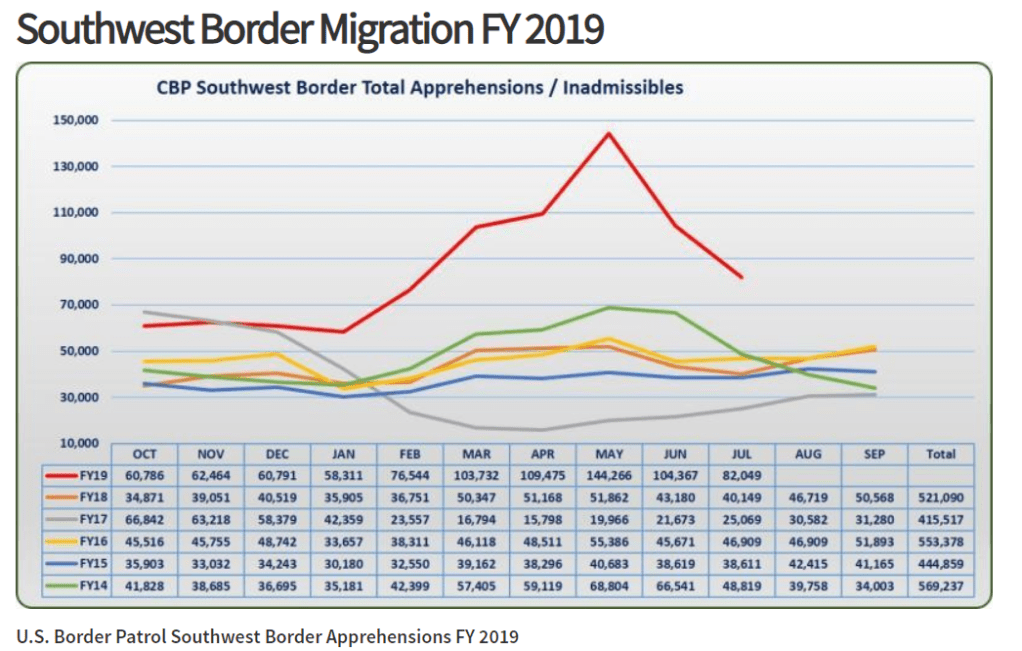
Homeland Security estimated 12 million unauthorized immigrants in 2015. In the aftermath of the financial crisis, unauthorized immigration grew by a small 70,000 per year (Note #5). In the 2000s, the influx was almost 500,000 per year, and that was a decline from the record 1.4 million apprehended at the southern border in 2000. In 2019, the number of border apprehensions will approach one million (Note #6).

Numbers like these cause Americans to disagree strongly about policy choices related to immigration. In the 1980s, in the late 1990s and again in the 2000s, the numbers were high and we argued. This time is no different. These numbers don’t include visa overstays which make up 40 – 50% of the unauthorized immigrant population (Note #7). Let’s guesstimate the population at 15 million, about 4.6% of the population. That 4.6% is paying less than 1/2% of total taxes.

We can go look at unauthorized immigrants and say that they are leveraging their taxes – paying a small amount of tax to receive proportionately more in benefit. But that is the case for all low-income people, unauthorized or not. Low-income people buy less stuff, so they pay less in sales tax. They live in lower-valued properties, so they pay less property tax. They make less money, so they pay less income tax. Those are the three primary sources of tax revenue in the U.S.

When President Trump said he wanted higher quality immigrants, he meant that he is not anti-immigrant. He is anti-poor-immigrant. Like Trump, some say we don’t need more poor people; we already have too many poor people.  Some people anticipate that their taxes will go up to provide benefits for the growing number of poor people, documented or not. Few want higher taxes to pay for services to people who just arrived in the country.

When my grandfather came to this country more than a 100 years ago, there was no income tax, no social security tax and property taxes were relatively low. The only benefit for immigrant families was public education. There were no school lunches, no food stamps, no medical care for children. Despite that, anti-immigrant sentiment was strong enough to pass a bill in 1924 that cut off legal immigration for all except northern Europeans. Our grandparents and great-grandparents were far less tolerant of immigrants than we are today.

Let’s keep some perspective. People who are concerned that they will have to pay higher taxes for benefits are not evil or uncaring. Low-income people who are worried about competition for their jobs in the construction industry are not moral slugs. Whatever your occupation, imagine that the number of people available to do that kind of work doubled in your community. How would you feel? The more the merrier? Probably not. Those workers will compete for your job and that competition will hamper any future salary increases you can expect.

We all need to admit that immigration presents complicated moral, political and economic choices. History has taught us that we don’t know how to solve this problem in a way that satisfies most of us. Each time we have to choose which side of the rope tug we are on. Each side hurls insults and curses at the other side. This is not the new normal. This is the old normal. How about if we try the new normal, sit down and hash out the difficult details of a compromise?

////////////////////////////

Notes:

  1. Homeland Security uses “unauthorized” to refer to those in the country without proper authorization
  2. Tax Policy Center calculation of total taxes paid to governments at all levels  
  3. Estimate of taxes paid by unauthorized immigrants – PDF
  4. IRS data on payroll and income tax paid by unauthorized immigrants- PDF
  5. Estimate of unauthorized immigrants – PDF
  6. Apprehensions at the border – CBP
  7. Visa overstays – Potitifact

The Politics of Compassion

July 14, 2019

by Steve Stofka

It was a busy week in Washington. Jerome Powell, the chair of the Federal Reserve, testified before a House subcommittee. His dovish remarks signaled Wall Street traders that the Fed would almost certainly lower interest rates at their next meeting on July 30-31 (Note #1). The market rallied to new highs even as investors continued to transfer funds from stocks to bonds during the past month (Note #2).

Not so dovish was the atmosphere at a House subcommittee hearing this week on immigration proceedings at the southern border. Very emotional testimony from several freshman House members who had visited immigrant detention facilities in Texas. The former head of ICE under Presidents Obama and Trump testified about the challenges that border patrol officers face under the surge of immigrants. Human and drug trafficking along the southern border has been at crisis levels for many months. Patrol officers are not trained to be social workers or medical attendants but find that most of their time is spent caring for people who lack the physical stamina necessary to navigate the harsh conditions of the deserts of northern Mexico.

Many immigrants are sick or injured after a long treacherous journey from Central America. The crowded facilities pose a challenge even for healthy immigrants. They are certainly no place for mothers with young children, but neither was Ellis Island (Note #3). However, most of the immigrants at Ellis left the building after several hours (Note #4).

I was reminded of my grandmother and aunt who were turned away twice for whooping cough and pink eye. It was easy to pick up contagious diseases on the 7-10 day journey in third-class quarters on a crowded transatlantic steamer a century ago. Processing hundreds of immigrants a day, doctors at Ellis Island were quick to reject those with even the hint of TB or trachoma (Note #5). In the years before World War I the northern states needed workers and government officials were largely forgiving of many disabilities and illnesses. Less than 2% of immigrants were deported. My family was one of the unlucky ones – twice. My grandfather waiting on the Manhattan shore a few miles away must have been confused and angry.

Some Americans are insistent that immigrants should follow our Constitution, but our founding document has little to say about immigration. Article 1, Section 8 states that the Congress shall “establish a uniform rule of naturalization.” End of story. For the first hundred years of our nation’s existence, each state processed immigrants. Many immigrants did not present any paperwork or pass a medical examination. State and Federal governments simply took an immigrant’s word as to their name and personal information. Those who insist most loudly that immigrants follow our laws may be descended from people who followed no laws when they immigrated into our country.

In 1891, Republican President William Henry Harrison signed into law the Immigration Act of 1891 passed by a Congress dominated by Republicans (Note #6). Republicans represented the interests of northern businesses who needed able bodied workers who were unlikely to become dependent on government for their care. The flood of immigrants into the northern states gave Republicans additional congressional seats and an edge over Democratic majorities in the southern states.

The founding documents of this country were forged in the fires of heated debate and hard bargaining (Note #7). In 230 years, the debate has not cooled. Today, Democratic majority states like California and New York stand to gain Congressional seats as they welcome and champion the rights of immigrants. While the Senate has a filibuster rule, only the Democratic Party can fix our broken immigration laws because they are the only ones capable of securing a filibuster-proof majority in the Senate. The Republican Party has not enjoyed such a majority since Senators were first popularly elected in 1914. If Republicans are ever going to take the lead on contentious issues, they will have to abandon the Parliamentary filibuster that chokes most legislation to death in the Senate.

Why didn’t the Democratic Party address the issue of immigration while they had a filibuster-proof majority in the Senate and controlled the Presidency and House? Was it not important then? Nancy Pelosi was House Speaker then and now. She is known for her political ability to “count votes.” Perhaps she would be more effective if she looked further than votes. In a deeply divided nation with a constitutional architecture that resists change, a resolution of our most intractable problems is a formidable challenge for any leader.

After the Financial Crisis in 2008, Pelosi helped patch together two large pieces of legislation under Obama’s first term. ARRA was an $800B stimulus package passed in February 2009 that did help keep unemployment from getting even worse but was ineffective in many areas because the stimulus was diluted over several years (Note #8). That and the passage of the controversial ACA, dubbed “Obamacare,” cost the Democrats dearly in the 2010 midterm elections. Obamacare has withstood both legislative and judicial assault but may fall sometime this year to yet another judicial challenge that was just heard by the 5th Circuit Court of Appeals. That’s a topic for next week’s blog.

///////////////////

Notes:

  1. Schedule of Fed meetings
  2. ICI flow of funds
  3. Crowded main hall at Ellis Island
  4. Relatively short processing time at Ellis Island
  5. Medical examinations of immigrants at Ellis Island
  6. Immigration Act of 1891
  7. Michael J. Klarman’s “The Framer’s Coup” is a thorough account of the construction of our nation’s Constitution. The audio book
  8. ARRA – the American Recovery and Reinvestment Act of 2009

A Nation of Farm Kids

June 30, 2019

by Steve Stofka

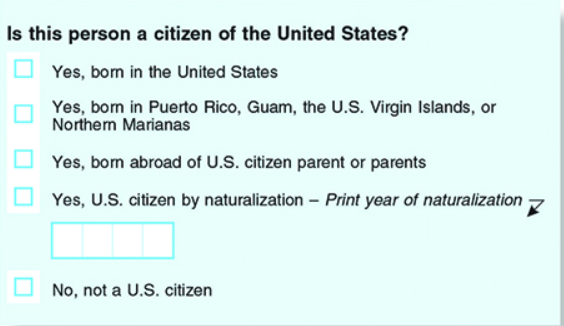
This week the Supreme Court ruled that the administration had not provided an adequate reason to include a proposed citizenship question on the 1920 census. Here’s a snapshot of that section of the census form (Note #1).

This week I’ll look at past census questions through the lens of personal family history – completed copies of census pages. In 1850, the Census first asked people their place of birth and naturalization status. For a hundred years, the census asked the question until the topic was dropped for the 1960 census (Note #2).

In 1860, just before the Civil War, some of my family ancestors were farmers in Mississippi. All forty people listed on that census page had been born in a southern state, most from Mississippi or Alabama.  The Education section of the census did not yet ask whether a person could read and write; only whether each person had attended school in the past year. Fourteen out of forty people listed on that census page had gone to school. There was only one child of school age who had not attended school. A rural farming community in the deep south with limited resources made sure that their children could read and write. That was an essential part of the American project.

In drafting the 14th and 15th Amendments after the Civil War, there was some discussion about adding an English language requirement for voting. At that time, German was the second language of America and was the most taught foreign language in schools. Considering the industriousness and good character of German men, lawmakers decided against such an exclusion. Fifty years later, in the midst of the WW1, Americans would excoriate the hated “Hun” and demean the character of many German immigrants. War changes attitudes.

Let’s skip ahead to the 1900 census taken in a Texas county east of Dallas. The question can you read and write had been added to the census. In a rural farming community, only four out of fifty people listed on that census page could not read and write. All were adults. One was over fifty. All the children aged eight and above were literate.

Let’s travel in time and space to an environment that couldn’t be more unlike rural Texas – the lower east side of Manhattan for the 1930 census. Of the fifty people listed, all adults were immigrants, most of them from eastern Europe. The earliest on that page had arrived in 1890; the latest was just a year earlier, in 1929. All except four people from Russia could read and write. The census asked the language spoken in the home before they came to America. Most people on that page answered Yiddish, except my grandparents, who spoke Slovak. My grandmother, a woman from a rural farming community, could read three languages. It was all part of growing up in the Austro-Hungarian Empire. By the time she died, she had added English to that list. I imagine that the Yiddish speakers had some familiarity with German and Hebrew. How many of us today can read several languages?

The farmers from western Europe had spilled out into the farms of America during the 19th century. In a second wave near the turn of the century, many farmers from eastern and southern Europe found work in the rural communities of the northern states. Many, like my grandparents, crowded into the dense streets of New York City when they first arrived. They worked hard because farm kids learn about hard work as they grow up.

A new generation of farm kids is arriving, but not by ship. They are coming from areas to the south that have been hit hard with drought, violence and political corruption. They come from hard work for little pay (Note #3). They have not waited in line for years to come into this country. Instead, they are showing up at the southern border just as many of our ancestors showed up at Ellis Island and other eastern ports.

Most of us in this country are the descendants of farmers who made sure their kids could read and write. That is the heart of the American spirit: character, hard work and education. Maybe the Congress needs to rewrite the laws so that they conform with the rules that we carry in our hearts and our guts from our parents and their parents and their parents…

//////////////

Notes:

  1. Some background on the 2020 census question from Pew Research
  2. Short history of census questions and index of past census questions
  3. See the six part series “Borderland” ( https://www.imdb.com/title/tt3300988/ for info). Six Americans follow the routes of migrants from Central America. An Idaho farmer experiences grueling work for little pay and understands the attraction of his farm to these migrants where they can make 5x as much or more harvesting crops.

The Green Divide

March 24, 2019

by Steve Stofka

Half of the country’s voters live on 80% of the land, which the political analysts color red. Half of voters live on the remaining 20% of land, which is colored blue. The needs, values and outlooks of those in the red are not the same as those in the blue. As the country’s population continues to migrate from rural to metropolitan areas, the country becomes ever more divided. As economist Paul Krugman wrote this week, no one knows how to fix the continuing economic decline in rural areas (Note #1).

A person’s views on an issue may depend on the state they live in. In the past several decades, immigration has had much more impact on California and the southern states. In 1980, 15% of California’s population was foreign born, almost four times the national average of 4.3%. In 2015, that share had doubled for both California and the nation as a whole. However, the national average is only a third of California’s numbers (Note #2). How does the nation adopt a single policy toward immigration when there are such differences in circumstances?

Regardless of our different experiences and outlooks, we are dependent on each other. 20% of Americans are on the Social Security and Medicare programs (Note #3). 24% are on CHIP and Medicaid (Note #4). 40% of the two million farms in America receive subsidies (Note #5). The transfers of money between Americans has reached 14% of GDP.

TransfersPctGDP

In 1962, Ronald Reagan took a stridently conservative tone when he warned that the Medicare program being developed in the Democratic Congress would lead to socialism and the destruction of American democracy (Note #6). Having married into wealth, he could afford a dramatic interpretation of social policy. Few Americans hold such extreme views today (Note #7).

The reasonable arguments of today might look oppressive to future generations, and progressive ideas seem natural to our descendants. Our ancestors had different views toward slavery, racism, voting rights and social programs than we have today. What has not changed is our distrust of those we regard as “other,” and our desire to make our principles universal for our fellow Americans. We want everyone to play by our rules, or our interpretation of the rules.

In the debates on the ratification of the US Constitution, some asked what the terms “provide for the …general welfare” meant (Note #8). Was the new government to become a national charity? The Federalists argued for the inclusion of the term to give the government a degree of latitude in changing circumstances. The anti-Federalists argued that this new government would eventually become the home of beggars and lobbyists wanting to promote their own welfare as the “general welfare.” In the past century, the phrase has become a constitutional bedrock of Supreme Court precedent underlying social programs. A person could argue that the size of social welfare spending and the extraordinary power of lobbyists in Washington has proven the anti-Federalist’s case.

America is the land of debate because the Constitution was structured to promote debate. While Americans had a platform to argue with each other, it was hoped that there would be less bloodshed, rebellion, and dictatorship (Note #9). Some days we might be less sure of that premise. As the circumstances of urban and rural America diverge further, we will struggle ever more to reach consensus. Each side will feel the need to impose its will on the other.  As we debate these issues, we should be just as careful of our own instincts as we are about the instincts of those on the other side of the debate.

////////////////////////

Notes:

1. Krugman op-ed on lack of solutions for the economic decline in rural America
2. Four decades of immigration numbers – pdf page 6
3. 62 million Americans on Social Security and Medicare – numbers here
4. 74 million Americans on CHIP and Medicaid – numbers here
5. 39% of 2.1 million farms receive agricultural subsidies
6. Reagan warns against Medicare
7. During the debate before the passage of Obamacare, some Tea Party members advocated a return to the days when we just let old people die.
8. U.S. Constitution, Section 8.1 “provide for the common Defence [sic] and general Welfare of the United States” http://constitutionus.com/
9. Former colonies of Great Britain have struggled with free speech issues. South Africans has only had freedom of expression for twenty years . Canada still does not have complete freedom of speech


The Coming Boom or Not

November 27, 2016

For most of Obama’s time in the White House, the Republican led House has fought more borrowing to repair the nation’s decaying infrastructure.  The incoming Trump administration has promised to fulfill a campaign pledge to spend $500 billion or more on these repairs. Funding this spending while reducing taxes may prove to be improbable.  A lack of available labor in parts of the country may stress the economies of some states.

In 2010, economists Robert Frank and Paul Krugman recommended additional infrastructure spending to take care of much needed repairs at low interest rates and an idle construction workforce.  In February 2010, the unemployment rate among construction workers was 27% (FRED).

Since early 2010 construction spending has increased by 42% (FRED).  As older workers in the field retire, the severe downturn in the housing industry dissuaded many young workers from entering the profession in the past decade.  Following the housing bust and the 2008 crisis, many workers native to Mexico left the U.S. to find lower paying work in their home country. Continuing high unemployment did not attact new migrant workers who would contribute to the productivity of the U.S. economy. A mood of hostility towards foreigners has furthered dampened the appeal of work in the U.S.  Only the desperate now risk the dangers of crossing the border.

While roofing companies struggle to find workers at $20 an hour, farmers are simply leaving crops to rot for lack of available workers to pick the vegetables and fruits.  Automated picking machines still can not tell ripe from unripe produce. As job openings go unfilled, employers cut back on plans for expansion.  After six years of paralysis and debate, fiscal stimulus may be achievable under a Trump regime.  Irony may have the final curtain if the extra spending is too much too late. Readers with a WSJ subscription can read more here.

//////////////////////////////

Existing Home Sales

Sales of existing homes in October notched a recovery high at 5.6 million.  Home prices are rising fastest in the western states at a 7.8% clip.  Prices are now 50% higher than the country’s median. (NAR)  Volume increases of 10% are far outpacing the national yearly increase of 5.9%. Expect continuing price increases in the western states.

Mortgage interest rates have risen 1/2% but are still low by comparison with past decades.  The increase has prompted an uptick in refinances.  Higher rates will put homes in some neighborhoods out of reach for first time buyers as well as current owners who were hoping to trade up.

In the early part of 2008, the delinquency rate on single family mortgages rose above 5%.  During the 90s and 00s, the rate averaged a little over 2%.  Despite seven years of recovery, escalating home prices and extremely low mortgage rates, the delinquency rate just fell below 5% earlier this year.  In short, there is still a lot of pain out there.

On the other hand, credit card delinquency is at an all time low.  So are consumer loan delinquency. Consumer credit continues to grow but at a slower pace since the financial crisis.

////////////////////////////

Commercial Loans

Tightening lending standards for large and mid-size companies has proven to be a reliable recession indicator.   When the percentage of cautious banks grows above 25%, recession has followed within the year.

We can also see periods of doubt in this chart.  In late 2011 to early 2012 a short rising spike indicates a growing caution following the budget standoff in the summer of 2011.  In response to an economic dip in the beginning of this year, banks again grew more cautious.

//////////////////////////////////

Stocks make new highs

Stocks continue to rise modestly on hopes of greater economic growth, future profits, lower taxes and tax policy changes.  After more than a year of declining profits, price levels are a bit rich but may be justified if…  After spiking up on election night, volatility has fallen near year to date lows.   Traders have priced in the likelihood that the Fed will raise rates in mid-December.

Dynamic Portfolio Allocation

March 27, 2016

Happy Easter!

Before I take a look at a dynamic allocation model for older readers, I’ll quote from a paper published in the last decade: “adequate savings is the primary driver of retirement success and is approximately 5 times more important than Asset Allocation.”  For readers who are not near retirement, what is called the accumulation phase of life, the one word that sums up a lot of financial advice is “Save.”

A reader sent me an article that recounts several common sense strategies for investors nearing or in retirement.  I was especially interested in a strategy for recent retirees: to have a cautious 30/70 stock/bond allocation in the first years of retirement and transition to a more agressive 60/40 portfolio over 10 – 15 years. Is this madness?  Conventional advice advocates more caution in the later years of life.

The initial conservative approach is designed to minimize the negative effects that a bear market would have on a portfolio in the first years of retirement.  At seven years old, the current bull market is long in the tooth, so to speak. One of the authors of the article is Wade Pfau, whose Retirement Researcher site I include in my blog links in the right column of this blog.  I have a lot of respect for Mr. Pfau’s work and his sensibilities so I was inclined to trust this recommendation.

In order to forecast, one has to backtest, and the authors have more sophisticated portfolio allocation testers than many of us have.  I have recommended before a free allocation tester at Portfolio Visualizer.  Their web site also has a free Monte Carlo simulation tool (MC).  What the heck is that, you ask?

For Dr. Who fans, an MC is like a time trip in the doctor’s Tartus.  First we set the thing jab on the whozee panel, spin the furbee wheel clockwise to go forward in time, then stand one pace to the left – do not stand on the right! – of the big lever as we pull the lever knob.

For those of you without a Tartus, an MC uses historical returns and creates a number of what-if possibilities based on variable parameters like the period of time to run the simulation, the inflation rate, the withdrawal amount or rate, the asset mix, etc.  If I start out with $1M in savings at age 65, for example, and I take out $40,000 each year adjusted for inflation, what are the chances I will have any money left after thirty years, at age 95?  Will the Daleks catch up with my savings and exterminate it?  No, not the Daleks!

The remaining balance, the money a person would have left, is ordered by percentile: 25%, 50%, the median, and 75% are common. Example:  A remaining balance of $500K for a certain allocation at the 75% percentile means that 75% of retirees will have less than that amount.

A success rate is computed; a 75% success rate means that you don’t run out of money in 75% of the simulations.  What about the other 25% of the time?  Care to roll the dice on that one? A 90% success rate is considered a desireable minimum in the industry.  I tend to focus on both the success rate and the median balance.

If using historical asset prices as a basis for computing future possibilities, an important assumption is the time period.  If the past forty years have included some really good returns for a few decades, then the MC results will be optimistic.  What if the next twenty years are not so good?  Move in with your kids?

Using the historical data of the past 20 years or 40 years as a basis for future returns is a bit optimistic, I think.  During this past twenty years, bond prices have been inflated by extraordinarily low interest rates set by the Federal Reserve.  The price of a composite of intermediate corporate bonds, Vanguard’s VFICX mutual fund, has almost quadrupled since 1995.  A 60/40 stock/bond mix has returned 9.5% over the past 20 years.  We are unlikely to see such returns in the future.  My gut instinct is to err on the side of caution and assume a 7.5% return on a 60/40 mix, and a 6% return on a 30/70 mix.

Here’s the assumptions:  $1M initial portfolio; 30 year future period; withdraw an initial $45K adjusted annually using a 3% inflation rate.

.nobrtable br { display: none } td {text-align: center;}

Stock/Bond % Success Rate Median Bal
30/70 57 $278K
60/40 73 $1.6M
30/70 –> 60/40 92 $1.7M

Using a 30/70 mix for the first 5 years and a 60/40 mix for the following 25 years gives a median balance of $1.7M after 30 years, about the same as the 60/40 mix above BUT the success rate shoots up to 92%.   The authors suggest a gradual transition but this simple simulation shows the advantage of a dynamic allocation strategy.

In short, this does look like a good strategy.

Readers who want to use the more optimistic historical returns of the past 20 years would see these simulation results:

Stock/Bond % Success Rate Median Bal
30/70 92 $2.7M 10 times higher!
60/40 88 $4.3M
30/70 –> 60/40 92 $4.3M

Using historical returns for the past 20 years sure pumps up the median balance on the conservative allocation.

///////////////////

Existing Homes

Existing Home sales fell 7% in February.  Mortgage rates are at all time lows.  What’s going on?
Below is a chart of the ratio of Existing Home Sales to New Single Family Homes.  As you can see, the ratio has remained fairly steady over the past several years.  The spike in the ratio in early to mid 2013 coincided with historically low mortgage rates (Money) .   In the last quarter of 2015, this ratio started sinking despite the stimulus of low interest rates.  Are home buyers at all levels being priced out of the market?

////////////////////////

The Immigration Carousel

The 1900 census counted a total population of 78 million, of which 13% were foreign born. Responding to a growing hostility toward immigrants, Congress passed strict quota laws for immigrants in 1921 and 1924. Regarded as lazy, shiftless, boorish, stupid, or criminal, southern Europeans were among the undesireable groups.  During the 1920s, the foreign born population began to decline and, beginning with the 1950 census, stayed below 8% for 40 years.

The 2000 census counted 11% of the population as foreign born. The 2010 census counted 13% foreign born, so that our population mix now matches that of the early 20th century.

It is hardly surprising then to see a growing antipathy towards immigrants in the past decade.  Donald Trump’s candidacy is partly fed by the same anti-immigrant sentiment prevalent in the America of one hundred years ago.  We like to think we have put some crude and cruel instincts behind us, but we are again confronted with our “herdness.”  We will tolerate “others” as long as their percentage of the herd remains relatively small. In America, that tolerance limit seems to be 10% foreign born. How does America compare to other countries?

Immigration

In a 5/14/09 WSJ article, Conor Dougherty reports on several Census Bureau studies.
“Four states, including California, Texas, New Mexico and Hawaii, already are majority minority,” meaning that there are more non-whites than whites in those states. Florida and New York are approaching the halfway point. Arizona and Nevada are not too far behind. In 2000, 40% of Californians and 37% of New Mexicans reported speaking a language other than English in their home.

The 1900 census counted a total population of 78 million, more than 10 million of them foreign born, or approx 13%. Responding to a growing hostility toward immigrants, Congress passed strict quota laws for immigrants in 1921 and 1924. During the 1920s, the foreign born population began to decline and, beginning with the 1950 census, stayed below 8% for 40 years.

However, the 2000 census counted 11% of the population as foreign born. The 2010 census will probably show an increase in foreign born, so that the composition of native born to foreign born becomes similar to that of the early 20th century.

It is hardly surprising then to see a growing antipathy towards immigrants in the past decade. Characterized by some as bigotry, this resentment towards immigrants may be little more than the natural reaction of human beings as herd animals. We will tolerate “others” as long as their percentage of the herd remains relatively small. In America, that tolerance limit seems to be 10% foreign born. What would a study of the immigration tolerance limits in other countries reveal?

For many of us born in this country, our foreign born ancestors were once regarded as lazy, shiftless, boorish, stupid, unpatriotic or criminal. In the 1800s, American Protestants, fearful of a takeover of the United States by the Vatican, tried to pass laws banning Catholics from entering the country.

As Kermit, the frog, once said, “It’s not easy being green.”