No Man’s Land

March 24, 2024

by Stephen Stofka

This week’s letter continues a look at taxes. This week the House passed a series of six spending bills that will avert a partial government shutdown. A majority of Republicans voted against the measure and Marjorie Taylor Greene, the bombastic representative from Georgia, filed a motion to remove Mike Johnson, the current House Speaker. It is unlikely to come to a vote because Republicans have only a one-member majority in the house after Mike Gallagher (R-WI) announced his early departure from Congress. A vote for a new speaker risks the chance that Democrat Hakeem Jeffries (D-NY), the current Minority Leader, might win the vote and become Speaker.

Most Republicans in the House and Senate have taken a “no-new-taxes” pledge called the Taxpayer Protection Pledge. The Americans for Tax Reform (ATR) database lists 191 members of the House and 42 members of the Senate who have taken the pledge. They have committed to not raising income tax rates. Additional tax revenues that arise from eliminating a tax deduction or loophole must be dedicated to lower taxes, according to the ATR’s FAQ page. Republican representatives implicitly committed themselves to increasing deficits but that is an unpopular political stance. They pledged to reduce spending but not military spending, the largest discretionary category in the budget. They pledged to reform entitlement programs like Social Security,  Medicare and Medicaid, but rural Republican voters repeatedly rejected such reforms because they depend on those programs. Each time Republican members of Congress stepped away from the issue to save their political hide.

Many conservative members of Congress protest the social spending programs that crowd out other priorities. In 2010 defense spending was over 5% of GDP, more than twice the percentage of the state and federal spending on Medicaid. Defense spending has been reduced to 3.6% of GDP and Medicaid spending has grown to 3.2% of GDP. I will leave the series and chart links in the notes. As a share of GDP, Medicare has grown from 0.5% in 1967, two years after the program was enacted, to a current level of 3.6%.

The trustees are projecting a per capita growth rate of 5.4% and the program is now almost half funded by general tax revenues. Dedicated payroll taxes and cost sharing by Medicare recipients were supposed to fund the program entirely. Democrats want to raise taxes to shore up underfunded entitlement programs they instituted last century when they had filibuster proof majorities. Republicans view these higher taxes as a moral hazard, a reward for Democrats’ excessively optimistic promises and poor planning.

Voters in rural counties form a strong Republican base but depend on state spending and taxes from urban taxpayers to support the infrastructure central to their local economies. The growing of grains and vegetables, and the raising of animals requires natural resources that include land, water and food. Highways and utility lines in sparsely populated counties connect farmers and ranchers to their markets. Despite gains in efficiency, the farming and ranching industries are less efficient than industrial production. Crops and animals do not pay taxes. People do.

Elected officials must play a game with their constituents. Politicians in state legislatures could enact a head tax on dairy cows and beef cattle to cover the cost of those direct and indirect costs. Federal officials could enact a pollution tax on cattle and chickens whose concentrated effluent contaminates interstate waters. However, such taxes would raise the prices of milk and beef in grocery stores. Officials are hesitant to enact specific taxes like that because such taxes arouse voter anger and risk a politician’s career. Lawmakers prefer to fund such costs with general tax revenues. The costs appear as line items on a state or federal budget that is hundreds or thousands of pages long and disappear in the thicket of words.

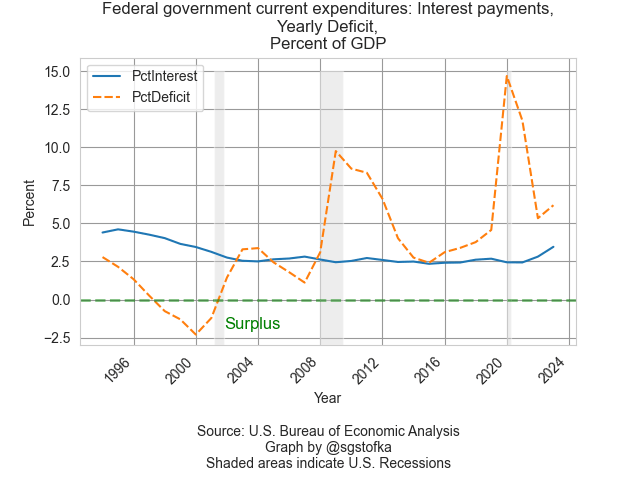
The private economy is not capable of supporting the current social and defense spending at this level of taxation. Neither political party wants to compromise on their priorities and the interest expense on the debt will grow, exacerbating the tensions between both political parties. That interest is now 3.5% of GDP, about the same as defense and Medicare spending. That interest is entirely funded by a deficit. We are borrowing to pay the interest on the debt we have accumulated.
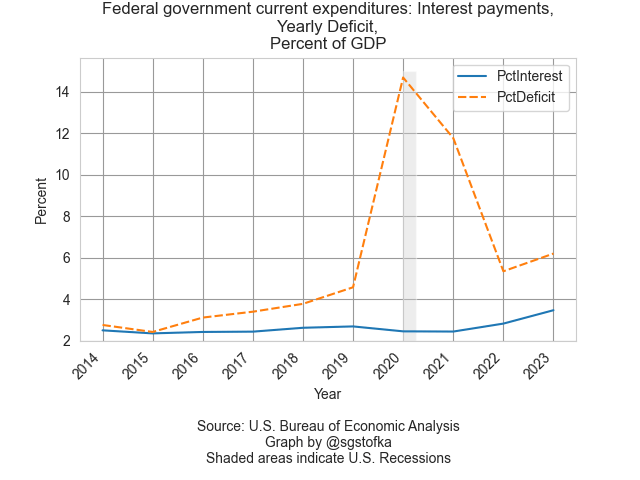
The blue line will continue to rise, pushing the orange line upward as well. The political parties will stay entrenched in their ideological bunkers, creating a daily drama covered by mainstream and social media whose coverage incentivizes posturing rather than compromise. Just as Britain did in the inter-war period a century ago, we are steadily losing resilience, ready to falter at the next crisis.

////////////

Photo by British Library on Unsplash

Notes on social programs: Defense spending is series FDEFX at the FRED database. Medicaid is series W729RC1. Medicare is W824RC1. Each series link is a percentage of GDP.

The Conflict in Policy

March 10, 2024

by Stephen Stofka

This week’s letter continues my analysis of the many roles of the federal government, comparing spending, tax revenues and the federal debt that has accumulated since 9-11. Governments accumulate debt by spending more than they collect in tax revenues. Farmers, businesses and households appreciate the subsidies and support from government but resist paying the taxes to fund those programs. The private marketplace depends on government funding of nascent technologies that may take decades to commercialize. Examples include the internet, the development of semiconductors, lithium batteries and the funding of pharmaceutical research. Investment in military readiness has spurred advancements in aerospace and satellite technology, the GPS that connects our phones and the Kevlar clothing that protects our soldiers and police officers. Critics may ridicule a government investment in solar manufacturer Solyndra, but it was also heavy government funding that provided the cash flow for SpaceX and Tesla.

In last week’s letter I showed that private investment and government spending and investment both averaged about 18% of GDP over the past three decades. A closer look at those two series shows how they complement and compete with each other. In the graph below, private investment dipped from 19% of GDP in 2006 to below 14% in 2009. As a percent of GDP, government spending and investment took up some of the slack.

As many people lost their jobs, they became eligible for Medicaid or food stamps. Both of these programs are included in government spending because the programs directly or indirectly provide people with goods or services. The graph above does not include increased unemployment insurance payments during the recession. These are included in government transfers since this is money, not services, transferred from the government to individuals. Policymakers refer to this combination of support programs as automatic stabilizers, providing assistance to households during hard economic times.

A recent analysis by the Congressional Budget Office (CBO) found that these automatic stabilizers were not “key drivers of debt over the long-term.” The federal debt was growing because government spending was increasing at a faster pace than revenues. The chart below shows spending and revenues for the past thirty years in a natural log form to portray the trends of change more clearly.

For most of the past three decades, revenue growth, the orange dashed line in the graph above, lagged government spending, the blue line. Note that this revenue series (FRED Series FYFR) does not include Social Security taxes. The growth in government spending showed some moderation only during Obama’s term and that was the worst time to slow the growth of government spending and investment. The Great Recession of 2007-2009 was the worst economic downturn since the 1930s Depression, surpassing the pain of the back-to-back recessions of the early 1980s.

Biden was vice-President during that recovery and was determined not to repeat that mistake in the aftermath of the Covid-19 pandemic. Although the Democratic majorities in the House and Senate were slim, unified government helped the effort to pass the Inflation Reduction Act and the CHIPS Act. Both pieces of legislation committed government funds to support investment in clean energy development and semiconductor manufacturing. Such commitment spurred private investment in the energy industry. In 2023 field production of crude oil surpassed 2019 levels, according to the Energy Information Administration (EIA). They report that natural gas output was up 2% in the first year of Biden’s term, then accelerated to 5% growth in 2022 and 2023 following Russia’s attack on Ukraine.

Despite big increases in the deficit after 9-11, and an accumulated debt of $22 trillion held by the public, the interest share of GDP has remained below the levels of the 1990s. In 2001, China was admitted into the World Trade Organization. As imports from China increased, we paid for them with U.S. Treasury debt, helping to keep interest rates low for most of the past two decades.

Unlike individuals and corporations, governments can buy their own debt. Unless a majority of that debt is sold in the private marketplace, there is no independent evaluation of the creditworthiness of that debt. At the end of last year, 65% of the total Federal debt was privately held, the highest percentage since 1997 (see notes). Including the Treasuries held by independent Federal Reserve banks, the percentage is close to 80%. A recent report from the Center for Strategic and International Studies (CSIS) calculates the percentage of debt held by two of our largest trading partners, China and Japan, at 5.8%. The wide ownership of U.S. debt validates it as a low-risk financial instrument.

The global financial system depends on tradeable sound securities. When the financial crisis undermined confidence in mortgage securities, private investment declined sharply, and it would do so again if investors doubted the soundness of Treasury securities. The recent CBO report points out a weakness in public policy that the Congress must resolve or risk damaging the credit of U.S. securities. 1997 was the last year when Congress submitted a budget by the deadline, according to the Congressional Research Service. When is the moment when the private debt market loses hope that Congress can match its spending and revenues? No one can forecast a stampede to safety but in hindsight many will claim to have seen the exit signs.

///////////

Photo by Manki Kim on Unsplash

Keywords: investment, debt, interest, Treasuries, government spending, taxes, automatic stabilizers

According the March 2024 Treasury bulletin, total Federal debt was $34 trillion. $21.7 trillion was privately held – about 65%. See Table OFS-2 of the March bulletin. Privately held debt plus $5.2 trillion of Treasuries held by independent Federal Reserve banks constitute Federal Debt Held by the Public (FRED Series FYGFDPUN) and is close to 80% of total federal debt. For a thirty-year series of the public’s portion of total debt, see https://fred.stlouisfed.org/graph/?g=1hYFV. Until the 2008 financial crisis Federal Reserve banks held less than 10% of total debt. During the pandemic, that share rose to 21%. At the end of 2023, the share was 15.4%.

The Interest Payment Load

November 26, 2023

by Stephen Stofka

This week’s letter is about the federal interest paid on the country’s debt. Why does the U.S. pay more on its debt than other advanced economies? In the second quarter of this year, federal government paid 20% of its revenue in interest, almost three times the average 7.34% percentage of similar countries. High interest payments crowd out spending in other areas. They spark even more debates about the debt itself which is now 120% of GDP. This added interest expense exacerbates animosities in a country that is already fractured by divided perspectives and priorities.

In the second quarter of 2022, before the Fed began to raise rates, the federal government paid 13.6% of its revenues in interest (I/R) to service the debt. That was 6% less than the percentage in 2023 and represented $280 billion, more than twice the $128 billion spent in 2022 for the SNAP (food stamp) program. The higher interest payments, however, were about the same as the 50-year average I/R of 19% (median = 17.8%). In 2021, the 27 countries of the Euro area reported to the World Bank that they paid 3.11% of their revenues in interest (see note below).

Over the past fifty years, the federal government has collected about 20% of GDP in taxes. In the chart below, I have added both averages to the chart of federal interest payments as a percentage of revenue. The average revenue is almost identical to the median so this average is representative of a variety of economic conditions and policy responses over the long term.

As an approximation, the interest expense is 20% of revenue and revenue is 20% of GDP so interest expense has averaged 4% of GDP. However, neither the public nor policymakers are accustomed to average. For two decades, the Fed has kept interest rates low to accommodate economic recovery after the dot-com bust, 9-11, the financial crisis, the slow recovery from that crisis and the Covid-19 pandemic.

The pandemic simulated several critical conditions of a large scale war and the inflation that followed was typical of those inflationary periods following wars. I will cover that in next week’s letter. To curb an accelerating inflation, the Fed began to systematically raise rates from zero in the spring of 2022. In six months it raised rates by 2%, a rapid change that was six times faster than the period from late 2015 to early 2019 when the Fed gradually raised rates by the same 2%. By early 2023, the Fed raised rates an additional 2% within six months.

As a consequence of the higher rates, the government has paid higher interest rates on its debt. (The reasons for that are complex). We have become so accustomed to “easy money” and lower interest rates that the sudden increase in interest payments has caught the attention of both the public and policymakers. Will this further fracture political sentiment ahead of the 2024 elections?

At the beginning of this letter I mentioned divided perspectives and priorities. What are they?  Some give priority to the social programs that promote individual citizen welfare as essential to a general welfare. Their opposition may deride them as socialists but they are more properly called institutionalists because they champion a lot of control and planning by a central government to achieve that welfare. Those who oppose institutionalist policies also care about individual welfare but think that well-intentioned bureaucrats in government can cause more damage to the general welfare than they repair. These might properly be called marketists who believe that the price system distributes resources in an efficient and sustainable manner.  They respond that a centrally planned economy creates moral hazard, rewarding individual needs instead of personal hard work, planning and integrity.

Institutionalists label marketists as capitalists or plutocrats and accuse them of being mean-spirited and driven only by profit and self-interest. Vulnerable communities do not have the resources to help themselves, the institutionalists argue. Marginalized communities need to draw from a central funding pool. They must overcome decades of legal policies that disenfranchised them to benefit other groups. Marketists respond that profits reward people for taking risks. The willingness to accept risk is a key component of technological innovation that benefits all of society.

Interest payments have nudged aside defense spending to become the third largest percentage of federal receipts. The top category is health insurance like Medicare, Medicaid, CHIP and payments under the ACA which take up 30% of federal receipts (see note below). Social Security comes in second. Cuts to either of these programs have been a “hot rail” for conservative politicians. Everyone in Congress talks about cuts to defense spending but not in their district because it supports the local economy. The issue of rising interest payments and the federal debt is a safe one for politicians of both parties to run on in the upcoming election. According to Open Secrets, $14.4 billion was spent on the 2020 election, double the spending of the 2016 election. As candidates complain about excess spending, voters might consider why the major parties will spend about $100 for each of the votes in this coming election (notes below). I would call that excess spending.

//////////////

Photo by Joshua Woroniecki on Unsplash

Keywords: health care, ACA, Social Security, Medicare, defense spending, interest payments

Health Care Note: The health care programs are 24% of the federal budget including deficits, according to an analysis by the Center on Budget and Policy Priorities.

Election Spending: $14,400 million / 160 million voters ≈ $86 per voter in the 2020 election.

World Bank data: https://data.worldbank.org/indicator/GC.XPN.INTP.RV.ZS?end=2021&start=1972&view=chart. You can download an Excel file at https://api.worldbank.org/v2/en/indicator/GC.XPN.INTP.RV.ZS?downloadformat=excel to view interest payments for countries and regions dating back several decades.