It’s Complicated

May 4, 2025

By Stephen Stofka

This is part of a series on persistent problems. The conversations are voiced by Abel, a Wilsonian with a faith that government can ameliorate social and economic injustices to improve society’s welfare, and Cain, who believes that individual autonomy, the free market and the price system promote the greatest good.

Cain said, “A little thing I appreciate about this place is they serve melted butter, not frozen butter packets.”

Abel nodded. “A little extra time and care.”

Cain asked, “You need to wash up before you eat?”

Abel turned his right hand over. “Oh, that’s just dirt under my fingernails. Getting the flower beds ready and weeding. What about you? Anything interesting this week?”

Cain spread a small amount of butter on his waffle. “We were talking about common problems like homelessness, and I thought we could talk about education this week. K-12, primarily.”

Abel put his coffee cup down. “Oops. That reminds me. Last week I mentioned that the Feds had helped fund the capital portion of Denver’s homeless program. This past week the city council learned that FEMA has canceled a $32 million grant because Denver is a sanctuary city (Source). The agency had already received $8 million of that grant.”

Cain frowned. “Can the Feds take the money back?”

Abel shook his head. “I don’t know. I don’t think the City Council knows. There’s no rules. The Trump administration is just doing stuff. Anyway, education is even more complicated than homelessness. What got you interested in education this week?”

Cain sighed. “An argument with my daughter.”

Abel frowned. “She teaches sixth grade, right?”

Cain replied, “Fifth. She says that kids are still kids at that age. Then they turn into discipline problems.”

Abel smiled. “The stages of child development. The terrible twos, the argumentative fours and then middle school.”

Cain laughed. “Then teenager. I used to think, ‘Was I like this when I was growing up?’ It gave me a new appreciation for my parents.”

Abel said, “So, go on. What was the argument about?”

Cain pursed his lips. “Oh, we got into one of those equity, equality discussions. I should know better. I said that a kid who can barely read is not going to do as well in life. Society should accept that and devote more of their resources to the more gifted kids. They are the ones who will do the most for society.”

Abel nodded. “A Pareto improvement in the long run. It would benefit the more gifted without materially harming outcomes for those with learning disabilities (Source).”

Cain replied, “I actually called it that. She said that such a shift in resources would harm struggling students. I said that the current condition already harms the more gifted and her perspective was too myopic. I might have characterized her position as Marxist.”

Abel gave a skeptical look as he lifted his coffee cup. “Rawlsian, maybe. The Difference Principle. The whole idea that we should reduce inequality so that the least of us benefit the most (Source). But, Marxist?”

Cain sighed. “Not my best moment. Anyway, she accused me of being uncharitable and I took offense. After helping her out so many times, she calls me uncharitable?”

Abel frowned. “Sorry that happened. I hate when arguments turn from an exploration of different claims to throwing word darts at each other.”

Cain raised his eyebrows. “Then she said I didn’t know what I was talking about. All opinion and little evidence.”

Abel winced. “Ouch. This is a topic you two should not discuss.”

Cain smiled. “Usually we don’t and this is why. Anyway, she started describing some education metrics that, I’ll admit, I was unfamiliar with. We didn’t have all this stuff when she was a kid in school. She mentioned all the pressure that teachers are under, and I didn’t appreciate her contribution or her sacrifice.”

Abel interrupted, “She took it personal. You were a stand-in for society as a whole.”

Cain bit his lip. “Looking back, yeah, I guess you’re right. I reassured her that I respected her choice of career and apologized for hurting her feelings.”

Abel clapped softly. “Smart dad.”

Cain smirked. “I’m either getting soft or wiser in my old age. Anyway, I went to look up some data.”

Abel leaned forward. “So her evidence comment had some effect on you. What are some of these new metrics?”

Cain said, “My daughter mentioned an iReady score so I watched a video on iReady tests (Source). Their scores indicate whether a child is performing at or below grade level. I think that would be easier for parents to understand than a percentile rank. When they summarize an entire school district, educators, politicians and parents can get a simple but clear picture of academic progress across several grades (Example). In the spring of 2024, only a quarter of students in the Rochester School District were performing at or above grade level. A third were three or more grades behind (Source).”

Abel frowned. “Oomph. I’ll bet that stirs up a lot of political disagreements and accusations.”

Cain nodded. “You bet. They are spending like $30,000 per student (Source), but that’s below the state average of $36,000 (Source). New York has some of the highest spending in the nation.”

Abel shrugged. “Childcare alone can run $20,000. We expect a lot more from schools. What’s the poverty level in Rochester? Do you know?”

Cain stared at his coffee cup as though it held the answer. “It was about 25% (Source). Yeah, a huge problem. That city is a cautionary tale in the benefits of economic diversification.”

Abel asked, “What got you interested in Rochester?”

Cain smiled. “I was looking up information on test scores and somehow wound up reading some article about Rochester. I’ve been through there a few times. It’s just north of the Finger Lakes in New York State. Beautiful in the spring. Brutal in the winter because it’s on Lake Ontario.”

Abel said, “I thought it was a booming city in the 1950s. Wasn’t Eastman Kodak headquartered there?”

Cain raised his eyebrows. “Yeah, that whole corridor along I-90 was booming in the post-war period. Kodak was a big employer. So was Xerox, the copier company. Bausch and Lomb, the eyeglass manufacturer. Less than two hours away to the east was Syracuse, another prosperous town at that time. General Electric had a plant there. So did Carrier, the air conditioner company. To the west was Buffalo. Bethlehem Steel was near there and some other manufacturers as well.”

Abel replied, “So this was the industrial Promised Land that Trump talks about. Like Moses, he will lead the MAGA tribe to that Golden Age.”

Cain smiled. “Yeah. There were similar industrial corridors like that in other states. Relatively high unionization rates. During that time, more than a third of workers in New York State were unionized. Workers earned middle-class incomes.”

Abel interrupted, “Mostly white?”

Cain’s eyes widened. “Yeah, almost 100% until the late 1950s (Source). As the workforce expanded, blacks moved to the area to take lower skilled jobs (Source).”

Abel interrupted again, “Companies were importing workers to cut costs. Eventually, those companies would export those jobs to other countries. So, what’s the unionization rate now?”

Cain put his coffee cup down. “New York still has a relatively high unionization rate, but it’s now just under 25%. In Rochester, it’s half that rate (Source).”

Abel asked, “A lot of homeless, I imagine.”

Cain nodded. “After the pandemic moratoriums on evictions ended, the number of unsheltered homeless almost doubled in Rochester (Source). I was surprised to find that Oregon and New York State have the highest rates of homelessness in the country, but New York finds shelter for most of their homeless. Oregon doesn’t (Source).”

Abel frowned. “That surprises me. I think of Oregon as a rather progressive state. They have voted for the Democratic candidate in past presidential elections.”

Cain raised his eyebrows. “California and Oregon have higher rates of unsheltered homeless than some warm southern states like Florida, Alabama and Georgia (Source).”

 Abel looked puzzled. “We started talking about problems in education, which took us to issues with poverty and now we are at the homeless problem that we discussed the past few weeks. In 2002, Stephen Wolfram published a book called ‘A New Kind of Science.’ In it he showed how a simple rule could produce complex visual patterns or a bland uniformity of color.”

Cain interrupted, “And this is leading to…?”

Abel gave a short laugh. “I’m thinking out loud. So, we recognize a problem in education, for instance. It’s related to poverty. That’s related to an industrial downturn over several decades. That’s related to too much reliance on related industries, you said. Maybe that’s related to Rochester’s role in industrial production during World War 2.  I think we long to discover that one simple rule that produced such a complex set of problems. Someone like Trump comes along and claims to know the rule and how to fix it. ‘Vote for me,’ they say. People do.”

Cain smiled. “You know I like simple rules.”

Abel grinned. “I know you do. Republican voters in general like simple answers. Tax cuts, for instance. Republican politicians promise, ‘Tax cuts will increase investment and boost jobs, and the benefits will trickle down to the larger population.’ In theory, it sounds plausible. We’ve had tax cuts in 2001, 2003, 2009, 2010, 2012 and 2017. There’s no evidence that they increased investment and boosted job growth.”

Cain argued, “Democrats are guilty of the same simplistic thinking. They say, ‘give government more money by taxing the rich. Government experts will fix it.’ Do those experts fix it? No. Experts are good at research and crafting a lot of rules. Not so good at implementing solutions.”

Abel nodded. “Proves my point. We like to believe in simple rules. Although, when given a simple rule, we don’t like to follow it. Jesus had just two rules. ‘Love thy neighbor as thyself’ was the second.”

Cain smirked. “That’s a simple rule to state, and a deceptively hard rule to follow. We could spend hours on the contradictions that such a rule generates.”

Abel snapped his fingers. “Eureka! Let’s call it ‘Cain’s Theorem.’ Simple rules can generate complex contradictions.”

Cain laughed. “When simple rules involve public policy. Maybe that’s what Wolfram’s complex visual patterns described. An intricate set of contradictions.”

Abel replied, “That’s good. Getting back to education, I think one of the problems is that the task of public education has gradually expanded. Their stated role is to educate our kids, but they are also babysitters. They provide at least some structured time and a place for kids to develop companionship.”

Cain interrupted, “For some kids, school is a food pantry and a security blanket. Special needs kids might need medical assistance.”

Abel nodded. “Good point. Then we fault the schools when the kids get low test scores. We give the schools all these tasks but measure only the test scores.”

Cain smirked. “What, like a babysitter score?”

Abel replied, “Well they could measure the diameter of each kid’s arm to test for malnutrition (Source). What about gains in productivity? While the school is babysitting children, the parents are more productive. That benefits society but who counts that?”

Cain frowned. “Hard to measure, but ok, I’ll give you that. So, your point is that school scores should reflect all the roles that society imposes on them? What, a composite score?”

Abel nodded. “Yeah, call it an iSchool score like that iReady score for students that you talked about.”

Cain shook his head. “Schools in middle-class and higher income neighborhoods would score well on those other measures with little effort. Schools in low-income districts would struggle.”

Abel argued, “But at least their efforts would be recognized.”

Cain shrugged. “What benefit is a good nutrition score if that doesn’t lead to higher test scores? The schools may have multiple responsibilities, but their main purpose is education.”

Abel frowned. “I don’t like the way the system treats kids like machines. Inputs and outputs.”

Cain replied, “Incentives are the key.”

Abel sighed. “Your answer to everything.”

Cain laughed. “Gimme a break. Look, test scores are important to some kids. Others, not so much. Social media apps like TikTok have been very successful at getting kids to spend a lot of time on their phones.”

Abel scoffed. “That’s not learning like school.”

Cain argued, “It’s engagement. Learning is an outcome of engagement. Look at those computer games where kids work their butts off to acquire some magical power token in the game.”

Abel agreed, “Kids are magical thinkers. What are you suggesting? There are no magical tokens in real life.”

Cain shook his head. “Sure, there are. Kids don’t recognize them. Language and math skills. Develop their memory, visualization and analytical skills. Hand-eye coordination. Manual skills. We give these kids numerical scores for their accomplishments, maybe a trophy or two. That’s not enough incentive for many students. They cry out for recognition and status.”

Abel said, “I worked with a guy who grew up in Detroit. A lot of kids planned on working the assembly line in an auto plant. School accomplishments weren’t all that important.”

Cain nodded. “Same thing in a mining town or any town where a single industry dominates the local economy. Like in West Virginia, dad works in a mine. The sons follow in his footsteps. Not much else to do in an economy like that. No policy solution can fit every circumstance.”

Abel replied, “Minority kids can get discouraged if they think that being a minority is a handicap in the job market. Resentment will interfere with any motivation they have to develop job skills. How many black students in Rochester public schools? Do you know?”

Cain replied, “Almost half. Less than 10% of students are white (Source).”

Abel whistled softly. “White flight. Another complication. Remember all the controversy in the 1970s over busing students to integrate schools after the Supreme Court decision? (Source)”

Cain nodded. “Yeah, and that reduces property values and property tax collections. That makes Rochester dependent on the state for a lot of it’s school funding (Source).”

Abel replied, “Reinforces my point. A simple solution like ‘incentives’ won’t work. Elements of the problem are interwoven throughout the society and the economy. As far as incentives go, what matters to kids changes as they grow up. That’s a relatively short time. We try to teach them what’s important when they become adults.”

Cain sighed. “In twenty years, what’s important in the job market can change. Kids need to be adaptable.”

Abel interrupted, “That supports my argument that school is about more than job skills. Developing values, a sense of history and past conflicts and learning about the society that kids were born into. I’ll grant you, these are not all marketable skills, but they help children become more complete human beings.”

Cain asked, “Is that the role of schools? Too many kids graduate high school and are little more than functional readers. How is a kid going to fully develop if they can barely read?”

Abel argued, “The answer is not to force all the marginal students on public schools, and allow charter schools to discourage children with learning disabilities. Anyway, how do these new metrics help students?”

Cain replied, “They indicate where the student is weak, particularly in math and reading skills. That helps the parents and student focus on those key areas. Teachers can form groups within a classroom, matching students who have similar areas that they need to focus on.”

Abel nodded. “A lot more work for the teachers. That’s what your daughter was talking about.”

Cain sighed. “Yeah. More work for the same pay.”

Abel asked, “How does a card carrying libertarian have a daughter teaching public school?”

Cain smirked. “Classical liberal, not libertarian. Don’t ask me. She has wanted to be a teacher since she was eight, I think. She would make tests for her mother and me.”

Abel gave a silent whistle. “She made you take tests?”

Cain laughed. “Yep. We had to keep our eyes on our own test paper. Very serious. I’ve come to believe that teaching is a passion. It’s like people who have to play music. It’s who they are.”

Abel nodded. “For a lot of musicians and teachers, it’s certainly not about the money. Have you suggested she teach at a charter school?”

Cain replied, “I did. She said she couldn’t afford to. A few years ago, teachers at charter schools in Denver were making about 60% of what public school teachers make (Source). I was shocked to learn that the average salary of about $44,000 is a little bit more than what a retail clerk earns (Source).”

Abel frowned. “That’s for nine or ten months of work, though.”

Cain’s jaw tightened. “My daughter informed me in a firm tone of voice that a lot of teachers squeeze a full year’s time working during that period.”

Abel raised his eyebrows. “School boards respond to shifts in cultural values, then impose those burdens on teachers. Why would a teacher work for that kind of money? It doesn’t exactly fit your favorite theory about how prices allocate resources.”

Cain replied, “Like I said, it’s a passion. But I still think that prices allocate resources. Just because there are black holes in space, we don’t say that the theory of gravity is wrong. There are limits to any theory.”

Abel set his fork down. “Is there a big move to charter schools in Rochester? An effort to cut costs?”

Cain replied, “More than a third of students in Rochester are in charter schools already (Source). For New York State as a whole, less than 10% of students are in charter school (Source). In Colorado, it’s 15% (Source).”

Abel frowned. “I thought the charter school movement was primarily about autonomy. It’s as much about costs.”

Cain looked up at the clock above Abel’s head. “I’m a firm believer in adaptability, a variety of solutions. That’s what the private marketplace is all about. Government institutions ignore varying circumstances when they impose a rigid standard on all communities.”

Abel interrupted, “There have to be some basic rules, civil rights and liberties that apply to all individuals. That spirit is at the heart of the Constitution.”

Cain nodded and stood, laying his napkin on the table. “You’re right, but I think the Feds should leave it to the states to craft solutions that protect those liberties. I grant you it’s not easy.”

Abel looked up. “I’ll talk to you next week.”

Cain turned to go. “Yeah. The time got away from me. I’ll see you next week.”

/////////////////////////

Image by ChatGPT in response to the prompt “draw an image of a cat’s cradle.”

Delmont, M., & Theoharis, J. (2017). Introduction: Rethinking the Boston “Busing Crisis”. Journal of Urban History, 43(2), 191-203. https://doi.org/10.1177/0096144216688276
A Debate on School Vouchers

December 22, 2024

by Stephen Stofka

This is sixth in a series of debates on various issues. The debates are voiced by Abel, a Wilsonian with a faith that government can ameliorate social and economic injustices to improve society’s  welfare, and Cain, who believes that individual autonomy, the free market and the price system promote the greatest good.

Wishing everyone a happy holiday this coming week.

Abel said, “Last week, we spoke about higher education but let’s look at the K-12 system. Your group advocates for school choice and a voucher program. For each school age child, the government gives families a voucher that can be applied to their school of choice.”

Cain replied, “There are a number of voucher programs in various states and studies have found an overall positive effect on student learning.”

Abel argued, “Our group is concerned that the costs outweigh the relatively small benefits. The key feature of those programs is parental freedom, your group says, but those taxpayer dollars are taken from established public schools to fund private schools. If voucher programs are more widely adopted, existing schools will have less money for capital improvements and repairs, forcing some to close. Lower enrollment causes public school districts to consolidate their students and close some. School choice transfers resources from one publicly funded school system to another.”

Cain insisted, “Parents are taxpayers. Many are homeowners whose property taxes are the main source of funding for public schools. Parents should have some control over where their property taxes are being spent. A voucher system allows parents to direct funds to those schools which serve their children best and away from low-performing schools or schools that do not provide a safe environment.”

Abel said, “Our concern is that parents will direct funds to those schools with students from similar backgrounds, effectively segregating the schools. As I mentioned last week, parents might choose schools with a curriculum that does not challenge their child in a particular subject like math.”

Cain shook his head. “Your group has too much faith in ‘experts.’ You readily overlook the many policy mistakes that education experts have made. The ‘new math’ that de-emphasized rote learning of arithmetic is one example. Kids got out of school and couldn’t make change when working in a retail store. In the 1970s, schools tried the ‘open classroom’ concept, a model based on the one-room country schoolhouse. Imagine the noise and distraction when fifty to sixty kids of various grade levels were squeezed into one big room and learning multiple subjects.”  

Abel nodded. “I’ll grant you that there have been policy mistakes. Your group has a faith in the wisdom of crowds. That’s the idea underpinning the free market and democracy. Our group is concerned about what Garret Hardin called the ‘Tragedy of the Commons.” The sum of  individual actions can produce a result that is harmful to the group as a whole. Overgrazing and overfishing are prime examples.”

Cain interrupted, “I’ll grant that the Tragedy of the Commons can be a problem. Our group worries about the ‘Tragedy of Group Think.’ Policymakers of like assumptions, values and policy preferences are attracted to each other like magnets. They implement some policy and overdo it. Their biases and loyalty to their political group make them unable to honestly evaluate the results of their policy. They become increasingly focused on countering any political opposition to their policies.”

Abel shrugged. “Yes, our system of checks and balances can be like a tired defensive line in the fourth quarter. Our group worries that the tragedy of the commons will become more acute as the  population concentrates in urban areas. As our technology and communications become more powerful, there is a greater likelihood that people synchronize their decisions and actions. The sum of those actions creates a negative feedback loop that creates the very circumstances that people fear.”

Cain’s said, “The problem with ‘top-down’ policymaking is that an interest group can influence policy to best meet their self-interest. The teachers’ union is a prime example. They have joined forces with a deep educational bureaucracy to take over the public schools. Administration is no longer responsive to parents’ concerns. When bad teachers get paid to sit and do nothing in so called ‘rubber rooms,’ that is a waste of taxpayer dollars and an insult to hard working parents.”

Abel shrugged, “A few bad teachers make the headlines, and your group uses that as an excuse to condemn all public-school teachers. Does one bad soldier make you condemn all soldiers? No, of course not. Most teachers work hard. They care about the kids. They make personal sacrifices and financial sacrifices.”

Cain objected, “It’s the teachers and administrators spreading their liberal ideology when the schools should be teaching reading and math skills.”

Abel sighed. “Now we are getting to the heart of the debate. How do kids learn to read? By reading. Your group objects to some of the material the kids read in class. Your group wants to hover over teachers’ shoulders, approving or disapproving of each piece of reading material. In 2023, Florida passed a law that allowed anyone in a school district to challenge the appropriateness of a particular book. Schools often remove a challenged book from their shelves while the book is under review. School districts insist the books are not banned – only temporarily removed.”

Cain made a ‘stop’ motion with his hand. “Most of those objections were raised by a single advocacy group. Florida passed a law in 2024 permitting only parents to raise an objection.”

Abel protested, “An advocacy group could enlist the help of a parent and raise an objection. Call it whatever euphemism you want; the policy effectively bans books.”

Cain argued, “Look, the responsibility for rearing children resides primarily with the parents, not the state. Only if the parents are unfit can the state override that fundamental right.”

Abel nodded. “But a school acts on behalf of parents when children are in their custody and care. A school cannot satisfy the preferences and ideologies of every parent who sends their child  to a school.”

Cain answered, “Should an unelected bureaucrat decide what is appropriate material for a library shelf in a K-12 school? Under that system, a small committee of bureaucrats can promote homosexuality or transgender issues, pushing their personal agenda on the community. Our group prefers  that parents make decisions about their children, not some supposed expert.”

Abel replied, “Teachers are promoting tolerance for others who may look or act different than the majority. In a classroom with children from different family structures, cultures and faiths, tolerance is an important character trait. In the Christian tradition, Jesus taught tolerance of those ostracized by their society – the leper and prostitute, for example. The Founding Fathers enshrined tolerance in the First Amendment, protecting speech and religion against government intrusion.”

Cain said, “As public institutions, public schools might have some Constitutional obligations that private schools don’t have. That is why some parents want the option of sending their children to private school.”

Abel interjected, “At taxpayer expense.”

Cain disagreed, “Parents are the taxpayers. Naturally, they don’t want to pay property and sales tax for public schools, then pay again to send their children to a private school.”

Abel argued, “Look, a voucher program is an ‘end-run’ around the Constitutional separation of church and state. The exchange of a voucher between a parent and a school does not obscure the fact that taxpayer money is funding the school. If the school is religious, that is a violation of the First Amendment.”

Cain said, “Is it? The term ‘separation of church and state’ was coined by Thomas Jefferson and is not in the Constitution. The text of the First Amendment is that the government can not inhibit or promote a religion. In a 1971 case, Lemon v Kurtzman, the Supreme Court established the ‘Lemon test’, a three-part test as to whether a particular law violates the Establishment Clause  of the First Amendment. In our opinion, school vouchers pass that test and do not violate the Establishment Clause any more than giving property tax exemptions to religious schools. In a 2002 decision, the court ruled that an Ohio voucher program was legal.”

Abel argued, “That Lemon case was a unanimous 8-0 decision. The 2002 case was decided 5-4. by the same slim conservative majority that handed George Bush the 2000 Presidential election.”

Cain objected, “Supreme Court decisions form legal precedent no matter what the ‘score’ was. The justices on the present court are even more conservative now.”

Abel said, “This year, the South Carolina Supreme Court found that a voucher program violated their state constitution. Obviously, the legality of voucher programs is not settled. To our group, the issue seems more like judicial political preference than judicial precedence.”

Cain replied, “A voucher program may violate the text of a state’s constitution, but it doesn’t violate the federal Establishment Clause.”

Abel raised his hand. “Let’s move on from the legality of it and return to the taxpayer expense aspect. Many private schools are exempt from state and local property taxes so the loss of that tax revenue is a taxpayer expense. Lower attendance in the public school system prompts school districts to consolidate and close some of their schools. Taxpayers have an ongoing expense to maintain or dispose of those buildings. School choice robs Peter to pay Paul, as the saying goes.”

Cain said, “Adopting any new policy of modifying an existing system incurs costs. A public expense may affect some taxpayers differently than others. That is the nature of a public expense and it’s why people often disagree on funding for public improvements. For instance, a district or county allows the building of new subdivisions. Then the county has to build a larger sewage treatment plant to process the extra waste from those residences. When the county proposes a special property tax assessment to pay for the plant, homeowners in older portions of the county object. They feel like most of the cost should fall on those newer homeowners.”

Abel replied, “Your example is about an addition to an existing system. School choice involves replacing, not adding to, existing public schools.”

Cain said, “A distinction without a difference. Often the schools that are closed have served their useful life. In other words, they are fully depreciated and would require a lot of ongoing expense to maintain or upgrade to current building codes. In that sense, private schools save taxpayers the burden of that expense and allow them to sell the property to a buyer who will maximize its usefulness.”

Abel insisted, “Often those closed schools are in low-income areas. A voucher may not fully reimburse a parent who wants to send their child to a more expensive school in a nearby district. School vouchers can further separate families by socio-economic status. Even if vouchers pass the court’s Lemon test, they will not afford all families equal access to the K-12 school system.”

Cain argued, “The vouchers would all be for the same amount within that geographical area. That’s equal access.”

Abel replied, “Equal access is not equal opportunity. The equality of the voucher amounts would not violate the text of the Fourteenth Amendment, but they would violate its spirit of equality.”

Cain turned to leave. “That equality issue is a Pandora’s box of different interpretations. We’ll cover that another time.”

Abel waved. “See you next week.”

/////////////////////

Photo by Julia Morales on Unsplash

New math focused on student comprehension of math concepts rather than rote learning of arithmetic skills like multiplication tables https://en.wikipedia.org/wiki/New_Math. Without fundamental skills in arithmetic, however, students struggled to understand conceptual relationships between quantitative measures.

Here is a recent article on Australia’s current experiment with the open classroom concept. https://en.wikipedia.org/wiki/Open_classroom. Montessori schools have a non-traditional design with class sizes of twenty to thirty students. https://amshq.org/Families/Why-Choose-Montessori/Montessori-FAQs

This Wikipedia article on the Tragedy of the Commons notes that Garret Hardin did not invent the concept but his 1968 article in Science brought widespread attention to the problem. https://en.wikipedia.org/wiki/Tragedy_of_the_commons

This article from the Fordham Institute contains links to several studies of voucher programs in the states. https://fordhaminstitute.org/national/commentary/impact-voucher-programs-deep-dive-research In Troxel v. Granville, 530 U.S. 57 (2000), the Supreme Court held that, under the 14th Amendment, parents have a fundamental right to “oversee the care, custody and control of a child.” https://supreme.justia.com/cases/federal/us/530/57/. Schools have an “in loco parentis” duty to act on behalf of the parents when the child is in the school’s custody, but states cannot supersede the fundamental rights of the parents “until a parent is proven unfit.” See https://www.supremecourt.gov/DocketPDF/20/20-618/162853/20201207145434898_20-616%20Amicus%20Brief%20The%20Justice%20Foundation%20cert%20stage.pdf.

Goldilocks Jobs

June 9th, 2013

In the long running comedy series “Frasier,” Frasier or Niles would often order a latte  in their local neighborhood bar, being careful to note exactly how they wanted the drink made.  Friday’s employment report was made to order – not too strong so as to hasten the end of the Fed’s latest bond buying program and not so weak as to confirm fears of another summer swoon.

Slowly and inexorably the number of employed trudges up the recovery hill.  The unemployment rate ticked up a scosh to 7.6% as more people tried to find work.  The year over year percent change is still in good territory.

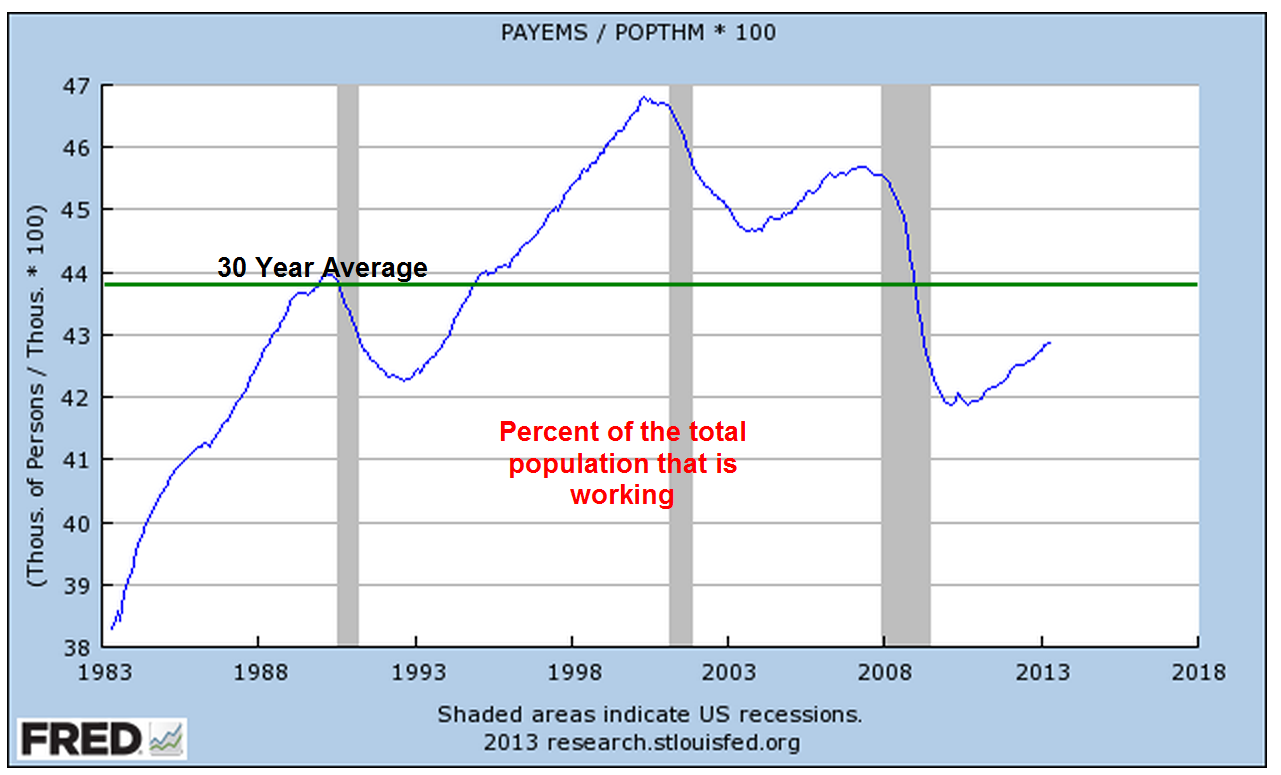
On the not so good side, the percent of the total population that is working is still below the 30 year average of almost 44%.

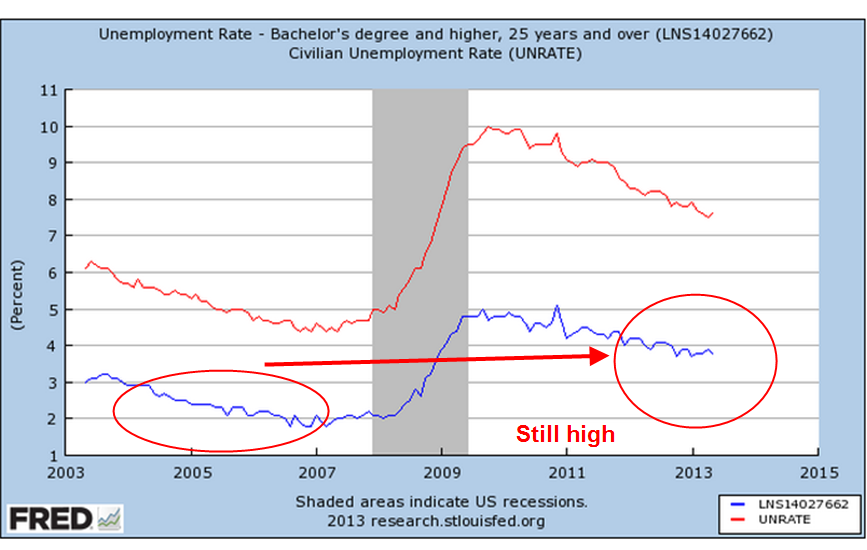
The unemployment rate of those with a college degree is far below that of the general labor force but is still 50% above the average of the early 2000s.

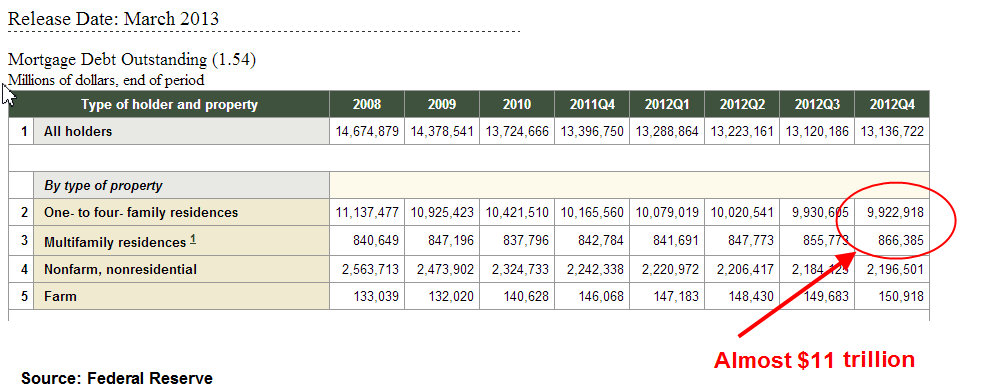
Student aid loans have passed a trillion dollars (source).  To put that figure in perspective,  student loan debt is about 10% of the $11 trillion in outstanding debt of residential mortgages (source)

Changes in the bankruptcy laws in 2005 exempted student loan debt from bankruptcy.  Over the next decade or so, will the investment in education pay off?  Let’s hope so.  100 years, an 8th grade education became a standard used by employers to winnow job applicants in a tough job environment.  70 years ago, the new standard became a high school education.  For the past 30 years, we have moved to a 4 year degree as the new standard.
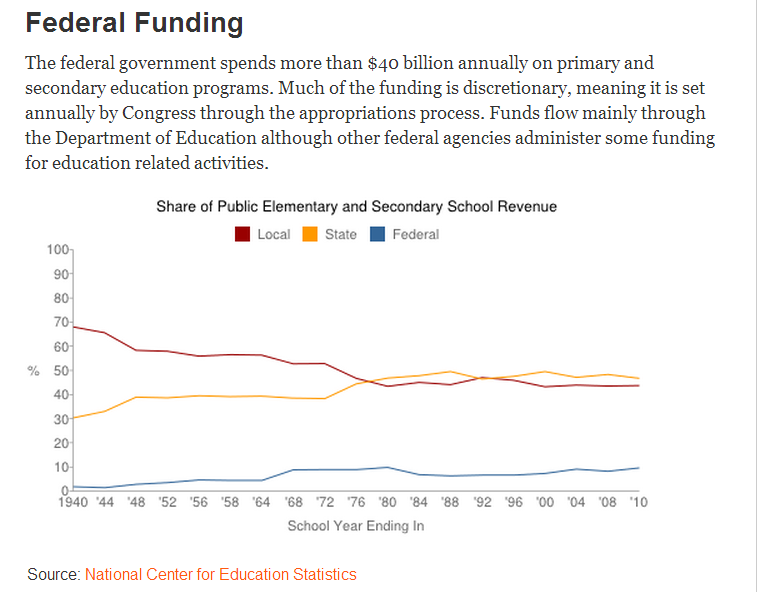
We now spend more on defense and more on Medicare that the $500 billion total amount spent by the state and the federal government on K-12 education. (source) Community college educators are painfully aware that many students are simply not prepared to take college courses.  Local communities used to fund 70% of K-12 education.  Thirty years ago, homeowners protested ever rising property taxes to fund K-12 education and, since that time, local funding has dropped below 50%.

If we expect our children to develop the skills for a college education, we are going to have to find an alternative model of funding.  The states have relied on an ever increasing share of Federal funding for K-12 education.  Although the percentage of Federal spending on K-12 is small, less than 10%, the aging Boomer generation will command ever more spending of general tax dollars in addition to the Medicare taxes collected.

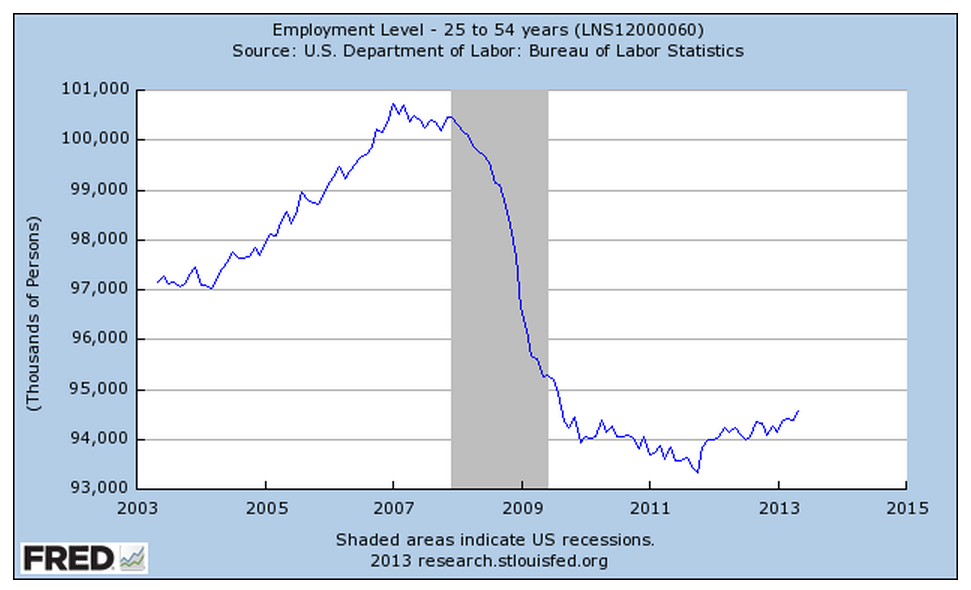
The core work force aged 25 – 54 struggled upwards

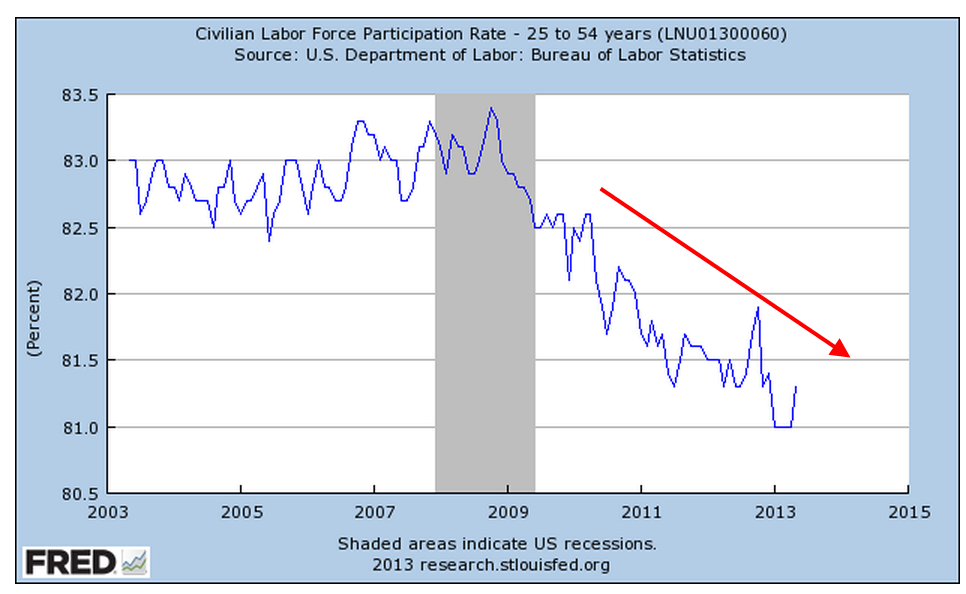
but the participation rate, the percentage of the population in the labor force, is still weak.

The “total” unemployment rate, which includes those working part time for economic reasons, continues to drift down but is still high.

Understand that this represents over 20 million people, a bit more than the entire population of New York State.  Turn on C-Span sometime and tell me how many committee hearings on jobs there are.  Immigration, federal surveillance and the targeting of conservative groups by the IRS are important matters, yes, but why aren’t politicians in Washington talking about jobs?  There are several reasons: no one has a clue; no clear political advantage to be gained; constituents are not writing letters to their representatives and senators about jobs.

Welcome to the “New Abnormal.”

Readin’, Writin’ and Arithmetic

April 21, 2013

In any lively discussion of public education – its effectiveness, the spending and taxes required – some people bring out their swords, others their shields, and some are armed with both.  Armed only with a crayon, I will examine some of these trends.

Let’s look first at higher education spending.  The National Center for Education Statistics (NCES) at the U.S. Dept of Education reported that real – that is, inflation adjusted – spending per pupil had increased 233% in the past 31 years, an annual growth rate in real dollars of 2.8%.

NCES reports a slower spending growth in K-12 education – 185% in 28 years, or an annual growth rate of 2.2%.

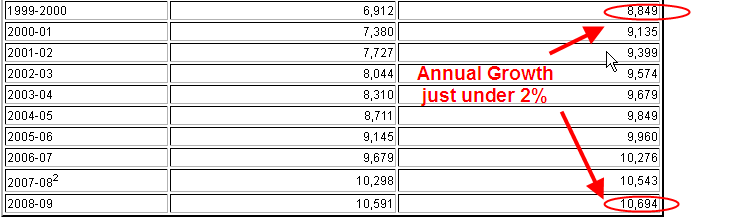
But the annual growth rate during the past decade, 1999 – 2009,  has slowed to just under 2%.


When we zoom in on the spending growth during the 1960s and 1970s, we see a real growth rate of 3.6%

What we see in the per pupil data is a gradual slowing down of the real growth rate of spending.  Those who claim that there have been spending cuts in education have not looked at the data.  There have been no cuts in real spending, only reductions in the rate of growth. 

Some decry “austerity” policies recently undertaken in some European countries – the U.K. is an example – claiming that a country pursuing these policies has cut spending.  When we look at the spending data, we find that there have been no decreases in real spending, only in the growth of spending.  This misconception is common and results from a comparison of what we expect and what happens

If we have usually received a wage or salary increase of 3% each year, we come to expect a 3% increase.  If we get a 2% increase this year, it is 33% less than our expections and feels like a cut.  A retiree who has become accustomed to an annual 8% return on her investments, may feel that she has lost money if her investments only gain 5% this year.  It does no good to mention that she has really not lost anything.

Let’s get up in our hot air balloons and travel to California, where the size of its economy puts the state above many  countries.  California has often been the leading edge of trends that spread to the other states.  Ed-Data reports that per pupil spending has flattened since the recession started in 2008.  In real dollars, there has been NO GROWTH in per pupil spending in the past ten years.

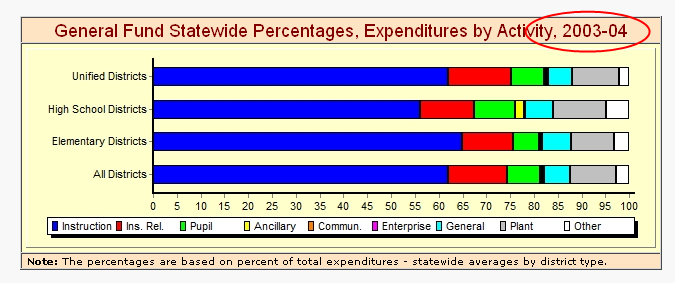
Another complaint from teachers is that money is increasingly being spent on administrative costs, not teaching.  In California, teachers still command the lion’s share of spending  – more than 60%.

The proportion of teacher spending has remained relatively constant – above 60% – in the past ten years.

What has been growing?  On a per pupil basis, “Services and Other Operating Expenses” have grown 4% per year, or 1.8% real annual growth,  above the 2.2% annual growth in inflation.  Administration expenses have grown at the same rate of inflation so that real growth has been flat.  However, spending on teacher salaries has declined in real money at an annual rate of .7%.  However, their benefits expenses have grown 1.4% annually in real dollars.  Again, most people do not “feel” the cost of a benefit increase.  The bottom line to most of us is what we bring home.  It does not pay to tell a K-12 teacher that they are actually receiving a slight increase in real total compensation.

In California, as in many states, property taxes are a major component of revenues for K-12 education.  Over the past nine years, revenues from property taxes for education have declined 3% annually in real money.  For each student, there is $500 less money available from property taxes than it would have been if property tax revenues had kept up with inflation.  As a percent of total revenue for K-12 education, property taxes make up a little over 60%.

In 2011-2012, property tax revenues essentially paid teacher salaries.  Ten years ago, the percentage of revenues from property taxes was about 6% higher.

Other State revenues have had to make up for the shortfall in property taxes; the gap is about $1000 per student.  The problem would be even worse if it were not for the slight decline in students for the past 8 years.

While California faces challenges from declining property tax revenues, what about the rest of the country?  Let’s climb back in our data balloon and look at student enrollment throughout the country.  The NCES reports the same slight decline in K-12 enrollment.  However, they estimate a total 6% growth in K-12 enrollment in this decade.

As K-12 enrollment grew by a little more than 1 million in the 2000s, post secondary education enrollment grew by 6 million, or 37%, to over 21 million. (Source http://nces.ed.gov/fastfacts/display.asp?id=98).  The growth rate in older students, those aged 25+ is even faster, rising 42%. In this decade, “NCES projects a rise of 11 percent in enrollments of students under 25, and a rise of 20 percent in enrollments of students 25 and over.”

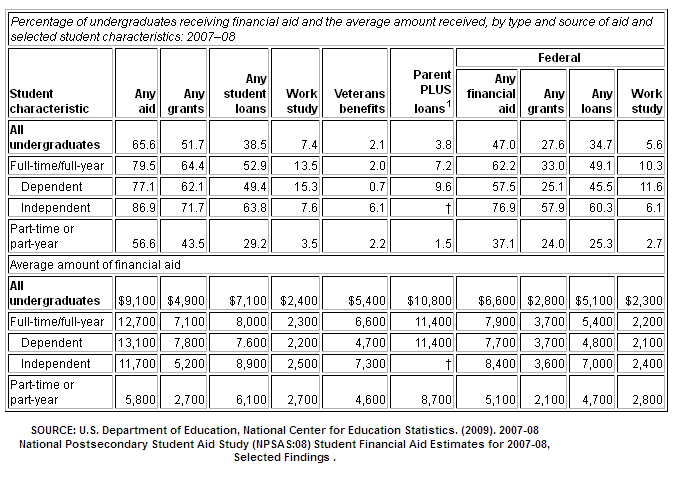
 The ratio of K-12 students to post-12 students was 28% in 2000; a decade later, it was 38%.  While K-12 enrollment is projected to increase for the rest of the decade, post-12 enrollment is estimated to be much faster.  How do these students pay for college?  The most recent data from NCES is at the start of the recession; I would guess that the need for aid has grown mightily since then. 

Put all of this in the blender: a declining work force (see my blog two weeks ago), a generational swelling of older people retiring, recovering but not robust state and local revenues, and more demand for K-12 AND post secondary education services.  How will politicians react in the midst of so many competing demands for money?

The increasing pressures for money from different segments of the population puts us in the precarious position that we can not afford to go into a recession, an impossible situation since the normal business cycle includes a recession every 7 – 10 years.  Europe is already in recession; China’s growth is still robust but slowing; on Friday, India announced a growth rate below 5%, the weakest in four years; in a hopeful sign, Brazil, the economic powerhouse of South America, is projecting GDP growth over 3%, rising up from an anemic 2.7% growth of the past 5 years.  (World Bank source)

Slackening demand around the world presents challenges for the U.S. economy, problems that a spastic Congress will only worsen. Y’all be careful out there…