An Economic Nexus

September 8, 2024

by Stephen Stofka

This week’s letter is about the labor market, part of a series on investing. Friday’s monthly labor report indicated a job market that is cooling but still growing. Although the market reacted negatively to the news, the Fed will begin reducing interest rates at its meeting next week. The S&P 500 index, the most widely held basket of stocks, is up 15% for the year but the index has twice risen above 5500 before falling back. An index of business activity in the services sectors continues to expand but manufacturing activity is still contracting slightly. When investors get conflicting economic signals, they are responsive to negative data points more than positive ones. The approach of what may be a contentious election creates an environment where investors are more likely to protect their portfolio value and exit short-term positions. Let’s now turn to long-term trends in the labor market.

Economists at the Bureau of Labor Statistics (BLS) refer to workers aged 25 -54 as the core work force. To save some typing, I will refer to this age demographic as the “core.” During those thirty years we accumulate stuff while we build our careers. We buy cars, furniture, homes and vacations. We build retirement savings for ourselves and college funds for our kids. The core is the nexus of a growing economy.

This coming Wednesday we will remember 9-11 and the 3,000 civilian lives lost in the attack on the World Trade Center in lower Manhattan. Since that time, there has been little investment in those workers who form the core of the labor market. From August 2001 to August 2024, the economy has added less than seven million jobs in that age demographic, an annual growth rate of just 0.28% (See FRED Series LNS12000060).

As you can see in the chart above, most of the growth in the core has occurred during the Biden administration. The surge in employment in this age group led to growing incomes and greater purchasing power in an age group that is in the accumulation phase of its lifetime. That rapid growth in employment, coupled with pandemic recovery payments from the government were strong contributors to the rise in inflation in the 2021 – 2023 period. Voter sentiment in this age group focused on the inflation, not the job growth, demonstrating again that we pay more attention to negative rather than positive news.

Several factors contributed to the plateauing of job growth in the core. Demographics played some part. Population analysts have assigned a span of about 18 years to each generation so that the thirty-year span of the core labor force encompasses two and sometimes three generations. The first of the large post-war Boomer generation turned 54 in 2000. As the Boomers aged out of the core, a smaller Generation X, born 1964 to 1982, became the dominant component of this age group. In 2013, the first Millennials, a generation larger than the Boomers, joined the core, and in 2016, the last of the Boomers aged out of the core.

A few months after 9-11, China was admitted to the World Trade Organization, and within a decade became the world’s factory. Investors poured capital into China, taking advantage of low labor rates and a currency whose exchange rate was maintained at a low level by the Chinese central bank. Investors from outside China got more bank for their buck. As investment moved to China, many production facilities in the U.S. shuttered their doors. In the seven-year span between China’s admittance to the WTO and the start of the financial crisis in September 2008, manufacturing employment (see FRED Series MANEMP) fell by a fifth. By January 2010, employment in the manufacturing sector had declined by a third.

During the 2000s, low interest rates fed a frenzy in home financing and produced a bubble in the U.S. real estate market that imploded in 2008. The resulting financial crisis affected assets and financial institutions around the world. Millions of Americans lost their jobs. From the start of 2008 until the end of 2009, the core work force fell by 6%, about six million jobs. In 2018, an interval of ten years, the level of employment in this age group finally rose above its 2008 level.

Instead of vigorously promoting policies that encouraged job growth, the Obama administration offered policies to support families suffering from the lack of job growth. Democratic politicians eagerly passed ambitious social programs but faltered when implementing policy solutions that embodied their legislative goals. In Recoding America, Jennifer Pahlka (p. 125) recounts the efforts to fix healthcare.gov, the bungled rollout of the health exchanges created under the Affordable Care Act known as Obamacare. In The Rise and Fall of the Neoliberal Order, Gary Gerstle (p. 226) notes that the Obama administration focused more effort and political capital on providing healthcare insurance for poor people rather than supporting the 9 million households in danger of losing their homes to foreclosure.

A sense of betrayal soured voter sentiment and helped to support the emergence of the Tea Party in the 2010 election and the MAGA voters who supported Donald Trump’s candidacy in the 2016 election. In 1976, voters punished President Gerald Ford for pardoning Richard Nixon. In the 2016 election, voters punished Hillary Clinton as a symbol of a set of values disloyal to many Americans. Donald Trump promised to bring manufacturing jobs back to America by taxing Chinese imports and cutting corporate taxes. In the first three years after the 2008-2009 recession, manufacturing employment under Obama grew by more than it did in the first three years of the Trump presidency (see notes for details). No amount of political rhetoric can overcome the power of a supply chain now firmly anchored in Asia.

Biden’s infrastructure policies have actively promoted job growth in the core. Can the economy sustain such growth in this acquisitive age group while keeping inflation at a reasonable level? Should the Fed raises its target interest rate from 2% to 3% to accommodate job growth that supports people when they are raising families and building careers? I think so. Should Harris win November’s election, she should adopt Biden’s pro-growth policies. Should Trump regain office in the coming year, he will try to use tariffs to shift the nexus of the global supply network from Asia back to the U.S. That policy will only increase prices and help maintain a higher level of inflation without promoting the economic growth that supports households in their middle years.

 ///////////////

Photo by Tim Mossholder on Unsplash

Manufacturing employment notes: From January 2010 to December 2012 manufacturing gained 500,000 jobs, an increase of 4.4%. From January 2017 to December 2019, the manufacturing sector gained 432,000 jobs, an increase of 3.5%. In January 2010, manufacturing employment was near a low, continuing to fall after the official end of the recession in July 2009.

Keywords: Obamacare, inflation, labor, financial crisis, China, manufacturing, infrastructure

Labor Productivity

September 24, 2023

by Stephen Stofka

This week’s letter is about labor productivity. The autoworker’s union (UAW) expanded its strike to 38 parts and distribution plants in the hopes that a wider impact will incentivize further concessions from auto executives. Labor constitutes only 10-15% of the price of a car yet labor disputes may give the impression that rising car prices are entirely or mostly the fault of labor union demand.

For more than 100 years, auto plants of the Big Three automakers have been union shops. Foreign manufacturers like Toyota and Honda have built non-union plants in southern states where union organizers have less influence with policymakers. There are almost a million auto workers now in Mexico where wages have been lower. In 2022, GM Mexico paid its workers between $9.15 and $33.74 an hour, but relatively few auto workers in Mexico make more than $16 per hour.

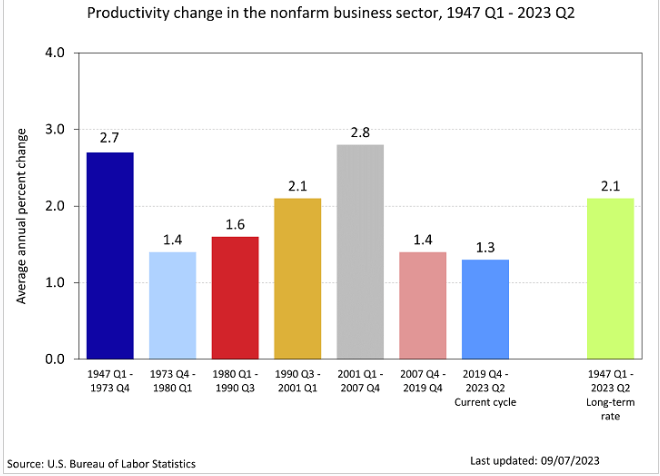
Two weeks ago, the BLS released their productivity figures for the second quarter. Productivity rose faster than labor costs by a good margin – notching a 3.5% annualized gain versus a 2.2% increase in unit labor costs. The manufacturing sector that car manufacturers belong to had a lower productivity gain of 2.9%. In that productivity release the BLS provided a chart grouping productivity gains by decade. The 75-year average is a 2.1% annual growth rate.

An often repeated theme of union workers and workers in general is that wage gains have not kept up with productivity gains. The BLS charted both series since 1973 and the divergence keeps growing by decade. American workers are competing with lower wage workers in Mexico, China and southeast Asia.

The annual gain in Productivity is erratic, rising sharply at the onset of recessions when workers are let go and the total hours worked declines. Recessions reduce the percentage of hours worked far more than the percentage reduction in output. I charted the annual gain in Labor Productivity (FRED Series OPHNFB) to show the effect of these shocks. The pandemic caused a particularly sharp rise and fall, as shown in the red rectangle below.

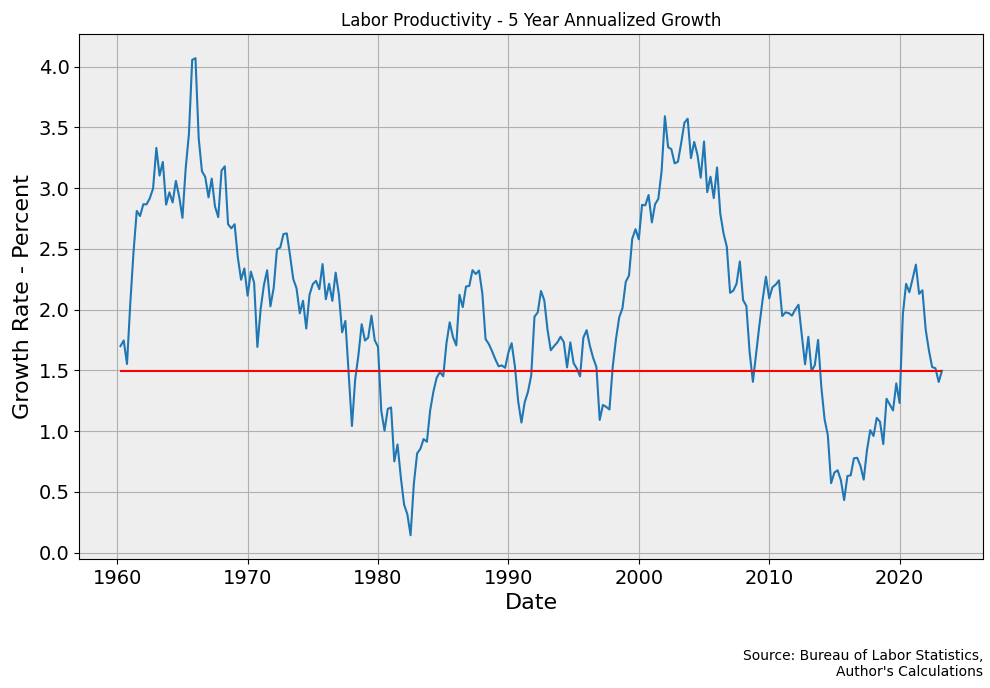
A five-year chart smooths out the divergences, letting us see the patterns more clearly. The red line in the graph below is the 1.5% current growth rate.

Trends in productivity growth are a medium term process, longer than any Presidential term. Despite that, candidates promise big productivity gains if they are elected. Republican candidates promise that lower taxes will boost productivity because that claim appeals to Republican voters. When productivity growth declined following the Bush tax cuts in 2001, conservatives blamed the stifling effects of regulatory compliance and called for more tax cuts. Democratic politicians promise more subsidies to an industry that is not nimble enough to respond to changing economic circumstances.

There are many factors that contribute to productivity growth. Some economists claimed that lower interest rates after the financial crisis would raise productivity. It fell. Those believers assert that declining productivity growth would have been worse without lower interest rates. This claim also cannot be disproved. Hypothetical situations are the favorite shield of a believer.

Corporate profits are up sharply since the start of the pandemic. For the past year, GM has enjoyed strong profit growth but they have had far too many down quarters since the financial crisis. Ford has fared better but its profit margin of 2.4% is only slightly more than the high-volume, low margin grocery giant Kroger. Stellantis has struggled to make a profit since 2018. For decades, federal and state governments have subsidized these auto giants with tax breaks and loans because the industry as a whole employs 1.7 million workers and contributes more than 10% to GDP. It is an industry where politics and economics are tightly intertwined. The politics clouds the economic analysis and the economics contorts the political calculations.

///////////////

20230924AssemblyLine

Photo by carlos aranda on Unsplash

Keywords: auto industry, GM, Ford, Stellantis, union, UAW, labor, workers, wages

Socioeconomic Engineering

April 30, 2023

by Stephen Stofka

Last week’s letter was about marginal loss and marginal value. This week I’ll continue exploring another topic in marginal thinking – the marginal disutility of labor. I will touch on the influence of John Stuart Mill, Karl Marx and Thorstein Veblen and revisit John Bates Clark from last week. I will finish up with Keynes, a seminal figure who voiced disapproval of some earlier economic ideas but incorporated portions of that thought into his General Theory.

What is the marginal disutility of labor? Disutility is a synonym for harm. There are two choices in each period of time: work and leisure. Leisure should be understood as non-work, not an activity like resting in a lounge chair on the beach. If the next period of work causes harm we will choose leisure, a rest from work. This idea became popular in the late 19th century as neoclassical economists adopted utilitarian ideas contained in John Stuart Mill’s Principles of Political Economics. Mill claimed that values were subjective, based on scarcity and the costs of production (Heilbroner, 1997). Mill rejected the claim by classical economists like Ricardo and Smith that there was some natural law of distribution of the gains from production. Mill wrote that distribution of gains was based on customs and morals peculiar to each society.

That was a bit too arbitrary and subjective for some neoclassical economists like Jevons and Menger. The neoclassical economists wanted to divorce politics from economics, to cut out the “Political” in the title of Mills book. They developed the concept of a marginal productivity of labor idea to accompany the marginal disutility of labor. Under this schema, every worker was paid their marginal product, their contribution to production. Neoclassical economists became preoccupied with equilibrium in a static world.

I wrote about John Bates Clark last week and I will mention him again. A neoclassical economist himself, his book The Distribution of Wealth reminded readers that most neoclassical ideas only made sense in a fictional world where labor and capital were free to go wherever they would earn the most return. It is a world without friction or gravity like Newton’s mechanical world of motion. The simplification helped Newton identify the interplay of forces on an object in motion.

Clark went down the rabbit hole himself and he defined and reconciled two sets of laws, the static and dynamic. In his theory, there were static laws of equilibrium between scarcity and wants. This was a system seeking rest like the swing of a pendulum as it gradually comes to rest at the lowest point of an arc. He identified five forces that disrupted the static laws. These were population, capital, technological improvements, the types of businesses and the wants of consumers. Each of these were increasing, a dynamism that interfered with any resolution.

At this point in the story, I will return to The Worldly Philosophers by Robert Heilbroner (1997).  One of Clark’s pupils was Thorstein Veblen, a Norwegian who would become one of the leading voices of what is called American Institutionalism. That school of economists proposed a class of socio-economic engineers who would optimize the institutions that dictated the distribution of property to make production more efficient. Marx had also insisted that production and distribution could not be separated. Veblen’s ideas were a rational system implemented by a trained intellectual elite. Marx envisioned a reactionary movement like the upheavals that swept Europe in the 1840s. Despite the stark differences between Veblen and Marx, the neoclassicals depicted Veblen as another Marxist philosopher and marginalized that school of thought.

John Maynard Keynes rejected the notion of the marginal disutility of labor because it failed to explain how millions of workers were idle regardless of their asking wage. Employers were not hiring because the expectation of sales was so low. Sales remained low because workers were not employed, a problem that Henry Ford had solved two decades earlier. Ford needed more people to buy his cars but even his own workers could not afford the cars. So he paid them more money. That solution was more difficult to deploy throughout an entire economy, however. Only a government had enough fiscal power to put a large number of people back to work, to increase what Keynes called effective demand.

In his General Theory Keynes introduced the same idea of the economist engineer but did not mention Veblen. Heilbroner thought it was because the neoclassicals had successfully stereotyped Veblen as a Marxist, a socialist without respect for private property. Keynes was essentially a conservative in the camp of Edmund Burke, someone who wanted to preserve the capitalist system based on private property. Despite the difference in intentions, Keynes introduced top down economic engineering at a time when people were desperate for solutions that would preserve existing institutions.

Our society today is based on these ideas and the institutional norms those ideas spawned. As the debate over raising the debt nears a critical standoff sometime this June, we will be able to see the clash of ideas tangled with the posturing and struggle for political dominance.     

/////////////////

Photo by Mykola Makhlai on Unsplash

Heilbroner, R. L. (1997). Teachings from the worldly philosophy. New York, NY: Norton & Company.

///////////////

The Fruits of Labor

March 6, 2022

by Stephen Stofka

In trips to the grocery store and gas station, many of us develop an inflation calculator that we trust because it tracks price changes in the unique basket of goods that we buy. If the price of mushrooms doubles, we only care if we buy mushrooms. Economists have the difficult task of computing the price changes of a common set of goods. They spend an extraordinary amount of time and expense surveying people in cities throughout the U.S. to construct a representative sample of the goods we buy (BLS, 2021). The price weighting that economists use to measure inflation differs from our instinctive approach. We assign weighting by the frequency we do something. What catches our attention gets more weight in our consumption basket.

Our sense of inflation can be guided by the price of gasoline when we fill up each week, but it is only 4% of the CPI measure of inflation (BLS, 2022). Many of us underweight the cost of housing that we provide to ourselves. Wait, what? In January, economists at the Bureau of Labor Statistics computed a 4% increase in housing costs even for those who owned their home outright. They call this Owners’ Equivalent Rent (OER) and it makes up a whopping 25% of the calculation of inflation. In the BLS methodology, homeowners are both landlords and renters. Actual rental increases made up only 7% of the index but the BLS uses those rent increases to compute the market price of what a homeowner could rent out their home for each month. For a homeowner, that 4% increase in housing costs is actually a 4% saving. Even better, homeowners do not pay income taxes on that imputed income.

Like gasoline, we overweight the effect of grocery prices because we frequently shop. If we enjoy a sirloin steak once a week, we notice when it increases in price from less than $10 to $13 a pound (FRED series APU0400703613). In the years after the financial crisis many households ate more ground beef. Prices doubled in response to the increased demand (APU000070312). Ground beef is what economists call a Giffen good. Unlike normal goods, we buy more of a Giffen good when our income goes down.

Many of us measure inflation by comparing the prices we pay to the wages we receive. Workers have gained little in the past two decades, eking out an extra 8% in real earnings over that time. All of that gain has come in the past eight years. Workers should expect to share in the productivity increases of the past two decades.

An assumption of neoclassical economics is that workers’ wages reflect their marginal productivity. A BLS analysis (Sprague, 2014) of labor productivity showed an average gain of 2.2% in real output per hour from 2000-2013, yet workers’ real earnings declined slightly. In the past eight years, annual productivity gains have averaged about 1%, slightly below the annual 1.2% increase in real wages. Why have workers been able to command wages appropriate to their productivity in the past eight years but not in the 14 years prior? The problem began before the financial crisis when productivity rose 2.7% per year and real wage growth actually declined. The 2000s came after a period of reversal for the owners of capital. During the 1990s, much money was lost in the pursuit of profits promised by the developing internet. Owners and management recaptured those losses by keeping the productivity gains to themselves during the 2000s. Workers may not be able to regain those lost wages but at least they are securing the fruits of their labor.

/////////////

Photo by Timotheus Fröbel on Unsplash

BLS. (2021, December 9). Consumer price index frequently asked questions. U.S. Bureau of Labor Statistics. Retrieved March 5, 2022, from https://www.bls.gov/cpi/questions-and-answers.htm

BLS. (2022, February 10). Table 1. Consumer price index for all urban consumers (CPI-U): U. S. city average, by Expenditure Category – 2022 M01 results. U.S. Bureau of Labor Statistics. Retrieved March 5, 2022, from https://www.bls.gov/news.release/cpi.t01.htm

Sprague, S. (2014, May). Definition, concepts, and uses. U.S. Bureau of Labor Statistics. Retrieved March 5, 2022, from https://www.bls.gov/opub/btn/volume-3/what-can-labor-productivity-tell-us-about-the-us-economy.htm

A Worker’s Costs

May 30, 2021

by Steve Stofka

As an employee, a worker moves between the “work box” and “life box” each working day. The business builds the work box and defines the boundaries for the worker. A worker who is a business and thinks like a business must build a box that incorporates work and life, with a moveable wall between the two. That worker must be more conscious of total production costs or they go out of business.

Almost half of this country’s output is produced by micro and small businesses owned by a few people who take an active part in the business and have their personal fortunes are at stake. Integrating and balancing work and personal life is especially difficult and economic models don’t incorporate the distinct dynamics of these companies. Politicians on both sides of the aisle pay lip service to small business but the substantive beneficiaries of most policies are medium and large businesses who spend heavily to influence lawmakers. Forced to work from home, workers in large companies experienced the production process much like the owners of small businesses. The world’s attention was drawn to a worker’s total costs of production. Will lawmakers and economists finally incorporate the interests and concerns of workers and small businesses?

In economic models there are two inputs to production, capital and labor. In the short-run, capital costs such as plants and equipment are fixed and labor costs are variable. What are the worker’s capital costs of producing that labor? An investment in a home or apartment, in transportation, and in human capital – education, training and past experience. In mainstream economic models, an investment in a home is recognized as an investment, but not as an input to the production of labor. The compensation for the human capital that a worker invests in production is supposedly included in the wage the worker receives. Tax law disregards the costs of housing unless they are traveling expenses away from the primary place of business. How the worker replenishes their physical and emotional needs when they are not at work is not a concern for economics, the Congress or the IRS.

What are a worker’s costs to produce their labor? In the  short-run, six months or less, a worker has supplier costs that are either fixed or “sticky,” variable obligations that are difficult to shed. They have leases and financial obligations for living and transportation, for childcare, for education and other commitments to family. For small business owners and many workers during the pandemic, space in the house must be set aside for work activities. In tax law and economic models, those fixed and variable costs are largely disregarded.

Subchapter S corporations are small businesses usually owned by a few shareholders who take an active part in the business. According to the IRS, there are five million S corps. In 2017, they filed 4.7 million returns accounting for $8.1 trillion in  business receipts. In that same year, more traditional C corporations filed only 1.6 million returns, but accounted for $21.2 trillion in business receipts (IRS, 2021). Even though larger corporations were only a third of small businesses, they produced almost three times the receipts.  

Larger companies leverage that volume to win favors in Congress and state capitols around the country, and those benefits come at the expense of smaller businesses. In political science and economics, it is known as “concentrated benefits, diffuse costs,” a groundbreaking insight of Mancur Olson in 1965 (2014). The few who receive the bulk of the benefits lobby hard to protect them. The many who pay the price are hurt but not crippled by the costs and do not fight as hard for change. Olson challenged the popular notion that the majority always oppresses the minority in a democracy, showing how a minority often controls many agendas. The pandemic has highlighted the plight of the majority of workers in large and small businesses.

In 2017, C Corps deducted 98% of their total business receipts (Table 2.3). S Corps deducted 94% of receipts, but there are also costs of production that a small business owner absorbs because the deduction is either disallowed or requires too much effort to substantiate for the cost of the deduction. For employees, the rules are stacked against them. A worker making $60K per year gets a standard deduction of $12,400, or 20% of their total receipts. If an employee were able to deduct their total costs of production, that standard deduction might be more than $50,000. Employees would pay far less income tax and this would put political pressure on large businesses to pay more taxes. How do a minority of large businesses control the fate of an overwhelming majority?

In Marx’s analysis, the rules of property were a remnant of feudalism, where a small minority of aristocracy controlled the land, had a large influence in policy making, and most workers were agricultural peasants with little education. He thought capitalism was the most formidable force of production that mankind had invented but its rules of who got what were founded on the rules under feudalism – a few got most of the gains.

John Stuart Mill, a contemporary of Marx, agreed that property rights had their foundation in “conquest and violence.” Although a staunch defender of property rights, he acknowledged that the distribution of property was arbitrary and not equitable (Heilbroner, 1997, p. 135). He predicted a gradual transition to socialism where society would distribute the benefits from production more evenly to both the capital and labor responsible for that production.

Those who favor capitalism think that the owners of capital should keep all the profits from production. Those who favor socialism think that the inputs to production should determine the outputs, the profits, from that production. Many advocates on each side are convinced that they are “right.” Believers in capitalism may, like John Locke did in the 17th century, found their “right” on the Bible. Long before game theory was formally developed, both Marx and Mill understood that property distribution was decided by arbitrary rules, not some inherent right. Even Marx disagreed with his own followers in that regard, declaring that he was not a Marxist (Heilbroner, 1999, p. 151). Europeans transplanted their sense of property rights to America, where the acquisition of property was now founded on the three-legged stool of hard work, conquest and violence.  

Economic models and tax law were crafted in the environment of 19th and early 20th century industrial production. Capitalists needed workers as disposable cogs in the factory machine and there weren’t enough of them. Policymakers sold a dream to poor but hopeful people in far off countries but awarded all the profits to the capitalists. A lot of workers died in the fight for an eight-hour workday and prohibitions against child labor.

Programs like Universal Basic Income and other variants hope to alter the distribution of profits. Those who gain from the current arrangements naturally resist any change. Laws and attitudes are “sticky” and slow to adapt. The changes in work production during the pandemic may bring new awareness to the totality of the worker’s cost of production, but will that effect policy changes? Let’s hope so.

///////////////

Photo by Martin Sanchez on Unsplash

Heilbroner, R. L. (1997). Teachings from the worldly philosophy. New York, NY: Norton & Company. (p. 137).

Heilbroner, R. L. (1999). The Worldly Philosophers the Lives, Times, and Ideas of the Great Economic Thinkers (7th ed.). New York: Simon and Schuster.

IRS. (2021). SOI Tax Stats – Corporation Complete Report, Table 2.3. Retrieved May 28, 2021, from https://www.irs.gov/statistics/soi-tax-stats-corporation-complete-report. Table 2.4 contains the data on Subchapter S corporations.

Olson, M. (2012). The logic of collective action public goods and the theory of groups. Cambridge, MA: Harvard University Press.

The Association – A Split

August 25, 2019

by Steve Stofka

A few things before I continue the saga of our mountain community. Bond yields have sunk to remarkable lows as the prices of those bonds climb higher in response to global demand for safe assets. Governments have borrowed trillions since the financial crisis, yet there is not enough debt to meet demand.

The private market created a huge supply of “safe” assets called Collateralized Debt Obligations, or CDOs, based on house mortgages. When the housing market imploded, it left a big hole in the market for safe assets. As countries around the world have adopted capitalistic market structures, the living standards of millions of people have improved and that has led to more savings in search of safe investments.

The U.S. still pays a positive interest rate on its debt and that is attracting a lot of foreign capital to our country – capital that is driving down the interest rates on our savings and pension assets. Unlike some other countries, capital moves freely across U.S. borders. It doesn’t wait in crowded spaces behind chain link fences.

Donald Trump’s family business relies heavily on borrowing, and most of that has come from a single source, the German firm Deutsche Bank. No other bank is willing to risk capital on a family business with a history of failure. The family’s business depends on the free movement of capital across national borders, yet Trump himself is adamantly opposed to the free movement of labor across borders.

Capital requires a legal framework of property rights protection, a robust banking system capable of servicing that capital, and a political system that protects the profits generated by investment from graft and corruption. Labor requires a social framework in addition to a legal system that enforces basic personal rights. Capital comes to this country because we spend a lot of money to nurture and protect it more than some other countries. Labor comes to this country for the same reasons – a higher return on their effort, an educational system that nurtures their families, a social and legal system that offers some protections.

“They’re taking our jobs!” some people complain of immigrant labor, yet few Americans are affected by an immigrant labor force that takes mostly lower paying jobs. The flow of capital into our country creates a competition that affects many more Americans – anyone who has a savings account, a pension fund, a 401K, an IRA. Where is the outcry against foreign capital?

Let us return to those dear souls who inhabited an abandoned mining town. In last week’s story, they had formed a homeowner’s association which created Money, Debt, and traded with another community called the Forners.

The board of the homeowners’ association complained often about the expense of handling the Money that it had created. The association decided that it would be more efficient to reduce the use of paper Money. It gave each homeowner a bank account and a Money shredder which scanned and tabulated the Money that each homeowner shredded. Homeowners didn’t have to go to the community center when they needed to pay another homeowner or the association. When they did receive Money, they deposited it in the shredder, which added the amount to their balance. When they wanted to pay someone, they tapped some buttons on their shredder and the amount went from their account to the other homeowner’s account. Paying their monthly homeowner fees was so much more convenient.

A homeowner called Mary decided to re-open the old restaurant, but she would need more Money than she had. What to do? The association could print the Money and loan it to her. Mary would put up 10% of what she needs, and the association would print the other 90%.  She would pay the money back over time with interest. One of the homeowners asked, “How will we be paid if we do work for Mary’s restaurant?” Someone answered, “With the same Money that you get paid when you work for the association.”

That was acceptable to everyone. With the extra Money earned by fixing up Mary’s restaurant, several other homeowners put down deposits and opened businesses with loans from the association (Note #1). The association held a mortgage on each business, but the business owner decided how to run the business and received the profits from the business.

When Stan’s business failed, the homeowners discussed what to do. Stan had spent the printed Money that the association had loaned him, so the Money had not disappeared. Like all the printed money, it was spread around the community. The effect of Stan’s business failure was the same as if the association had started the business, hired people to do work, paid them and then closed the business after a time. The printed Money went out into the community but never made it back to the association in the form of loan payments. Someone said, “There is extra Money in our community because Stan’s business loan won’t be paid back.”

They agreed that this was so but what to do about it? They all had some extra Money because of Stan’s business loan. “What if more businesses fail?” someone asked. “What will we do with all the extra money the association has printed?”

“Prices will go up,” someone else said. “That’s what happened last time.”

“If more businesses failed, I would be more careful and buy less stuff,” another offered. Several heads nodded. “I’d deposit some extra Money in the shredder.”

“Well, that doesn’t make the Money go away,” someone argued. “The money is still in your bank account with the association.”

“But prices won’t go up because people are spending less Money, isn’t that right?” someone asked. That was the confusing part. The last time there was extra Money, prices went up. But in this case, prices were likely to go down if more businesses failed and there was extra Money.

Someone stood up and said, “I’ve got the answer. When we all worked fixing up Stan’s business, the Money was exchanged for our labor and supplies. Since the Money was exchanged for goods and services, there is no extra Money.”

Someone else countered, “What if we all started businesses, borrowed Money from the association and we all failed? There would be a lot of extra Money.”

The other person answered, “Yes, the amount of circulating Money would be suitable for a thriving community. Too many people with a lot of Money and nowhere to spend it would drive up prices. But just one or two business failures has such a small effect that it is negligible.”

They decided to continue printing and loaning money but formed a loan committee whose job was to review an applicant’s business plan before loaning the money.

Bob, the community’s propane dealer, bought his supplies from the Forners. One month, the Forners got very angry at the whole community and would not sell propane to Bob. He contracted with another community for propane but there wasn’t enough for everyone’s needs. Bob raised the price of propane then began rationing propane by selling only to those who were in line at his station at 6 A.M. After two hours, he shut off supplies until the next day. Some homeowners threatened Bob and so he had to hire a few people for extra security (Note #2).

Mary used a lot of propane for cooking, so she had to spend several hours each day buying propane. Naturally, she raised prices to account for the additional time and higher price of propane. Homeowners ate fewer meals at Mary’s and she had to let go of several employees.

As prices rose, some homeowners who had bought association debt at low interest rates began to complain. “We loaned the association money at 5% interest and prices are going up at 10% a year. We’re losing money!”

Everyone agreed that this wasn’t fair, but no one knew what to do about it. Should they cancel the old debt and reissue debt at higher interest rates? That would lead to higher homeowner fees for everyone. “You want us to pay extra so that your interest income will keep up with inflation? Why should I take money out of my pocket and put it in yours?”

Tempers flared. “I’m not loaning this association money ever again,” complained one homeowner and several stormed out of the clubhouse. True to their word, these homeowners would not renew their loans to the association unless it paid much higher interest rates. After several months, the Forners resumed propane deliveries but a vicious cycle of higher prices had started. Homeowners had to pay higher association fees and wanted more money for their labor to pay those higher fees. No one knew how to fix the situation.

“We need to charge high interest rates on the Money we print and loan to homeowners for their businesses and homes,” a board member said.

“Are you crazy?!” Several complained. “Rates are already too high. People can’t afford to start businesses or buy a home!”

“We need to raise them so high that it will hobble the economy for a while,” the board member said. “That’s the only way to bring prices down. It won’t take long.”

It took much longer than anyone anticipated, and the economy declined for almost two years. This period of higher prices followed by high interest rates caused a divide among the homeowners – between those who relied on the association for services and help during hard times, and those who formed a deep distrust of the association (Note #3). No one fully understood how deep the divide would grow.

/////////////////////

Notes:

  1. The process where loans generate income for others which generates more loans is called the Money Multiplier in economics.
  2. In the 1970s, two gas embargoes led to similar circumstances.

This is a retelling of the high inflation of the late 1970s, followed by nose-bleed interest rates that caused back-to-back recessions in the early 1980s. The recession of 1981-82 was the most severe since the 1930s Depression.  

An Unwelcome Guest

Nov. 30, 2014

The short week of Thanksgiving should have been rather uneventful.  The week before, officials in Ferguson, Missouri had announced an imminent decision in the grand jury hearing of the fatal shooting of Michael Brown, an African American, by Darren Wilson, a Ferguson police officer who was European American.

Slavery, the denial of civil rights to African Americans, and persistent housing and job discrimination against African Americans are an integral part of American history.  Bankruptcy is a formal discharge of debt.  There is no formal procedure for discharging past wrongs.  Some Southerners are still distrustful of the Federal bureaucracy in Washington that committed so many wrongs in the period after the Civil War.  The wounds inflicted by white skinned Americans on dark skinned Americans is fresher than those suffered by Southerners during the Reconstruction period almost 150 years ago.  Fresh wounds bleed easily when scratched.

The grand jury took several days longer than “imminent” to reach its decision, announced Monday night.  Several weeks of protests during the course of the hearing erupted into violent rioting at the grand jury’s decision that Officer Wilson should not be indicted for any charges, ranging from first degree murder to manslaughter.  The decision, right or wrong on the facts, picked at the scab of the soul of some African Americans, provoking senseless violence.  Americans of every skin color riot when their team wins the World Series (San Francisco 2014) or Super Bowl (Denver 1998).  Dark skinned Americans riot when they perceive that some injustice has been committed against them.

The costliest riots, over $1 billion in damages, had occurred in Los Angeles in 1992 after the Rodney King beating.  Whether in response to victory or injustice, rioting provoked confusion and condemnation in any society.  It was both uncomfortable and strangely seductive to watch the emergence of a super two-year old, having a temper tantrum, from a group of civilized human beings.

Property damage from civil unrest was covered by many business insurance plans, George knew, but he wondered how many businesses damaged in the Ferguson riots were covered for interruption of business operations, replacing some or all of the owner’s lost income.  Sometimes these were sold as riders to a commercial policy.

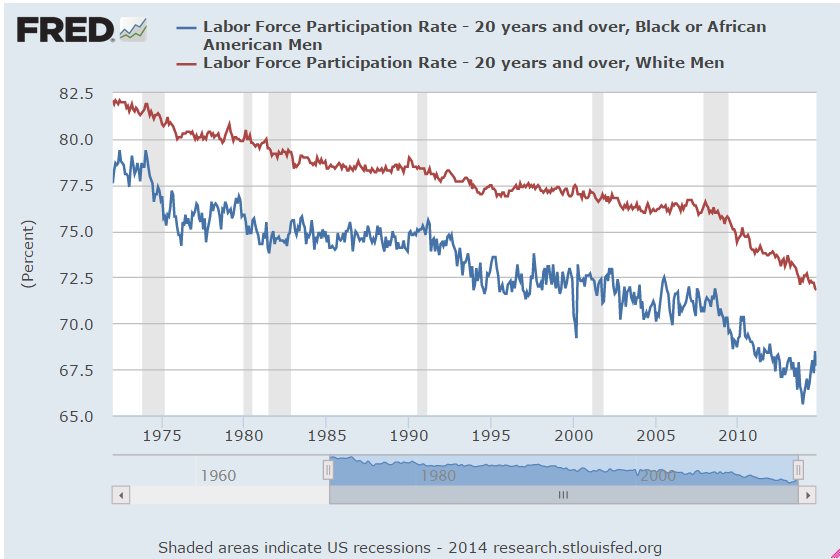
People with jobs were less likely to get angry.  Unemployment among African Americans was at the same level as the early seventies, when the economy was in a severe recession, and the oil embargo and inflation had prompted Nixon to enact wage price controls.  Those had not been good times for many Americans. Five years after the official end of this last recession, the unemployment rate among African Americans was twice the rate of the general labor force.

The participation rate among African Americans was about 1% less than that for the entire labor force but the rate difference for men was about 4 to 5%.

George was a bit concerned that Monday night’s riots in Ferguson might have a secondary effect on Tuesday’s trading if the 2nd estimate of GDP growth for the 3rd quarter was below 3%.  Yes, he should have been more focused on making turkeys out of construction paper for the Thanksgiving dinner.  He and Mabel – well, mostly Mabel – had started the tradition when the kids, Robbie and Emily, were younger.  Somehow they had continued the tradition after the kids had gone.  George told Mabel that he would do it while they watched the season finale of Dancing With the Stars on Tuesday night.  Somehow he felt like a kid saying he would do his homework later.  Long marriages result from both partners doing stuff they don’t particularly like doing, George thought.

Tuesday morning’s report of GDP growth allayed George’s concerns.  October’s initial estimate of growth had been 3.5%.  This second estimate was higher, at 3.9%.  The Case Shiller 20 city home price index showed a slight month-to-month increase, but the yearly increase in price was just about 5%, more in line with historical averages.  
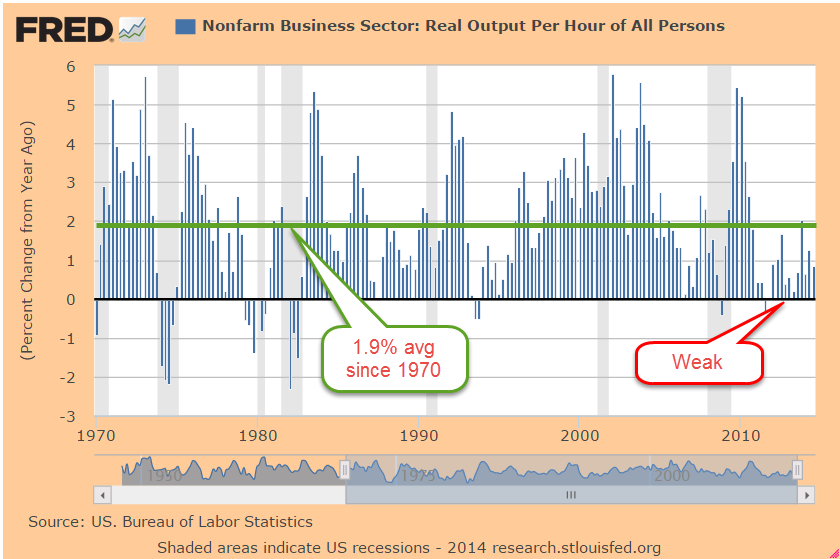
 Corporate Profits for the 3rd quarter gained 3.8% year-over-year, slowing down from the 4.6% year-over-year growth in the 2nd quarter.  Profit growth was ultimately driven by growth in productivity.  Capital investments in technology had reaped the greater share of overall growth in the past decade or more.  Labor’s share of growth had been particularly weak the past few years, far below the average of the past forty years. 
A closer look at labor productivity gains in the past decade showed just how meager they were.  
A work force unable to capture productivity growth could not command strong pay growth.  Economists at the BLS anticipated increasing overall output growth in this next decade but those projections were sullied by the lack of clarity regarding the causes for the slow growth in labor productivity of the past decade. Did the shift further away from manufacturing make gains harder to come by?  Was there a limit to growth that could be achieved by better management, process design and innovation? Some blamed the exponential growth of the regulatory state, forcing businesses to devote an increasing number of hours on compliance and reporting.  Others blamed the increase in social benefit programs for softening the competitive edge of American workers.  Got a reason?  Throw it in the hat, George thought. The market traded in a flat range for the day.
On Wednesday, George went to the bank to cash in the joint CD that he and Mabel had discussed the previous week.  He was surprised to learn that the bank did not require the both of them to cash in a joint CD.  Mabel was busy with Thanksgiving fixings so it was convenient that George could go alone to handle the matter.  He picked up a certified bank check from one bank and drove over to the bank where they kept their checking account to deposit the money.  He was also surprised to find that the bank did not credit the money to their account for a few days. “The other bank is just like 10 to 15 blocks away,” George told the teller.  “Well, we have to guard against fraud,” the teller responded.  “So it would have been better to have gotten cash?” George asked. “Well, yeh, but then I think you would have to fill out a form because it’s a large cash transaction,” the teller informed him.  “You know, to say you got the money by legal means, that you’re not a drug dealer,” he went on, “but I’d have to ask my supervisor about that.”
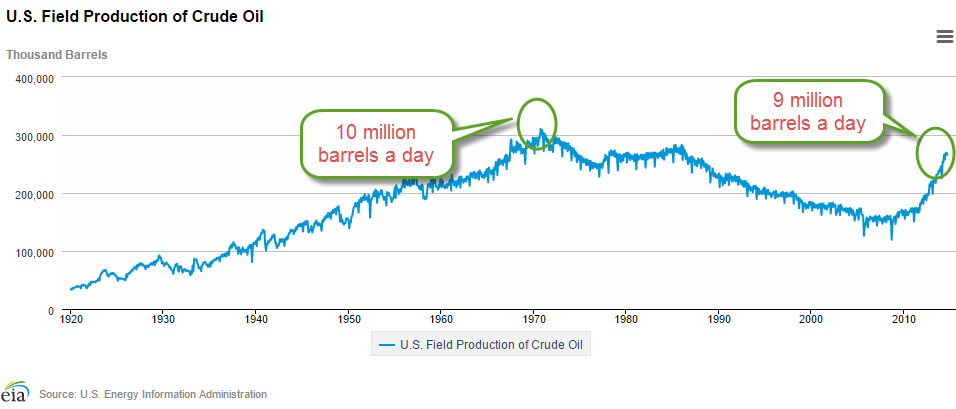
George was going to transfer the money that day to their brokerage but thought he should wait till Monday.  George was tempted to buy maybe a 1000 shares of USO, the commodity ETF that tracked West Texas Intermediate Oil.  OPEC was scheduled to meet Thanksgiving day to discuss the near term future of oil prices.  They had dropped by about a third in the past year as increasing barrels of U.S. shale oil were added to the supply for a weakening global demand.  U.S. oil production was now at 9 million barrels a day, the same level  as the mid-1980s, and rising toward the record production of 10 million barrels in the early 1970s.
Poorer countries in OPEC who funded their government with the sale of oil, wanted to set production cuts to halt any further declines in oil prices.  With their huge supply of oil and relatively inexpensive production costs, the Saudis were content to let the slide continue.  On Tuesday, oil prices had dropped a few percent.  But if the other members of OPEC prevailed and production cuts were announced, George reasoned, he could make a bundle of money in a short time by buying oil the day before.  That was the speculative angel, or devil, on his shoulder whispering in his ear.  His other angel simply asked, “Are we investing or gambling?”  George gave in to his cautious angel.  He could also lose a bunch of money really quickly if the Saudis prevailed.  
Thanksgiving dinner was a relatively muted affair, unlike those of past years.  Bob, George’s older brother, and his wife, Flo, had flown down to Cabo to work on an archaeological dig.  The digging part of that “vacation” didn’t sound appealing to George but this archaeological club, or group, would put them up for 10 days in exchange for their labor and they would still have time for sun and surf.  Bob had become fascinated with archaeology when he was about 60 years old and had pursued it with a passion since then.
Mabel, the oldest of five siblings, had taken on the Thanksgiving festivities.  Two of her sisters lived in Colorado but only Susan, the youngest, came to dinner this week.  Most unusual, George thought, that Charlie was the only child at the dinner this year.  The talk at the dinner table turned to Ferguson.  Robbie had read quite a lot of the testimony at the grand jury hearing and was full of facts.  Charlie got bored as the adults chattered on during the meal. He saw a squirrel coming down the trunk of the tree in the front yard and asked George if he could have some peanuts to feed them.  George had showed Charlie how to sit still on the back deck after putting peanuts out for the squirrels in the middle of the backyard.  He was quite surprised that a child of that age could be motionless and silent for that long as they waited for the squirrels to scurry out from the bushes to snatch up a peanut in their wiry paws.
As the talk and opinions swirled around the table, Mabel was quiet, chewing methodically while listening attentively to the others.  George had already had a few testy words with her earlier in the week so he knew how strong her opinions were.  Robbie’s wife Gail all but accused her husband of being a racist because he did not understand that the facts of the case had been carefully cultivated in favor of the police officer.  Robbie asked his mom for some affirmation.  Mabel finished a bite of sweet potato. 
“About fifteen years ago, I stayed a bit late after school, finishing up some paperwork,” she said to Robbie, then turned to the others around the table.  “It was late October,  maybe early November.  The sun had already set.  There were only a few cars left in the parking lot.  There was one of those parking lot lights, the high ones like street lights, near my car but it would go on for a few seconds, then go off for about a minute.  As I walked to my car in the semi-darkness, I noticed a figure walking to me from my right as though to intersect me as I got to my car.  A second glance up and I saw he was wearing one of those,” she paused, “hoodies, I think they’re called.  As he got closer, maybe twenty feet away, I realized that I couldn’t see his face, that it was a black man in a hoodie. My heart instantly started flippity flopping as I realized that I was going to be attacked.”  
Mabel had everyone’s attention, a difficult thing to do in an family that was not reluctant to share their opinions. “There was no one else in the parking lot that I could call out to for help,” she continued in a purposeful voice. “I hurried my step, reached into my bag, fumbling for the car keys as I approached the car.  I didn’t want to look panicked, fearing I don’t know what.  Maybe that my panic would provoke the attacker.  As I reached out my arm to unlock the car, the man’s voice broke the darkness.  All I heard was ‘Hey’ and I turned and I yelled back ‘Aaaaahhhhh,’ grunting it out like some Kung-Fu movie.  “Mabel?  Is that you? I didn’t mean to startle you,” the voice from the hoodie said.  He brushed back the hood of his parka and I could see that it was James, the biology teacher. 
He was so apologetic and I pretended that I had not noticed him until just that minute. ‘My battery’s dead and I was wondering if you have some cables, could give me a jump,’ he explained to me.  ‘I was going to call AAA and then I saw someone come out of the school entrance and I thought it might be you but I wasn’t sure,’ he went on.  I had cables in the trunk, but I was so upset that I lied and told him no, I didn’t have any.  He thanked me and went back across the parking lot to his car.”  Mabel took a quick sip of water from her glass.  George had never heard this story.  After 35 years of marriage, that rarely occurred.
“I started up the car, then sat there crying,” she continued, her lips tense.  “It’s as though my ideals, my view of myself, was a cloak that I had worn and then, that night, I looked in the mirror without my cloak on.  I wasn’t racist in spirit,” she paused, searching for the words to complete the thought, “or intention, but I realized that I was a racist in perception. Racism is embedded in our culture, in me, whether I like it or not.”  
She stopped and there was silence around the dinner table, a rare event at a Liscomb family gathering.  Robbie, sitting close by his mother, reached across the table to grasp his mother’s hand. From the far end of the table, George was struck by her – what would he call it? Her forthrightness. She had an ability he lacked, and perhaps that’s why the seeing of it in her gave him a sense of admiration.  The moment snapped like a crisp carrot as the front door swung open and Charlie burst through the doorway.  “The squirrel was eating a peanut this far from me!” he yelled excitedly and spread wide his arms.

On Friday, George learned that the Saudis had prevailed at the OPEC meeting.  By the end of the day, USO had dropped more than 8%.  We bear the fruits of what we do and don’t do, George reminded himself, then wondered if that was a line from Shakespeare or maybe Leonard Cohen?

While the stock market stayed relatively quiet during the week, ten year bond prices continued to gather strength.  Stocks and bonds tended to move opposite each other in a dance of risk and return. When they both gained in strength, something had to give.  The last time they met at this strong level was at the end of August, when bonds faltered first, falling  about 5% over two weeks while the SP500 remained fairly stable.  In mid-September they flipped.  Bonds rallied up 8-9% as stocks fell the same amount.  Then stocks rallied to all time highs in the past four or five weeks but bond prices had not fallen more than a few percent.  George resolved to watch this dance during the following week.  It was the first week of the month, filled with a number of reports including the employment report that could renew or drain confidence in the stock market. 

Continuing Unemployment Claims

July 21st, 2013

Since I’m on the road this will be a short piece.  Every week the Bureau of Labor Statistics (BLS) releases their estimate of new unemployment claims based on a compilation of state filings for unemployment.  Labor market analysts pay more attention to the 4 week moving average of this series because the weekly numbers can be volatile or affected by weather and holidays.

Each month the BLS releases their estimate of the number of unemployed and the percent of unemployment but this figure comes from a survey of households.  People surveyed report that they are unemployed and BLS interviewers substantiate responses by asking additional questions. However, there really is no independent verification that someone who says they are unemployed is actually unemployed.

As the states update their tally of those unemployed who continue to claim benefits, the BLS reports the number as Continuing Unemployment Claims.  While no number is entirely accurate, there is a greater degree of accuracy in this number of unemployed.  It does not include those who have not filed for unemployment or those who have run out their benefit period and are no longer eligible for benefits.

I wanted to compare this fairly reliable number with another somewhat reliable number – the number of employed from the Establishment survey.  This total is based on a survey of companies who report the number of employees on their payroll.  While this total has some problems it has proven to be more reliable than the employed number from the Household Survey.

Below is the number of continuing unemployment claims.  Four years after the official end of the recession in June 2009, continuing claims are still at levels seen in the earlier two recessions.  This indicates the persistent underlying weakness in the labor market.

Comparing continuing claims to the total employed reveals some surprises.

This metric shows the severity of unemployment in the recession of the early 1980s; the percentage surpassed the peak in this past recession.  We can see that current levels are high but not dangerously so.  We have seen higher levels during periods of robust growth in the mid to late 1980s and in the recovery years in the mid 1990s.  What we want to see is a continued decline in this percentage.