A Debate on Immigration

December 29, 2024

by Stephen Stofka

This is seventh in a series of debates on various issues. The debates are voiced by Abel, a Wilsonian with a faith that government can ameliorate social and economic injustices to improve society’s  welfare, and Cain, who believes that individual autonomy, the free market and the price system promote the greatest good.

Wishing everyone a happy and flourishing New Year.

Abel opened the conversation. “I thought we might talk about immigration this week.”

Cain replied, “You mean illegal immigration.”

Abel said, “Our group doesn’t like calling people illegal. The only illegal act that many of these migrants have committed is crossing the border, a Section 1325 offense. That carries civil, not criminal, penalties.”

Cain shook his head. “You make it sound like a speeding ticket. If your group doesn’t like the term ‘illegal,’ we can refer to them as ‘illegitimate asylum seekers.’ Most of them are not fleeing persecution. They are jumping the immigration line. They are cheaters, taking advantage of the huge backlog in processing asylum claims.”

Abel shrugged. “Everybody cheats. Thousands of people and businesses fraudulently applied for Paycheck Protection checks during the pandemic. The bankers cheated the system and provoked the financial crisis that caused millions of Americans to lose their homes. Then the bankers claimed asylum from their own stupidity and recklessness and the government bailed them out.”

Cain’s expression was grim. “Our group did not approve of bailouts for bankers. It cost taxpayers billions, and they kept their bonuses. None were prosecuted under Obama’s watch.”

Abel argued, “No jail time for fat cats but your group wants to jail vulnerable migrants. Why don’t we put some of the migrants in the penthouses that the bankers bought with taxpayer money? Your group imagines a world where everyone plays by the rules. Like I said, everyone cheats.”

Cain shook his head. “They can wait in the immigration line like millions before them. Think of the people waiting in line outside of the U.S. for their immigration application to be processed. Illegals jump the line and claim asylum as they’ve been told to do by the cartels and coyotes. It’s an insult to those who are playing by the rules.”

Abel said, “Many recent immigrants have been coming from Venezuela. It is a failing state, ranked 28th out of 178 states. Nicaragua, Columbia and Honduras are ranked in the sixties, putting them in the top third of vulnerable states.”

Cain nodded. “So, some of the Central American countries are stressed. Their economy is poor. Maybe there is some gang activity. When Congress passed the asylum law in 1980, the basis for a refugee claim was fear of persecution because a person belonged to some group. Their race, religion, nationality or membership in a social group made them a target. A parent might be worried that a local gang will target her son or daughter. I sympathize but that is not grounds for an asylum claim.”

Abel said, “The U.S. has been an economic leader because of our openness to immigrants. The Census Bureau recently reported that 83% of the net increase in population came from immigration. Our population is getting older. We are having fewer children. Our economic stability depends on immigrants to expand our workforce.”

Cain said, “Look, I agree that immigrants may become net contributors to our society and economy. But that takes a long time. Newly arrived immigrants at the southern border have so many immediate needs. That includes housing, health care and other social services. The kids need education. They make huge demands on a community before they make any notable contribution.”

Abel argued, “Many Americans are descended from immigrants who came from similar circumstances. It takes a lot of desire and gumption to tear up roots and start over in a new country. America became the world’s leader by welcoming people like that.”

Cain shrugged. “No doubt it takes heart, but many of our ancestors came over when governments provided far fewer social services.”

Abel said, “Your group wants to keep a balance sheet for each immigrant. How many services do they use? What taxes do they pay? The sum of a person’s contributions and withdrawals from the community cannot be summed up so easily.”

Cain agreed, “The accounting is not perfect, I’ll admit, but policymakers need some concrete measures to evaluate the policies they implement.”

Abel argued, “Let’s go back to the peak years of European immigration in the late 19th century and early 20th century. Many of those immigrants were exploited by employers and landlords. In the late 19th century, Jacob Riis published pictures of the slum conditions in New York City. Immigrants lived in cramped conditions without proper water or sanitation. They worked in sweat shops and factories where they had few safety protections. Any ‘contributions’ they made to society were skimmed off by unscrupulous employers and landlords.”

Cain was adamant. “You think that kind of exploitation has stopped? Migrants working seasonal harvests under the H-2A visa program are often housed in accommodations with minimal standards. Their status affords them little bargaining power, so they are under the control of the subcontractor who employs them or the farmer that engages the subcontractor. Employers want cheap labor.”

Abel said, “Tighter borders controls in the past few decades have made it impractical for some seasonal workers to follow the harvests in Mexico and the U.S. They have stayed behind in the U.S., supporting their families in Mexico from afar. They pay taxes but are not entitled to retirement benefits even after twenty or thirty years of working in the U.S. If they are cheating the system, they are doing a terrible job. They are funding benefits to native Americans.”

Cain continued, “Your group advocates policies that only encourage labor exploitation, whether you mean to or not. Immigrants increase the supply of labor and lower wages for native Americans. It’s Econ 101. Supply and demand.”

Abel disagreed, “Lower wages would increase the supply of goods and lower prices. That’s also Econ 101. Immigrants increase demand for the very goods they help produce. That increases employment and reduces the unemployment rate for native workers with low-skills.”  

Cain shook his head. “I disagree. At any rate, social services for illegal immigrants are costly. Sanctuary cities like Denver and New York City have discovered just how expensive and disruptive these immigrants can be. The mayors complained when Texas and Arizona sent them some of the thousands of immigrants that cross the border every day. Policymakers in those cities sure got a taste of the problems that border states are dealing with.”

Abel sighed, “It was a political stunt by Abbott, the governor of Texas.”

Cain replied, “Martin Luther leading a bunch of black people across the Edmund Pettus Bridge in Birmingham was also a ‘political stunt.’ A better word is ‘protest.’ Busing illegal immigrants to other cities was a legitimate form of protest for Texas and Arizona.”

Abel argued, “Citizens protesting government abuse is a protest. When one state uses people as a political hot potato with another state, that’s a stunt.”

Cain shook his head. “Texas and Arizona have long complained about federal immigration policy. All those words fell on deaf ears in Washington. Actions do speak louder than words. Liberal states like Colorado and New York woke up to the reality of immigration policy when they had to deal with the problem in a concrete way.”

Abel insisted, “States should be working their policy disagreements out in Congress. Abbott’s stunt was sophomoric and vindictive.”

Cain replied, “Congress has been at a stalemate for years. The states have to take matters into their own hands where and when they can. The immigration system has been broken for years because Congress wants it broken. A persistent problem gives politicians an issue they can campaign on. Why is the minimum wage not indexed to inflation? Because Congress wants to fight over it.”

Abel asked, “So what does your group propose? Close all the borders?”

Cain said, “This country was founded on federalism, a compact between the states. The border states should have more autonomy in border control.”

Abel scoffed. “That won’t work. Immigrants will go to the border state with the most relaxed controls. Once they are in the country, they can move to another border state.”

Cain shook his head. “Make it illegal. If California lets in an illegal, that person has to stay in California for five years or so.”

Abel sighed. “How will the states enforce that? Each state would have to implement border controls on each highway going into their state. It’s not practical. The only practical policy solution is a unified federal response from Congress.”

Cain said, “Then the problem will plague this country forever, particularly Texas, Arizona and California. Congress doesn’t compromise on a solution until it becomes a crisis.”

Abel said, “Now we are getting to the heart of the matter. The two parties have created a political system that cannot craft coherent policies to address our problems. Americans suffer. They get cynical. Only 60% vote in a Presidential election. Only 20% may vote in a primary. Most of them tune out of politics because it’s a maze with no exit.”

Cain’s tone was resolute. “Then we need to fundamentally alter our system. The states need to call for a Constitutional Convention and bypass this dysfunctional Congress.”

Abel said, “That movement grew in popularity during the 1960s and 1970s. It seems to be gaining popularity recently. Maybe that’s the only solution. I’m afraid the two-party system that cripples our policymaking today will subvert a convention.”

Cain turned to leave. “That’s a discussion for another day. In a first ‘past the post’ election system, two parties are inevitable. The convention would have to implement a Parliamentary system, I suppose.”

Abel waved. “See you next week.”

////////////////////

Photo by Greg Bulla on Unsplash

Jacob Riis’ photos uncovered the abuses of immigrants in the Gilded Age. https://www.britannica.com/biography/Jacob-Riis

The Census Bureau’s recent report on population growth. Most of the 1% increase in population came from immigration. https://www.census.gov/newsroom/press-releases/2024/population-estimates-international-migration.html

Many undocumented immigrants are not eligible for federal subsidy programs. A state may allow them to participate in a particular program administered by the state. https://www.nilc.org/resources/overview-immeligfedprograms/

In a 2015 analysis of 2000-2010 data, Andri Chassamboulli and Giovanni Peri found that “increasing deportation rates and tightening border control weakens low-skilled labor markets, increasing unemployment of native low-skilled workers.” The incoming administration assumes that the opposite is true, that tougher border policy will strengthen low-skilled labor markets. https://www.sciencedirect.com/science/article/abs/pii/S1094202515000514

The New York Times related the stories of several aging farm workers. https://www.nytimes.com/2023/12/05/us/aging-undocumented-farmworkers.html

A Colorado Public Radio report on the difficulties and cost of treating newly arrived immigrants. https://www.cpr.org/2024/03/19/colorado-new-immigrant-population-adds-strain-to-hospital-system-already-stretched-thin/

An explainer of the H-2A worker program from the U.S. Citizenship and Immigration Services. https://www.uscis.gov/working-in-the-united-states/temporary-workers/h-2a-temporary-agricultural-workers

The Congressional Research Service investigated the mechanisms of calling a Constitutional Convention and a range of issues that the convention would debate. https://crsreports.congress.gov/product/pdf/R/R42589/15

Labor Trends

June 8th, 2014

This week I’ll look at some long term trends in the labor market, short term economic indicators and an unusual move by the European Central Bank.

**************************

May Labor Report

On Friday, the BLS reported job gains of 217K, in line with expectations.  The big headline is that we have finally recovered all the jobs that were lost during the recession.

That headline obscures the weakness in the recovery of the labor market.  The number of jobs gained comes from the monthly survey of businesses.  The household survey shows that the economy is still short about 1 million jobs from its mid-2007 high.  A million jobs is less than 1% of the workforce but we’ll see in a minute that the household survey may be giving us a truer sense of the labor market.  Like a fighter who has been knocked down a few times, the labor market is back on its feet but still maintains a defensive posture.

The number of involuntary part-time workers, those who want full time work but can’t find it, has declined in small increments over the past few years but remains stubbornly high.  Gone are the upward spikes in part-time employment, indicating that the labor market is at least more predictable.

7.3 million involuntary part-timers is about 2.3 million more than a more normal level of 5 million.  Half of that number means that there are effectively 1.2 million jobs still “missing.”  Add to that 1.2 million or more jobs needed each year just to keep up with population growth.  1.2 million x 6 years = 7.2 million.  Add in the 1.2 million jobs to reduce part-timers to normal levels and that is 8.4 million jobs still missing.  Let’s deduct a million jobs or so that were gained before the recession because of an overheated housing market and we still have a 7.5 million jobs gap, or 5% of the potential workforce.  As I will show next week, this job gap puts downward pressure on wages, on personal income, on consumer demand, on…well, just about everything.

This month marked the fourth month in a row that job gains have been higher than 200K.  Two of those four months of  consistently strong job gains came during a weak quarter of economic growth and particularly weak corporate profit growth.  More on that next week.

The narrow measure of unemployment remained unchanged at 6.3% but the widest measure, the U-6 rate, continues to decline from a high of (gulp!) 17% to a current level of 12.2%.

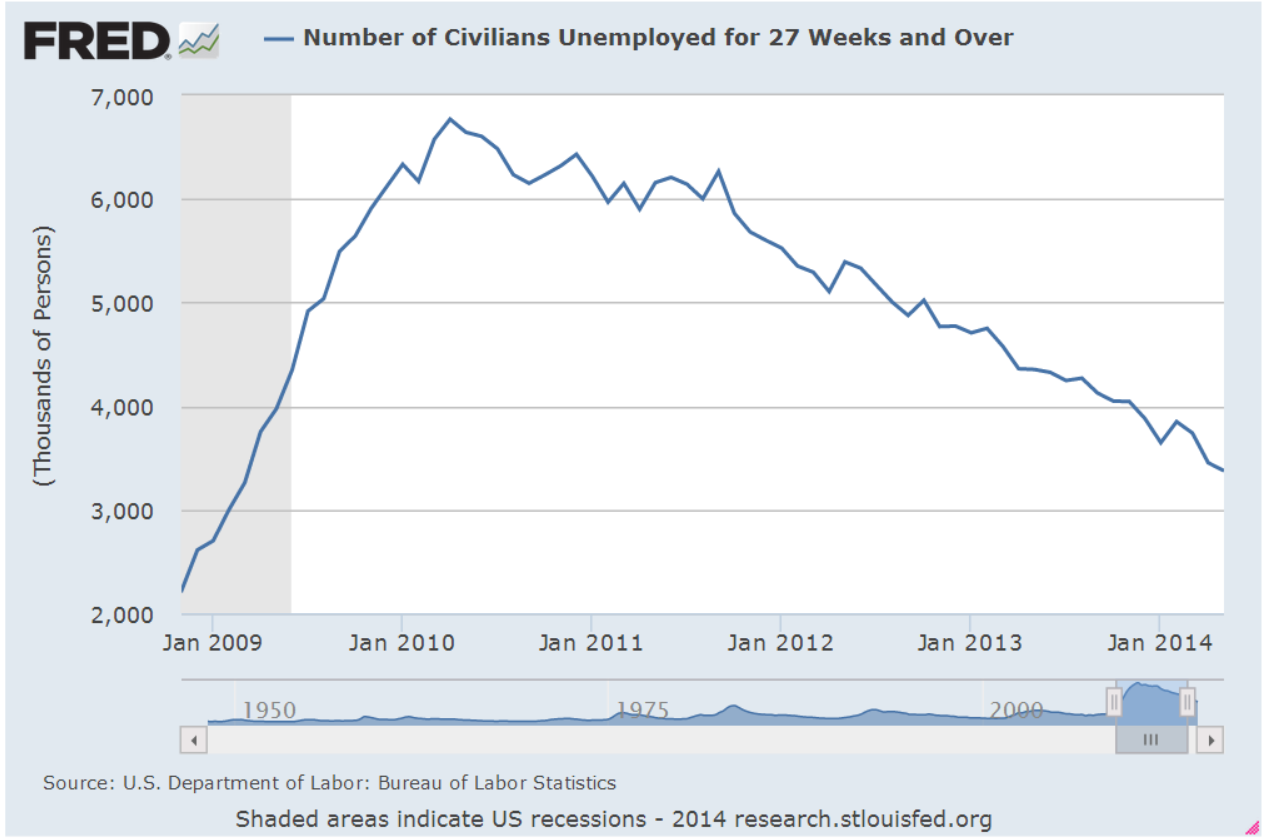
The number of long-term unemployed edges downward.

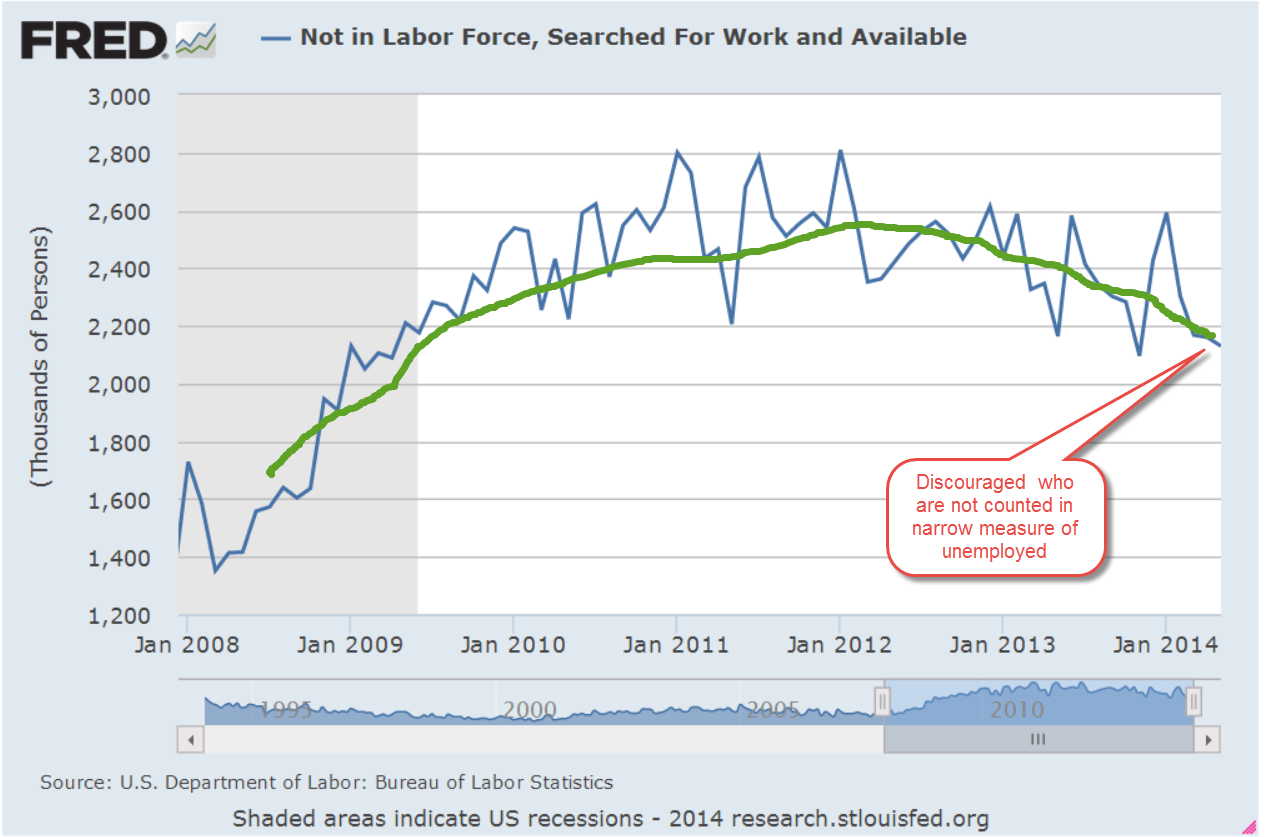
Although there is much variation in the monthly count of people who are classified as discouraged, the trend is downward from the hump in 2011 and 2012.

After breaking above the 95 million mark earlier this year and rising, the number of workers aged 25 – 54, what I call the core work force, has declined back toward the 95 million mark.

According to the monthly survey of businesses, half of all employees are women.  My gut instinct tells me that this is more out of necessity than desire.  Women do what they have to do to meet the needs of their families and many of those jobs may be part-time to accommodate family needs.

The decline in male-dominated employment in the manufacturing and construction sectors can be seen in the declining participation rate of men in the work force.

Earlier in the week, ADP reported private job gains of 180K, below the consensus estimate of 210K.  A graph of the past decade shows that private job growth has steadied during the past year.

We should probably keep this longer-term perspective in mind to balance out the monthly headlines. Zooming in on the past few years shows the dips, one of which was the recent winter lull.  The trick is to keep a balance between the short-term and the long-term.

The market is expecting growth this quarter that will offset the winter weakness and will probably react quite negatively if prominent indicators like employment, auto sales or housing should disappoint.

Over 10,000 boomers a day reach retirement age.   Not all of them retire but some back of the envelope estimates are that 100K or more do drop out of the labor force each month.  For the past eight months or so, new entrants and re-entrants into the job market has offset these retirees and the number of people not in the labor force has leveled off in the range of 91 to 92 million.

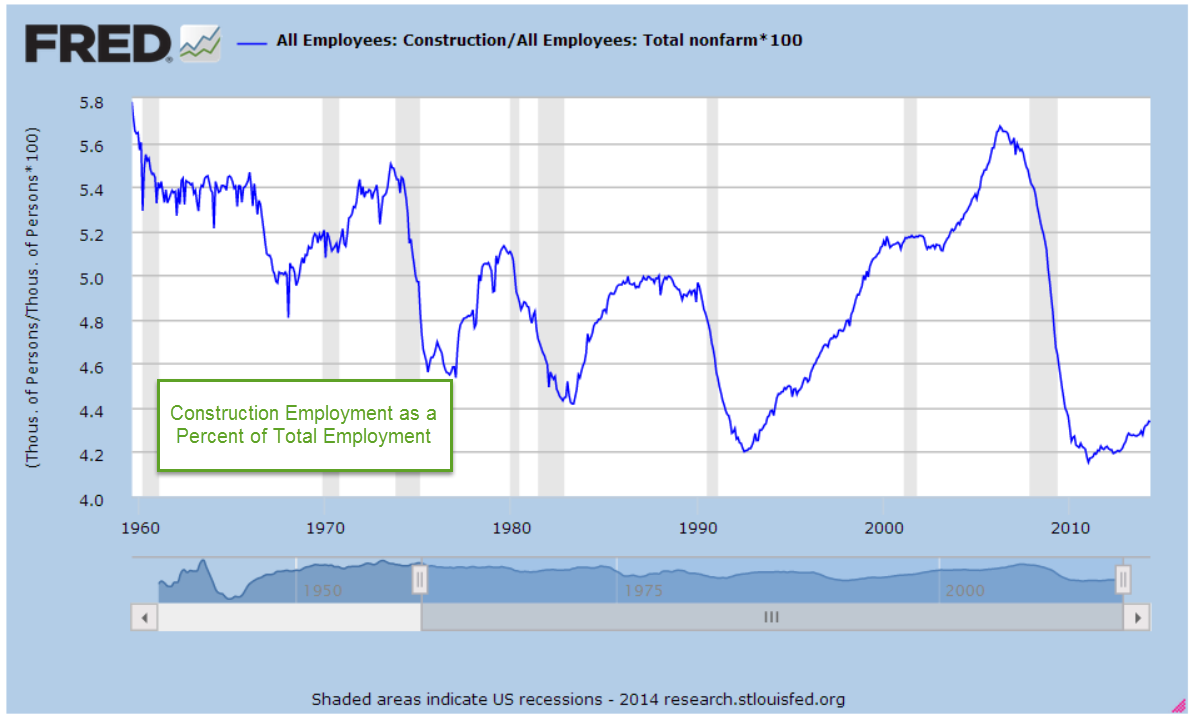
Construction employment finally crossed the psychological 6 million mark this month and for the past year or so has been on the rise from historic lows.  As a percent of the work force, however, employment in this sector is near all-time lows.  Let’s zoom out and look at the past fifty years to get some perspective on this sector.  A more normal percentage of the work force would be about 5%.  The difference is 1 to 1.2 million jobs “missing” in a sector which pays better than average.

In summary, there is a lot to like in the labor reports of the past few months.  But we should not kid ourselves.  The long-term trends show that the challenges are steep.  The question is not whether the glass is half empty or half full.  The question is how many small holes there are in the bottom of the glass.

*********************

Central Banks

Helping to fuel the upward climb in the market this week was the message that central banks are willing to adopt whatever policies they can to support the economy.  In response to the threat of deflation in the Eurozone, the European Central Bank (ECB) made an unprecedented move this week, charging banks 1/10% to park their excess reserves with the central bank.  What does this mean?  Customary policy is that member banks must keep on deposit with the central bank a certain percentage of their outstanding loans and other securities to guard against losses.  For larger banks, this is about 10%.  In a simple example, let’s say that a bank makes another loan for $100.  It must keep an additional $10 on deposit with the central bank.  Let’s say it already has $12 extra on deposit with the central bank.  The central bank would then pay interest to the bank for the extra $2.  The policy change this week by the ECB reverses that policy:  member banks must now pay the central bank for any excess reserves.  Essentially the central bank is charging banks for not making more loans,  a policy which some monetary economists have encouraged the Federal Reserve to adopt.

**********************

CWPI (Constant Weighted Purchasing Index)

On Monday, the Institute for Supply Management released their monthly survey of purchasing managers, then revised it shortly after the release, then revised it again later in the day.  This should remind us that economic gauges are not  like measuring a 2×4 stud with a tape measure.  Seasonal adjustments and other algorithms are applied to most raw data to arrive at a published figure.

The CWPI index I have been tracking for about a year showed further gains in May, rising up from the winter doldrums.  The composite index of the manufacturing and services sectors stands at a bit over 57, solidly in the middle of the strong growth range of 55 to 60.  If the pattern holds, we should expect to see this economic gauge rise during the next few months, peaking at the end of the summer.

An average of two key components of the economy, employment and new orders in the services sector, rose back above 55 this month, a level that hasn’t been seen since last October.

**********************

Key Takeaways

The numbers from the labor market are cause for optimism – job gains are rising while new claims for unemployment are falling.  Auto sales are strong, an indication that consumers have more confidence.  New orders and employment are rising.  Weakness in the housing market bears a close watch.

Labor Report – August Doldrums

This past Friday, the Bureau of Labor Statistics (BLS) released their monthly report for August and the employment gains of 96,000 were below the already muted expectations of 120,000 jobs gained.  Many economists estimate that it takes 150,000 jobs per month just to keep up with population growth.  On the day before the BLS report, the large payroll processing company, ADP, released their estimate of 201,000 private job gains in August, leading some to speculate that total job gains for the month would be above 150,000.  As you can see below, the BLS and ADP counts of private employment closely track each other. (Click to enlarge charts in a separate tab)

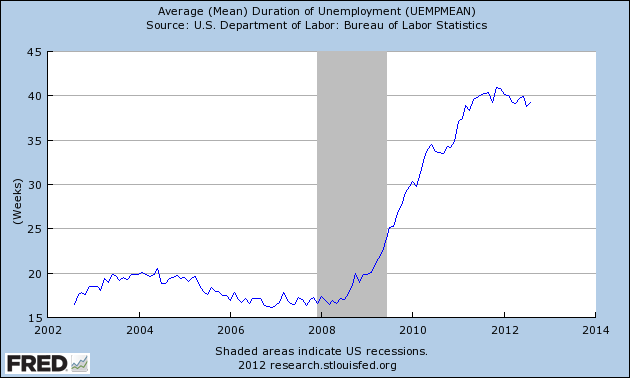
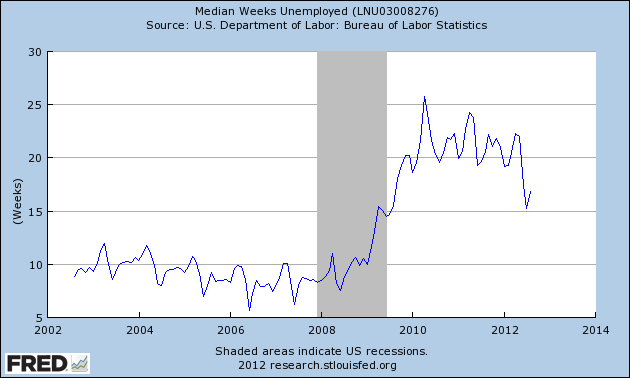
On Thursday afternoon before the Friday morning release of the BLS report, the White House is notified of the numbers.  The disappointing numbers may have led President Obama to tone down the rhetoric of his speech that evening at the Democratic National Convention.  He did not seem to have the “fire in the belly” when he delivered his acceptance speech.  The unemployment rate ticked down from 8.3% to 8.1% because 368,000 dropped out of the work force and are no longer counted as unemployed.  Some of this number retired, either voluntarily or involuntarily.  Some have simply become discouraged.  Some have gone back to school.  The average number of weeks of unemployment is still at high levels. 

Some of this is due to changes in BLS reporting since Obama took office.  Before January 2011, the BLS allowed a maxiumum of 2 years, or 104 weeks in their survey.  Starting in 2011, the BLS allows a maximum of five years, or 260 weeks.  Since a small number of unemployed forces the average number higher, the BLS recommends using the mean for comparison. (BLS Source

Most of Europe is in recession; growth in South America, China and India have slowed.  Several strong economic reports in the winter and spring of this year led many to think that the U.S. economy might be less tethered to this global malaise.  The stock market rose over 10% in the first few months of 2012; then China reported contracting manufacturing and real estate sectors, and European leaders showed their continued inability to resolve the fiscal and monetary policy challenges that threaten to crack the European Union.  We realized that we were not immune to the global financial flu and the stock market fell 10% in May, wiping out the gains of the winter and spring. The monthly employment gains dropped during the summer.

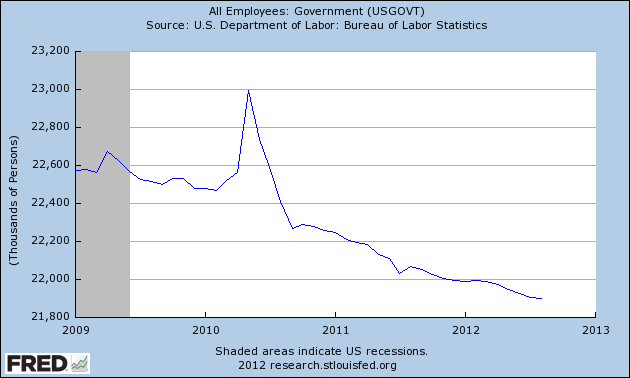
Recent employment and industrial reports have showed that our growth, while still positive, is struggling.  Private job growth has been hampered by the layoffs of government workers, as the chart below shows.

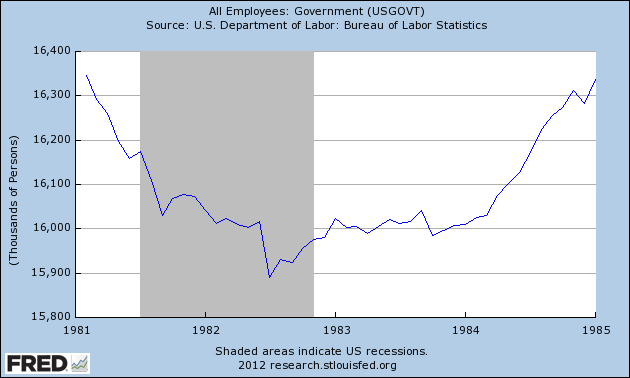
The shedding of government jobs halted this past month as Federal employees actually gained about 3,000.  Those on the left have criticized the Republican House for aggravating job losses in state and local governments by blocking any further federal aid to the states.  A comparison with the first term of the Reagan administration shows a similar decline in government employment during the 1981 – 1982 recession.  However, following the end of the recession, government employment increased in the last two years of his first term and helped Reagan get elected to a second term.  The Democratic House was kinder to Reagan than the current Republican House is to Obama.

The slow growth of the past several months has fueled speculation that the Federal Reserve will once again come to the rescue with a bond buying program.  Since the beginning of June, the stock market has “melted up” on very low volume.  Once again, it is at the peak reached earlier this year and in 2007 before the recession began.

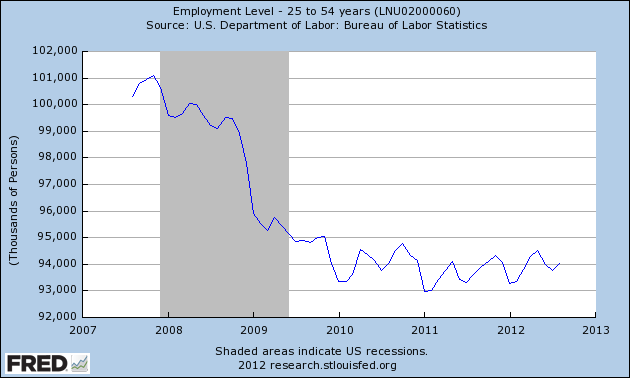
The uninspiring lack of job growth among what I call the core labor force, those aged 25 – 54, is a predictor of a sluggish economy in the near future.  These workers buy a lot of stuff. No jobs, no stuff.

The larger group of adult workers, those aged 25 plus, continues to show gains, indicating that older workers are continuing to keep and get jobs.  The old are simply not making way for the young.  Severe declines in house values and the loss of value in their retirement funds has forced many older workers to continue working longer than they may have planned.  Older workers do no buy a lot of stuff.

During the 2010 elections, Republican candidates for the House promised that job programs would be first priority.  We have been waiting two years.  Both houses of Congress have historically low voter approval ratings yet the burden of the sluggish job growth continues to fall on the President’s shoulders.  Politicians on the Republican side of this dysfunctional Congress point to the President as the cause of the muddle through labor market; they know most voters can’t remember what they learned in civics class in grade school and don’t understand that it is Congress, not the President, that initiates legislation.  It is Congress, both Democrats and Republicans in the House and Senate, that is responsible for the lack of job growth.  Who elected these men and women to the Congress?  Look in the mirror.  That’s who’s responsible for the slow job growth. 

January JOLTS

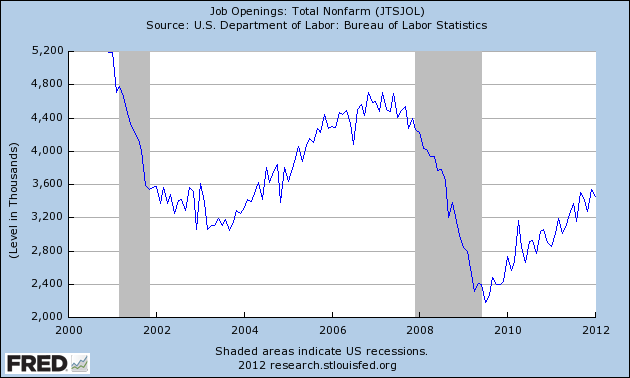
As a followup to my blog on the February jobs report and the job openings for December, here is the job openings report – JOLTS – for January from the Bureau of Labor Statistics:

The number of job openings in January was 3.5 million, unchanged from
December. Although the number of job openings remained
below the 4.3 million openings when the recession began in December
2007, the number of job openings has increased 45 percent since the
end of the recession in June 2009.

These are seasonally adjusted figures. As the graph shows there is steady but stuttering progress.

The Core Work Force

The Bureau of Labor Statistics (BLS) released their monthly Employment Summary this past Friday and the market cheered, the Dow jumping up 100 or so at the open.  The Sunday talk shows have been abuzz about the report, which showed a January gain of 243,000 jobs.  After 5 months of increasing job gains, how improved are Obama’s chances of re-election?  Does the improving job picture cause the Republican Presidential contenders to change course a bit?  Wanting not to appear as though they are rooting against the American economy, do the contenders aim at specific policies of Obama in the coming months?  With the S&P500 index at 1344, some market pundits are whispering the 1500 mark that the S&P could take a run at this year.  Holy moly, macanoli, what a buzz about one labor report!

The labor report is only part of the picture puzzle that shows an improving economy.  The ISM manufacturing report was slightly below expectations but still growing.  Two key components of the index, new orders and backlogs, showed a robust increase, hinting at continuing improvement in the coming months.  The recent durable goods report shows that businesses are building inventories, a sign that expectations are improving.   Retail sales tapered off in December, but Personal Income was slightly above expectations, growing .5% over November.  Caterpillar, the large equipment maker, is looking forward to revenue and profit increases in 2012, reducing earlier concerns of a global recession.  A recent report indicates that the ongoing contraction in China’s manufacturing has slowed and is close to the neutral mark between contraction and growth. 

So, what’s not to like?

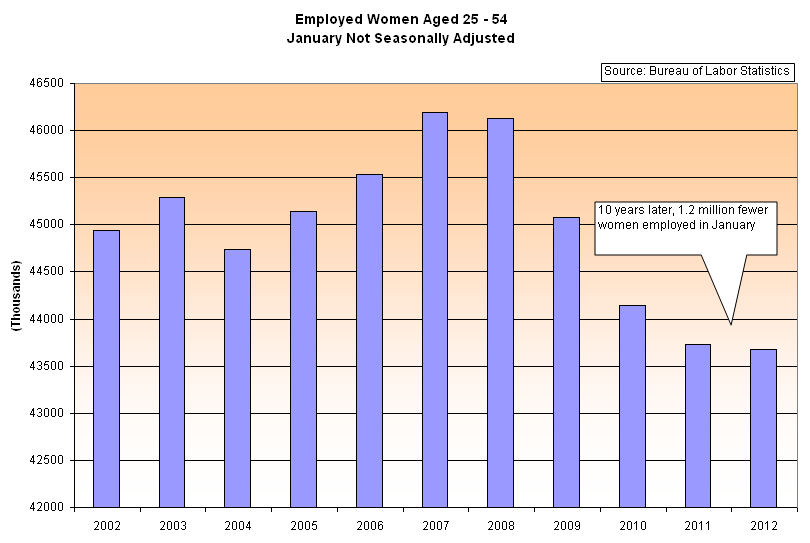
Looking past the monthly headline numbers of job growth, let’s look at this country’s core work force, men and women aged 25-54.  The BLS just made several census adjustments which resulted in upward revisions to seasonally adjusted job growth from April to December.  Instead of looking at seasonally adjusted numbers, I’ll take a look at the raw numbers from the BLS employment report for January and compare them to BLS January data for the past ten years.

A unseasonably warm winter throughout much of the U.S. gave a boost to construction jobs in the office building and multi-family residential construction.  Although the construction industry is still far below 2007 levels, that boost shows up in a comparison of employed men aged 25 – 54 from last January to this January. (Click to enlarge in separate tab)

The ongoing attrition in government jobs, which disproportionately employs women, has slowed but is still evident in comparisons with past Januaries.

This rather tepid growth, or lack of it, in our core work force is troubling.  This age demographic forms the backbone of a healthy economy, raising children, buying furniture and homes, saving for retirement and their kid’s college. Any job growth is good, but when I see a better improvement in the employment numbers for this group, I will know that we are building a resilient economy, one that can withstand some shocks.  We know of some possible shocks – the probable default of Greece, the ongoing recession in Europe and the possibility of some armed conflict with Iran, to name but three.  The shocks we don’t forsee are what can push our economy off balance.  Last year was a reminder of the impact of unforeseen shocks.  The tsunami  in Japan and the flooding in Thailand not only devastated those countries and their people but impacted supply chains in Asia and consequently sent after shocks throughout the world.

Recently fashionable has been talk of a decoupling of the U.S. and emerging countries’ economies from the sovereign debt and financial troubles in Europe.  If recent history has taught us nothing, it is that much of the world is joined together by interdependent webs of financial conglomerates and the monetary policies of nation states, by the tension between global consumer demand and multi-national supply chains to meet that demand.

Economic Weather

Understanding and predicting the economic weather is less precise than, well, predicting the weather.  The stock market is a composite “vote” of the direction and strength of corporate profits in the coming six months to a year.  It is not a barometer of what the economy will do, but an indicator of people’s predictions, their fears, their hopes. Predicting the economic weather involves a complex interplay of many factors, which, by themselves, are not that complicated.  It is the interplay and the weight, or importance, given to each factor that accounts for the range of prediction.

Henry Blodget is a former Wall St. analyst who was indicted by the Securities and Exchange commission for ethics violations during the “dot com” boom at the end of the nineties.  Blodget subsequently founded the Business Insider, a blog about trends in business and the economy.  Here  is a compilation of charts on the labor market, housing, and manufacturing output for several decades.  You may or may not agree with Blodget’s dire prognostications but the overall picture of data that he has pulled together is worth a look.

The Labor Force


Here’s a time series graph of the Colorado civilian labor force, which includes everyone over 16 not institutionalized or in the service and who is either working at least a few hours or looking for work. If a person is retired, they are not in labor force. Nor is a person who has given up looking for work and no longer bothers to register with the state unemployment office after running out of benefits.

I have added some approximate numbers in the graph to highlight the employment – or rather lack of it – problem. The difference between the upper green line and lower green line is about 100,000 decrease in the number of people counted in the labor force in the last 15 months or so. Despite that decrease, the graph shows an increase of 300,000 in the labor force over the past decade. Until the latter part of 2008, Colorado enjoyed a low unemployment rate, meaning that most of that net 300,000 growth was new jobs being created. So, what’s the problem? New jobs are good, right?

This past week came the announcement that Colorado’s estimated population had crossed the 5 million mark, meaning that, in the past decade, the population has grown by approximately 700,000. Colorado has a relatively younger population. In a healthy economy, the ratio of those in its workforce to those not in the workforce is about 55 to 45, higher than the national average of 51 to 49. As a comparison, Florida has an older population and its ratio has averaged 49 to 51 over the decade.

With the population increase scaled to this ratio and overlayed on the graph (blue line), we can see that the growth in the labor force matched the growth in the population until the past year or so. With an total estimated population of 5 million, a healthier labor force would total about 2.75 million. We are about 80,000 short.