Ingredients of a Good Society

November 30, 2025

By Stephen Stofka

Seated around the table this Thanksgiving week were several generations, Boomers, GenX, Millennials and Zoomers. Here is a list of generational cohorts and the span of their birth years (Source). Some Boomers reminisced about rock groups and concerts they had been to in the 1960s, 70s and 80s. The names might have been vaguely familiar to the late Millennials and Zoomers. The younger folks talked about video games and music groups that were barely familiar to the old timers there. One younger person had repetitive motion syndrome, like an arthritis in their thumb from overuse of a game controller. The Boomers at the table had the arthritis of old age, unable to bend a thumb into a 90 degree angle.

The multi-generational gathering prompted me to look at the world through the lens of age, from the young to the old. As we grow up, we borrow money for a car, a vacation, higher education or a house. The source of those funds is the savings of older workers and retired people. As we reach middle age, we become keenly aware of our future financial security. Our social contract is an intergenerational compact, a churning of money between the generations. Money helps support our sense of security and I thought security would be a good second avenue of exploration.

We don’t get to choose our birth parents, our country or time of birth. All of us are fragile at birth, but some of us are born into fragile circumstances. Our country may be at war or suffering  political instability. Our community or home may be violent. Perhaps our parents are poor or homeless. One or both parents may have a mental illness or a drug addiction. We grow up in an environment of fear and anger, then absorb that into our personality, our soul. Or we may be born into a stable home and community where fear and anxiety is not the background music to our daily lives.

Professional athletes test the boundaries of their sense of security. They develop strength, stamina and skills by extending their comfort zone. By repeatedly taking chances, they learn to use their fear as a preparation for competition. When a top athlete starts fighting the fear instead of using it, they can’t compete at the highest levels. They are competing with their own fear instead of another athlete.

In his book Leviathan, the 17th century philosopher Thomas Hobbes (1588 – 1679) wrote that the instinct for survival was an essential characteristic of human temperament. Government was an artificial creature created by society as a means of security in an “every man for himself” world. For that security, we traded away some of our individual freedom, reaching a delicate compromise between security and freedom. In ancient Mesopotamian lore, the Leviathan was a sea serpent that attacked sailing ships (Source). I like to think that Hobbes chose that mythical creature to symbolize the danger inherent in a sovereign government. It is not a benign force in our lives, but the lesser evil.

This is in stark contrast to another 17th century philosopher John Locke (1632 – 1704), who saw government as the instantiation of a social contract. Government was a protector, a guarantor of natural rights. These two different perspectives of government shape the policy choices we favor. Libertarians think government should be a peacekeeper, a security broker between all the elements in society. It should be a keeper of the commons, the public institutions that connect us and guard both our internal and external security. It should facilitate the economic exchange between local regions, between people and companies as we provide for our daily needs. It should protect and enforce the sanctity of contract that supports that economic exchange.

Liberals favor a far more expansive role for government as the embodiment of the social contract. Even the word security has a broad meaning that encompasses far more than physical protection from harm. On his annual State of the Union speech on January 6, 1941, President Roosevelt articulated four freedoms, one of which was a freedom from want. As Roosevelt saw it, government had a responsibility to provide some economic and health security to its citizens. These two visions of the boundaries of a government’s responsibility underlie much of the Congressional combat we read about each day.

Hobbes was alive in 1648 when the Treaty of Westphalia ended the Thirty Years War and established state sovereignty within the Holy Roman Empire. To maintain its sovereignty, or self-governance within its territory, a state must manage the flow of people and goods across the borders of it territory. We do not choose our country of birth but we can choose to flee that country if political and economic circumstances threaten the security of ourselves or our family. Do immigrants have a natural right to live in a safe and flourishing environment wherever they choose? Immigrants can challenge a country’s management of its borders and in doing so, challenge its sovereignty and security.

A state cannot live by the same principles as people. In the Groundwork of the Metaphysics of Morals, the philosopher Immanuel Kant (1785) wrote that people were autonomous individuals with an intrinsic worth and in pursuit of their own purposes. Even though we interact with people in limited roles during the course of our daily exchange, we should respect their autonomy and dignity and not regard people merely as tools. In international relations, a liberal perspective wants states to abide by that Kantian principle.

States are not people, living in a society where a government provides some security. States live in the dog eat dog world that Hobbes imagined, a state of anarchy where each state must be on guard against threats from other states. That is the realist perspective in international relations. To protect their autonomy, sovereignty and capacity, they must occasionally act in a ruthless manner. During war, states draft men in their late teens and twenties, taking disproportionately from some families and not others. Is that fair? The key to survival is surviving, not fairness.

If their parents cannot bring them enough food, then eagle chicks will kill their siblings to increase their share of food. Is that fair? No. Is it moral? No. Without morality, there can be no dignity. Kant simply posited an inherent dignity to each individual, a fait accompli. Even though they lived at different times, I imagine that Hobbes would have been dubious of such a claim. Dignity is not inherent but ensured by a government that makes and enforces rules. I imagine that Locke would have countered Hobbes by arguing that governing by cooperation works better than intimidation. That requires a consensus among the individuals of society who recognize the benefits of the tradeoff between security and freedom. The debate is a constant tug of war between different visions and principles.

Young states are vulnerable to threats from more established states. Their political, military and bureaucratic systems are not fully developed and tested. The newborn United States was mindful of the threats posed by older European powers like England, France and Spain as well as the native Indians. In a major revision to the 1776 Articles of Confederation that bound the 13 colonies into a United States, the Constitution, drafted in 1787, gave the office of the President a lot of power to counter those threats. Many Presidents, including President Trump, have tested the boundaries of that power. Rarely have the other two branches of government offered so little resistance. All of the generations sitting at the Thanksgiving dinner table were worried about that.

Compromise is at the heart of the Chinese notion of the interaction between yin and yang. Freedom and security are like that, ever searching for a balance. Too much of one results in too little of the other. Each lifetime contains about four generations with different priorities. They must reach a political compromise but can never reach a satisfactory compromise that satisfies those different priorities. I hope everyone had a good holiday and I will see you next week.

/////////////////////

Photo by Jed Owen on Unsplash

The Political Middle

October 12, 2025

By Stephen Stofka

In the past few weeks, I have focused on the progressives and conservatives, two groups that have opposite ideologies regarding the social order. This week I will look at those ideologies that lie between those two extremes. First, let’s look at degrees of equality, a key characteristic of political ideologies. I’ll start with the extremes.

Progressives believe in the goal of an egalitarian society where everyone is equal in rights, resources and opportunities. The justification for that goal is a belief that all human beings have an intrinsic moral worth that is equal, a spirit embodied in the Declaration of Independence (Source). Inequality is a defect in the political, social and economic institutions that must be modified or expunged. Progressives thought that the equality promised by the Declaration of Independence and guaranteed by the 14th Amendment were intrinsically linked to economic equality, job opportunities, and pay equality.

Conservatives reject this approach. People of many persuasions, religious or secular, cringe at the claim that Mother Teresa and Hitler had the same moral worth. Despite the separation of Church and state in the First Amendment, the principles of the founding generation were built on conflicting religious beliefs. Some Protestant Christian sects believe in predestination, that God has chosen the saved and unsaved. Many Southern Baptists and Presbyterians, numbering almost 16 million in the US, cling to that doctrine (Source, Source). Others within the Protestant tradition are Arminian, believing that people can redeem themselves through faith. Catholics take a more nuanced view that faith, God’s grace, and good works can help a person attain salvation (Source). Each of these religious traditions focuses on the individual rather than the institutional environment.

Edmund Burke was an 18th century English philosopher, political writer and Parliamentarian who founded modern conservatism. In 1790 he wrote an essay Reflections on the Revolution in France that was highly critical of the overthrow of the aristocracy in the French Revolution. He wrote “all men have equal rights, but not to equal things.” He believed that societies evolved over generations to form a cohesive coalition of many roles occupied by people with different temperaments and talents (Source).

Burke had less faith in reason than Locke and worried about the disruptive force of people’s passions. Ruling institutions must “thwart” the “inclinations of man,” control their wills and subject their passions. Taking a broader perspective, Burke wrote, “In this sense the restraints on men, as well as their liberties, are to be reckoned among their rights.” That may seem curious. How is a restraint on me a right? Burke seemed to reason that a restraint placed with equal force on my neighbor may protect me from my neighbor’s passion. This viewpoint is rather utopian for restraints are not implemented equally on each individual. Those inequalities are the systemic defects that the progressives rightly criticize.

At either end of this axis of equality and inequality lie the Progressives and Conservatives. Let’s turn to the ideologies that occupy the middle between these two extremes. To the right of center there are classical liberals and neoconservatives. Neoliberals lie on either side of the center and liberals are to the left. Although neoconservatives do not have liberal in their name they evolved from classical liberalism with some important differences. Let’s start with classical liberalism.

The classical liberal tradition began with John Locke, a 17th century British philosopher. In Two Treatises of Government, he argued that people had natural rights given to them by God and that a government was bound to respect and protect those rights. Writing at the dawn of the Age of  Enlightenment, Locke argued that reason distinguishes human beings from other animals (Source, p. 20). Reason was God’s gift to each individual to use in the pursuit of happiness and freedom (Source).

Because a person has a property right to their own labor, Locke despised the institution of slavery. In Two Treatises, he wrote “Slavery is so vile and miserable an estate of man, and so directly opposite to the generous temper and courage of our nation, that it is hardly to be conceived that an Englishman, much less a gentleman, should plead for it” (Source, p. 7) Behind closed doors in a courthouse in Philadelphia, some of the framers of America’s Constitution reviled slavery as well but could not convince southern slaveowners whose economic self-interest and social status trumped liberal principles.  

The Constitution did not include any protections for the property rights of women either. As the nation prepared to declare independence from Britain in 1776, eleven years before the Constitution, Abigail Adams, the wife of John Adams, wrote in a letter to her husband, “I desire you would Remember the Ladies, and be more generous and favorable to them than your ancestors. Do not put such unlimited power into the hands of the Husbands. Remember all Men would be tyrants if they could. If perticuliar care and attention is not paid to the Laidies we are determined to foment a Rebelion, and will not hold ourselves bound by any Laws in which we have no voice, or Representation” (Source. Note: several decades later, Daniel Webster’s dictionaries helped standardize the spelling of many words).

The Constitution is intertwined with both progressive and conservative sentiments regarding equality and inequality. The document was a compromise after much argument. It is no wonder that we continue to argue over this central issue.

Like John Locke, the 18th century philosopher Adam Smith thought that the market helped rational people pursue their self-interest and advocated a limited role for government in the market. In business or in government, men were not angels. In the Wealth of Nations he criticized businessmen  who were prone to price fixing. In government, officials interfered with commerce, granting their allies monopolies on certain markets. In The Rise and Fall of the Neoliberal Order, Gary Gerstle (2022) writes that classical liberalism “sought to liberate markets from encumbrances: monarchy, mercantilism, bureaucracy, artificial borders and tariffs.” It wanted to “release the economy from the heavy hand of the state in its various guises” (p. 6).

Although libertarians champion the values and principles of classical liberalism, they disagree on the limits of government’s role in governing individual behavior, economic or otherwise. The accept the principle of equality, but reject the idea that government should take from some and give to others to achieve equality. Ardent libertarians regard such social taxation to be a violation of one’s property rights. Some libertarians advocate an extremely minimalist role for government in society. Others adopt a more practical approach that admits a more expansive role for government in a highly complex society and economy.

This sense of realism is shared with neoconservatives who argue that the role of government is to preserve moral order in a domestic society, and promote democratic principles and institutions around the world. Neoconservatives advocate both soft and hard power to combat the inherent anarchy of the world order. Contrast this darker outlook on human nature with Locke’s view that rational human beings are capable of self-governance.

Gary Gerstle (2022, p. 5) argues that the term liberal describes the version of social democracy that the Roosevelt administration introduced during the 1930s. Some call it modern liberalism to distinguish it from classical liberalism. During FDR’s presidency, the government exerted a far greater force in the market than previous administrations. At a time when 25% of working age people were unemployed and millions had lost their savings, FDR expanded government’s role to achieve more social and economic well-being.

In his first 100 days, FDR signed 99 executive orders to bring some quick relief to a nation suffering during the Great Depression. He did not act alone. In that time, Congress passed almost as many laws (Source), a partnership of the executive and legislative branches. In his second term, Trump has broken that record, signing 143 order in his first 100 days. However, Congress has been little more than a silent partner, quietly acquiescing as the executive assumes much of its legislative power. In the first 100 days, Congress passed only five laws, a stark contrast to the vigorous production of the 1930s Congress (Source).

During the 1960s, modern liberalism evolved to place far more emphasis on equality among members of society. Progressives wanted to use all the power of government to achieve an egalitarian society, a utopia of equality. In the 1970s, neoliberalism arose as a counterforce. Ronald Reagan, Margaret Thatcher, and economist Milton Friedman were right of center, placing little emphasis on economic equality. They believed that the market was the best mechanism to distribute the rewards and risks of individual behavior. They wanted to blend elements of 19th century classical liberalism with some social supports of 20th century liberalism like Social Security. Bill Clinton espoused a version of neoliberalism that was left of center with more emphasis on economic equality. His administration coupled government social welfare supports with individual effort and market incentives. In an ironic twist, Gerstle argues, the neoliberals used as much coercion to implement market reforms as the liberals had used to achieve a more equal distribution of economic gains (p. 7).

Our political loyalties may shift with age, sometimes with circumstance. Many of us do not cling to a consistent political ideology on every issue. We may vary our emphasis on some principles. Our priorities and viewpoints change. When I was in my twenties, I was against Social Security. Like so many government programs, it was poorly designed from the start. Until 1960, the combined tax share for both workers and employers was less than 6%. By 1980, the combined tax had doubled to 12% and the program was still running out of money (Source). In my view at that time, retiring workers had paid relatively little and were “milking” the younger generation. We had to keep paying higher Social Security taxes at a time when inflation was more than 10%. Some of us struggled to pay rent and feed our families so that we could pay some stranger’s retirement benefits.

Regardless of ideology, each of us has a unique sense of what is fair. That is true north on our moral compass and we act on that. That needle may sometimes point to the left or right on an issue or a candidate. No matter how pollsters and political analysts categorize our beliefs, we have only one political ideology, the Fair ideology.

////////////

Photo by Tomoe Steineck on Unsplash

Gerstle, G. (2022). The rise and fall of the neoliberal order: America and the world in the free market era. Oxford University Press.

Pandemic Detour

July 19, 2020

by Steve Stofka

World War 1 and the flu epidemic that followed was the death knell for the 19th century. Previous epidemics ended the Middle Ages in the 14th century and the Renaissance in the 17th century. Pandemics are permanent detours onto an alternative route through time. Will historians regard the Covid pandemic as the close of the 20th century? Depends on what happens in the next hundred years. History travels slow as a tortoise. The present is as fast as Achilles and eventually overtakes the past.

Pandemics cleanse the politics of the age. Both political parties have fractured in the past two decades. Will this pandemic close the coffin on one or both parties? In name, no. Both parties have a duopoly on voting in each state so sub-groups within each party try to take over the party apparatus. The 2016 election was a takeover of the Republican Party by conservative media, legal and political interests that have been fighting for control of the party since the 1980s.

President Trump is the poster boy of that effort. Conservative groups needed someone to sign off on judicial appointments and other legislation. They preferred someone with little experience, who was impressionable and a bit dim for the rigors of the office. They got more buffoon than they bargained for. If he becomes a one-term President, the people, organizations and money that put him in power will fight their long game – to gut or eliminate most of the federal bureaucracy. The few Federal government institutions left will be the military, a slim State department, domestic policing agencies like the DEA and the Border Patrol, the Treasury, IRS and the courts. In a strict conservative view, defense, enforcement, monetary authority and justice are the only legitimate functions of a federal government.

Each pandemic is a challenge to competing visions of the future. Conservative groups have patience, resolve, and money. If they have their way, the 20th century will have been a political experiment in American socialism that began when progressives gained political power at the start of the last century. The 21st century will return the country to its founding principles.

Liberals envision a more expansive role for a central government. Should there be a limit to the role of government in our daily lives and where should it be set? Without a limiting principle, liberal groups struggle to develop a concise and cohesive philosophy. Perhaps that is the strength of a liberal viewpoint.

Americans have been fighting each other for far longer than they have fought with the rest of the world. In a country with diverse cultural backgrounds, social and political tension is inevitable. The 1918 epidemic helped reshape the country but did not end this grand experiment in republican democracy. Let’s hope that the 2020 pandemic doesn’t change the chemistry of this country so drastically that the experiment ends.

/////////////

Notes:

Photo by 35mm on Unsplash

Employment, Income and GDP

May 4th, 2014

Employment

Private payroll processor ADP estimated job gains of 220K in April and revised March’s estimate 10% higher, indicating an economy that is picking up some steam.  Of course, we have seen this, done that, as the saying goes.  Good job gains in the early months of 2012 and 2013 sparked hopes of a strong resurgence of economic growth followed by OK growth.

New unemployment claims this week were pushing 350K, a bit surprising.  The weekly numbers are a bit volatile and the 4 week average is still rather low at 320K.  In a period of resurgent growth, that four week average should continue to drift downward, not reverse direction. Given the strong corporate profit growth expectations in the second half of the year, there is a curious wariness in the market.  Conflicting data like this keeps buyers on the sidelines, waiting for some confirmation.  CALPERS, the California Employees Pension Fund with almost $200 billion in assets, expressed some difficulty finding value in U.S. equities and is looking abroad to invest new dollars.

On Friday, the Bureau of Labor Statistics reported job gains of 288K in April, including 15K government jobs.  Most sectors of the economy reported gains but there are several surprises in this report.  The unemployment rate dropped to 6.3% from 6.7% the previous month, but the decline owes much to a huge drop in labor force participation.  After poking through the 156 million mark recently, the labor force shrank more than 800,000 in April, more than wiping out the 500,000 increase in March.

To give recent history some context notice the steady rise in the labor force since the end of World War 2, followed by a flattening of growth in the past six years.

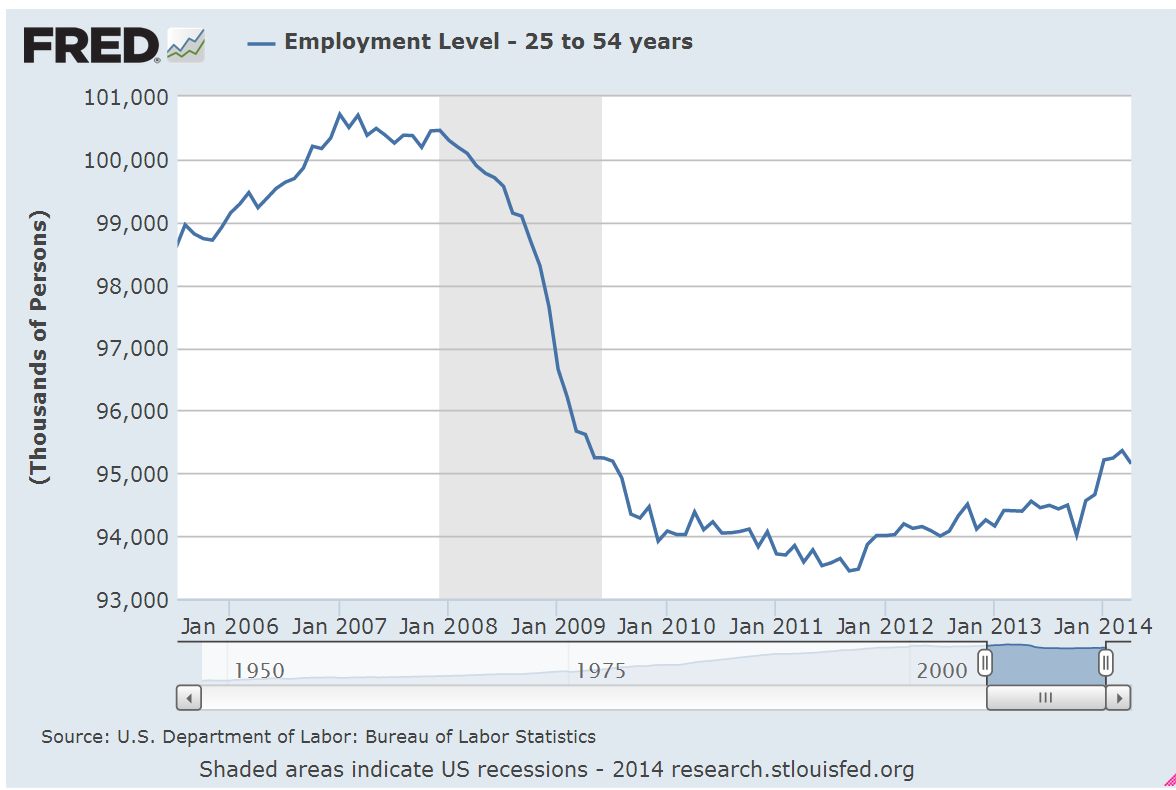
The core work force, those aged 25 – 54 years, finally broke through the 95 million level in January and rose incrementally in February and March.  It was a bit disappointing that employment in this age group dropped slightly this month.

To give this some perspective, look at the employment rate for this age group. Was the strong growth of employment in the core work force largely a Boomer phenomenon unlikely to repeat?  Perhaps this is why the Fed indicated this week that we may have to lower our expectations of growth in the future.

Discouraged job seekers and involuntary part timers saw little change in this latest report.  On the positive side, there was no increase.  On the negative side, these should decline in a growing economy.  There simply isn’t enough growth.  Was the strong pickup in jobs this past month a sign of a resurgent economy?  Was it simply a make up for growth hampered by the exceptional winter?  The answers to these and other questions will become clearer in the future.  My time machine is in the shop.

************************

GDP

Go back with me now to those days of yesteryear – actually, it was last year.  Real GDP growth crossed the 4% line in mid year.  The crowd cheered.  Then the economic engine began to slow down. The initial estimate of fourth quarter growth a few months ago was 3.2%.  The second estimate for that period was revised down to 2.4%, far below a half century’s average of 3%.  This week the final estimate was nudged up a bit to 2.6%, but still below the long term average.

Earlier in the week, the Federal Reserve announced that it will continue its steady tapering of bond buying and that it may have to adjust long term policy to a slower growth model.  The harsh winter makes any analysis rather tentative so we can guess the Fed doesn’t want to get it wrong?

************************

Manufacturing – ISM

ISM reported an upswing in manufacturing activity in April, approaching the level of strong growth.  The focus will be on the service sector which has been expanding at a modest clip.  I’ll update the CWPI when the ISM Service sector report comes out next week.

************************

Income – Spending

Consumer income and spending showed respectable annual gains of 3.4% and 4.0%.  The BLS reported that earnings have increased 1.9% in the past twelve months. CPI annual growth is a bit over 1% so workers are keeping ahead of inflation, but not by much.   Auto sales remain very strong and the percentage of truck sales is rising toward 60%, a sign of growing confidence by those in the construction and service trades.  Construction spending rose in March .2% and is up over 8% year over year but the leveling off of the residential housing market has clearly had an effect on this sector in the past six months.

***********************************

Conservative and Liberals

While this blog focuses mainly on investing and economics, public policy is becoming an ever increasing part of each family’s economic heatlh, both now and particularly in the future.
Some conservatives say that they endorse policies which strengthen the family yet are against rent control, minimum wage and family leave laws, all of which do support families.  How to explain this apparent contradiction?  A feature of philosophies, be they political, social or economic, is that they have a set of rules.  Some rules may be common to competing philosophies but what distinguishes a conceptual framework or viewpoint is the difference in the ordering of those rules.  The prolific author Isaac Asimov, biologist and science fiction writer, proposed a set of three rules programmed into each robot to safeguard humans.  A robot could not obey the second law if it conflicted with the first.  Robots are rigid; humans are not.  Yet we do construct some ordering of our rules.

A conservative, then, might have a rule that policies that protect the family are good.  But conservatives also have two higher priority rules which honor the sanctity of contract and private property: 1) that government should not interfere in voluntary private contracts, and 2) that private property is not to be taken from private individuals or companies without some compensation, either money or an exchange of a good or service. Through rent control policies, governments interfere in a private contract between landlord and tenant and essentially take money from a landlord and give it to a tenant, a violation of both rules 1 and 2.  Minimum wage and mandatory family leave laws enable a government to interfere in a private contract between employer and employee and essentially transfer money from one to the other, another violation of both rules.

In my state, Colorado, there is no rent control.  Instead, landlords receive a prevailing market price and low income tenants receive housing subsidies and energy assistance.  Under rent control, money is taken from a specific subset of the population, landlords, and given to tenants.  Under housing subsidies, money is taken from general tax revenues of one sort or another and given to tenants.  Of the two systems, housing subsidies seems the fairer but many conservatives object to either policy because the government takes from individuals or companies without any exchange, a violation of rule #2.  All policies like housing subsidies which involve transfers of income from one person to another, are mandatory charity, and violate rule #2.

Liberals want to support families as well but they have a different set of rules that prioritizes the sanctity of the social contract: 1) individuals living in a society have an obligation to the well being of other members of that society, and 2) those with greater means have a greater obligation to the well being of the society.  A government which is representative of the individuals of that society has the responsibility to facilitate the movement of wealth and income among those individuals in order to achieve a more equitable balance of happiness within the society.  Flat tax policies espoused by more conservative individuals violate rule #2.  Libertarian proposals for a much smaller regulatory role for government violate rule #1.

For liberals, both of the above rules are subservient to the prime rule: humans have a greater priority than things.  When the preservation of property rights violates the prime rule, property rights are diminished in preference to the preservation of human well-being.  On the other hand, conservatives view property rights as an integral aspect of being human; to diminish property rights is to diminish an individual’s humanity.

In the centuries old dynamic tension between the individual and the group, the liberal view is more tribal, focusing on the well being of the group.  Liberals sometimes ridicule some tax policies espoused by conservatives as “trickle down economics.”  In a touch of irony, it is liberals who truly believe in a trickle down approach in social and economic policies.  The liberal philosophy seeks to protect society from the natural and sometimes reckless self-interest of the individuals within that society. The conservative viewpoint is concerned more with the protection of the individual from the group, believing that the group will achieve a greater degree of well-being if the individuals are secure in their contracts and property. Conservatives then favor what could be called a bottom up approach to organizing society.

Conservatives honor the social contract but give it a lower priority than private contracts.  Liberals honor private contracts but not if they conflict with the social contract. Most people probably fall somewhere on the scale between the two ends of these philosophies and arguments about which approach is “right” will never resolve the fundamental discord between these two philosophies.

In the coming years, we are going to have to learn to negotiate between these two philosophies or public policy will have little direction or effectiveness.  Negotiating between the two will require an understanding of the ordering of priorities of each ideological camp.

Before the 1970s political candidates were picked by the party bosses in each state, who picked those candidates they thought would appeal to the most party voters in the district.   The present system of promoting political candidates by a primary system within each state has favored candidates who are fervent advocates of a strictly conservative or liberal philosophy, chosen by a small group of equally fervent voters in each state.  The middle has mostly deserted each party, leading to a growing polarization.  Survey after survey reveals that the views of most voters are not as polarized as the candidates who are elected to represent them. A graph from the Brookings Institution shows the increasing polarity of the Congress, while repeated surveys indicate that voters are rather evenly divided.