A Debate On Medicare

December 8, 2024

by Stephen Stofka

This is part 4 of a weekly series of debates on various issues, including climate change, pollution, rent control and market failures in general.

Abel said, “I’d like to pick up where we left off last week, talking about monopolies.”

Cain added, “And monopsonies, you said, where there is only one buyer in a specific market.”

Abel nodded. “There is no better example of both monopoly and monopsony than the health care industry. Your group wants to keep government interference in the market to a minimum. In the health care market, it’s just not possible.”

Cain said, “Private companies offer health insurance. Why do we need government?”

Abel replied, “A product might be labeled health insurance, but insurance companies stay in business by selling risk mitigation. Consumers buy an insurance policy to protect them from a large expense. A for-profit insurance company has an obligation to their shareholders first and they use every legal ruse to reduce the amount they pay on medical claims from their customers.”

Cain argued, “We agree that insurers sometimes deny or delay legitimate claims for care. Congress passed Medicare in 1965 to provide low-cost health care to seniors. The government uses less discretion in paying claims but pays below market rates. That system welcomes fraud and abuse. Health and Human Services estimated that the Medicare and Medicaid programs paid out $100 billion in improper payments in 2023.”

Abel nodded. “The price system doesn’t account for dishonesty by private providers. All the more reason why there has to be greater supervision by government agencies to ensure compliance. A frequent police presence incentivizes people to police themselves.”

Cain disagreed, “No, the government has become a monopsony in the healthcare market. Providers are attracted to Medicare because there is such a large pool of buying power. Providers and suppliers are eager – too – eager – to diagnose and treat older people. Those are resources that cannot be spent on younger people.”

Abel countered, “Younger adults in their prime working years use far less health care services than older people. Without government subsidies, an insurance company would need to charge a prohibitively high rate to insure 70-year-olds.”

Cain asserted, “When people or things get old, they require more service. Imagine if the government funded low-cost auto repairs on cars that were more than ten years old. Car makers would be reluctant to develop improvements in newer car models. Why bother? There is more profit in fixing up the old cars.”

Abel protested, “That’s a stupid analogy. People are not cars.”

Cain nodded. “Exactly. My point is that our society is currently spending a lot of money on old people and the diseases that affect old people. That money is not available to help young people, the newer models of people.”

Abel argued, “Your group sees every problem in dollars and cents. Health care is about human dignity and flourishing as well as the alleviation of suffering, especially for older people who have spent a lifetime working and contributing to their community. What is the price of human dignity? The price system is incapable of measuring the value of intangibles that are precious to us. Government’s role is to protect those qualities we hold dear and that takes regular intervention. Government can’t just step in, assign property rights and let the private market and the price system manage the problem.”

Cain shook his head. “As a share of GDP, healthcare spending in this country continues to grow larger. Per capita spending on healthcare has more than doubled since 2001. The Centers for Medicare and Medicaid Services says that the share was 17.3% in 2022. Out of every $6 of economic activity in this country, more than $1 is spent on healthcare.”

Abel explained, “But that’s because the Boomer generation is so large, and many are seniors. Naturally, healthcare spending will rise because older people use more healthcare services.”

Cain replied, “Yeah, but Medicare spending as a share of total healthcare costs was rising before any of the Boomers became eligible for Medicare. In 2001, Medicare spending was just $1 out of every $5 spent on healthcare. By 2011, that share was more than $1 out of every $4 and the first Boomers had just turned 65 and become eligible for Medicare. In 2021, Medicare spending accounted for almost $1 out of every $3 spent on healthcare (FRED chart and data here). Out of $20 spent in the entire economy, the government now spends $1 taking care of old people. And that doesn’t include Medicaid spending on low- income seniors. That is a burden on younger generations.”

Abel said, “Those costs went up in the 2000s after Republicans revised the Medicare Advantage, Part C, program and added a drug benefit, Part D. Obamacare expanded the program even further. The latest annual report to Congress from the  Medicare Payment Advisory Commission found that Medicare Advantage plans paid providers 122% of the amount paid for similar services to Fee-For-Service plans under traditional Medicare.”

Cain replied, “That illustrates my point. When politicians and government agencies try to improve any program, they don’t make the program more efficient. They spend more money. The people who work in government want to codify their principles, their ideals, their sense of fairness into law. Despite their rhetoric, they do not serve the cause of efficiency. They only make things more expensive and more complicated for the people they are supposed to serve.”

Abel countered, “I’ll repeat, your group looks only at the dollars and cents. In 1965, a 65-year-old male could expect to live another 13 years. In 2021, that same male could expect to live another 17 years. Women have had a similar increase of almost four years in life expectancy. The government is spending more on seniors because they are living longer and living better, thanks to the Medicare program. A 70-year-old Boomer today is far healthier and more active than a 70-year-old was in 1965. The price system can not value improvements in the quality or quantity of life.”

Cain argued, “When the government buys almost a third of the entire healthcare market, that’s effectively a monopsony, which distorts the price system. With a functioning market, seniors would pay more for those healthcare services which improved their quality of life. Instead, the government writes the checks, so seniors overconsume healthcare services. Why not? It’s effectively free. That distorts any measure of value that the price system can determine.”

Abel shook his head. “Seniors on fixed incomes have reduced options. There is too much danger that they will forego needed medical care simply because they can’t afford it. For most of their lifetime, they got over respiratory diseases like colds. After an initial visit, injuries like broken bones healed. It may be difficult for seniors to understand that the diseases of old age will not just go away on their own. High blood pressure and heart disease, Type 2 diabetes, arthritis and chronic respiratory problems need active management. Putting off care for a lack of funds only makes those conditions less manageable.”

Cain said, “Educating seniors is the key. Instead, the government treats old people like children. The Medicare program lacks the discipline that private insurance companies bring to the market.”

Abel objected, “A doctor specializing in breast cancer shouldn’t have to justify his recommended course of treatment to some clerk at an insurance company. That’s not a disciplined approach. That’s abuse by an insurance company and people die from that abuse.”

Cain said, “Some unfortunate cases get all the headlines. The government pays out $100 billion in improper payments. That is taxpayer abuse but there is no identifiable victim so that news story runs on page 6. Everyone is so accustomed to government inefficiency and abuse that another example of it causes little outcry. Politicians depend on a voting public that has become numb to the ineptness and unfairness of the political process. Congress has an approval rating of less than 20% but every two years, over 90% of House members are re-elected.  Voters act like they are wind up toys.

Abel sighed. “Your group has a deep skepticism of government. Is that likely to change? Probably not. What’s the point of debating these issues if you have a fundamental distrust of government?”

Cain replied, “Hope. Hope that together we can struggle toward some compromise that can curb the excesses of elected and unelected officials.”

Abel nodded. “Ok, we’ll try again next week. Try to think of a public goods program you like. I can see that Medicare is not one of them.”

Cain replied, “See you then.”

///////////////

Photo by Dominik Lange on Unsplash

Medicare Spending charted by Federal Reserve https://fred.stlouisfed.org/series/W824RC1

Per capita healthcare spending, FRED Series https://fred.stlouisfed.org/series/HLTHSCPCHCS

Medicare spending as a share of total health expenditures https://fred.stlouisfed.org/graph/?g=1BYRn

Period Life Expectancy 2004 – 2021 from the Social Security Administration https://www.ssa.gov/oact/STATS/table4c6.html

Period Life Expectancy 1940 – 2001 from the Social Security Administration https://www.ssa.gov/OACT/TR/TR02/lr5A3-h.html

Series of Gallup surveys rating Congress https://news.gallup.com/poll/1600/congress-public.aspx

Re-election rates for House members https://www.opensecrets.org/elections-overview/reelection-rates

A Kaiser Family Foundation brief on the annual report from the Medicare Payment Advisory Commission https://www.kff.org/medicare/issue-brief/medicare-advantage-in-2024-enrollment-update-and-key-trends/

A report on improper Medicare and Medicaid payments https://www.justice.gov/archives/jm/criminal-resource-manual-976-health-care-fraud-generally

//////////////////
Prejudice and Jobs

April 22, 2018

by Steve Stofka

America is built on prejudice and the passionate denial that we are a country built on prejudice.

Investors who understand the role of prejudice in the economics of this society can recognize a few early signs of a coming recession. A strong economy, like a bull stock market, raises all boats, including those at the margins who are easily stranded.  During the financial crisis, they were the first to be discarded.  As the current strength of the economy is finally able to lift the fortunes of the more vulnerable, countervailing forces will undermine that strength.

From the country’s founding, broken and forced land treaties, enforced by superior military power, have sidelined those with red skin.  Like the thoroughbred horses in the upcoming Kentucky Derby, Americans with black or brown skin must carry an extra weight during the race of life. I’ll show one data sign of this weight. White people must bear their own burden: privilege. Centuries of discrimination blocked those with black skin from many housing and job choices to give those with white skin a better chance at success. The prejudice against those with brown skin is less strong but has intensified when Candidate Trump used the issue of illegal immigration to taint those with brown skin or Hispanic surnames, regardless of their citizenship.

America has a shorter history of isolating and persecuting immigrants of white skin. First it was the Irish who immigrated to America after the potato blight devastated Ireland’s staple crop in the mid-19th century. Newspapers and periodicals portrayed the Irish as ignorant, shiftless criminals. In a country dominated by Republicans, many Irish were Catholic and suspected of being more loyal to the pope in Rome than democratically elected leaders in America.

As the century turned, Italians and southern Europeans became the target of American prejudice (History). Like the Irish, many Italians were Catholic and not to be trusted. To this day, no Italian has been elected President. JFK was the first successful Irish Catholic candidate for the Presidency, and he had to overcome objections that he would turn to the Pope for advice on national policy.

As discriminatory as Protestants have been to Catholics, they have been especially unkind to those of other Protestant sects. As more Catholics migrated to America, many Protestants in America deflected their prejudices from other Protestants to the Catholics as easy targets of discrimination.

In America, Jews encountered less discrimination than in Europe but housing, job and social discrimination were prevalent in the first half of the 20th Century. In the 19th Century, those of the Mormon faith were driven out of Ohio, then Missouri, and Illinois by Protestant sects who regarded Mormons as non-Christians. The abandoned farms and businesses were auctioned off to the Christian righteous who remained. Mormons escaped across the Great Plains and the Rocky Mountains to settle in a valley in Utah. Following the Holocaust during World War 2, there was a proposal to settle many European Jews in Utah, but Mormons nixed the idea. Even those who suffer persecution for their religious beliefs are not immune to bias.

From Europe, Protestant settlers brought their prejudices with them. Those Protestants who immigrated to America because of religious persecution were often fleeing long standing animosities with other Protestant sects. Eight of the thirteen colonies established churches of a particular denomination and only those citizens belonging to that denomination were allowed to hold office. Each Protestant sect was convinced that the other sects had strayed from the message and meaning of the Bible. To counter such discrimination, Virginia adopted an amendment to protect religious freedom even before the founding of the United States. Mindful of these bedrock prejudices, the Founding Fathers based the language of the First Amendment on the laws of several states protecting religious freedom.

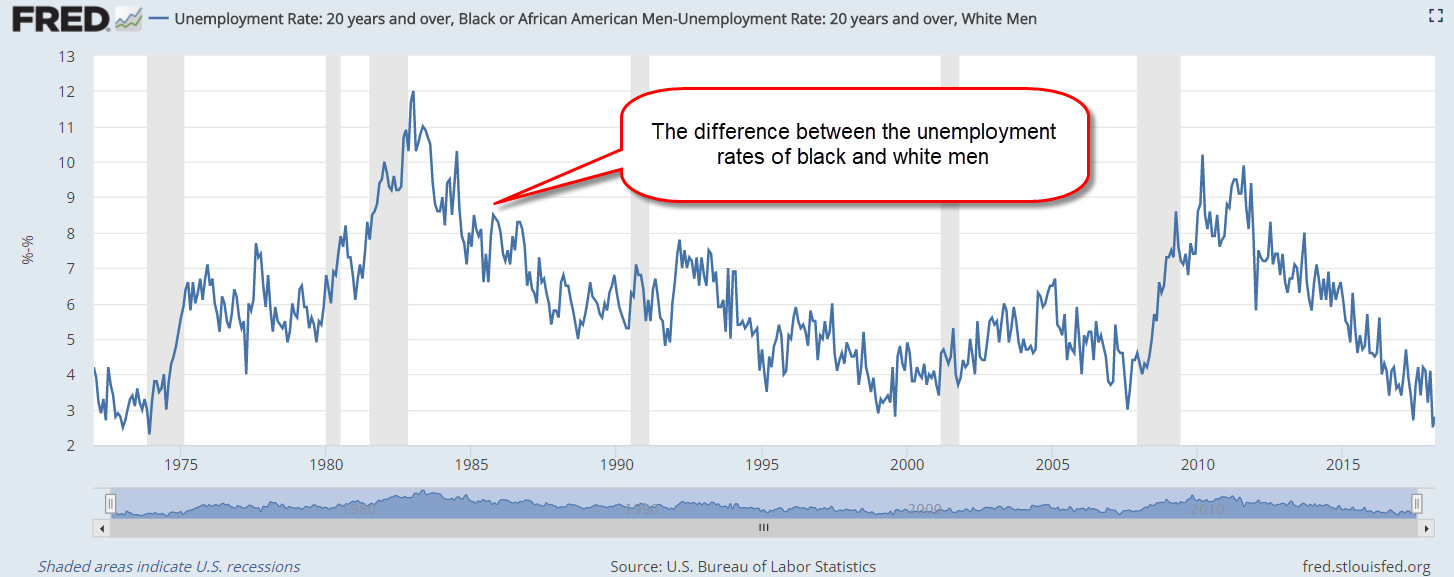
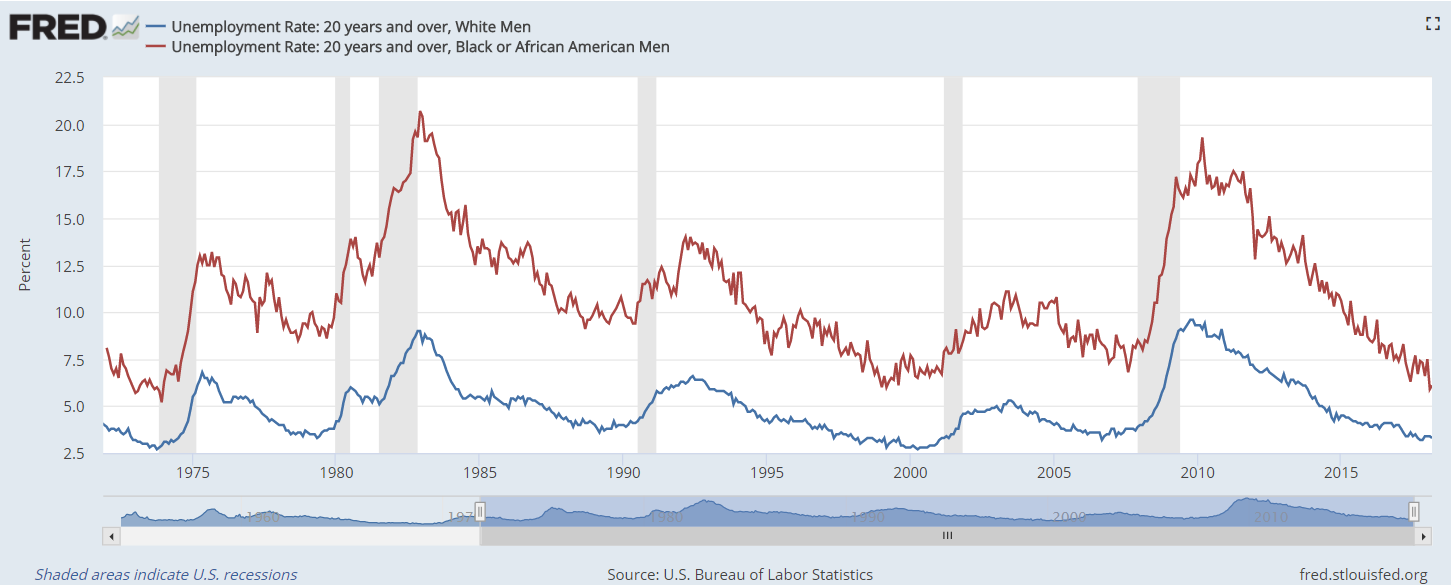
Jobs and their compensation reflect the value that a society places on an individual’s labor. The graph below is a sign of prejudice in America. The unemployment rate for blacks is always higher than the rate for whites. If this were a chart from the year 1890, the persistently higher unemployment rate could be labeled Irish or Italian.  A disadvantaged class of worker is more willing to do unpleasant jobs for less money.

UnemployBlackWhite

Under Obama, the unemployment rate for black men dropped from 18% in the spring of 2010 to 7.7% in November 2016. Since Trump’s election to the Presidency in November 2016, that rate has fallen another 20%. At 6.1% this rate is the lowest since the early 1970s. There are black grandfathers who thought they might die before seeing a younger generation enjoying an unemployment rate this low.

Still, the current rate for black men is 2.8% higher than the 3.3% rate for white men. Over the past forty years, the average difference between the two unemployment rates is close to 6%. This is the burden of being black in America. In the past half century, there have been few times when the difference in rates is this low: 1) during the Vietnam War when many black and white men were removed from the labor force; 2) 1999, near the height of the dot-com boom; and 3) several months this past year.

UnemplRatesDiff

It’s not just skin color, religion and nationality that drives prejudice in America. Five years after the end of the Civil War in 1865, the 15th Amendment gave black males the right to vote. Women suffragettes lobbied hard to be included in the Amendment and win their right to vote. Susan B. Anthony and Elizabeth Cady Stanton were prominent leaders of this movement. The idea was just too crazy, they were told. Women were too guided by their emotions, and too irrational, particularly during their menses, to be trusted with the vote.

In 1920, exactly fifty years later, the ratification of the 19th Amendment gave women the right to vote. The Suffragette movement had allied with the Prohibition movement to press each of their causes in a joint effort. The Volstead Act, the implementation of the 18th Amendment prohibiting the sale of intoxicating liquor, was passed a few months before the ratification of the 19th Amendment. They were a package. Had women been granted the right to vote in 1870, the Prohibition movement would have lacked a critical partner to win passage of the Amendment. Without Prohibition, the rise of organized crime might not have occurred.

Whenever there is a war, or any act of aggression with another country, Americans single out those nationalities or races for discrimination. In the 19th Century, those of Mexican descent were vilified after the Mexican-American War.

Many Germans were denied jobs and housing following the start of WW1. Historical prejudices were resurrected. German soldiers, known as Hessians, had fought with the British against American colonists in the War for Independence. Americans began to see that there was something wrong with the German character. Political cartoons pictured Germans as Huns, a mongrel and violent race of uncivilized people always lusting for battle.

Following Japan’s 1941 attack on Pearl Harbor, U.S. citizens of Japanese descent were forced to sell their homes and businesses at below market value, then were moved to internment camps away from the west coast.

The most recent assault on U.S. territory was the 9-11 attack by multiple suicide squads. Most hijackers were from Saudi Arabia, but we did not single out Saudi nationals in the U.S. Unlike the targets of previous war discrimination, Saudis have no unique language. Instead we singled out all Muslims, and all Arab speakers as potential threats.

Prejudice based on sex, on religion, on skin color, and on nationality have formed our country. America is built on prejudice and the passionate denial that we are a country built on prejudice. We can’t do the work of healing until we admit the reality.

Low unemployment rates among minority groups means that the economy is especially strong. Low levels of unemployment for black, brown and white men usually precede a recession. For white men, the benchmark is 4%. For black men, it’s 7%. For Hispanic men, 5%. Below those benchmarks, the Fed has coincidentally seen what they consider to be inflationary pressures.

In a strong economy with low unemployment, confidence and spending increase. This puts some upward pressure on prices. Central bankers jump at the slightest hint of rising prices. Inflation and employment models like the Phillips curve are imperfect. Despite mountains of surveys, equations and data, inflation is difficult to measure, and many factors influence its rise and fall.  Building a model is made more difficult because each high inflation period has had its own unique features. Among economists, fears of an awakening of the inflation beast has persisted since the recovery in 2009.  Economists had begun to worry why the beast has not awoken.  The models said the beast should be awake! Finally, the Fed is seeing some consistent signs that inflation is growing toward their 2% mark. It has begun to lift interest rates to curb inflationary pressures.

I’ve added the Federal Funds rate to a chart of the unemployment rate for white men to show the pattern. I’ve left off the series for black males that I showed earlier so that the chart was not too cluttered.

UnemplVsFedFundsRate

Economists joke that it’s the Fed’s job to remove the punch bowl just when the party is getting going. Want to know what’s ailing the stock market lately? One of them is the greater likelihood of four rate hikes by the Fed this year. At the start of the year, investors put the chances of four rate hikes at 15%. This week it stands at 45%.

To those on the edges of our society and labor force, and to those just entering the job market, the easier job market that others have enjoyed for several years is just opening to them. If there has been a party, they have been left out. As their prospects brighten, the Fed’s raising of interest rates is a cruel joke.

As interest rates go higher, fewer people can afford to buy homes, cars and furniture. Many companies run on borrowed money to meet short term funding needs and long-term investment. As money becomes more expensive, companies tighten their belts and hiring slows. The most vulnerable are the recently hired and they are often the first to be let go. Like marine life that lives in the tidepools at the ocean’s edge, some are left high and dry when the tide of easy money ebbs.


NHS vs US Health

The good, bad and ugly of the American and British health care systems. In an 8/15/09 FT article, Nicholas Timmins gives a brief comparison of the two systems.

In a 9/15/09 PBS program, “Retirement Revolution”, host Paula Zahn spoke with a doctor who has worked in both systems. The doctor summed it up: The British NHS works well for most patients whose disease presents no particularly difficult or unusual complications. The American system, with much more emphasis on advanced technology and public funding for academic institutions, is better for those patients who do have unusual complications.

At town hall meetings this summer, some Americans touted the U.S. health care system as the best in the world, citing the estimated 400,000 people who come here each year to get medical care. An 8/24/09 AP article cites a 2007 estimate that almost twice that number, 750,000 U.S. citizens left the country to get medical care elsewhere. Estimates by the Medical Tourism Board for 2010 are that 1.6M patients will leave the U.S. for care outside the country.