Inflation and Profit Flow

September 18, 2022

by Stephen Stofka

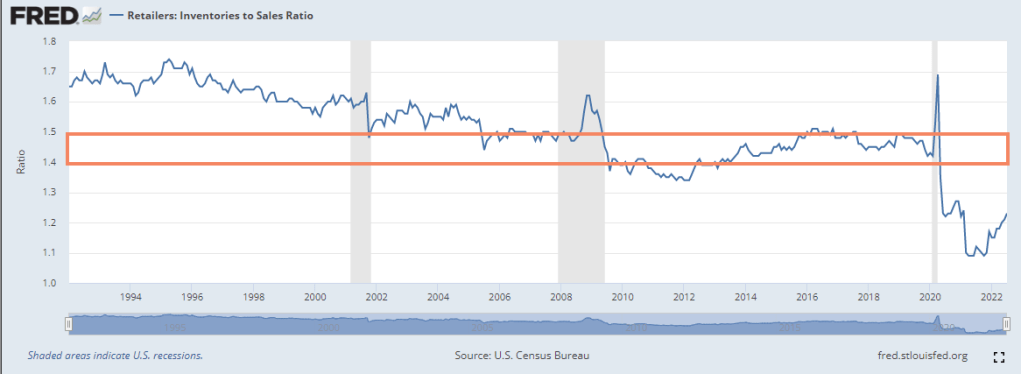
Price records circumstances, not value or utility. Our buying power is like a bar of soap. As water shrinks soap, high inflation shrinks our buying power. Economists offer several explanations for the persistent inflation but the one that I buy is that constrained supply and fairly steady demand are driving prices higher. Rising prices are a symptom of a shortage of goods – a quantity issue. Retailers inventory to sales ratio has increased slightly from the historic low in May 2021 but the ratio is still far below the range of 1.4 – 1.5 that was the benchmark before the pandemic.
This past Thursday, I picked up three jars of my favorite crunchy peanut butter. Some stores have been out of stock on the crunchy variety so I bought extra to be sure. I was not concerned about rising prices. I was responding to a quantity shortage, or the fear of a shortage. The difference is important. In Econ 101, students are shown the standard supply and demand diagram.

Left out of this stylized relationship is that supply is on a slower time scale than demand. It takes time, planning, investment and risk to produce all that supply. To cope with that reality, businesses must keep an inventory on hand to meet changes in demand which happen on a shorter time scale. Shift the red supply line to the left and the intersection of supply and demand occurs at a higher price. The Fed and the market thought that the supply constraints would fully resolve by this year but they have not. As stores and restaurants reopened, customers put away the electric panini sandwich makers, bread machines and gym equipment they had bought during the pandemic. They began purchasing consumables and were willing to pay higher prices for clothes, airline and movie tickets, and restaurant meals. In the face of ongoing supply constraints, the Fed has had to keep raising interest rates to try to curb demand, shifting the blue demand line to the left as well.

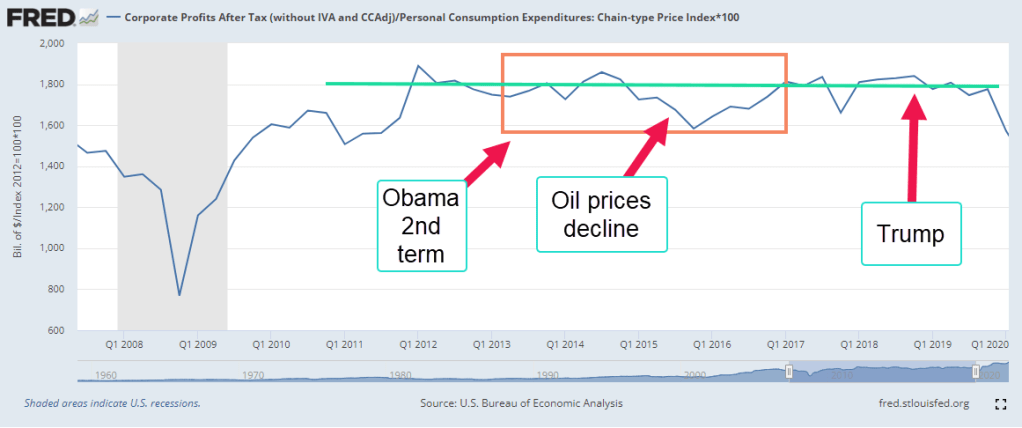
The higher prices helped businesses recover profits lost during the pandemic. Businesses have taken advantage of the supply disruptions to juice their profits by 33% (BEA, 2022).

When the Republicans took control of both chambers of Congress and the Presidency, they lowered corporate taxes. Those on the left often blame the economic elite for society’s problems and wasted no opportunity in criticizing Republicans for gifting the corporate elite. Mr. Trump boasted on his business prowess, promising to get the economy revving up again. Despite his rhetoric, corporate profits remained at the same level as during Mr. Obama’s second term.
A Presidential veto can block legislation but it is Congress that passes the laws that affect the economy. As I wrote last week Congress sometimes buys voter approval, creating bubbles that finally implode. The State Historical Society of Iowa (2019) has an image of a 1928 campaign ad for Herbert Hoover. It is a resume of economic progress under total Republican control during the 1920s. The Congress had won the public’s approval with easy credit and lax regulation. The following year the onset of the Great Depression brought down the house of cards. 25% of workers lost their jobs. Many lost their homes and farms.

Corporations exist to turn money flows into profits. Whatever money Congress spends winds up in corporate coffers. After 9-11, the federal public debt rose by $3 trillion (U.S. Treasury Dept, 2019) while corporate profits more than doubled, all thanks to Congress. Democrats and Republicans supported higher military spending and a building boom supported by easy credit policies.

In response to the pandemic, a bipartisan effort in Congress passed relief packages of more than $3 trillion. Today the public debt is $7 trillion above the pre-pandemic level. Much of that money became corporate profit because that’s what good companies do – turn cash flows into profits. Some of those profits were then used to buy the Treasury bills generated when the government increased their debt. This completed the cycle of debt and profits.

On average voters re-elect 90% of House members and 80% of Senate members. Midterm elections are less than two months away. Both parties take advantage of the public’s tendency to pin responsibility – good or bad – on the President, both the current and the past President, Mr. Trump. “Inflation is Biden’s fault,” Republicans will say and hope it sticks with some voters. Democrats hope that Trump will announce a 2024 run for President before the coming midterm election. They hope that independent voters, particularly suburban women, will vote for Democrats to voice their disaffection with Mr. Trump.

The election spending will juice the profits of media companies who depend on the craziness of our democratic politics. People in western European countries look in dismay at our frenzied politics that makes us vulnerable to a populist like Trump. Some Americans long for authoritarian measures that might curb the craziness of our politics and promote more cooperation. They are tired of the demolition derby of American democracy and wish they could go to sleep for a few months until it is over.

////////////////////

Photo by Anvesh Uppunuthula on Unsplash

State Historical Society of Iowa. (2019, January 14). “A chicken for every pot” political ad, October 30, 1928. IDCA. Retrieved September 16, 2022, from https://iowaculture.gov/history/education/educator-resources/primary-source-sets/great-depression-and-herbert-hoover/chicken If you have a moment, do check this out!

BEA: U.S. Bureau of Economic Analysis, Corporate Profits After Tax (without IVA and CCAdj) [CP], retrieved from FRED, Federal Reserve Bank of St. Louis; https://fred.stlouisfed.org/series/CP, September 16, 2022.

U.S. Department of the Treasury. Fiscal Service, Federal Debt: Total Public Debt [GFDEBTN], retrieved from FRED, Federal Reserve Bank of St. Louis; https://fred.stlouisfed.org/series/GFDEBTN, September 16, 2022.

A Voting Booth

February 6, 2022

By Stephen Stofka

How important are energy prices? British homeowners are paying almost 60% more than last January’s prices to heat their homes with natural gas (https://tradingeconomics.com/commodity/uk-natural-gas). They are upset at government officials and the party in power. In the U.S., the annual January increase to residential consumers was only 2.6% (https://www.eia.gov/dnav/ng/hist/n3010us3m.htm). The UK imports most of their natural gas while US consumers enjoy the benefits of US gas reserves. Americans drive far more than Brits so the weathervane of popular sentiment  in the US is the movement of gasoline prices. In general people don’t like rising prices – period – but when gasoline prices rise faster than paychecks, the public has the sense that something is broken and they want government to fix it. A gas pump can be a voting booth.

During the eight years of slow recovery following the financial crisis in 2008, paychecks struggled to keep up with the rise in gasoline prices. Income growth finally rose above gasoline price growth in the middle of 2016. As incoming Presidents do, Mr. Trump took credit for some of the gains and policies of his predecessor. Until the pandemic struck, paycheck growth stayed above the growth in gasoline prices. These annual growth rates erase most of the seasonality of gasoline prices, which fall in the winter and rise in the spring when the refineries must switch to a more expensive blend for the heat of summer.

That trend took a “wheelie” in the spring of 2020 when the entire country responded to the swell of pandemic deaths in New York City. Headed by a soapbox President with little organizational skill, the Trump administration struggled to cope with the daily demands of the pandemic. Mr. Trump himself cared little for the research his staff brought him. He has admitted that he is not a reader, trusting his instincts more than information. Had he shown more consistency during this singular pandemic, he might have retained enough college educated male voters to tip the 2020 election in his favor. As with many of us, Mr. Trump cannot come to grips with his own failings so he blames others. He has turned that nasty habit of self-deception into an art form of grand deception.

As the chart shows, the annual growth in gasoline prices was far above the growth in paychecks when Mr. Biden took office in the beginning of 2021. Both growth rates reached 10% in the 3rd quarter of last year, but people pay more attention to the sticker price on the pump as they fill up their cars. In the fourth quarter, paycheck growth edged up while gasoline prices growth edged down, a heartening trend if it continues.

Presidents have little effect on gasoline prices, a global commodity dependent on supply and demand around the world and subject to geopolitical tensions. However, the public holds Presidents responsible. If gasoline prices are high, reporters at White House press briefings ask what the administration is going to do about it. Occasionally, they release some of the government’s strategic gasoline reserves to show some action. That release has only a small effect on global prices but it shows the administration’s attention and good intentions. Until the country went off the gold standard during the Depression, each President had to answer for movements in the price of gold. Gasoline powers our daily lives. It is our daily gold.

Mr. Biden is mindful of the electoral beating that Mr. Obama took in the 2010 elections when the Tea Party led a Republican movement to forcefully take the majority gavel from the House Democrats. Most Presidents suffer election losses in the midterms but it was a devastating turnaround in a census year. Mr. Obama was more skilled at rhetoric than taking the tiller of a national political party. As a politician with decades of experience, Mr. Biden is already in campaign mode, moving funds to battleground states to get out the vote in November. He will be mindful of the public’s sensitivity in the final months leading up to the midterms.

Gasoline prices are higher in the summer months and people drive more so they notice high prices. The press is quick to point out Mr. Biden’s low approval ratings, currently in the low 40s. Mr. Biden’s low was Mr. Trump’s high. In a country evenly split between Democrats, Republicans and Independents, a President will struggle to gain and hold a majority favorable public opinion above 50%. According to Gallup (https://news.gallup.com/poll/116500/presidential-approval-ratings-george-bush.aspx) George Bush did not enjoy a majority opinion after 2005, his first year of his second-term. His ratings fell near 30%, lower than Mr. Trump’s lowest ratings. When did those lows come? During the summer months of 2008 when gasoline prices rose above $4 per gallon. Voters carried their sticker shock at the pump into the voting booth a few months later and gave Democrats a resounding majority.

If gasoline prices are moderate this summer, that will give a boost to Democratic chances at the polls but Mr. Biden should be savvy enough not to count on that. He must assume that prices will not be friendly to him or his party this summer. The Republican strategy is to use pocketbook issues to regain a majority in both the House and Senate. Their divisive stance on moral issues only antagonizes Independent voters in the suburbs so Republicans must focus on practical issues. Midterm elections suffer from low turnout. Voters shrug. The party that can energize their voters can command the political field for the next two years. Gasoline prices energize voters.

////////////////////

Photo by Dawn McDonald on Unsplash

Voter’s Guide

November 4, 2018

by Steve Stofka

This week – a break from personal finance and economics to bring you a voting guide for Independent voters who make up more than a third of the electorate. Circle which position you favor in each category below. Add up the choices. Vote for whichever party gets the most circles.

Role of Federal Government
If you believe that the Federal government has too much power over individual lives, Vote Republican.
If you believe that the Federal government should have more power to promote an egalitarian society, Vote Democrat.
////////////////

Political Structure
If you want to change the existing political structure to a democratically elected Parliamentary Republic, Vote Democrat.
If you like the existing system of a Constitutional Republic of democratically elected state legislatures, Vote Republican.
///////////////////

Regulation
If you think that regulation should be primarily left up to state and local agencies who will be more responsive to the people of that district or state, Vote Republican.
If you prefer federal regulation because you distrust the ability of state and local agencies to apply regulations fairly and evenly, Vote Democrat.
/////////////

Family Planning
If you think state and local agencies acting as agents of God’s will should control your family planning decisions, Vote Republican.
If you believe in personal autonomy in family planning decisions, Vote Democrat.
///////////////

Equality of Social Contracts
If you believe that all people should have equal rights to make legal contracts regardless of their social or sexual identity, Vote Democrat.
If you believe that an elected government has a right to restrict access to legal contracts to promote certain moral values and behaviors, Vote Republican.
/////////////////

Defense
If you believe that national defense is the primary legitimate function of a Federal government, Vote Republican.
If you believe that the Federal government should provide a safe environment for all citizens, and that defense is just one part of that safety net, vote Democrat.
/////////////////

Taxes
If you believe that taxes for common benefits should be applied more evenly so that everyone has “skin in the game,” Vote Republican.
If you believe in progressive taxation, that the Federal government has a right to take more from you, so it can give more to someone else, Vote Democrat.
///////////////////

Immigration
If you believe that we are a nation of laws and that foreigners coming into our country should respect our laws, vote Republican.
If you believe that the administration of immigration law must respond to the plight of human beings seeking a secure home for their family, vote Democrat.
////////////////////

Environment
If you believe that there is not yet enough actionable evidence for climate change caused by human activity, Vote Republican.
If you believe that we should pursue policies that limit activities which promote climate change, Vote Democrat.
/////////////////////

Social Welfare
If you believe that government has a responsibility for the welfare of all Americans, Vote Democrat.
If you believe that state and local governments have a responsibility to act with charity toward those who cannot care for themselves through no fault of their own, Vote Republican.
////////////////

There are many particular issues, some of which are sub-genres of these categories, at https://www.isidewith.com/polls.


Reagan and Obama

As the 1982 elections approached, Ronald Reagan’s Presidency was unpopular. The unemployment rate was 9.7%, about the same as it is now. Interest rates were high: a 6 month CD paid about 13% interest, which was good for those who had savings but terrible for small business owners who had to work extra hard to pay the 20% interest rate banks were charging for business loans. The dead carcasses of 17,000 businesses littered the economic and social landscape, one of the highest failure rates since the 1930s depression. The stock market was in the doldrums – why bother investing in stocks when bonds and CDs paid such generous interest rates?  GDP had grown an anemic 2.2% the past year.  The national debt had gone up by 14% that year.  In short, the Reagan Presidency was promising to be one of the worst in American history. 

In 1982, the voters realized that they had traded in a bumbling governor from Georgia, Jimmy Carter, for a bumbling governor from California, Ronald Reagan. After the election, Democrats, already in control of the House of Representatives, were given another 25 seats and a commanding majority.  The Republicans continued to hold a slim majority in the Senate.

Shortly after the election, Reagan launched his “Star Wars” or Strategic Defense Initiative (SDI), long on imagination and his willingness to further bankrupt this nation, but rather short on any actual ability to employ such a grandiose scheme.  In the first year of Reagan’s reign, tax rates had been cut but the Social Security tax had been raised so, for most of us working for a living, it was pretty much of a wash.  Inflation was killing us.

If you are an older Republican, you may have forgotten those years.  They have been conveniently hidden under the party mattress by the Republican campaign machine and the retelling of the “Reagan legacy.”  In the seventies and early eighties, there was so much distrust in the judgment and morality of elected representatives that it was a strategy by some disaffected voters to pull alternate levers in the voting booth, voting Democrat on one row, then Republican on the next row, in order to gridlock the government.

Reagan kept on borrowing on the taxpayer’s credit card.  By the time he left office, the national debt had tripled. 

Midterm elections often are a vote on the Presidency and the dominant party. The Democrats may have to give up most of the 30+ Congressional seats they won in 2008, making it even more difficult for President Obama to get his agenda enacted.  In 30 years, how will the story of the Obama presidency be told?  Will it be altered or swept under the table by the Democratic campaign machine just as the Republican machine has retold the Reagan years?  Probably.

Both Reagan and Obama had monumental tasks in their first few years, burdens so great that neither of them could achieve their goals in a short two years.  However, voters focus on the present, throwing hindsight, history and perspective out the window as they drive down the rutted road of the present.  The political machines of both parties know this and play to that short attention span. Unemployment is high, just as it was in Reagan’s 2nd year.  Obama can only hope that, by 2012, the unemployment rate gets down to the 7.4% rate it was in 1984, when Reagan came up for re-election. 

Traditionally, the political campaigns get into gear after the Labor Day holiday.  There is one thing we know for certain:  we will be entertained by a lot of lies and half truths for the next few months.  If you listen to talk radio, both conservative and liberal, you are accustomed to this kind of entertainment year round.

(Side note 9/8) Here is a CNN  review of some of the tax policies and their effects during the Reagan administration.