Money – the Shape Shifter

December 10, 2023

by Stephen Stofka

This week’s letter is about public goods and the characteristics of public goods. I’ll discuss whether money or a digital currency is a public good. I’ll explore the four types of goods as economists classify them. These properties can enrich our understanding of some contentious debates. Hop on board as we tour the safari park of economic ideas.

Economists use two criteria to classify goods: whether they are rival and whether they are excludable. Rival means that one person’s consumption of a good lessens another person’s consumption of the good. An excludable good means that there is a feasible mechanism to prevent someone from consuming a good. A private good is both rival and excludable. A public good is both non-rival and non-excludable. It helps to look at public goods from a cost perspective. The marginal cost of providing the good to one more person is practically zero. The marginal cost to prevent someone from consuming a public good is very high.

An example of a public good is the national defense. One person’s protection from attack has little if any effect on another person’s protection. A country cannot practically prevent someone from being protected. Another example is firework displays. Although we call the street out in front of our house a “public street,” it is a toll good or club good according to these characteristics. Once built and maintained, the cost for one more driver to use the road is zero so it is non-rival just like the national defense. But it can be made exclusive at a reasonable cost by restricting access. A toll road is an example. A city makes a street public by decree, not by any characteristic of the road. A decree can be undone as when a city converts a city street to a pedestrian mall.

Another type of good is rival but non-exclusive. These are called pooled goods. A classic example is fishing in the ocean. The fish that someone catches are no longer available to someone else so they are a rival good. However, it is difficult and costly to prevent someone from fishing in the ocean. Pooled goods typically include natural resources or game animals. A government manages the depletion of the resource by issuing licenses and imposing fines. Overfishing of the world’s oceans has been a contentious issue for decades.

Governments have managed the problem of pooled resources by selling a property or use right to a private owner. The manager restricts access to the resource and charges a fee to users of the resource, effectively turning a pooled good into a toll good. A use right might be in the form of a 99 year renewable lease or a public-private partnership where a private company manages a park or other natural resource. 

These characteristics can provoke some lively discussion. For instance, is money a public good? It might seem so. It costs almost nothing to make another $1 of currency. But providing the next $1 of currency requires billions of dollars of legislative and judicial debate because public spending is rival. If that $1 is spent on one cause, it cannot be spent for another project. If transferred to one person, that same $1 cannot be given to another person. Is it excludable? Social spending programs are based on criteria that exclude some while entitling others to the benefits of the program. We argue so much about “public” spending because the spending itself has characteristics of a private good. It is rival and excludable. Once built an air defense system might act as a public good, providing non-excludable protection. The spending itself is not a public good.

Let’s follow the path of a tax dollar. It went from a private party through a banking system that restricts access to money resources, then into a government pool where it became an indistinguishable unit of tax revenue, a pooled good, then became private again when the tax dollar was spent or transferred to someone. If spent, the use of the good or service became public in some sense. An air defense system or the building of a public library, for example. If transferred to a person, the money was spent in the private economy for goods and services like food and rent. The  transformation of private dollars to public pot and back to private dollars is accompanied by a lot of heated debate.

The money supply has characteristics of a pooled good although it is not a natural resource. In circulation it acquires the characteristics of a natural resource, a good that has many access points. A government manages the money supply like a pooled resource. It licenses out the ability to create money to member banks, imposing some regulations and trusting that the discipline of gain and loss will cause banks to act prudently when making loans that increase the money supply. However, banks don’t just loan money to individuals and businesses. They loan money to financial institutions who loan money, thus magnifying the power of the money-creation process.

Money in the economy acts like a magnetic field in a giant turbine. The turbine turns as long as the magnetic field keeps changing. Money has the characteristics of a private good in exchange, then a pooled good in taxation and a toll good in the banking system, and then a private good again. Money can buy public goods and services but can’t assume the characteristics of a public good. Like money, a digital currency like Bitcoin has an exchange power between private parties that relies on the seller’s willingness to accept payment in Bitcoin. But it cannot act as another type of good because the government refuses to accept Bitcoin as a payment for taxes. Doing so would interrupt its control of the money licensing process. Money then becomes an intermediary in a Bitcoin exchange, like the Universal Translator on the original Star Trek TV series. Money is adaptable to each type of good for which it is exchanged. That adaptability gives money power, a power that governments have abused in centuries past, giving people a cause for concern.

///////////////

Photo by Richard Horvath on Unsplash

Keywords: private goods, public goods, toll goods, club goods, private goods. Bitcoin, digital currency.
The Money Cycle

March 5, 2023

by Stephen Stofka

This week’s letter is about money and a natural resource like water. The nature of money, its origin and history have long been a subject of lively debate. What similarities and differences does money have with water? Does an analogy help uncover some less apparent characteristics of money? I’ll start with the three purposes of money that every economics student learns: a medium of exchange, a store of value and a unit of account. Coincidentally, water has three phases, gas, solid and liquid, and in each of those phases has some of the characteristics of money. The quantity of money can expand. The volume of water in all its phases is fixed.

Ice stores the energy of water the way that money stores value. As freezing water locks together in a crystal lattice, it becomes its own container. Oddly enough, most ice exhibits a hexagonal form, an efficient material transformation in response to changes in temperature. Only 2.5% of the world’s water is freshwater and most of that is locked up in glaciers. Money’s store of value is contained within assets.

In Part 5, Chapter 3 of the Wealth of Nations, Adam Smith noted that people tend to hoard their capital, to lock it away from a government which has little respect for individual property – what he called a “rude state of society.” If merchants and manufacturers have confidence in a government, they are willing to lend it money because the debt of that government can be traded in the market as though it were money. It is an interest bearing money. He lamented the fact that too many governments borrowed money to finance war and taxed people to build infrastructure. He suggested that governments do the opposite – borrow as much idle capital as possible to enhance the productivity of a country and tax people to finance wars. There would be less war and more progress.

Like money, water vapor is a medium of exchange between sky and ocean, between sky and earth. It is in constant motion within the atmosphere because its density quickly changes in response to changes in heat. It carries the water from the ocean and drops it onto the land in a conveyer belt system called the hydrological cycle. When all the earth came together in one supercontinent called Pangea 250 million years ago, water vapor transported little moisture from the oceans to the interior of the vast continent and the land was mostly desert (Howgego, 2016). When businesses around the world closed their doors at the onset of the pandemic in March 2020, we became very aware that our society, not just our economy, depends on a cycle of exchange.

Money is a unit of account, a common denominator to add up all the various goods and services in an economy. We add up tons of wheat and corn and millions of hours of labor in terms of money. . While we often think of fractions as “this divided by that,” economists understand fractions as “this in relation to that.” A social scientist might question whether it is a good idea for people to think of their labor in relation to money, the common denominator. Sadly, our society judges our worth to society in relation to that common denominator, money.

Water has a density like money has a purchasing power. Water is at its most dense – its weight per unit of volume – at 39°F and that benchmark is standardized at 1 in the metric system. The density of water at 39°F is like the benchmark price that economists use when they compute real GDP. Its volume expands as it gets colder or hotter than that temperature, so it’s density declines. The most measurable changes come at higher temperatures; at 200°F, the density is .963. We often use the language of heat when talking about inflation. The economy is overheating, for example. When there is hyperinflation¸ society itself begins to change state, just as water does at the boiling point.

Changes in the market value of our assets can have a material effect on our sense of safety. We work hard and save only a small portion of what we earn. When the value of an asset declines, it seems to melt away as though it were a block of ice on a sunny day. We may get a sense of helplessness or anxiety similar to the feeling we have when we lose electricity and worry that we will have to replace all the food in our fridge.

Readers may have other insights into money based on this water analogy. Just as equations can expose relationships that we did not understand before, analogies can do the same.

////////////////////

Photo by Ryan Yao on Unsplash

Howgego, J. (2016, July 14). Travel back in time to the most extreme desert and monsoons ever. New Scientist. Retrieved March 3, 2023, from https://www.newscientist.com/article/mg22730300-600-travel-back-in-time-to-the-most-extreme-desert-and-monsoons-ever/

House of Money

June 12, 2022

By Stephen Stofka

Economics students learn that money is a complex function, a multi-tool that plays three roles in our lives. Lawyers study the role of money in contracts. Psychologists study how our beliefs and personal history shape our distinct attitude to money. Our use of money embodies our expectations of the future and our perceptions of risk. The financial crisis demonstrated that money connects us and separates us. The struggle between cooperation and distrust is the foundation of our experiment in democracy.

Money is the Swiss army knife of most societies. As a medium of exchange, it saves us the cost of matching our needs. We can store our labor in a unit of money, then trade it for the things we want. The law regards an exchange of money as a “consideration” that distinguishes a contract from a gift. Current Supreme Court precedent has held that money is speech. Because we use money to store purchasing power, we want it to be a reliable container that doesn’t leak value. Money’s role as a unit of account requires legal institutions to administer the rules of that accounting.

We buy insurance to mitigate risk but to do so we are herded into risk pools based on age, sex or occupation. Those under age 25 pay higher car insurance premiums but lower health insurance premiums. Because they make less money as a group, they have a higher loan default rate and must pay higher borrowing costs. Roofers pay higher workmen’s compensation premiums than police. Heights are more dangerous than criminals. Before Obamacare, health insurance companies charged women of childbearing age higher premiums for individual policies (Pear, 2008). The premiums reflected the higher expected costs of pregnancy regardless of whether a woman had any intention of getting pregnant. We are Borg.

Companies may classify our risk profile but we have a unique relationship with money, a composite of personal experience and inclination. “Me” and “my” are appropriately contained in the word “money” because our attitude toward money is as unique as our fingerprints. In 1984, British psychologist Adrian Furman (1984) led a study to assess people’s attitudes toward money. The questionnaire included 150 questions grouped into five areas that probed the subjects’ beliefs, their political attitudes and affiliations, their sense of autonomy and personal power. An argument about money can be as complex as that questionnaire.

Many political debates involve money. Each party tries to gain control of the public purse to fund its priorities. After 9-11, the debate over money intensified. The hijackers had attacked a money center as a symbol of American hegemony. While Americans debated the justification for an invasion of Iraq, the budget surplus of the late Clinton years evaporated. For some voters, the choice was a stark one – spend money to blow up people in a foreign land or spend it to strengthen American communities. To calm his critics, Mr. Bush promised that Iraq would repay American war expenses with its oil revenues. This was one of several follies that turned voter sentiment toward Democrats in 2008.

The financial crisis showed us the complex nature of money and tested the values that we attach to money. In the last months of a flailing Bush Presidency, the crisis exposed the corruption, greed and stupidity of the country’s largest financial institutions. Billions of taxpayer money had created and fed a thicket of regulatory agencies that were either corrupt or incompetent. The crisis ignited a strong moral outrage that intensified when Democrats fought to pass Obamacare.

The debate may have ebbed during the decade that followed but the Republican tax cuts of 2017 reignited public disdain and distrust. While many American families struggled to recover from the crisis, the politicians and their rich patrons fattened their fortunes.

Money is the heart of the American experience. The American confederacy of colonies that had won independence from Britain could not pay its debts or borrow money. The writing of the Constitution was sparked by the urgent desire to resolve that crisis or risk becoming subjects again of a colonial power. To reach consensus, the colonies had to overcome their distrust of a central government with the power to levy taxes. The colonies distrusted each other and the regional coalitions that might take the reins of that central government. The founders built their distrust into the Constitution and its governing institutions. In grade school we learn them as “checks and balances,” a euphemistic phrase for distrust.

On social media we argue about the many aspects of money. Our experiment in democracy will be over when Americans stop having spirited discussions about money.

////////////////

Photo by Kostiantyn Li on Unsplash

Furnham, A. (1984). Many sides of the coin: The psychology of money usage. Personality and Individual Differences, 5(5), 501–509. https://doi.org/10.1016/0191-8869(84)90025-4

Pear, R. (2008, October 30). Women buying health policies pay a penalty. The New York Times. Retrieved June 7, 2022, from https://www.nytimes.com/2008/10/30/us/30insure.html

Money Flows

Since the election, the SP500 index has risen about 10%. A broad bond composite has lost about 3%. Investors are clearly willing to take on a bit more risk. Prices are generally a good indicator of trend, but let’s take a few minutes to look at the flows of money into various investment products to understand the shifts in sentiment and confidence.  In the first two weeks of February the flows of money have been staggering.

The Investment Company Institute (ICI) tracks (Stats) the money flows into long-term equity and bond mutual funds as well as hybrid funds that contain both stocks and bonds (Target date funds, for example).  ICI also includes data on ETFs that can be bought and sold like stocks during the trading day. To avoid confusion, I’ll use “products” to describe combined data of mutual funds and ETFs. These long-term products reflect investors’ broader outlook on the market and economy rather than a short-term trading opportunity. For most of 2016, investors withdrew money from equities. Since the election, there has been a surge of $45 billion into equity products, causing a surge in prices.

icifundflows2014-2016

Financial advisors recommend some combination of both stocks and bonds for most investors. Let’s look at the money flows into bond products over the past year. When investors withdraw money from stocks, they tend to put them in bonds or money market funds, a shift from risk to safety.

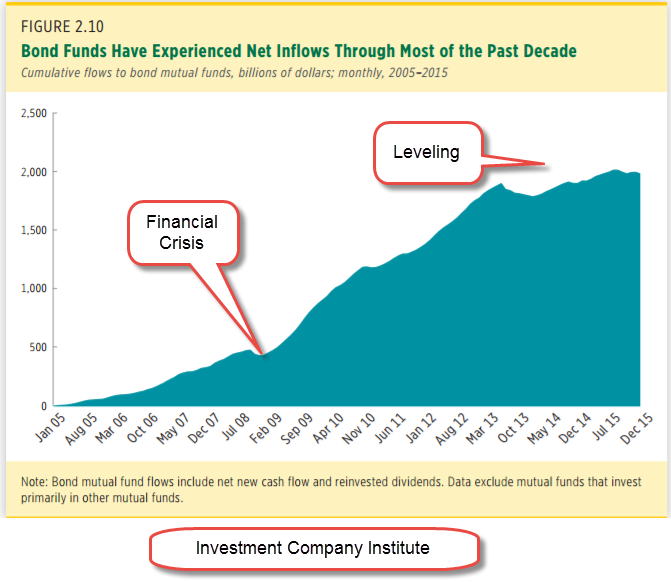
Older people are more cautious and have more of a preference for the price stability and dividends of bond products. The aging population and the painful memories of the financial crisis prompted a rush into bond mutual funds. The cumulative money flows into bond funds has increased from $500 billion in the summer of 2008 just before the financial crisis to over $2 trillion in 2015. (ICI chart)

icibondflows2005-2015

In the chart below we can see inflows into bonds during 2016, counterbalancing the outflows from equities. Since the election, investors have shifted $17 billion from bonds to riskier equity products. Not shown here was a further outflow of $20 billion from balanced hybrid products containing both stocks and bonds.

icibondflows2014-2016
Let’s review those totals. In November and December, there was a net INflow of $8 billion. Compare that with the $43 billion OUTflow in November and December 2015. Clearly, there was an increased appetite for risk. In 2015 and 2016, inflows into stock, bond and hybrid products declined rather dramatically from 2014’s totals.

icistockbondhybrid2014-16

In the first six weeks of this year, that lack of confidence has disappeared. Investors have pumped $63 billion into stock, bond and hybrid products, almost as much as the $74 billion invested in ALL of 2016. Should that pace continue – unlikely, yes – the inflow would be about $550 billion, far outpacing the inflows of 2014.  Over $40 billion of that $63 billion has come in during the first two weeks of February.  That is a $1.1 trillion annual pace. Where has this 2 week surge of money gone?  Half into equity – about $20 billion – and half into bonds -about $20 billion.

Had that money surge gone mostly into equities or mostly into bonds, I would be especially worried of a mini-bubble.  As I wrote last week, I am concerned that anticipated profits have already been priced in. Somewhat reassuring is the Buddha-like balance of flows – the “middle way.”

///////////////////////////

Tools

I have added some resources on the Tools page.  You can click on the menu item at the top of this page to access.  If you have any suggestions or additions, please let me know.


Rebound

October 25, 2015

Last week we looked at two components of GDP as simple money flows.  In an attempt to understand the severe economic under-performance during the 1930s Depression, John Maynard Keynes proposed a General Theory that studied the influences of monetary policy on the business cycle (History of macoeconomics).  In his study of money flows, Keynes had a fundamental but counterintuitive insight into an aspect of savings that is still debated by economists and policymakers.

Families curtail their spending, or current consumption, for a variety of reasons.  One group of reasons is planned future spending; today’s consumption is shifted into the future.  Saving for college, a new home, a new car, are just some examples of this kind of delayed spending.  The marketplace can not read minds.  All it knows is that a family has cut back their spending.  In “normal” times the number of families delaying spending balances out with those who have delayed spending in the past but are now spending their savings.  However, sometimes people spend far more than they save or save far more than they spend, producing an imbalance in the economy.

When too many people are saving, sales decline and inventories build till sellers and producers notice the lack of demand. To make up for the lack of sales income, businesses go to their bank and withdraw the extra money that families deposited in their savings accounts.  Note that there is no net savings under these circumstances.  Businesses withdraw their savings while families deposit their savings.  After a period of reduced sales, businesses begin laying off employees and ordering fewer goods to balance their inventories to the now reduced sales.  Now those laid off employees withdraw their savings to make up for the lost income and businesses replace their savings by selling inventory without ordering replacement goods.  As resources begin strained, families increasingly tap the several social insurance programs of state and federal governments which act as a communal savings bank,   Having reduced their employees, businesses contribute less to government coffers for social insurance programs.  Governments run deficits.  To fund its growing debt, the Federal government sells its very low risk debt to banks who can buy this AAA debt with few cash reserves, according to the rules set up by the Federal Reserve.  Money is being pumped into the economy.

As the economy continues to weaken, loans and bonds come under pressure.  The value of less credit worthy debt instruments weakens.  On the other side of the ledger are those assets which are claims to future profits – primarily stocks.  Anticipating lower profit growth, the prices of stocks fall.  Liquidity and concern for asset preservation rise as these other assets fall.  Gold and fiat currencies may rise or fall in value depending on the perception of their liquidity.

Until Keynes first proposed the idea of persistent imbalances in an economy, it was thought that imbalances were temporary.  Government intervention was not needed.  A capitalist economy would naturally generate counterbalancing motivations that would auto-correct the economic disparities and eventually reach an equilibrium.  Economists now debate how much government intervention. Few argue anymore for no intervention.  What we take for granted now was at one time a radical idea.

While some economists and policymakers continue to focus on the sovereign debt amount of the U.S. and other developed economies, the money flow from the store of debt, and investor confidence in that flow, is probably more important than the debt itself.  As long as investors trust a country’s ability to service its debt, they will continue to loan the country money at a reasonable interest rate.  While the idea of money flow was not new in the 1930s, Keynes was the first to propose that the aggregate of these flows could have an effect on real economic activity.

***********************

Stock market

A very good week for the market, up 2% for the week and over 8% for October.  A surprising earnings report from Microsoft lifted the stock -finally – above its year 2000 price.  China announced a lower interest rate to spur economic activity.  ECB chair Mario Draghi announced more QE to fight deflation in the Eurozone. Moderating home prices and low mortgage rate have boosted existing home sales.

The large cap market, the SP500, is in a re-evaluation phase.  The 10 month average, about 220 days of trading activity, peaked in July at 2067 and if it can hold onto this month’s gains, that average may climb above 2050 at month’s end.

The 10 month relative strength of the SP500 has declined to near zero.  Long term bonds (VBLTX) are slightly below zero, meaning that investors are not committing money to either asset class.  The last time there was a similar situation was in October 2000, as the market faltered after the dot-com run-up.  In the months following, investors swung toward bonds, sending stocks down a third over the next two years.  This time is different, of course, but we will be watching to see if investors indicate a commitment to one asset class or the other in the coming months.