
Profits and Savings Diverge

November 20, 2022

by Stephen Stofka

This week’s letter is about household savings and corporate profits. As a share of GDP, savings are near an all-time low while profits are at an all-time high. Elon Musk, the CEO of Tesla, appeared in court this week. No, this wasn’t about his acquisition of Twitter. It concerned a shareholder lawsuit against Tesla regarding the $50B stock option package the company awarded him in 2018. In 2019 the company’s total revenue – not profit – was less than $25B. In 2022, annual revenue was $75B. At a 15% profit margin, the company must continue growing its revenue at a blistering pace to afford Mr. Musk’s incentive pay package. Large compensation packages like this are only a few decades old. Let’s get in our time machine.

In 1994, Kurt Cobain, the 27 year old leader of the rock group Nirvana, died from an overdose of heroin. Something else was dying that year – corporations were breaking free of national boundaries and moving production to countries other than their home nation. This was the last stage in the evolution of multinational corporations, or MNCs. In earlier decades, companies had licensed or franchised their brand. Perhaps they had set up a sales office in a foreign country. Now they were becoming truly global. Fueling that expansion was an increase in equity ownership by large institutional investors. To accommodate these changes, their governance structures changed. Executives capable of leading this global growth were rewarded on a parallel with superstar sports talent. That was the conclusion of Hall and Liebman (2000, 3), two researchers at the National Bureau of Economic Research. 

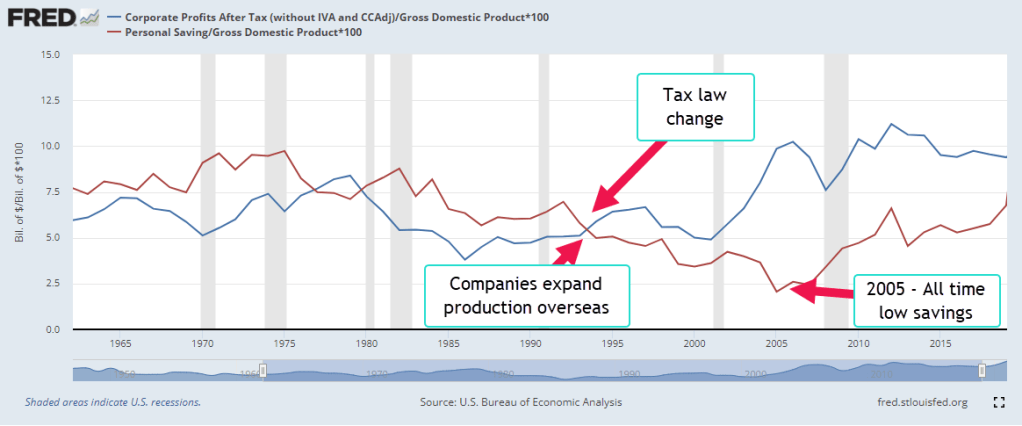
Let’s look at two series over the past sixty years – personal savings and corporate profits. If we think of a household as a small enterprise, personal savings is the residual left over from the household’s labor. Likewise, corporate profits are the residual left over from current production. In 1994, the two series diverged. Corporate profits (the blue line in the graph below) kept rising while personal savings plateaued for a decade. Each series is a percent of GDP to demonstrate the trend more easily.
Executive Compensation

In the mid-1990s, corporations began to issue a lot more stock options to their executives. Some think that a change in the tax code might have precipitated this shift in compensation.  In 1994, Section 162m of the IRS code limited the corporate deductibility of executive pay to $1 million (McLoughlin & Aizen, 2018). By awarding non-qualified stock options to their executives, companies could preserve the corporate tax deduction. However, the slight tax advantage did not account for the rapid increase in options awards. Hall and Liebman found that the median executive received no stock option package in 1985. By 1994, most did. The tax change was secondary – a distraction. Institutional investors wanted more growth and more profits and companies were willing to reward executives with compensation packages similar to sports stars (Hall & Liebman, 2000, 5). Some of these superstars included Jack Welch of General Electric,  Bill Gates of Microsoft, Michael Armstrong of AT&T.

Income Taxes – Less Savings

In 1993, Congress passed the Deficit Reduction Act that raised the top tax rate from 31% to almost 40%. Personal income tax receipts almost doubled from $545 billion in 1994 to almost $1 trillion in 2001. The booming stock market in the late 1990s produced big capital gains and taxes on those gains. For the first time in decades the federal government had a budget surplus. However, more taxes equals less personal savings so this contributed to the flatlining of personal savings during that period.

Household Debt Supports More Spending

During the 2000s, personal savings remained flat. On an inflation adjusted basis, they were falling. Too many people were tapping the rising equity in their home to pay expenses and economists warned that household debt to income ratios were too high. Savings as a percent of GDP fell to a post-WW2 low. As home prices faltered and job losses mounted in late 2007, people began to save more but their debt left them with little protection against the economic downturn. During 2008, personal savings began to increase for the first time in fifteen years. More savings meant less spending, furthering the economic malaise that began in late 2007.

Multi-National Corporate Profits

During those 15 years corporate profits rose steadily as companies increased their global presence. Beginning in 1994 U.S. companies began shifting production to Mexico where labor was cheaper. In 2001, China was admitted to the World Trade Organization (WTO) and production outsourcing continued to Asia. Despite the profit gains, companies kept their income taxes in check. In 2021, corporate income taxes were at about the same level as in 2004. That contributed to the rising budget deficit during the first two decades of this century.

Federal Deficit

The prolonged downturn in 2001-2003 and the financial crisis and recession of 2007-2009 put a lot of people out of work. This triggered what are called “automatic stabilizers,” unemployment insurance and social benefits like Medicaid, housing and food assistance. The federal government went into debt to pay for the Iraq War, pay benefits to people and help fill the budget gaps in state and local budgets. The tax cuts of 2003 enacted under a Republican trifecta* of government control reduced tax revenues, further increasing the deficit. During George Bush’s two terms, the debt almost doubled from $5.7 trillion to $11.1 trillion.

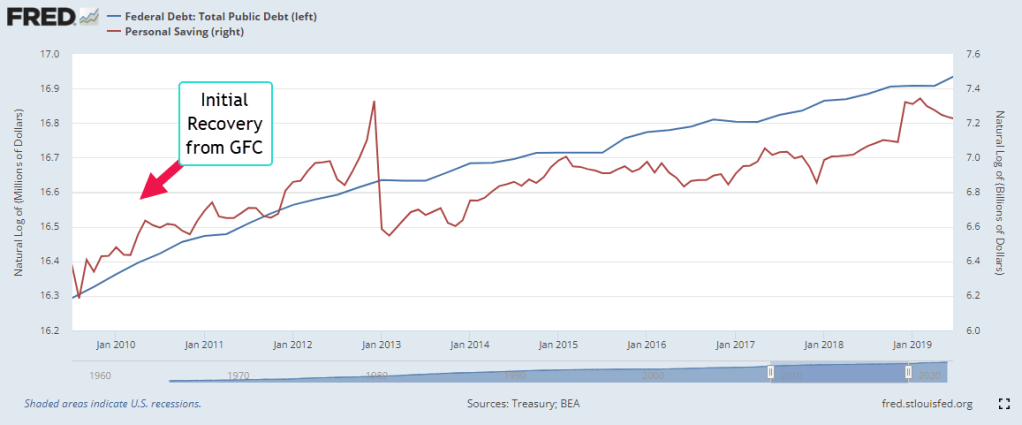
In coping with the recovery from the financial crisis, the government added another $8.7 trillion to the debt. That negative saving by the government helped add to the personal savings of households but too much was spent on just getting by. Following the Great Financial Crisis (GFC), the trend of the government’s rising debt (blue line below) matched the trend in personal savings (red). Sluggish growth and lower tax revenues caused the two to diverge. While the debt grew, personal savings lagged.  
Before and During the Pandemic

Following the 2017 tax cuts enacted under another Republican trifecta, personal saving rose, then spiked when the economy shut down during the pandemic and the federal government sent stimulus checks under the 2020 Cares Act. In the chart below, notice the spike in debt and savings. By the last quarter of 2020, personal savings had risen by $600 billion from their pre-pandemic level of $1.8 trillion. In late December, President Trump signed the $900 billion Consolidated Appropriations Act (Alpert, 2022) but that stimulus did not show up in personal savings until the first quarter of 2021. In March 2021 President Biden signed the $1.7 trillion American Rescue Plan. Personal savings rose $1.6 trillion in that first quarter, the result of both programs.

After the Pandemic

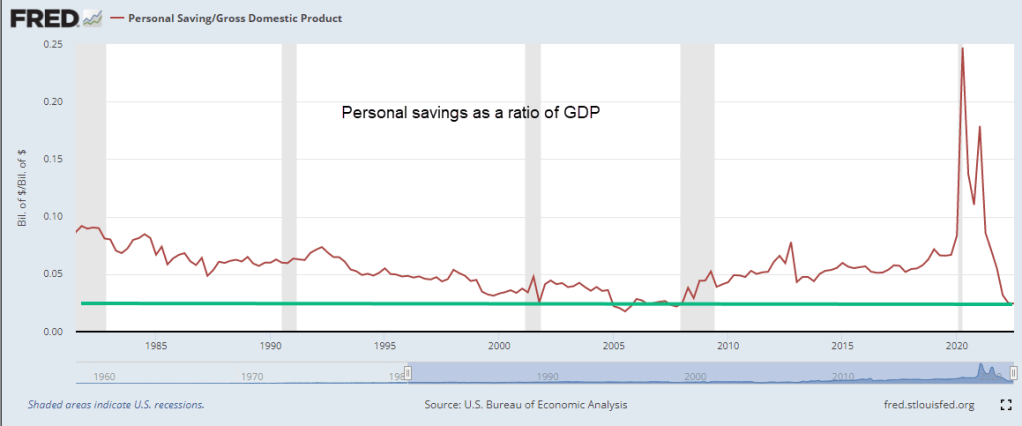
Some economists have said that the American Rescue Plan was too much. In hindsight, it may have been but we don’t make decisions in hindsight. As more schools and businesses opened up, households spent far more than any extra stimulus. They spent $1.2 trillion of savings they had accumulated before the pandemic and savings are now at the same level as the last quarter of 2008 when the financial crisis struck. Thirteen years of cautious savings behavior has vanished in a few years. On an inflation-adjusted basis, personal savings is at a crisis, almost as low as it was in 2005. In the chart below is personal savings as a ratio of GDP.
The Future

In the past year savings (red line) and corporate profits (blue line) have resumed the divergence that began almost three decades ago. Profits were 12% of GDP in the 2nd quarter of 2022. Savings is near that all time low of 2005. Rising profits benefit those of us who own stocks in our mutual funds and retirement plans. However, the divergence between the profit share and the savings share is a sign that the gap between the haves and the have-nots will grow larger.

////////////////////

Photo by Jens Lelie on Unsplash

  • A trifecta is when one party controls the Presidency and both chambers of Congress.

Alpert, G. (2022, September 15). U.S. covid-19 stimulus and relief. Investopedia. Retrieved November 19, 2022, from https://www.investopedia.com/government-stimulus-efforts-to-fight-the-covid-19-crisis-4799723. See Stimulus and Relief Package 4 for the December 2020 CAA stimulus. See Stimulus and Relief Package 5 for the American Rescue Plan in March 2021.

Hall, B. J., & Liebman, J. B. (2000, January). The Taxation of Executive Compensation – NBER. National Bureau of Economic Research. Retrieved November 19, 2022, from https://www.nber.org/system/files/chapters/c10845/c10845.pdf. Interested readers can see Moylan (2008) below for a short primer on the recording of options in the national accounts. Until 2005, these options were recorded as compensation for tax purposes but not recorded on financial statements so they did not initially affect stated company profits.

McLoughlin, J., & Aizen, R. (2018, September 26). IRS guidance on Section 162(M) tax reform. The Harvard Law School Forum on Corporate Governance. Retrieved November 18, 2022, from https://corpgov.law.harvard.edu/2018/09/26/irs-guidance-on-section-162m-tax-reform/

Moylan, C. E. (2008, February). Employee stock options and the National Economic Accounts. BEA Briefing. Retrieved November 19, 2022, from https://apps.bea.gov/scb/pdf/2008/02%20February/0208_stockoption.pdf

Informed Expectations

May 8, 2022

by Stephen Stofka

A second round of the pandemic in key areas of China, continuing bottlenecks at ports and the war in Ukraine have played a key part in the persistence of inflation over the past few months. Supply shocks give companies a chance to raise prices faster than their production costs and increase profits – at first. This gives companies a chance to make up for lost profits during the pandemic. The rise in costs will hurt eventually and companies will blame rising wages.

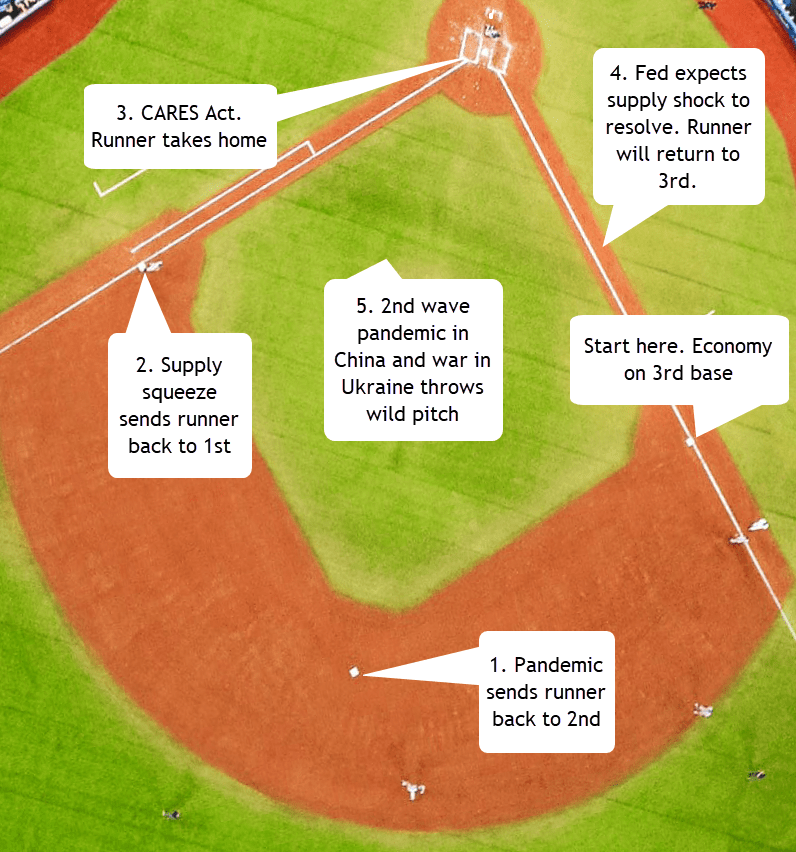
Some people are blaming the Fed, accusing them of being behind the curve. I’ll present a model that helps readers understand the sequence of events over the past two years. Economists study how events, people and money interact. Like a football coach drawing out a strategy for a defensive backfield, economists use graphs with diagrams of solid and dashed lines with arrows to describe the dynamics of a process. For the layperson, it can be confusing. To make it fun, I sketched the dynamics on a baseball field. The action starts in the spring of 2020 with the runner – the economy – on 3rd base. Governments around the world dampened or shut down their economies to arrest the spread of the Covid-19 virus. I’ll put the graphic up here. Economists will recognize the bases as equilibrium points, and the left and right shifts of demand and supply.

 The pandemic sent the runner to 2nd base, a shift of demand. Supply constraints then sent the economy back to 1st base, a shift of supply. The CARES act and other government support programs could only send the runner to home, a shift of demand. Why not back to 2nd? Let’s keep it simple and say that those are the rules. The Fed’s monetary policy has already consisted of large measures in response to the pandemic. That is on another graph with DD and AA curves that would give a casual reader a headache.

The Fed knew that the economy should be on 3rd – not home base – but expected the supply constraints to resolve enough to shift the economy back to 3rd base. If the Fed took monetary action when it was not needed, the runner might get injured and have to rest. That’s a recession. So the Fed waited, ready to take action if the existing supply chain problems didn’t resolve.

Another wave of pandemic struck key manufacturing areas in China. In the U.S., ports on the west coast and transportation links to those ports were still not working properly. Russia attacked Ukraine, driving up the price of gasoline by more than 50%. Natural gas prices rose 160% (DHHNGSP  https://fred.stlouisfed.org/graph/fredgraph.png?g=P3jr ). As the war continued for several weeks, it became clear that there would be no spring planting of crops in Ukraine, a country that is a global food supplier. Futures prices rose, increasing grocery store prices and exacerbating the sharp rise in oil prices.

The Covid-19 virus, the many people and businesses in the supply chain, and Vladimir Putin did not pay attention to the informed expectations of the Federal Reserve. The Fed is a convenient target for pundits. Before the Fed was created in 1913, people blamed gold and anonymous speculators for panics and price instability. However, anonymous speculators do not show up for Congressional committees. A bar of gold just sits silent in the chair while committee representatives rant on at finance hearings. That’s no fun. The Fed has a chairperson, Jerome Powell, a punching bag for Congress and pundits. Taking verbal abuse is part of the job of being Fed Chair.

Congressional representatives often use charts in the main chamber. An aide slides a cardboard chart on an easel while the Congressperson explains the whole idea in 5 minutes. At a finance subcommittee hearing, Mr. Powell can bring in an easel with a diagram of a baseball field. He can point to the economy on 3rd base and explain the whole process in a simple but more eloquent way than I can. Once the committee members understood the idea, they would apologize to Mr. Powell for their earlier criticism and Washington would be a more peaceful place. If baseball players and managers could resolve their differences this spring, why can’t the folks in Washington? Play ball and a shout out to moms everywhere!

////////

Photo by petr sidorov on Unsplash

Finger Pointing

April 18, 2021

by Steve Stofka

Some restaurant employers complain that they can’t find workers and blame the stimulus payment and the extension of unemployment benefits. Workers complain that businesses are not willing to pay for the additional health risk of close contact with the public. Child-care remains an ongoing obstacle for many. Pick your target – the bums in Washington and their relief programs, cheap business owners, belligerent customers, or unmotivated employees. Oops, almost forgot one other culprit – the Covid virus. Finger pointing does not build solutions. Finger touching does.

In its March survey, the National Federation of Independent Business reported (2021) that 42% of owners reported that they could not fill a job opening, yet only 28% reported offering higher wages. Some expressed their concern that unemployment benefits were too generous, reducing the demand for jobs.

In a recent study, Gabriel Chodorow-Reich and his colleagues at Harvard (2018) found that an extension of unemployment benefits had only a small macroeconomic effect on unemployment, employment, job vacancies, and wages. However, they noted that some studies focusing on particular industries and workers have found greater effects from more generous unemployment benefits.

In macroeconomic models benefits for employed or unemployed workers does affect the unemployment rate. Benefits for the employed raise the input cost of labor and causes an increase in the price of a product. An increase in price leads to a reduction in demand. Employers respond to that demand reduction by laying off employees or not adding to their workforce. Unemployment benefits reduce incentives for workers to find work. States charge employers a fee for additional benefits, further driving up labor costs. However, in the aggregate, a change in benefits has only a small effect on wages and unemployment.

In a crisis, providing relief to specific populations and business sectors is difficult. When the CARES act was passed at the start of the pandemic, the paycheck protection aspect was designed to help small businesses. Big corporations took advantage of loopholes in the law’s language and exhausted that targeted relief for small businesses. Big business got big by being voracious, leaving little for the competition. A government that enacts broad relief measures are criticized for giving relief to those who don’t need it. We would rather blame each other than blame a virus.

Inflation

Inflation expectations have an effect on wages. If workers expect higher prices in the near future, we want higher wages to cover our living costs. We see the price of gas go up from $2 per gallon to $2.80 per gallon in the past six months and reason that a lot of prices will be going up. We listen to the news in our car and hear inflation is up such and such a percent. We check the price of hamburger or some other grocery item. For the sake of simplicity, some economic models assume that consumers are knowledgeable about setting inflation expectations. We don’t have the time to be experts, so we guess at it and correct our expectations as we get new information.

In a recent paper, Ehsan Ebrahimy (2020) and fellow economists at the International Monetary Fund studied the effects that pandemics and wars had on inflation. Pandemics generated uneven swings in prices during the pandemic, but the recovery period brought an offsetting of those price swings. They found no net inflation effects from pandemics like the Spanish flu.

Expectations contribute to inflation. The price of residential toilet paper during the Covid crisis is a small example of this phenomenon. Different production plants make commercial and residential toilet paper because consumers are willing to pay more for a softer product. In the first months of the pandemic, panic buying and hoarding caused a shortage of toilet paper and a rise in price. Manufacturers like Kimberly-Clark built more production of residential toilet paper and store shelves were restocked in recent months. Responding to the increased inventory, people started using the toilet paper they hoarded. Now there is a surplus of toilet paper and prices have dropped below pre-pandemic levels.

Unlike pandemics, war involves the destruction of  physical capital, factories and offices. In the recovery periods following war, the IMF researchers found a persistent inflation in developed economies because some of the productive capacity had been destroyed. When there was less supply to meet demand, prices went up. Even a country not directly damaged in a war, like the U.S. in the past two world wars, suffered lasting inflationary effects in the post-war recovery periods. During WW2, the U.S. used up a lot of raw materials and production to make weapons. Following the war, inflation shot up over 10% in the U.S., five times the current rate. Following that inflation spike, the economy fell into recession, which caused a price plunge, followed by another spike in inflation to over 7%. The inflationary shock waves following the war took seven years to dissipate.

The researchers concluded that there was little evidence to support a belief in a sustained inflationary trend during the recovery from this pandemic. That does not rule out the possibility of uneven short-lived price rises. As shown above, expectations have an effect on prices.

We are more comfortable when we humanize the causes of inflation, pointing the finger at “those people.” We prefer to live in a world of intent, not random chance. Attacks on Asian-Americans have increased as if someone born and raised in America had something to do with the Covid virus. Employers blame Congress or unmotivated job applicants, who blame heartless employers. As Rodney King said, “Can’t we all just get along?” (Sastry & Bates, 2017). We can use our fingers to connect, not blame.

///////////////

Photo by Humberto Arellano on Unsplash

Chodorow-Reich, G., Coglianese, J., & Karabarbounis, L. (2018). The macro effects of unemployment benefit extensions: A measurement error approach*. The Quarterly Journal of Economics, 134(1), 227-279. doi:10.1093/qje/qjy018. Retrieved from https://scholar.harvard.edu/files/chodorow-reich/files/ui_macro.pdf

Ebrahimy, E., Igan, D., & Peria1, S. M. (September 10, 2020). The Impact of COVID-19 on Inflation: Potential Drivers and Dynamics. International Monetary Fund Research. Retrieved from https://www.imf.org/~/media/Files/Publications/covid19-special-notes/en-special-series-on-covid-19-the-impact-of-covid-19-on-inflation-potential-drivers-and-dynamics.ashx

NFIB. (2021, April 13). Small business owners struggle to find qualified workers. Retrieved April 17, 2021, from https://www.nfib.com/content/press-release/economy/small-business-owners-struggle-to-find-qualified-workers/

Sastry, A., & Bates, K. (2017, April 26). When L.A. erupted in anger: A look back at the Rodney King riots. Retrieved April 17, 2021, from https://www.npr.org/2017/04/26/524744989/when-la-erupted-in-anger-a-look-back-at-the-rodney-king-riots

The Long and Short Run

August 16, 2020

by Steve Stofka

Gold is at an all-time high. Like wheat and other commodities, it pays no interest. Gold’s price moves up or down based on expectations about the value of money used to buy gold. If inflation is expected to increase, the price of gold will go up. Eight years ago, after several rounds of quantitative easing by central banks, gold traders bet that inflation would rise. It didn’t, and the price of gold declined by a third.

Since mid-February, the U.S. central bank has pumped almost $3 trillion of liquidity into the economy (Federal Reserve, 2020). Numbers like that hardly seem real. Let’s look at it another way. The overnight interest rate is so low that it is essentially zero – like gold. People around the world regard U.S. money and Treasury debt as safe assets – like gold. Imagine that the central bank went to Fort Knox, loaded up 1.5 billion troy ounces of gold – about 103 million pounds – in gold coins and dropped them on everyone in the U.S. There are about 190,000 tonnes (2204 lbs./tonne) of gold in the world, a 70-year supply at current production. A helicopter drop of gold would be almost 47,000 tonnes, or 25% of the world supply. It would take five C-5 cargo planes to haul all that.

Milton Friedman was an economist who believed in the quantity theory of money. His model of money and inflation held “inflation is always and everywhere a monetary phenomenon.” If the growth of money was greater than the growth of the economy, inflation resulted. The data from the past decade has refuted this model. Former chairman of the Federal Reserve Ben Bernanke noted that the evidence suggests that economists do not fully understand the causes of inflation (C-Span, 2020, July). He was including himself in that group of economists because he had been an advocate of that model (Fiebiger & LaVoie, 2020).

What has the Federal Reserve and the government done to navigate the difficult path created by this pandemic? Helicopter Money for businesses and consumers. Lots of toilet tissue, so to speak. No reason to hoard, folks. There’s plenty. They have followed the first of John Maynard Keynes’ prescriptions for a downturn. The government should spend money. Why? It is the only economic actor that can make long-term decisions. Everyone else is focused on the short term.  Keynes badly mis-estimated the short-term thinking of politicians, particularly in an election year.

Will the flood of money cause inflation as gold bugs assert? Some point to the recent rise in food prices as evidence of inflationary forces. However, the July Consumer report indicates only a 1% annual rise in prices, half of the Fed’s 2% inflation target. The rise in food prices this spring was probably a temporary phenomenon. It suggests that the Fed is fighting deflation, as Ben Bernanke noted this past April (C-Span, 2020 April).

Since March, government spending has helped millions of American families stay afloat during this pandemic. Congress has gone home without extending unemployment relief and other programs. Many families are being used as election year hostages by both sides. House Democrats put their cards on the table three months ago. Republicans in the Senate and White House have dawdled and delayed. Faced with a chaotic consensus in his own coalition, Senate Majority Leader McConnell has largely abdicated control of the Senate to the White House and the wishy-washy whims of the President.

We return to where we began – gold. It is neither debt, equity nor land. As a commodity, only a small part is used each year. It has been used as a medium of exchange and a store of value. Except for a few years during and after the Civil War, gold held the same price from 1850 until the 1929 Depression – $20.67. In the long run, longer than a person’s retirement, gold is good store of value. In the ninety years since the Great Depression began, the price of gold has grown 100 times. Yet it is still lower than its price in 1980. The U.S. dollar does not hold its value over several decades, but it is predictable in the near-term. In a tumultuous world, predictability is valuable. The dollar has become the new gold.

//////////////////////

Photo by Lucas Benjamin on Unsplash

C-Span. (2020, April 7). Firefighting. Retrieved August 12, 2020, from https://www.c-span.org/video/?471049-1%2Ffirefighting (00:21:15).

C-Span. (2020, July 18). Ben Bernanke and Janet Yellen Testify on COVID-19 Economic Inequities. Retrieved August 12, 2020, from https://www.c-span.org/video/?473950-1%2Fben-bernanke-janet-yellen-testify-covid-19-economic-inequities (01:35:20)

Federal Reserve. (2020, July 29). Recent Balance Sheet Trends. Retrieved August 12, 2020, from https://www.federalreserve.gov/monetarypolicy/bst_recenttrends.htm

Fiebiger, B., & LaVoie, M. (2020, March 4). Helicopter Ben, Monetarism, The New Keynesian Credit View and Loanable Funds. Retrieved August 12, 2020, from https://www.tandfonline.com/doi/abs/10.1080/00213624.2020.1720567?journalCode=mjei20

Pandemic Detour

July 19, 2020

by Steve Stofka

World War 1 and the flu epidemic that followed was the death knell for the 19th century. Previous epidemics ended the Middle Ages in the 14th century and the Renaissance in the 17th century. Pandemics are permanent detours onto an alternative route through time. Will historians regard the Covid pandemic as the close of the 20th century? Depends on what happens in the next hundred years. History travels slow as a tortoise. The present is as fast as Achilles and eventually overtakes the past.

Pandemics cleanse the politics of the age. Both political parties have fractured in the past two decades. Will this pandemic close the coffin on one or both parties? In name, no. Both parties have a duopoly on voting in each state so sub-groups within each party try to take over the party apparatus. The 2016 election was a takeover of the Republican Party by conservative media, legal and political interests that have been fighting for control of the party since the 1980s.

President Trump is the poster boy of that effort. Conservative groups needed someone to sign off on judicial appointments and other legislation. They preferred someone with little experience, who was impressionable and a bit dim for the rigors of the office. They got more buffoon than they bargained for. If he becomes a one-term President, the people, organizations and money that put him in power will fight their long game – to gut or eliminate most of the federal bureaucracy. The few Federal government institutions left will be the military, a slim State department, domestic policing agencies like the DEA and the Border Patrol, the Treasury, IRS and the courts. In a strict conservative view, defense, enforcement, monetary authority and justice are the only legitimate functions of a federal government.

Each pandemic is a challenge to competing visions of the future. Conservative groups have patience, resolve, and money. If they have their way, the 20th century will have been a political experiment in American socialism that began when progressives gained political power at the start of the last century. The 21st century will return the country to its founding principles.

Liberals envision a more expansive role for a central government. Should there be a limit to the role of government in our daily lives and where should it be set? Without a limiting principle, liberal groups struggle to develop a concise and cohesive philosophy. Perhaps that is the strength of a liberal viewpoint.

Americans have been fighting each other for far longer than they have fought with the rest of the world. In a country with diverse cultural backgrounds, social and political tension is inevitable. The 1918 epidemic helped reshape the country but did not end this grand experiment in republican democracy. Let’s hope that the 2020 pandemic doesn’t change the chemistry of this country so drastically that the experiment ends.

/////////////

Notes:

Photo by 35mm on Unsplash

The Best in History

March 29, 2020

by Steve Stofka

The financial crisis a decade ago prepared us to better handle this historic pandemic. Gambling by financial companies, fraud and foolishness sparked that crisis. It had a large impact on the economy and the lives of millions of Americans who lost their homes, savings and jobs. It did not shut down the entire economy.

The Federal Reserve has enacted many emergency measures to support the money market and bond market during the current crisis. Many were set up under the leadership of former Chairman Ben Bernanke in response to the last crisis. In the last crisis, heavy Republican opposition delayed or blocked bailout measures. Republicans whipped up that political sentiment and won back the House in 2010. At a Tea Party rally against Obamacare, one old geezer complained that people used to just go home and die. What does he think now about the pandemic? Should the hospitals turn away all those people? The Tea Party is largely inactive now. Former Congressman Dick Armey helped spark the movement, the Koch Brothers funded it, and the Republican Party rode the wave. In the House, a coalition of about thirty members call themselves the Freedom Caucus (DeSilver, 2015). They are the remnant of the Tea Party movement.

During his campaign, candidate Donald Trump was criticized for his support of the relief policies during the financial crisis (Sherman, 2015). In a recent NBC / Wall Street Journal poll, Republican voters gave President Trump a 92% job approval rating. Overall, the public gives him about 50% on his handling of the coronavirus crisis (POS, 2020).  As a presidential candidate in 2016, Mr. Trump famously joked / bragged that he could shoot somebody on fifth Avenue in Manhattan and get away with it (Diamond, 2016). Have his policies contributed to the deaths of New Yorkers during this crisis? Depends on which political glasses you wear.

55 years ago, many Democrats defended President Johnson who sent hundreds of thousands of Democratic and Republican sons to be slaughtered in the swamps of Vietnam. Communism was the virus then. It infected the young and turned them into anti-American socialists. The only remedy was to send the young to another country or beat them with batons at anti-war rallies in Chicago, Washington, and New York City. In the first years of the war, fathers and mothers blamed Communism not President Johnson for the death of their sons. My Lai was the most famous of many atrocities committed during that war (Levesque, 2018). Shortly after that tragedy in March 1968, Mr. Johnson abandoned his re-election bid. Was Mr. Johnson a monster or a hero? Depends on which political glasses you wear.

President Trump is a singular brand but was undoubtedly influenced by the culture of fear and hate that marked his formative years. He wears his hate like a favorite shirt. Like so many, he’s a “used to be”, a former Democrat turned Republican. On C-SPAN’s Washington Journal daily call in program, there’s at least one person who says, “I used to be.” Fill in the blank – either a Democrat or a Republican. They have donned a different shade of glass.

“I’m a this-ism” is another pandemic sweeping the nation. People no longer act in support of their beliefs. Christians declare that they are Christian. They don’t need to act with generosity to others. Progressives declare that they are progressives but don’t have time to vote. That lack of support in the voting booth has hurt the Sanders campaign. He often reminds his supporters that they need to show their enthusiasm at the ballot box. I don’t often hear liberals declare themselves as such. They might be socially liberal but fiscally conservative. Neo-liberals never declare themselves but there are a lot of them, from what I hear. Politicians who have the least restraint in their behavior declare that they are Conservative. Really?

Mr. Trump is the King of Declarations. He’s the greatest President with the greatest policies and his administration is handling this crisis better than any other country. As some people take their last breaths in an emergency room, they are thinking exactly that. This administration is handling this crisis better than anyone in history. How will President Trump’s leadership during this crisis be judged? That will depend on which glasses you wear. Remember, you can trade in for another color of glasses.

///////////////////

Notes:

DeSilver, D. (2015, October 20). House Freedom Caucus: What is it, and who’s in it? Retrieved from https://www.pewresearch.org/fact-tank/2015/10/20/house-freedom-caucus-what-is-it-and-whos-in-it/

Diamond, J. (2016, January 24). Donald Trump could ‘shoot somebody and not lose voters’ – CNNPolitics. Retrieved from https://www.cnn.com/2016/01/23/politics/donald-trump-shoot-somebody-support/index.html

Levesque, C. J. (2018, March 16). The Truth Behind My Lai. NY Times. Retrieved from https://www.nytimes.com/2018/03/16/opinion/the-truth-behind-my-lai.html

Photo by Giorgio Trovato on Unsplash

Public Opinion Strategies (POS). (2020, March 26). Coronavirus National Polling (March 26th). Retrieved from https://pos.org/coronavirus-national-polling-march-26th/

Sherman, A. (2015, September 15). PolitiFact – Did Donald Trump support the Wall Street bailout as anti-tax Club for Growth says? Retrieved from https://www.politifact.com/factchecks/2015/sep/15/club-growth/did-donald-trump-support-wall-street-bailout-club-/